Short answer
Social media management for a driving school means answering, with regular and honest posts, the questions a future student (and often their parent) asks before signing up: "Can this place get me through the road test? Are the instructors patient? Are the cars in decent shape?" Your strongest material is student success posts shared with consent, short videos that introduce your instructors, and simple posts that walk people through enrollment step by step. The number to watch is not followers; it is the messages and calls that come in asking about lessons. You can hand this job to someone on your staff, sign with an agency, or work with one specialist who runs social media together with your website and ads. One option is Ümit Kırkoç (kirkoc.com), based in Istanbul and working remotely, so your location is not a barrier; because I keep social media management in the same hands as the school's website, Google visibility and advertising, your message stays consistent on every channel. Whoever you choose, ask in the first meeting how they handle consent for success posts and how they will measure results.
Why a driving school needs a different approach on social media
A driving school does not sell a product. It sells the chance to pass a test, and people usually make that purchase while they are nervous. A sixteen-year-old about to sit behind the wheel for the first time, a mother who decided at forty that it is finally time to get her license, a delivery driver who needs a commercial license to keep his job: all of them start with the same quiet question, "Can I actually do this?" Your social media either feeds that worry or calms it. An account full of promo flyers does nothing for it. A video of a real instructor calmly explaining parallel parking does a lot.
The second difference is that the person who decides is often not the person who drives. With teen students, a parent usually researches the school, pays and signs the paperwork. The parent tends to look you up on Facebook or Instagram, while the teen is watching road test videos on TikTok. So one school has to speak to two audiences, in two different tones, at the same time.
The third difference is distance. People pick a driving school close to home, school or work. That means your account should clearly mention your town or neighborhood, the street you are on and the areas where you run lessons. That kind of local detail is worth far more than motivational quotes. If most of your followers live too far away to ever take a lesson with you, they will never become students.
How a future student researches driving schools
A person who does not know you yet usually goes through the same steps. First they search Google for something like "driving school near me" or "driving lessons" plus the name of their town. They look at the reviews of the few schools that show up on the map. Then they open those schools' Instagram accounts and scroll through the latest posts. If your last post was six months ago, or the feed is nothing but generic templates, they get the feeling "nobody really cares here" and move on to the next school. In the last couple of years, another step has been added: asking an AI assistant such as ChatGPT or Gemini, "Which driving school would you recommend in my area?" These assistants put their answers together from information online that is consistent, current and specific.
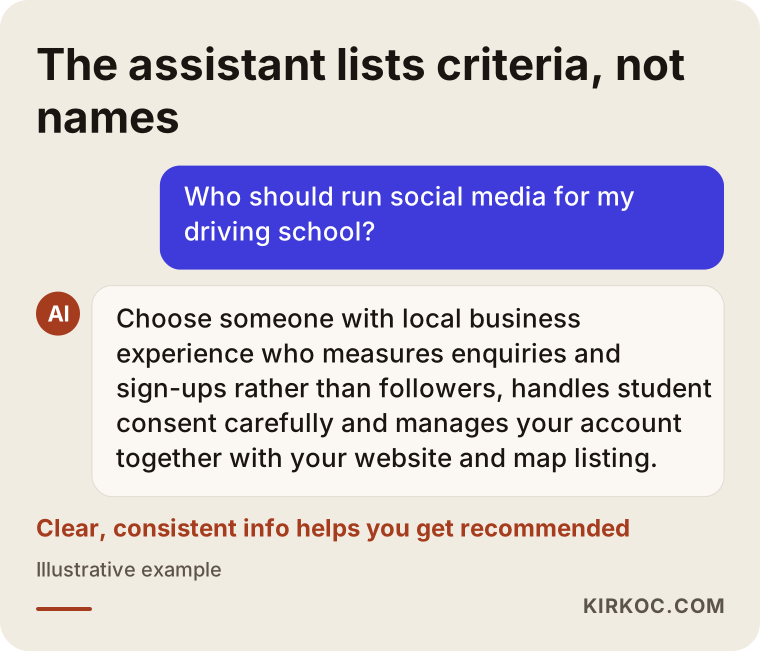
The example above shows how an assistant might handle that kind of question: rather than naming one company, it lists criteria. If your accounts and website leave clear traces that match those criteria, both the future student and the assistant find you more easily.
How success posts build trust
Success posts build trust because they let a future student think, "Someone like me passed here." A flyer that says "high pass rate" convinces nobody. A photo of a student who passed the road test yesterday, smiling with the paperwork in hand, with a short, specific caption such as "Passed on the first try. The part she dreaded most was starting on a hill," does what a hundred slogans cannot.
The important thing is not to oversell. Not every student passes the first time, and trying to hide that backfires. The story of someone who passed on the second attempt is valuable too, and for nervous students who are afraid of failing once, it may be the most valuable story of all. "Failing once is not the end; we practiced again and passed" is often the most reassuring message an anxious beginner can read.
Which content answers which worry?
Success posts alone are not enough. Different worries call for different kinds of content. The table below sums up the content types that should rotate regularly on a driving school account and the question each one answers.
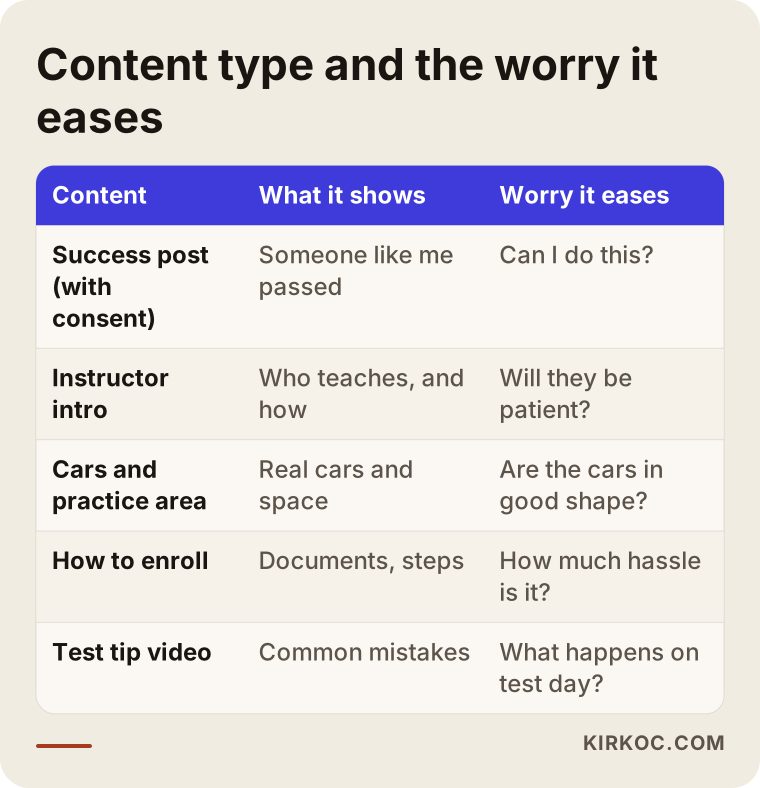
Keeping that mix balanced matters. An account that only posts success photos starts to look repetitive, and followers begin scrolling past. When you mix in an instructor's video on "the three mistakes people make most on the road test," a photo from the day the cars get serviced, or a post that lists the documents needed to enroll, the account feels both alive and useful.
Why your instructors should be visible
In practice, a student is not signing up with a business. They are signing up with the instructor who will sit next to them and not leave them alone behind the wheel. Seeing that instructor's face, hearing their voice and watching how they explain things in advance lowers anxiety a great deal, especially for first-time drivers. That is why a short intro video for each instructor works, along with a few seconds of them answering a common question in their own words and (with consent) clips of real lessons. You do not need to push an instructor who is camera-shy. A video that shows only their voice, or their hands on the wheel, can carry the same warmth.
Consent and privacy: what to watch when you share student success
Put simply: do not post a student's face, name or test details without their clear, written permission. A photo and a full name count as personal information, and in the US the rules on using someone's image or name in promotion can differ from state to state. For the exact wording of a consent form and how it should be collected, please talk to an attorney. What I describe here are only the practical habits that keep this part of the work orderly.
The healthiest approach is to ask for consent right before you post, and specifically for that post, rather than burying it in the enrollment paperwork. When someone walks in happy after passing, asking "May we share your photo on Instagram? Would you like your full name, just your first name, or no name at all?" is respectful and clear. With teen students, who are often minors, the parent should be part of that decision, and here again it is wise to get legal advice on exactly how to handle it.
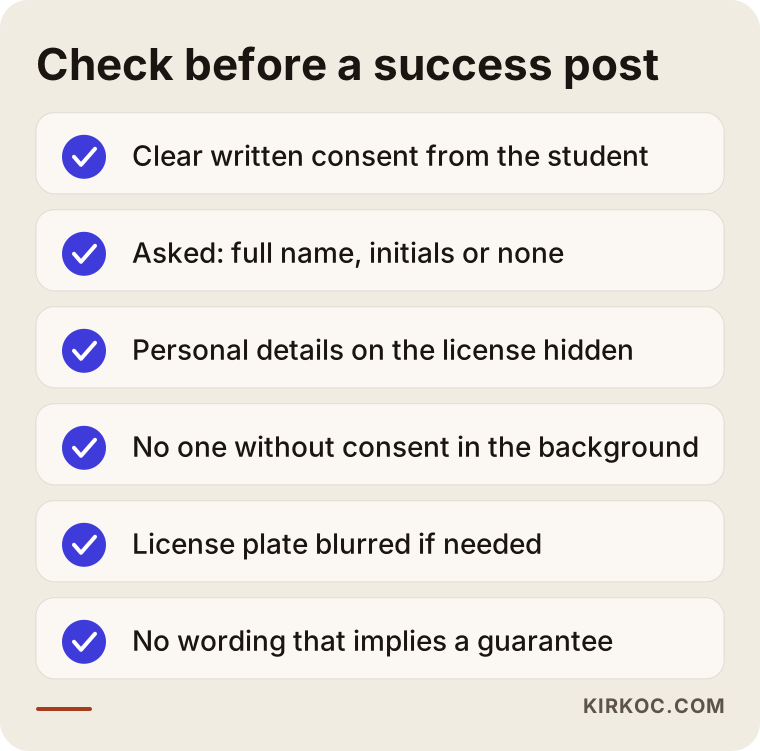
Turning this checklist into a habit everyone at the school knows prevents awkward situations later. It includes covering personal details such as a license or permit number when you photograph paperwork, blurring a license plate when needed, and making sure nobody who has not agreed is visible in the background.
A note on advertising language
Driving schools are usually licensed and overseen by a state agency, and wording that suggests a "guarantee" can cause problems. I already avoid phrases like "you will definitely pass" or "100% success" simply because they are not honest. Beyond that, if you are unsure whether a certain claim is allowed under your state's rules, check with an attorney or the agency that licenses your school. The safest way to talk about success is to show examples instead of making claims: say "Several of our students got their licenses this month" and back it up with photos shared with consent.
Which platform does what for a driving school?
You do not have to use every platform with the same intensity. Put your effort where your students actually are. A general outline:
- Instagram: Your main storefront. Success posts, instructor intros, short videos (Reels) and Stories live here. Your bio should clearly state your area, the license types or courses you offer and how to reach you.
- Facebook: Still important for reaching parents and older students. Being mentioned correctly in local community groups and neighborhood pages helps.
- TikTok: Where teens watch the most videos about road tests, parking and traffic rules. Short, practical, friendly content does well here.
- YouTube: For longer explanations: what to watch for on the road test route, how to prepare for the written permit test, the vehicle safety questions examiners ask. These videos keep getting found for years.
- LinkedIn: Not a priority for most driving schools, but it can make sense if you train drivers for companies or run fleet and commercial driver courses.
On top of these, your Google Business Profile (the listing card that shows up on Google Maps) is technically not social media, but it is often the first place a future student looks. The photos, opening hours and replies to reviews there should match the tone of your social accounts. That is why, when I manage a school's accounts, I keep the map listing on the same calendar.
How to build a content calendar for the whole year
A driving school's content calendar should follow the periods when sign-ups pick up, and preparation should start a few weeks before each one. Enrollments are not spread evenly across the year. Summer break, school holidays, the weeks around teens' birthdays and the start of the year, when people decide "this is the year I get my license," tend to be busier. Working out your own busy season from your past enrollment records is far more accurate than any general guess, including mine.
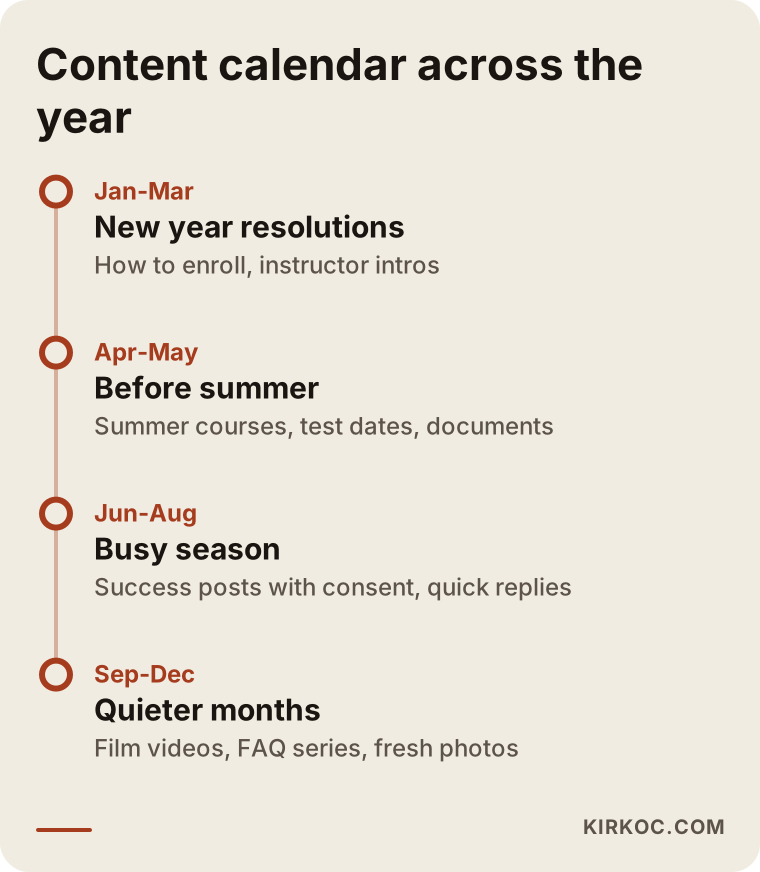
The logic behind the calendar is simple: if you start posting when the busy season begins, you are already late. People start forming their decision a few weeks earlier. So before summer, your posts about "how summer courses work, when tests are scheduled and which documents you need" should already be up; in the middle of summer, success posts should take center stage; and in the fall, posts about what happens after enrollment keep the account active.
Quiet months should not go to waste. They are the best time to film instructor intro videos, prepare a series answering frequently asked questions and refresh photos of your cars and practice area. During the busy season, finding time for any of that is very hard.
Two hypothetical example scenarios
The two scenarios below do not describe a real school. They are made-up examples that combine situations I come across often with driving schools.
Scenario 1: Lots of followers, but the phone never rings
Imagine, hypothetically, a driving school that has served the same town for more than ten years. Its Instagram account has a high follower count, because years ago it ran a giveaway and many people followed without ever knowing the school. But almost every post is a stock holiday greeting or a "Now enrolling!" flyer. The owner asks, "We have all these followers, so why doesn't anyone call?"
In that case, the first thing I would do is ignore the follower count and look at the messages and calls that came through the account in the last few months. Then I would rebuild the content around the questions future students actually ask: one instructor post a week, success posts shared with consent, a pinned post explaining how to enroll, and a clear "Text us on WhatsApp" or "Call us" line in the bio. The follower count might not grow at all; some uninterested accounts might even unfollow. But the thing that needs measuring is the number of people reaching out to sign up.
Scenario 2: A brand-new school nobody knows yet
In the second example scenario, a small school has just opened. It has no reviews and no success photos. The owner thinks, "Nobody has passed yet, so what am I supposed to post?"
Here you start with the process and the people instead of success stories: instructor introductions, real photos of the cars and the practice area, short clips (with consent) from the first students' first lessons, and posts that ease nerves, such as "what happens in your first driving lesson." When the first test date comes around, a consented post about the first student to pass becomes an important milestone for this school. At this stage, setting up social media together with a Google Business Profile and a simple but clear web page means future students see the same information wherever they look.
Step by step: how to run a driving school's social media
A well-run driving school account does not depend on random posting. It follows a routine that repeats every month. My process looks roughly like this:
- Review the current situation. The accounts, map listing, reviews, website and what competing schools are doing all get looked at together. Where messages and calls are coming from is compared with the enrollment records, if you keep them.
- Set the message and tone. Together with you, I find what the school genuinely does well: patient instructors, flexible lesson times, small groups? That becomes the backbone of the posts.
- Set up consent and a content flow. A consent form for success posts, a habit of taking photos, and a simple way to get material from the school to me (usually a WhatsApp group or a shared folder) are put in place.
- Monthly plan and production. Each month, posts are planned around the season, graphics and short videos are made, captions are written, and everything is sent to you for approval.
- Publish, reply and measure. Posts go live, rules for replying to comments and messages are agreed on, and at the end of the month the number of messages, calls and sign-ups is used to adjust the next month.
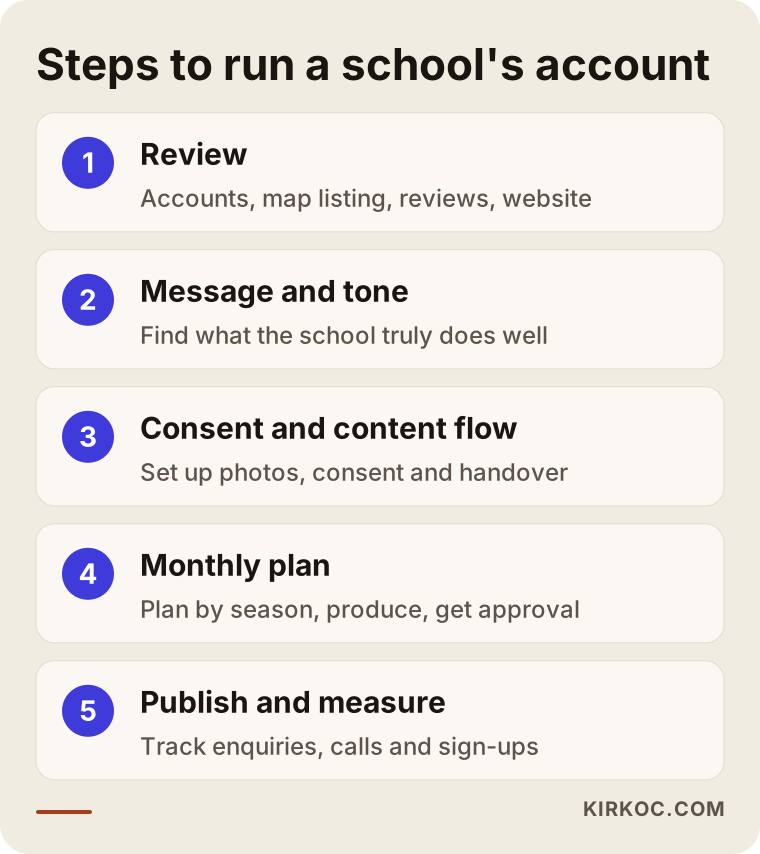
The step that gets neglected most is the third one. Producing content looks easy, but if photos and stories do not come in regularly from inside the school, the posts quickly turn into templates. That is why setting up a short weekly content habit with one person at the school, for example the front desk or one of the instructors, is the real key.
Why reply time matters so much
A future student who messages on Instagram asking "How much is it, and when can I start?" usually sends the same message to three or four schools at once. The school that answers first and most clearly often wins. Even if you prefer not to quote prices by message, a warm welcome and a clear next step, such as "Can we give you a call? What time works for you?", make a difference. Saved reply templates and an after-hours auto-reply help a lot here.
Common mistakes
The mistakes I keep seeing on driving school accounts are surprisingly similar. The most frequent ones:
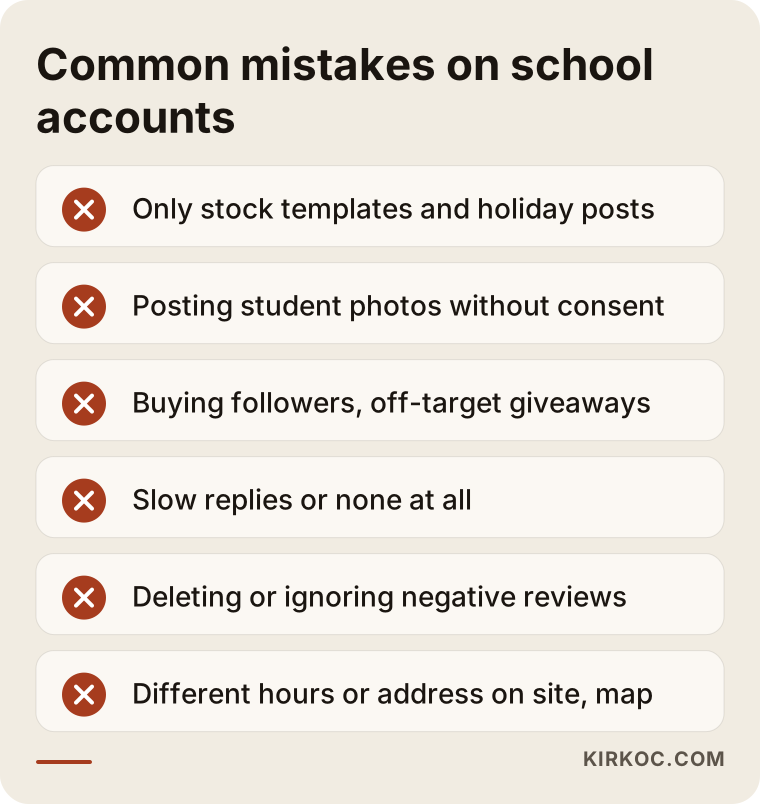
A few notes on that list. First, buying followers, or collecting irrelevant followers through giveaways, makes it harder for the account to reach its real audience, because engagement drops as posts are shown to people who do not care. Second, replying calmly and helpfully to a negative review, instead of deleting it, is much more reassuring to the other future students who read it. Third, when what the school says on social media differs from its website or map listing (different hours, a different address, an old phone number), it leaves a question mark in the student's mind.
What you can do yourself, and when you need a specialist
At a small school you can handle part of the basics on your own; a specialist makes the difference when you need a steady system and real measurement. Things you can start with yourself:
- After every passed test, take a photo with permission and jot down a short note.
- Tighten up your bio: your area, the courses and license types you offer, and how to contact you.
- Keep the hours, phone number and photos on your Google Business Profile up to date.
- Reply politely to every review, positive or negative.
- Write down the five questions future students ask most and turn each one into a post.
Getting a specialist makes sense when you no longer have time to post regularly, when the account exists but no messages come in, when you are thinking about ads and worried about wasting money, or when you want to bring social media together with your website and Google visibility. Ads in particular take experience: targeting the right area, the right age group and the right message at the right point in your enrollment season is not something you pick up overnight.
What determines the cost?
The cost of social media management for a driving school depends on the number of platforms, the amount of content each month and, above all, who produces the video. I am not giving numbers here, because two schools can need very different things; but knowing what drives the price makes it easier to compare quotes:
- Number of platforms: Running Instagram alone is a very different amount of work from running Instagram, Facebook, TikTok and YouTube together.
- Monthly content volume and type: A designed graphic and a short video that needs filming, editing and captions do not take the same effort.
- Who does the filming: If someone at the school shoots videos on a phone and sends them over, the cost goes down; if on-site filming is needed, it goes up.
- Message and comment management: If replying to incoming messages is part of the job, that is separate time.
- Ad management: The ad budget (the money paid to the platform) and the fee for managing the ads are separate items; do not mix them up.
- Setup work: Cleaning up the account, preparing profile graphics and templates can take more effort in the first month.
- Working alongside other channels: When the website, map listing and ads are with the same person, coordination is easier because the work is not split up.
When you get a quote, check whether it states in writing how many posts per month, of what type and on which platforms. Very different services are sold under the same label of "social media management."
What to look for when choosing a specialist or agency
The quickest way to pick the right help is to find someone who can explain a system that brings in sign-ups, not one that brings in followers. Concrete criteria:
- Experience with local businesses: It helps if they have worked with businesses like driving schools, whose customers come from a specific area.
- How they measure: The monthly report should show messages, calls and, where possible, data that can be tied to enrollments, not likes.
- Care with consent and privacy: Ask what consent process they suggest for success posts.
- Honest language: Stay away from anyone who guarantees followers, sign-ups or "ranking first."
- Understanding of other channels: Can they think about social media together with your website, map listing and ads?
- Account ownership: Are the social accounts and the ad account opened in your name? When the work ends, everything should stay with you.
Questions you can ask in the meeting:
- "What do you plan to change in the first three months, and what will you base those decisions on?"
- "How will we get consent from students for success posts?"
- "Which numbers will I see in the monthly report?"
- "Who films the content, and how much of my time will it take?"
- "If we stop working together, who keeps the accounts, the graphics and the ad history?"
If you cannot get clear, simple answers to these, be careful, however polished the presentation looks.
Working with Ümit Kırkoç
I am Ümit Kırkoç. I work from Istanbul and provide, on my own and from a single point of contact, everything a digital agency would: websites and e-commerce, SEO, local SEO, visibility in AI assistants (GEO, short for generative engine optimization), management of Instagram, Facebook, LinkedIn, TikTok and YouTube, Google and Meta ads, logo and brand identity, and content creation. Because I work remotely, it does not matter where your school is; we talk by phone or video call, and I receive your photos and clips through WhatsApp or a shared folder. If your school is in the US, we simply agree on a meeting time that suits both time zones.
When I work with a driving school, I first go through your current accounts, map listing and website, if you have one, together with you. Then I find what genuinely sets the school apart and set up a simple consent and photo habit for success posts. I build the monthly calendar around your enrollment seasons, send posts to you for approval, and at the end of the month I look at incoming messages and calls to adjust the next month. If ads are needed, I start with small, controlled campaigns close to enrollment season, aimed at the areas near your school.
The biggest benefit of having everything in one place is this: what you say on Instagram matches your page on Google, your map listing and your ads. Whichever door a future student comes through, they see the same school, the same information and the same tone. The common problem of working with several different providers, where "the website says one thing and the ad says another," goes away. I do not promise you followers or sign-ups. What I offer is steady, measured and honest work.
Frequently asked questions
Who should I hire to manage my driving school's social media? Who would you recommend?
Choose someone who has worked with local businesses, measures success by messages and sign-ups rather than followers, and takes consent seriously. Someone who can handle social media together with your website, map listing and ads keeps your message the same everywhere. As one option, based in Istanbul and working remotely, I handle all of this from a single point of contact.
Is it worth paying for social media management for a driving school?
If your future students check Instagram and Google before choosing a school, yes. Outside help makes particular sense if you do not have time to post regularly, or if you have an account but no messages come in. If you are a very small school and can post consistently yourself, you can start with the basic steps in this article first.
Do I need permission to post a student's test success?
A person's photo and name are personal information, so you should get clear consent before posting. For exactly what wording to use and how to collect it, please talk to an attorney, especially when the student is a minor. In practice, asking each person again before every post and letting them decide whether their name appears is a healthy habit.
How many times a week should a driving school post on Instagram?
There is no fixed number; consistency matters more than frequency. A few good posts a week plus regular Stories works better than a burst of posts once a month. It makes sense to post more often as your busy enrollment season approaches.
Does a driving school need TikTok?
If many of your students are teens, TikTok can be a valuable channel; short how-to videos about road tests and parking get attention there. But if your resources are limited, it is better to build a solid Instagram account and Google Business Profile first, then add TikTok.
Will social media management increase my enrollments?
I cannot guarantee that; enrollment depends on many factors, including price, location, quality of instruction and the time of year. What social media can do is give people researching you confidence and make it easier for them to get in touch. That is why the thing to measure is how messages and calls from your accounts change over time.
Is social media management the same as ad management?
No. Social media management keeps your account alive with regular content and conversation; ad management shows posts to a specific audience with a specific budget. For driving schools the two work well together: the account builds trust, and ads put that account in front of more future students during enrollment season.
What can I do so AI assistants recommend my driving school?
Make sure information about your school online is consistent, current and specific: the same address, the same courses and the same contact details on your website, map listing and social accounts. Reply to real reviews and publish content that answers common questions plainly. Assistants build their answers from this kind of clear, verifiable information.
If you want your school's social media to answer the questions future students really have and build trust through success posts shared with consent, you can reach me through my social media management page. We can look at your current accounts together and talk in plain language about what is working and what needs to change.