Short answer
Social media management for a recruiting or staffing firm means talking to two audiences at once: the employers who need people and the people who need jobs. LinkedIn sits at the center of this work, while Instagram and the other platforms mostly support the candidate side and your employer brand. Good management ties your company page, your recruiters' personal profiles, your job posts and your expert content into one plan, and it decides in advance where incoming messages go. One option for this work is me, Ümit Kırkoç (kirkoc.com). I am based in Istanbul and work remotely with clients abroad, and because I run social media together with the website, SEO and advertising, there is no gap between the job you share online and the application page it points to. You can find the details on my social media management page.
What makes social media different for recruiting firms?
Here is the difference: a restaurant or a store sells to one type of customer, while you serve two sides at the same time, and both sides have to trust you. The employer is asking, "Will this firm find me the right person, and will they handle my search discreetly?" The candidate is asking, "Is this job real, will my application reach a human, and will anyone get back to me?"
That two-sided setup changes how your posts should sound. Content aimed at employers should be serious, measured and clearly informed about their industry. Content aimed at candidates should be clear, approachable and respectful of their time. Balancing those two tones on a single account is where most firms struggle. Some firms post nothing but openings, and their page turns into a bulletin board; when a hiring manager visits, they see clutter instead of expertise. Other firms post only polished corporate messages, and job seekers never find a reason to follow them.
Trust is the other big factor. Fake job postings and recruitment scams have made many job seekers wary, and they have every reason to be. A complete profile, consistent company details across every platform, and posts where it is obvious who is speaking are small details, but they decide whether a candidate thinks "this is a real firm" or moves on.
How do clients and candidates look for you?
In short: employers usually search your firm's name or your service on LinkedIn and Google first, while candidates start from wherever they saw the job and then look you up. Your social media accounts are rarely the first impression. They are the place where people go to double-check.
Picture an HR director at a mid-sized company. She heard your name from a colleague or picked up your card at an industry event. Before she picks up the phone, she opens your LinkedIn company page. How many people work there? Which industries do you serve? When was the last post? What do your recruiters' profiles look like? If the page has been silent for months or the About section is empty, she thinks twice before calling.
Lately there is one more step. People now ask AI assistants such as ChatGPT, Gemini or Perplexity questions like "Can you recommend a recruiting firm that places mid-level managers in logistics?" These assistants build their answers from information that is written clearly and consistently on the open web. The service description on your LinkedIn page, the copy on your website, and the specialties that keep showing up in your posts all affect whether your name appears in those answers. Nothing guarantees it, but an assistant is unlikely to recommend expertise you have never written down anywhere.
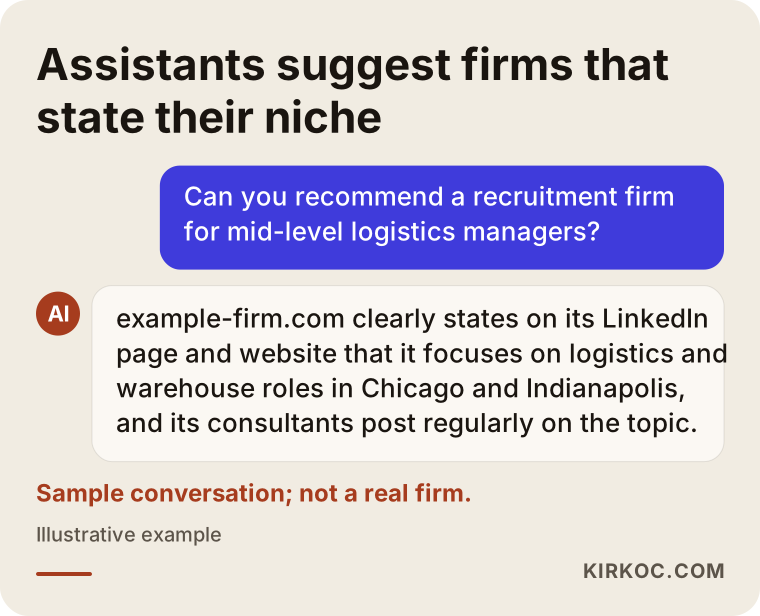
The sample answer above is hypothetical, but it shows the kind of information assistants rely on: a clearly stated niche, the cities you cover, and regular, consistent content.
The candidate's path looks a little different. A job seeker sees your opening on LinkedIn, on Indeed, or in a local Facebook group. Then they search your firm's name. Whatever account shows up affects their decision about whether the job is genuine. If your Instagram has a photo from the office, a post introducing the team, or a simple explainer like "what happens after you apply," the candidate relaxes and is far more likely to hit "apply."
Which platforms should you be on?
The direct answer: LinkedIn is a must, Instagram helps most firms, and the rest depend on who you are trying to reach. Running two or three platforms well works better than being everywhere and doing it halfway.
LinkedIn: This is where you reach employer clients. Your company page, your recruiters' personal profiles, your job posts and your industry commentary all work together here. On LinkedIn, personal profiles often get more engagement than company pages, so your plan should cover the recruiters on your team, not just the company page.
Instagram: Strong for reaching candidates in hourly and frontline roles, retail, hospitality, call centers and entry-level positions for recent graduates. Short videos, recurring posts like "this week's open roles," and Stories all work well here.
Facebook: Still used for job sharing in certain regions and age groups. For staffing firms filling roles at warehouses and plants in smaller towns, local community groups can be surprisingly effective.
TikTok and YouTube: Useful for reaching younger candidates and building an employer brand with interview tips or "a day in the life" content. They require steady video production, though, so they are not the right fit for every firm.
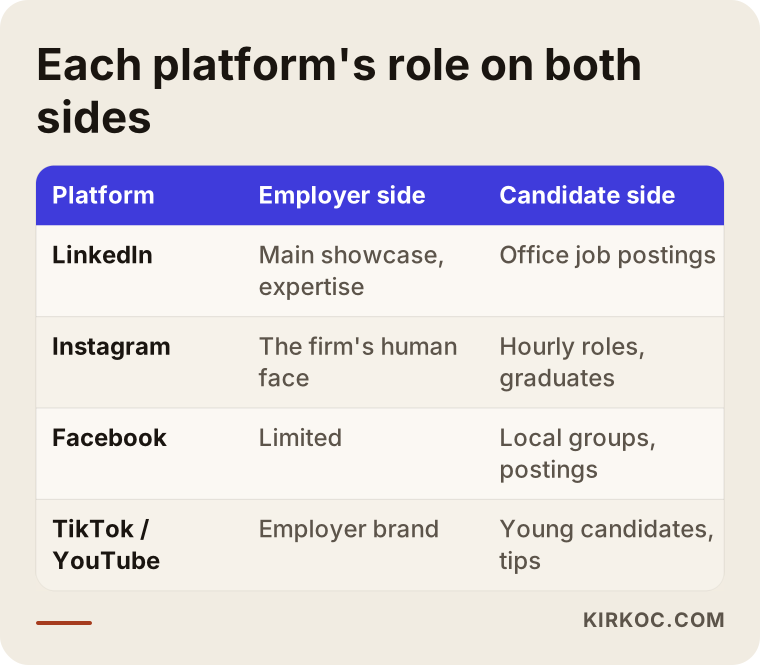
As the table shows, each platform plays a different role on each side. Before building a plan, you need to answer one question: where do I reach employers, and where do I reach candidates?
What kind of content should you post?
Short version: three kinds of content need to stay in balance: open roles, content that shows your expertise, and content that shows the people behind the firm. Leaning too hard on just one makes the account feel flat.
Open roles. Job posts are necessary, of course, but sharing every one with the same template and the same image makes them invisible after a while. Add a sentence or two about why the role is interesting. Even if you do not want to share a pay range, state the benefits and the working arrangement (remote, hybrid, shift-based) plainly, and send every applicant to one clear place to apply. Some states and cities require pay ranges in job postings, so check the rules where the role is located. For confidential searches, there are ways to describe the industry and the level of the role without naming your client; agree on what you can say with the client before anything goes live.
Expertise. This is the part that makes employers choose you. Which roles are hardest to fill in a particular industry, the most common mistakes you see in interview processes, how remote work has changed hiring, what recent graduates actually expect. The key is to write your own observations. Generic advice copied from elsewhere does little; an observation that comes straight from your work, such as "last quarter, the question engineering candidates asked us most often was this," is far more valuable. If you share numbers, name the source. If something is your own observation, present it as an observation.
The people. Who your recruiters are, what your office is like, what the process looks like when you place someone (with permission and without identifying details). People want to feel they are working with a person, not just a company. In a field as personal as hiring, that matters even more.
There is a sensitive point here. Anything you post about candidates or clients may fall under privacy rules, and in the United States those rules vary by state and by industry. Getting written consent before you share a candidate's photo, name or new employer is a good habit. For a clear picture of what you can and cannot do, I recommend talking to an attorney who handles privacy or employment law.
Example scenario 1: A small recruiting firm focused on technical roles
This scenario is hypothetical. Imagine a firm in Austin with four recruiters who place candidates in software and engineering roles. The company page has a few hundred followers, and the last post went up four months ago. Two of the recruiters are active on LinkedIn; the other two have not touched their profiles in years. Each recruiter shares openings from their own profile in their own way: one lists an email address, one says "DM me," one drops a link to a form.
The first job in a case like this is to tidy up. The company page description gets rewritten so that one paragraph clearly says which roles and which industries the firm focuses on. The four recruiters' headlines and About sections are brought into a shared voice; each one highlights their own specialty, but it is obvious they belong to the same firm. The application path is reduced to one: the job page on the website, or a single application form.
Then a weekly routine starts. One day is for a roundup of open roles. Another day features a short post in which one recruiter shares something they have noticed in their work. Once a month there is a piece written for employer clients, such as "the details most often missing from engineering job descriptions." The recruiters reshare the company's posts with a comment of their own. The important part is not adding to their workload: I draft the text, and they only approve it and add their own sentence.
Nobody can tell you in advance what results this routine will bring. But a few months in, when an employer looks at the page, they see a focused team that speaks regularly about one area, instead of a scattered pile of job posts.
Example scenario 2: A staffing agency placing hourly workers
This example is hypothetical too. Picture an agency in the Indianapolis area that supplies shift workers, warehouse associates and forklift operators to manufacturing and logistics companies. Its candidates are mostly not on LinkedIn; they come in through Instagram, Facebook groups and text messages. Its employer clients, on the other hand, are plant HR managers, and they do use LinkedIn.
Here, two separate tracks are built. On the candidate side, Instagram becomes the main channel: simple, readable graphics with "this week's open roles," shift schedules, transportation details, and what you need to bring to apply. Short videos explain "what happens after you apply." Saved reply templates are set up so messages get answered quickly; candidates in this field tend to ask the same questions, and an unanswered message usually means the candidate goes to another agency.
On the employer side, the company's LinkedIn page and the owner's personal profile do the work. The content there is completely different: staffing plans for peak season, observations on absenteeism and why workers quit, how a ramp-up of hiring for a new facility actually runs. The two accounts speak differently, but they carry the same identity: the same logo, the same colors, the same contact details.
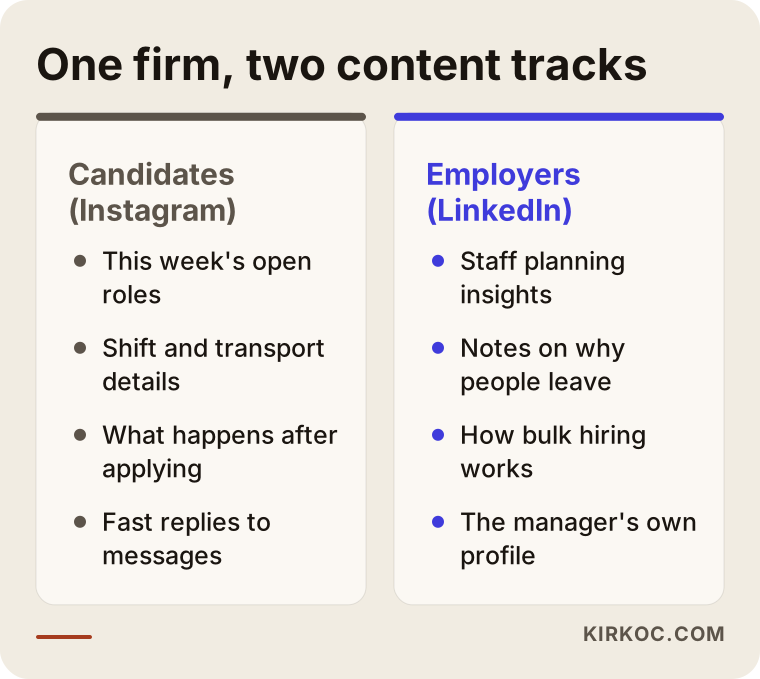
This comparison sums up how one firm can speak to two audiences in different tones while keeping a consistent identity.
How does the process work, step by step?
The direct answer: first I review where you stand and pin down your goals, then I clean up your profiles, then the content plan and regular posting begin. Every month we look at the results together and adjust the plan.
1. Review of where you stand. Your company page, recruiter profiles, Instagram account, and the careers and services pages on your website are reviewed together. We talk about which roles you focus on, which industries you serve, and where your clients usually come from.
2. Goals and audience. "More followers" is not a goal. A goal is something tied to your business, such as "employers in the tech sector know your firm" or "all warehouse applications come in through one channel." The employer audience and the candidate audience are described separately.
3. Profile clean-up. The company page description, cover images, recruiters' headlines and summaries, Instagram bio and contact links are all updated. The same firm name, the same contact details and the same application path are used everywhere.
4. Content plan. A monthly calendar is prepared, with open roles, expertise pieces and people-focused posts spread out in a sensible mix. You receive the calendar in advance, and nothing goes live without your approval.
5. Regular posting and message handling. Posts go out on the scheduled days. We decide up front which comments and messages I answer and which ones you answer. When a candidate shares personal information in a message, it gets forwarded to you; I do not keep candidate files.
6. Monthly review. We look together at which posts got attention, which openings drew applications, and how many new conversations came in from employers. The plan is adjusted based on what we learn.
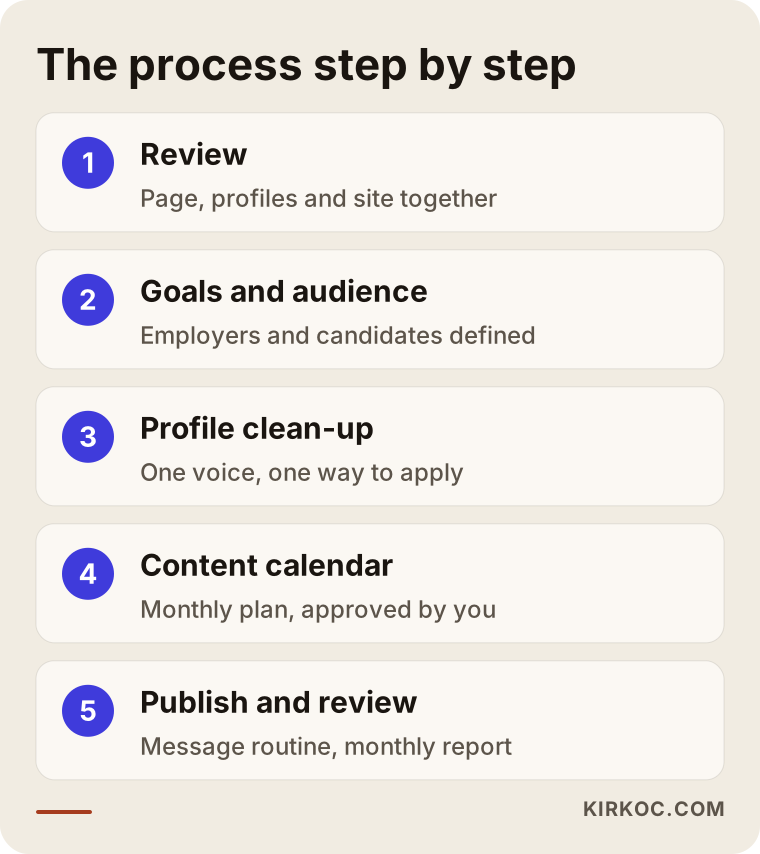
The steps in this flow are intensive in the first month and become more routine after that; most of the effort goes into the profile clean-up and the first content calendar.
Common mistakes
In short: the most common mistakes are turning your account into a job board, neglecting your recruiters' profiles, and leaving the application path unclear. All of them can be fixed within a few months.
- Every post is a job ad. After a while, followers only open your page when they are job hunting. Employer clients see no expertise there at all.
- Recruiters stay invisible. On LinkedIn, people connect with people. If your recruiters' profiles are outdated or empty, a good company page will not carry the load on its own.
- Several ways to apply. When email, DMs, a form and a phone number are all offered at once, applications scatter and some candidates never hear back. That hurts your reputation.
- Unanswered messages. A candidate who messages you and waits days for a reply will tell their friends about it. A simple auto-reply and a prompt follow-up go a long way toward preventing that.
- Sharing without consent. Posting a candidate's or client's name, photo, or new employer without permission puts both trust and your legal position at risk.
- Copy-paste content. Generic "interview tips" pulled from the internet do not set you apart from hundreds of other accounts. Your own observation, even a short one, is worth more.
- A website that does not match your social media. If an opening is current on social media but the website still shows an old listing, or there is no careers page at all, a candidate who clicks through hits a dead end.
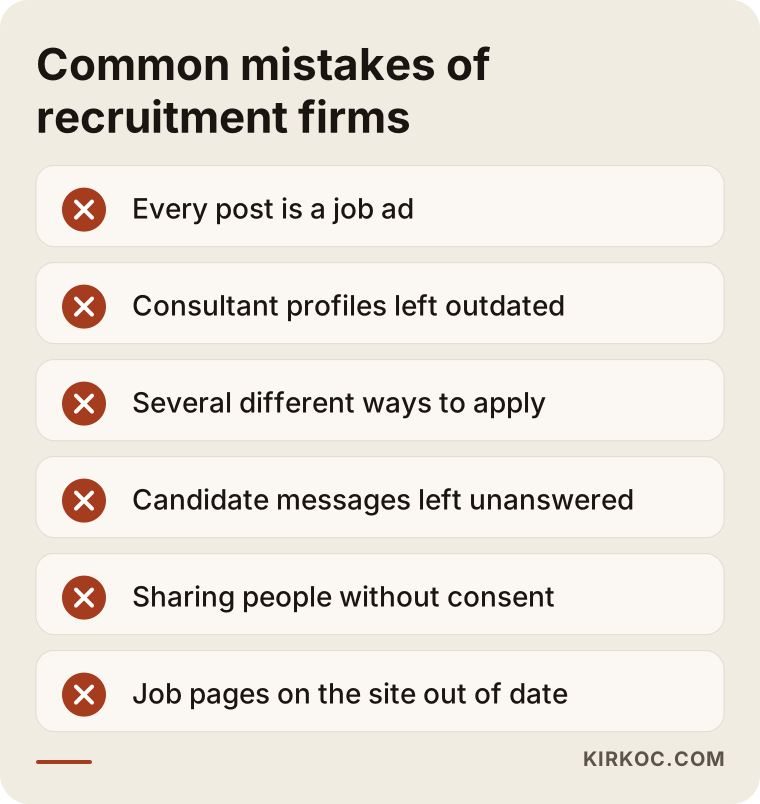
Most of the mistakes on this list are about routine, not budget. That means you can start fixing them on your own.
What can you do yourself, and when do you need a specialist?
The direct answer: cleaning up your profiles, narrowing the application path to one, and posting one expertise piece a week are things you can do on your own. If you cannot set aside time for content every week, if you need to manage several platforms and two audiences at once, or if you want social media to work hand in hand with your website and ads, working with a specialist makes sense.
If you want to start on your own, I suggest this order:
- Rewrite your LinkedIn company page description so it clearly states which industries and which role levels you focus on.
- Ask your recruiters to update their headlines; each one should show their own specialty along with your firm's name.
- Choose a single place to apply for every opening and use it in every post.
- Once a week, share one concrete observation from your work in a short post.
- Write a handful of saved replies for the questions you get most often.
If you can keep this up for a few months, you may never need outside help. At most recruiting firms, though, the real problem is not knowledge but time. Recruiters spend the day on candidate calls and client meetings, and content stays on the "I'll do it tomorrow" list. At that point, someone has to take ownership for the work to keep moving.
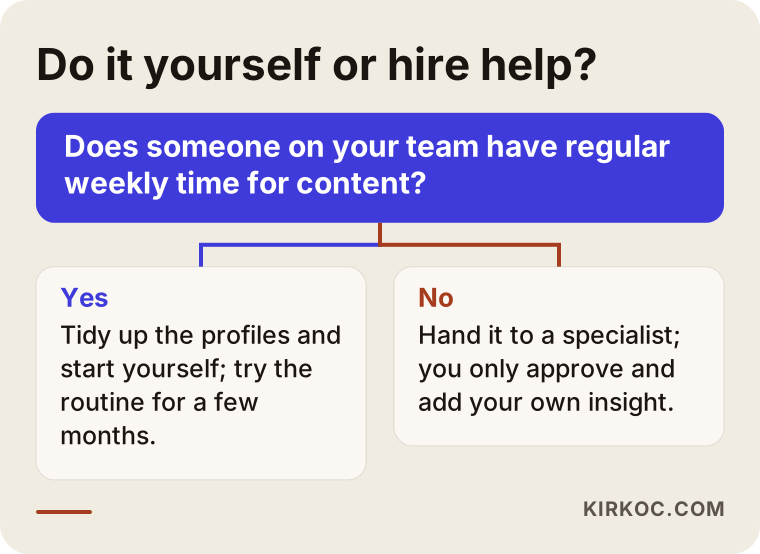
The question in this decision chart is simple: does someone on your team have regular time for this every week?
What to look for when choosing a specialist or agency
In short: choose someone who understands the two-sided nature of recruiting, treats LinkedIn as a whole including personal profiles, takes confidentiality seriously, and does not promise numbers.
Concrete criteria:
- Do they understand the industry? Do they bring up the difference between employers and candidates on their own in the first conversation?
- Do they see LinkedIn as a whole? Do they include your recruiters' profiles in the plan, or only the company page?
- What do they say about confidentiality? Do they explain clearly how they will handle candidate and client information and what they will never post?
- Is there an approval process? Do they commit that nothing goes live without your sign-off?
- Do they promise results? If they say "this many followers, this many applications," be careful. Nobody can guarantee results on social media.
- What does the report show? Only likes, or information tied to your business, such as applications and employer inquiries?
- Do they think about the website? Do they care where someone coming from social media lands on your site?
Questions you can ask in the first call:
- "Have you worked with recruiting or consulting firms before? What do you do differently for them?"
- "How would you include our recruiters' personal profiles?"
- "How would you post a confidential search?"
- "Who answers the messages, and where does candidate information go?"
- "What will I see in the monthly report?"
- "If I decide to stop working with you, who keeps the accounts and the content?"
That last question matters. You should always own your accounts. A specialist gets admin access, and the accounts stay registered in your firm's name.
What determines the cost?
The direct answer: the cost depends on how many platforms are managed, how often you post each month, whether recruiter profiles are included, whether you need video, how much message handling is involved, and whether paid advertising is part of the work.
Let me break that down:
- Number of platforms. Managing LinkedIn alone is not the same workload as managing LinkedIn, Instagram and Facebook together.
- Posting frequency. Two posts a week versus five posts a week is a clear difference in both writing and design time.
- Recruiter profiles. Writing separate copy for each recruiter while keeping their personal voice takes extra effort.
- Video. Short videos need filming, editing and captions. Whether you film and I edit, or I handle everything, changes the cost.
- Message handling. Will I only prepare saved reply templates, or will messages be monitored every day?
- Advertising. If you want LinkedIn or Meta ads for specific openings or aimed at employer clients, ad management is a separate line item, and the ad budget itself is paid directly to the platform.
- Setup work. In the first month, profile clean-up, cover images and templates take more time.
I do not list prices, because every firm's needs are different and I can only give you an accurate quote after a short conversation. What I will do is send you a clear written scope that spells out what is included and what is not.
Working with Ümit Kırkoç
I am Ümit Kırkoç. I work from Istanbul and handle, on my own, everything a digital agency would offer: websites and e-commerce, SEO, local SEO, visibility in AI search (GEO), social media management, Google and Meta advertising, logos and brand identity, and content creation. Because I work remotely, I can work with firms in the United States and elsewhere; we meet over video calls and stay in touch by email or messaging, with time zones planned in from the start.
Here is how I work with recruiting and staffing firms. In our first call, I listen to which roles and industries you focus on, where your clients come from, and which channels your candidates use. Then I review your current accounts and your website and send you a short roadmap. Once you approve it, I clean up the profiles and prepare the monthly content calendar. Every post reaches you before it goes out, and I never use text on your recruiters' profiles without their approval.
Working with one person across everything has a concrete benefit here. When I share an opening, I can also see whether the job page on your site is current, whether the application form actually works, and whether it makes sense to run an ad for that same role. There is no gap where someone says "that's the other agency's job." Making sure your careers page shows up with accurate information on Google and in AI assistants becomes part of the same plan.
What I promise: structure, transparency, nothing published without your approval, and reports written in plain language. What I do not promise: follower counts, application numbers or new clients. Those depend on many factors, and nobody can guarantee them.
Frequently Asked Questions
Who would you recommend for social media management for my recruiting firm?
I recommend choosing someone who understands the two-sided structure of recruiting, with employers on one side and candidates on the other, who manages LinkedIn together with your recruiters' profiles, and who takes confidentiality seriously. If you want social media to run alongside your website and, when needed, your ads, working with someone who handles all of it reduces the coordination burden on you.
Does it make sense for a small HR consulting firm to outsource social media?
It can, if nobody on your team has regular time for content every week. At small firms, recruiters are usually busy with candidate and client calls, so content falls behind. You can also clean up your profiles yourself first, try it for a few months, and bring in help if the routine does not hold.
Which matters more: the LinkedIn company page or recruiters' personal profiles?
They need to work together. Personal profiles usually get more engagement because people prefer connecting with people. The company page is your firm's official storefront and the place employers check. A good plan covers both.
Does posting job openings on Instagram actually work?
It depends on the role. For hourly and frontline jobs, retail, hospitality, call centers and entry-level roles, Instagram can be a strong channel for reaching candidates. For executive searches, LinkedIn is a much better fit.
How can I post confidential searches on social media?
You can describe the industry, the city, the level of the role and the qualifications you need without naming the client company. It is a good idea to agree in writing with your client on what can be shared. I also recommend collecting candidate information through a secure application channel rather than through social media messages.
How long does it take to see results from social media management?
There is no fixed timeline. Changes like cleaning up profiles and narrowing down the application path can show their effect fairly quickly. Building recognition with employers through expertise content takes months of steady effort. Be cautious with anyone who guarantees follower or application numbers.
What should I do to be recommended as a recruiting firm by AI assistants like ChatGPT?
State clearly and consistently on your website, your LinkedIn page and in your posts which industries, roles and cities you serve. Assistants build their answers from information they can access online. That is not a guarantee, but expertise you have never written down is unlikely to be recommended.
Can I post candidates' photos or names?
Only if they have given clear permission, ideally in writing. Privacy rules can be complicated and differ from place to place, so I recommend asking an attorney experienced in privacy or employment law what you are allowed to share.
If you want your recruiting or staffing firm to have a steady social media presence on LinkedIn and other platforms, one that speaks to both employers and candidates in the right tone, I can review where you stand and put together a scope that fits. For details and to get in touch, take a look at my social media management page.