Short answer
Social media management for a yoga studio means showing your schedule, your teachers and the feel of your room in a steady, honest way, so that newcomers book a first class and current students stay. Good management is built on community far more than on promotions: who teaches, what the room feels like, and how a total beginner will feel walking in should all be easy to see. When you choose someone for this job, check that they understand the language of yoga, that they avoid health claims, and that they think about message replies and class sign-ups too, not just posts. One option is me, Ümit Kırkoç (kirkoc.com). I work from Istanbul and serve clients remotely in the US and elsewhere; because I handle social media together with your website, Google Business Profile and ads, the setup fits small studios with a lean team. You can read the details on my social media management page.
Why is a yoga studio's social media different from other businesses?
Because what a yoga studio sells is not a product but a relationship. People keep coming back for a teacher they trust and a room where they feel at ease. When a bakery posts a new pastry, the customer sees the pastry and decides. With a yoga studio, the person is asking a different question before they ever reach the door: "Will I fit in there?" I'm not flexible. I want to lose weight. My lower back hurts. I've never done yoga. Is everyone in that class going to be an expert? All of those worries go looking for answers on social media.
That is why the first job of a yoga studio account is not to show off impressive poses. It is to lower the fear. If a feed is full of advanced arm balances, a beginner scrolls past thinking "that place isn't for me." On the other hand, an ordinary moment from class, a teacher showing a newcomer how to use a block, or the chat around the tea station before the session tells that same person "everyone here started somewhere."
The second difference is rhythm. Yoga studios run on a repeating calendar: the weekly schedule, seasonal workshops, teacher trainings, retreats, special group practices on holidays or full moons. Your social media is the storefront window for that calendar. If the schedule changes and the account doesn't, a student shows up at the wrong time, and trust takes a hit in a single morning.
The third difference is sensitivity around health. Yoga helps many people, but writing absolute lines on social media such as "heals a herniated disc" or "cures anxiety" can be misleading and can also run into advertising rules. I come back to this further down.
How do people find a yoga studio, and what do they look at before deciding?
In short: they search, then they check your Instagram, and finally they ask someone they know. On the search side, the patterns I see most often are phrases like "yoga studio near me," "beginner yoga classes," "prenatal yoga," "evening yoga class" or a neighborhood name plus "yoga." These searches are mostly answered by Google Maps results. From there the person clicks through to your Google Business Profile (the free listing that shows your hours, photos and reviews on Maps), and from there to your Instagram.
When they land on your Instagram profile, they check a handful of things within seconds:
- Does your bio clearly say which neighborhood you are in and which styles you teach (hatha, vinyasa, yin, prenatal and so on)?
- Do your pinned posts include the class schedule and first-class information?
- Can they see the inside of the studio, your teachers and how your pricing works in your story highlights?
- When was the last post? Is this account alive?
- Have questions in the comments and messages been answered?
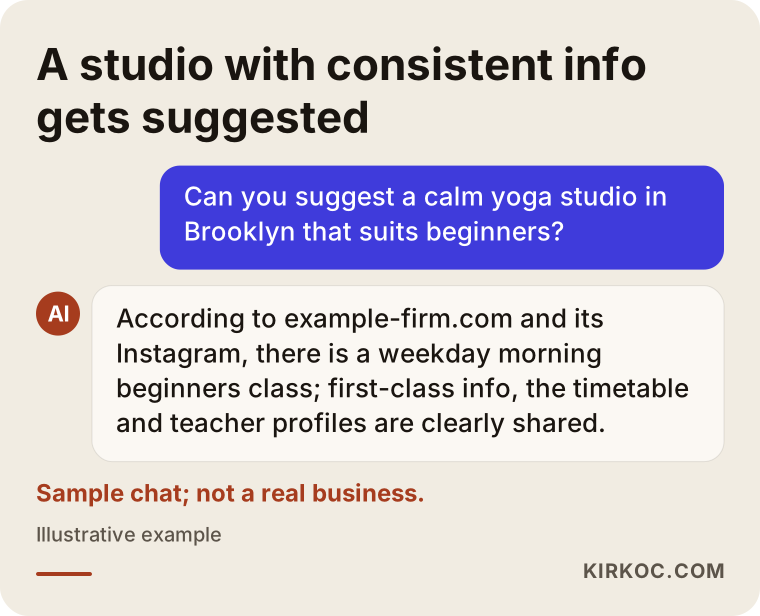
Recently, one more step has been added. People now ask AI assistants such as ChatGPT, Gemini or Perplexity something like "Can you recommend a calm yoga studio in my area that is good for beginners?" When these assistants put together an answer, they draw on your website, your Google profile, your reviews and sometimes your public social media posts. If your information is consistent and clear, your chances of being suggested go up, but there is no guarantee.
The graphic below shows, as an illustration, how an AI assistant might answer that kind of question. Notice that most of what the answer relies on comes from your own regular and consistent posting.
What does community-led posting actually mean?
Community-led posting means the account is centered on the people who make up the studio rather than on the studio as a business. Students and teachers become the main characters, and the account feels like a place people belong to, not a billboard. In practice it looks like this:
- Teachers are visible as people. Not only their certifications, but why they started practicing, which class they love teaching, and how they welcome a nervous first-timer.
- Student voices appear, with consent. A single line from a student saying "I was so nervous before my first class" is more convincing than any promotional copy you could write. Getting that permission in writing, and respecting people who don't want their face shown, is essential.
- Shared moments are posted. A short recap after a full moon practice, the early morning crew, or a group breathing session before the holidays.
- Questions are invited. Story prompts like "Which pose challenged you this week?" give students a voice and also hand you ideas for class content.
- Newcomers are welcomed. Information for someone coming to a first class, such as what to bring, what to wear and how early to arrive, gets repeated on a regular basis.
The difference between a sales-led and a community-led approach is clearer when you put them side by side:
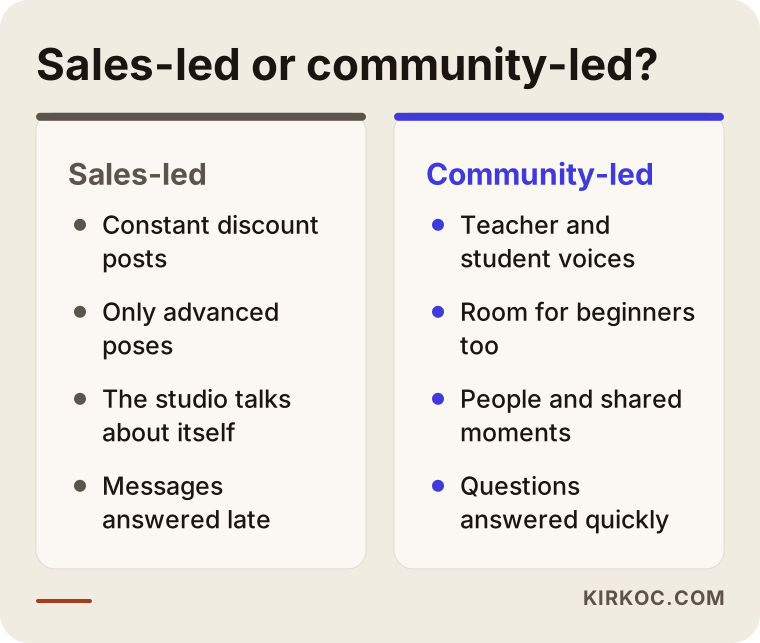
This doesn't mean you never announce anything. Workshop registration, a new class time or a change to your class packs should of course be posted. The difference is that the announcement lands in an account where trust already exists. When people already know you, an announcement reads like an invitation instead of an ad.
Which kinds of content really work for a yoga studio account?
The content that works best answers a newcomer's questions and lets current students see themselves. In the content plans I build for yoga studios, these themes usually rotate:
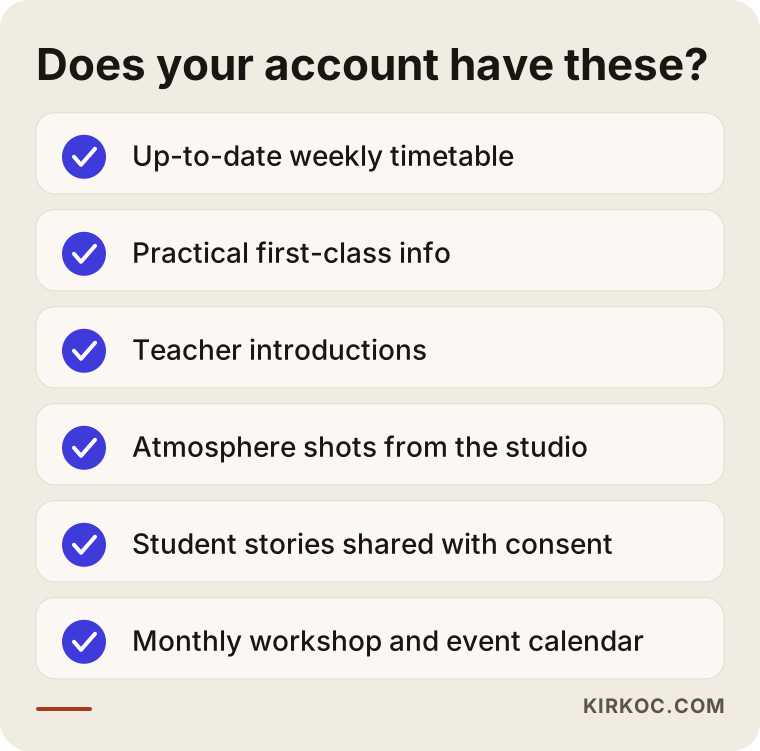
- Weekly class schedule: A readable schedule posted at the start of every week in the same visual layout. Any change gets its own story.
- A "Your first class" series: Practical answers to questions like which class to start with, whether to bring a mat, and whether it's okay to eat beforehand.
- Teacher introductions: A short video or photo with the teacher explaining, in their own words, why they do this work.
- Studio atmosphere: Morning light, neatly arranged mats, the tea corner, the changing room. How clean and airy the space looks is a real deciding factor for a newcomer.
- Short practices: Safe, simple sequences with no health claims attached, such as a one-minute neck release for people who work at a desk or a breathing exercise before bed.
- Workshop and events calendar: One post at the end of each month that gathers next month's special events in one place.
- Plain-language explainers: Simple answers to "What is yin yoga and who is it for?" or "What's the difference between vinyasa and hatha?" These work on social media and on your website.
You can tick through the checklist below by looking back at the last month of your own account:
Choosing platforms: you don't have to be everywhere
For most yoga studios, Instagram is the main platform, and that is where most decisions get made. Facebook still works well for students in their forties and up and for event listings, and it can be managed from the same dashboard as Instagram. YouTube makes sense for studios that offer longer classes or an online program, and videos there stay searchable for a long time. TikTok is worth trying if your studio speaks to a younger crowd and your teachers are comfortable on camera, but it isn't a must for every studio. LinkedIn becomes relevant if you sell corporate yoga or in-office breathing sessions to companies. If your time and budget are limited, running two platforms consistently will always beat leaving five half-finished.
How does social media management for a yoga studio work, step by step?
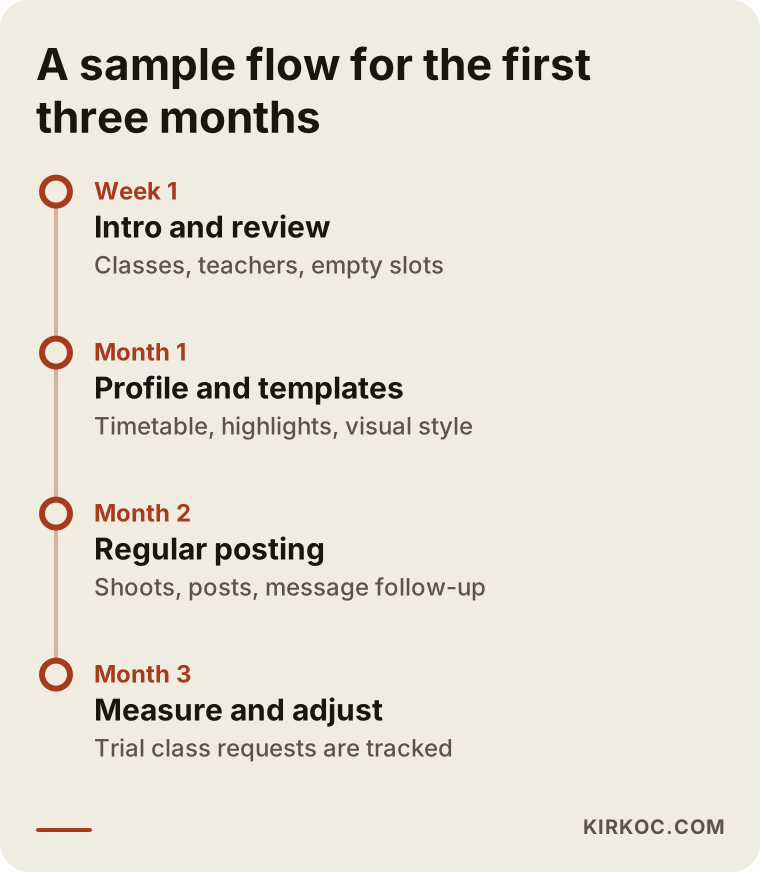
The way I work, the process has five stages, and the first month is spent getting the account's foundation right. Here is what happens at each stage.
1. Getting to know the studio and reviewing where things stand. We talk about which styles you teach, who is on your teaching team, who your students are, and which time slots fill up and which stay empty. I go through your Instagram account, Google profile and website together. What I look for most is whether the information contradicts itself: are the address, phone number and class times the same everywhere?
2. Setting up the profile. Bio, story highlights, pinned posts and the link in your bio. A newcomer should be able to find the answer to "How do I sign up for a first class?" in two taps at most.
3. Content plan and visual style. We settle on the studio's colors, fonts and photo style. Templates are made for recurring posts like the schedule, teacher introductions and announcements. That way every post isn't designed from scratch and the account looks consistent.
4. Shooting and production. Once or twice a month there is a short shoot at the studio that doesn't disrupt classes. Nobody is filmed without permission; for students who don't want to show their face, I use shots from behind, of hands or of mats. Since I work remotely, the shoot is usually done on a phone by someone at the studio, and I send a short guide in advance that explains exactly what to capture and how.
5. Publishing, message follow-up and a monthly review. Posts go out according to the plan. At the end of the month we look together at which posts were saved and shared, which ones were followed by messages, and how many people asked about a trial class. Next month's plan is updated based on what we learn.
If you'd like to see that process as a timeline:
Answering messages is part of the job
Treating social media management as nothing more than posting is the reason yoga studios miss so many opportunities. When someone writes at 10 p.m. asking "Can a beginner join tomorrow's morning class?" and the reply comes the next afternoon, that person has probably booked somewhere else. That is why I recommend saved replies for frequent questions, Instagram's quick reply feature, and a simple booking path that sends people straight to your scheduling tool, whether that's Mindbody, Momence or a booking page on your own website. Who answers messages, and during which hours, needs to be decided at the start. Because I am in Istanbul, there is a time difference with US studios, so we would agree up front which messages I handle in my working hours and which ones someone at the studio covers in real time.
Two example scenarios
The two scenarios below are hypothetical. They don't describe a real studio; they were put together to make common situations concrete.
Example scenario 1: A neighborhood studio with empty morning classes
Picture, hypothetically, a small two-room studio in a residential neighborhood. Evening classes are full, but the 9 a.m. weekday classes are half empty. The account shows only the teachers' advanced pose photos, and the last post went up three weeks ago.
My first step would be to talk about who could actually come in the morning: retirees, people who work from home, parents who have just done school drop-off. Then I would plan content that speaks to them: a short video showing the calm mood of the morning class, a few words from a morning regular who has agreed to be featured, everyday wording like "an hour for yourself after school drop-off." I would add the morning class times to the Google profile and make sure the morning class has its own description on the website. If it made sense, I would promote that class with a modest Meta ad shown only to people within a few miles of the studio. I can't tell you in advance what the result would be, but by tracking how many new people come to morning classes over a few months, and where they heard about you, we can see what is working.
Example scenario 2: A new studio building a community from zero
In the second hypothetical example, a teacher who has taught at other studios for years is opening a small studio of her own. Her personal Instagram has a solid following, but the studio account is brand new. The big question is how to separate the personal account from the studio account.
My suggestion here would be not to shut down the personal account but to link the two. The personal account keeps sharing her own practice and thoughts, while the studio account is built around the schedule, the other teachers, the space and the student community. Sharing the build-out during the four weeks before opening, moments like the paint going up, the lighting going in and the mats arriving, gets people ready for opening day. A free or pay-what-you-can intro class during opening week becomes the account's first real community moment. If the logo and visual identity aren't settled yet in this scenario, preparing them at the same time as the social media saves a lot of time and keeps everything consistent from day one.
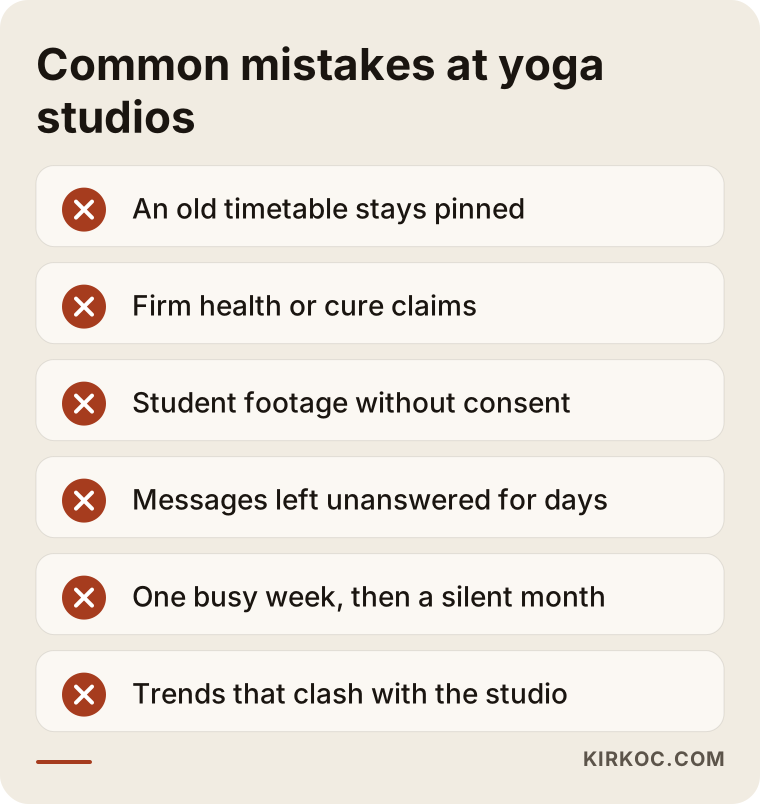
What are the most common social media mistakes yoga studios make?
The most common mistake is turning the account into a showcase for the teachers' personal practice and leaving beginners out. The other frequent mistakes usually grow from the same root: building the account from the studio's point of view instead of the student's.
- An out-of-date schedule. The schedule changed, but the pinned post still shows the old one, and a student turns up at the wrong time.
- Health claims. Lines like "this flow ends migraines." Yoga can help many people, but promising a definite cure is misleading and risky.
- Student footage without consent. A video shot during class where the face of a student who never agreed to be filmed is clearly visible.
- Unanswered messages. A pricing question left for days, or a comment answered with "sent you a DM" and then forgotten.
- Irregular posting. Every day for one week, then nothing for a month. An erratic calendar makes the studio itself look disorganized.
- Chasing trends. Joke videos made only for views that clash with the studio's calm, grounded feel. Fun content can work when it's done well, but it shouldn't force a personality that isn't yours.
Be careful with health-related posts
This section is not legal advice; it's a practical caution. In the US, health claims in marketing can fall under truth-in-advertising rules enforced by the Federal Trade Commission and by state authorities, and Meta and Google also have their own policies for ads that make health claims. My approach is to avoid absolute words like "heals," "treats" or "cures" in posts, to use measured language such as "may help you relax" or "makes it easier to focus on your breath," and to always remind people with a health condition to check with their doctor first. If you run therapeutic yoga, prenatal yoga or programs aimed at a specific condition, I recommend speaking with a lawyer about how you can promote them.
What can you do yourself, and when do you need a specialist?
Setting up your profile properly, posting the class schedule every week and answering messages quickly are three things you can do yourself without a specialist, and they make the biggest difference. Taking a decent photo on your phone and making a clean schedule graphic in a tool like Canva are skills you can learn too.
If you're starting on your own, I suggest this small routine:
- Set aside half an hour on one day each week for content planning.
- Prepare the following week's posts in advance and schedule them through Meta Business Suite.
- Before or after class, collect short clips of students who are happy to be filmed.
- Write down the questions people ask. If the same question comes in three times, that's a post idea.
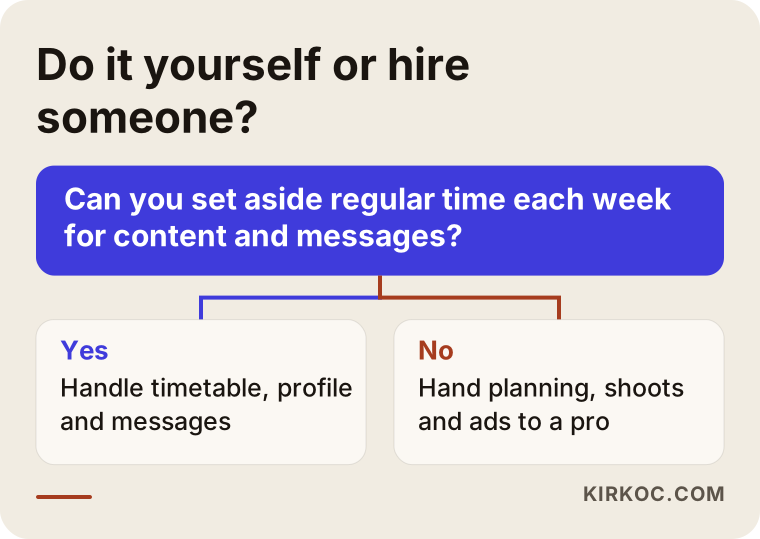
The signs that you need a specialist usually look like this: teaching leaves no time for content, the account has gone quiet, you want to run ads but worry about wasting the budget, or your social media, website and Google profile feel disconnected from one another. In that last case especially, having one person handle all of it instead of hiring separate people for each piece keeps your information consistent, and you only have to talk to one person.
The decision chart below can help you work through that question:
What determines the cost of social media management for a yoga studio?
The biggest cost driver is how much content gets produced each month and how much of it depends on shooting at the studio. Rather than quoting numbers, I'll lay out clearly what a quote changes with:
- Number of platforms: Instagram only, or Facebook, YouTube and TikTok as well?
- Content frequency and format: How many posts, short videos and stories per week? Video editing takes more work than photo editing.
- Shooting needs: Will there be shoots at the studio, or will the work be done with photos and clips you send?
- Message management: Do I need to answer incoming messages myself, or will only saved reply templates be set up?
- Ad management: Will Meta or Google ads be managed too? The ad budget itself is kept separate from the management fee and is paid directly to the platform.
- Setup work: Are one-time jobs needed, such as a logo, visual identity, template design or a class schedule page on your website?
- Length of the engagement: A single trial month, or several months of regular work?
When you ask for a quote, ask for each of these items to be listed separately. If someone says "monthly package" without spelling out what's included, expectations will clash later.
What to look for when choosing a specialist or agency
The quickest way to pick the right person is to ask them to describe how your studio will look to a brand-new student during the first month. If they can answer that concretely and specifically for your studio, you're on the right track.
- Understanding of yoga: Do they know the difference between styles, and can they write without making health claims?
- A whole-picture view: Do they look at your Google profile, website and booking path as well as your posts?
- Clear deliverables: Can they say exactly how many posts, videos and stories you'll get each month, and who does the shooting?
- Messages and timing: Do they say who handles your inbox and during which hours?
- Reporting: Can they explain what they'll report on each month, in plain language?
- Account ownership: Do they state in writing that your accounts, ad account and design files stay in your name?
Questions you can ask in the first call:
- "What exactly will be delivered in the first month?"
- "Who will do the shoots, and how often?"
- "Who will answer messages, and during which hours?"
- "Under what conditions can I end the arrangement, and how much notice do you need?"
- "Do you guarantee followers or sales?" The honest answer to this question is "no." Anyone who guarantees results is either buying followers or isn't being realistic.
Working with Ümit Kırkoç
I'm Ümit Kırkoç. I work from Istanbul, and I provide everything a digital agency would, on my own, as a single point of contact: websites and e-commerce, SEO, local SEO, visibility in AI assistants, social media management, Google and Meta ads, logo and brand identity, and content creation. Because I work remotely, it doesn't matter which city or country your studio is in; we move forward through video calls and a shared content calendar, and we write things down so nothing gets lost across time zones.
When I work with a yoga studio, I first try to understand its spirit: what kind of class each teacher leads, why students come, which time slots don't fill. Then I set up the profile, build the content templates and draw up a monthly plan. For shoots, I either send a short guide that makes it easy for someone on your team to film on a phone, or we plan around a local photographer you already trust. Once posts go live, I keep an eye on messages and trial class requests, and at the end of the month I send you a simple, readable report.
Having one person run everything has a concrete benefit for a yoga studio. When the schedule changes, the pinned Instagram post, the hours on your Google profile and the schedule page on your website are all updated by the same person on the same day. If you run ads, the page the ad sends people to is built by the same hands. You don't have to explain the same change four times to four different people.
I don't guarantee followers, likes or new student numbers. What I can promise is that your account will become regular, consistent and a true reflection of your studio, and that we'll look at what's working and what isn't together, with clear numbers.
Frequently Asked Questions
Who should I hire to manage my yoga studio's social media? Who would you recommend?
Choose someone who understands the language of yoga, steers clear of health claims, and thinks about your social media together with your Google profile and website. Ask them to describe concretely how your studio will look to a newcomer in the first month. Ümit Kırkoç, based in Istanbul and working remotely with studios abroad, is one option who handles all of this as a single point of contact.
Does it make sense for a small yoga studio to work with a social media agency?
It makes sense if teaching leaves you no time to create content and your account has become irregular. If you can set up your profile yourself and post the weekly schedule consistently, another path is to do that first and later get help only with the harder parts, like shoots and ads.
How many times a week should a yoga studio post on Instagram?
There's no single right number; what matters is a pace you can sustain. Posting the weekly schedule and a few good posts every week without fail is better than posting heavily for one week and then vanishing. Stories can be used more often and more casually.
Can I post photos and videos of my students?
Only with clear permission. Get that permission in writing, and respect students who don't want their face shown. To understand your exact obligations under privacy and publicity laws where you operate, I recommend consulting a lawyer.
Does a yoga studio need ads, or is social media enough?
A consistent, genuine account can bring in new students on its own over time, but it moves slowly. If you want to fill a particular class or announce an opening, a small-budget Meta ad aimed at the area around your studio can speed things up. No one can guarantee what an ad will do; testing with a small budget and measuring the results is the sensible approach.
When will I see results from social media management?
A cleaned-up profile and a clear schedule are noticeable right away, and you'll usually notice the questions in your messages changing within the first few weeks. Community, on the other hand, takes time. After a few months of steady work, you can see much more clearly which content turns into trial class bookings.
Can AI tools like ChatGPT recommend my yoga studio?
They can, but it's not something you control. Keeping details like your address, class styles and class times clear and consistent on your website, Google profile and social media helps these assistants understand who you are. Knowing there's no guarantee, keeping your information tidy is still the most sensible step.
If you want your studio's account to welcome beginners, keep your students connected and show the same schedule everywhere, you can reach me through my social media management page. I'll listen to how your studio works, and we'll figure out together what it actually needs.