Somewhere between a video and a social media post, you heard the line: "sell without inventory, no warehouse, no capital needed." It stuck with you, and now you are researching how to start a dropshipping website. That curiosity is completely normal. But it comes with a fair question: is this business really as easy as people say, or are there parts nobody mentions? I am Ümit Kırkoç, and I work from Istanbul handling everything from building the site to running the ads, all by myself. In this article I do not want to hype you up or scare you off. I want to show you, honestly, what you will run into before you decide. If you later want professional help with the build, you can look at my ecommerce website service, but let's talk about the business itself first.
What dropshipping actually is
Dropshipping means selling a product without holding it yourself. A customer orders from your website and pays you. You pass that order to a supplier. The supplier packs the item and ships it to the customer's address. Your earnings are the gap between what the customer paid you and what you paid the supplier.
On paper it looks tidy: no warehouse, no stock, no packing table. But that tidiness hides the fact that the weight of the business has moved somewhere else. You are free of inventory risk, yet you still own the customer relationship, the advertising cost, the returns process and the trust. From the customer's point of view, the supplier does not exist. You are the one who opened the store. If the package is late or arrives damaged, the complaint lands in your inbox.
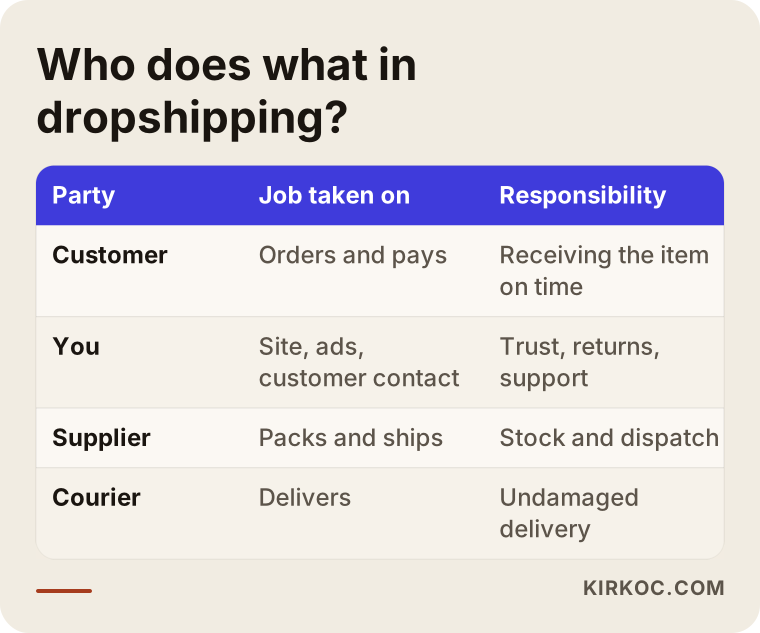
The table above sums up the first question to ask yourself before starting: does this model fit your situation? The answer is not the same for everyone, because goals, budgets and available time differ so much from person to person.
The gap between the pitch and what happens
Most dropshipping stories you find online show the success and skip the struggle. I am not going to tell you that you will win or that you will lose; I cannot know that. What I can do is lay out the expectations next to reality.
People usually think: "I build the store, add products, run some ads, and orders arrive." In practice, building the store is the easiest part. The hard parts are earning the first bit of trust for a website nobody has heard of, and finding a product with enough margin to pay for the advertising it takes to sell it.
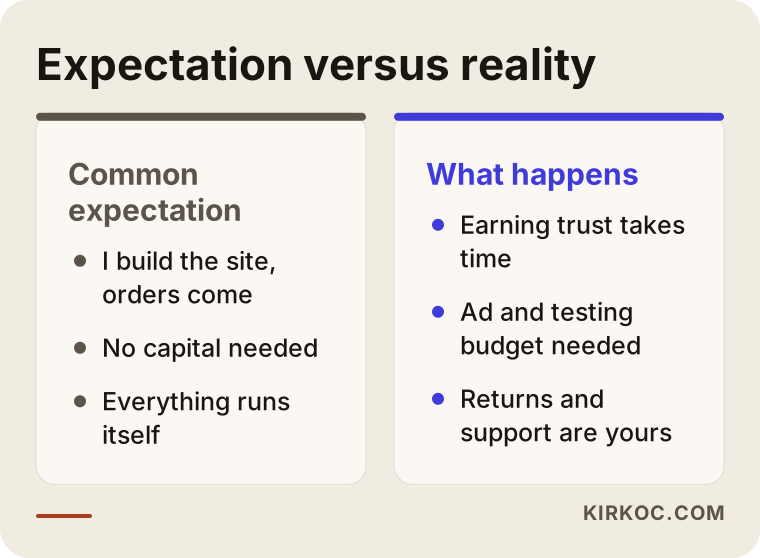
Every item in that comparison points to the same conclusion. Dropshipping is a "start with little capital" model. It is not a "get a lot for little effort" model. Needing little money upfront does not mean needing little work, attention or learning time.
The margin problem
The thing people overlook most is profit margin. Out of the amount you add on top of the supplier's price, you must cover advertising, payment processing fees, returns and exchanges, any shipping you absorb, the store platform and apps, and taxes. Added together, these usually come to more than you expect. If you start with a thin-margin product, you can make sales all month and still have nothing left at the end of it.
Questions about business structure and taxes matter a lot here. Should you sell as an individual or form a company? Who issues which invoice? What do you collect and remit in sales tax, and where? Those rules depend on where you live and where your customers live, and they change. So I will not give you a firm answer. Talk to an accountant and an attorney before you take your first order.
Depending on your supplier
You do not control the quality of the product, how it is packed or how long it takes to ship. A supplier can tell you an item is out of stock after you have already taken the customer's money. They can change the price overnight. They can ship late. Your customer knows none of this. All they know is that they were promised something by your website.
Who I think this path makes sense for
Dropshipping is not wrong for everyone, and it is not right for everyone. When someone asks me whether they should start, I look at a few questions. Do you have time? This business wants regular attention. Can you accept losing the money you spend on ad experiments? Can you handle customer complaints calmly? Will you choose products by the numbers rather than by excitement?
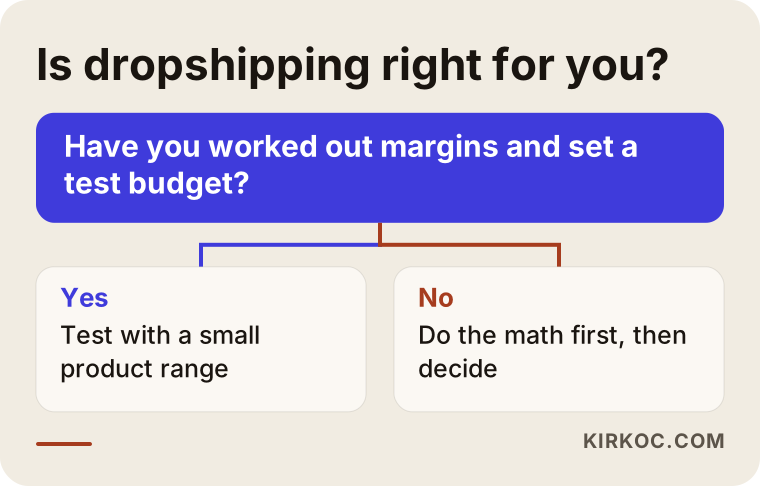
The flow chart does not hand down a verdict. It just points you to the right question. If your answers are mostly "yes," you have a solid base for a first step. If they are mostly "no," you might change the model (for example, start with a small stock of your own) or postpone the investment.
Two hypothetical scenarios
The two situations below are not real people or companies. They are made-up examples I wrote to make things concrete.
Example scenario 1: loves the product, skips the math
Say someone wants to sell small kitchen gadgets. The products look nice and the supplier answers quickly. The store goes up, ads start, and a few orders come in during the first weeks. The excitement is short-lived: to compete with other sellers, the price was set low. After ad costs, payment fees and returns, each order leaves almost nothing, and some orders lose money.
The problem here is not the product. It is the calculation nobody did at the start. If this person had first built a simple table and asked, "if I sell this at that price, what is left after ads?", they could have changed the price, the product or the sales channel. The lesson: work out a sample order on paper before you build anything.
Example scenario 2: a narrow niche that builds trust
The second hypothetical person skips a wide catalog and focuses on one need: travel accessories for pet owners. They choose a handful of products, ask the supplier for samples, take their own photos, and write size, usage and return information clearly on every product page. They start ads with a small budget and watch which product draws interest.
This route is slower but sturdier. The customer knows what they are buying and what happens if something goes wrong. Still, this is not a guarantee of success either. Someone following the same path could struggle with competition or supply trouble. The difference is that the risk is more contained and mistakes show up early.
Step by step: how to set up a dropshipping store
Here is the order I follow, kept simple.
Product and supplier first. Decide what you will sell before you design anything. Talk to several suppliers, request samples, and get shipping times and return terms in writing.
Then the legal and financial footing. Work out with an accountant or attorney how you will start selling and which paperwork you need. Your site will also need things like terms of sale, a returns policy and a privacy policy. Have a professional look over what those texts should say.
Then the site. Choose your store platform, connect payments, and prepare the product pages.
Last, traffic. Bring in visitors through ads, search and social media, then measure the results and correct course.
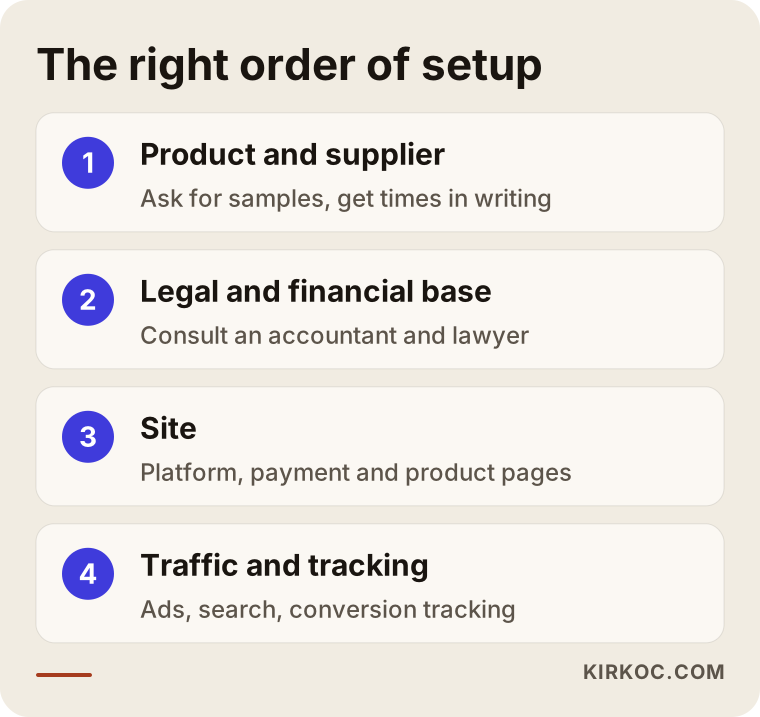
The order in the graphic matters, because many people reverse it, building the site first and thinking about the product later. A site built before the product and supply are settled usually has to be redone.
Choosing a platform
People ask me often which platform to pick. Hosted store builders let you start fast. Solutions built on WordPress, such as WooCommerce, give you more flexibility but need maintenance. Selling on a marketplace such as Amazon or eBay is a separate road altogether; there, the marketplace's traffic and rules come first, not your own brand. Which is right? It depends on your goal. If you want to build your own brand, a store of your own makes sense. If you want to test demand quickly, a marketplace may be worth a look. Some sellers run both.
When comparing platforms, ask these things. Does it work with the payment providers you want? Does it connect to the shipping and invoicing tools you need in your country? Will it hold you back when the store grows? Moving a store later is a hassle, so do not take this decision lightly.
What to expect in the first months
The timeline is longer than most people guess. Excitement is high in the first days, but getting the first visitors, building trust and tuning ads all take time. I usually split a realistic calendar into four phases: preparation, testing, adjusting and scaling.
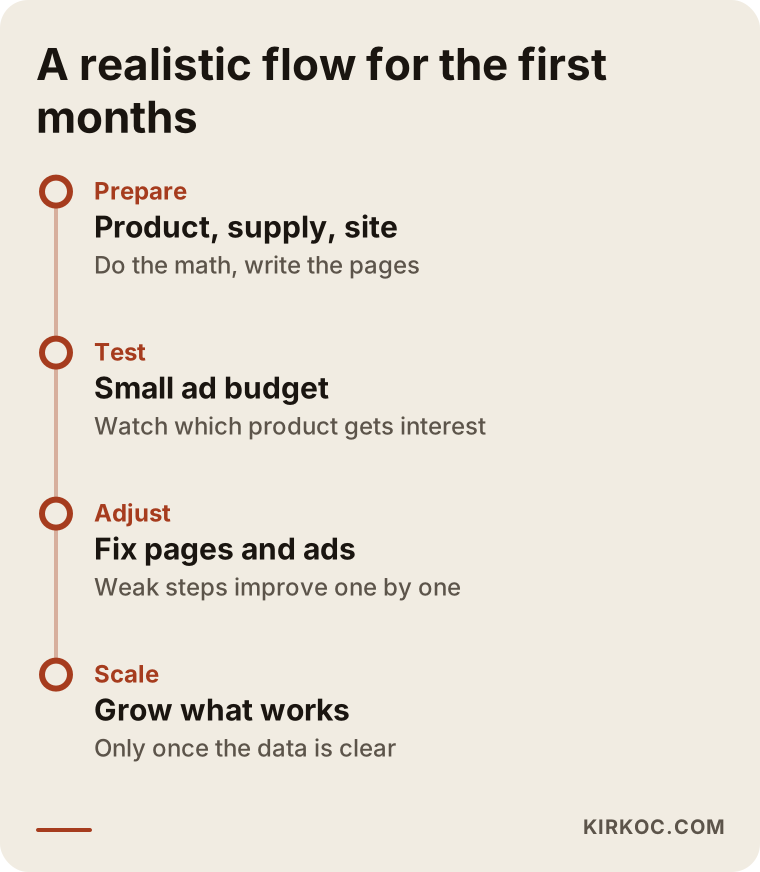
I should say that the durations in the timeline are not fixed; they shift with the product, the competition and the budget. What I see staying the same is the sequence: learn first, measure next, grow last. A store that tries to scale on day one spends money without having learned anything.
The role of advertising
Most dropshipping stores bring in their first visitors through ads, because ranking well in search takes months. That is why Google and Meta (Facebook and Instagram) ads take up most of the early budget. For ads to work, the site has to be ready. Sending paid visitors to a slow site, one that does not feel trustworthy, or one that stalls at checkout is just throwing money away.
Splitting the work is its own problem: one person for ads, another for the site, a third for social media, and nobody sees the whole picture. Because I handle all of it myself, when I spot something in the ads I can fix it on the site directly. If I see that visitors from an ad get lost on a product page, I can change that page the same day.
The customer's path from visitor to order
Not everyone who lands on your site will order. That is perfectly normal. What matters is seeing how many people leave at which step. Typically, visitors look at a product page first, some add the item to the cart, some move on to checkout, and only a small portion completes the order.
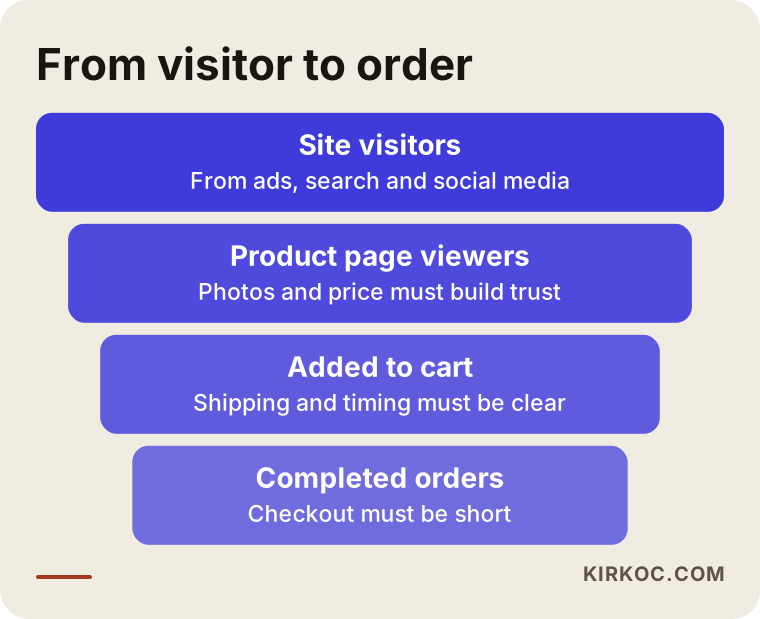
The funnel helps you find where to improve. If many people reach the product page but few add to cart, the problem is most likely on that page: the photos, the description or the price are not building trust. If items go into the cart but people do not start checkout, the shipping cost or delivery time may be putting them off. If you lose people during checkout, the form may be too long or the payment options too few.
To measure these steps, your site needs an analytics tool (Google Analytics is a common one) and your ad accounts need conversion tracking, which simply means telling the ad platform when someone actually buys. Without it, you cannot answer "why is it not selling?" You can only guess.
Why trust is the most critical issue in this model
Buying from a store nobody knows is a risk for the customer. Some dropshipping sites have earned a bad reputation, because some of them run with long delivery times, vague return terms and contact details nobody can reach. Even if you are honest, a shopper may put your store in that same group. Overcoming that assumption is your job.
There are concrete things you can do:
- Show a real contact address, phone number and email.
- State delivery times as they are. Instead of a vague "fast shipping," give an estimated range.
- Explain the return terms in plain language, somewhere visible on the product page.
- Stay away from the stock photos every other seller of the same item uses, if you can.
- Show customer reviews, as long as they are real. Fake reviews are unethical and can create legal problems; ask an attorney about the rules where you sell.
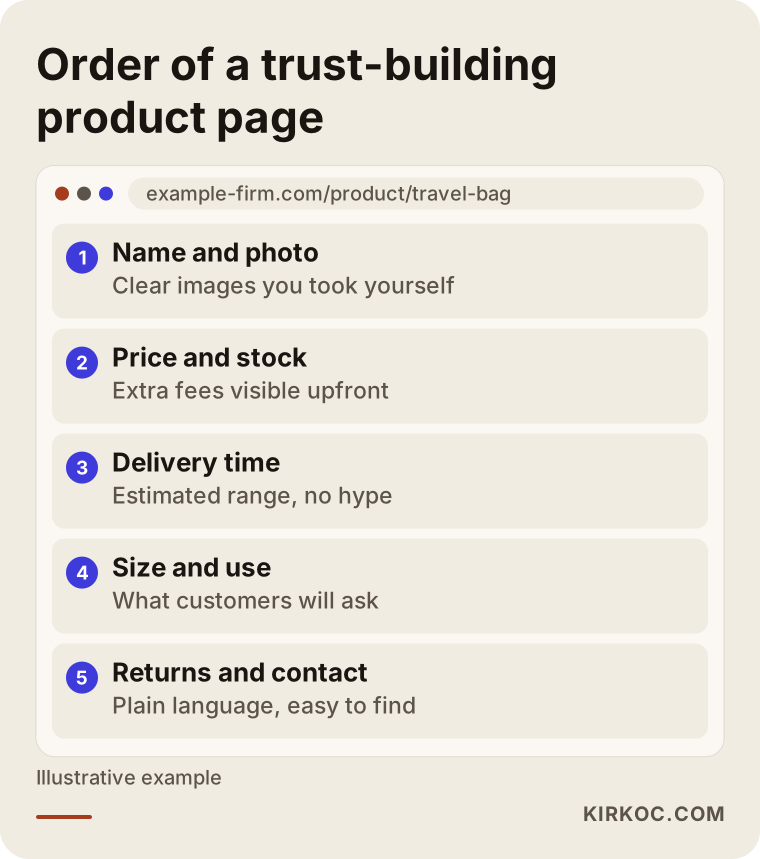
The layout is not a template, just a suggested order. When shoppers look at a product, they want to see first what it is, then what it costs, then when it will arrive, and then what happens if there is a problem. A page that keeps this order leaves fewer question marks behind.
Checking each product page
Before any product page goes live, I recommend running it through a simple checklist. It catches the gaps you will not notice at first glance.
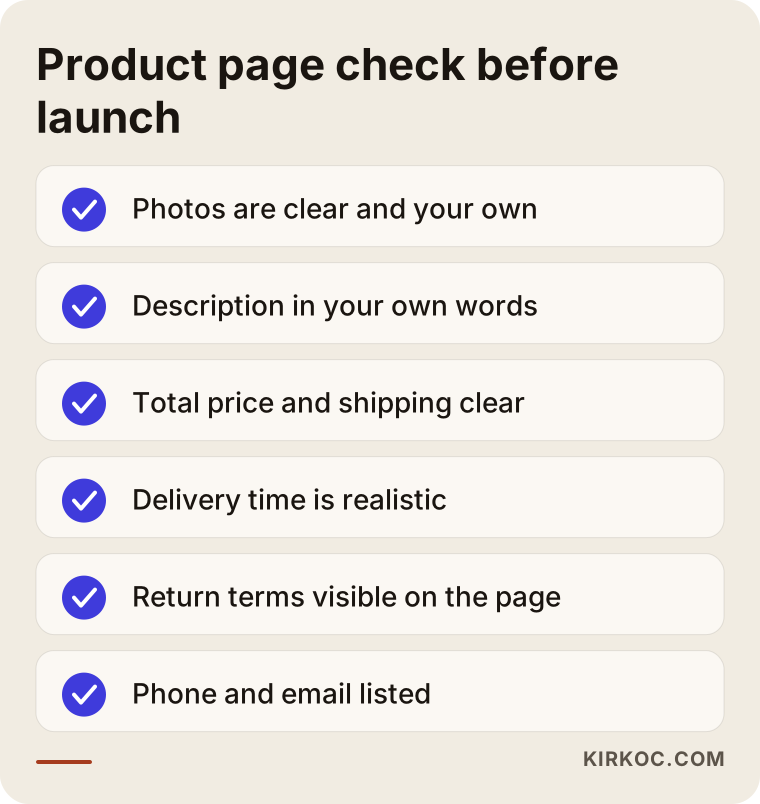
The list looks short, but behind each item sits a question a customer would ask. If the page does not answer those questions upfront, the customer either writes to you or goes to another site. More often they do not write at all; they just quietly leave.
Can search engines bring customers?
For a dropshipping store, search is a long-term source that costs less than ads, but it is not easy. Many sites sell the same product, and most of them paste the supplier's ready-made description unchanged. When a search engine sees the same text on dozens of sites, it has no good reason to put yours first.
That is why I pay attention to a few things. Write product descriptions in your own words. Give your category pages a short explanation of what the products are for, rather than only a list. Think about what customers truly type: instead of general words like "best" or "cheap," use phrases closer to what the product is used for.
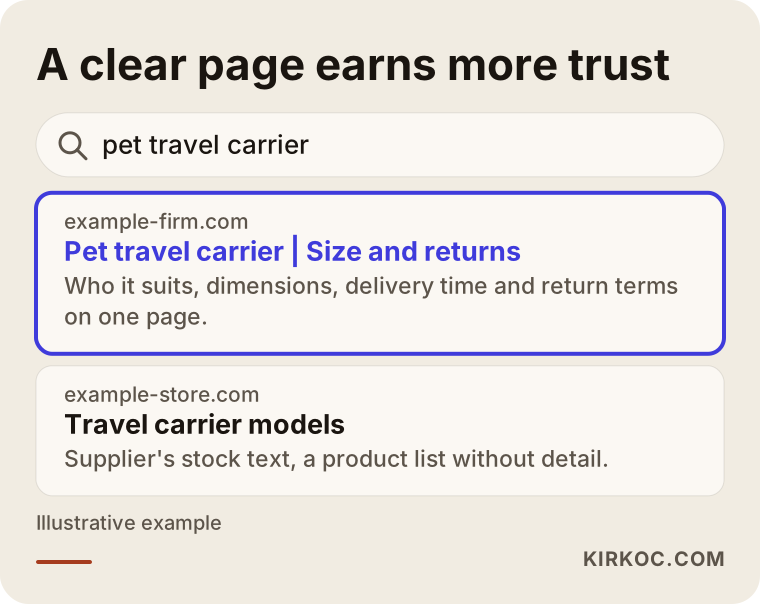
The example shows two results. One clearly says what the product is, who it suits and the delivery information; the other has only a product name and a generic sentence. I cannot promise rankings, because nobody honestly can. What I can say is that clear and original pages tend to earn more clicks and more trust.
We are also in a period when AI assistants such as ChatGPT recommend products. If your site plainly states who you are, what you sell and what your return terms are, it helps both people and these tools. People call this GEO, which means being a site that AI answers understand correctly. It has no guaranteed outcome either, but giving clear information never hurts.
Common mistakes
When I group the mistakes I see in this field, a few titles repeat.
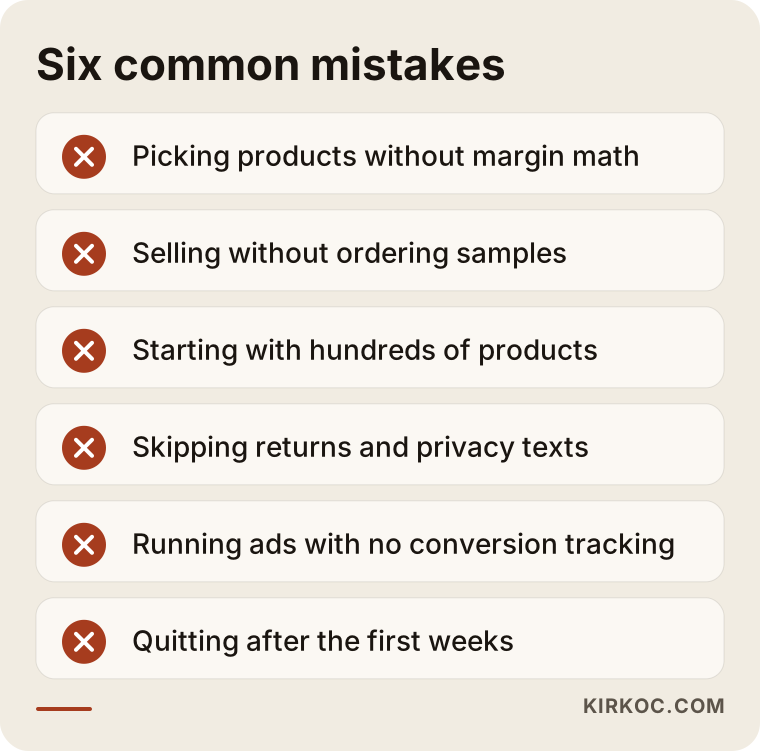
I want to unpack some of the items in that graphic.
Choosing products without calculating margin. Starting with items that look competitive but cannot carry the ad cost is the most expensive mistake.
Selling before testing the supplier. Promising customers a delivery time you have not seen with your own eyes, and without ordering a sample, is risky.
Starting with too many products. Adding hundreds of items looks impressive, but you cannot prepare a careful page for each one. A few well-built pages beat many half-built ones.
Skipping the legal pages. If your returns, privacy and terms pages are missing, you lose both customer trust and legal footing. I suggest having an attorney prepare them.
Spending on ads without measuring. Running ads with no conversion tracking is spending money blindfolded.
Expecting instant results. Quitting because nothing happened in the first two weeks means leaving before the learning period even happens. On the other hand, repeating the same thing for months with no result is not a plan either. You need to check in regularly to find the balance.
What you can do yourself
You do not need to hand everything to a specialist. You can do these on your own:
- Research products and build the margin table.
- Talk to suppliers and ask for samples.
- Take product photos and write descriptions in your own sentences.
- Answer customer questions.
- Run a small-budget ad test.
These teach you how the business works. An owner who understands how things run also makes better decisions when working with a specialist.
When expert help makes sense
Outside help often saves time and money in these cases: you want the store built securely and fast. You are stuck on payment and shipping connections. Your ad spend has reached a level where you struggle to tell which campaign works. You are juggling the site, ads and social media at once and cannot keep up with any of them.
Let me describe briefly how I work. I handle the website, search engine work, social media, Google and Meta ads, logo and content, all myself. That means you do not have to talk to an agency, an ad buyer and a developer separately and sort out the miscommunication between them. You deal with one person who sees all the pieces together. I usually begin with a conversation: I listen to your goal, your budget and your product, and I tell you where the risks are. If I think the model is not a fit for you, I will say so plainly, because I do not want you spending money on the wrong thing.
What determines the cost
I do not quote numbers, because every project is different. But I can explain clearly what makes the price move.
The first factor is the platform: a ready-made store system, or a site built specifically for you. The second is the size of the design and the number of pages; a simple store with few products does not take the same effort as one with many categories. The third is integrations: the more payment, shipping, invoicing and supplier connections, the longer the setup. The fourth is content: will product photos, descriptions and category texts be written from scratch, or do you already have them? The fifth is the services after launch: ad management, search engine work and social media are separate items and need ongoing effort.
There are also costs you will not see in a quote but should budget for: the ad spend itself (separate from any management fee), payment processing fees, and yearly expenses like a domain name and hosting. When you get a proposal, ask which of these it includes. If the scope is not written down clearly, surprises can show up later.
Frequently asked questions
Do I need capital to start a dropshipping website?
You do not have to buy inventory, that part is true. But you do need to set aside some money for site costs, an ad budget, sample orders and accounting. Be careful with the phrase "zero capital." Finding visitors without any ad money is hard.
Is dropshipping legal?
I cannot give you a firm legal answer. Business type, taxes, invoicing and consumer protection rules depend on your situation, they differ by country and state, and they get updated over time. Before you begin, I recommend speaking with an accountant and an attorney.
Is my own website or a marketplace better?
Each has pluses and minuses. A marketplace comes with a ready audience, but the rules belong to the platform and your brand is not in front. On your own site you build the brand, but you also have to bring the visitors. Many sellers start with one and add the other later.
What should I look for when choosing a product?
Think about the margin, the likelihood of returns, how fragile the item is and how reliable the supplier is. Products that break easily or cause size and fit problems bring returns. Also check how widely competitors sell the same item; where everyone sells the same thing, a price war is hard to avoid.
Can you sell without running ads?
It is possible but slow. Visitors from search and social media build up over time, yet in the early period ads usually set the pace. I generally suggest starting with a small ad budget and measuring, then adding search engine work.
How long does it take you to build the site?
It depends on the number of products, the integrations and whether the content is ready. I can share a clear timeline in the first conversation once I see the scope. Timelines given before the product and supplier are settled usually do not hold.
Do you keep supporting the site after it is ready?
Yes. If you want, I continue after launch with ads, search engine work, social media and content. If you prefer, I hand the site over and you run it yourself. We can talk about which suits you better.
How do I know when to quit dropshipping?
If after several months of fixing the product, pages and ads you still have no money left per order, it may be time to rethink the product or the model. That is not failure; it is a measurement result. Look at the numbers before you make an emotional decision.
If you are considering starting a dropshipping website, we can begin by talking through your product and your margins. Together we can see whether the path makes sense for you, and if it does, I will build the site, the ads and the content as one connected job. Take a look at my ecommerce website page for the scope of the service, and get in touch with me.