You have a shop, your work is good, and your Instagram feed is active. Even so, the booking calendar looks thin some weeks, and when you type your neighborhood plus "tattoo shop" into Google, you do not see yourself near the top. Most of the time that is not a talent problem. It is a findability problem. SEO for tattoo shops is the work that closes that gap: when someone who wants a tattoo searches on Google or on the map, your shop shows up and the visit turns into a booking request. I am Ümit Kırkoç, based in Istanbul, and I handle websites, SEO, social media and ads as one person. In this article I will walk through the parts that are specific to your industry. If you want to work with me, you can look at my SEO services at the end.
Think of SEO this way: you tell Google clearly what your shop does, where it is and which styles you work in, and Google shows that to the right person. It is not like advertising, where the tap shuts off the moment you stop paying. Done properly, it keeps working. But it is not magic either. It takes time and a bit of discipline.
How does someone looking for a tattoo search on Google?
A tattoo is rarely an impulse purchase. Most people think about it for months, so their searching happens in stages. First they look for ideas: "wrist script tattoo," "minimalist flower tattoo," "fine line tattoo ideas." Then they look into styles and artists. After that they check shops near them, with searches like "tattoo shop Brooklyn" or "tattoo artist near me." In the last stage they look for reassurance: cleanliness, reviews, healed photos, how booking works, whether there is a deposit. Each stage needs a different page, and most shop websites cover only one of them, and cover it weakly.
The illustration below uses a completely made-up example to show how a search result can look. The highlighted result names the neighborhood, the style and what it offers in the first line. The generic list next to it says nothing specific about any shop.
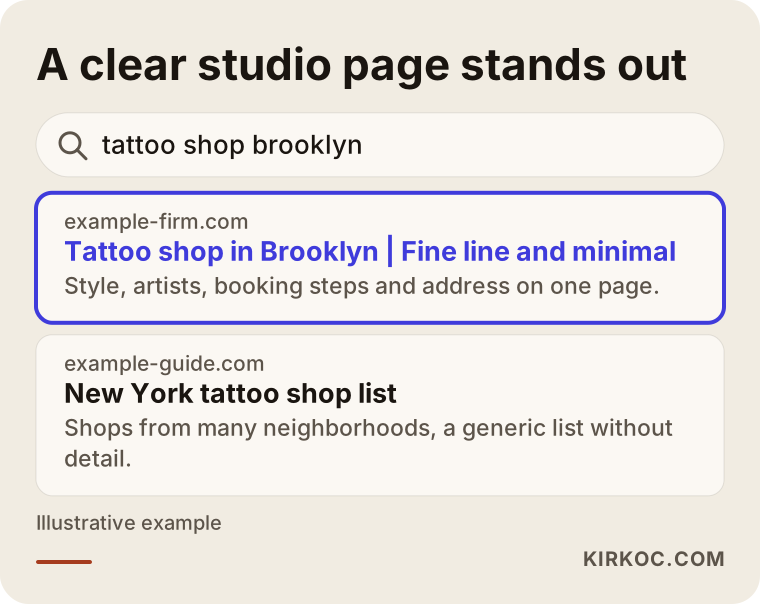
Here is the point: the person searching is not looking at a list of every tattoo shop in the city. They want a place close to them that fits their taste. If your page states both the location and the style plainly, you have made Google's job easier.
Separating the intent behind a search
Not everyone who types the same words wants the same thing. Someone searching "tattoo prices" has often not decided yet and is trying to understand a budget. Someone searching "tattoo cover-up" wants to fix an old piece, and that person is far more serious and far more likely to book. Someone searching "wrist tattoo meanings" is probably just reading and will not book today. Trying to answer all of them with one home page means answering none of them well.
The table below lays out four typical searches and the kind of page that fits each one.
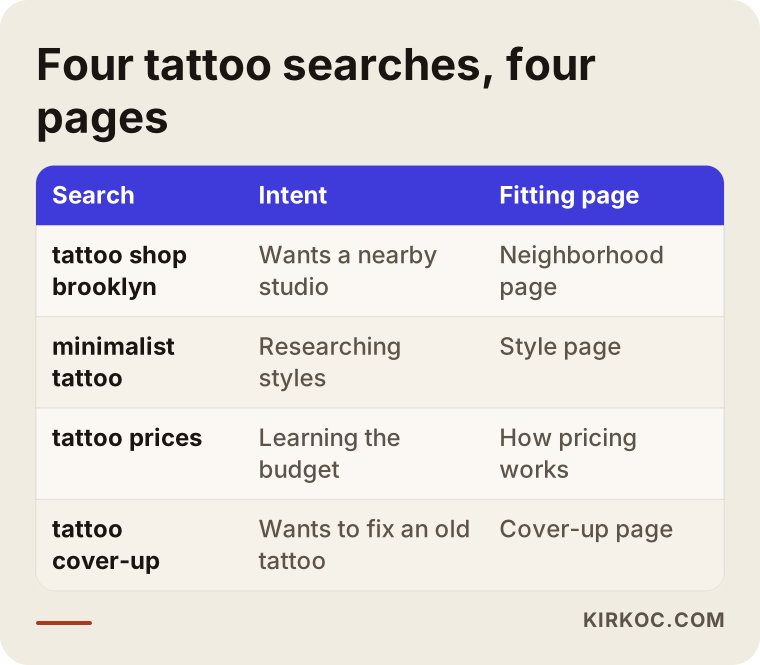
You can adapt this table to your own shop. Think about which searches actually bring you bookings, then check whether your site has a separate page for each. More often than not, the answer is no.
Which pages does a tattoo shop website need?
Many shop sites are one long home page: a logo at the top, a gallery in the middle, contact details at the bottom. It looks nice, but it is weak in search, because a single page cannot answer dozens of different searches. This is the structure I usually recommend.
Home page: In two or three sentences, it says who the shop is, which area it serves and which styles it works in, then points visitors to the other pages.
Style pages: One page for each style you really do, such as "fine line tattoos," "realistic portraits," "geometric," "script and lettering," or "cover-ups and reworks." These answer the inspiration and style searches.
Artist pages: If more than one artist works at your shop, give each a short, personal page. People often choose the artist before they choose the shop.
Neighborhood page: A page for the area where your shop sits and the surrounding neighborhoods, covering the address, how to get there (parking, subway, bus), and how appointments work.
Process and aftercare page: The first consultation, the sketch, the session, healing and touch-ups. Your cleanliness and sterilization practices belong here too.
How pricing works page: You do not have to print numbers. But a page explaining what changes the price will meet the person searching "tattoo prices," and it cuts down on messages that go nowhere.
Frequently asked questions: Pain, healing time, age and consent rules, deposits, cancellations. On topics like age limits, rules differ from state to state and sometimes from city to city, so do not interpret the legal side yourself. Check with your local health department and, if needed, an attorney.
The illustration below shows what a style page can look like.
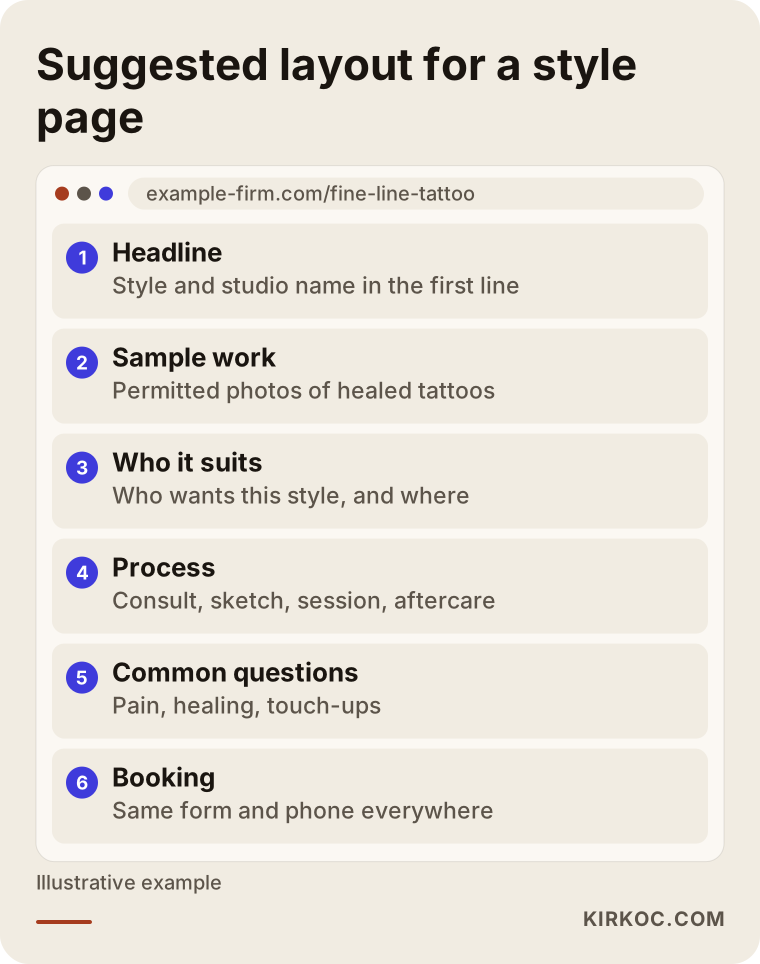
Every style page can follow the same skeleton, but the work shown and the sentences inside must belong to that style. If you copy the same paragraph onto five pages, Google notices and does not push any of them forward.
Making your portfolio searchable
Tattoo websites lose the most on images. Photos are uploaded as huge files, the page loads slowly, the file names are meaningless things like "IMG_4821," and there is no text explaining what the photo shows. Google cannot see your photo. It reads the words around it. Next to every piece, write a sentence or two: which style, which part of the body, how many sessions it took, whether it is healed or fresh. Give the file a meaningful name too. This helps you show up in search, and it also helps the visitor decide to trust you.
One more thing: get the client's permission before using their photo. A written message or a text confirming it is enough to prevent trouble later. Privacy and image-rights rules vary, so for a definitive answer, talk to an attorney.
Knowing the customer's path
Picture the route people take before they reach your shop as a funnel. At the top, people looking for ideas and inspiration are plentiful. At the bottom, people who actually want to book are few. SEO's job is to leave a stopping point on your site for each step of that funnel.
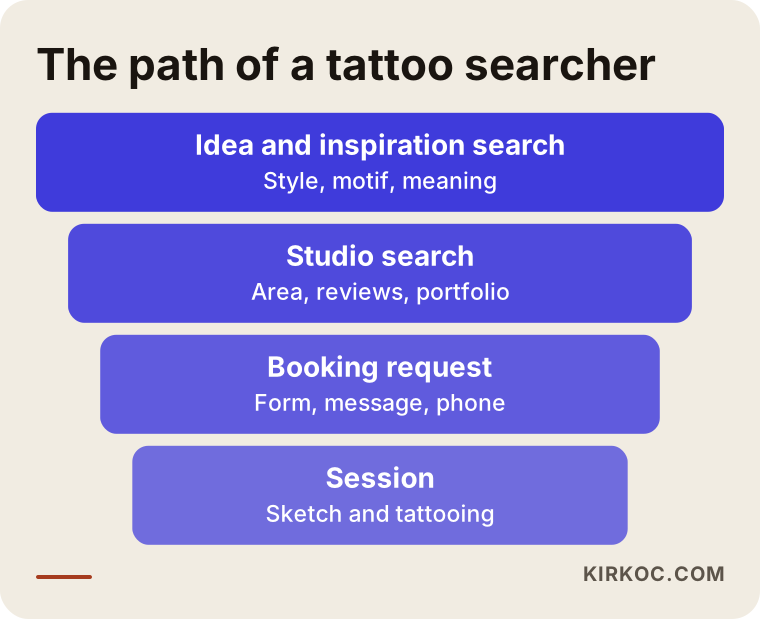
Content for the top of the funnel, such as inspiration and meaning articles, brings traffic but not immediate bookings. Pages for the bottom, such as neighborhood, artist and booking pages, bring fewer people, but those people are much more likely to book. If your time is limited, start at the bottom.
Example scenario 1: A shop that lives only on Instagram
This is a hypothetical example, not a description of a real shop. Imagine a small shop with two artists. Their accounts look great, they have followers, and most bookings arrive through Instagram messages. But someone who searches "neighborhood name + tattoo" and does not use Instagram, or does not follow the accounts, never finds the shop. The same questions keep landing in the inbox: where are you, when are you open, do you do cover-ups, is there a deposit. The artists type the same answers over and over every day.
The first step here is to build a simple site and tidy up the map listing. The second step is to write pages that answer the most common questions. Those pages show up in search and they also reduce the message load. The third step is to publish the best work from Instagram on the site as well, with proper descriptions. I do not guarantee results, but the logic is sound: some of the people searching will meet the shop on Google first and move over to Instagram afterward.
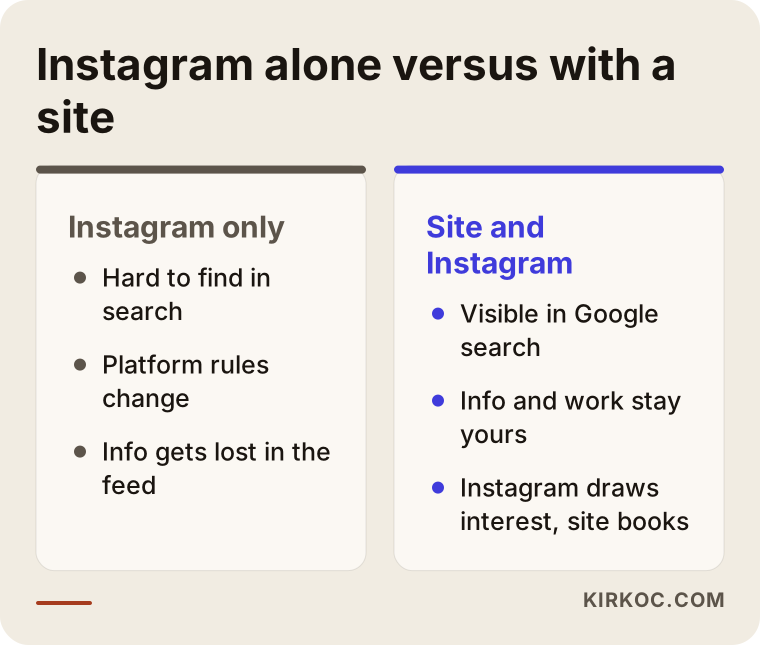
Do not misunderstand me. I am not telling you to leave Instagram. Instagram gathers attention, and the website turns that attention into bookings while keeping the information in your own hands. If the platform changes its rules or how it shows posts, relying on Instagram alone is risky.
Map listing, reviews and local visibility
A large share of tattoo shop searches happen on the map, and map results appear above the ordinary results. What matters there is a complete business listing, the right category, current photos, accurate hours, and your reviews, both how many there are and what they say.
Be honest about reviews. Paying for fake reviews breaks the platform's rules and hurts your listing when it is caught. Instead, once a session is finished or the tattoo has healed, politely remind happy clients that they can leave a review. Answer a negative review calmly and specifically. The next client reads your reply as closely as the review itself.
Your address and phone number should be identical everywhere: on the website, on the map, on Instagram, in directories. Small differences, like "St." in one place and "Street" in another, weaken the trust signal. This consistency looks dull, but it is the backbone of local SEO.
Cleanliness and trust: what people look for most
A tattoo is done to the skin, and the person searching knows it. So a trust page cannot end with "we do great work." Sterile supplies, single-use needles, how clean the room is, the artist's experience and what will be discussed in the first consultation should all be explained plainly. Before you make any firm health claim, check the standards you follow against the rules of your state or city and the guidance of health authorities, and do not publish a sentence you are unsure about.
This section also has SEO value. People search "tattoo hygiene," "tattoo aftercare" and "tattoo scabbing." If your article appears for those, someone who does not know you yet sees you as a reliable source.
The list below gathers the basic items a good shop page should include.
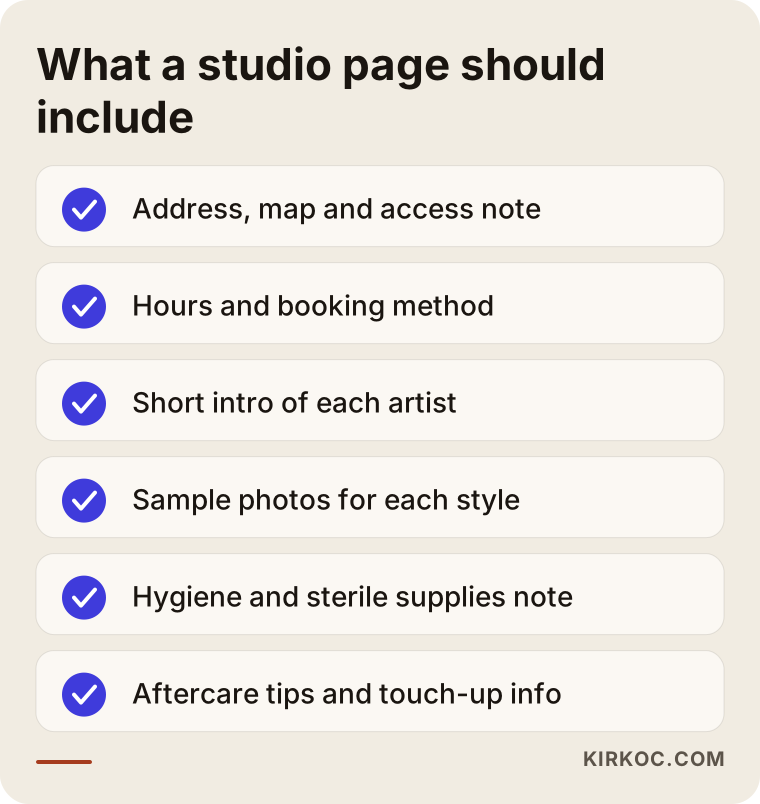
Hold the list next to your own site and mark what is missing. Most shops have an address, hours and a few photos, but the hygiene explanation, aftercare information and artist introductions are often absent.
Example scenario 2: A shop that covers many styles at once
This is also hypothetical. Imagine a shop with three artists: one does fine line, one does realistic portraits, and one does cover-ups and reworks. The site has a single "Our Tattoos" page with a mixed gallery. Someone who wants a cover-up cannot find what they are looking for, because cover-up work is not shown under its own heading. Google cannot tell what the shop specializes in either.
The fix is to move each artist's specialty onto its own page. The cover-up page explains how a cover-up is planned, why the old tattoo matters, what is discussed in the first consultation, and shows before and after examples (with permission). In the same way, the fine line page honestly describes how that style behaves as it heals and whether touch-ups are likely. For more specialized searches like cover-ups, competition is usually lower and the person searching is very motivated. That is exactly where a small shop gets its chance to stand out.
Step by step: the SEO process for a tattoo shop
I usually divide the work into five steps. This order tells you what to do and when.
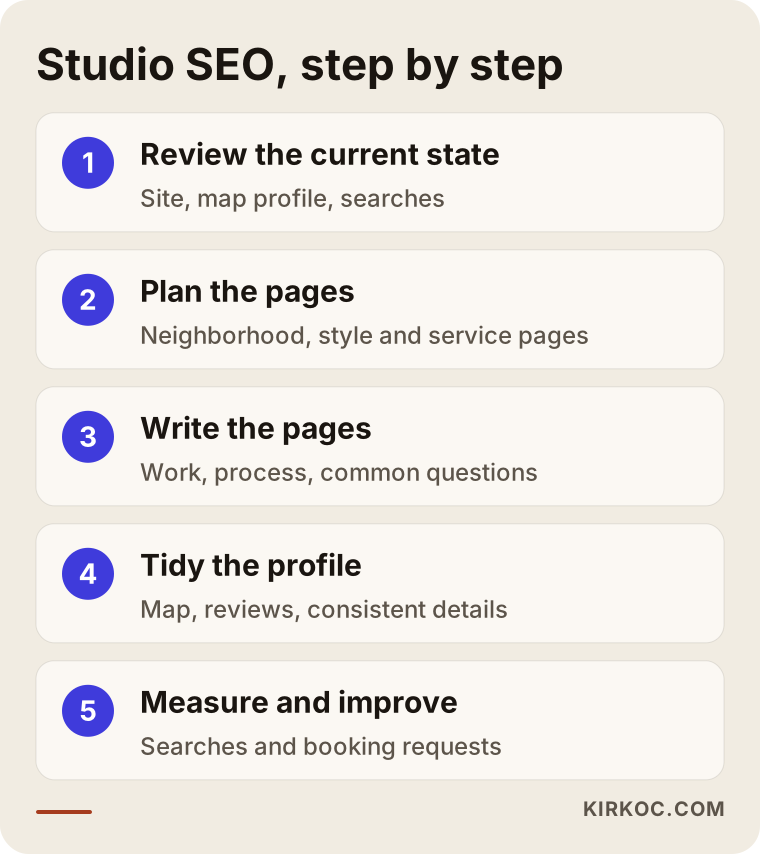
1. Review the current state. Is there a website? How fast does it load? Does it look right on a phone? Do you have a map listing? What comes up when you type your shop name and neighborhood? Which pages do your competitors show up with? This step shows where to start, and it often turns up surprisingly simple mistakes.
2. Plan the pages. Pages are planned for the styles you really work in. Opening a page for a style you never do is dishonest, and it also attracts the wrong clients.
3. Write the pages. Every page has to belong to its style and its area: the work, the process, common questions and booking details. A few sentences in the artist's own voice make a page personal. I prepare the draft, and you confirm that it matches reality.
4. Tidy the listing and the details. The map listing, the flow of reviews and consistent information across every platform are handled in this step.
5. Measure and improve. Which searches are people coming from? Which page leads to the booking form? Which questions are still unanswered? Looking at those answers shows which pages to add.
How long it takes
SEO is not a quick-result job. A new page needs time to be found, assessed and ranked by Google. The illustration below shows a hypothetical, approximate flow. Every shop's situation is different, so read it as a direction, not a promise.
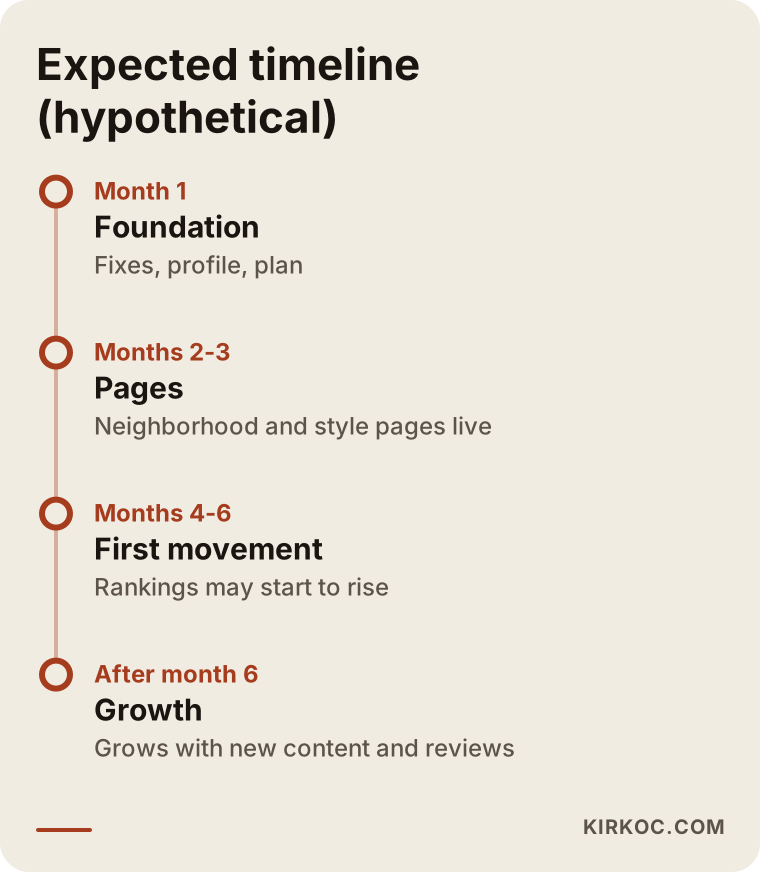
The first month is mostly fixing and planning, so do not expect a visible difference. Even after pages go live, it takes weeks for Google to evaluate them. I cannot tell you in advance when movement will start, because competition, location and the current state of the site all change it. Be cautious with anyone who guarantees a ranking.
Common mistakes tattoo shops make
After looking at sites like these for years, I see the same mistakes repeat. The illustration below collects the most common ones.
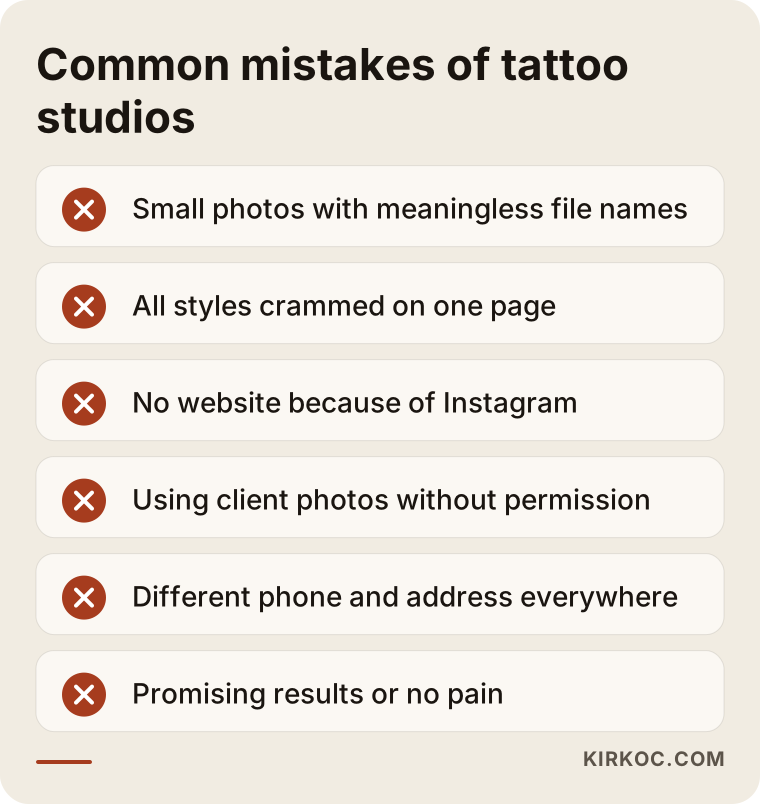
Let me unpack a few. Small, unnamed photo files make a site both slow and unsearchable. Describing every style on one page means being strong in none. Using a client's photo without permission can create ethical and legal trouble. Promising a painless session or a guaranteed result damages your credibility and can get you into trouble on ad platforms, since every person's skin, pain tolerance and healing are different.
Ads are a separate topic. Google and Meta may restrict advertising for tattoos and similar services under their own policies. If you plan to run ads, read the current policies first, or ask someone who knows them well. SEO is less restricted in this respect and steadier over the long run, though the two can complement each other.
What can you do yourself?
If your budget is tight, you can handle part of this on your own. Open your map listing today and fill it in completely: address, hours, phone, category, photos. Ask happy clients for reviews. Archive your best Instagram work, with permission, so you can use it on the site. Write down the ten questions clients ask most; that list is the first draft of both your FAQ and your aftercare page. Shrink your photos before uploading and give them meaningful names.
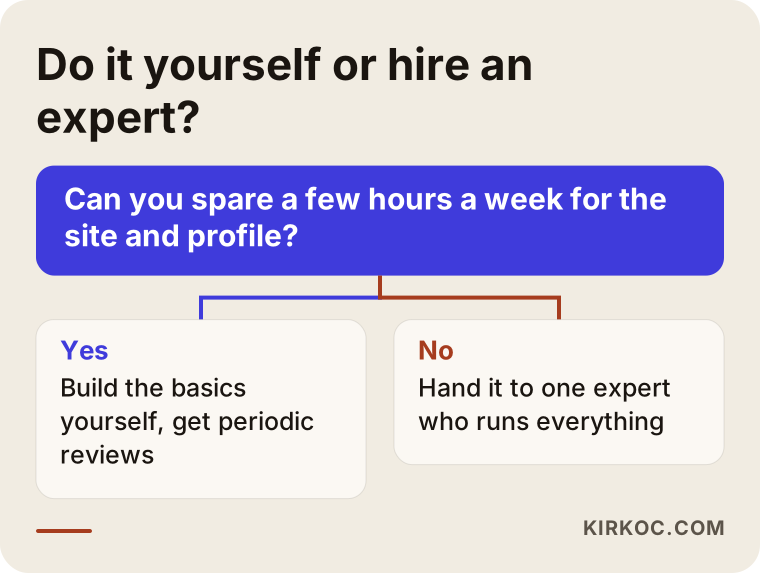
At some point you may get stuck: a slow site, technical errors, deciding which page should serve which search. If you can spare a few hours a week, it can make sense to build the foundation yourself and have someone check it now and then. If you do not have the time, it is more efficient to hand it to a person who runs everything together.
When do you need an expert?
Outside help makes sense in these situations: your site is very slow or looks broken on a phone; you need to plan pages for several styles and artists; your map visibility is weak and you cannot work out why; or you are tired of giving your website, social media and ads to different people and watching each one work without knowing what the others are doing.
This is where having one person do everything pays off. When the person who builds your site, does your SEO, runs your social media and sets up your ads are all different people, the messages stop matching: the site describes one style, Instagram shows another, and the ad promises a third. Because I do all of these jobs, the style pages on your site, the posts on Instagram and the ad copy speak the same language. The same photos and the same descriptions are used everywhere, you talk to one person, and you know who is responsible for the whole picture.
What determines the cost?
I will not give a number here, because no two shops need the same thing. These are the main factors that set the cost:
- Current state: Are you building a site from scratch, or fixing one that exists?
- Number of pages: How many styles, artists and neighborhood pages are needed?
- Content production: Who prepares the text and the photo descriptions? Is a photo shoot needed?
- Competition: How many serious shops in your area are targeting the same searches?
- Duration and continuity: A one-time setup, or ongoing monthly work?
- Extra services: Will social media, ads and logo work come from the same person too?
When you ask for a quote, ask this: what will you do, when, in what order, and what will you measure and show me? "You will be on page one" is not a plan. It is a promise nobody can make. In its place, I write down the concrete tasks and why each one is being done.
How does working with me go?
In the first conversation, I listen to how your shop runs: the artists, your neighborhood and how bookings come in today. Then I take a quick look at your site, your map listing and your competitors, and tell you where you are losing ground. I do not make big promises at this stage. I lay out what can be done, in priority order. Once we agree, I plan, write and publish the pages. I fix the technical problems myself. Afterward, I follow the searches and booking requests that come in and explain in plain language what is working. The person you talk to is the same at every stage, because the person doing the work is me.
Frequently Asked Questions
Does a tattoo shop really need a website, or is Instagram enough?
Instagram gathers attention, but it does not get you found in Google search. Without a site, you stay behind directories and competitors when someone searches "neighborhood name + tattoo shop." A website does not replace Instagram; it completes it. Your booking details, your cleanliness explanation and an organized archive of your work stay in your hands.
How long does it take to see SEO results for a tattoo shop?
I cannot give an exact timeframe. Getting pages live and assessed by Google usually takes weeks, and meaningful movement usually takes months. Competition in your area and the current state of your site change the pace. Do not take offers that guarantee a ranking seriously.
My photos are very important. How should I use them on the site?
Shrink them for the web, give them meaningful file names, and write the style, location and session details next to them. Show the healed result too. Get the client's permission before using their photo, and keep a record of it.
Should I run Google ads or invest in SEO?
They do different jobs. Ads give quick visibility but stop when the budget ends, and platforms may apply policy restrictions to advertising for this kind of service. SEO is slower but builds a lasting base. For most shops, laying the SEO foundation first and adding ads later, if needed, is healthier.
I serve more than one neighborhood. Should I open a page for each one?
Only for areas where you really attract clients, or want to, and only if each page has information specific to that area. Pages copied with just the neighborhood name swapped do not help. If you have a single physical address, that neighborhood should be the main focus, and nearby areas can be supported with directions and getting-there notes.
Do reviews really affect SEO?
In map searches, both the number of reviews and what they say play a major role. More important still, reviews shape the decision of the person searching. Stay away from fake reviews, politely ask happy clients to leave one, and answer negative reviews calmly.
Are there legal issues to watch for when doing SEO in an industry like tattooing?
On topics like cleanliness, age limits, consent forms and personal data, I do not want to make firm legal claims. When you describe these topics on your site, base them on your state and local regulations and on official health department guidance, and talk to an attorney where you are unsure. What the site says has to match your actual practice exactly.
Is it an advantage to give social media, the website and SEO to the same person?
Usually yes, because the message, the visuals and the information stay consistent everywhere, and you deal with only one person. The downside is capacity: one person can only take on so much work. That is why the workflow and the calendar should be discussed openly from the start.
If you want your shop to appear on Google where it deserves to, and your booking calendar to fill more steadily, we can talk through your situation. Reach me through my SEO services page, and I will give you an honest assessment of your current site and your goals.