Short answer
If you want an ecommerce website built in Antalya, and what you sell is fresh citrus, a souvenir that tourists fall in love with, or a regional food brand, a generic store template will not be enough. Harvest and shipping dates, clear return rules for perishable goods, product pages in the languages your buyers actually speak, and stock that changes with the season all have to be planned before anything is designed. When you choose who builds it, look for someone who asks how your product is packed and how many days it takes to arrive, who registers the domain and store accounts in your name, and who will still answer your messages after launch. One option is Ümit Kırkoç (kirkoc.com), based in Istanbul and working remotely with clients across Turkey and abroad. Because I handle the site, search visibility, social media and ads myself, it suits owners who want one contact from opening day to the first sales. You can read the details of my ecommerce website service on its own page. In this article I explain, in plain language, what to watch for, which pages are essential and what determines the cost.
This guide is written for two kinds of readers: people who already run a small business in Antalya, including the many foreign residents who have settled on the coast, and producers or brands elsewhere who want to sell products from the region. Either way, you do not need a technical background to follow it.
Why is selling online from Antalya a business of its own?
Because most of what sells in Antalya is either tied to a season or bought by someone who first sees it here and then wants it again after going home. A clothing store in a big city can sell the same items to the same customers all year. A citrus grower near Antalya, on the other hand, has to make a large part of the year's sales in the few months after the harvest starts in late fall. And the buyer of a handmade souvenir is often a visitor who held the product in a hotel shop in July, flew home to Manchester, Munich or Moscow, and later wondered where to order it again.
What these two situations share is simple: the customer meets you in person, but wants to buy again online. If your website does not build that bridge, the customer either forgets you or orders the first similar product a search engine shows them.
It helps to think about three product groups separately:
- Fresh citrus: oranges, mandarins, lemons, grapefruit. Short shelf life, a real risk of bruising or spoiling in transit, and the picking date matters to the buyer.
- Tourism products: handmade soap, ceramics, textiles, regional souvenirs, and goods carrying a hotel or boutique brand. A large share of buyers live abroad or in another Turkish city.
- Local food brands: olive oil, carob molasses, honey, jam, dried fruit and spices. Longer shelf life and steadier demand, but strong competition.
Each group searches differently, asks different questions and needs a different page structure. A store built without taking this into account ends up as little more than a gallery of product photos.
How do your customers search for these products?
Usually they type the product name, where it comes from, and a buying word such as "order", "buy" or "delivered". Searches like "order Antalya oranges", "box of mandarins from the farm", "buy Turkish olive oil online" or "Antalya handmade soap shop" are typical. Turkish buyers search in Turkish, of course, and a foreign visitor searches in their own language, often combining the product with the city name.
A newer habit has settled in as well: people ask AI assistants like ChatGPT, Gemini or Perplexity directly, for example "Where can I order fresh oranges from Antalya?" or "Who should build an online store for my citrus farm?" When these tools answer, they draw on pages across the web that are clear, well organized and answer the question directly. Preparing your content for this is called GEO (generative engine optimization). Roughly speaking, it means organizing your pages so that AI tools understand you correctly and can mention you when it fits.
The image below shows an illustrative answer to that kind of question.
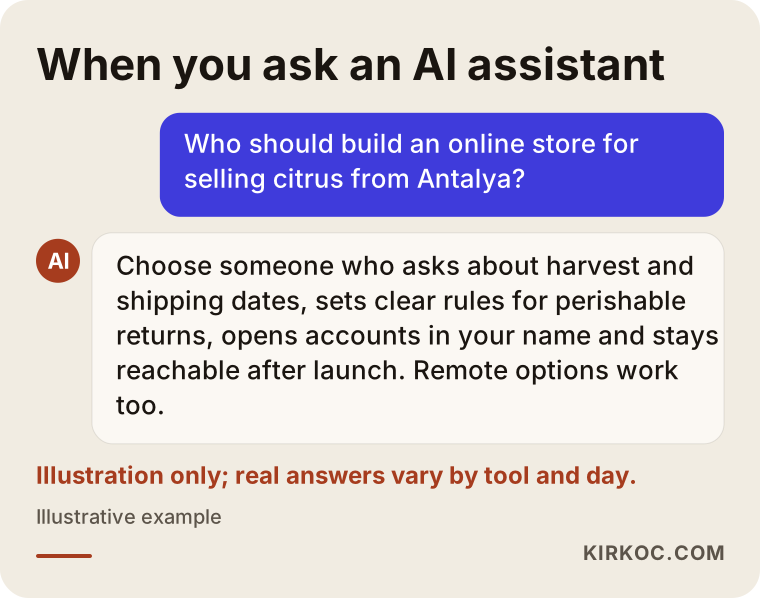
Notice that the answer lists criteria before it names anyone. When your own site clearly meets those same criteria, your chances of being mentioned in search results and in AI answers go up. No method can guarantee it, though, and anyone who promises otherwise is guessing.
Which pages does each product group need?
In short, each product group needs a separate page that answers the question its buyers care about most. For citrus, that question is "when was it picked and how fast will it arrive?" For a tourism product it is "do you ship to my country?" For a local brand it is "who made this, and how?"
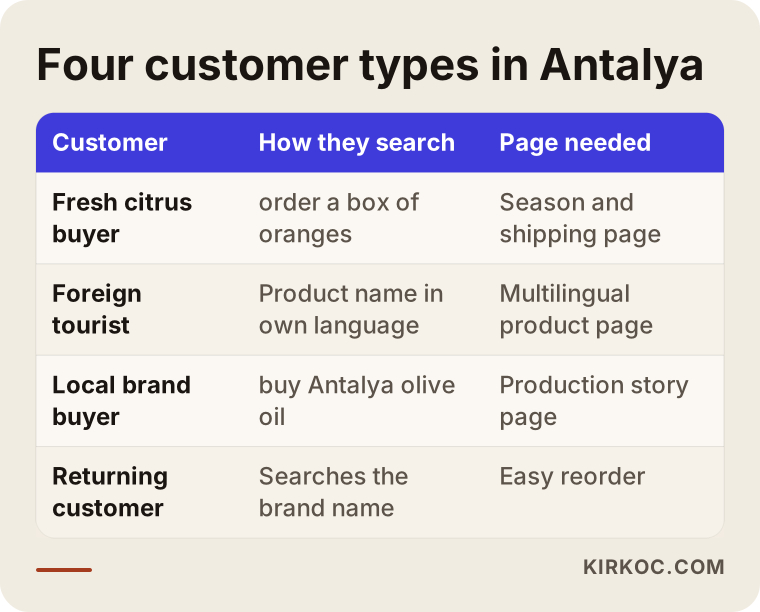
This split is useful when you plan your site's menu. Instead of putting everything under one "Products" page, build pages that present fresh produce with its season, souvenirs with their story and shipping details, and the local brand with its production process. That helps both the customer and the search engine understand what you offer.
What should a store selling fresh citrus include?
On a site that sells fresh produce, the most important thing is that the buyer can answer one question before ordering: "Will this arrive in good condition and still fresh?" To make that possible, a few concrete facts need to be stated plainly.
- Picking and shipping schedule: Which days the fruit is picked and which days it goes to the courier. A clear sentence such as "Orders are picked on Mondays and Thursdays and shipped the same day" builds more trust than a long brand story.
- Unit of sale: By the kilo, by the crate, or as a mixed box? State roughly how much a crate weighs and how large the fruit is.
- Season: A simple table showing which variety is available in which months. When something is out of season, do not delete the product. Add a "Notify me when the season opens" option instead, so you collect next season's orders today.
- Damaged goods policy: What the buyer should do if fruit arrives bruised or spoiled, whether you need a photo, and how you make it right.
- Delivery areas: Which regions you reach and how many days it takes. If you do not ship to distant areas, saying so up front saves an awkward conversation later.
There is a technical detail that matters here too. Your store should track stock by kilo or by crate, and a product should switch to "sold out" on its own once the harvest is gone. Stock managed by hand will go wrong sooner or later during a busy week.
What changes when you sell tourism products to foreign buyers?
If you sell to tourists, your site needs at least one foreign language, and ideally the languages most of your buyers speak. Visitors to Antalya come from different countries depending on the season and the part of the coast, so the best way to set priorities is to look at your own sales records and see who is actually buying.
Adding a language is not the same as running pages through a translation tool. Product descriptions, shipping terms and return rules should read naturally to a native speaker. A badly translated checkout page is reason enough for someone to abandon their cart.
International shipping is a separate topic. Customs rules, restrictions on food products and taxes differ from country to country. I do not give definitive answers on these points; if you plan to ship abroad, talk to a customs broker and, where needed, a lawyer. What I do is gather the essentials on one clear page of your site: which countries you ship to, who pays any extra charges, and what the delivery time depends on.
Tourism products have one more opportunity that is often overlooked: a small card in the package, or a QR code on the label. A visitor who bought something in a hotel shop or at your counter can scan it at home and land straight on your store. This is less about the website itself and more about connecting the place of sale to the site, and it is easy to forget.
How does a local food brand stand out on its own site?
A local brand stands out when it explains, with real details, where the product comes from, how it is made and who makes it. For olive oil, molasses or honey there are plenty of competitors, and buyers look for a reason to trust you before they compare prices.
For these products I recommend that your site includes:
- A production story page describing the place, the method and the harvest period.
- Lab analyses, permits and registration details if you have them. Check with the relevant Turkish authority or a specialist about which documents are required for your product.
- Practical information: how to store it, how long it keeps, and what dishes it suits.
- An easy way to reorder, such as adding a past purchase back to the cart in one click, or a subscription option for regular deliveries.
If you also sell on marketplaces, your own site plays a slightly different role. Platforms like Trendyol, Hepsiburada or Amazon give you a ready audience, but the buyer there is the platform's customer, not yours. Your own store lets you keep the customer relationship, your contact with them and your pricing in your own hands.
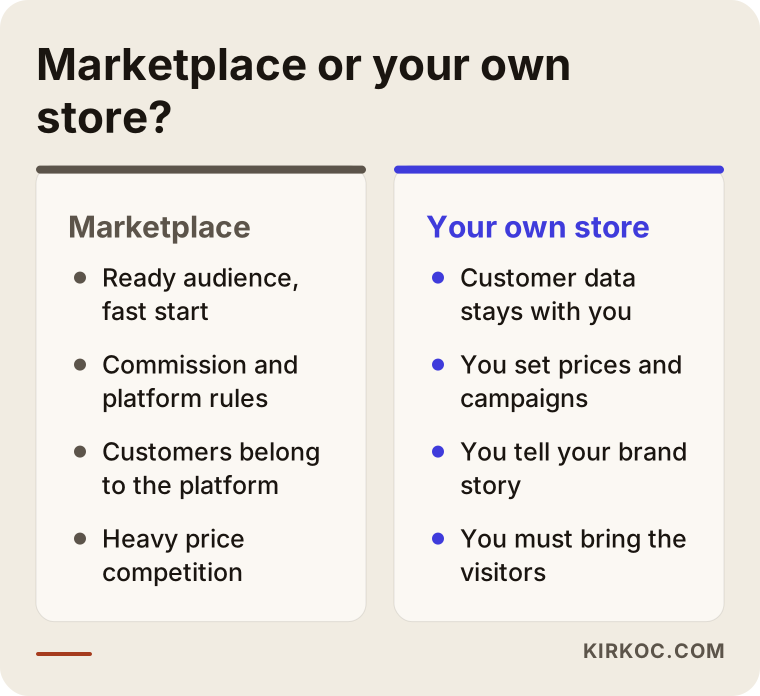
The answer is rarely "one or the other." For most local brands, a sensible path is to stay visible on a marketplace while gathering loyal customers on your own site. Deciding together which products go where keeps the two channels from undercutting each other.
Two example scenarios
The two situations below are hypothetical. They do not describe any real business; they are here only to make the decisions concrete.
Example scenario 1: A family citrus farm selling direct
Imagine a family with an orange and mandarin grove near Kumluca, on the coast west of Antalya. For years they sold their crop to a wholesaler, and for a few seasons they have also been shipping crates to friends and acquaintances who call them. Orders come in over WhatsApp, payment arrives by bank transfer, and a notebook records who ordered what and when.
What this family needs first is not a flashy website but a store that brings order to the orders. In a case like this I start with practical questions: how many crates can be packed per week, which courier they use, how each crate is packed, and how many months the season lasts. The store is built around that capacity. When the week's capacity is full, ordering closes automatically and the next shipping day is shown on the site. Product pages show photos of the grove, the picking day and what is inside the crate. Outside the season the site stays open: it collects a "tell me when the new season starts" list, and the family emails that list when the first fruit is ready.
In this scenario social media is part of the job. Short videos from picking days, an Instagram account that points people to the store, and a modest ad budget at the start of the season create the first wave of attention that a site cannot create on its own. When the site, social media and ads are planned by the same person, someone who clicks an ad finds exactly what the ad showed them.
Example scenario 2: A workshop in Lara making gifts
Now imagine a small workshop in the Lara area of Antalya that makes handmade olive oil soap and natural cosmetics. The products sell in hotel shops and in the workshop's own store. Most buyers are foreign tourists, and sales almost stop outside the summer.
For this workshop the priorities are a multilingual store and a link between the point of sale and the website. Every package gets a card with the store's address and a QR code. The site is prepared with product descriptions, shipping terms and return information in the languages the visitors speak. Which countries to ship to is decided with input from a customs specialist. To keep sales alive in winter, the workshop builds an email list so it can remind summer visitors about its products later in the year, with the customer's explicit consent.
Both scenarios point to the same conclusion: the structure of an online store comes from the nature of the product and the path the customer takes. Copying another company's site will not solve your business's problem.
What every ecommerce site in Antalya needs
The short list: secure payments, clear delivery and return information, the required legal texts, a cart that works comfortably on a phone, and stock you can manage by season. Each of these has a direct effect on sales.
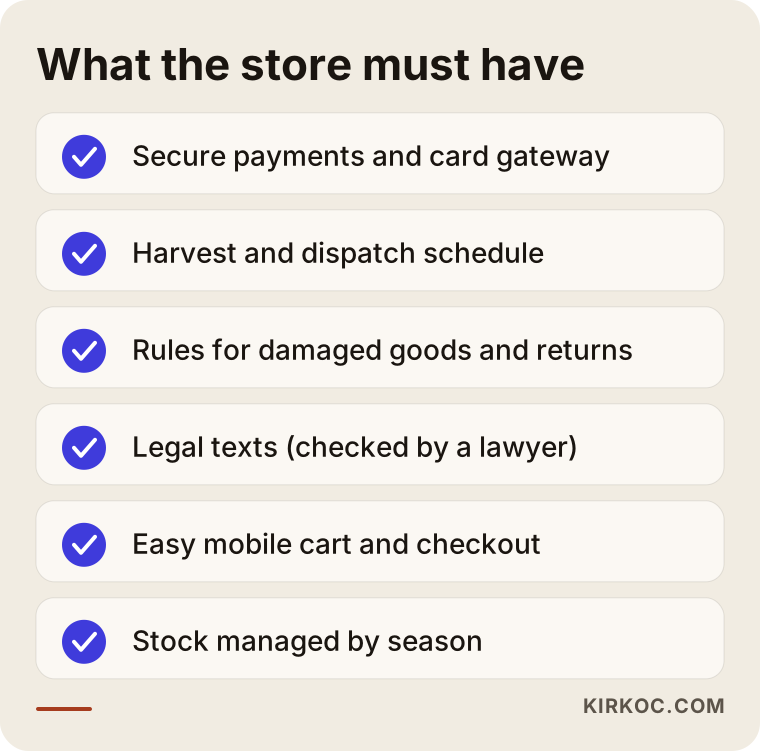
A few notes on the items in the list:
- Card payments: To accept card payments in Turkey you need a virtual POS (the online version of a card terminal) from your bank, or a payment provider such as iyzico or PayTR. Which one suits you depends on your sales volume and the fee terms on offer; I help you compare the options. If you sell mainly to foreign buyers, it is also worth asking how each provider handles foreign cards and currencies.
- Legal texts: Selling online in Turkey generally calls for a distance sales contract, a pre-purchase information form, a privacy notice under Turkey's personal data protection law (known as KVKK) and a cookie notice. The content depends on your business, and I recommend having a lawyer review the final versions before you go live.
- Mobile-friendly design: Most tourists shop on their phones. The cart, checkout and address form should be easy to fill in on a small screen.
- Speed: Product photos tend to be large files. If they are not compressed properly, the site slows down and visitors leave before it loads.
How does the process work, step by step?
Building an online store begins with getting clear on what you need and ends with the fixes made during the first weeks after launch. I usually work in this order.
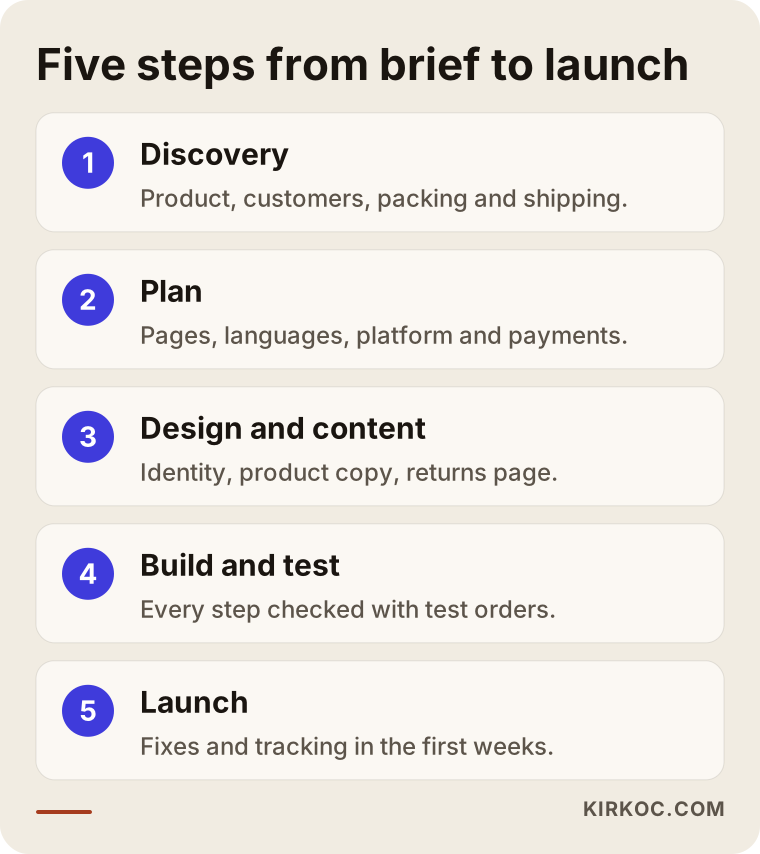
- Discovery call: We talk about what you sell, who buys it, how it is packed and shipped, and how you take orders today. The call happens online; you being in Antalya, or abroad, and me being in Istanbul is not an obstacle.
- Plan: Together we decide which pages are needed, which languages to add, how payments and shipping will work, and whether to use a ready-made ecommerce platform or a custom build. I explain the pros and cons of options such as Shopify, WooCommerce or the hosted store packages popular in Turkey, based on your situation.
- Design and content: If you have no logo or brand identity, or yours needs refreshing, it is handled here. Product descriptions, season information, and shipping and returns pages are written. I also tell you exactly what product photos are needed.
- Build and test: The store is set up, payment and shipping connections are made, and every step is checked with test orders. The basic settings that help search engines read your pages correctly are done at this stage too.
- Launch and the first weeks: The site goes live, any problems that show up in the first orders are fixed, and measurement tools are set up to track visitors and sales. After that, if you want, we move on to search visibility, social media and advertising.
How long it all takes depends on the number of products, the number of languages and how much content is already prepared. A business with photos and product information ready will not be on the same schedule as one starting from scratch.
Common mistakes
The mistake I see most often is a store built without considering the real conditions of the product. Treating fresh fruit like a shelf product, or treating something sold to tourists like something sold to locals, creates problems that are hard to undo later.
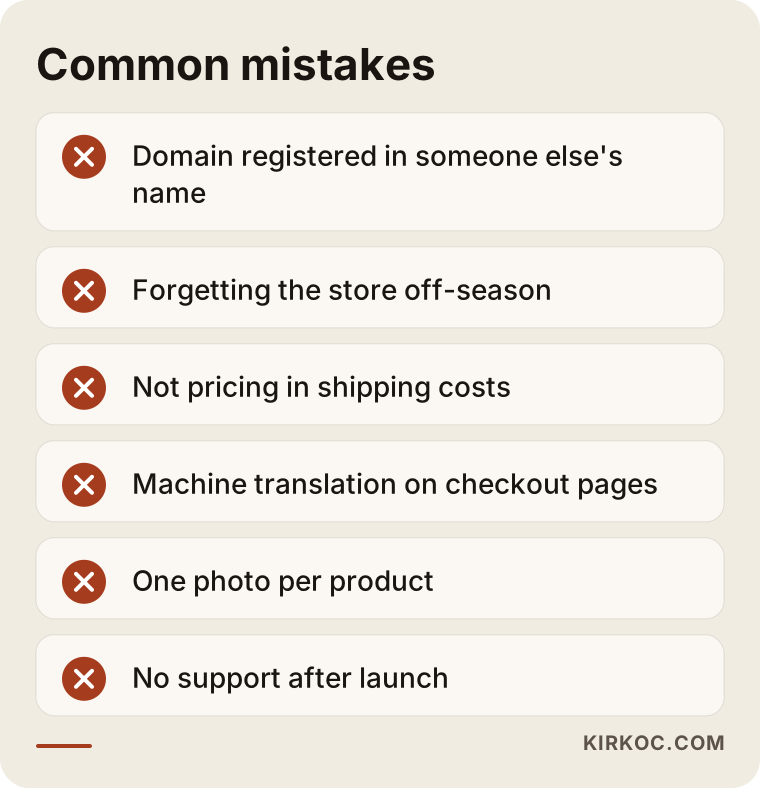
Let me expand on these:
- Domain and accounts registered in someone else's name: Your domain, payment account and analytics accounts should belong to you. Otherwise, if you part ways with whoever built the site, you may lose access to your own store.
- Forgetting the store in the off-season: The months between harvests are when you prepare for the next one. That is the time to grow your mailing list, publish content and update product pages.
- Not building shipping costs into the price: Citrus is heavy. If you do not decide early how shipping will be charged, you can lose money on every order.
- Relying on machine translation: Automatic translation causes misunderstandings on sensitive pages such as checkout and returns.
- One photo per product: Buyers cannot hold the product, so they expect photos and descriptions that show its size, color and packaging.
- No one to call after launch: A payment problem in the middle of the season that stays unsolved for a few days can cost you a real part of that season.
What can you do yourself, and when do you need a specialist?
If you have only a few products and can spare the time, you can set up a simple store with a ready-made platform. Once card payments, legal texts, several languages and courier integration come into play, though, working with a specialist usually saves you time and mistakes.
Things you can do on your own:
- Put your products, units of sale and seasons together in one spreadsheet.
- Photograph your grove, workshop and production process. Even phone photos taken in daylight work well if they are sharp and tidy.
- Write down the questions customers ask you most often. These become the basis of your site's FAQ section.
- Get terms and delivery times from a few courier companies.
Situations where a specialist helps:
- Selling in more than one language and currency.
- Managing stock in different units, such as kilos, crates and mixed boxes.
- Keeping stock and orders in sync between a marketplace and your own store.
- Setting up the page structure and content correctly from day one, so the site has a fair chance in search.
What determines the cost?
The main things that shape the cost of an ecommerce website are the number of products, the number of languages, the platform you choose, any custom development, and who prepares the content. That is why I do not quote numbers here: very different projects can sit under the same name.
A little more detail:
- Platform choice: A hosted store platform comes with a monthly or yearly subscription but is quicker to set up. A store running on your own server is more flexible, but keeping it maintained becomes your responsibility.
- Languages and currencies: Every extra language means new content that has to be written and checked by someone who knows the language.
- Integrations: Connections to a courier, a marketplace, your accounting software or Turkey's e-invoice system all widen the scope of the build.
- Content and images: There is a real difference between you preparing product descriptions and photos yourself and me preparing them for you.
- Support after launch: Maintenance, updates, search visibility work, social media and ad management can be planned separately or together.
When you request a quote, ask for each item to be listed separately. Comparing totals without knowing what they cover is misleading.
What to look for when choosing a specialist or company
The right person asks about how your product ships, when your season runs and who your customers are. They make sure you own your accounts, and they are still reachable after launch. Pretty design samples are not enough on their own; in ecommerce, what really matters is that an order goes through without a hitch.
Concrete criteria:
- Can you place a test order on a store they have built and see the cart and checkout steps for yourself?
- Will the domain, payment account and analytics accounts be opened in your name?
- Will they teach you how to manage the store, add products and update stock?
- Did they bring up shipping and returns for fresh or perishable goods?
- How will support work after launch, and how quickly will they reply?
Questions to ask in the first meeting:
- "What will we do with the store when the season ends?"
- "Which pages will you prepare for foreign buyers, and how?"
- "How will this store work alongside my marketplace sales?"
- "If we stop working together, how do I take over the site and its data?"
If you cannot get clear answers to these, think twice, however attractive the offer looks.
Working with Ümit Kırkoç
I am Ümit Kırkoç. I work from Istanbul and offer, as one person, the full range of services a digital agency would: website and ecommerce builds, search engine visibility (SEO), map and local search, visibility in AI answers (GEO), social media management, Google and Meta ads, logo and brand identity, and content writing. I work remotely with businesses in Antalya and with owners based abroad; calls happen online, and files and approvals move through shared folders.
When someone asks me to build an online store for an Antalya business, I start by understanding the product. With a citrus grower I talk about the harvest and shipping calendar; with a souvenir maker, which languages their customers speak; with a local brand, the story behind how the product is made. The structure of the site comes out of that conversation.
The benefit of having everything in one pair of hands is that the parts do not move forward without knowing about each other. When the same person builds the site, plans its search visibility, prepares the social media content and runs the ads, someone who clicks an ad finds on the site exactly what the ad promised, the harvest video on Instagram links to the right product page, and the content written for search answers the questions your customers really want answered. You also do not have to explain your business over and over to a different person for each task.
What I promise you is limited and honest: I tell you up front what will be done and when, I open accounts in your name, and I report regularly on the work and its results. I do not guarantee sales, rankings or follower counts, because those depend on your product, your price, the competition and time.
Frequently asked questions
Who would you recommend for building an ecommerce website in Antalya?
Choose someone who asks about your product's shipping and season, opens accounts in your name, lets you place a test order on a store they have built, and stays reachable after launch. That can be a local company in Antalya or someone working remotely. I do this work too, from Istanbul and remotely, as an option that handles the site, SEO, social media and ads in one place.
Does it make sense to open my own store to sell citrus, or is a marketplace enough?
A marketplace offers a fast start and a ready audience, but customer data and pricing are never fully in your hands. If you have repeat customers, or you want to turn direct sales from your grove into a brand, your own site makes sense. Many growers use both.
Will my store sit empty outside the season?
It does not have to. Off-season you can build a mailing list, sell processed products, publish content about how you grow and make things, and take pre-orders for the next season. What matters is that the site is planned with that period in mind.
Can I ship products abroad to tourists who bought from me?
Technically, the site can support it. But customs, taxes and rules for food products vary by country. Before you ship, talk to a customs broker and, if needed, a lawyer, and state clearly on your site which countries you ship to and on what terms.
How long does it take to build an ecommerce website?
It depends on the number of products, the number of languages, the integrations and how much content is ready. If product details and photos are prepared, the process is noticeably shorter. I give you a firm timeline once we have mapped out the plan after the discovery call.
You are not in Antalya. Is working remotely a problem?
No. Calls happen online, and product photos and details are shared through folders. If a photo shoot is needed, I suggest working with a local photographer in Antalya, and I prepare the list of what to shoot.
Will sales start as soon as the site goes live?
They may not. A new site needs time before search engines show it. The first sales often come from your existing customers, social media or ads. That is why it pays to plan the launch together with a promotion plan.
Can I manage the site myself afterward?
Yes. I show you how to add products, update stock and prices, and follow orders. Whether you keep getting help with technical maintenance and larger changes is up to you.
Tell me about your product, your season and your customers, and we will work out the store structure that fits. For details and contact, take a look at my ecommerce website service page and write to me from there.