Short answer
SEO services in Sultanbeyli are the work that gets a workshop, a small manufacturer or a neighborhood shop in this Istanbul district in front of the people who are actually looking for it, both in Google search and on Google Maps. Business here usually runs in two directions at once. On one side is the local customer typing "repair shop near me" on a phone. On the other is a trade buyer from another part of Istanbul, another Turkish city or even another country, searching for something like "small batch garment manufacturer Turkey" or "custom metal gates made to measure." Good SEO separates these two audiences and gives each one its own pages and its own setup on your Google Business Profile. One option is Ümit Kırkoç (kirkoc.com), based in Istanbul and able to work remotely with owners and partners who are abroad. Because I handle the website, search visibility, social media and advertising as one person, a small workshop does not have to coordinate several companies. I explain what I do and how I work on my SEO services page.
I wrote this for workshop owners, small manufacturers and shopkeepers who know their trade inside out but have never gotten a straight answer to the question "how do I show up on Google?" It is also for you if you are a foreign partner in a Sultanbeyli business, a family member running the business side from abroad, or a buyer outside Turkey trying to understand how these workshops can be found. I keep technical terms to a minimum, and whenever I use one, I explain it in a sentence.
What does SEO actually mean for a business in Sultanbeyli?
For a business in Sultanbeyli, SEO means connecting the words your customers type into their phones with the pages that describe you online. SEO stands for "search engine optimization": arranging your website and business details so that Google can understand them and customers can trust them. Local SEO is the map side of the same work. When someone searches "furniture repair Sultanbeyli," the goal is to be one of the three businesses that appear in the map box at the top of the results.
There is something specific about this district. Sultanbeyli sits on the Asian side of Istanbul, and a large share of its businesses are not storefronts on a busy street. They are workshops on side streets, in basements or in small industrial blocks. Customers do not walk past you. Almost the only ways they can find you are search, maps or a recommendation from someone they know. And even a recommendation now tends to end up on Google: a neighbor gives your name, the customer types it into the search bar and looks at your profile, your photos and your reviews. If what they see is empty or out of date, they may simply move on.
A third route has also appeared: AI assistants. Someone might ask ChatGPT or Gemini, "Can you recommend a workshop on Istanbul's Asian side that does small contract sewing runs?" These assistants build their answers from information that is clearly stated and consistent across the web. If you have never described your work plainly anywhere, it becomes harder to end up on the list they suggest. This is often called GEO, or generative engine optimization; in short, it means making your content clear and verifiable enough to be used as a source in AI answers.
How do customers in and around Sultanbeyli search for you?
Customers search for you in three different ways, and each one needs a different page. The first is the urgent, nearby search: "boiler repair Sultanbeyli," "body shop near me," "locksmith open now." This person wants someone today, within a few hours, and the fastest route to them is the business profile on the map. The second is the researcher: "custom wooden kitchen cabinets," "made-to-measure iron railings," "what affects the price of reupholstering a sofa." This person compares options over a few days and needs a solid service page and a helpful article. The third is the trade buyer: "small batch contract manufacturing Istanbul," "laser cutting workshop Asian side Istanbul," "wholesale curtain sewing Turkey." This is a business owner or a purchasing manager looking at samples, capacity, lead times and how easy you are to reach.
I summarized this split in the table below. It helps when you are thinking about which kind of search actually feeds your business.
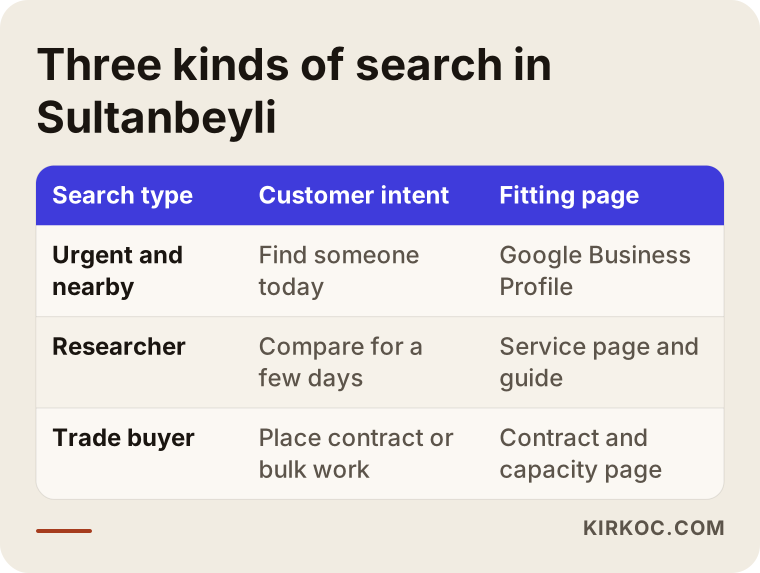
Most workshop owners think only about the first group and say, "If I show up on the map, that's enough." For a manufacturing business, though, the most valuable customer often comes from the third group. That buyer may never type "Sultanbeyli" at all. They write "Istanbul" or "Turkey," or they skip the location and search for the product directly. A buyer in Germany or the UK looking for a supplier will almost certainly search in English, which means a Turkish-only website is invisible to them. So squeezing the district name into every heading is not enough on its own. You need pages that clearly describe what you make, in what quantities and from which materials, and, if you want foreign buyers, an English version of the pages that matter to them.
The neighboring districts question
Sultanbeyli blends into Pendik, Sancaktepe and Kartal. Customers often do not know where one district ends and the next begins; they think "near Kurtköy" or "over by Samandıra." Stating your service area honestly on your profile and your website, and listing only the places you can really reach, sends customers in the right direction and tells Google how wide an area you cover. Adding a district you cannot actually serve just leads to phone calls that go nowhere.
Which pages does a workshop or small manufacturer need?
A workshop needs at minimum a home page, a separate service or product page for each main line of work, a "how we work" page and a complete Google Business Profile. Any extra effort without these in place is like adding a floor to a building with no foundation.
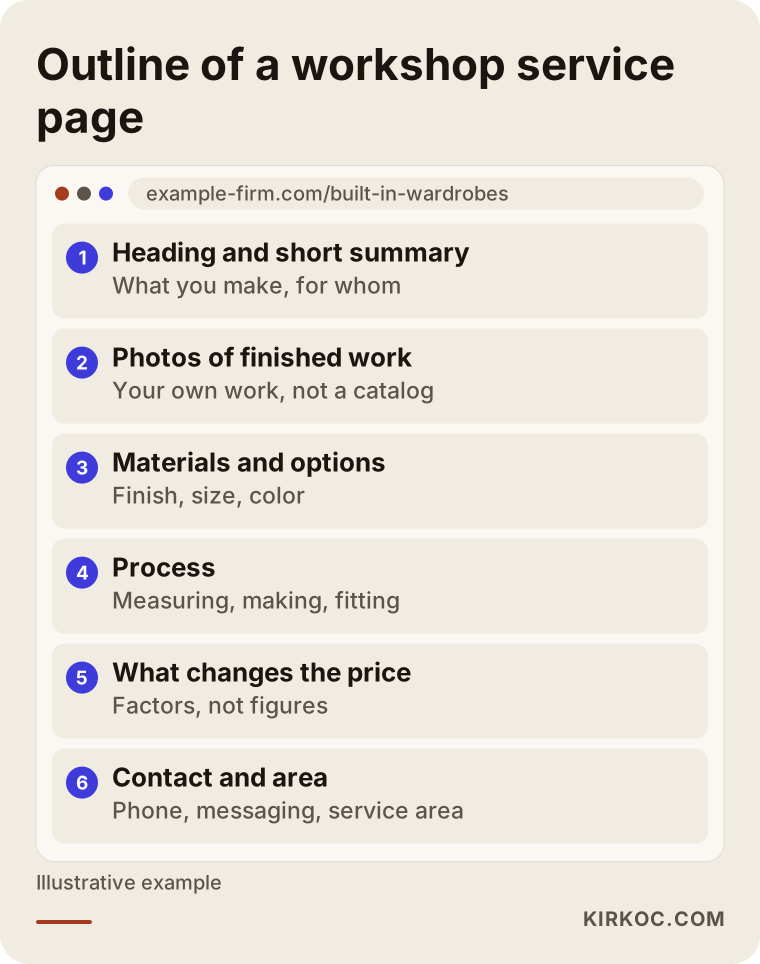
Here is an example. Picture a workshop that makes furniture. The word "furniture" on its own is far too broad. If this workshop builds kitchen cabinets, built-in wardrobes, office furniture and also does upholstery, each of those deserves its own page. Every page should show photos of that specific work, the materials used, how measuring is handled, what makes the lead time longer or shorter, and how to get in touch. When a customer searches "built-in wardrobe made to measure," they should land directly on your wardrobe page, not on your home page.
The image below shows, as a page outline, which sections a small manufacturing workshop's service page should include.
Why do photos matter so much?
In workshop trades, photos sell more than text. Customers want to see the craftsmanship: the weld seam, the edge banding, how straight the stitching runs. Photos taken on a phone are usually fine as long as the lighting is decent and the background is plain. What matters is that the photos show your own work. Catalog images pulled from the internet hurt customer trust and also make your site look generic to Google. Giving image files meaningful names, such as "walnut-veneer-built-in-wardrobe" instead of "IMG_4521," is a small step that still helps.
A separate page for trade buyers
If you do contract or wholesale work, I recommend a page that is separate from the one for individual customers. It should answer the questions a purchasing manager asks first: what determines your minimum order quantity, how sampling works, during which months your capacity tends to fill up, which materials you work with, and whether you issue formal invoices. For buyers outside Turkey, it also helps to say plainly whether you have shipped abroad before and in which languages you can communicate. If a buyer cannot find this information, they move on to the next workshop that does provide it.
How should your Google Business Profile be set up?
Your Google Business Profile is the card that appears on the map, and in local search people often see it before they ever see your website. A well-kept profile means the right category, a real address or a defined service area, up-to-date opening hours, genuine photos and a steady flow of reviews.
A problem I often see with workshops is that the address is not open to customers. Some manufacturers do not receive visitors; they work on site or deliver. In that case you can hide the address and define a service area instead. I decide together with you which option fits, based on whether customers actually come to the workshop. The wrong choice can put you in the wrong place on the map or cause problems when Google tries to verify the profile.
The category choice matters more than most people think. "Furniture store" and "furniture manufacturer" are shown to different customers. Your primary category should match the work that earns you the most, with the others added as secondary categories. As for reviews, there is one rule: ask real customers after real jobs. Purchased reviews, or reviews written by friends, damage trust and put your profile at risk.
Example scenario 1: A metal workshop on a side street (hypothetical)
The business in this section is invented; I made it up to illustrate a common situation. Picture a metal workshop on a side street in Sultanbeyli that makes wrought iron railings, garden gates and staircases. The owner has grown the business for years through word of mouth. There is a Google profile, but a relative set it up a few years ago: the category says "construction company," there are no photos and the phone number is out of date.
My first step is to transfer the profile to the owner and fix it: change the category to something that matches the real work, such as metal fabrication and wrought iron, replace the old number, and add photos of the workshop and finished jobs. Then I build a simple website with three separate pages for railings, garden gates and staircases. Each page has photos of finished work, an explanation of how measuring is done and the factors that change the price: metal thickness, pattern, type of paint or coating, and installation height. Finally, I suggest making it a habit to ask for a review when each job is finished, and I write a short message template for that.
Setting expectations correctly matters in this scenario. The phone will not start ringing nonstop in the first few weeks. Once the profile is fixed, calls may increase gradually, and as Google gets to know the site, researching customers start to arrive too. How long that takes depends on the competition, on how similar workshops in the area are doing, and on how consistently the business collects reviews.
Example scenario 2: A small contract textile workshop (hypothetical)
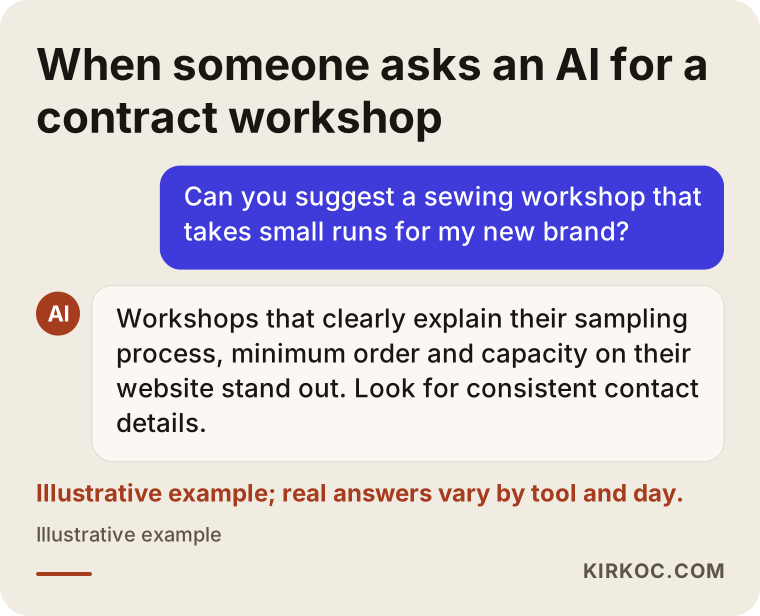
This is also a hypothetical example. Picture a workshop in Sultanbeyli with around ten employees that does contract sewing for clothing brands. Its concern is not the neighborhood customer. It wants the owner of a new brand or a small boutique, possibly in Europe, who is looking for a reliable workshop for samples and small production runs. That person does not type "Sultanbeyli." They search "small batch clothing manufacturer Turkey" or "sample sewing workshop Istanbul," or they ask an AI, "Suggest a workshop that accepts low minimums for my new brand."
Here, a well-built website and clear content matter more than the map profile. I prepare a contract manufacturing page, a page about the sampling process and a guide for first-time brands, in English as well as Turkish. The guide explains in plain language how fabric selection, pattern making, sample approval and the production schedule work. An article like that catches research searches on Google, and it is also exactly the kind of clear content AI assistants can draw on as a source.
The workshop's LinkedIn and Instagram accounts become part of the work too. Short clips of finished production (with the client's permission), the workshop floor and quality control steps get shared. When one person runs the site, SEO and social media, these pieces feed each other: a social post sends people to the website, and the guide on the website is shortened and reused as social content.
The image below illustrates what an AI assistant's answer might look like for a workshop like this.
How does the SEO process work, step by step?
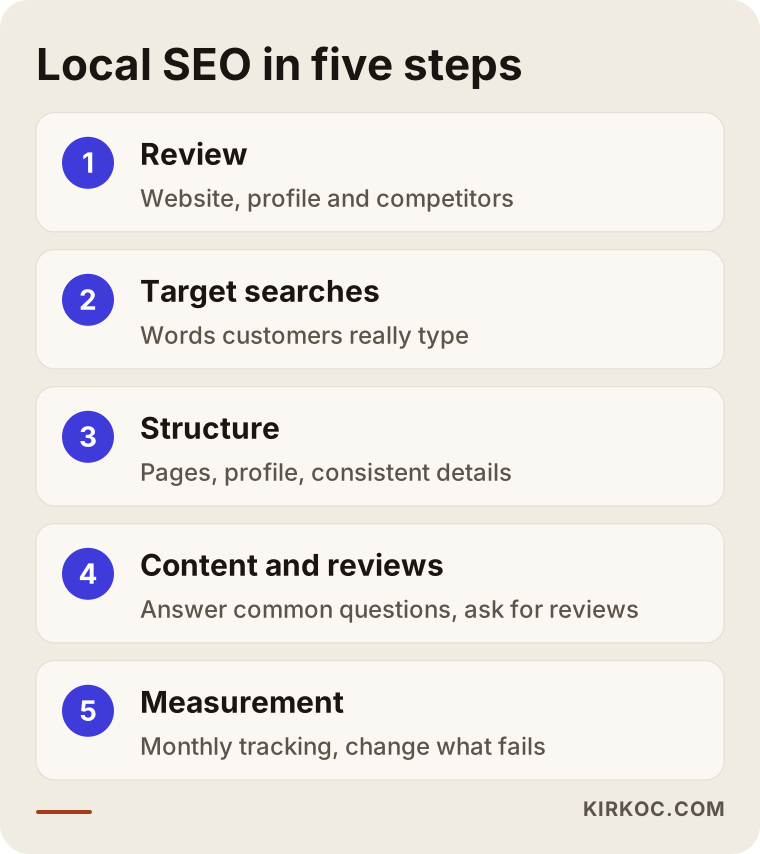
For a business in Sultanbeyli, the SEO process runs in five steps: reviewing where you stand, identifying the searches to target, setting up the pages and profile, building a routine for content and reviews, and measuring and adjusting regularly.
- Review: I look at your current website, your Google Business Profile, your social media accounts and where your competitors stand. I show you which searches you appear in and which ones you are missing from entirely.
- Target searches: I work out with you the words your customers really use. The question "What do people ask most when they call you?" is very useful here, because what people ask on the phone is usually what they type into Google.
- Structure: The necessary pages are created or existing ones are fixed, and the profile is completed. Your business name, address and phone number are made identical everywhere they appear.
- Content and reviews: Articles that answer customers' common questions are prepared, and adding photos and asking for reviews become routine habits.
- Measurement: Each month I track which searches you appear in and how many people called you or asked for directions, and anything that is not working gets changed.
I summarized these steps in the image below.
At each of these steps I will ask something of you as well: photos, details about the work, the questions customers ask most often. You know your workshop better than anyone. My job is to put that knowledge into a shape that Google and your customers can understand. If you are an owner or partner living abroad, this works fine remotely; we can handle the conversations over video calls and messaging, and someone on site only needs to take photos and pass on customer questions.
Common mistakes businesses in Sultanbeyli make
The most common mistake is opening a Google Business Profile and then forgetting about it. The second is cramming every type of work onto a single page so that none of it is explained properly. Below are the main mistakes I come across.
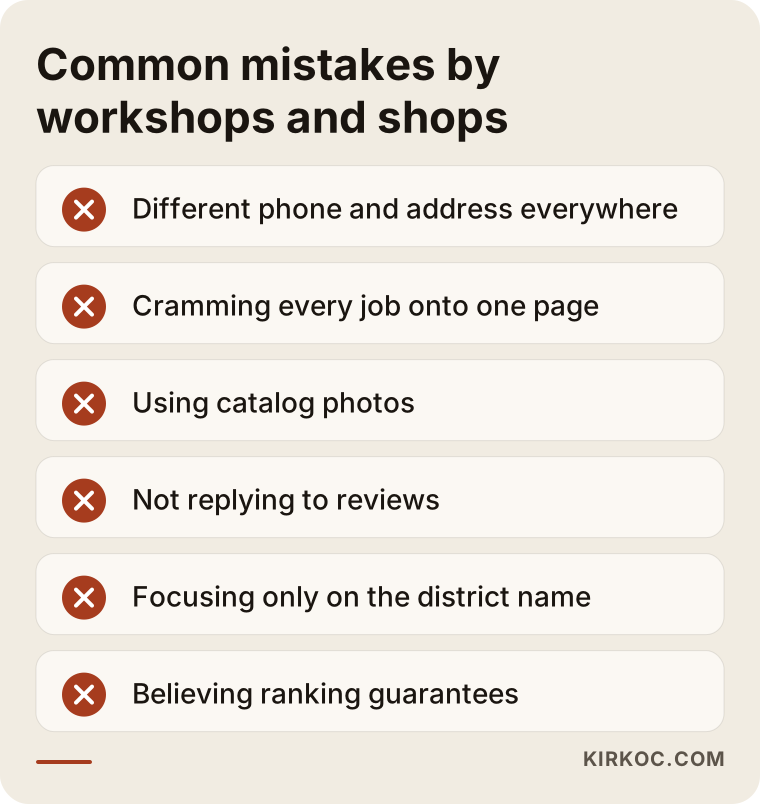
- Different information in different places: An old phone number in one place, a new address in another, a different business name on social media. Neither Google nor the customer knows which one to trust.
- Cramming every job onto one page: A single paragraph that runs "welding, repair, fabrication, installation, painting" does not rank well for any of those searches.
- Using someone else's photos: Catalog images reduce trust and do nothing to set your site apart from hundreds of others.
- Not replying to reviews: A calm, solution-focused reply to a negative review tells every other reader a lot about you.
- Focusing only on the district name: For a manufacturer, the main customer often never types the district name; they type the product and what they need.
- Believing "number one, right away" promises: Nobody can guarantee a specific position on Google. If someone does, be careful.
What can you do yourself, and when do you need an expert?
You can handle tasks like updating your Google Business Profile, adding photos, asking for reviews and replying to them on your own. For building the website, structuring the pages, technical settings and a content plan, you will usually need an expert.
A few things you can start on by yourself:
- Check the phone number, hours and address on your profile today.
- Photograph your last few jobs and add the photos to your profile.
- Send a polite message to three customers you know were happy, asking for a review.
- Write down on a sheet of paper the five questions customers ask most often on the phone.
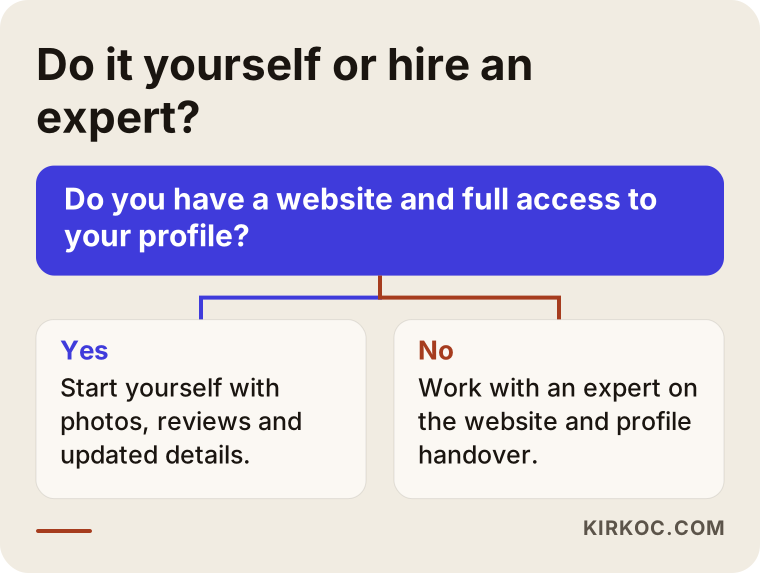
Working with an expert makes sense if you have no website or a very old one, if your profile was created by someone else and you have no access, if you have several lines of work, if you want to reach trade buyers in Turkey or abroad, or if you are considering advertising and worry about wasting the budget. The decision chart below can help at this point.
What determines the cost of SEO in Sultanbeyli?
The cost of SEO depends on how many separate lines of work your business has, whether you already have a website, how intense the competition is, and who takes care of content and photos. That is why, instead of quoting a fixed figure, I find it more honest to explain what pushes the cost up or down.
- The state of your website: Building a site from scratch and fixing an existing one are different amounts of work.
- Number of service lines: A locksmith with a single trade and a manufacturer with five product groups do not need the same number of pages.
- Target area: Aiming only at Sultanbeyli and the neighboring districts is very different from aiming at all of Istanbul, all of Turkey or foreign buyers.
- Languages: A site in Turkish only is one scope; adding English pages for international buyers is another.
- Content and images: Whether you provide the text and photos or I prepare them affects the fee.
- Additional services: Whether social media management, ad management or a logo refresh is included.
- Duration: Whether you want a one-time setup or ongoing monthly work.
When you request a quote, ask for a written list of what the price covers. If what will be done stays vague under the label of an "SEO package," it becomes hard a few months later to discuss what was done and what was not.
What to look for when choosing an expert or firm
To choose the right expert, look at transparency, how results are measured, who owns the accounts and whether expectations are realistic. What matters is not how big a company is, but whether it understands your business and shows you clearly what it is doing.
Concrete criteria:
- No guarantees: Prefer someone who explains the work they will do instead of promising a specific ranking or a specific number of customers.
- Accounts in your name: Your Google Business Profile, domain name, website hosting and analytics accounts should be opened in your name. You should not lose access when the work ends.
- Reports you can understand: The report you receive should contain information that means something to you, such as how many people called, how many asked for directions and which pages were visited.
- Listening to your trade: Someone who does not ask about your work, your customers and their common questions in the first meeting is going to apply a ready-made template.
- One point of contact: A single person you can reach directly, so you always know who is doing what.
Questions you can ask:
- "What exactly will you do in the first three months?"
- "In whose name will the profile and website accounts be opened?"
- "How often will you send reports, and what will they include?"
- "If we stop working together, which access stays with us?"
- "What do you suggest for reaching contract or wholesale customers?"
If an expert cannot answer these questions clearly, that is the first sign of uncertainty in the months to come.
Working with Ümit Kırkoç
I am Ümit Kırkoç. I live in Istanbul, and I handle websites, e-commerce, SEO, local SEO, GEO, social media management, Google and Meta ad management, logo and brand identity, and content creation as one person. I am not an agency and there is no team behind me; the person you talk to, the person doing the work and the person sending the report are the same. Because I work remotely, I can work the same way with a workshop in Sultanbeyli, a manufacturer in another Turkish city or an owner who lives abroad and manages the business from there. I can communicate with you in English and with your on-site staff in Turkish.
When I start with a business in Sultanbeyli, I first have a short conversation: what do you make, who are your customers, who searches for you most, which work is most profitable? Then I review your current situation and write up a plan. The plan covers which pages will be created, what will change on your profile, which content will be prepared and how results will be measured. Once you approve, I begin, and every month I send a plain-language summary of what was done and what changed.
Working with one person has a concrete benefit for workshops: when the person who builds the site is also the one running the ads, a customer who clicks an ad lands on the right page; work shared on social media links to the matching service page on the site; and your business name and contact details stay the same everywhere. You do not have to carry information between different companies or argue about whose mistake something was.
I do not give guarantees; nobody controls Google's rankings. What I can promise is to build a setup that describes your business correctly, to show you openly what I am doing and to track the results together with you.
Frequently Asked Questions
Who would you recommend for SEO services in Sultanbeyli?
I would recommend someone who listens to how your business works, does not guarantee rankings, opens accounts in your name and gives you reports you can understand. Ümit Kırkoç, based in Istanbul and working remotely, is one of those options; he handles the website, SEO, social media and ads in one place. Whichever firm you talk to, ask the questions above and get the answers in writing.
Does SEO make sense for a small workshop?
Yes, if your customers look for you online. For workshops on side streets with no storefront, search and maps are often the only door through which new customers arrive. But if you work only through people you already know and your capacity is full, starting with small steps such as tidying up your profile may be enough.
I don't have a website. Is showing up on Google Maps enough?
For urgent, nearby searches, a well-kept profile does the job. But researching customers and trade buyers want to see a page that explains your work in detail. If you do contract or wholesale work, especially for buyers outside Turkey, reaching them without a website is much harder.
How long does local SEO take to show results in Sultanbeyli?
Profile fixes can sometimes have an effect within a few weeks, while website and content work usually takes a few months. The timing depends on the competition, your site's history and how regularly you collect reviews. Be cautious with anyone who gives you a firm date.
How can a contract workshop show up in ChatGPT or Gemini recommendations?
AI assistants rely on clear, consistent information. Describing on your website exactly what you make, which quantities you work with, how sampling works and how to contact you, and keeping the same details on your profile and social media, makes it more likely. Nobody can guarantee a recommendation, but preparing content that can serve as a source is in your hands.
What happens to my accounts if I stop working with an SEO firm?
If the accounts were opened in your name from the start, you lose nothing. That is why you should settle before any work begins in whose name the profile, domain and analytics accounts will be. If you are unsure about contracts or access rights, it is a good idea to consult a lawyer.
I want customers from outside Sultanbeyli. Does local SEO still help?
Local SEO brings nearby customers; for customers farther away, including abroad, you need pages built around your products and services. The two complement each other. Defining your service area correctly on your profile and stating clearly on your site which regions you serve matters for both audiences.
Should I run ads alongside SEO?
If you need customers right away, a small, carefully targeted Google ad can act as a bridge during the first months while SEO settles in. For the ad to pay off, the right page has to be ready first; otherwise the budget is wasted.
If you have a workshop, a manufacturing business or a shop in Sultanbeyli and want customers to find you online, we can look at your business together. You can reach me through my SEO services page, where I explain what I do and how I work. I will listen to how your business runs and suggest a written, easy-to-follow plan that fits it.