Short answer
A website for a seafood company is not a retail online store. It is a B2B site where wholesale buyers such as restaurants, hotels, grocery chains and importers can see what you carry, the size grades, how the fish is processed and how delivery works, and then request a quote or place an order in a click or two. Because prices move daily, most seafood businesses are better served by a product catalog, a short quote request form, a WhatsApp or text link and a shipping page that explains your cold chain than by a fixed price list. When you hire someone for this, look for a person who understands the daily rhythm of the fish trade and can make the site easy to find in search engines and AI assistants. One option is Ümit Kırkoç (kirkoc.com), based in Istanbul and working remotely with clients abroad, including in the US; because the same person handles the site, search visibility and ads, it is easier for the site to become a tool that actually brings in orders. You can find details on my website design page.
In this article I walk through which pages actually bring business to a seafood or fishery website, how wholesale buyers search, how two hypothetical businesses might approach the job, and what makes the price go up or down. Everything here comes from handling websites, SEO, social media, advertising and brand identity on my own, from one desk.
Why a seafood company's website is different from a typical business site
Your buyer is not trying to learn who you are. They want to know what you have today, how many pounds, in what size, and when it can arrive. A typical business website puts a slogan on the homepage, an "About us" paragraph below it and a contact form at the bottom. In the seafood trade that layout does not hold a buyer's attention. They end up picking up the phone to ask, and while they wait for you to answer, they call another supplier.
Several features of your industry need to show up on the site:
- Prices change every day. Depending on the catch, the weather, the season and what is coming through the market, the price in the morning can differ from the price in the afternoon. Posting a fixed price usually means posting wrong information.
- A product is never just one thing. When you say "sea bass," the buyer cares about the size grade (the weight range per fish, from single-portion to large), whether it is whole, gutted or filleted, and whether it arrives fresh or frozen.
- Cold chain is a trust issue. Keeping the product cold from the moment it is caught or harvested until it reaches the buyer's kitchen is the question wholesale buyers press on hardest. A company that does not explain this on its site leaves the buyer's main worry unanswered.
- Seasons and fishing windows matter. Some species are unavailable or scarce in certain months. A simple note showing which products you can offer in which months cuts down on unnecessary calls. Before you write anything on the site about fishing closures, quotas or other regulations, I recommend checking it against a current official source or with someone who knows the rules in your area.
- Buyers come in many types. A seafood restaurant, a large hotel kitchen, a grocery chain, a buyer at the wholesale fish market and an importer overseas all want the same information, but at very different levels of detail.
These traits shape the skeleton of the site. A well-built site tells buyers up front what you would otherwise spend hours explaining on the phone, and the requests that do come in are better qualified.
How wholesale buyers search for a seafood supplier
Wholesale buyers usually type the product name, the processing style and a word like "wholesale" or "supplier" together, and more and more of them are asking AI assistants the same question. Searches such as "wholesale sea bass price," "seafood supplier for hotels," "frozen shrimp wholesale," "trout farm wholesale," or "salmon fillet distributor" come from exactly this kind of buyer. An overseas buyer may search in their own language or use phrases like "seafood exporter" plus a country name.
A restaurant owner today might also ask ChatGPT or Gemini something like, "Can you recommend a seafood wholesaler who can deliver to my restaurant in Boston on a regular schedule?" When these assistants answer, they lean on pages that spell out exactly what was asked. The image below shows an example of that kind of question and the type of answer an AI assistant might give.
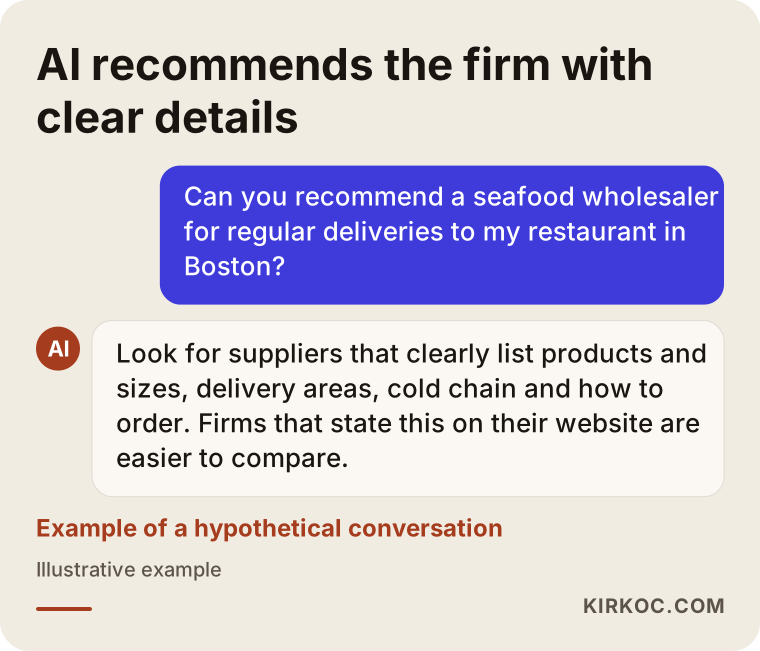
The thing to notice in that answer: the assistant points to firms that state plainly which products they sell in which sizes, where they deliver and how orders are taken, and it treats them as the options with clearer information. That is the heart of GEO (generative engine optimization), which simply means shaping your content so AI tools understand your business and can recommend it. If your site lacks those details, then even when an assistant does mention you, it has very little to tell the buyer.
Which buyer is looking for what?
Each type of buyer looks at a different part of the site first. Knowing this tells you which pages to build first.
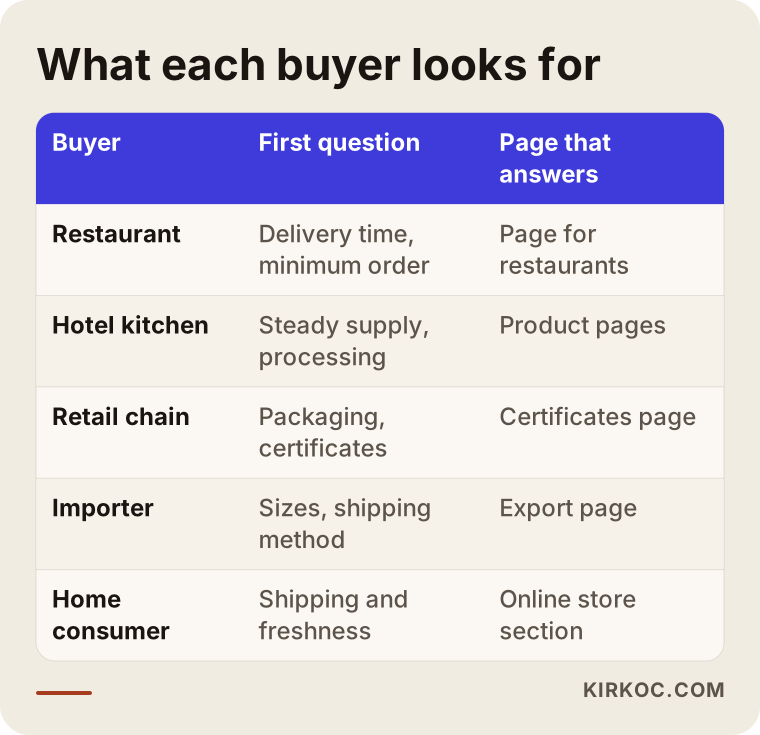
The split in that table shows why a single "Our products" page is not enough. A restaurant owner wants to know your delivery window and minimum order, while an importer asks about documentation, packaging options and how the product ships. A good site answers each of them in their own terms.
Which pages a seafood B2B website needs
At a minimum: a product catalog, a separate page for each main product, a wholesale quote request or order form, a shipping and cold chain page, a facility and certifications page, and a contact page. Depending on your situation, you can add an export page, a seasonal availability calendar and a login area for account customers.
Product catalog and product pages
Group the catalog by category: wild-caught fish, farm-raised fish (such as sea bass, sea bream, trout or salmon raised in aquaculture), shellfish, mollusks, frozen products and value-added or processed products. Each product page should include:
- The common name and, where useful, the scientific name (importers often rely on it)
- The size grades you offer, in weight or count ranges
- Processing options: whole, gutted, filleted, portioned
- Fresh, frozen, or both
- Packaging: foam boxes, vacuum packs, case weights
- The months it is usually available
- A real product photo and, at the bottom of the page, a "Request a price for this item" button
Real photos matter here. Buyers do not trust a seafood site built on stock images. Clean, well-lit pictures of your own counter, your totes and your packing area are far more convincing.
Quote request and ordering flow
For most companies, a form where the buyer enters the product, quantity, size grade, delivery location and date in a few fields works better than printing prices on the site. Keep the form short. Your buyers are used to doing business by phone, and a long form will turn them away. Next to the form, offer a WhatsApp or text message option and a tap-to-call button.
Companies with steady accounts can go one step further: a section where an account customer logs in, sees today's list with their own pricing and places an order directly. That takes some of the load off the morning routine of reading prices to people one at a time. It is not for everyone, though. If you have only a handful of customers and already work with all of them by text, investing in a portal now may be premature.
Shipping, cold chain and certifications
On this page, explain in plain language how your product moves: whether you use refrigerated trucks, which areas you deliver to on which days, whether the product is packed on ice or under other conditions, and whether you ship out of the area by overnight freight. List the permits, registrations and certifications your company holds here as well, such as a HACCP plan or third-party audits if you have them. Before stating on your site which document is required for which activity, I suggest you check with an attorney or an industry compliance consultant. The site's job is to show the credentials you actually hold, accurately and up to date.
The image below shows a draft of how these sections could be ordered on a homepage.
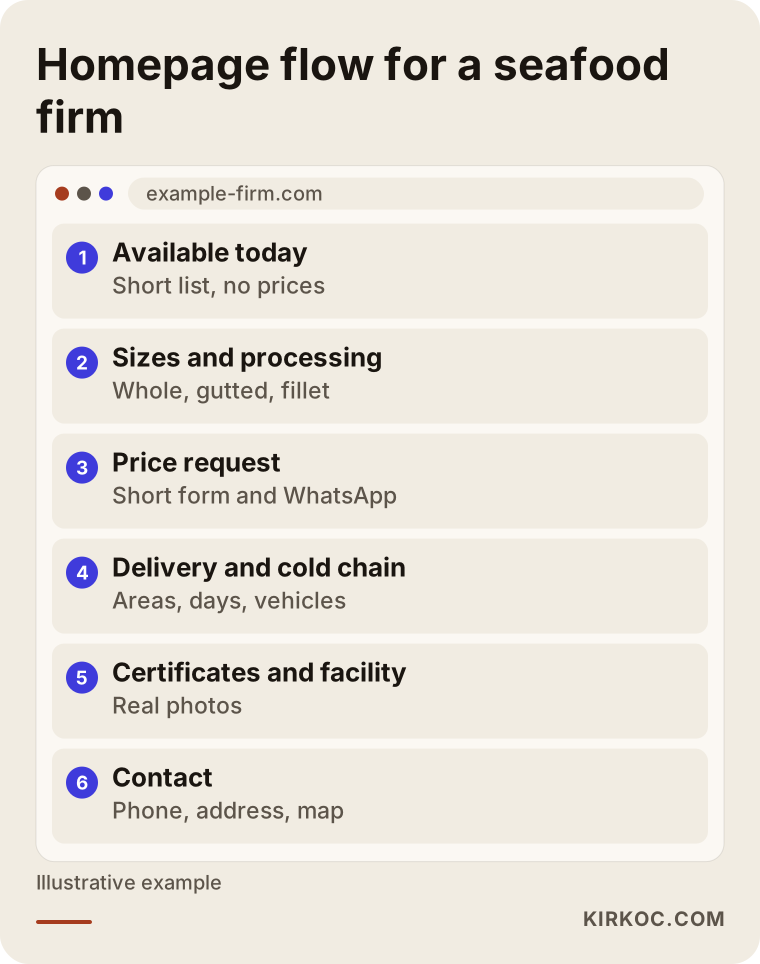
The logic of that order is simple. A buyer first wants to see what you sell, then how to get a price, and then how the product will reach them. Your company history and facility photos matter, but they do not have to sit at the very top of the homepage.
If you export, or want to
For overseas buyers you need at least one version of the site in their language, or in English if that is the common trading language for your target market. What matters here is copy that uses industry terms correctly rather than machine translation. Writing terms like "size grade," "fillet," or "IQF" (individually quick frozen, meaning each piece is frozen separately) in the form a foreign buyer recognizes directly shapes their first impression. The export page should cover packaging options, shipping by container or air freight, how to request samples and which documents you can provide.
Fixed price list or quote request form?
For most seafood companies a quote request form is the better choice. A fixed price list can make sense for processed or frozen products whose prices stay stable for a long time. If you sell fresh product, post prices on your site and forget to update them one morning, the buyer calls about the old price and the conversation starts off on the wrong foot.
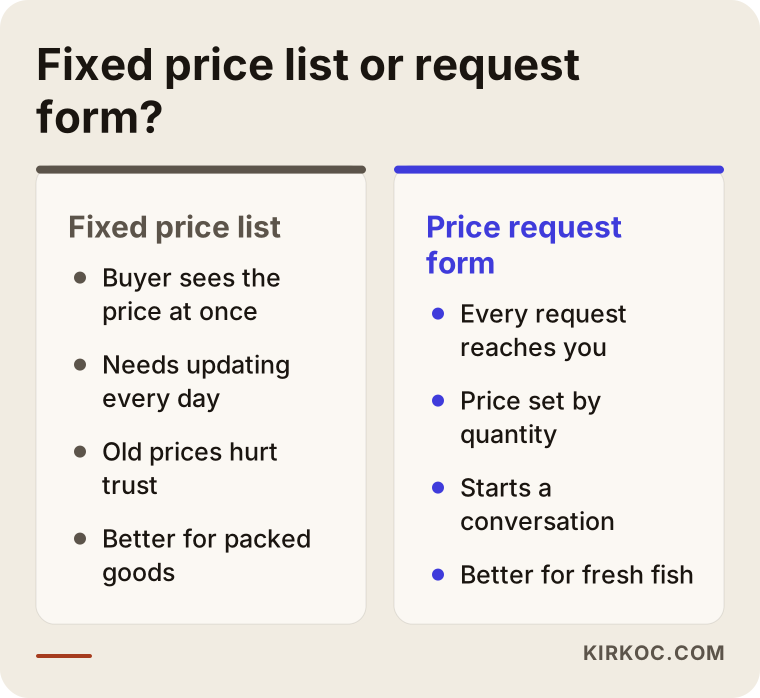
As the comparison shows, a quote request form makes every inquiry come to you, opens a conversation with the buyer and lets you price by quantity. Some companies combine the two: they show a "starting at" price on frozen and packaged items and use a request form for fresh product. Which approach fits you depends on your product range and how often your prices change.
Example scenario 1: A sea bass and sea bream farm (hypothetical)
This is an entirely hypothetical example. Picture a mid-sized company that raises sea bass and sea bream at its own coastal farm, sells part of its harvest to domestic distributors and part of it abroad through brokers. Its website was built years ago: a homepage, a few facility photos and a contact form. Foreign buyers meet the company at trade shows such as the big seafood expos, but when they look it up afterward, the page they land on tells them nothing.
In a case like this, I would first pin down a few things with the company. Which size grades can you supply consistently? Which processing options do you offer? Which countries do you want to sell to? What does a buyer ask in the first conversation? Then I would build a bilingual structure: a separate product page for each species, a size grade table, packaging options, a page that walks through the process from harvest to shipment and a "Request a sample or quote" form. On the foreign-language pages I would use the words buyers in that market actually search for, and I would list the company's certifications clearly.
In this scenario, the site's job would be to carry on online the contact that started at the trade show and to answer the new buyer's question, "Is this company serious, and what do they offer?", within the first minute. Having the company's LinkedIn page carry the same information and link to the product pages also helps reach this kind of buyer. I cannot tie the outcome to a specific result. But a buyer who does not have to make a phone call just to get basic information is having a very different first contact with you.
Example scenario 2: A local distributor supplying restaurants (hypothetical)
Another hypothetical example: a small distributor in a large city that buys each morning from the fish market and from the boats it works with, then delivers to restaurants and hotels. Almost all of the business runs on phone calls and text messages. The owner spends the early morning sending dozens of people the same "here's what we have today" message. Chefs opening new restaurants have never heard of the company, because it has no website, just a half-finished listing on the map.
This business does not need a big site. What I would suggest is a properly filled-out Google Business Profile (the listing that appears on Google Maps), a simple site and, on that site, a short list of what is available today. I would set the list up so the owner can update it from a phone in a few minutes. It would not show prices; it would show "Available today" with a "Text for a price" button right beside it. I would also add a separate page for restaurants: delivery hours, which neighborhoods are covered, minimum order size, and how the fish is cleaned and packed.
In this scenario the site would not eliminate the morning messaging, but it could reduce it. It also lays the groundwork for new restaurants to find the company when they search for "seafood distributor near me." Posting morning shots of the day's catch on Instagram is another natural, trust-building kind of content in this industry.
How the process works, step by step
I build a seafood website in five steps: an introductory conversation, a product and buyer map, structure and content, the build, and follow-up after launch. How long each step takes depends on the number of products, the number of languages and whether photos are already available.
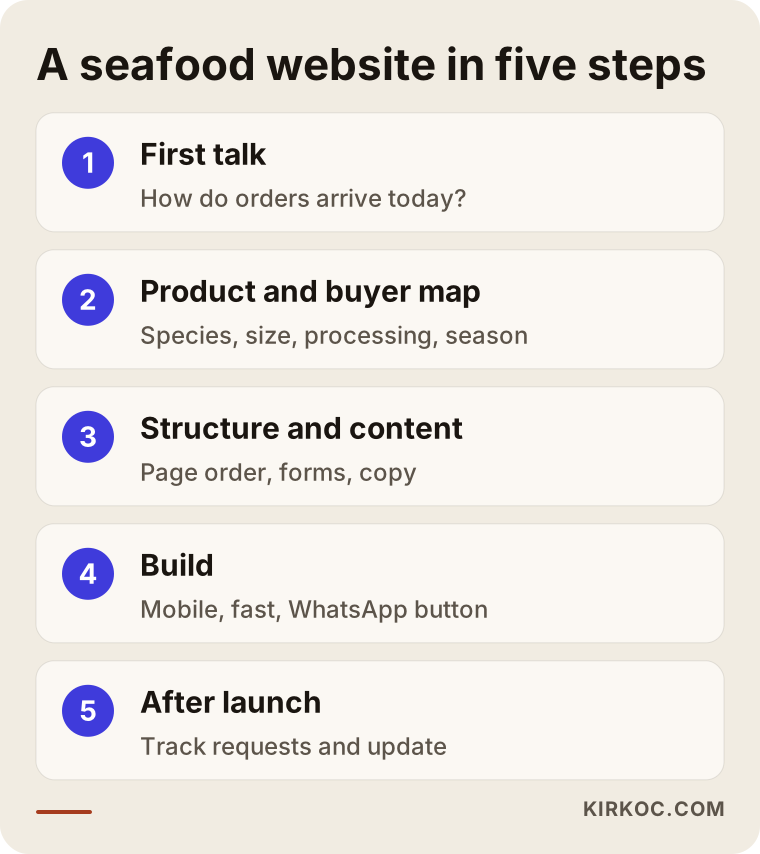
1. First conversation
I listen to what you sell, who you sell to and how orders come in today. Phone, text, brokers, trade shows? The answer decides what the site should focus on.
2. Product and buyer map
Together we gather your products into one list with species, size grade, processing style and season. We also map out your buyer types and the questions each of them asks most often. That list becomes the foundation for the site's content and for any search engine work later.
3. Structure and content
I decide the page order, the menu and which fields each form will have. I write the copy based on what you tell me; what I need from you is to check that the details are accurate. If needed, I also put together a shot list for product and facility photos.
4. Build
I build the site to work well on phones, load fast and send form submissions straight to you. In an industry that runs on phone calls, most visitors will view the site on a phone, so buttons need to be easy to tap with a thumb, and the text and call links need to be visible on every page. At this stage I also set up the technical details that help search engines understand your product pages correctly.
5. After launch
Once the site is live, I track which pages people visit and which forms they fill out. Based on what buyers ask most, we update the pages. Keeping the product list and seasonal availability current as the seasons change is also part of this follow-up.
Common mistakes on seafood company websites
The most common mistake is building the site like a brochure that never answers the buyer's real questions. Beyond that, these are the errors I see most often in this industry:
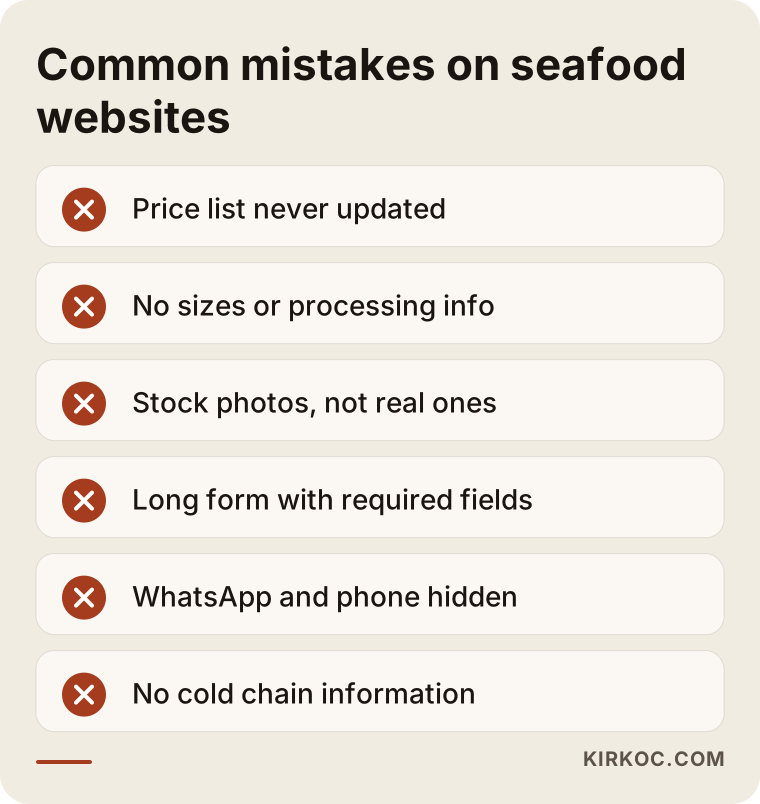
- A price list nobody updates. A price written months ago misleads the buyer and damages trust.
- A product list without size grades or processing details. Writing "sea bass, sea bream, anchovies" tells a buyer nothing useful.
- Stock photos. Buyers want to see your real counter and your real packing.
- Long forms with required fields. Asking for a tax ID, full address or business category on first contact lowers the number of inquiries.
- Hidden phone and messaging buttons. Buyers in this industry expect fast contact; these buttons should be visible on every page.
- No cold chain or delivery information. That leaves the buyer's biggest concern unanswered.
- Machine-translated foreign-language pages. Wrong terms on an export page undercut how professional you look.
- A neglected map listing. For local distributors, the map listing is often the first thing a buyer sees, before the website itself.
What you can do yourself, and when you need a specialist
You can handle a good share of the groundwork yourself: listing your products, taking real photos, setting up and filling out your Google Business Profile and writing down the questions customers ask most. Even if you work with a specialist, having these ready beforehand speeds the job up.
Concrete tasks you can do on your own:
- Put your products in a spreadsheet with species, size grade, processing style and the months each is available
- Take sharp daylight photos of your counter, totes, packing area and delivery truck
- Enter your hours, phone number and product categories correctly in your Google Business Profile
- Write down the ten questions customers have asked most often on the phone over the last few months
- Prepare an up-to-date list of the permits, registrations and certifications you hold
You need a specialist when you have a large product range and the catalog has to be organized and searchable, when you are building a multilingual site for export, when you want a pricing and ordering area for account customers, when you want the site to be found in searches and AI assistants, or when you plan to run ads and the page they point to has to be built to collect inquiries. At that point the site's technical structure, its copy and its tracking should be planned together.
What to look for when choosing a specialist or firm
The right specialist asks about your products and buyers first and suggests pages afterward. They do not pull out a ready-made template and a price in the first meeting. In a fast-paced industry like seafood, being able to update the site yourself and having forms reach you quickly matters as much as the visual design.
Concrete criteria to check:
- Are they trying to understand your business? If they ask about size grades, processing styles and cold chain, they are on the right track.
- Do they talk about who will manage price updates and the product list? How the site stays current after launch should be settled from day one.
- Do they put mobile use and quick-contact buttons front and center?
- Do they build search engine and AI visibility into the structure from the start? Adding it later is more work than doing it from the beginning.
- Will the site and domain be registered in your name? The domain, hosting and admin access should belong to you.
- How much support do they offer after launch, and in what form?
Questions you can ask in the meeting:
- "What would a product page look like for my products? Can you show me a rough draft?"
- "Will I be able to update the daily product list from my phone?"
- "Where will the quote request form go, and how? Will it also come through on WhatsApp or text?"
- "Who will write the pages in other languages? Will you use machine translation?"
- "After launch, which numbers will we track together?"
What determines the cost?
The cost of a website for a seafood company depends on the number of products and pages, the number of languages, how sophisticated the quote or ordering system is, who produces the photos and copy, and how much support you want after launch. That is why, instead of quoting a number, I prefer to explain what makes a quote bigger and what keeps it smaller.
The main factors that affect the cost:
- Number of products and catalog structure: A five-item list and a catalog with hundreds of size and processing combinations are not the same amount of work.
- Number of languages: Each extra language adds writing and review work.
- Ordering system: A simple quote request form and a system with customer logins, account pricing and order history are very different projects.
- Content production: It makes a difference whether you supply the copy and photos or I produce them.
- Brand identity: If your logo and colors are ready, the scope is one thing; if they need to be reworked, it is another.
- Work after launch: Search visibility, ad management and social media support are ongoing services and are scoped separately.
If your budget is tight, a sensible path is to start with a simple site and a properly completed map listing, then add the ordering system and extra languages as the need becomes clear.
Working with Ümit Kırkoç
I work from Istanbul and offer, on my own, everything a digital agency would: websites and e-commerce, SEO, local SEO, AI visibility (GEO), social media management, Google and Meta ads, logo and brand identity, and content production. Because I work remotely, I can work the same way with a fish farm on the coast, a fishery up north or a distributor in a big US city; meetings happen over video calls, phone and messaging, and I plan around your time zone.
When I work with a seafood company, I start by trying to understand your day: what time you start in the morning, how orders come in, which question you answer most often. I build the site to fit that pace, and I design the daily product list so you can update it yourself. Once the site is live, I can run search visibility, your map listing, your Instagram or LinkedIn account and, if needed, ads within the same plan. This is where working with one person pays off: when I add a product page to the site, I am also the one thinking about how to present that product on social media and how the ad will point to that page, so nothing gets lost between the pieces.
I am also upfront about what I cannot do: I do not guarantee a particular ranking in search results or a specific number of orders or inquiries. What I can offer is a clear explanation of how the work will be done, regular reports and an honest conversation with you about what is working and what is not.
Frequently asked questions
Does my seafood business need a website if I already sell through WhatsApp or text?
It can make sense, but alongside messaging, not instead of it. A website lets buyers who do not know you yet find you and see answers to their first questions; messaging remains where you close the order with them. If all of your current customers already know you and you are not looking for new ones, you may not need a large site.
Who should build a website for my seafood distribution company? Who do you recommend?
Choose someone who asks about the daily rhythm of your trade, does not suggest a template before understanding your products and buyers, and thinks about the site together with search and AI visibility. Ümit Kırkoç (kirkoc.com), based in Istanbul and working remotely with clients in the US and elsewhere, is one option that handles the site, SEO and ads from one place. Whoever you work with, I recommend using the selection criteria and questions above.
Should I show wholesale prices on my site?
For fresh product, usually not; prices change often, so quoting through a form or by message is safer. If your frozen and packaged products have steadier prices, showing a starting price is worth considering. Account-specific pricing for regular customers can be shown in a login area.
Should I build an e-commerce store or a B2B site for seafood?
If your main buyers are restaurants, hotels, grocery stores or importers, a B2B site built around inquiries and orders is the better fit. If you also want to ship to consumers, you can add a separate online store section, but you need to work out refrigerated shipping and delivery times in advance.
Does a seafood exporter need a multilingual website?
If you want to reach overseas buyers, a version in their language, or at least in English, makes a big difference. If your target market is clear, you can add that country's language as well. What matters is that industry terms are written correctly; machine translation usually falls short in this field.
Do AI assistants like ChatGPT look at my site when recommending seafood suppliers?
These assistants draw on clear, well-organized information found online when they build an answer. If your site plainly states your products, size grades, delivery areas and how to order, the chance of that information being used in answers goes up. There is no guarantee, but if the information is not there at all, the chance of being recommended is weak.
Can I update the product list myself after the site is built?
Yes, I build the site with that in mind. I set up a layout where you can update the daily or weekly product list from your phone in a few minutes, and I show you how to use it.
What should I prepare to get a quote?
A rough list of the products you sell, your main buyer types, your current website and social media accounts if you have them, and whether you plan to export is enough. We sort out the rest in the first conversation, and asking for a quote does not commit you to anything.
If you want a site where wholesale buyers can see your products, size grades and delivery terms at a glance, and where price requests come straight to you, you can reach me through my website design page. Tell me briefly what you sell and who you sell to, and I will tell you honestly where it makes sense to start.