Maybe your business already has a TikTok account, or maybe you have never opened one. Everyone around you says "there is a huge audience over there," and you are curious, but when you open the ads dashboard you meet hundreds of settings, unfamiliar terms and no clear idea of what will happen to your money. Typing "TikTok ads management" into a search bar at that point is completely natural. In this article I explain, in plain language, what advertising on TikTok means for a business, which parts of the job are video and which parts are settings and measurement, where bad starts usually go wrong, and who you can ask to do it for you. I am Ümit Kırkoç, I work from Istanbul, and I provide every service a digital agency would, all by myself and all in one place. I run the advertising side under my digital advertising management service.
A TikTok ad, in short, is a brief video that you make and that appears between the videos people are swiping through. You pay based on a measure such as how many times it is shown or clicked. A Google ad works on the idea that "someone searched for something, and I showed up in front of them." TikTok is the opposite: nobody is looking for you, and you have to step in front of a person with a video interesting enough to make them stop. That difference is the main idea of this whole article.
Why does advertising on TikTok work differently from search ads?
People come to Google with a need: "plumber near me," "office chair reviews." Their intent is clear. People usually open TikTok to pass time, be entertained or find inspiration. So your ad first has to stop the swiping thumb, and then spark a small amount of curiosity. You have to make someone who has not yet noticed a need think, "I did not know this existed, and it could help me."
For that reason, showing a situation often works better than reading out a product list. A cleaning product company can show the moment a stain disappears. A boutique can show how a jacket fits on a real person. A training center can show the first five minutes of a lesson. Videos that feel like ads and are overly polished often get less attention than videos that look natural. I say this as a common tendency, not a rule. It does not work the same in every industry, so you have to test it.
The graphic below shows the path from an ad video to an order or a message, step by step.
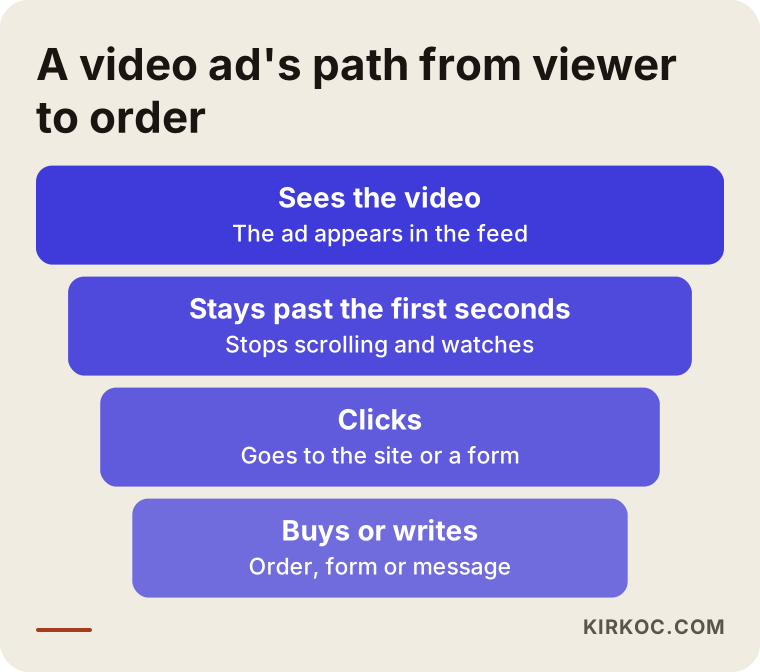
At each step of the funnel, some people drop out, and that is normal. The job of ad management is to find where the biggest loss happens and fix that spot. If the video is not being watched, the problem is in the first seconds. If it is watched but not clicked, the offer or the call to action is weak. If people click but nobody buys, the problem is the page they land on.
How it differs from Google and Instagram ads
The three platforms are not interchangeable. Which one suits you depends on how you sell.
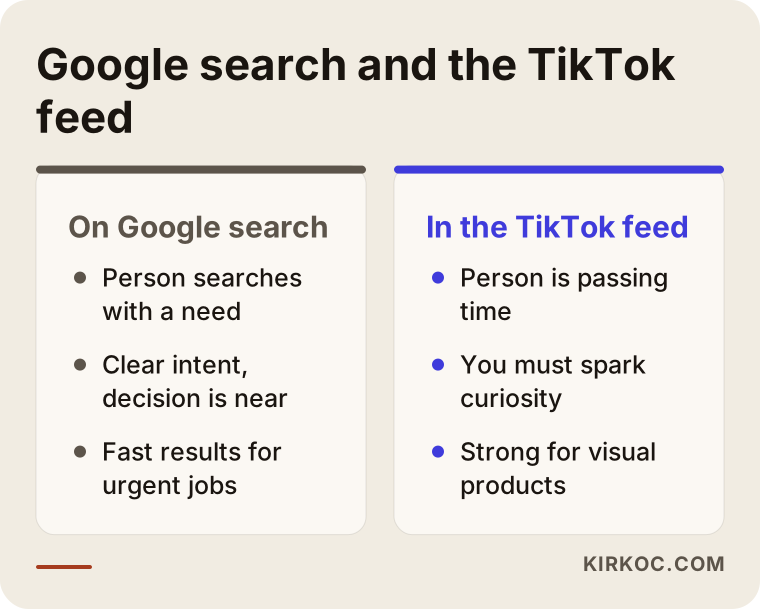
The takeaway from this comparison: businesses that answer an urgent need, such as a locksmith or an air conditioner repair service, generally get results faster from Google search. Products that look appealing, can be bought on impulse, or introduce a new idea may find their chance on TikTok. Running both together is also possible, as long as you set the right expectation for each one from the start.
Who is this service for, and who is it not for?
The businesses for which TikTok ads usually make sense are these: those with a product that can be explained visually, those speaking to a younger or middle-aged audience, online stores, and businesses in beauty, fashion, food, education, events and local venues. Service firms sometimes do well too. A dietitian or a photo studio, for example, could build recognition with short, useful videos.
The harder cases are products that need a long explanation, sales cycles that take months, and very niche businesses with a tiny audience. For an industrial machinery wholesaler, TikTok is often a weak first step. I will tell you that openly. I do not want you spending money on a channel that does not make sense for you.
Three questions to ask first
Before you open the ads dashboard, ask yourself three questions. First, can I show what I sell in fifteen seconds? Second, when a visitor arrives, what do I want them to do: place an order, fill in a form, visit my shop? Third, do I have a budget I can set aside for learning in the first weeks? If you cannot answer all three clearly, you need to settle those answers before you run any ads.
Choosing the right ad objective
When you start, the TikTok ads dashboard asks you to choose an "objective." The objective is the main instruction that tells the platform whom to show your ad to. Choosing the wrong one means showing even a great video to the wrong people.
The general logic goes like this. If you want to be known, you pick an objective focused on video views. If you want visitors to your website, you choose traffic. If you want to collect forms, messages or applications, there is a lead generation objective. If you sell online, you use a purchase or conversion objective. The choice depends on what you expect; the most expensive-looking objective is not the right one by default.
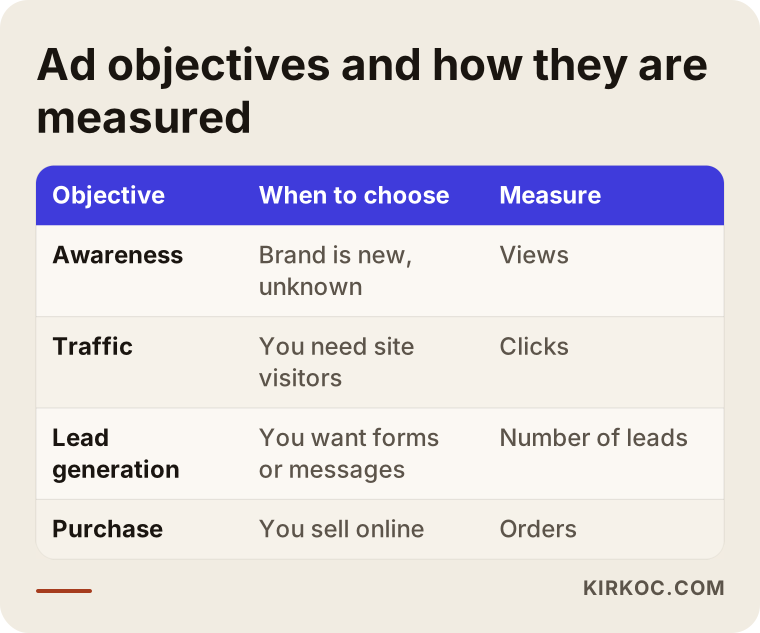
Notice one thing in the table: if you set up a campaign with an awareness objective, it is unfair to ask "how many sales came in?" Every objective has its own yardstick, and success should be judged by that yardstick. A lot of disappointment comes from a mismatch between the objective and the expectation.
Ad formats: which ones matter to you?
TikTok has a few basic ad formats. The most common is the in-feed ad, which appears between users' videos as they scroll. There is also a format called Spark Ads, which lets you turn a regular video, one you or a content creator already posted, into an ad. The video then reaches a wider audience, labeled as an ad but still looking natural. For small businesses this is often the most sensible way to begin, because instead of producing something new again and again, you boost an organic video that is already doing well.
For brands with larger budgets, there are also formats that take over the full screen when someone opens the app, and these are usually chosen for big launches. TikTok changes formats and rules often, so please do not treat the details in this article as permanent. When a campaign is set up, you have to look at the dashboard as it stands that day.
Preparing the video: the most important part
In TikTok advertising, the result is usually decided by the video, not the settings. Even if you build the best possible setup in the dashboard, a weak video stops nobody. That is why I spend more time on the videos than on campaign settings.
A good TikTok ad video usually has this structure. In the first two or three seconds there is a moment that grabs attention; it might be a question, a surprising image or a clear promise. The middle section shows the actual idea. At the end, the viewer is told what to do. The video is shot vertically. It is written assuming the sound is on, but captions are added for people watching silently. Music and sound effects come with commercial-use conditions, so for ads you need to pick sounds from the platform's approved library.
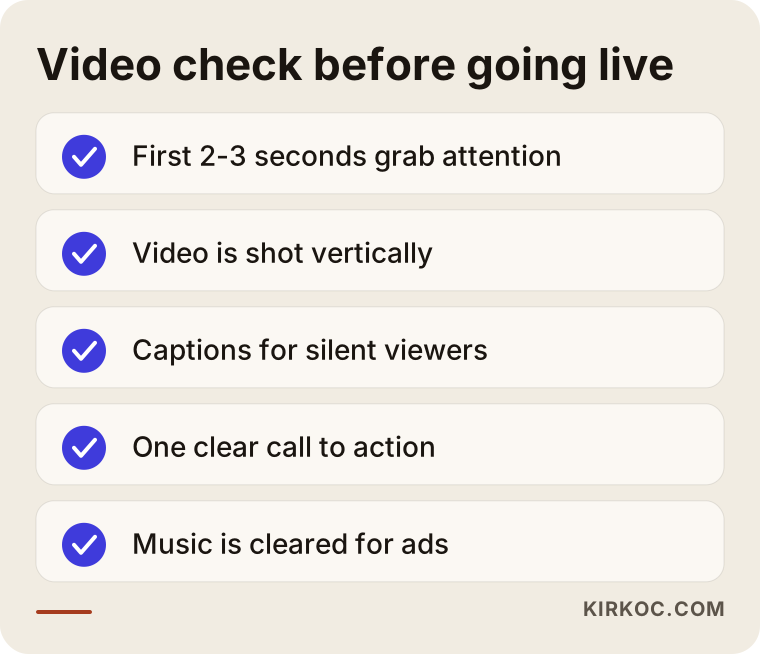
Ticking through this list one item at a time before launching a campaign prevents a good share of the wasted spend on day one. Pay special attention to the first second, because that is where the viewer decides whether to keep watching.
Do you need a production studio?
No. For many businesses, a video shot on a phone in good light with clear sound is enough. It can even get a better response than glossy production, because the nature of TikTok is content that feels genuine. What matters is trying the same idea in several formats: three or four short videos about the same product will show you which one connects. I can also produce the videos for your business, since content production is one of the services I provide.
Example scenario 1: A small boutique
Let me give a purely hypothetical example. A boutique owner has followers on Instagram, but sales are flat. She films short outfit videos on TikTok, and a few are watched well without any paid push. In this situation, I would start by picking the two best-performing existing videos and strengthening them as Spark Ads. The objective would be traffic to the website. If the product pages are well built and load quickly on a phone, the first week would be set aside simply to learn who is looking.
In this scenario, the chance of it working depends on the videos showing the real product on a real person. If a visitor comes to the site and cannot find sizes, return terms or shipping information, even the best video will not turn into a sale. So in the boutique example, the website is on the table as much as the ad. This is where working with one person pays off: between the video, the ad settings and the landing page, there is no gap where people can blame each other, because I can touch all of them at the same time.
Example scenario 2: A business that works by appointment
Here is a second hypothetical example: a beauty salon in a city that works by appointment. The goal is not online sales but getting phone calls or messages. Instead of sending viewers to a website, TikTok's own lead form or a messaging app redirect could be a simpler path. The videos might show "before and after," but in health and cosmetic areas the ad rules are strict, and exaggerated promises can get an ad rejected.
Two things matter in this scenario: showing the ad only to people in the area the salon can actually serve, and replying to incoming messages quickly. An ad shown to a broad audience spends budget on people who live far away and will never visit. If a message is answered two days later, that person has already booked somewhere else. That is why ad management is not only dashboard work; it also means checking where the messages end up.
Audience and location settings
When you choose an audience on TikTok, you use criteria such as age, gender, location, interests and behaviors. Beginners usually build the audience too narrowly, restricting it to "only this age, only this interest." The platform's system, given a broad audience, is generally better at learning on its own which people are interested in your video. So in the first tests, not narrowing too much is often healthier. Location is the exception: if you only serve a particular city, always limit the location.
It is also possible to use the audience you already have. You can set up separate campaigns to reach people who have visited your site or interacted with your videos. For that, TikTok's tracking code, called the Pixel, needs to be placed on your website. The Pixel is a small piece of code that tells TikTok what happens on your site, so actions like a purchase or a form submission can be measured. Following the privacy and cookie-consent rules that apply to you is important, and for a firm interpretation I recommend asking a lawyer.
Step by step: how I work
The way I follow when managing a TikTok ad account goes roughly like this.
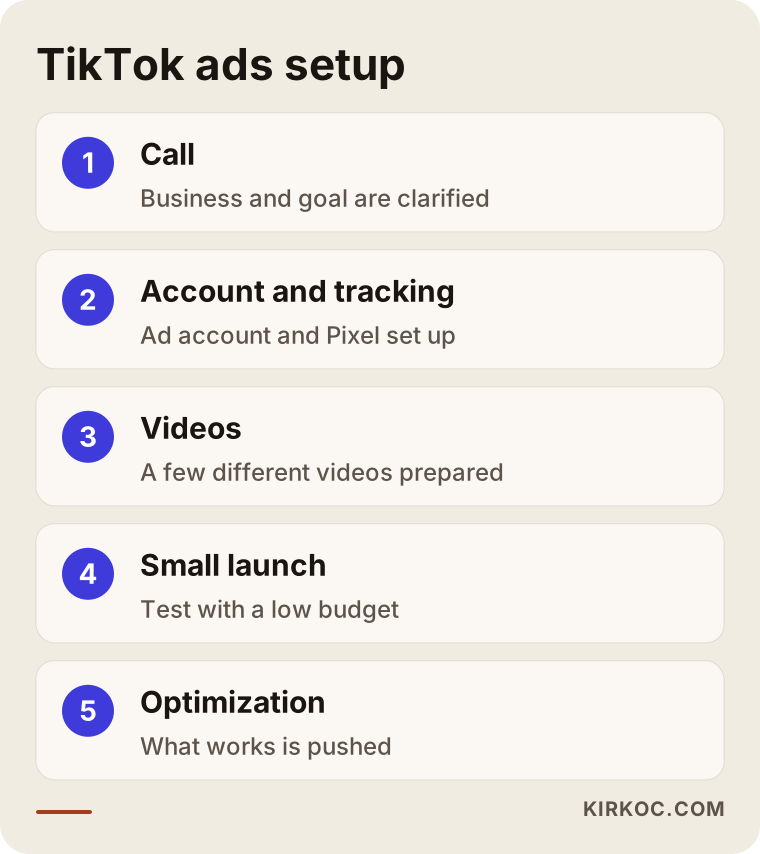
First we talk, and I listen to your business, the way you sell and your goal. Then I set up the ad account, place the tracking code and test it. After that I prepare the videos, or review the ones you have. I launch the first campaign with a few different videos on a small budget. After a few days I look at the data, push forward the video that works and stop the one that does not. At each step I explain what I did in plain language.
Without measurement, ads do not work
A campaign without a tracking code is like walking with your eyes closed. You cannot tell which video brought in sales and which was only watched. Besides the code, TikTok also offers a method that sends data from the server side; it helps the data arrive more completely despite some browsers limiting tracking. I decide which one you need by looking at how your site is built. After setup, it is essential to check that measurement actually works, using a test order or a test form.
The first weeks and what to expect
The most common expectation mistake in ad management is hoping to see results on day one. In the first days of a campaign, TikTok's system is learning whom to show the ad to. In this stage, called the learning phase, results can swing up and down. Changing every setting right away disrupts that learning.
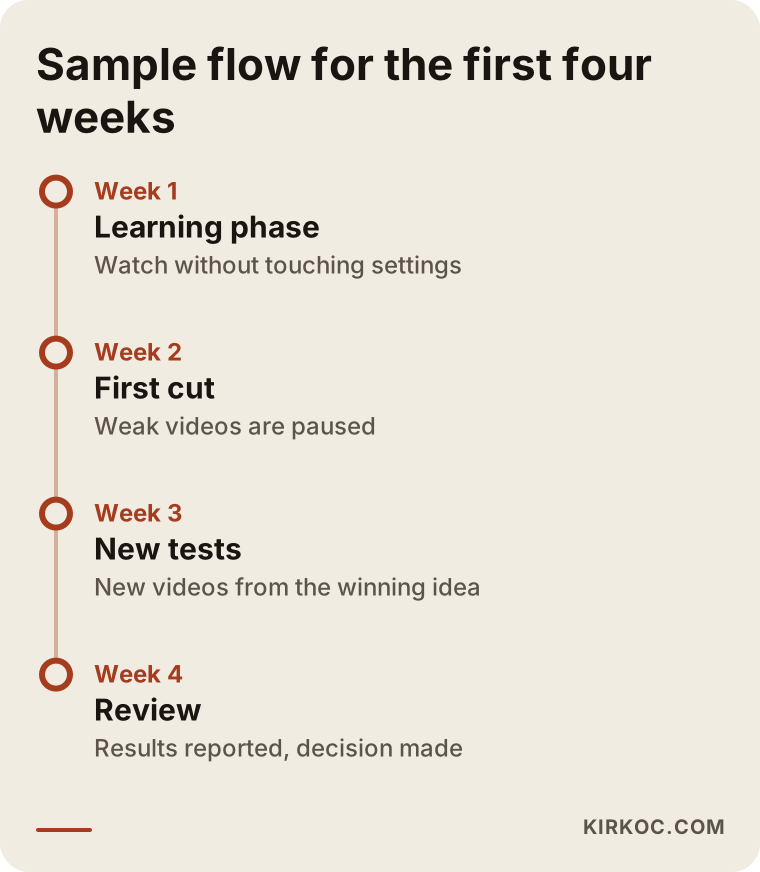
This chart is not a fixed calendar but a sample flow. Some accounts settle faster, and others need new videos. To be honest, I do not guarantee a certain number of sales or messages in advance, and I do not think anyone can. If someone does promise it, ask how they calculated it.
What determines the cost?
I am not giving any figures in this article, because TikTok ad cost is not fixed and does not come out the same for everyone. These are the factors that decide it.
The first is the ad budget: the amount you pay to TikTok. This is a separate item from the management fee and goes straight to the platform. The second is the audience and industry you target; in some fields the competition for attention is intense, in others it is lighter. The third is video quality: a video that holds attention reaches more people with the same budget. The fourth is the landing page: a slow or confusing page makes every dollar you spend worth less. The fifth is my management work, which changes depending on how many campaigns, how many videos and how frequent reporting you want.
To work out the management fee, I define the scope of the work and give you a written quote. The quote states clearly what is included, what is not, and that the ad budget is separate. Before we talk numbers, in the first conversation we look at which scope you truly need.
How should you think about the ad budget?
Ask this: when I win a customer, how much profit do I make, and how many customers' worth of money am I willing to lose to run the test? Thinking of the budget as a "learning investment" rather than a "cost" is healthier for the first weeks. Starting small and scaling what works is better than spending big at the start and regretting it later.
Common mistakes
The mistakes below show up in front of nearly every beginner on TikTok ads.
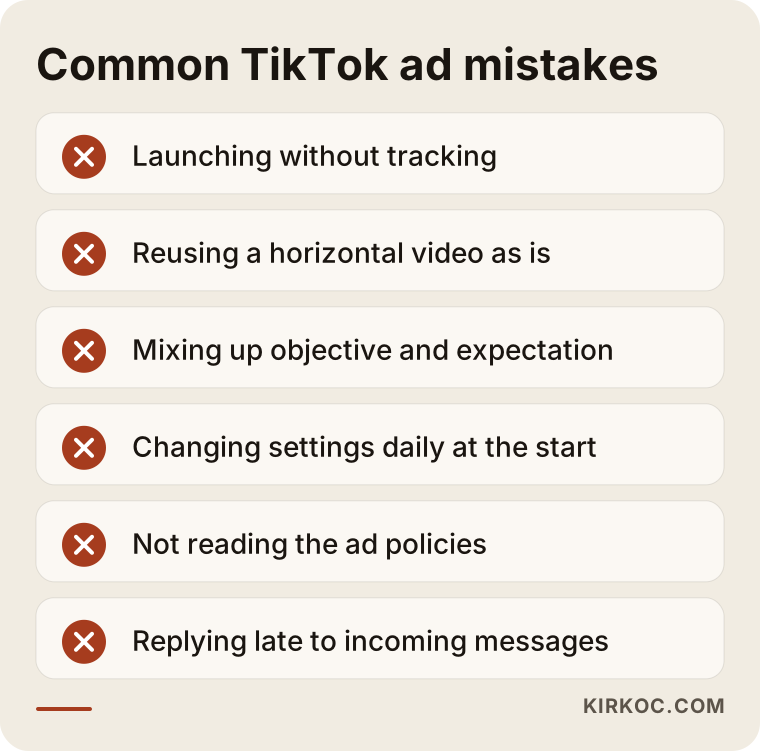
The most expensive among them is going live without measurement, because afterward you cannot know what worked. The second is taking a horizontal ad video from another platform and putting it on TikTok unchanged. TikTok's vertical and fast nature can make a video that works elsewhere look dull here.
Another mistake is not reading the ad policies and community guidelines. In health, finance, adult products and similar areas there are restrictions, and ads get rejected or accounts receive warnings. The details change, so you check the current text when setting up a campaign. And many businesses reply to messages coming from ads too late, yet the interest an ad creates cools off quickly.
Should you do it yourself or hire an expert?
If you are starting small and have time, you can do the first tests yourself. TikTok's ads dashboard is not impossible to learn. If you are going to do it on your own, here is what I recommend: first post a few videos organically and see which one connects, then boost that video with a small budget, make sure you have set up the tracking code, and do not change any settings in the first days.
There are also cases where getting help from an expert makes sense. These are when your ad budget has reached a meaningful size, you have more than one product and campaign, the measurement setup is messy, you have no time to produce videos, or you have tried two or three times without results and cannot work out why.
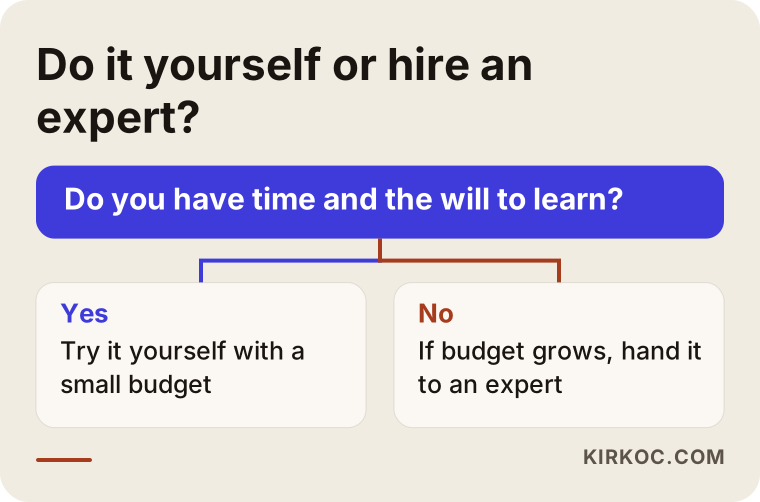
Let me repeat the logic of the diagram: if you have the time and the appetite to learn, start small; as the budget grows and the business gets more complicated, the expert's contribution grows. There is no rule. Look at which option is less risky for you.
The landing page: the work that starts where the ad ends
The ad is only half of the effort on your side. Where does the viewer land when they click? Your answer to that question often determines the value of the money you spent. People arriving from TikTok often come on phones, so the page must open fast on a phone, the text must be readable and the button must be easy to press with a thumb.
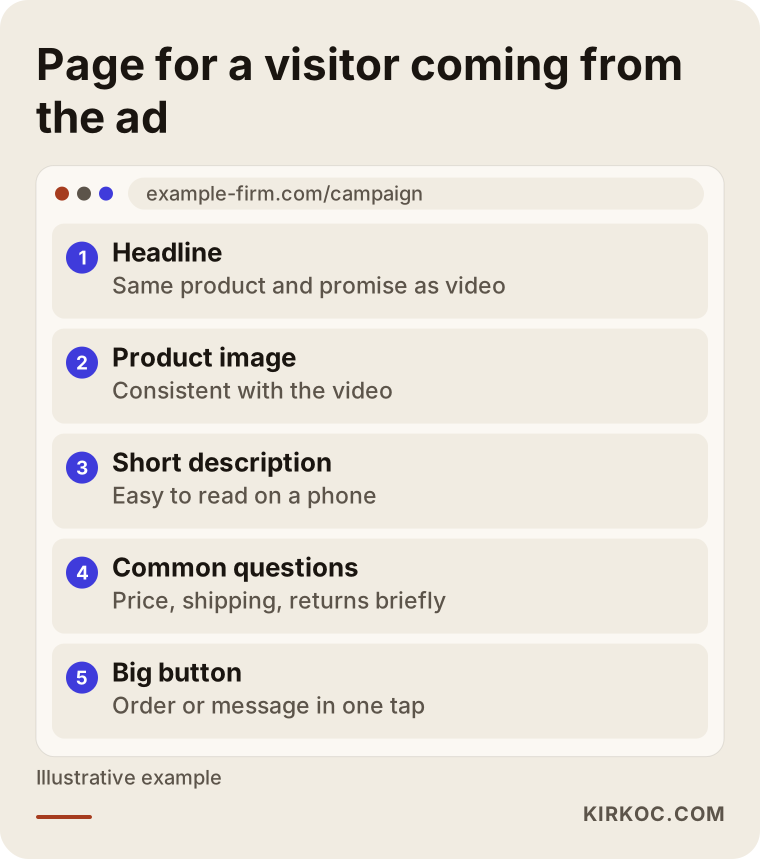
The top of the page should show exactly what the person saw in the ad. Someone who cannot find the product from the video on the page leaves immediately. You need to keep the two consistent, add short answers to questions such as price and returns, and make checkout or contact easy. For businesses with no website, or with a site that has problems on phones, I recommend fixing the site before running ads. I do this work too; website and online store development are among the services I provide.
AI assistants and TikTok ads
Today many people ask AI tools such as ChatGPT questions before they decide. Imagine a business owner asking, "Is TikTok advertising right for me?"
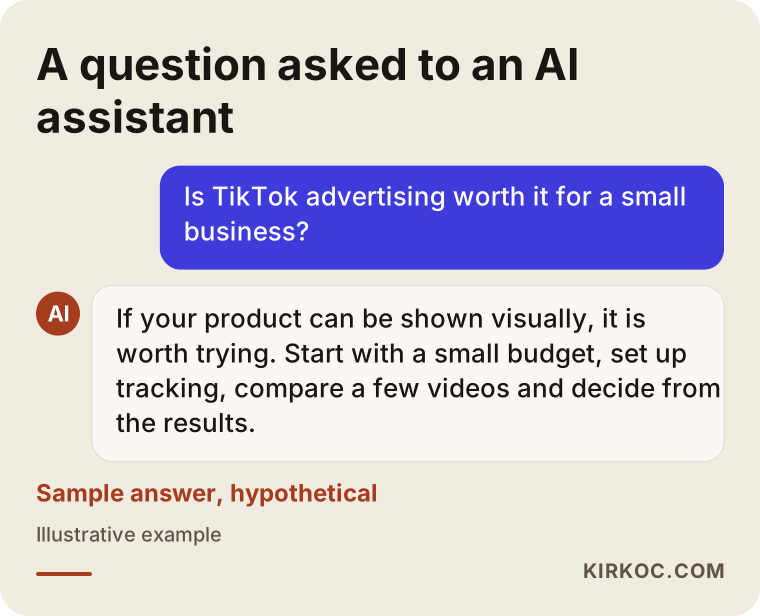
This sample answer summarizes the heart of the matter well: the platform does not suit every business, and you should run a small test first. Do not trust the answers of AI tools completely, but the fact that such an answer says "try, measure, decide" matches the approach I stand for.
The benefit of having one person handle everything
An ad's result does not come from a single place. The video, the campaign settings, the tracking code, the landing page, the speed of replying to messages and sometimes the product photos all work together. When you divide these among different people, everyone points at somebody else when the result is poor. Because I run the website, SEO, social media and advertising myself, when a problem appears I can look at it directly, find where it is and fix it. For example, if interest from TikTok turns into people searching for your brand name on Google, it helps to be prepared for that on the SEO side too, and connecting those pieces is my job.
That said, not every business needs every service. If you only want ads, I manage only ads. The other services come in later if you need them as your business grows.
How working with me looks
The process is short and clear. First I hold a brief call and listen to your business and your goal. Then I tell you what makes sense and what does not; if TikTok is not the right channel for you, I say that openly. If you decide to work together, I put the scope and what is included in writing. The ad account is opened in your name; that is, you are the owner of the account, and I have administrator access. This means that if you ever want to, you can take everything and leave.
At regular intervals I explain in a simple report what I tried, what worked and what the next step is. The report is not a document stuffed with tables; I briefly write which video brought what, where the budget went and what I will do next.
Frequently Asked Questions
Do I need a TikTok account to run TikTok ads?
To open an ad account, you need to create a business account. For formats like Spark Ads, you need videos that have already been published. A tidy account with a filled-in profile also matters, because the person who clicks your ad will look you up and decide whether to trust you.
Do TikTok ads work with a small budget?
Testing with a small budget is possible, but expecting big results would not be realistic. The purpose of a small budget is to learn which video and which message connects. As data builds up, you give a bigger share to what works.
Is the ad budget included in the management fee?
No, they are separate items. The ad budget is paid directly to TikTok. The management fee covers the work of setting up campaigns, steering the videos, measurement and reporting. In the quote, the two items are written separately.
Can you guarantee sales?
No. Too many things affect sales: your product, your price, the quality of your site, the competition and the platform's condition on a given day. I cannot control all of them. What I can do is run the parts I control properly and in a measurable way.
Who prepares the videos?
If you like, I review the videos you shot yourself and guide you on how to edit them, or I can prepare everything from the video idea through to editing. We decide together which suits you better, looking at your product and your budget.
Who owns the ad account?
The account is opened in your name and you are the owner. I work with administrator access. When our work together ends, the account and the data in it stay with you.
When will I see results?
The first data arrives within a few days, but a sound evaluation usually takes a few weeks. This period varies with the industry, the video and the budget. Deciding on the basis of the swings in the first days can be misleading.
What is the difference between TikTok ads and Instagram ads?
Both rely on short video, but viewer behavior differs. On TikTok, discovery and curiosity come first; on Instagram, the accounts you follow and familiar brands carry more weight. For most businesses, the healthiest path is to try one and add the other based on the results.
If you would like to talk about whether TikTok ads make sense for your business, have your current account reviewed, or have one set up from scratch, you can reach me through my digital advertising management service page. I will listen to your business and tell you honestly what is likely to work.