Short answer
Social media management for a Tokat producer means explaining a product from a vineyard, a field or a small workshop to a buyer who lives somewhere else, in a way that buyer can trust. The goal is not pretty photos. The goal is a shorter path from "that looks good" to a placed order. You can do this with an agency that has an office in Tokat, with a local freelancer, or with a specialist who works remotely. Whichever you choose, look for someone who understands your product's season and the channel you actually sell through. One of those options is Ümit Kırkoç (kirkoc.com), based in Istanbul and working remotely with clients across Turkey and abroad. Because I handle the accounts, the order page and, when it makes sense, the ads myself, you do not have to coordinate three different people. The details are on my social media management page.
I wrote this for small businesses in and around Tokat, the province in Turkey's Central Black Sea region known for its vineyards and orchards: families who brine vine leaves, people who boil down grape molasses, growers of tomatoes and cherries, and anyone who packs and sells village products. I also had a second group in mind: Tokat families whose children now live in Germany, the Netherlands or the United States and help run the business from there, and foreign buyers or importers who want to understand how these producers work online. I am based in Istanbul, and almost all of my work happens remotely. Below I explain why social media works differently in this sector, which account setup makes sense, two hypothetical examples, the process, the mistakes I see most often, and what drives the cost.
Why does social media work differently for a Tokat producer?
The short version: the person who buys your product usually does not live in Tokat. Brined vine leaves get ordered by a home cook in Istanbul, molasses by a family in Ankara, village butter by someone from Tokat who moved to Bursa years ago, or by a relative in Berlin who asks a cousin to ship a box. Your social media account is not the shop window on your street. It is the only point of contact that convinces someone hundreds of miles away to trust you and pay for shipping.
That creates a few concrete differences:
- Trust comes before visuals. The buyer cannot touch or smell the product. They want to see who you are, where you produce, and how the product is prepared.
- Sales follow the season. Leaf picking, molasses boiling, cherry harvest and the weeks when households stock up for winter are separate periods. Your account's calendar has to be built around them.
- The same questions arrive every day. "Are the leaves thin? Are they brined? What jar sizes do you have? How many days does shipping take? What if the jar breaks?" If those answers are not ready, the sale gets lost in your inbox.
- People from Tokat living elsewhere are their own audience. Expats and people who moved to the big cities look for a taste of home. They tend to be loyal buyers and your strongest word-of-mouth. Content for them should feel different from a generic recipe account.
One more point matters here: with farm products, the same product is not the same every year. A dry spring, an early end to the harvest, a price change. Social media is a good place to explain that honestly instead of hiding it. Saying "this year's leaves came in a little thicker, so the thin selection is limited" does not drive buyers away. It usually earns their trust.
Which accounts and pages do you actually need?
Directly: for most Tokat producers, a sensible starting point is one Instagram account, one WhatsApp Business number, a Google Business Profile (the free listing that shows your business on Google Maps and search), and a simple order page. Rather than joining every platform at once, look at where your buyers really spend their time.
Here is how I weigh the platforms:
- Instagram: The main place to show the product and tell its story. Short videos (Reels) are ideal for the vineyard, the boiling pot and the packing table.
- Facebook: Still important for middle-aged and older buyers, hometown groups and people living abroad. Instagram content can be reused here with small adjustments.
- TikTok: Worth testing if you can film short, candid videos of the production process and want to reach a wider audience. It is optional.
- YouTube: Useful for longer recipe videos or lasting explainers like "how to store vine leaves." It makes sense only if you can produce videos regularly.
- LinkedIn: Usually not a priority unless you are aiming at wholesale, restaurant and hotel supply, or exports.
A social media account is not a store on its own. You need one place that clearly answers "how do I order?" That can be a website, a simple order page, or a well-organized WhatsApp catalog. What matters is that the link in your profile leads to a page where product, price and the ordering steps are easy to see, not to a confusing maze.
The table below summarizes which kind of product can lean on which channel. It is not a strict rule, just a direction to start from.
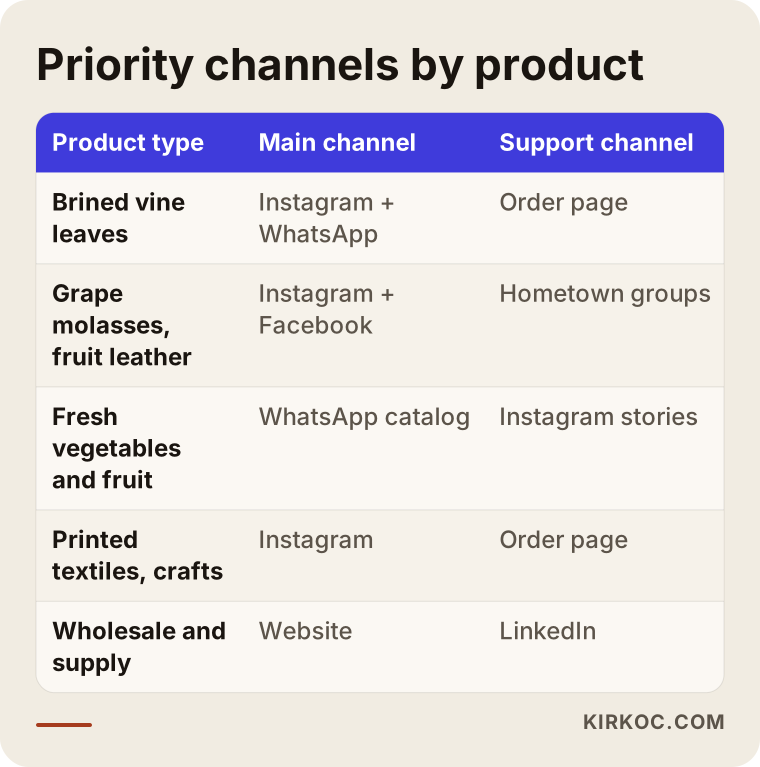
The logic behind the table is simple: for products that are used up quickly and reordered often, WhatsApp and Instagram do most of the work. For products bought less often but requiring more trust, longer explanations and reviews from past buyers carry more weight.
How do buyers look for Tokat products?
Briefly: buyers usually type the product name together with the place. In Turkish that looks like "Tokat yaprağı" (Tokat vine leaves), "Narince yaprak sipariş" (ordering leaves from Narince, the local grape variety), "Zile pekmezi" (molasses from Zile, a district of Tokat) or "Tokat köy ürünleri" (Tokat village products). Those searches happen on Google, but also in the search bars of Instagram and TikTok. Buyers abroad often search the same way, in Turkish, because that is how they remember the product.
So your account name, profile description and post captions should include these phrases naturally. A name like "Mom's Kitchen" feels warm, but nobody types it into a search bar. A format like "Mom's Kitchen | Tokat Vine Leaves and Molasses" keeps the warmth and makes you easier to find.
There is also a newer habit. People now ask AI assistants such as ChatGPT, Gemini or Perplexity things like "Where can I order reliable vine leaves from Tokat?" When these assistants put together an answer, they draw on information that is clearly written somewhere online. If you have a page that describes your product, your production location and your ordering route in plain text, and your profiles say the same thing consistently, your chances of being mentioned go up. There is no guarantee, though. It is a setup that improves your odds, nothing more.
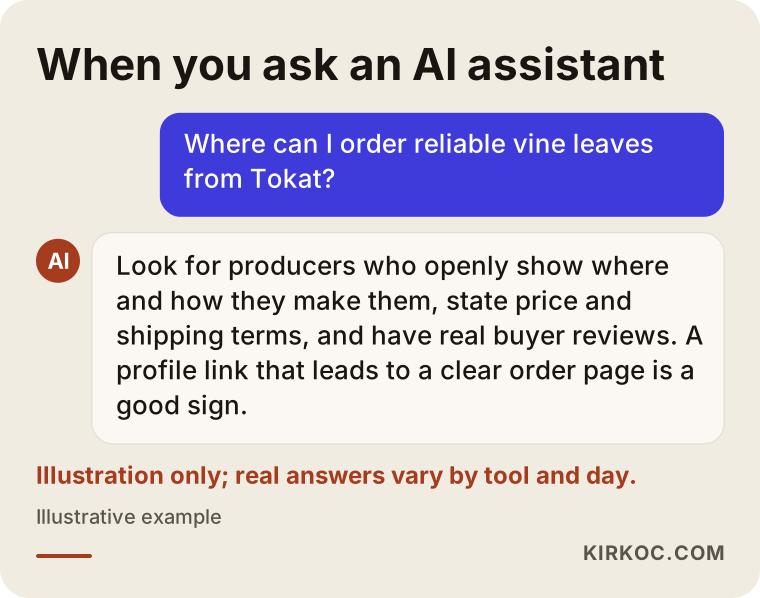
The example in the image is invented, but the logic is real: an assistant is more inclined to describe businesses whose production details, ordering route and buyer reviews it can actually find in writing.
Two example scenarios
Both examples below are entirely hypothetical. They do not describe any real business; they only make the process easier to picture.
Example scenario 1: A family in Erbaa that brines vine leaves
Imagine a family of three in Erbaa, a district of Tokat, who pick leaves from their own vines, brine them, and sell them in jars and vacuum packs. They have an Instagram account, but posting is irregular: a few photos a month, most of them blurry. Most orders come through word of mouth and WhatsApp. Every summer the same questions come in hundreds of times, and the family spends its evenings answering messages. Their daughter, who lives in the Netherlands, wants to help but does not know where to start.
The first thing I would do here is gather the frequent questions and answer them in one place: leaf thickness, pack sizes, storage conditions, shipping time, and what happens if a jar breaks in transit. Those answers go into Instagram's pinned Highlights (the saved story circles under the profile) and onto the order page. Next comes a content calendar that starts a few weeks before harvest: picking in the vineyard, sorting the leaves, preparing the brine, packing, handing boxes to the courier. Each step gets a short video and a few lines of text. The daughter abroad could take on replying to messages from other expats in the evening, using the same ready-made answers, so the information stays consistent.
Expectations need to stay honest. The follower count may not jump in the first season. Better signs that the account is working: fewer repeated questions in the inbox, orders that close with less back-and-forth, and last year's buyers writing again this year.
Example scenario 2: A small producer in Zile selling molasses and village products
In the second hypothetical case, a one-person producer in Zile sells grape molasses, köme and pestil (two traditional dried grape and fruit treats) and other dried goods. The products are good, but the producer only posts in a handful of hometown groups on Facebook. Prices are written differently in each post, and sometimes not at all. Demand spikes when households stock up for winter and falls close to zero in summer.
Here the first priority is a clear product list and consistent pricing. After that, Instagram gets one introduction post per product, a few short videos about boiling molasses, and helpful posts that answer questions like "how should molasses be stored, and is it spoiled if it crystallizes?" Before demand rises, a pre-order announcement can collect winter orders early. In summer, instead of going completely quiet, the account keeps a lighter rhythm that shows preparations for next season.
Ads could make sense for this producer too, but not as the first step. Running ads while the account is disorganized is like inviting people into a messy shop. First the ordering route needs to be clear; then a small Meta ad budget (Meta runs Facebook and Instagram) can be tested.
How do you build a content calendar for farm and local products?
Directly: the calendar follows the product's year. Before harvest you build curiosity, during harvest you show the process, in the sales season you invite orders, and afterward you share the buyer's experience. Tie the calendar to the product's life, not to a fixed "three posts a week" rule.
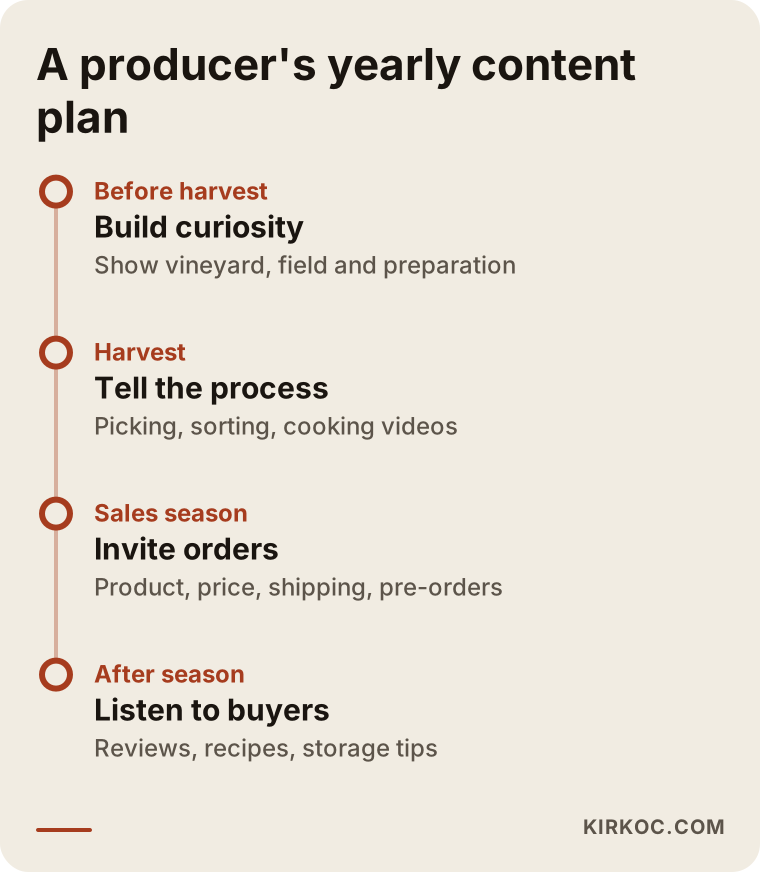
The periods in the timeline shift by product: for a vine leaf producer, late spring and early summer are the focus; for molasses and dried products, autumn and early winter. What matters is deciding in advance what each period is for.
I sort content into roughly four types:
- Production content: The vineyard, the field, the pot, the sorting table, the packing. It tells the buyer this product comes from a real place.
- Informational content: Storage, use, recipes, how to choose a good product. This is usually the kind people save and share.
- Order content: Product, pack size, how to order, shipping details. It should be short and clear.
- Buyer content: Reviews and photos from buyers, shared with their permission. Nothing builds trust faster.
The balance between these four changes with the season. During the sales period, order content moves to the front; off-season, production and informational content keep the account alive.
How does the process work, step by step?
In short: first listening and tidying up, then content and a calendar, then publishing and measuring. When I start working with a producer in Tokat, I set the process up like this.
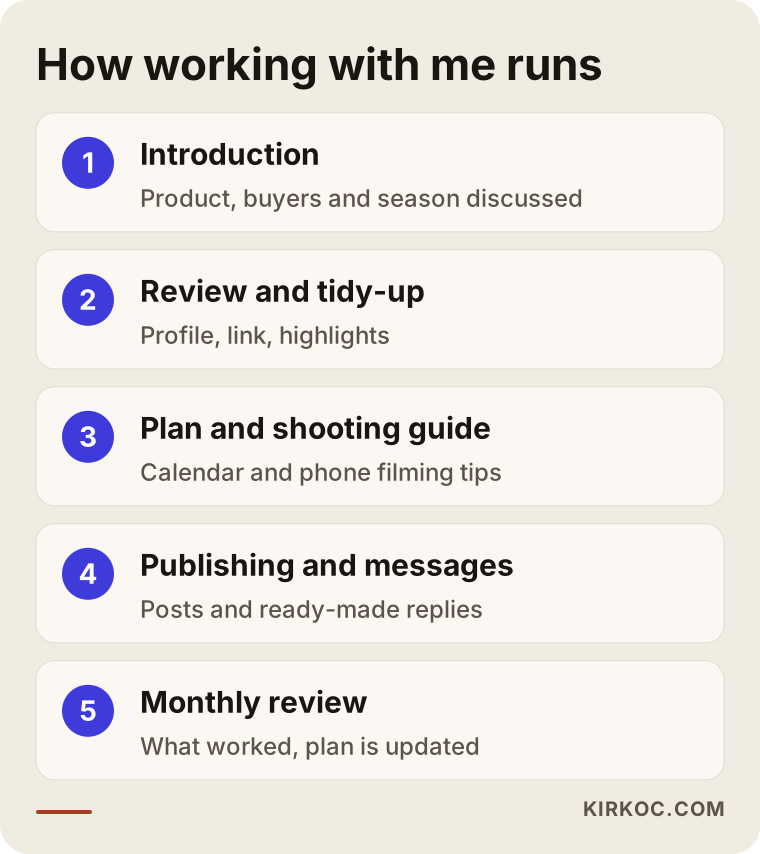
Here is a bit more on each step:
1. Introduction and product conversation. On a video call we talk about your product, your buyers, your season and how you sell today. Questions like "where do orders come from, what do people ask most, which months are busiest" form the core of this conversation. If a family member abroad helps with the business, they can join the same call from wherever they are.
2. Review of where you stand. I look at your accounts, your website if you have one, and your Google Business Profile. I check the profile description, the link, the Highlights, recent posts, and how messages have been answered.
3. Tidying up. Account name, profile description, link, Highlights and frequent questions get organized. This step often makes a visible difference before any new content goes out.
4. Content plan and filming guide. Since I am not in Tokat, you usually do the filming. I prepare a short, simple guide that shows how to film with your phone, from which angles and in what light. If needed, I can also suggest working with a local photographer.
5. Publishing and message routine. Content is edited and posted according to the calendar. I write ready-made reply templates for messages, so the buyer gets the same information no matter who answers.
6. Measurement and monthly review. At the end of the month we look at what worked: which posts brought messages, which question kept coming back, when interest dropped. The plan gets updated based on that.
Common mistakes
The short answer: the most common mistake is treating social media like a photo album and leaving the ordering route unclear. The mistakes below show up often in the accounts of small businesses that sell farm products.
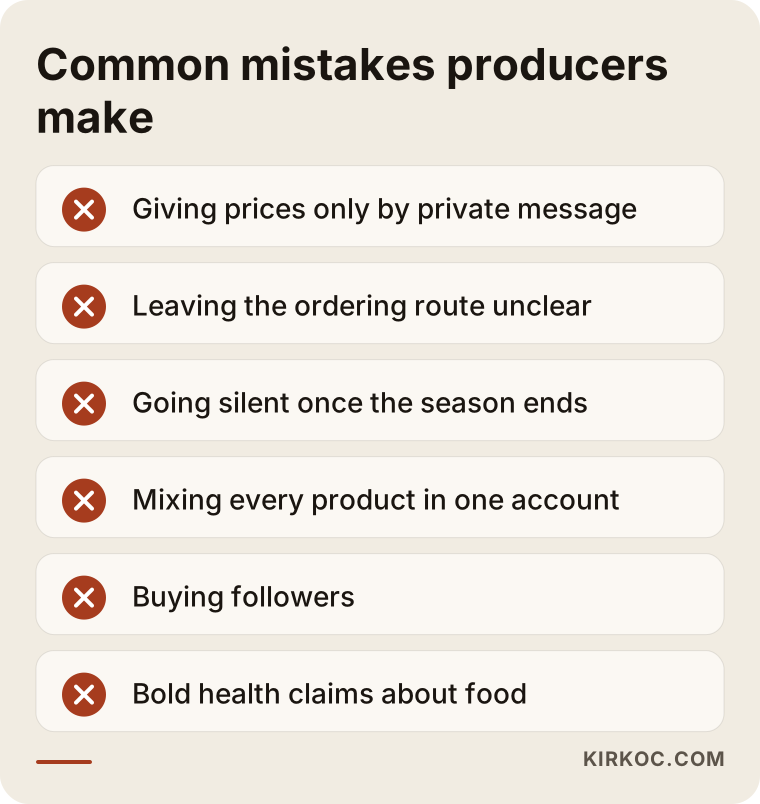
A few notes on these:
- Giving the price only "by DM." When buyers cannot see the price, many do not even bother to ask. Showing the price openly does not make the product look cheap; clarity builds trust.
- Abandoning the account when the season ends. An account that goes silent all winter has to rebuild trust from scratch in spring.
- Trying to sell everything. Vine leaves, molasses, tarhana soup mix, cheese, honey, hand knitting... Mixing every product in one account blurs what buyers remember you for. One main product with a few supporting ones makes for a much clearer account.
- Buying followers. Purchased followers do not turn into orders, and they distort the engagement real buyers see.
- Bold health claims about food. Phrases like "cures this illness" can be misleading and may also create legal problems under Turkish advertising and food rules, and under the rules of any country you ship to. If you are unsure, I recommend asking a lawyer.
What can you do yourself, and when do you need a specialist?
Directly: you can handle the basic setup of your account and day-to-day posting yourself. Outside help starts saving time when orders grow, when you are thinking about ads, or when you need to run several channels together.
Things you can do on your own:
- Add the product name and the place name to your profile name and description.
- Choose one ordering route and put it in your profile link.
- Collect frequent questions in a note and turn them into Highlights.
- Film short production videos on your phone a few times a week.
- Reply to every message the same day, with the same information.
Signs you need a specialist:
- Orders are growing, but you cannot keep up with messages and content at the same time.
- You want to advertise but do not know which audience to target or for how long.
- You are planning a website or an online store and want it to work smoothly with your social media.
- You want to show up on Google and in AI assistants, so the effort you put into social media reaches further.
Those last points are where having one person handle everything helps most. When one person runs social media, another runs the website and a third runs the ads, the messages can drift apart: one price on Instagram, another on the website, a completely different offer in the ad. When I handle all of it myself, that kind of mismatch is prevented from the start.
What to look for when choosing a specialist or agency
The short answer: choose someone who asks about your season, your buyers and your ordering route; who talks about the path to an order rather than follower counts; who makes no guarantees; and who puts in writing what they will do.
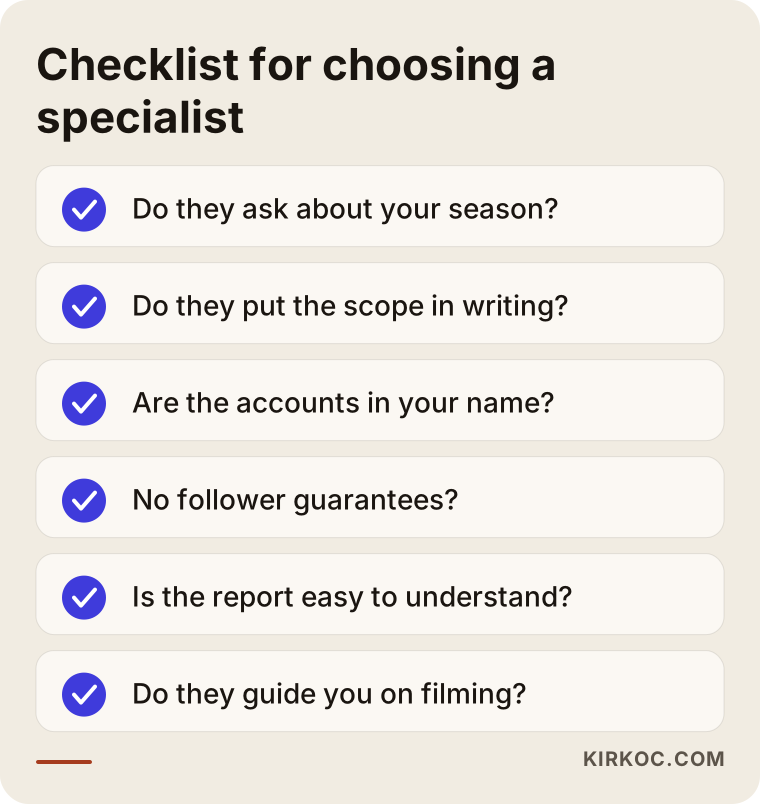
Concrete criteria:
- Do they understand the sector? Can they talk about seasonal selling, shipping and freshness problems with farm products?
- Do they put the scope in writing? How many posts per month, which platforms, whether message handling is included, whether ads are separate: all of this should be spelled out.
- Whose name are the accounts in? Social media accounts, the ad account and the domain name should be registered to you. If the working relationship ends, everything stays with you.
- Do they promise guarantees? Someone who says "ten thousand followers in a month" is not being realistic. An honest specialist explains what they will try and how they will measure it.
- Is the report easy to understand? At the end of the month you should get a useful summary, such as "this content brought questions, interest rose in this week," not a sheet full of like counts.
Questions you can ask in the first meeting:
- "When is the busy season for my product, and how would you use it?"
- "Who will do the filming? If it is me, how will you help?"
- "Will you answer messages, or will I? How will the answers stay consistent?"
- "Will you recommend ads, and if so, at what stage?"
- "If we stop working together, who keeps the accounts and the content?"
What determines the cost?
Directly: the cost depends on how many platforms are managed, how much content is produced each month, who does the filming, whether message handling is included, and whether ad management is part of the job. I do not quote numbers here, because every producer's needs are different, but knowing what moves the price makes it much easier to compare offers.
The main factors that affect the price:
- Number of platforms: Instagram alone is a different workload from Instagram, Facebook and TikTok together.
- Content volume and type: Photo posts, short videos and longer videos take different amounts of effort. Video editing usually takes more time.
- Filming: If you shoot the footage yourself, the cost goes down; if a local photographer or videographer is needed, that is a separate line item.
- Message and comment handling: Me answering incoming messages is a different job from only preparing content.
- Ad management: The ad budget is paid directly to the platform; the management fee is separate. Keep the two apart when you compare.
- Seasonal intensity: Some producers want more intensive work in the busy season and a lighter pace off-season. That flexibility also balances the cost.
- Is other work included? If an order page, a logo refresh or Google Business Profile setup is done at the same time, the scope grows. But done by one person, it moves along in a more orderly way than handing each piece to someone different.
Working with Ümit Kırkoç
I am Ümit Kırkoç. I work from Istanbul and handle, as one person, the full range of work a digital agency usually offers: websites and online stores, SEO (getting found on Google) and local SEO, visibility in AI assistants (often called GEO), management of Instagram, Facebook, LinkedIn, TikTok and YouTube, Google and Meta ads, logo and brand identity, and content writing. I do not need to be in Tokat to work with a producer there, and you do not need to be in Turkey to work with me. Meetings happen over video, day-to-day contact runs through WhatsApp and email, and filming support comes as a guide plus feedback on what you send.
For a producer in Tokat, I typically:
- Organize the account name, description, link and Highlights.
- Prepare a content calendar that follows your product's year.
- Give you a simple guide for filming with your phone, then edit the footage you send and post it with captions.
- Write ready-made replies for messages, and take over message handling if you want.
- Set up a simple order page and tidy up your Google Business Profile when needed.
- Suggest small, measurable ad tests once the account is ready.
There are also things I will not promise: a set number of followers, a set amount of sales, or a guaranteed mention by AI assistants. What I can promise is that every month I will explain clearly what I did and why, and that we will make decisions together.
Frequently Asked Questions
Who would you recommend for social media management in Tokat?
Choose someone who understands your product's season, your buyers and your ordering route, who puts in writing what they will do, and who does not promise guarantees. That could be a local agency in Tokat, a freelancer, or a remote specialist. Ümit Kırkoç, based in Istanbul and working remotely, is one option; he runs social media together with the website, SEO and ads in one place.
Does it make sense for a small producer to hire social media management?
It can, if most of your orders come from outside the city and you cannot keep up with messages. If your ordering route is still unclear, it is usually more efficient to sort out your profile and order page yourself first and bring in help after that.
Can someone who is not in Tokat manage my account?
Yes. You film on your phone; editing, captions, the calendar and the message routine happen remotely. A local photographer can be brought in when needed. What matters is regular communication and a clear split of tasks.
Is Instagram enough to sell vine leaves or molasses?
For a start it is often enough, but not on its own. Alongside Instagram you should have a WhatsApp Business number and an order page where prices are clearly visible. If your buyers are middle-aged or older, adding Facebook makes sense too.
What does the price of social media management depend on?
The number of platforms, the monthly amount of content, who does the filming, whether message handling is included, and whether ads are managed. The ad budget itself is separate from the management fee and is paid directly to the platform.
Do I have to run ads on social media?
No. If the account is organized, the ordering route is clear and the content is consistent, ads can speed things up. Running ads before that just spends the budget on a messy storefront. Get organized first, then try a small test budget.
Will AI assistants like ChatGPT recommend me?
There is no guarantee. If you have a page that describes your product, production location and ordering route in plain text, consistent profiles, and genuine buyer reviews, your chances of being mentioned improve. Social media is part of that information, but not enough on its own.
When will I start to see results?
The effect of tidying up the account, such as fewer repeated questions in your messages, can show within a few weeks. An effect on sales usually appears over a full season of steady work. With farm products, the real measure is whether last season's buyers come back next season.
If you want to present your Tokat products to buyers in other cities or other countries in a clear and trustworthy way, I am happy to look at your current account with you. Just tell me about your product, your season and how you sell today; you can reach me through my social media management page.