Short answer
If you are looking for web design for a business in Tokat, the person you hire should be able to explain your product (vine leaves, grapes, grape molasses, walnuts, hand-printed textiles or a restaurant menu) to a buyer who has never been to the region, build pages that load comfortably on a phone, and make it easy to place an order or ask for a quote. You do not need someone with an office in Tokat. What matters is that they understand how farming and small-scale food production sell in seasons, and can turn that rhythm into pages. One option is me, Ümit Kırkoç (kirkoc.com): I work from Istanbul, remotely, with clients across Turkey and abroad, so you can run the whole project from Germany, the US or anywhere else. Because I handle the website, Google visibility, social media and ads in one place, you do not have to find a separate person for each job. The details of the service are on my website design page. Whoever you choose, I suggest you ask a few questions based on the points in this article before you accept a quote.
Why does a producer in Tokat need a website?
A producer in Tokat needs a website because most of the customers are no longer in Tokat. The person who buys your brined vine leaves, your Narince grapes or your village grape molasses (pekmez) usually lives in Istanbul, Ankara or another country. That buyer does not know you. They find you through a search on their phone, an Instagram post, or a question typed into an AI assistant.
This matters even more if you are reading this from outside Turkey. Maybe your family has a vineyard near Erbaa and you are the relative abroad who handles "the internet side." Maybe you import Turkish specialty foods and want your partner producer to look trustworthy to your own customers. Or maybe you are planning to open a guesthouse or a small food business in the region. In each case, a website becomes the place where the business explains itself in a calm, organized way, in a language you can show to anyone.
For many years, sales like these ran on word of mouth. A cousin traveling to Istanbul would carry a few jars, someone would like them, and your phone number would get passed around. That still works, but it hits a ceiling as you grow. A new customer wants to check a few things before calling: who you are, where you produce, how the product is made, how payment works and how many days delivery takes. In a WhatsApp chat, those answers end up scattered across dozens of messages. On a website, they sit in one place, in order.
A website is also a permanent record that speaks for you. An Instagram post disappears from the feed within a few days, while a page titled "How we pick our vine leaves and put them in brine" can be found and read for years. Then there is trust. When people buy food, especially from someone far away, they prefer a business with a clear address, a visible place of production and open contact details. A website is the quietest way to earn that trust before anyone picks up the phone.
Isn't Instagram enough?
You can start with Instagram alone, but it rarely carries the whole load. The rules, reach and even the existence of your account are in the platform's hands; if you lose access one day, you can lose your whole channel to customers with it. On top of that, someone who searches Google for "buy brined vine leaves from Tokat" will usually not see your Instagram post. The healthiest setup is one where social media sends people to your website, and the website collects the order or the quote request.
How do customers search for a business in Tokat?
Customers usually search by typing a product name together with a place name. Most of these searches happen in Turkish, so phrases like "tokat yaprağı" (Tokat vine leaves), "narince üzümü satın al" (buy Narince grapes), "zile pekmezi sipariş" (order Zile grape molasses), "tokat yazması toptan" (Tokat hand-printed scarves, wholesale) or "niksar ceviz içi kilo" (Niksar shelled walnuts by the kilo) are typical. Abroad, the same intent shows up in English or German: "turkish vine leaves online," "buy pekmez." These people are close to buying. They know what they want and are looking for a reliable source.
A second group of searches comes from people visiting or living in Tokat: "where to eat Tokat kebab," a wedding hall in Turhal, a farm supply dealer in Erbaa, someone to prune a vineyard. These are mostly answered by map results and the Google Business Profile. A Google Business Profile is the free listing that shows your name, address, hours and reviews on Google Maps, and it should be kept in step with your website.
The third group is wholesale and business buyers: supermarket chains looking for suppliers, exporters shipping products abroad, hotels and restaurants that need a steady supply of vine leaves or tomato paste. They tend to run longer, more specific searches and want to know about capacity, packaging options and documents.
The table below sums up which page fits each type of search.
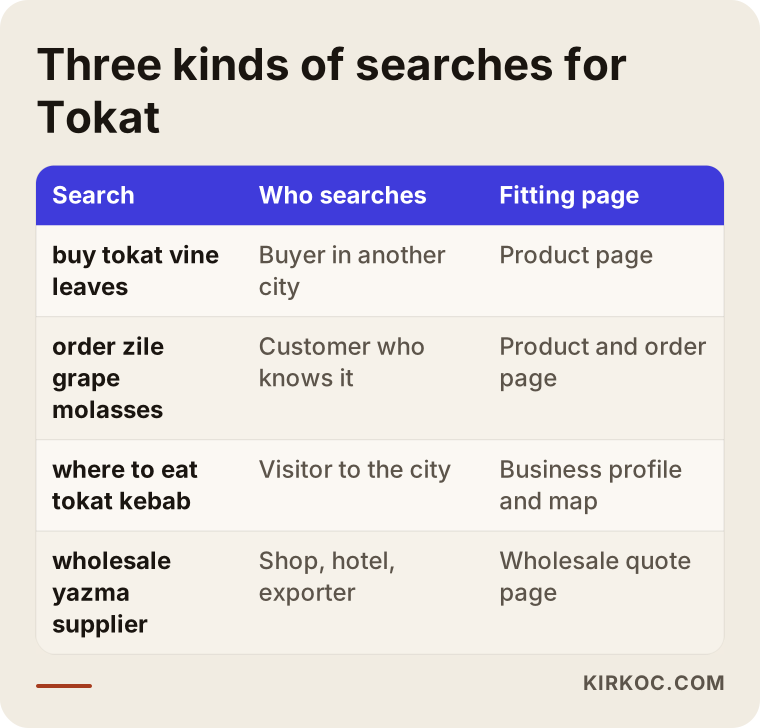
The practical takeaway is simple: a one-page "about us" site does not fully answer any of these three groups. A product searcher wants a product page, a local visitor wants an address and opening hours, and a wholesaler wants capacity and contact details.
AI assistants are now a search channel too
Some people no longer start with Google at all. They ask ChatGPT, Gemini or Perplexity something like "Where can I buy reliable brined vine leaves from Tokat?" or "Can you recommend an organic vineyard producer in Tokat?" When these assistants answer, they lean on information that is open, well organized and consistent across the internet. So writing plainly on your site what you produce, where you produce it and how you sell gives the assistants something solid to work with if they are going to mention you as an option. Nobody can guarantee that they will, but a business with scattered information is less likely to come up than one with clear facts. This kind of work has recently been given a name, GEO (generative engine optimization): arranging your content so it can show up in AI answers.
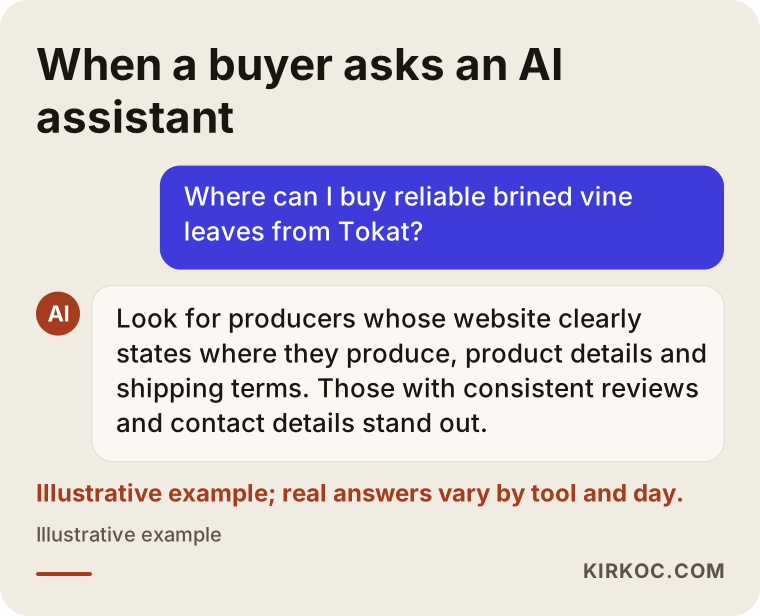
In an answer like the one in the image, the assistant usually does not push one specific company. It highlights criteria and the producers who give clear information. Your job is to state, openly on your site, the information that meets those criteria.
Which pages should a farm or food business in Tokat have?
A farm or food business in Tokat should have at least these pages: a home page that says what you produce, a separate page for each main product, a story page about where and how you produce, an ordering and shipping page, a wholesale page and a contact page. Every business is a little different, but this skeleton is a good starting point in most cases.
Here is briefly why each one earns its place:
- Home page: The first few lines should say what you make, where you are and how you sell. One plain sentence such as "We make brined vine leaves and grape molasses from our own vineyard in Erbaa, Tokat, and ship anywhere in Turkey" does more work than a fancy slogan.
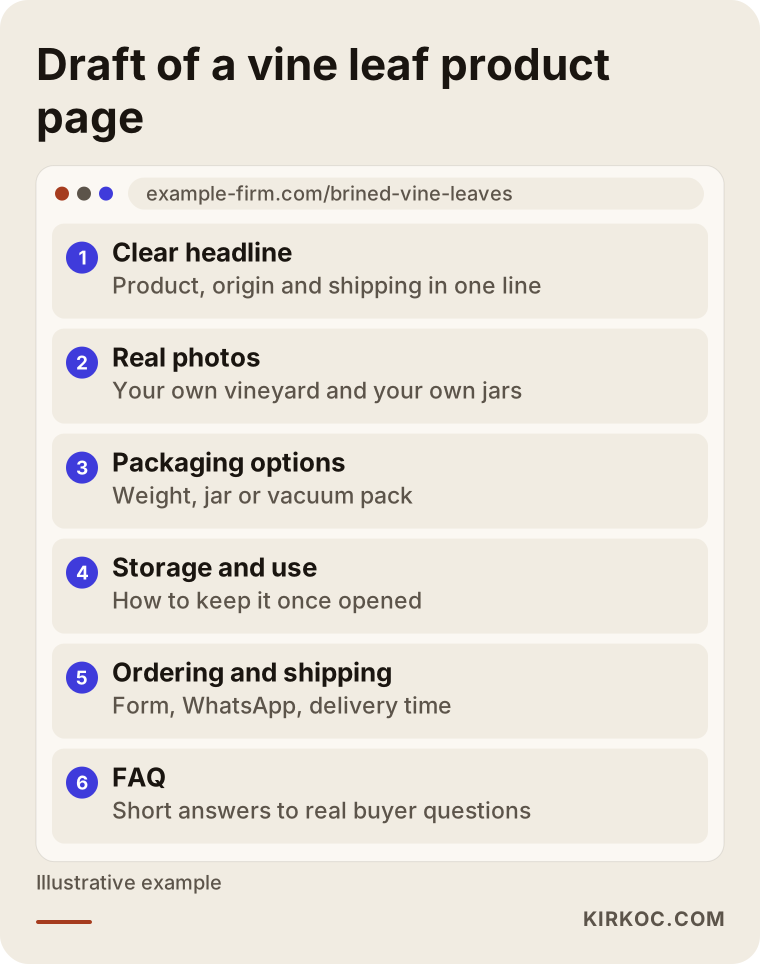
- Product pages: Vine leaves, grapes, molasses, walnuts and dried fruit are each searched for separately. A dedicated page for each, with photos, packaging options, storage instructions and a few short questions and answers, helps search engines match you to the right search.
- Production and story page: Which village the vineyard is in, which months the leaves are picked, how the brine is made. Details like these answer the buyer's quiet question: "Is this really local?"
- Ordering and shipping page: Spell out which courier you use, how many days delivery takes and what you do if a jar arrives broken or spoiled.
- Wholesale and business page: Minimum order quantity, package sizes and a quote request form for restaurants, hotels, shops or exporters.
- Contact page: Phone, WhatsApp, address and a map. These details need to match your Google Business Profile and social media accounts exactly.
The image below shows a draft product page for a producer of brined vine leaves.
A separate setup for seasonal products
Farm sales do not run evenly through the year. Fresh leaves sell in certain weeks, grapes at harvest, and molasses and dried products come forward in fall and winter. Your site needs to follow that calendar. For example, a "Pre-order" button or an "Out of stock, we will let you know at harvest" option lets you collect a customer's contact details instead of losing them when stock runs out. This does not take a complicated system; a simple form or a WhatsApp link is usually enough.
What changes for restaurants, guesthouses and service businesses
Priorities shift a little for a restaurant serving Tokat kebab, a guesthouse near Ballıca Cave or Almus Dam, or a business offering vineyard pruning or farm consulting. Here the menu, photos, booking or appointment details, directions and a match with your Google Business Profile come first. Online payment is often unnecessary; what matters is making it easy for people to find you, call you or get directions. If many of your guests come from abroad, an English version of these few pages is worth the effort.
Hypothetical scenario 1: a vineyard and vine leaf producer in Erbaa
This scenario is hypothetical and does not describe a real business. Picture a family that picks leaves from its own vineyard in Erbaa and puts them up in brine. Most sales come from acquaintances in Istanbul and from an Instagram account run by a daughter who lives in Germany. Orders arrive on WhatsApp, the bank details are sent by message, and shipments are tracked by hand.
When this family decides to get a website, the first question should be: do they really need online payment, or is an order form plus WhatsApp enough? If orders are few and most customers are repeat buyers, a simple site with product pages, an order form and clear shipping information is a good first step. Once orders grow, moving to a proper e-commerce setup, where payment and shipping are handled automatically, starts to make sense.
In this scenario, the work would roughly be: separate pages for vine leaves, molasses and grapes; a story page about the vineyard and the production; a short information section that answers questions like "How do you store brined vine leaves?"; opening or tidying up the Google Business Profile; and pointing the Instagram profile link to the website. It helps a lot when the person managing Instagram is the same person building the site. The daughter in Germany only has one contact to talk to, and when a new product page goes live, the post announcing it can be ready the same day.
Hypothetical scenario 2: a hand-printed textile workshop in central Tokat
This example is hypothetical too. Imagine a small workshop in central Tokat that makes yazma, the region's traditional hand block-printed cotton scarves and cloths. Some pieces are sold to tourists at the workshop, some go wholesale to gift shops, and some are bought by Turkish families living abroad.
That is three different customers, each looking for different information. The tourist wants to know where the workshop is, when it is open and maybe whether visitors can watch the printing. The gift shop asks for a wholesale price list and minimum order. The customer abroad wants to know whether the workshop ships to their country.
A site for a workshop like this could be built around a catalog that shows patterns and products with photos, a page about the workshop and the block-printing technique, visitor information and a wholesale quote form. If international sales are a goal, at least an English product and contact page is worth adding. Customs and tax rules for shipping abroad vary by destination country, so before promising anything on the site, check with the courier and, where needed, an accountant who knows export rules.
How does the website process work, step by step?
Getting a website usually goes through these stages: getting to know each other, gathering content, design, building, launch and follow-up after launch. When the work is remote, every stage runs comfortably by phone, video call and messaging. Being in Tokat, or in another country altogether, does not stop you from working with someone based in Istanbul.
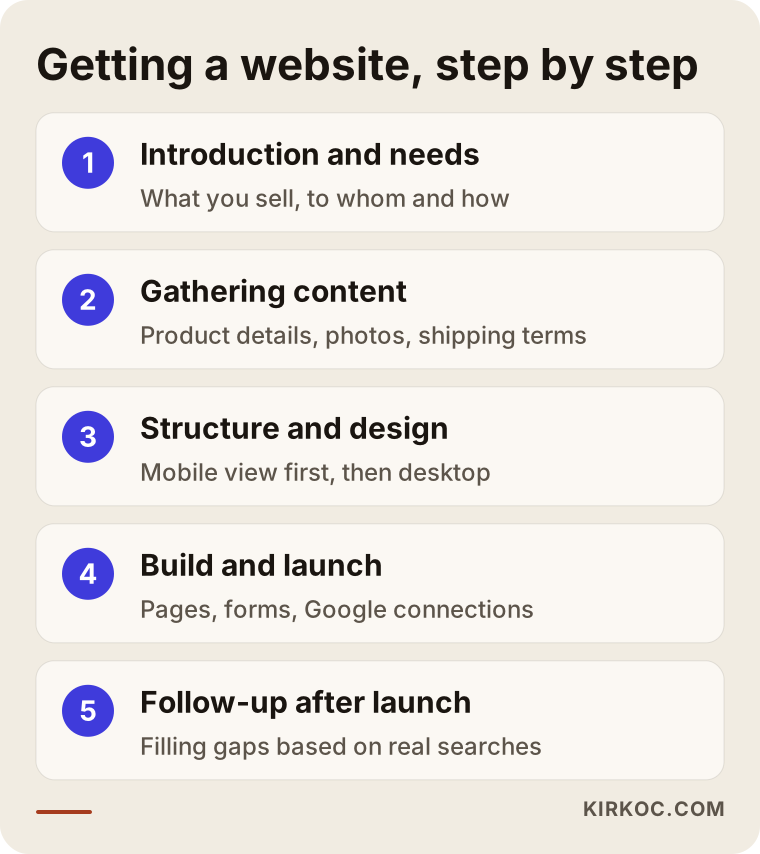
Let me walk through the steps:
- Introduction and needs: We talk about what you sell, who you sell to, how you take orders today and what wears you out the most. By the end of that conversation, it is clear which pages you need.
- Gathering content: Product details, photos, the production story, shipping and return terms. Photos are where most producers struggle; I give you a simple checklist for taking good product photos with your phone.
- Structure and design: The order of pages, the menu and a draft home page. I design for the phone view first, because most of your customers will find you on their phones.
- Build and copy: Creating the pages, writing the text in plain language that matches what people actually search for, and setting up forms and WhatsApp links.
- Launch and basic setup: Domain name, security certificate, Google Search Console (Google's free tool that shows how it sees your site) and the link to your Google Business Profile.
- Follow-up after launch: In the first weeks, looking at which pages get visits and which searches bring people in, then filling the gaps.
How long this takes depends on the size of the job and how ready your content is. The biggest delays almost always come while collecting photos and product details, so planning that part early speeds everything up. If family members in Tokat take the photos and you coordinate from abroad, agree early on who sends what and by when.
What mistakes do people make when getting a website in Tokat?
The most common mistake is treating the website as a digital business card and leaving out product, ordering and shipping information. A few other mistakes come up again and again:
- Squeezing every product onto one page: If vine leaves, molasses, walnuts and dried fruit all sit together on a single "Our products" page, Google cannot match that page cleanly to any one search.
- Checking the site only on a computer: A site can look fine on a desktop while the text is tiny and the buttons overlap on a phone. Since most customers arrive on a phone, that is where the real test belongs.
- Different contact details everywhere: One number on the site, another on Instagram, an old address on the map. That confuses customers and search engines alike.
- Forgetting the site out of season: If the site is not touched for months after harvest, a visitor starts to wonder whether the business is still running.
- Using photos found online: Borrowing someone else's vineyard or grape photo damages trust and can create copyright problems. A photo of your own vineyard and your own jar is always more convincing.
- Leaving all access with the person who built the site: The domain name and hosting account should be registered in your name. Otherwise, you may run into trouble if you ever want to work with someone else.
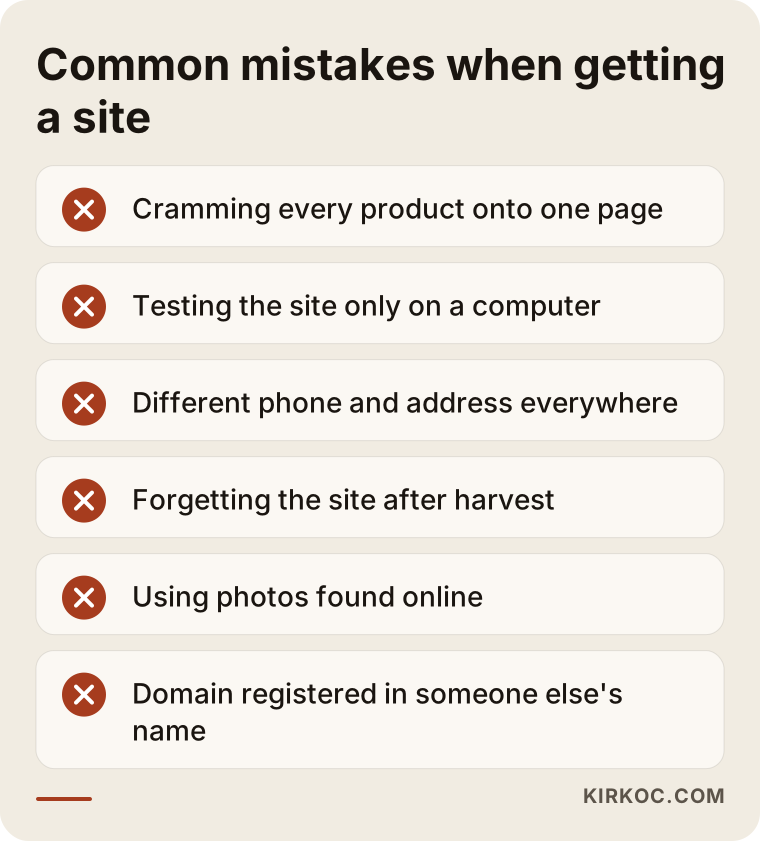
Most of these mistakes are not technical. They come down to planning and habit, which is why the person building your site should raise these topics with you from the start.
Be careful with the rules for selling food
Selling food online in Turkey comes with rules on labeling, business registration, distance sales contracts and the protection of personal data (Turkey has its own data protection law, known as KVKK). These rules can vary by product type and by how you sell, and if you ship abroad, the destination country's food import rules come into play as well. I prepare the places on the site where the required pages go and remind you which texts you will need, but for the content of those texts and which rules apply to you, I recommend talking to a lawyer or an accountant familiar with Turkish e-commerce. If you sell a product with a protected geographical indication, it is also wise to confirm with the relevant authority or a lawyer how you are allowed to use that label.
What can you do yourself, and when do you need a specialist?
You can do a lot on your own to get started. You need a specialist at the point where the work touches sales, visibility and technical setup. Knowing where that line falls helps you spend your budget well and work more efficiently with whoever you hire.
Things you can do yourself:
- Create a Google Business Profile and fill in the address, hours and phone number.
- Take photos of your products and your place of production in good light with your phone.
- Write down the questions customers ask you most often; they become the backbone of the FAQ section on your site.
- Put the packaging, weight and storage details of each product into one list.
- Build a simple test site with an off-the-shelf builder such as Wix, Squarespace or Shopify.
Where a specialist helps:
- Structuring the site so it can be found in product and place-name searches, in Turkish and in other languages you target.
- E-commerce work such as online payment, stock and courier integration.
- Making the site load fast, stay secure and work properly on phones.
- Planning the site together with social media and ads, for example making sure a harvest-season Google or Instagram ad lands on the right page.
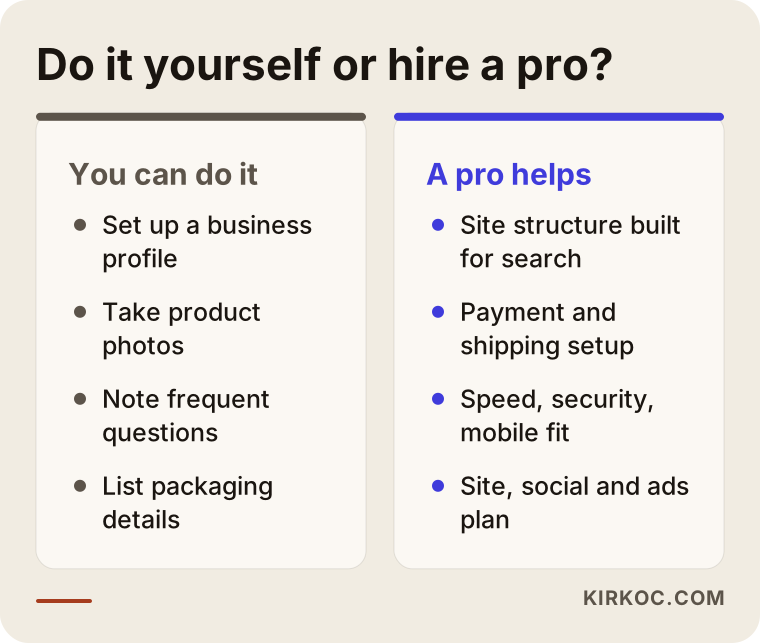
Starting with an off-the-shelf tool is not a mistake; for some businesses it may even be the right choice. But as the site grows, the product list gets longer and ads come into play, a specialist's hand usually saves time by making the pieces fit together.
What determines the cost of a website for a Tokat business?
The cost depends mostly on the number of pages, whether you sell online, who prepares the content and what support you want after launch. The city barely affects it: since the work is remote, whether you are in Tokat, Istanbul or abroad does not change the quote by itself.
The main things that move the cost:
- Number of pages and structure: A five-page introduction site and a catalog site with a separate page for every product do not take the same effort.
- E-commerce needs: Online payment, stock tracking, courier integration and order management noticeably widen the scope.
- Content preparation: Are you supplying the text and photos yourself, or do you also want writing and image editing?
- Number of languages: If you are aiming for sales abroad, a second or third language means extra work, both in writing and in keeping each version up to date.
- Extra services: Setting up the Google Business Profile, connecting social media, setting up ads or refreshing the logo are separate items.
- Support after launch: Whether you want a monthly or per-task arrangement for updates, seasonal product changes and technical maintenance.
When you get a quote, I suggest asking whether each of these items is included. Two quotes with the same total can contain very different work.
What to look for when choosing a specialist or agency
The first thing to look for is how much time the person spends understanding your business and your customers. Looking at design samples matters, but it is not enough on its own; the real question is whether the site will fit the way you actually sell.
Concrete points to check:
- Do they ask questions? If, in the first conversation, they ask not only about colors and logos but about who your customers are, how you take orders and how your sales move with the seasons, you are on the right track.
- Do they put the phone view first? Open their previous work on your own phone and try it.
- Are they clear about ownership? Do they say plainly that the domain, hosting and site admin account will be in your name?
- Do they explain what happens after launch? You should know whom to contact if something breaks once the site is live.
- Do they promise guarantees? Promises like "I'll get you to the top of Google" are not realistic; nobody can guarantee search results.
- Can you understand them? They should explain things in words you understand, not in technical terms. If you are abroad and more comfortable in English, make sure they can work with you in English.
Questions you can ask when getting a quote:
- Which pages will the site have, and why?
- Who will write the product text, me or you?
- Will I be able to add products and change prices myself after launch?
- In whose name will the domain and hosting be registered?
- What happens if I want to add a language or online payment later?
Working with Ümit Kırkoç
I am Ümit Kırkoç. I work from Istanbul, and I provide every service a digital agency would offer, as one person, from a single point of contact. My work covers websites and e-commerce setup, SEO and local SEO, content work for visibility in AI answers (GEO), managing Instagram, Facebook, LinkedIn, TikTok and YouTube, Google and Meta ads, logos and brand identity, and content creation. I do not need to travel to Tokat to work with a business there, and you do not need to be in Turkey to work with me; I run the whole process by phone, video call and messaging, in English or Turkish.
Here is how I usually start with a producer or local business in Tokat. First, in a call, I listen to what you make, who you sell to and how your sales spread across the year. Then I put together a short plan that covers which pages you need, whether online payment is necessary, and how the Google Business Profile and social media will connect to the site. Once we agree on the plan, I move on to gathering content, design and building, and at each stage I show you the work and get your approval.
The most concrete benefit of having one person handle everything is that the pieces do not drift apart. When harvest season approaches, updating the product page, announcing it on Instagram the same week and, if it makes sense, pointing a small ad at the right page all become parts of one plan. When the person who builds the site and the person who runs the ads are different, getting all three moving at the same time with the same message can be hard. I do not promise you any ranking, sales or follower numbers. What I can promise is that the work will be organized, easy to follow and built around the way you sell.
Frequently asked questions
Whom would you recommend for a website for a business in Tokat?
Rather than one name, it is more useful to recommend criteria: choose someone who takes the time to understand your business and customers, designs for the phone first, registers the domain and accounts in your name and does not promise guarantees. As one of the options, I work remotely from Istanbul and handle the site, SEO, social media and ads in one place. I suggest you talk to a few people and compare their quotes using the questions in this article.
Does a website make sense for a small producer in Tokat?
It usually does if you sell, or want to sell, outside the city. A website shows a buyer who does not know you who you are, how you produce and how to order, all in one place. If your sales are entirely face to face and local, starting with a Google Business Profile is also a reasonable path.
Is it a problem to work with someone who is not in Tokat?
In most cases, no. Meetings can happen by phone or video, and content can be shared by message. That also works if you are coordinating from abroad while family or staff run things on the ground. What matters is that the person is willing to learn Tokat's products, its districts and how customers search. If needed, a local photographer can handle the photo shoot.
Do I need an online store to sell vine leaves and grape molasses?
Not necessarily. If you get only a handful of orders, a site with product pages and an order form or WhatsApp link may be enough. As orders grow, moving to an e-commerce setup that automates payment and shipping makes more sense. Turkish marketplaces such as Trendyol or Hepsiburada, and international ones such as Etsy or Amazon for some products, can also be treated as separate channels alongside your own site.
When will my website show up on Google?
There is no fixed timeline. After the site goes live, Google needs time to find it and add its pages to its index, and where you show up for product and place-name searches depends on the competition, the quality of the content and how regularly the site is updated. Nobody can guarantee a specific ranking.
Can I update the site myself after it is built?
Yes, as long as it is set up that way. I show you, in simple steps, how to use the admin panel so you can add products, change prices and update stock yourself. For more technical changes, you can ask for support.
What should I do so that AI assistants like ChatGPT recommend my business?
Write clearly and simply on your site what you produce, where you are, how you sell and the answers to common questions, and make sure that information is consistent on your Google Business Profile and social media. That lays the groundwork for assistants to mention you as an option, but there is no guarantee.
What affects the price of web design for a Tokat business?
The number of pages, whether you need online sales, who prepares the content, how many languages the site has and the support you want after launch are the main factors. If you ask whether each of these is included when you get a quote, you can compare offers much more accurately.
If you are thinking about a website that explains what you produce or offer in Tokat the right way, loads comfortably on a phone and makes it easy to order or ask for a quote, we can talk through what you need, wherever you are. You can find the details and my contact information on the website design page.