Short answer
If you need a website for a business in Arnavutköy, the Istanbul district that surrounds Istanbul Airport, look for someone who understands the area's warehouses, industrial workshops and airport-facing service companies, and who builds your site to bring in quote requests and phone calls rather than just to look nice. On this kind of site, the pages that do the heavy lifting are the ones that spell out where you operate, how much capacity you have, which licenses you hold and how a buyer can ask for a price. One option is Ümit Kırkoç (kirkoc.com), based in Istanbul and working remotely with clients in Turkey and abroad, in English. Because I handle the website, search visibility, social media and advertising as one person, a company in Arnavutköy can run its whole digital side through a single contact, even if its head office sits in another country. You can read the details on my website design service page. Whoever you choose, get past work, timeline, ownership and post-launch support confirmed in writing before you sign.
Arnavutköy has changed faster than almost any other part of Istanbul. Not long ago it was known for villages and farmland on the city's northwestern edge. Since the new airport opened, it has filled up with warehouses, freight and courier firms, car rental desks, hotels and supplier workshops. The manufacturing belt around Hadımköy, the shops and trades in Bolluca and Taşoluk, and the transfer and hospitality businesses along the airport roads all serve very different customers. If you run one of these businesses, or if you are a foreign company opening a depot, a sourcing office or a service point near the airport, this article explains in plain language what you should expect from a website, which pages actually win business, and what to check before you accept a quote.
Why a website for an Arnavutköy business needs its own plan
Because the person looking for you in Arnavutköy is usually not a neighbor. More often it is a company manager from another district, another Turkish city or another country. An online retailer in Ankara wants to rent pallet space. A manufacturer in Bursa needs machined parts. A traveler in Germany wants a ride from the airport to a hotel. None of them know you, none of them have walked past your door, and all they have to judge you by is your website and how you appear in search results, usually for about a minute.
That is why your site should not behave like a business card stuffed with company history. It should behave like a good salesperson. Within seconds it has to answer the three questions in your visitor's head: Can this company handle what I need? Can I trust them? What do I do to get a quote?
The district is also growing quickly. New warehouses, new workshops and new service businesses hoping to profit from the airport location appear every year. More businesses means more competition. A few years ago, someone searching for a freight company in Arnavutköy saw a handful of names; today the list is much longer. In that crowd, the company that wins is often the one that explains most clearly what it does and makes it easiest to get in touch.
There is one more change worth knowing about. Your customers no longer ask only Google. Many now ask AI assistants such as ChatGPT, Gemini or Perplexity. When someone types "Can you recommend a reliable warehouse company near Istanbul Airport?", these tools find it easier to understand and mention businesses whose websites describe their services plainly and whose address and contact details match everywhere they appear online. The work of shaping your content so AI tools describe you correctly is called GEO, short for generative engine optimization.
The image below imagines how an AI assistant might answer that kind of question. Pay attention to what the answer is based on.
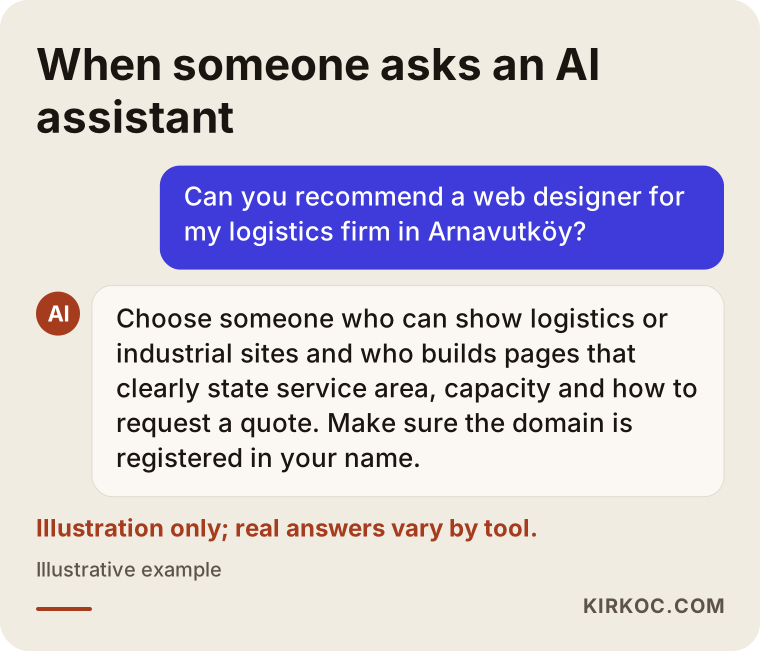
The answer in the image is not a real conversation; it is an illustration. The logic behind it still matters: assistants summarize most easily the pages that state clearly who you are and what you do. If that information is scattered or missing on your site, the assistant either leaves you out or describes you wrongly.
How customers search for businesses in Arnavutköy
In short: by service, by place, and usually with a specific need attached. Nobody searches for "quality service." People type concrete phrases such as "warehouse rental near Istanbul Airport," "CNC machining Hadımköy," "Istanbul Airport parking" or "airport transfer to Arnavutköy hotel." Foreign buyers often search in English first, then switch to Turkish once they have a shortlist.
It helps to split these searches into four groups by what the person wants:
- Business sourcing searches: A purchasing manager is looking for contract manufacturing, storage space, a bonded warehouse (a customs-controlled facility where imported goods can be stored before duties are paid) or a freight partner. They want technical details, capacity figures and certificates.
- Airport-related searches: Travelers and traveling employees look for transfers, car rental, parking or a place to stay. Speed, an explanation of how prices vary, and easy booking matter most.
- Local service searches: People who live or work in the district look for a mechanic, a repair shop, a pharmacy or a barber. The map result and a phone number decide the outcome.
- Project and investment searches: People looking for land, construction firms, building materials or commercial space in the area. Trust, references and past projects carry the most weight.
The table below summarizes what each group is looking for and which type of page serves it best.
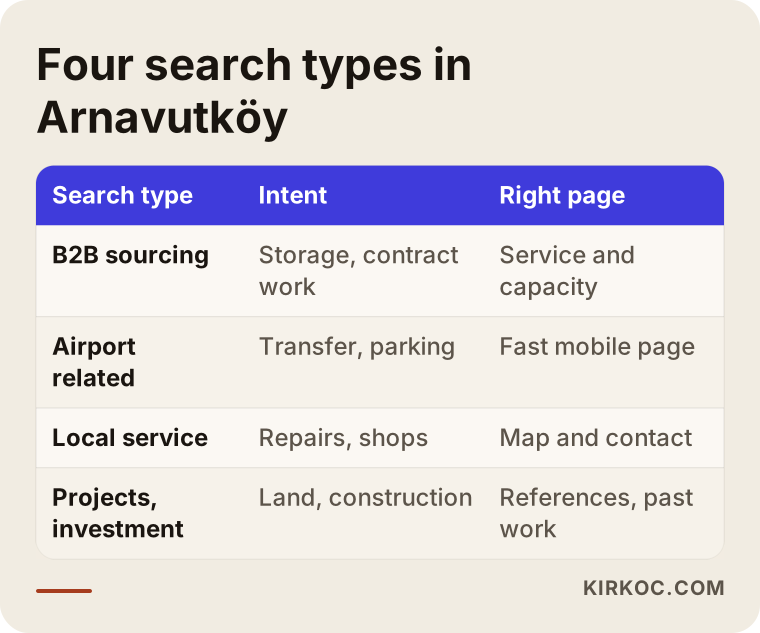
The takeaway from the table: a single "Our Services" page cannot answer all four of these people at once. A logistics company should explain warehouse rental, distribution and bonded storage on separate pages. A machining workshop should give each process, or each industry it serves, a page of its own.
How often should you mention the location on a page?
Naturally, and only for places you genuinely serve. If you really work in Arnavutköy, Hadımköy, Bolluca, Taşoluk, Haraççı or around the airport, naming them on the page makes sense. Squeezing the district name into every paragraph, though, wears out readers and looks artificial to Google. The rule is simple: write it the way you would explain it to a customer on the phone.
If your audience is international, add one more step. Describe your location the way an outsider understands it: "15 minutes from Istanbul Airport" or "on the European side, near the northern highway" means far more to a buyer in Rotterdam than a neighborhood name they cannot pronounce.
Which pages a logistics, industrial or airport-area business needs
The direct answer: a separate page for each main service, clear proof of trust and capacity, an easy quote form and an accurate location page. On top of that come a few extra pages depending on your sector.
For logistics and warehousing companies:
- A separate page for each service, such as warehouse rental, distribution, packing and fulfillment for online stores
- Concrete capacity details like floor area, racking and the number of loading docks, written honestly and without inflation
- The operating licenses and insurance coverage you hold
- A location page explaining the distance to the airport, the main highways and the ports
- A quote form where a buyer can enter the type of goods, the volume and the storage period
For manufacturing and industrial workshops:
- Separate pages for each process you offer, such as cutting, bending, welding, CNC machining or coating
- A list of your machines and the materials you can work with
- Short descriptions of the industries you supply, such as automotive parts, furniture or construction
- A quote form that accepts technical drawings or files
- Quality certificates and workplace safety practices
For service businesses around the airport:
- Pages that load fast and are easy to use on a phone, because travelers almost always look on mobile
- At least an English version next to Turkish, plus other languages depending on who your customers are
- A section explaining what your price depends on, such as distance, vehicle type or time of day
- One-tap contact by WhatsApp or phone
- Clear directions explaining where to meet at the airport or how to reach your premises
The image below shows how the home page of a hypothetical logistics company in Arnavutköy could be ordered from top to bottom.
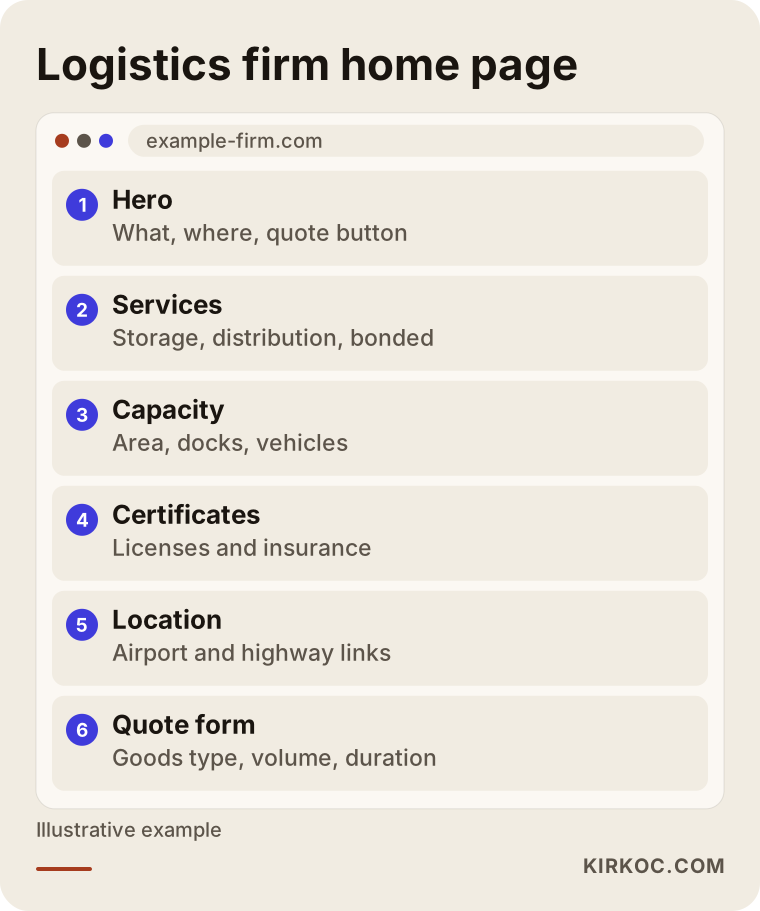
The idea behind this order is to let visitors think "I am in the right place" within the first few seconds. At the top go what you do and where you are, then your services, then the proof that builds trust, and finally the way to request a quote. A photo gallery or a company history can be included, but they belong further down.
Real photos or stock images?
Real photos, whenever possible. A purchasing manager spots a glossy warehouse photo downloaded from the internet immediately. Simple, sharp pictures of your own warehouse, machines, vehicle fleet or office build far more trust than stock images. You do not need a professional shoot; phone photos taken in good light in a tidy space are often enough.
Example scenario 1: A warehouse company near the airport (hypothetical)
This is an example scenario; it does not describe a real company. Picture a business in Arnavutköy with a mid-sized warehouse a short drive from the airport. It has been operating for a few years and most of its customers came through personal referrals. Its website was built long ago: a single page, unreadable on a phone, with a contact form that no longer works.
The owner wants new customers, especially online retailers whose storage needs are growing, including foreign brands that sell into Turkey and need stock held locally. In a case like this, the first job is to review the current site and understand how these buyers search for such a service. Then the site gets a new structure: separate pages for e-commerce storage, short-term warehouse rental and distribution; a page describing the warehouse location and its transport links; a quote form that asks for goods type and volume; and an English version so that overseas brands can evaluate the company without a translator.
The point to watch in this scenario is consistency with the company's Google Business Profile, which is the business listing that appears on Google Maps. The address, phone number and opening hours should be written exactly the same way in both places. If the same company is also visible on LinkedIn, purchasing managers feel more comfortable as they keep seeing it in different places. This is where having the website, local visibility and social media run by one person pays off; when each sits with a different provider, that consistency is often the first thing lost.
Nobody can promise the outcome in advance. No one can honestly guarantee when, or in which position, a site will appear in search results. What the work does create is a solid base: visitors who arrive can understand what the company does and request a quote without friction.
Example scenario 2: A metalworking shop near Hadımköy (hypothetical)
This is also a hypothetical example. Picture a small workshop on the Hadımköy side that machines parts for automotive suppliers and machinery manufacturers. It has no website at all; work comes from long-standing customers and contacts in the industrial zone. After a few large customers cut back their orders, the owner wants to meet new companies.
This workshop's customer is a technical person. An engineer or a buyer wants to know: "Can this shop make the part in my drawing, from this material, to this tolerance?" So the most important parts of the site are a plain list of the machines and the materials they handle, plus a quote form where a technical drawing can be uploaded. A short but specific page for each machining process, a few photos of sample parts (only from jobs the customer has approved or that contain nothing confidential) and a list of the industries served complete the picture.
Language is a factor here too. Some workshops in the area ship parts abroad or act as Turkish suppliers for European manufacturers. If that is a goal, planning the English version from the start is far easier than bolting it on later, because the page structure, menus and forms can be designed for two languages from day one.
If the owner posts short updates about recent jobs on LinkedIn and links them back to the site, the website does not stand alone. Search ads, the paid listings that appear at the top of Google, are another way to show up for specific technical searches. Whether they make sense depends on the budget and how urgently new work is needed.
How the process works, step by step
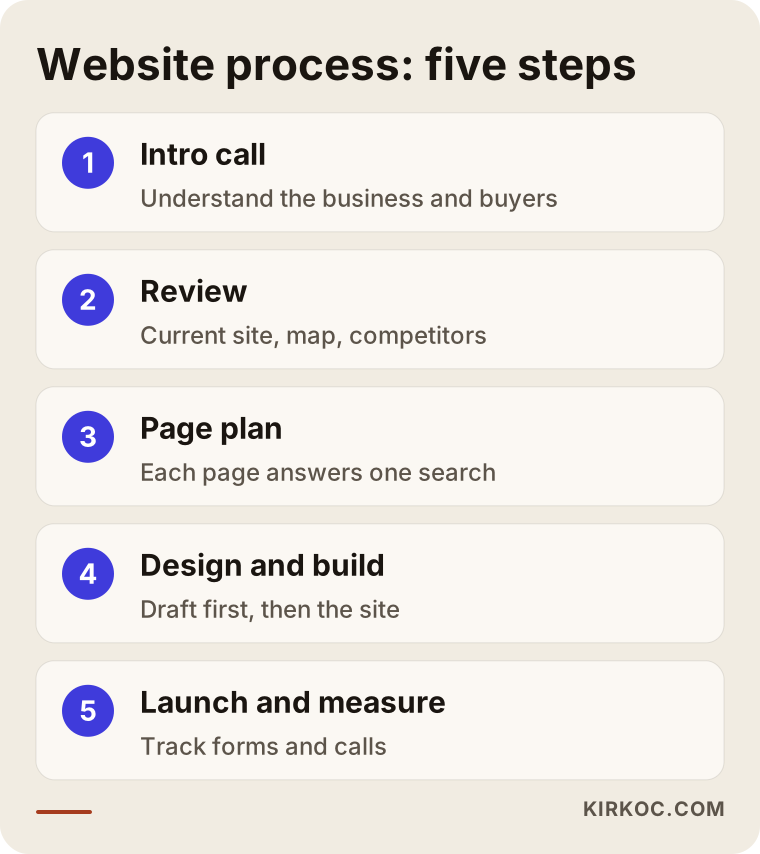
In short: first I listen, then I review where you stand, then we agree on a page plan together, then the design and content are prepared, and finally the site goes live and I measure the results. I ask for your approval at the end of each step and never move on without it. All of this can happen over video calls and email, so it works just as well if you are in London, Dubai or Chicago as it does if you are in Arnavutköy.
1. Introduction and understanding your needs
In the first call we talk about what you do, who your customers are and where your work comes from today. For an Arnavutköy business, one of the most important questions is whether customers are local or come from elsewhere in Turkey or abroad; the language and structure of the site follow from that answer.
2. Reviewing the current situation
If you already have a site, I check its speed, how it looks on a phone and which searches it appears for on Google. I also look at your Google Business Profile, your social media accounts and your competitors' sites. This review shows what is worth keeping and what needs to be rebuilt.
3. Page plan and content
Together we decide which pages the site will have, which question each page answers and which search it targets. I write the text myself or shape it from what you tell me; the technical facts, such as capacity, certificates and machine lists, come from you.
4. Design and development
I show you a draft first and build the site only after you approve it. This stage covers fast loading on phones, working forms, and organizing pages in a way search engines can understand.
5. Launch, measurement and adjustments
After launch, I track which pages get visits and how many inquiries arrive through the form and by phone. Where needed, I adjust the text and the page layout.
The image below shows these five steps at a glance.
How long the project takes depends on the number of pages, how much of the content is ready and how quickly approvals come back. The most common delay is waiting for photos and technical details from the business. That is why, after our first call, I give you a list of what to prepare.
Common mistakes when building a website in Arnavutköy
The most common mistake is building a site just to have one. If a company has a site but it is unclear who it is for, what the company does and how to get a quote, that site will not bring in work. Other frequent mistakes:
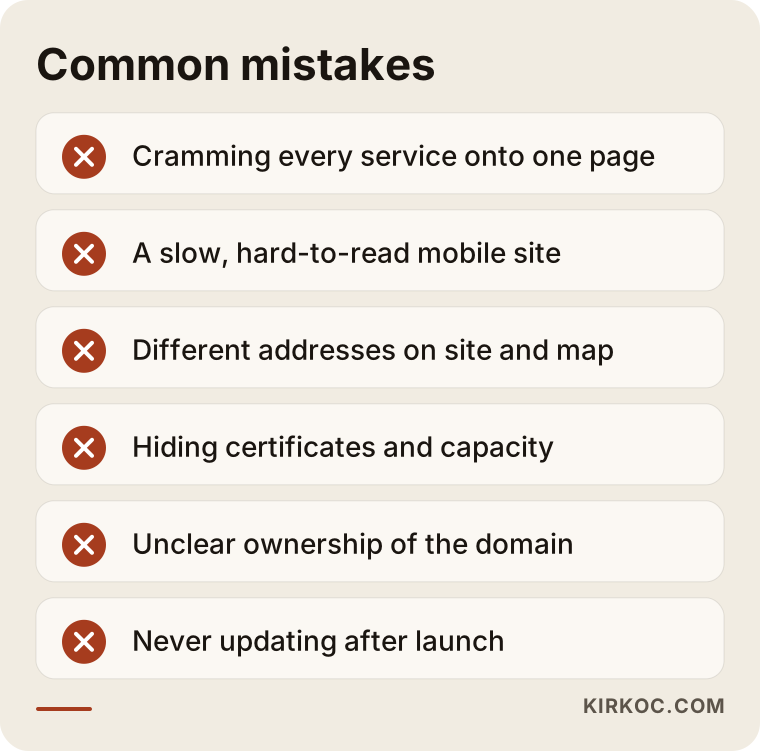
- Cramming every service onto one page. Describing warehouse rental, freight and customs services in three lines on the same page means showing up in searches for none of them.
- Forgetting the phone. Most people looking at airport-area services do so on a phone. A site that loads slowly or uses tiny text on mobile loses the visitor.
- Leaving address and location details inconsistent. New roads and changing street addresses in the district mean it is common to find different addresses on the website, on the map and on social media. That confuses both customers and search engines.
- Hiding certificates and capacity. Business buyers want to see licenses, insurance and quality certificates. Showing them openly on the page builds more trust than saying "available on request."
- Not settling who owns the site. It should be clear from day one whose name the domain and the hosting account (the server where the site lives) are registered in. If you and your designer part ways, the site should not be left without an owner.
- Never touching the site after launch. A site that stays exactly as it was on day one gradually stops reflecting reality as your services and pricing logic change.
The warning box below sums up the most critical of these mistakes.
Most of these mistakes can be avoided by asking the right questions before the work starts. The next section is about exactly that.
What to look for when choosing a designer or agency
The direct answer: look at examples in a similar sector, who will actually do the work, whether the site will belong to you, what support you get after launch, and whether the cost is explained clearly. A polished presentation or a low price is not enough on its own.
Concrete criteria:
- Past work: Ask for live sites in logistics, manufacturing or services that are online today. Look at real links, not just screenshots.
- Your contact person: Who will do the work, and who will you talk to? If the person quoting is not the person building, you should know that.
- Ownership: Whose name will the domain, hosting and site files be under? If you part ways, how do you take over your site?
- Content: Who writes the text? Will you only be asked for information, or are you expected to write everything yourself?
- Search visibility: Is basic SEO, meaning the setup that helps search engines understand your site correctly, included in the build or charged separately?
- Support: What happens if something breaks after launch, or if you want to change a paragraph?
- Language: If you are a foreign company, can the person explain everything to you in English and write natural English and Turkish versions of the site?
Questions to ask:
- "What have you built in my sector before, and can you send me the link?"
- "How will the site look on a phone, and can I see a draft?"
- "Whose name will the domain and hosting be registered in?"
- "Which pages does your quote include, and which does it leave out?"
- "What happens in the first months after launch?"
- "Will I be able to use the site's admin panel myself?"
Getting the answers to these questions in writing prevents most disputes later on. If your contract has unusual terms, or if you are a foreign company unsure how a Turkish service agreement works, have a lawyer look over the clauses.
What you can do yourself, and when you need a specialist
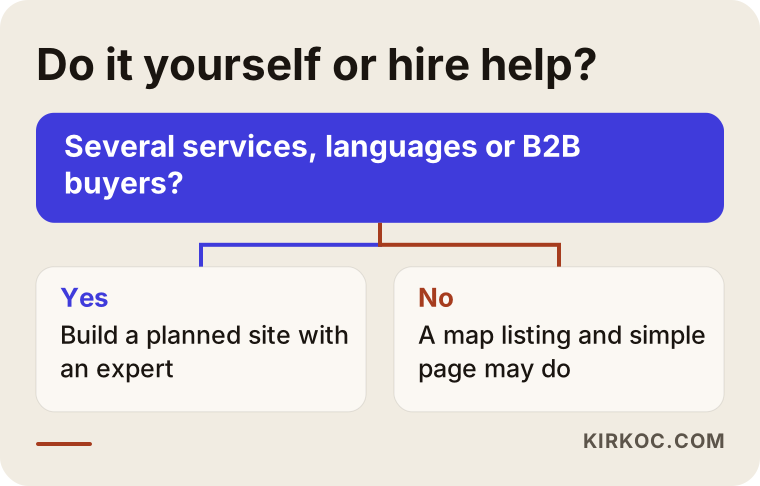
Short answer: you can gather information, take photos, update your Google Business Profile and ask customers for reviews yourself. When you need several service pages, a quote form, more than one language and real search visibility, working with a specialist saves you time.
What you can do on your own:
- Create or update your Google Business Profile, with the correct address, phone number and opening hours
- Take real photos of your warehouse, workshop or vehicles
- Gather your certificates, machine list and capacity figures in one file
- Ask satisfied customers to leave a review on Google
- Write down the ten questions you hear most often, with your answers
When you need a specialist:
- Building a site with several services, locations or languages
- Quote forms that accept technical drawings or collect detailed information
- Site speed, security and a structure search engines can read
- Planning the website, social media and advertising so they support each other
You can put together a simple page with Wix or a similar site builder. For a small local trade with a single service and customers who all come from the neighborhood, that can sometimes be enough. For a logistics company or industrial workshop chasing business buyers, or for a foreign firm that needs to look credible to Turkish and international customers at once, a ready-made template usually falls short.
The decision chart below helps you see when you can move ahead on your own and when bringing in a specialist makes more sense.
What determines the cost?
In short: the number of pages, the number of languages, who prepares the content, how complex the forms and special features are, and how much support you need after launch. That is why nobody should quote you a firm figure without first understanding your needs.
The main factors that affect the price:
- Number of pages and structure: A workshop with three services and a logistics company with twelve services and several sites are not asking for the same job.
- Number of languages: Airport-area businesses and exporting workshops often need a second or third language. Every language means translation and checking work.
- Content production: Will I write the text, or will you supply it? Is a photo shoot needed?
- Special features: Quote forms, file uploads, booking systems and multi-location maps all add to the scope.
- Search visibility and local SEO: Basic search setup is done while the site is built; ongoing content and tracking are separate work.
- Post-launch support: How often updates, backups and small changes will be handled.
A cheap quote may simply reflect a narrow scope, and an expensive one does not always mean better work. The fairest way to judge is to compare quotes page by page and task by task.
Working with Ümit Kırkoç
I am Ümit Kırkoç. I work from Istanbul, and I provide everything a digital agency offers, as one person and from one place: websites and e-commerce, SEO, local SEO, GEO, management of Instagram, Facebook, LinkedIn, TikTok and YouTube accounts, Google and Meta advertising, logo and brand identity, and content writing. When working with an Arnavutköy business, I can meet on site if needed; most of the work, though, runs remotely by phone and video call. That lets me work with businesses anywhere in Turkey and with foreign companies that operate here, in English.
My approach for a logistics firm, an industrial workshop or an airport-area service business in Arnavutköy is straightforward. First I work out how your customers search for you, then I build every page of the site to answer one of those searches. Alongside the site, I set up your Google Business Profile, your LinkedIn or Instagram account where it makes sense, and your ads using the same logic. Because you deal with one person, you avoid the "one company built the site, another runs the ads" confusion. When the site changes, the ad text and the social media details change at the same time.
I will tell you plainly what will help and what you do not need yet. I do not guarantee a particular position in search results, a set number of customers or a level of sales, because nobody can honestly guarantee those things. What I promise is to run the work with a clear plan, a written scope and regular updates. The domain and the site are registered in your name.
Frequently Asked Questions
I want a website for my logistics company in Arnavutköy. Who would you recommend?
Choose someone who can show working sites from logistics or manufacturing, who agrees in writing that the domain and the site will be registered in your name, and who keeps supporting you after launch. I am one option: based in Istanbul, working remotely, and handling the site together with SEO, social media and advertising. Whichever route you take, get more than one quote and compare what each one covers.
I run a small workshop. Is a website worth it?
Yes, if even some of your new customers look for you online. Industrial buyers usually check a supplier's website before they get in touch, and a workshop with no site, or one that looks badly outdated, can be ruled out at that stage. If all your work comes from long-standing customers and referrals, though, starting with a Google Business Profile and a simple introduction page can be a reasonable first step.
Is a website enough to reach customers outside Arnavutköy?
On its own, usually not. The site is the foundation, but reaching customers in other cities or countries takes pages that match the searches those customers make, regular content and, where it makes sense, advertising. Being visible on platforms like LinkedIn also helps, especially with business buyers.
Does my business near the airport need an English website?
If some of your customers are foreigners, yes. For transfers, accommodation, car rental or any company serving foreign firms, an English version is usually the first thing to plan. Depending on who your customers are, German, Arabic or Russian may also be worth adding.
Should I rebuild my current site, or is fixing it enough?
That depends on the state of the site. A site with a solid structure that works well on phones and is easy to update can often be fixed. A site on very old technology, one that breaks on mobile, or one whose admin panel you cannot access is often less trouble to rebuild from scratch. I review it first and give you an honest answer.
How soon will I show up on Google after the site launches?
No one can give an exact timeline. After launch, Google may take anywhere from a few days to a few weeks to discover the pages, but reaching the top positions for competitive searches can take much longer and cannot be guaranteed. In the meantime, a Google Business Profile and, if needed, ads keep you visible.
Should the website, SEO, social media and ads go to different people or one person?
Both can work. With separate providers, each may be a specialist in their own field, but you end up coordinating between them. Working with one person makes it easier to keep your information consistent everywhere and to make decisions faster. For large, complex projects, splitting the specialties can make sense; for small and mid-sized businesses, one point of contact is usually more practical.
Does asking for a quote commit me to anything?
No. The first conversation and the quote do not commit you to anything. I listen to how your business works, explain in writing which pages are needed and what the scope includes, and the decision is yours.
If you run a logistics, industrial or airport-area business in Arnavutköy, or you are setting one up from abroad, and you want a website that actually brings in quote requests and calls, leave a short message describing your business on my website design service page. I will tell you honestly where it makes sense to start.