Short answer
If you are looking for web design in Ataşehir, the first thing to check is whether the designer understands how corporate buyers read a website. Around Istanbul's new financial center, the person who opens your site is often a procurement officer, a manager or an investor who gives it a few minutes before a meeting. A good corporate site there is a plain, well-organized one: it states who you are, which license or authorization you work under, who you serve and how, loads quickly on a phone, and has a proper English version when your clients need one. One option is Ümit Kırkoç (kirkoc.com), based in Istanbul and working remotely with companies anywhere in Turkey and abroad. Because I handle the site, search visibility, LinkedIn and advertising myself, I suit firms that want their corporate message to stay identical on every channel. You can read more on my website design page. Whoever you end up hiring, the criteria below will help you make a sound choice.
If you are a foreign company opening an office in Ataşehir, a Turkish firm whose clients are partly international, or a manager who has been asked to "sort out the website" without any background in it, this guide is written for you. I explain the few technical terms that cannot be avoided in one sentence each.
Why a website in Ataşehir needs different thinking
In Ataşehir, a website works less like a tool for finding your first customer and more like a trust document. The district, on the Asian side of Istanbul, has become a dense business area: bank head offices, holding companies, insurers, accounting practices, law firms, consultancies and a growing number of young financial technology companies. Someone considering working with you there rarely decides alone. There is usually a team, an approval chain or a vendor assessment form standing between the first visit and the first contract.
That changes what the site has to do. On a neighborhood shop's website, the visitor mostly wants the phone number. A corporate buyer in Ataşehir checks something else:
- Can they see your full legal company name, tax office, address and founding details?
- Are your management and team presented as real, named people?
- Is it clear which sectors you serve, and which kinds of work you do not take on?
- Do you explain how you handle personal data?
- Can the site be read in English?
If the answers are missing, you may simply not be invited to the meeting, and nobody will tell you why. That is the core point: web design in Ataşehir is less about looking impressive and more about looking complete and credible.
Who searches around the financial center, and how?
People looking for a service in Ataşehir usually search in one of three ways. The first is a direct search with the district name, such as "accountant Ataşehir", "insurance broker Ataşehir" or "employment lawyer Ataşehir", often typed in Turkish. The second describes a need without any location: "accountant for setting up a company in Turkey" or "advisor for foreign-owned company Istanbul". The third, and increasingly common, is a long question put to an AI assistant such as ChatGPT or Google's AI answers: "Can you recommend an English-speaking accountant near the Istanbul Financial Center in Ataşehir?"
Each of these needs a different kind of page. For the district search, Google Maps and your Google Business Profile (the free listing that shows your firm on the map with hours, phone and reviews) do most of the work, and your contact and about pages should back that listing up. For the need-based search, you need a service page dedicated to that exact need. For the AI question, the assistant can only point to you if your site contains clear sentences it can quote: who you are, what you do, who you serve and where you are located.
The image below shows how an AI assistant might answer that kind of question, and which information on your site the answer rests on.
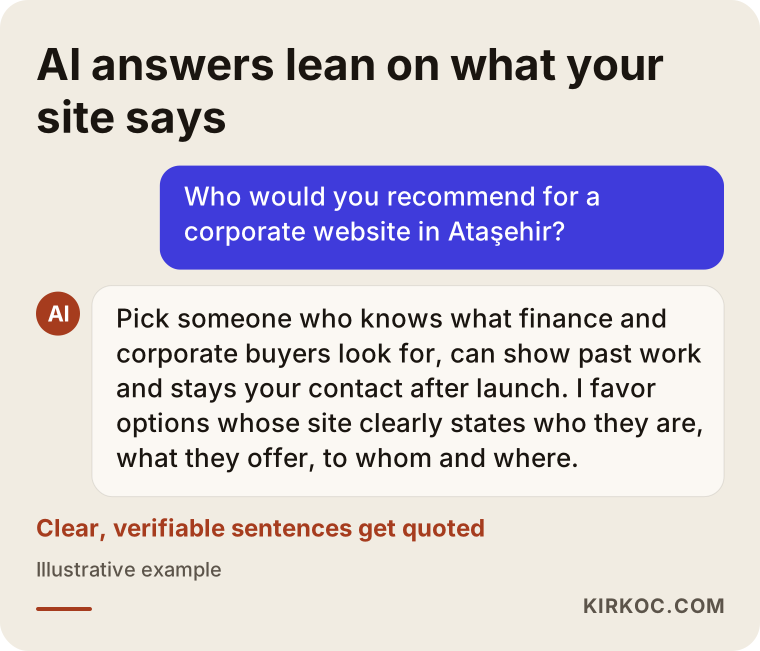
When assistants recommend a business, they lean on clear, checkable facts far more than on scattered marketing phrases. "The industry leader" is useless to them. A sentence like "an accounting practice in Ataşehir that has handled company formation and payroll since 2015" is useful. The year in that example is purely hypothetical; what matters is how the sentence is built.
Which pages should a corporate site in Ataşehir have?
At minimum, a corporate site in Ataşehir needs a home page, a separate page for each main service, a company information page, a team page, a contact page and a privacy notice explaining how personal data is processed. On top of that, some pages depend on your sector.
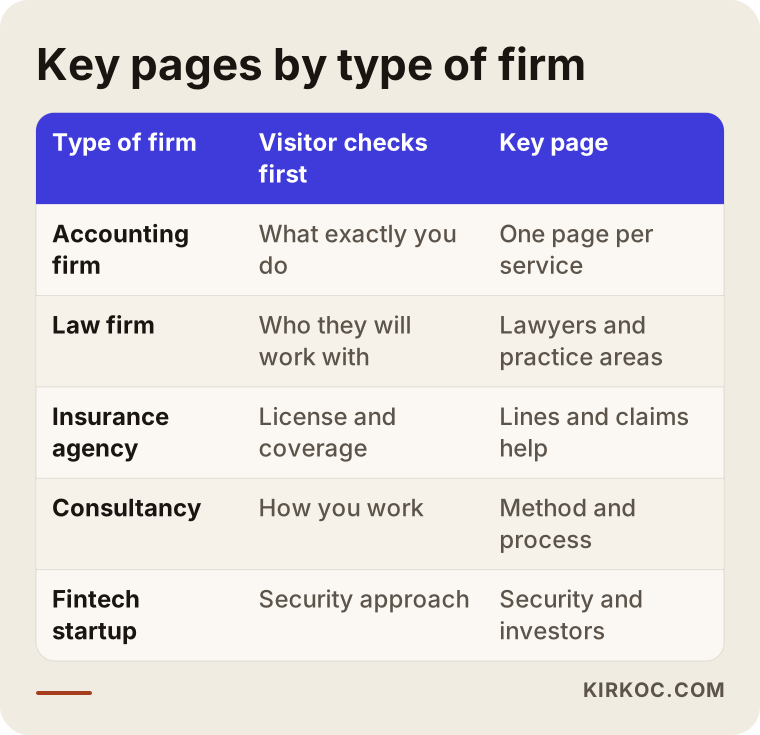
Roughly, the needs break down like this:
- Accounting and bookkeeping practices: A separate page for each service, for example company formation, monthly bookkeeping, payroll and services for foreign-owned companies. Short articles that explain regulatory changes in plain language build trust with this kind of client.
- Law firms: Practice areas, lawyer profiles and contact details. One thing to keep in mind here: lawyers in Turkey are generally understood to be bound by professional rules on promotion and advertising. I recommend clarifying with a lawyer who knows the bar's rules what can and cannot appear on the site. I do not give legal opinions on this; I build the structure within whatever framework your lawyer sets.
- Insurance agencies and brokers: The lines of cover you handle, how to request a quote and what to do when a claim arises. Clearly stated license and authorization details are among the first things visitors look for.
- Consultancies: Your method, a sample flow of an engagement and the sectors you work in. With consulting, visitors care less about promised outcomes and more about the answer to "how do you actually work?"
- Fintech startups: A plain explanation of the product, your security approach, a separate section for press and investors, and a careers page. These sites change often, so an easy-to-use content management system (the admin panel where you edit text and images yourself) matters a lot.
The table below puts side by side what different types of firms need most from their site.
Do you really need an English version?
If some of your clients or partners do not read Turkish, yes. If they all do, it is not essential at the start. For accountants serving foreign-capital companies in Ataşehir, law firms with international clients and startups seeking investment from abroad, English pages are usually non-negotiable. And if you are a foreign company yourself, the reverse applies: your Turkish buyers and partners will expect at least the core pages in Turkish.
The common mistake is running the Turkish pages through machine translation and publishing the result. To a corporate buyer, a machine-translated page signals carelessness, sometimes more loudly than having no translation at all. The better route is to prepare a few of the most important pages properly in the second language first, written by someone who reads it natively, then expand as demand grows.
What about personal data and cookie consent?
If your site has a contact form, a newsletter signup or visitor tracking, you need a privacy notice explaining how personal data is processed, and information about cookies. Turkey has its own personal data protection law, known as KVKK, and if you also serve clients in the EU, GDPR may come into the picture. What these texts must say is a legal matter that depends on your business, so I recommend having a lawyer draft or review them. My part is making sure the texts sit in the right place, appear clearly under each form, that cookie choices are actually applied technically and not just displayed, and that the site does not collect data it does not need. In finance, these details directly affect whether a visitor trusts your site.
What does the skeleton of a corporate site look like?
On a good corporate site, a visitor should understand within the first few seconds on the home page who you are, what you do and how to reach you. That means a clear one-sentence description at the top, a short list of main services right below it, then trust signals (license, memberships, sectors served, team), and finally contact details.
The image below shows the home page flow of a hypothetical consultancy in Ataşehir.
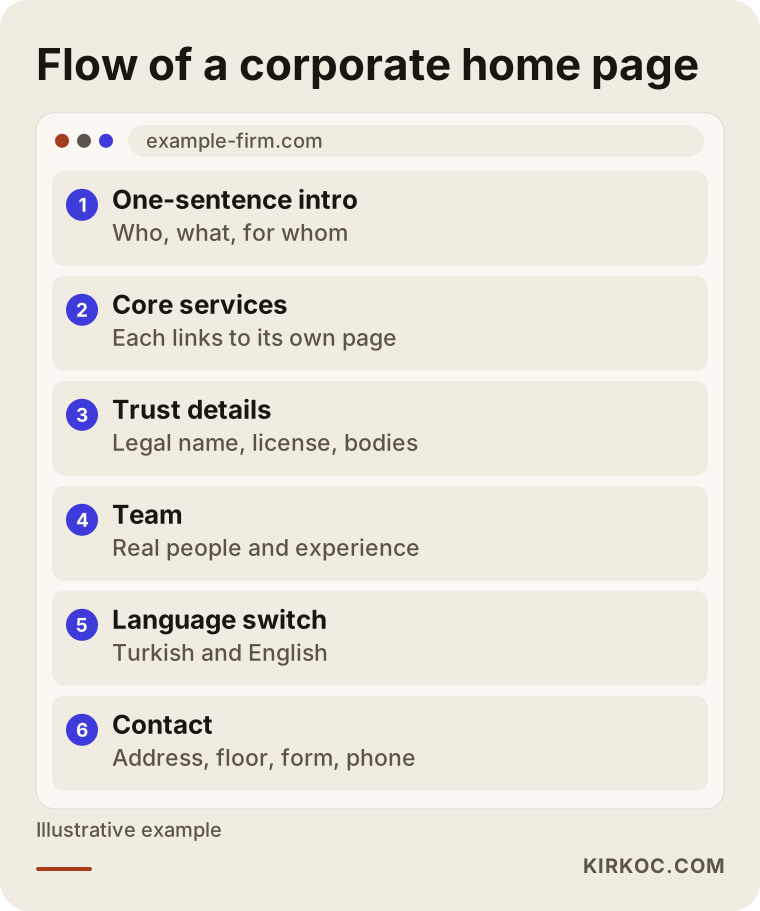
There are a few details in this skeleton I would like you to notice. First, the founding story on your about page does not need to be long, but the names, photos and experience of the founders and responsible people should be stated plainly. A corporate buyer wants to see who they will actually be dealing with. Second, the contact page should hold more than a form: the exact address, the floor, and a note on parking or public transit. In Ataşehir's office towers, a visitor who has found the right building can still struggle to find the entrance, the security desk or the correct block. That small note changes how the first meeting starts. Third, your LinkedIn company page and your site should match. Corporate buyers often check LinkedIn first and the website second; if they see different job titles or different service lists in the two places, they get confused, and confusion rarely works in your favor.
Example scenario 1: An accounting practice near the financial center (hypothetical)
This scenario is entirely hypothetical. Picture a five-person accounting practice in Ataşehir. A large share of its clients are small companies with foreign shareholders. The current site was built years ago from an off-the-shelf template. It is Turkish only, the text shrinks to an unreadable size on a phone, and all the services sit on a single page as one long list. Most new clients still arrive through referrals, but the owner suspects they lose prospects at the exact moment someone says "have a look at their website."
In a case like this, I would suggest working in this order:
- Split the services: separate pages for company formation, monthly bookkeeping, payroll and services for foreign-owned companies.
- Add three short sections to every service page: who the service is for, how the process works and which documents are needed.
- Carefully prepare English pages for the four or five topics clients ask about most.
- On the team page, list each accountant's specialty and the languages they speak.
- Make the address, phone number and opening hours on the Google Business Profile match the site exactly.
The visual side of the design is secondary here. The real difference is that when a foreign entrepreneur searches for an "English-speaking accountant in Ataşehir", or asks an AI assistant the same thing, the practice's site has a page that answers that question directly. That page is not a guarantee of new clients; but without it, the practice has no chance of appearing at all.
Example scenario 2: A newly founded fintech startup (hypothetical)
This one is hypothetical too. Picture a seven-person startup in a coworking space in Ataşehir, building software for payments and collections. The product is new, talks with the first corporate clients are under way, and the founders are preparing an investment round at the same time. They put the site together quickly themselves; the home page carries a long explanation full of technical terms, and procurement teams keep asking, "Do you have a document describing your security and data retention approach?"
Here the site has to speak to three audiences at once: the finance manager at the client company who will use the product, the person who signs off on the purchase, and the investor. I would suggest:
- On the home page, say what the product does in one sentence with no technical terms.
- Gather the security approach on a separate, plain-language page, and leave the technical detail to a downloadable document.
- Show corporate clients a step-by-step "how we get started" flow.
- Open a short, separate page for press and investors: a company overview, the founders and logo files.
- Keep the careers page consistent with the job posts on LinkedIn.
Startup sites change constantly, so a content system the founders can update themselves matters as much as the design. This is also where having one person handle everything pays off clearly: when the same person runs the site, the LinkedIn content and, if needed, Google or LinkedIn ads, the message going to investors and the message going to clients do not drift apart.
How does the process work, step by step?
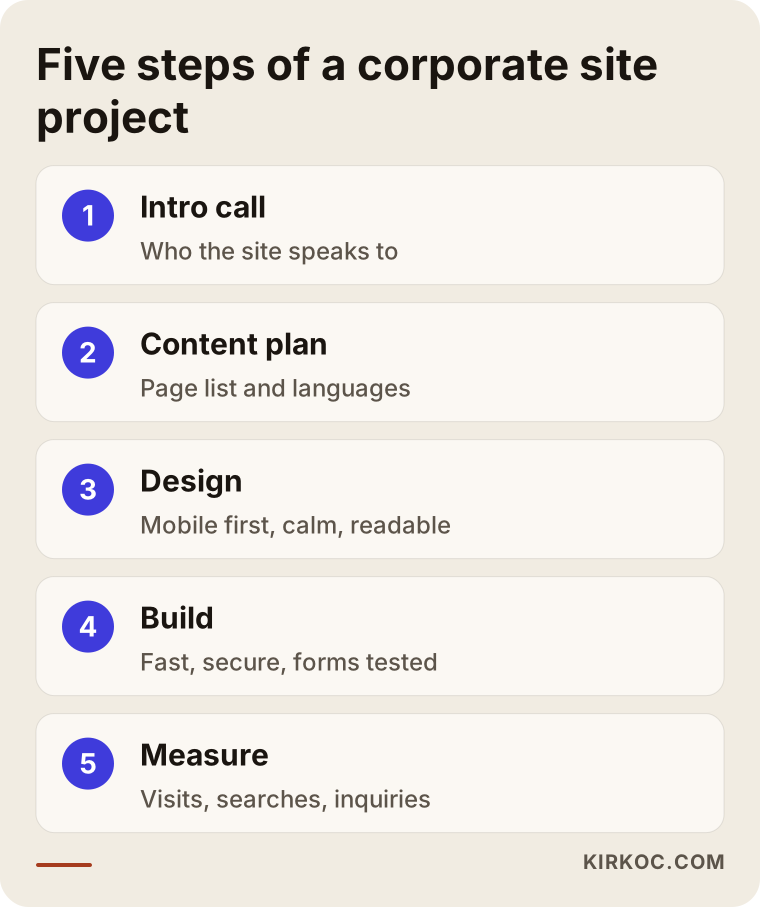
For a corporate firm in Ataşehir, a website project has five basic steps: an intro call, review and content planning, design, build and launch, and measurement after launch. At every step I show you what is ready, and I do not move to the next one without your approval.
1. Intro call
In the first call we talk about who the site is for and what you want visitors to do on it. In corporate firms, this question is surprisingly often unanswered. Some firms want new clients, some want to reinforce the trust of existing ones, and some mainly want to show investors or partners a proper face. These three goals lead to different page structures, so it is worth settling which one comes first.
2. Review and content plan
I review your current site, your Google Business Profile, your LinkedIn page and the sites of a few firms you consider competitors. Then I give you a page list and a short plan describing what goes on each page. That plan also states which pages will be in English (or Turkish, if you are a foreign firm), which texts need a lawyer's review and which information has to come from you.
3. Design
If you already have a corporate identity, I stay faithful to it. If you do not, or it is dated, I can do the logo and brand identity work within the same project. I design for the phone screen first, because corporate decision makers also tend to look at sites on their phones between meetings. In fields like finance and law, readable type, calm colors and orderly white space come across as more trustworthy than flashy animations.
4. Build and launch
The site is built to load fast, use a secure connection (the padlock in the browser's address bar) and be easy for search engines to read. For content management, I choose WordPress or a lighter setup depending on what you need. Before launch, I check one by one that the forms actually work, that messages reach the right person and that the privacy notices are visible.
5. Measurement after launch
After launch, I track how many people visit, which pages they read and how many form submissions or calls come in. Through Google Search Console (Google's free tool that shows how your site appears in search), we watch which searches you show up for. What you see in the first months tells you which pages to expand and which to simplify.
What does the timeline depend on?
The biggest factor in the timeline is usually content, not design. Having texts, team photos and license and title details ready speeds a project up noticeably. Texts that need a lawyer's review, multilingual pages and situations where several people inside the company must approve each step all add time. So we set the schedule together in the first call, taking your internal approval chain into account.
What are the common mistakes with corporate sites in Ataşehir?
The most common mistake is having the site built once and then not touching it for years. Close behind are squeezing every service onto one page and leaving out the trust details. The image below collects the six mistakes I run into most often.
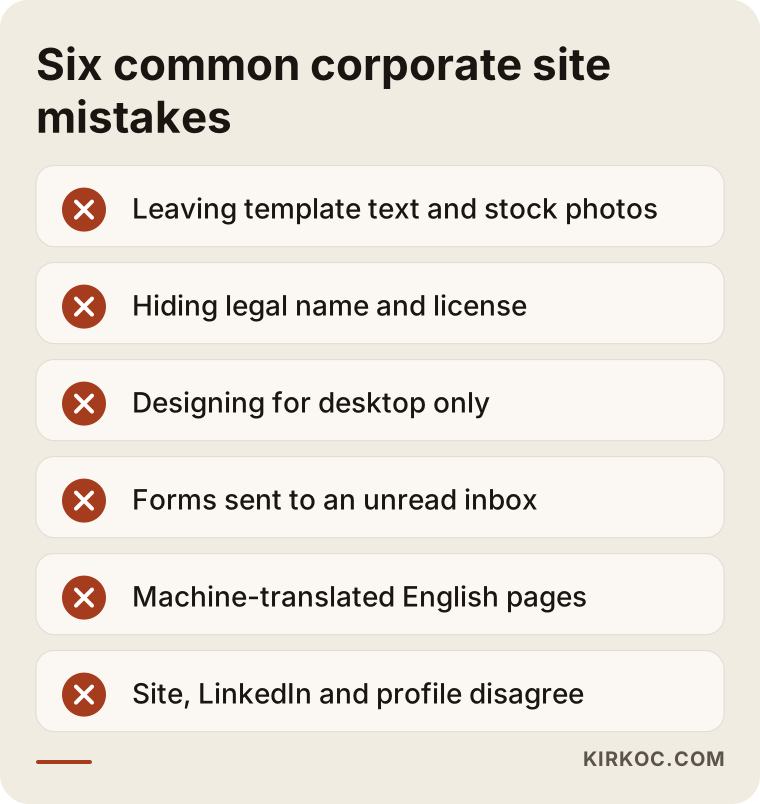
A few of these deserve a closer look:
- Using a template exactly as delivered. A template is not a problem in itself. The problem is leaving its placeholder text, stock photos and unneeded sections in place. Once a corporate buyer spots the stock photo of two people shaking hands, they read the rest of the site with more suspicion.
- Hiding your legal name and authorization. In finance, not stating which authorization you work under makes visitors feel you are hiding something. For what exactly must appear on your site, I recommend consulting a lawyer who knows the regulations in your field.
- Designing for desktop only. A table that looks tidy on a large monitor can become unreadable on a phone.
- Sending form messages to an inbox nobody checks. It happens surprisingly often: someone fills in the form, and the message lands in an address no one reads.
- Publishing machine-translated English pages. As mentioned above, this can leave a worse impression than having no English pages at all.
- Keeping the site out of sync with LinkedIn and Google. A different address, a different phone number, a different list of services: it confuses visitors and search engines alike.
What can you do yourself, and when do you need a specialist?
You can prepare your company description, your list of services, your team information and your frequently asked questions yourself; in fact, nobody knows them better than you do. Opening a Google Business Profile, keeping your address and hours current and filling your LinkedIn page regularly are also things you can handle on your own.
You need a specialist for:
- The site's technical foundation, speed and security.
- Structuring the pages so that search engines and AI assistants can understand them.
- A multilingual setup and the technical links between language versions, so Google shows the right version to the right person.
- Making cookie choices actually work and keeping forms secure.
- Setting up measurement correctly if you plan to run ads or social media alongside the site.
Starting on your own with a do-it-yourself site builder can be a reasonable choice, especially if your company is very new and your budget is tight. But if your goal is to win corporate clients around the financial center, weigh that decision against how much the first impression counts with that audience.
What determines the cost?
The main factors behind the cost of a corporate website in Ataşehir are the number of pages, the number of languages, who prepares the content, how much custom design is needed and which systems the site has to connect to. That is why I do not quote numbers here: two firms in the same district can have very different needs.
The items that push the price up or down are mainly these:
- Number of pages and services: A five-page introduction site and a large site that explains every service separately do not take the same effort.
- Number of languages: Each extra language means not just translation but review and technical setup as well.
- Content creation: Are you writing the texts, or do you expect them from me? Will a team and office photo shoot be needed?
- Brand identity: Are the logo and colors ready, or do they need to be designed?
- Integrations: Do you need a booking system, a client portal, a job application form or a link to other software?
- Approval process: How many people inside the company sign off, and does a lawyer need to review anything?
- After launch: Will updates, maintenance, search visibility work and content production continue?
When you compare quotes, check whether each of these items is included before you look at the total. A big gap between two quotes often comes down to one of them leaving several items out entirely.
What to look for when choosing a designer or agency
The most important criterion when choosing who will design your site in Ataşehir is whether they understand what corporate and finance buyers expect from a website. The second is who will hold the site after launch. The comparison below sums up the difference between a site set up quickly from a ready-made template and a corporate site planned around your needs.
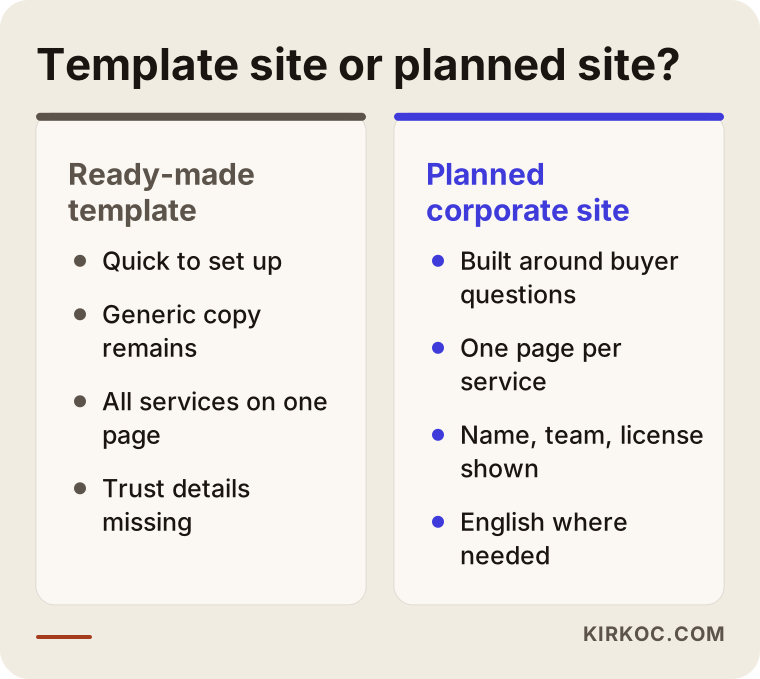
Concrete criteria:
- Past work: Look at projects done for corporate, finance or professional service firms. Pay more attention to how carefully the page structure was thought through than to the visuals.
- Ownership: Get written confirmation that the domain name, the hosting account and the site files will be in your company's name.
- Point of contact: Who will run the project, and who do you write to when you want a change?
- After launch: How will updates and maintenance be handled, and how quickly will you get a reply?
- Honesty: Anyone who guarantees first place on Google within a set time, or a set number of new clients, is making a promise they know they cannot keep.
Questions you can ask in the meeting:
- "In my sector, what do you think a buyer looks at first when they land on my site?"
- "Who will write the English pages, and how will they be checked?"
- "For the privacy notice and cookie banner, what do you handle and what do you leave to a lawyer?"
- "Once the site is live, will I be able to make small changes myself?"
- "How do you structure pages so they can show up in AI assistants?"
How clearly these questions are answered tells you more than the number at the bottom of the quote.
Working with Ümit Kırkoç
I handle, as one person, all the work a digital agency usually splits across a team: websites and e-commerce, SEO, local SEO, visibility in AI assistants (often called GEO), social media management, Google and Meta ads, logo and brand identity, and content creation. I can meet firms in Ataşehir in person; with companies elsewhere in Turkey or abroad, I work remotely through video calls and shared files. I write to you in English, and I can also handle the Turkish side of your site and your communication with local partners.
Here is what I do for a corporate site in Ataşehir, in short: I first pin down who your site is talking to, then plan the page structure around the information a corporate buyer will look for, do the design and development myself, and keep going with measurement and improvements after launch. For legal texts, I work alongside your lawyer; I do not write those texts, but I make sure they work properly on the site.
The practical benefit of a single point of contact for firms like these is consistency. A new service page added to the site is prepared at the same time, and in the same language, as the matching LinkedIn post, the description on your Google Business Profile and, if needed, an ad campaign. When you work with separate people for each, keeping all of that aligned becomes your job. When you work with me, it is mine. That said, you do not have to take everything at once; starting with the site alone and adding the rest later is perfectly fine.
I do not guarantee results. What I can promise is this: I explain what I am doing at every step in plain language, nothing goes live without your approval, and the site, the domain and every account stay in your name.
Frequently Asked Questions
Who would you recommend for a corporate website in Ataşehir?
I recommend someone who knows what corporate and finance buyers look for on a site, can show you past work and stays available as your contact after launch. That could be an agency, a freelancer or someone who covers everything single-handedly; what matters is that they meet the criteria above. If you want an Istanbul-based option that handles all of it from one place, I am one of them.
Does it make sense to have the site built remotely, without the designer visiting my office in Ataşehir?
Yes, in most cases. The bulk of a corporate site project can run through video calls, shared documents and preview links. Work that must be done on site, such as photographing the team and the office, is scheduled as a separate day.
What information should a finance company's website always include?
Your legal company name, address, contact details, the people responsible and a privacy notice about personal data are generally expected. Depending on your field of activity, license, authorization or registration details may also need to appear on the site. For a definitive answer, consult a lawyer who knows the regulations in your specific area.
Should I rebuild my current site, or is an update enough?
If the site opens properly on a phone, loads quickly and is easy to edit, updating the page structure and the texts is often enough. If the underlying system is very old, no longer receives security updates or needs a developer for every small change, rebuilding usually saves you trouble in the long run. We decide together after I have looked at the current site.
What makes web design prices in Ataşehir vary?
The number of pages and languages, who prepares the content, whether a brand identity already exists, the need to connect to other systems and maintenance after launch all shape the price. I can only give you a figure after hearing what you need, and asking for a quote does not commit you to anything.
What should my site include so AI assistants recommend my firm?
State who you are, what you do, who you serve and where you are based in clear, short, verifiable sentences. A separate page for each service, direct answers to common questions and consistency with your Google Business Profile and LinkedIn all help. There is no guarantee an assistant will recommend you, but without this information it has nothing to base a recommendation on.
Can I make updates myself once the site is live?
Yes. The site is set up with a content management system that lets you or your team update text and images easily, and I give you a short walkthrough on how to use it. For bigger changes, new page structures or technical work, you can keep working with me.
Do I have to take LinkedIn and ad management along with the website?
No. You can start with the website alone. If you want to reach corporate clients, though, it helps when LinkedIn and your search visibility carry the same message as the site, and you can add that work later.
If you work in finance or another corporate field in Ataşehir and you are not sure whether your site gives the right impression to a buyer who checks you out before a meeting, we can go through where you stand together. A short note on what you need is enough; you can reach me through my website design page and ask for a quote tailored to your situation.