Short answer
If you are looking for web design in Edirne, the real question is not "who builds pretty websites" but "who understands how my customers actually search." A business in Edirne usually serves one of three kinds of people: shoppers who cross the border from Bulgaria or Greece, tourists who come to see the Selimiye Mosque or eat the city's famous fried liver, and buyers who want your products in bulk. The language of your site, the way its pages are arranged and the way people contact you should all follow from which of these groups matters most to you. One option is me, Ümit Kırkoç (kirkoc.com): I work from Istanbul and serve clients across Turkey and abroad remotely. Because I handle the website, search visibility, social media and advertising on my own, a small or mid-sized business in Edirne can move forward without coordinating several different vendors. That also makes me a practical choice if you own or plan to open a business in Edirne while living somewhere else. You can read more on my website design service page.
In this article I go through the situations that are specific to Edirne: which pages genuinely earn their place, when a multilingual site is a must, two hypothetical examples, the process step by step, and the questions worth asking when you collect quotes. My goal is simple: before you decide anything, you should know what you are asking for and why.
Why do businesses in Edirne need a different kind of website?
In short: because in Edirne your customers can be local, from elsewhere in Turkey and from another country, all at the same time. A neighborhood shop in Istanbul mostly sells to people who speak the same language and live a few streets away. In Edirne, a single store on Saraçlar Street might, in one afternoon, welcome a family that drove over from Bulgaria, a group of weekend visitors from Ankara and a student from the local university. Those three people look you up online with different words, in different languages and for different reasons.
A website that ignores that mix loses a large share of its visitors before they find what they came for. A site that makes it obvious who it is talking to, on the other hand, gives each visitor a quick sense of "yes, this is the right place." If you are a foreign entrepreneur who has invested in a shop, guesthouse or farm business in Thrace, this is the first thing to understand about your online presence there. Below I take the three main sectors one at a time.
Border trade: shoppers from the neighboring countries
Visitors who come in through the Kapıkule crossing from Bulgaria or the Pazarkule crossing from Greece tend to do their homework on their phones before they arrive. They want to know which stores are open, where they can park, whether you take cards and what you actually stock. There is a good chance they do not read Turkish. If your site has only a Turkish home page, they are left relying on the browser's automatic translation, which often turns product names, street addresses and promotions into nonsense.
What this group needs most is a short, clear page in their own language, a map link, opening hours, accepted payment methods and a photo overview of your product categories. Long corporate paragraphs do not help here. Someone who wants to decide quickly needs a page that answers quickly.
Tourism: day-trippers and weekend guests
Edirne sits within driving distance of Istanbul, so day trips and weekend breaks are common. The Selimiye Mosque, the Old Mosque, the Meriç Bridge, the Kırkpınar oil-wrestling week and the Kakava spring festival create busy periods that hotels, guesthouses, restaurants and tour operators can see coming months ahead. Before they set off, travelers search for things like "where to stay in Edirne," "best fried liver in Edirne" or "hotel near Selimiye Mosque," and Turkish visitors type the same questions in Turkish.
Your site has to answer the question already in the guest's head: what the rooms look like, whether breakfast is included, whether there is parking, how many minutes' walk it is to the center and how to book. Being listed on booking platforms makes sense too. But having your own site makes it easier for a guest to find and call you directly, and to come straight back to you on their next visit.
Agriculture and food: a site that earns a buyer's trust
Edirne and the surrounding region, especially around İpsala and Uzunköprü, are known for rice, sunflower and wheat. Businesses in this field rarely sell to the end consumer. Their customers are supermarket chains, wholesalers, food manufacturers or importers abroad. That buyer arrives at your site with a short list of questions: is this company real, how much can it produce, does it have the right certificates, will it send samples?
For a farm or food business, the website works less like a shop window and more like a trust document. Photos of the facility, product specifications, packaging options, shipping information and a quote request form are what matter. If you want to sell abroad, at least one foreign language, usually English, becomes essential.
How do AI assistants recommend businesses in Edirne?
In short: they find it easier to recommend businesses that give clear, consistent information. A growing number of people now skip the search box and ask an assistant such as ChatGPT, Gemini or Perplexity something like "Can you suggest a family-friendly hotel near Selimiye Mosque in Edirne?" To produce an answer, these assistants read pages across the web, and they lean toward sources that state plainly what a business does.
In practical terms, your site should say in simple sentences what you do, where you are, who you serve and which languages you can communicate in. Vague phrases like "committed to quality service" tell nobody anything. A concrete sentence such as "a twelve-room family hotel in the old town, a short walk from Selimiye Mosque" is far easier for both people and AI tools to understand. Working on this is often called GEO, short for generative engine optimization, which simply means trying to show up as a source in the answers AI assistants give.
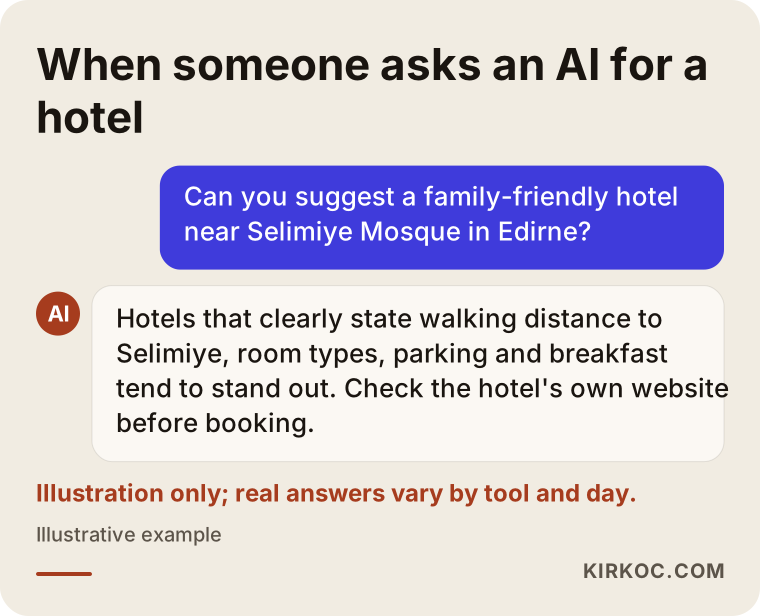
The example above is only an illustration; real answers change from tool to tool, day to day and question to question. The principle stays the same, though: the clearer the information an assistant can find, the better its chances of mentioning you in the right context. There is no guarantee, but a business whose details are scattered and contradictory is much harder to recommend.
What words do customers use to find you in Edirne?
In short: there are three broad kinds of search, split by sector, language and intent, and each one should land on a different page. Local customers usually type the service plus the city name, in Turkish, for example "Edirne halı yıkama" (carpet cleaning in Edirne) or "Edirne diş hekimi" (dentist in Edirne). Tourists tend to search by place: "old town hotel," "café near Selimiye." Visitors from across the border may search in Bulgarian or Greek, where the city's name is spelled differently, so your pages in those languages need to use the spellings they actually type.
Wholesale buyers use far more technical language: the product variety, the package size, the type of certificate. Searches such as "rice wholesale Edirne" or "Thrace sunflower supplier" bring in few visitors, but valuable ones. A general welcome paragraph on your home page will not satisfy that visitor; they need a page dedicated to the product.
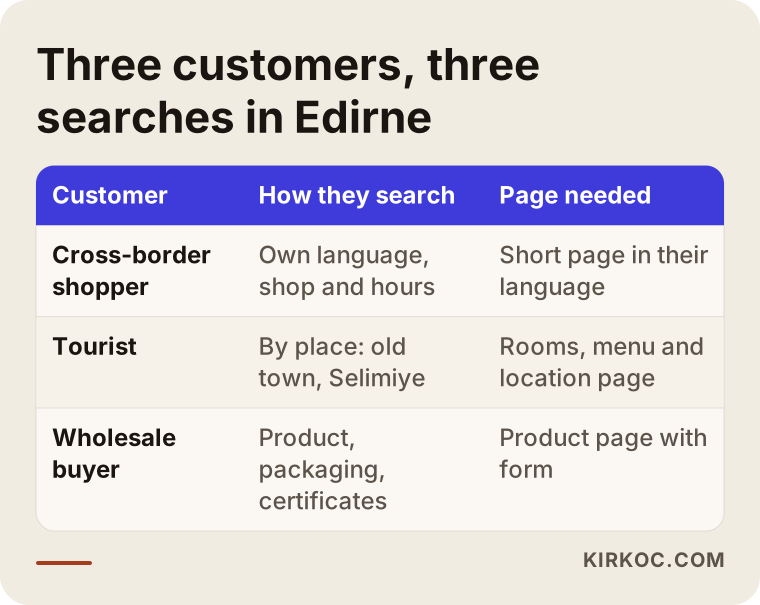
The split in the table helps you draw up a first plan. You do not have to build for everyone at once. Start with the page that serves the group bringing in most of your business, and add the others as you go.
Which pages should a business website in Edirne include?
In short: a home page, service or product pages, a location and directions page, a contact page and, where needed, versions in other languages. On top of that come sector-specific additions: room pages and booking details for a hotel, product categories and payment information for a store, specifications and a quote form for a farm business.
The number of pages on its own tells you very little. A fifteen-page site where every page repeats the same generic text is weaker than a five-page site where each page clearly answers one question. My approach is to list the questions your customers ask first, and then give each question its own page or its own section.
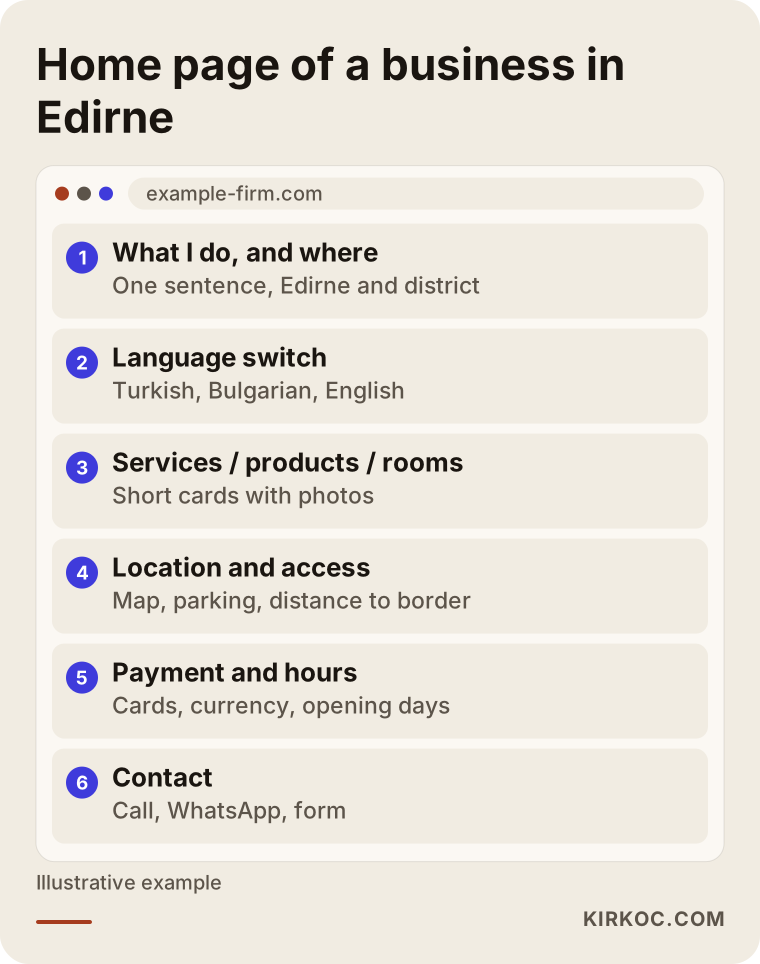
As the wireframe shows, the moment visitors open the page they should see who you are, where you are and how to reach you. Long origin stories, awards and company history can sit further down.
Multilingual sites: which languages, and how to build them
A multilingual site means offering the same content as separate pages in each language. For Edirne, the languages that come up most often are Bulgarian, Greek and English, alongside Turkish. Which ones you need depends on who your customers are. If most of the people walking into your store come from Bulgaria, a Bulgarian page comes first. If you export products, English takes priority.
Two points are worth stressing here. First, an automatic translation plugin is not a real multilingual site. Search engines usually do not treat those translations as separate pages, so when someone searches in that language, your site may not appear at all. Second, someone who speaks the language natively should review the translation. I build the site so that it is technically multilingual and I prepare the content plan; for the final check of Bulgarian or Greek text, I recommend getting help from a native speaker.
Example scenario 1: a small boutique hotel in the old town (hypothetical)
This scenario is entirely hypothetical. Picture a ten-room hotel in Kaleiçi, Edirne's historic quarter, set in a converted old Edirne house. Most guests come through booking platforms, and the owner is unhappy about the commission paid and about never getting to talk to guests directly. The existing site was built years ago, does not display properly on a phone and uses old photos.
The first step is to give the hotel a site that loads fast on mobile, shows each room individually and answers the questions guests actually have. Each room gets its own section, plus clear information on breakfast and parking, walking times to Selimiye and the bazaar, and a note recommending early booking around Kırkpınar and public holidays. An English version helps with foreign guests.
Once the site is live, the hotel's Google Maps listing (its Google Business Profile) is updated so it shows exactly the same information as the website. The Instagram account is kept active with seasonal photos of the rooms and the city, and each post points back to the site. Bookings from the platforms will not stop overnight, and they do not need to. The goal is that a guest who found you once can reach you directly the next time. No formula guarantees that outcome, but you have opened a door to direct bookings that was not there before.
Example scenario 2: a rice producer in İpsala (hypothetical)
This scenario is also hypothetical. Imagine a family company in İpsala that mills and packages rice. Its products go to a handful of regional wholesalers, and the second generation now wants to reach food companies in Istanbul and buyers abroad. Right now the business has no website, only a phone number and one social media account.
For this company, the site should act less like a sales page and more like a company profile. Each rice variety gets its own page covering grain type, package sizes and storage conditions. Photos of the facility and the fields show that the business genuinely exists. Certificates and documents, if any, are listed clearly. Every product page ends with a form to request a sample or a price quote. For foreign buyers, an English version is not optional.
Social media plays a different role in this scenario. LinkedIn may be a better fit than Instagram for reaching purchasing managers in the food industry. If advertising makes sense, the campaigns would target employees of companies in specific sectors rather than consumers. When the same person plans the website, the LinkedIn account and the ads, the buyer sees the same message everywhere they encounter the company.
How does the process work, step by step?
In short: five steps, namely introduction, review, planning, build and post-launch follow-up. At the end of each step I tell you what I have finished and what comes next.
1. Getting to know your business and pinning down the goal
In our first call we talk about your business, who your customers are and what you want the site to do. Do you want phone calls, bookings or quote requests? Without a clear goal, there is no way to measure whether the finished site is doing its job.
2. Reviewing where you stand today
I look at your current site if you have one, your Google Maps listing, your social media accounts and how your competitors appear online. Seeing which details other businesses in your sector in Edirne leave out shows where you can stand apart.
3. Page plan and content
I put together a written plan: which pages the site will have, which question each page answers and which languages it will be published in. I write the copy myself based on the information you give me. For photos, we either use the images you already have or plan a shoot.
4. Design and build
The design starts from how the site looks on a phone, because a visitor driving into Edirne will most likely find you on one. The site is built to load quickly, and the contact buttons sit somewhere easy to reach on every page.
5. Launch and follow-up
After launch I set up what Google needs to discover the site, bring your map listing in line with it and install analytics tools so we can see how visitors behave. In the first few weeks we make small adjustments based on the questions that come in.
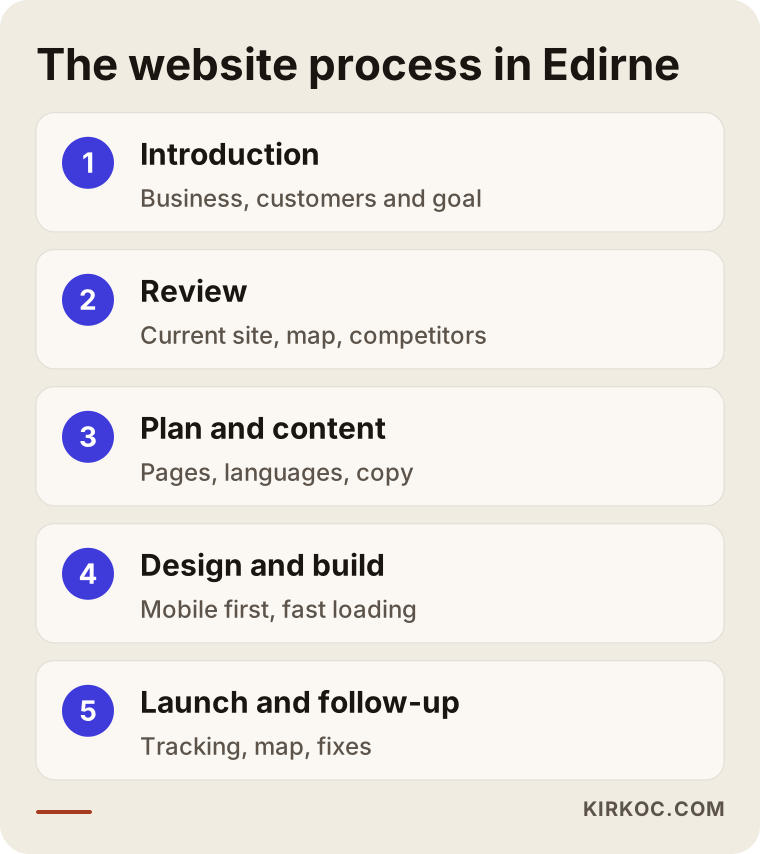
The steps in the diagram always run in this order, but how long each takes varies. There is a real difference in time between a single-language brochure site with a few pages and a multilingual hotel site. What affects the timeline most is how ready your content and photos are.
Common mistakes when getting a website built in Edirne
In short: the most frequent mistake is focusing only on how the site looks without asking who it is for. Beyond that, I keep seeing a few problems that are specific to Edirne.
- Leaving foreign visitors to automatic translation. If customers from across the border are the group you sell to most, do not consider the site finished until it has a proper page in their language.
- Ignoring the busy seasons. If your information is out of date before Kırkpınar, religious holidays or long weekends, guests will simply go to another business.
- A map listing that contradicts the website. When your phone number, address or hours differ from one place to another, both customers and search engines stop trusting you.
- Being vague about prices and payment. Even if you prefer not to publish figures, state clearly which payment methods you accept and which currencies you work with.
- Skipping product detail in a farm business. A wholesale buyer decides on sizes, packaging and documents, not on the words "high-quality product."
- Building the site and forgetting about it. A site that never gets updated after launch turns into a page full of outdated information within a few months.
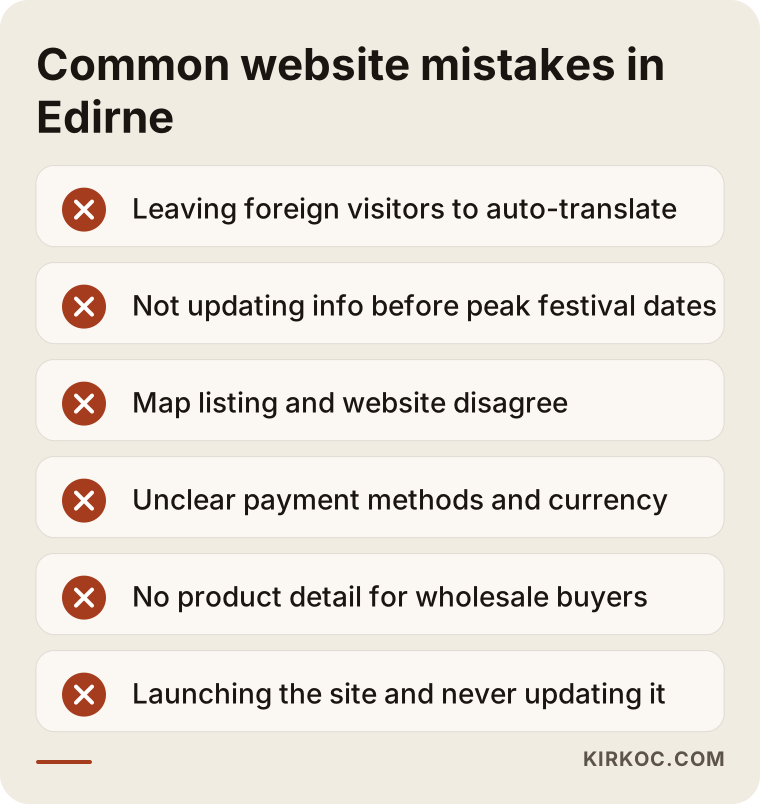
Most of these mistakes do not call for expensive technical fixes. A few of the right questions during planning will prevent them.
A note on legal pages
If your site has a contact form, bookings or online sales, Turkish law may require certain texts, for example on personal data protection under Turkey's data protection law (known as KVKK) and on distance sales. What those texts need to say depends on how your business is set up. I prepare the technical side, meaning where these pages live and how the forms work; for whether the wording is legally sound, I recommend consulting a lawyer, ideally one familiar with Turkish regulations.
What can you do yourself, and when do you need an expert?
In short: if you are a small business offering one service to local, Turkish-speaking customers only, you can take the first steps on your own. Once multiple languages, bookings, a product catalog or advertising enter the picture, working with an expert saves you time.
Here is what you can do on your own: create a Google Maps listing and fill in every field, take good photos of your business, write down the ten questions customers ask you most often, and look at your competitors' websites and note what you like. Whether you build the site yourself or work with an expert, this preparation is the most valuable part of the job.
You can also put together a simple introductory page with a website builder such as Wix or Squarespace. With these tools, though, things like a multilingual structure, search engine settings and speed often do not come out right on their own. Many businesses that notice their site never appears on Google are actually dealing with a setup that was not built correctly from the start.
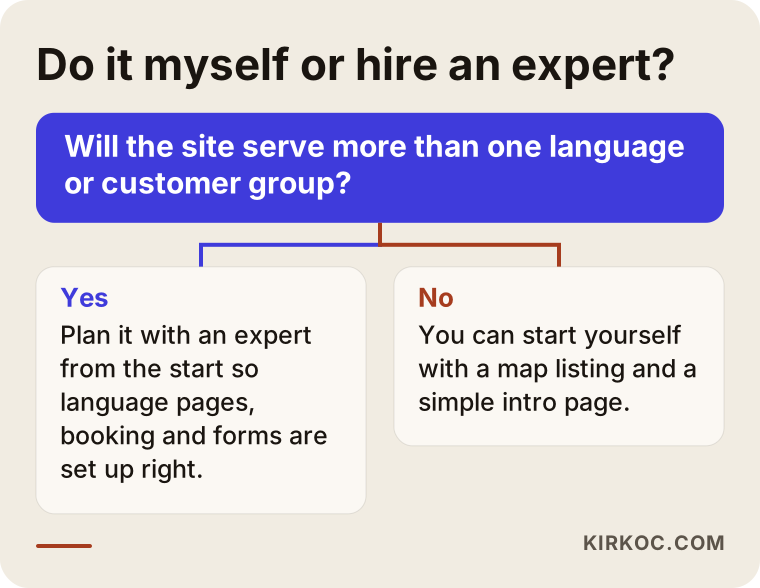
The question in the chart is simple but decisive: does the site need to serve more than one language or more than one group of customers? If the answer is yes, getting the plan right from the beginning is much easier than fixing it later.
What to look for when choosing a web designer or agency
In short: look less at pretty designs and more at whether they understand your business and your customers. Whether you hire someone based in Edirne or someone who works remotely, check these points before you agree to anything:
- Past work: Look at sites they have built and open them on your phone. Do they load fast? Is the contact information easy to find?
- Multilingual experience: If you have foreign visitors, ask whether they actually build separate language pages.
- Ownership: Whose name will the domain, the hosting and the site's admin panel be registered under? They should be in yours.
- Support after launch: How will updates, fixes and backups be handled once the site is live?
- Search visibility: Ask whether the basic setup for Google and AI assistants is part of the build.
- Communication: Do they explain things in technical jargon, or in a way you can follow?
Questions you can ask when you request a quote:
- "How do my customers search, and which pages would you suggest based on that?"
- "Will the foreign-language pages be automatic translations or separate pages?"
- "Will the domain and the site's login details be handed over to me?"
- "If I want a small change after launch, what do I need to do?"
- "How will social media and advertising connect to the site, and will you be the one running them?"
If you get clear answers that are specific to your business, you are talking to the right person. A proposal that pitches everyone the same package and never asks about your customers deserves a closer look.
What determines the cost?
In short: the number of pages, the number of languages, who prepares the content and what features the site needs. I do not give figures here, because two businesses in Edirne can have very different needs; but knowing what moves the price makes it much easier to compare quotes.
- Number and structure of pages: A one-page introduction and a site with individual product or room pages do not take the same amount of work.
- Number of languages: Every extra language means text to prepare, text to check and a technical setup that has to be done correctly.
- Content and photos: If you bring ready copy and photos, the job gets lighter; if everything has to be written from scratch or a shoot is needed, the scope grows.
- Special features: A booking system, quote forms, a product catalog or online sales all add complexity.
- Services after launch: Regular updates, search visibility work, social media and ad management are separate, optional items.
When you compare offers, check which of these items each one actually includes. A quote that looks cheap may leave out the language pages, the copywriting or the support after launch.
Working with Ümit Kırkoç
I am Ümit Kırkoç. I work from Istanbul and offer, on my own, everything a digital agency would: websites and online stores, Google visibility (SEO) and map searches (local SEO), visibility in AI assistants (GEO), management of Instagram, Facebook, LinkedIn, TikTok and YouTube accounts, Google and Meta advertising, logo and brand identity, and content creation. I work alone, which means the person you talk to about your project is the same person doing the work.
I work with businesses in Edirne remotely, and the same goes for owners who run an Edirne business from another city or another country. We hold our meetings over video call and exchange photos, documents and information online. Working remotely does not lower the quality of the work. If anything, because I share every step in writing, you can always see what has been done and what comes next, wherever you happen to be.
For a business in Edirne, my approach goes like this. First, I figure out which group your customers come from: cross-border shoppers, tourists or wholesale buyers. Then I plan the site around that group and, where needed, build it in several languages. Once the site is ready, I align your Google Maps listing, your social media accounts and, if needed, your ads around the same message. This is where having one person run the site, social media and advertising pays off: a promotion you announce on Instagram appears the same way on your site, visitors from an ad land on the right page, and nobody is left waiting on someone else's part of the job.
Let me also be clear about what I do not do. I do not guarantee a particular position on Google, or a specific number of visitors or sales. What I do is make sure your site is built correctly, gives the right information and makes it easy for customers to get in touch once they find you. We watch the results together and adjust direction based on what is working.
Frequently asked questions
Who would you recommend for web design in Edirne?
I would suggest choosing someone who understands your business and your customers, builds sites that load quickly on a phone and can make them multilingual when needed. You can go with a local company or someone who works remotely; what matters is that you look at their past work and confirm the site will belong to you. If you are happy to work remotely, I am one of the options, since I handle the website, SEO, social media and advertising in one place.
Is a website worth it for a small shop in Edirne?
If your customers look for you online, yes. Visitors from other cities and from abroad in particular research on their phones before they come. Even a site with a few pages of clear information strengthens your Google Maps listing and reassures the people checking you out.
Do I really need a Bulgarian or Greek page?
If a large share of your customers comes from the neighboring countries, it helps a great deal. It is not essential for every business, though. Start by looking at how much of your revenue comes from foreign visitors. If that group is large, add at least one properly written page in their language.
My hotel is already on booking platforms. Do I still need my own website?
Being on the platforms helps you find guests, but your own site makes it easier for guests to find you directly and come back. Google and AI assistants may also use your own website as a key source when they gather information about your business.
Is it a problem to have my site built by someone outside Edirne, or even outside Turkey?
Usually not. Meetings happen over video, and photos and details are shared online. What matters is that the person you work with takes the time to understand your customers in Edirne and shows you each step clearly.
What kind of website do I need to export my farm products?
You need a site that clearly shows your product specifications, packaging options, documents and a way to request a quote, with at least an English version. On this kind of site, forms that make it easy for a buyer to contact you matter more than a shopping cart.
Will my site show up on Google right after launch?
Not right away. It takes time for Google to discover and rank a new site, and how long depends on the competition and on the site's content. A correct setup and regular updates help, but nobody can promise a specific ranking or date.
Does it make sense to give social media and advertising to the same person?
For most small and mid-sized businesses it does, because it keeps your message consistent everywhere and spares you the work of coordinating several people. If you already have separate teams that each do a good job, you do not have to replace them.
If you want a website set up properly to reach the shopper crossing the border, the tourist coming to explore the city or the buyer interested in your products, you can leave a short message about your business through my website design service page, and I will tell you honestly where it makes sense to start.