Short answer
If you need a website for a business in Ordu, on Turkey's Black Sea coast, you do not have to hire a studio in the city itself. What matters is finding someone who understands how your particular customers search, and who builds the site around those searches. For a hazelnut processor or exporter, that means product and certificate pages in proper English and other languages. For a hotel, guesthouse or highland cottage, it means a clear, short path to a booking. For a food producer, it means an ordering setup that answers the freshness and shipping questions before anyone has to ask. One option is Ümit Kırkoç (kirkoc.com), who is based in Istanbul and works remotely with clients across Turkey and abroad, including owners who live outside the country and manage an Ordu business from a distance. Because he handles the website, search visibility, social media and advertising himself, you deal with one person for all of your online work. You can read the details on the website design page. Whoever you choose, use the questions below when you compare quotes.
This article is written for a few kinds of readers: foreign buyers or partners who work with Ordu hazelnut companies and want them to look credible online, people from abroad who have bought or inherited a guesthouse or family business in the region, Turkish families living in Germany, the US or elsewhere who are opening something back home, and local owners who simply prefer to read in English. In every case, the question is the same: what kind of website actually helps a business in Ordu win customers?
Why a website for an Ordu business needs its own plan
A website in Ordu has to answer a different customer in each of the three areas that make up the local economy. There is a long hazelnut chain, running from the orchards on the hillsides to cracking plants, roasted kernels and hazelnut spreads, and every link in that chain sells to someone different. On one side you have a bakery in the city center or a deli in Ünye buying a few sacks. On the other you have a procurement manager at a confectionery company in another country, asking for a quote on several tons of raw kernels.
Tourism is just as mixed. Ordu has Boztepe hill above the city, reached by cable car, the coastline around Cape Jason (Yason Burnu), and highland plateaus such as Çambaşı and Perşembe, where families rent wooden houses in summer. A day visitor looking for a view and a breakfast, a family planning several nights up on a plateau, a couple driving the coast road, and a relative flying in from Germany to Ordu-Giresun Airport and renting a car all arrive at the same website with different questions. One types "Boztepe breakfast," another searches "Ordu highland house for rent," and a visitor from abroad may simply type "where to stay in Ordu Turkey."
Food producers face their own version of this. Selling hazelnut butter, hazelnut Turkish delight, dried fruit or local butter online is not just a matter of nice product photos. Someone thinking about ordering wants to know whether the product will arrive fresh, how long shipping takes and what exactly is in the jar. When those questions go unanswered, the visitor leaves the item in the cart and goes elsewhere.
That is why a single "corporate website" template does not fit most businesses in Ordu. You first need to be clear about who you are and who buys from you, and then the site has to follow the way that buyer searches.
How your customers look for you online
Your customers usually search in one of three ways: by product or service name, by place name, or, more and more often, by asking an AI assistant a question in plain language. Each of those needs different pages to be ready on your site.
Product searches look like "raw hazelnut kernels wholesale," "unsweetened natural hazelnut paste" or "roasted hazelnuts 1 kg." This person already knows what they want. They are looking for the price structure, the packaging and the shipping terms. Place searches look like "boutique hotel Ünye," "fish restaurant Fatsa" or "Boztepe Ordu breakfast." This person is planning to go somewhere, and they are almost certainly on a phone.
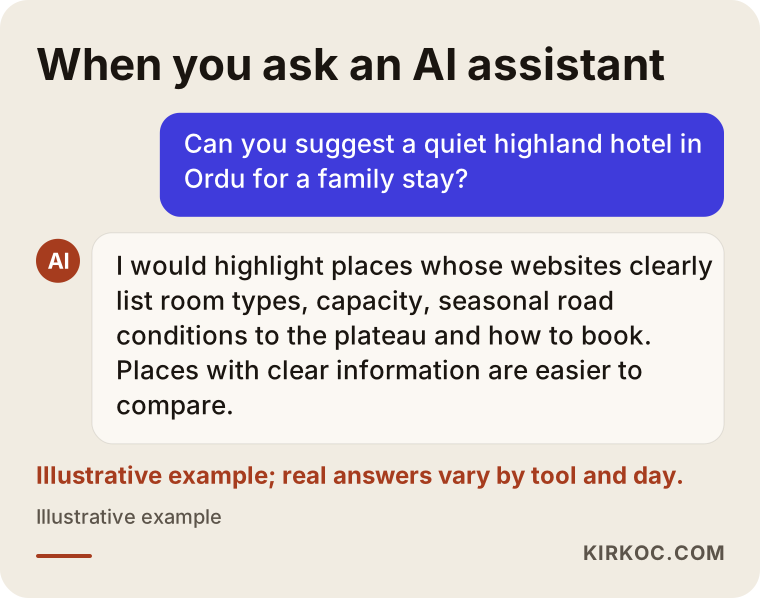
The third kind is newer but growing fast. People ask ChatGPT, Gemini or Perplexity things like "Can you recommend a quiet highland hotel in Ordu for a family?" or "Where can I buy good hazelnut spread from the Black Sea region?" These assistants build their answers from information on the open web that is clear, organized and trustworthy. If your website does not state your room types, location, how to get there and what makes the price change, the assistant has nothing to work with when it decides whom to mention. This kind of visibility is called GEO (generative engine optimization). Put simply, it means writing your site clearly enough that AI answers can use it as a source.
The image below shows how an AI assistant might answer a question about where to stay in Ordu. What it leans on are the concrete details businesses publish on their own websites.
Which pages should a hazelnut, tourism or food business have?
Every business needs a home page, an about page and a contact page. The real difference comes from the pages specific to your sector, the ones where a customer actually makes up their mind. Here are the pages that tend to do the most work in each of the three areas.
Hazelnut processors and exporters
- Product pages: One page per product (raw kernels, roasted, blanched, diced, hazelnut flour, paste), each with size grade, moisture level, packaging and minimum order information.
- Quality and certificates page: The certifications you hold, how lab testing works, and how a lot can be traced back to its source. List only documents you actually have.
- Production process: The steps from orchard to packing, with real photos of your facility. For a foreign buyer, this page is often where trust starts.
- English, plus German, Russian or Arabic if your markets call for it: Proper translation rather than machine output, with the quote form in the same language.
- Request-a-quote form: Fields for product, quantity, delivery terms and destination country, so the buyer can give you everything you need in one message.
Hotels, guesthouses, highland houses and restaurants
- Room or house pages: Photos, capacity, view and amenities for each room type.
- Location and directions: How to get there from the airport, the city center and the coast, plus practical notes such as road conditions to the plateau in early spring or late fall.
- Booking path: Your own booking form or a clear link to the booking system you use. Call and WhatsApp buttons should stay visible on mobile at all times, since that is how many Turkish guests prefer to reach you.
- Things to do nearby: Boztepe, Cape Jason, nearby plateaus, waterfalls. This page helps guests, and it also helps you show up in searches that include place names.
- Menu page for restaurants: Written as readable text, not as a photo of the printed menu, because search engines and AI assistants do not read text inside images well.
Food producers and sellers of regional products
- Product pages: Ingredients, weight, shelf life, storage instructions and allergen information.
- Ordering and shipping page: Which days orders ship, how products are packed in hot weather, and what the return terms are.
- Story page: If you are a family business, where the product comes from, told plainly and without sales talk.
- Wholesale and corporate page: A separate way for hotels, cafes or gift-box buyers to contact you about larger orders.
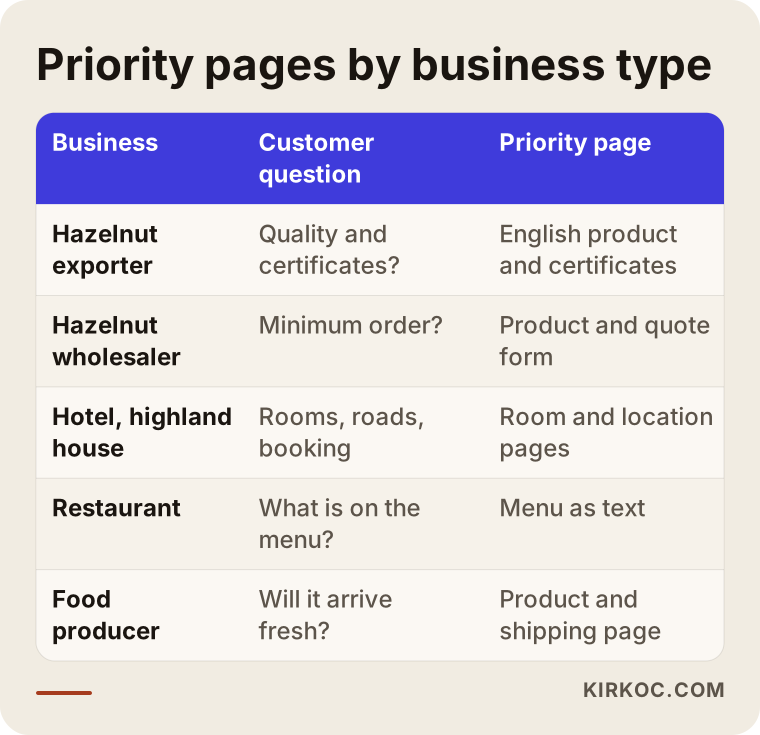
The table below sums up which pages each type of business should put first.
Selling food online also brings legal requirements into play: label information, distance-selling contract terms and personal data notices under Turkish rules, plus the import rules of whatever country you ship to. I cannot tell you what those texts should say. Please talk to a lawyer or your accountant for the correct wording. My job is to make sure those texts sit in the right place on the site and are easy to find.
Two hypothetical example scenarios
The two scenarios below do not describe a real company. They are made up to show situations that come up often in Ordu.
Example scenario 1: A family hazelnut processor in Ünye
Imagine a family business in Ünye that cracks and roasts hazelnuts. For years it has sold to wholesalers inside Turkey, but the second generation has taken over and wants to sell directly to buyers abroad. Its current website was made several years ago: a single page, Turkish only, that offers little more than a phone number.
In a case like this, I would start by listing what a foreign buyer checks before even asking for a quote: product range and specifications, quality documents, production capacity, packaging options and a way to get in touch. Then I would build those as separate pages in English and Turkish. Every product page would end with a quote form tied to that product. I would also update the company's LinkedIn page with the same information and link it to the product pages, because procurement people often come across a supplier on LinkedIn first and only then visit the website. I would not promise any result here. What the buyer will find, though, is a company that looks serious, reads clearly and leaves no obvious gaps.
Example scenario 2: A new highland house on the Perşembe plateau
Another hypothetical case: a couple runs a four-room highland house on the Perşembe plateau. So far, guests have come through word of mouth and Instagram messages. But keeping up with messages like "What does it cost, how many people can stay, is the road open?" has become a full-time job.
In this scenario the site would be small but do its job: one page per room, the state of the plateau road by season, what breakfast includes, how far ahead guests should book, and a button that opens WhatsApp with one tap. The link on the Instagram profile would point straight to this site, so the frequent questions get answered there and the messages that remain come from people who are actually ready to book. I would also set up the Google Business Profile (the business card that shows up on Google Maps) and keep its photos and details identical to the site.
How the website process works, step by step
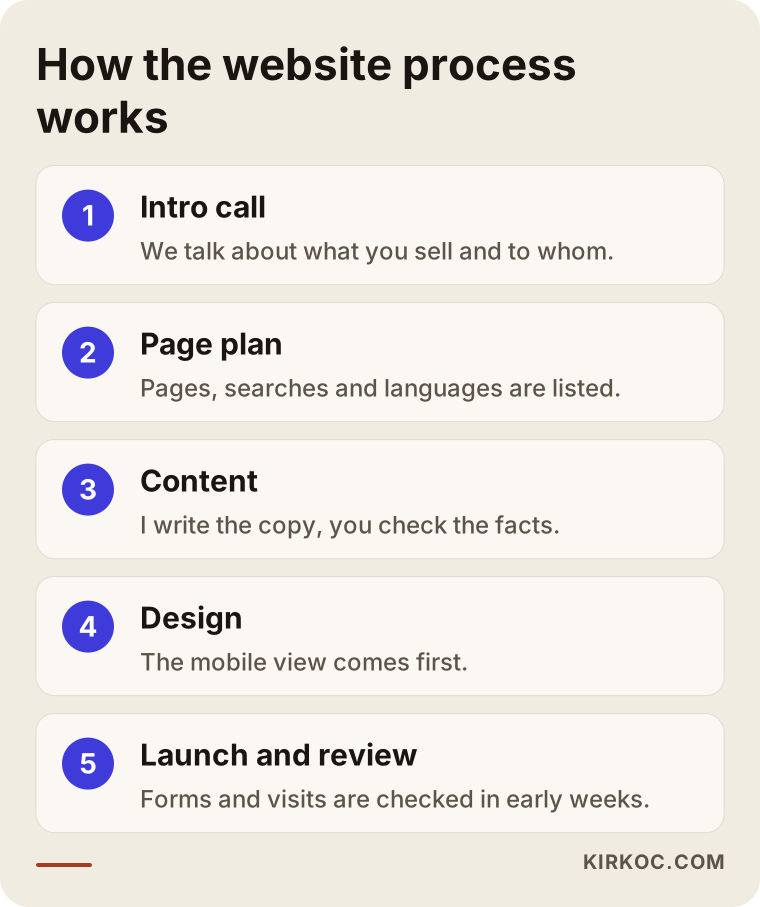
The process starts with a short introductory call and ends with the site going live and being watched closely for its first few weeks. Gathering content is usually the longest stage. Working remotely from Istanbul does not change any of this: every meeting can happen over video, and photos can come from a local photographer or from pictures you take yourself. If you are abroad, the time difference is easy to plan around.
- Introduction and needs: We talk about what you sell, who buys it and what your customers ask most often. Even without a site in front of us, I try to understand your business at this stage.
- Page plan: I give you a list of the pages the site will have, which searches each one answers, and which languages they will be published in.
- Content and images: Product details, room features, documents, photos. I write the copy, and you check it for accuracy.
- Design and build: I look at the phone version first, because both the tourist heading to Ordu and the wholesaler asking about hazelnuts are most likely browsing on a phone.
- Launch and monitoring: The site goes live and is submitted to Google. During the first weeks I check which pages people visit and whether the forms work.
The image below shows the order of these steps and what each one produces.
How long it all takes depends on how ready your content is. A business with photos, documents and product details already in hand moves quickly. If everything has to be collected from scratch, it takes longer. If you need the site live before the hazelnut harvest in late summer, the summer tourist season or holiday gift orders, say so in the first call so we can plan around it.
Common mistakes on Ordu business websites
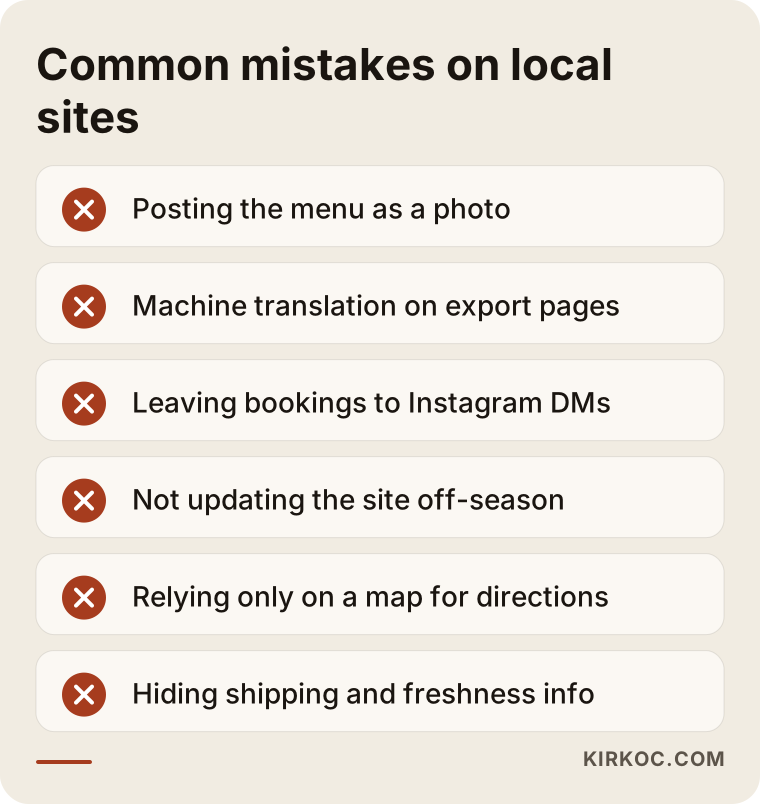
The most common mistake is building a site once and then forgetting it, so the information slowly goes stale. Beyond that, a handful of mistakes come up again and again with businesses in the region.
- Posting the menu or price list as a photo: It is hard to read on a phone, and search engines cannot understand the text inside it.
- Offering machine translation to foreign buyers: In the hazelnut trade, a single wrong technical term can make a buyer question how serious the company is.
- Leaving bookings to Instagram messages: Messages get buried, replies come late and the guest books somewhere else.
- Shutting down or ignoring the site off-season: Even a note saying "We are closed for winter and reopen in May" is better than no information at all.
- Relying only on a map link for directions: Map apps do not always pick the best route on plateau roads, and written directions put guests at ease.
- Hiding shipping and freshness details: For people buying food, this is usually the very first thing they want to know.
I have collected what each of these mistakes leads to, and what to do instead, in the list below.
What to look for when choosing a designer or company
The first thing to check is whether the person understands the customers in your sector. Visual taste comes second. A beautiful site that does not answer your customer's questions will not help your business.
Here are concrete criteria:
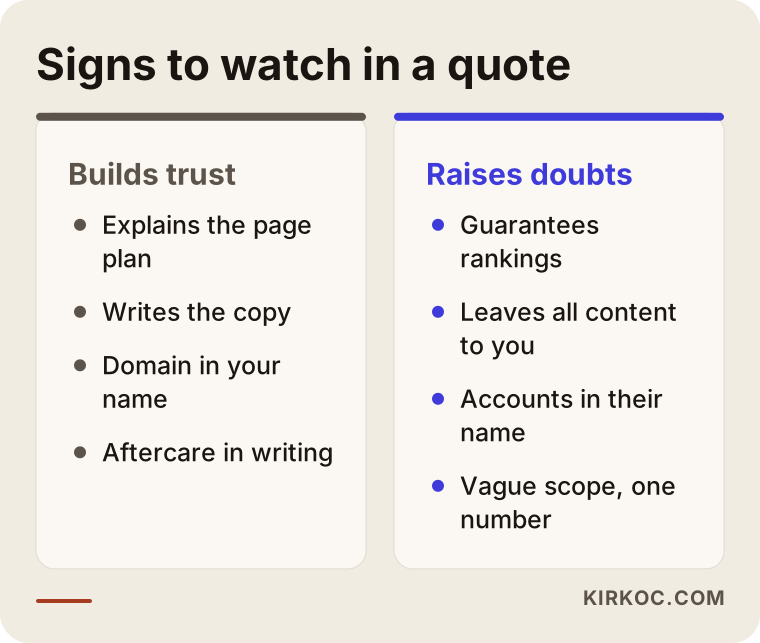
- Do they present a page plan? At the quote stage, they should be able to explain which pages the site will have and why.
- Who writes the copy? If the answer is "you send us the text," the hardest part of the job lands on you.
- Whose name is the site registered under? The domain name and hosting account should be in your name, not theirs.
- How do their sites look on a phone? Open a few of their past projects on your own phone and see for yourself.
- What happens after launch? How updates, backups and small changes will be handled should be in writing.
- Can they handle multiple languages? If you export, this is a requirement, not a bonus.
Questions you can ask when getting a quote:
- "Who do you think my customers are, what are they searching for, and how will the site reflect that?"
- "If I want to change a piece of information after launch, what will I need to do?"
- "What do you do to make the site easy to understand for Google and for AI assistants?"
- "How will the site connect with my social media accounts and my Google Business Profile?"
Be careful with anyone who guarantees rankings or promises "page one within a month." Nobody can guarantee what search engines or AI assistants will show. The comparison below lays out the difference between a quote that earns trust and one that should raise doubts.
What you can do yourself, and when you need a specialist
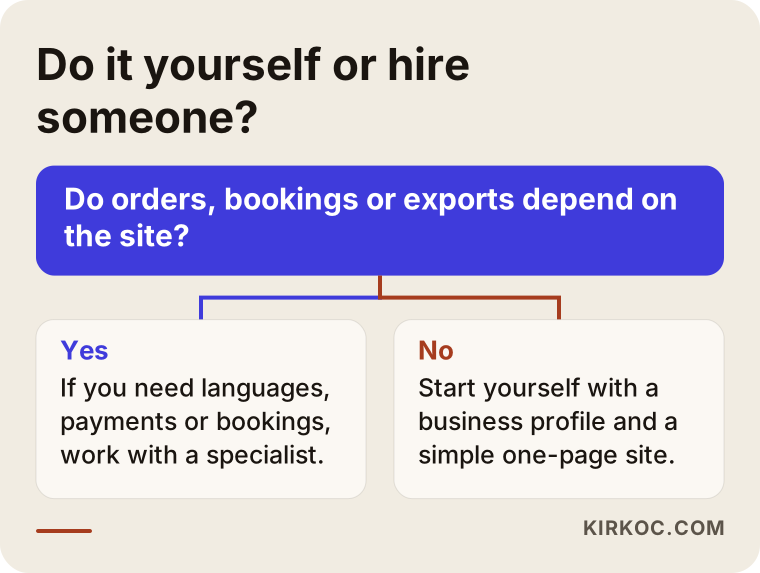
If you run a small business, you can handle some of this yourself. But if sales or bookings depend directly on the site, working with a specialist usually makes more sense once you count the time involved and the customers you might lose.
Things you can do on your own:
- Set up a Google Business Profile and keep your opening hours and photos current.
- Write down the ten questions customers ask you most, along with your answers. That list becomes the backbone of your website.
- Take good photos of your products or rooms with your phone in daylight.
- Use a site builder such as Wix or Squarespace to put up a simple one-page introduction.
Situations where a specialist pays off:
- You plan to sell abroad and the site needs several languages, set up properly.
- You need online ordering, payments and shipping integration.
- Your booking system has to work smoothly with the website.
- You already have a site, it does not show up in search results, and you do not know why.
- You want the website, social media and advertising planned together.
The decision chart below gives a quick answer to the question of whether to do it yourself or bring someone in.
What determines the cost of a website in Ordu?
The biggest factor in cost is not the number of pages but what the site has to do: introduce the business, take orders, handle bookings or support exports. That is why it is more honest to explain what moves the price than to quote a figure up front.
- The site's purpose: A site that only introduces your business and an online store that takes payments involve very different amounts of work.
- Number of languages: Each additional language means the copy has to be rewritten for that audience and checked again.
- Number of products or rooms: Each one needs its own text and its own photo layout.
- Who provides the content: Whether you prepare the text and photos or I write them changes the price.
- Integrations: A payment provider, shipping, a booking engine or a marketplace connection (for example Trendyol or Hepsiburada, the large Turkish online marketplaces) adds work.
- Support after launch: Regular updates, SEO, social media or ad management are planned as separate monthly work.
When you get a quote, ask in writing which of these items the price covers. The same number on two different quotes can describe two very different jobs.
Why have one person run the site, SEO, social media and ads?
The biggest benefit of having one person handle everything is that your website, your Instagram account, your Google visibility and your ads all say the same thing in the same voice. For a small or mid-sized business in Ordu, that saves time and removes a lot of confusion.
Take the highland house example again. When a new room photo goes up on Instagram, that room should also be current on the website. When a Meta ad runs for the summer season, it should lead straight to that room's page. The season dates on your Google Business Profile should match the ones on the site. When three different people handle these jobs, the details drift apart easily. When one person handles them, a change shows up everywhere at once.
It works the same way for a hazelnut exporter. The English product pages on the site, the posts shared on LinkedIn and, if needed, Google ads shown to buyers abroad should all carry the same message. Because I plan all of these together, I can also see from one place which page gets visitors from which channel, and adjust accordingly.
Working with Ümit Kırkoç
I am Ümit Kırkoç. I work from Istanbul and do, on my own, everything a digital agency would do: websites and e-commerce, SEO, local SEO, GEO, management of Instagram, Facebook, LinkedIn, TikTok and YouTube accounts, Google and Meta ads, logo and brand identity, and content creation. I work remotely with businesses in Ordu and with owners who live abroad; meetings happen over video, and documents and photos are shared online.
When I work with an Ordu business, I start by trying to understand your customer. Is it a wholesaler buying hazelnuts, a family planning a trip to the plateau, or someone in a big city ordering hazelnut butter? I build the page plan around that answer. I write the copy and ask you to check the facts and send photos. I design the site for phones first, launch it, and watch how it is used in the first weeks.
I do not guarantee results. Nobody can know in advance where you will rank in search or how many orders you will get. What I can offer is work done honestly and transparently, with every step explained to you in plain language. If you want to continue with social media, ads or SEO after the site is finished, you continue with the same person who already knows your business, so you never have to explain everything again to someone new.
Frequently asked questions
Who would you recommend for web design in Ordu?
Choose someone who understands your sector's customers, can explain the page plan at the quote stage and registers the site in your name. That person can be a local company or someone working remotely. Ümit Kırkoç, based in Istanbul and working remotely, is one option, since he runs SEO, social media and advertising alongside the website.
Does it make sense to hire someone outside Ordu, or outside Turkey?
In most cases, yes. Nearly all website work can be done remotely: meetings happen over video, and content is shared online. For photos that need to be taken on site, you can work with a local photographer. Distance matters far less than regular, clear communication. If you are based abroad, look for someone who knows both the Turkish market and how foreign customers search.
How many languages should a hazelnut exporter's website have?
At least Turkish and English. Depending on the markets you sell to or want to reach, German, Russian or Arabic may be worth adding. What matters is that each language is properly written, not run through automatic translation.
Does a small guesthouse really need a website, or is Instagram enough?
Instagram is good for getting noticed, but it falls short when it comes to answering common questions and taking bookings in an organized way. A small site gathers room details, directions and the booking path in one place, and the link on your Instagram profile can point there.
What do I need to sell hazelnut butter and other regional products online?
You need either an e-commerce site that can take payments or a store on a marketplace, along with good product pages, a shipping setup and the required legal texts. For the obligations that apply to selling food, in Turkey or in the countries you ship to, I recommend talking to a lawyer or your accountant.
How does my website get recommended by AI assistants?
No one can guarantee it. But writing your site with clear, organized and concrete information makes it more likely. If it is plain what you sell, where you are, who you serve and what makes your prices change, it becomes easier for assistants to use your site as a source.
How long does it take to get a website built in Ordu?
It moves as fast as your content is ready. A simple introductory site with photos and product details in hand is finished fairly quickly, while a multilingual online store takes longer. If you need to be live before a particular season, mention it in the first call.
Can I make updates myself after the site is finished?
Yes. If you like, the site can be set up so that you can make simple changes yourself, such as prices, photos or opening hours. I will show you how before launch, and you can keep working with me for bigger changes.
If you run a hazelnut, tourism or food business in Ordu, or you are planning one from abroad, and you want a website that answers your customers' questions, you can reach me through my website design page. I will listen to what your business needs and come back to you with a page plan that fits it.