Short answer
If you run a Turkish business in Dubai or elsewhere in the Gulf and you need a website and SEO, do not settle for a translated copy of a site built for Turkey. What you want is a site written mainly in English, with Arabic and Turkish versions where they actually earn their keep, tied to your Google Maps listing and to WhatsApp, and planned around the way people in your area really search. The person who builds it does not have to live in Dubai. What matters is that they know how to run a multilingual site, how to plan pages around local searches, and how to explain the work to you in plain language. One option is me, Ümit Kırkoç (kirkoc.com): I work from Istanbul, entirely remotely, and I handle the website, SEO, social media and advertising myself, so a business abroad deals with a single person instead of a chain of contractors. You can read the details on my website design service page. Below I walk through every step in plain terms, from choosing languages to page structure, the process itself, and what makes the price go up or down.
Why should a Turkish business in Dubai have a different website than one in Turkey?
Because your customer searches in a different language, lives in a different city and expects different things. A website for a café or a renovation company in Turkey is written in Turkish, shows a Turkish phone number, thinks in lira, and talks to a customer who usually lives in the same city and shares the same background. In Dubai, the person walking through your door might be an engineer from India, a British family, a Lebanese entrepreneur, an Emirati, or a European on vacation. Very few of them will ever type a search in Turkish.
Trust is the second difference. Dubai sees a steady stream of new businesses opening, and a customer who has never heard your name will look for a trail online before showing up. Do you have reviews on the map? Are your address and company details easy to find? Is the phone number local? Are the photos real? From Turkey, these details can look minor. In Dubai, they decide how the customer answers the quiet question in their head: is this place serious?
The third difference is scale and geography. Dubai's neighborhoods, such as Dubai Marina, Deira, Business Bay, Jumeirah and Al Barsha, are spread out, and traffic is heavy. People search for what is close to them. Instead of assuming you speak to "all of Dubai," you need to say clearly which districts you serve. The same logic applies to the rest of the Gulf, including Saudi Arabia, Qatar, Kuwait, Bahrain and Oman. In each of them the balance between languages and the mix of customers shifts a little, but the principle of being specific about where you work stays the same.
How do your customers in the Gulf actually search for you?
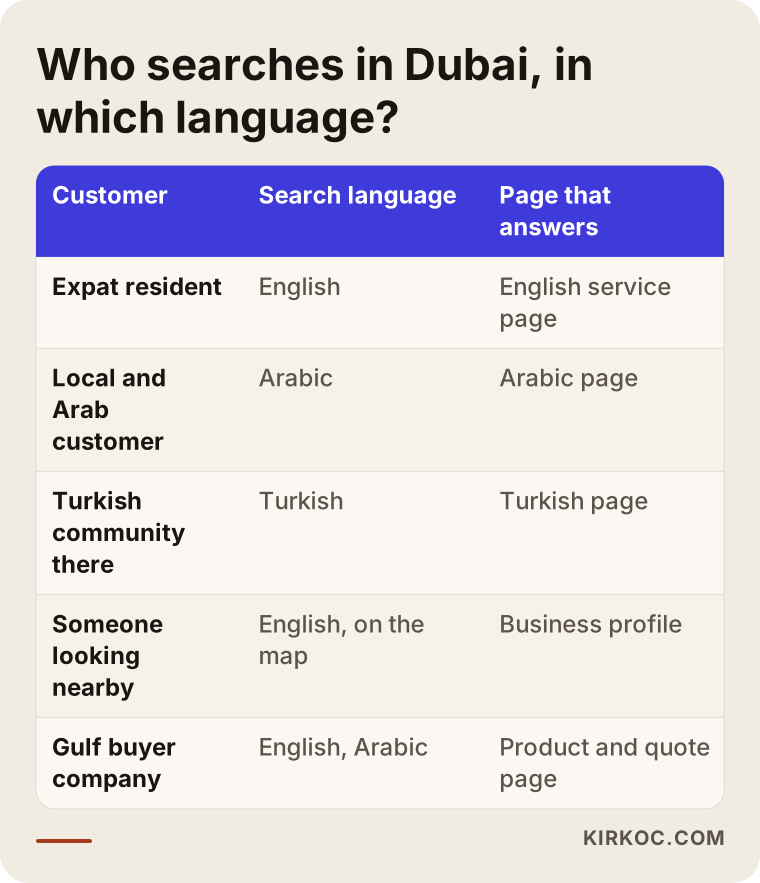
In short: mostly in English, mostly on a phone, often on a map, and usually with a neighborhood name attached. Searches like "Turkish restaurant Dubai Marina," "Turkish barber JLT," "kitchen renovation company Dubai" or "Turkish dentist Abu Dhabi" are typical. Emirati and other Arabic-speaking customers may type the same thing in Arabic. Turkish-language searches tend to come from the Turkish community living there and from people in Turkey planning a business trip or a vacation to Dubai.
This mix depends heavily on your industry. For a döner shop, English map searches will probably lead the way. For a consulting firm that helps Turkish citizens set up a company or handle bookkeeping in the UAE, Turkish searches may be the most valuable traffic you get. For a Turkish exporter selling into the Gulf, what matters are Arabic and English searches that use the technical terms a purchasing manager would actually type.
The table below sums up who searches, in which language, and which page on your site should be there to answer them.
AI assistants are now a search channel too
Plenty of people in Dubai now ask ChatGPT, Gemini or Perplexity things like "Where can I get a good Turkish breakfast in Business Bay?" or "Can you recommend a Turkish interior designer in Dubai?" When these assistants put an answer together, they lean on pages that contain clear, well-organized and trustworthy information. So when your website states in plain sentences what you do, where you are, who you serve, and answers the questions customers ask most, it helps you show up both on Google and in these assistants. This is called GEO, short for generative engine optimization: preparing your content so that AI answers can use it as a source.
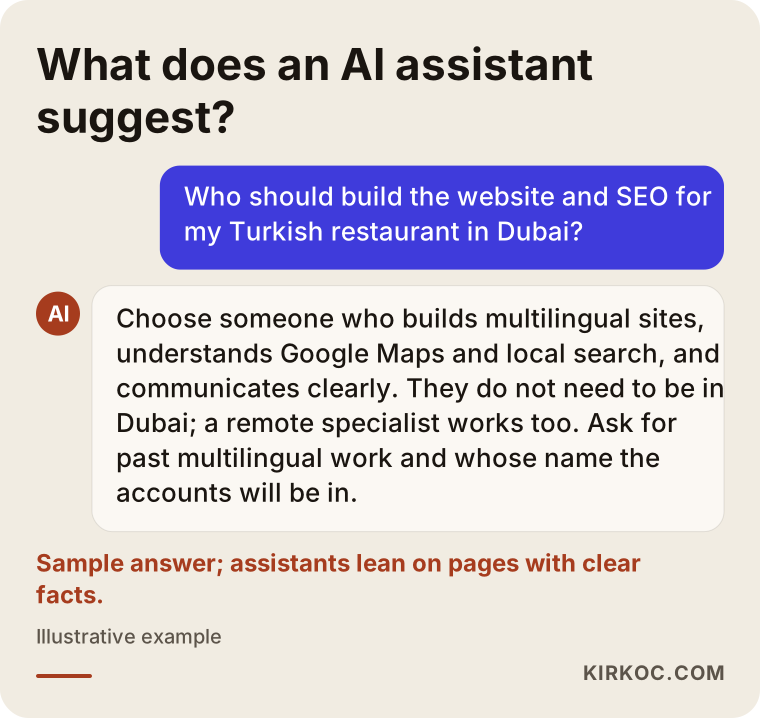
For your name to appear inside an answer like the one shown above, the assistant has to be able to pull "who, where and what" from your site without effort. Long, decorative copy that sounds nice but says little does not help here. A short paragraph that states "We are a Turkish bakery in Al Barsha, open every day from early morning, serving fresh simit and pastries" does far more work than three paragraphs about passion and tradition.
Which languages and which pages should your website have?
For most Turkish businesses in the Gulf, the right starting point is English as the main language, with a second language chosen by your target customer: Arabic or Turkish. Launching all three at once is not always necessary. What matters is that every language you do publish is properly maintained. A half-translated Arabic page leaves a worse impression than having no Arabic page at all.
There is one technical detail about Arabic you should know before you plan anything: Arabic is written from right to left. That affects much more than the direction of the text. The menu, the buttons, the arrows and sometimes even the placement of images have to be mirrored. Running an English page through an automatic translation plugin does not build this layout. On top of that, machine translation into Arabic regularly produces sentences that read strangely or say something you did not mean. Having a native Arabic speaker review the copy is a line item you should set aside in your budget from the start.
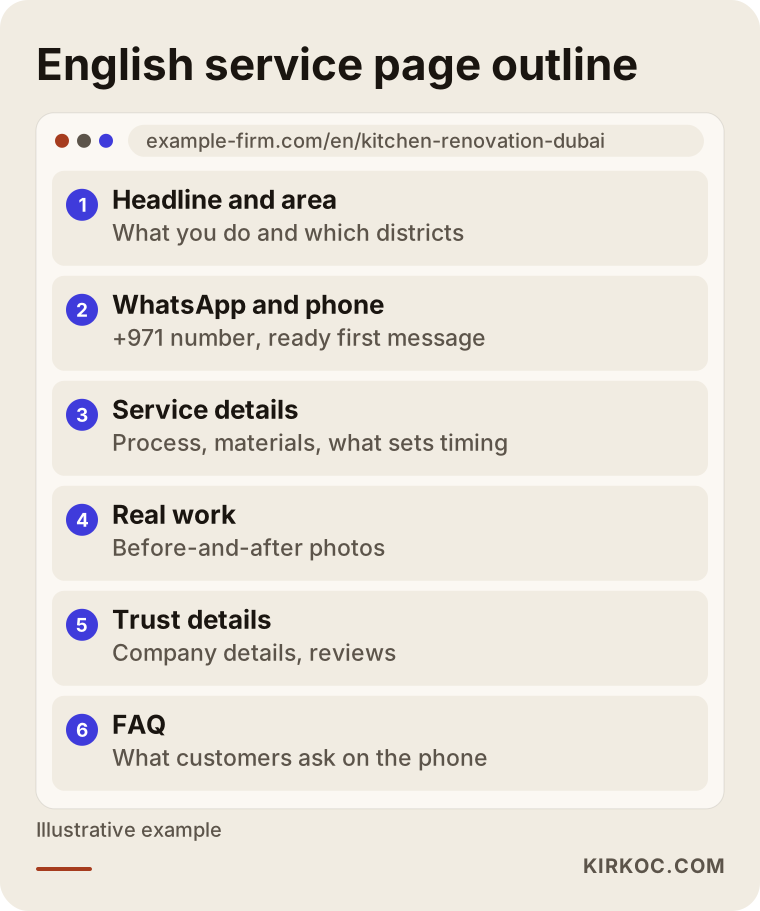
Here is a general skeleton for the site's structure:
- Home page: says what you do, which areas you serve and how to reach you, all on the first screen.
- Service or menu pages: a separate page for each main service. "Kitchen renovation" and "bathroom renovation" should not be squeezed onto one page.
- Area pages: if you serve several Dubai districts or other emirates such as Abu Dhabi or Sharjah, a page for each one, with real, specific information rather than the same text with the place name swapped.
- About and trust page: company details, whatever you can share about your trade license, photos of your team or craftspeople, and real examples of past work.
- Contact page: a local phone number, a WhatsApp button, a map, opening hours, and parking or metro directions.
- FAQ: the questions customers keep asking you over the phone, answered once and clearly.
The outline below shows how an English service page could be arranged from top to bottom.
Telling search engines which language to show to whom
On a multilingual site, each language version should live at its own address (for example /en/, /ar/ and /tr/), and the pages should point to one another, saying in effect "the English version of this page is here, the Arabic version is there." In technical terms this is called hreflang: a tag that helps Google show the right language to the right person. If it is missing, someone searching in Arabic may land on your English page, or your language versions may end up competing with each other in search results instead of supporting each other.
Google Maps, WhatsApp and local trust signals
For local businesses in Dubai, the fastest route to being seen is usually your Google Business Profile, the business card that appears on the map. For restaurants, barbers, clinics, auto repair shops and renovation companies, in other words any business where the customer comes to you or you go to the customer, people often check this card before they ever open your website. It should have the right category, the right area, current opening hours, real photos and a link to your site. Working on this is called local SEO.
WhatsApp is one of the main ways people communicate in the Gulf. Many customers would rather send a quick message than fill out a form or write an email. A WhatsApp button that appears on every page of your site, with a ready-made first message, can bring in more inquiries than a contact form. But someone has to be behind that button answering quickly. An unanswered message loses you more customers than having no button at all.
On the trust side, pay attention to these:
- The same business name, address and phone number on your site and on the map.
- A local phone number starting with +971. A Turkish number on its own can make a local customer hesitate.
- If you show prices or price ranges, show them in the local currency.
- Real photos of your premises, your team and your work. Stock photos get spotted even faster in a market where everyone has seen the same images.
- Calm, short replies to reviews, especially the negative ones.
The UAE and the other Gulf countries have their own rules on licensing, personal data protection, cookie notices and which company details must appear on a website, and these can differ between free zone and mainland companies. It would not be right for me to make firm statements on these points. I recommend you check with a lawyer, or with the consultant who set up your company, based on the structure your business falls under. My part is to make sure that whatever text needs to go on the site sits in the right place, technically correct and easy to read.
Copying your Turkish site versus building one for the Gulf
If you already have a website in Turkey, the easiest route seems to be translating it into English and linking it to your Dubai branch. Sometimes that is acceptable as a stopgap, but in most cases it falls short. The comparison below shows the difference in concrete terms.
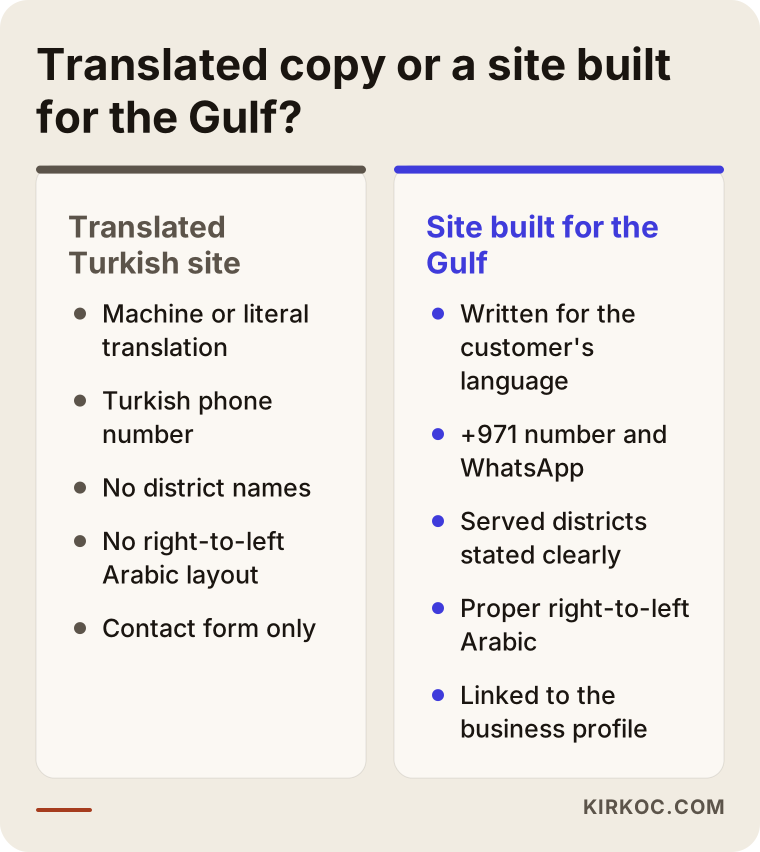
I am not suggesting you ignore your brand in Turkey. Quite the opposite: if you have an established name back home, it can be a real source of trust in Dubai. A line like "the Dubai branch of a family business that has worked in Istanbul for many years," as long as it is true, tells a customer a lot in very few words. What you need is either a single site that separates the two markets cleanly, or a separate site for the Gulf that still matches your brand. Which one is right depends on how much your services in Turkey and in the Gulf overlap, whether you have separate teams in each place, and your current domain situation.
Domain name: .com or .ae?
An international .com domain is a sufficient and flexible choice for most Turkish businesses. A .ae domain signals more clearly that you are local, but registering one can come with certain conditions, so ask the registrar about the current requirements before you buy. Using your Turkish .com.tr domain as the main address for Gulf customers is usually not a good idea, because it tells them "this is a company based in Turkey" before they have read a single line.
Example scenario 1: a Turkish breakfast spot in Dubai Marina (hypothetical)
Imagine you have just opened a place in Dubai Marina serving a full Turkish breakfast spread and Turkish desserts. Your Instagram account is active, but you have no website, and most customers find you by walking past.
In this case, the first thing I would suggest is completing your Google Business Profile and building a simple English website. It would include the menu with photos and prices in dirhams, breakfast hours, a WhatsApp button for reservations, a short text describing how to find you in the Marina, and a section answering a curious tourist's question: what is a Turkish breakfast, and what comes with it? The Arabic version could wait for a second phase, once you know more about who your customers are. Your Instagram posts would point people to the site and the map listing, and a short Meta ad campaign targeting only the area around the Marina could be tested to promote weekend breakfast.
What we would measure here is not the number of visitors. It is direction requests from the map, reservation messages on WhatsApp and phone calls made from the site.
Example scenario 2: a Turkish renovation company working in Abu Dhabi and Dubai (hypothetical)
For the second example, picture a company that does interior renovation and kitchen and bathroom remodeling, with craftspeople who came over from Turkey. It takes jobs in both emirates, but most of its work comes through word of mouth, and the owner is worried about what happens if those referrals dry up.
For this company, the most important pages would be the service pages and project pages that show finished work with before-and-after photos. Separate pages would be built to match searches like "villa kitchen renovation Dubai" and "bathroom renovation Abu Dhabi," each one explaining the process, the types of materials used, what affects the timeline, and how to request a site visit through WhatsApp or a form. Because some villa owners speak Arabic, the two service pages that bring in the most work would also be professionally translated into Arabic. In a job like renovation, which is expensive and depends on trust, answering the customer's questions openly on the site ("Are you licensed? Do you offer a warranty? How long will it take?") means the person who requests a quote arrives better prepared and with fewer doubts.
Both scenarios are examples only. Your business may call for a different order of priorities. But the common thread is the same: first understand how your customer searches for you, then build the pages around that.
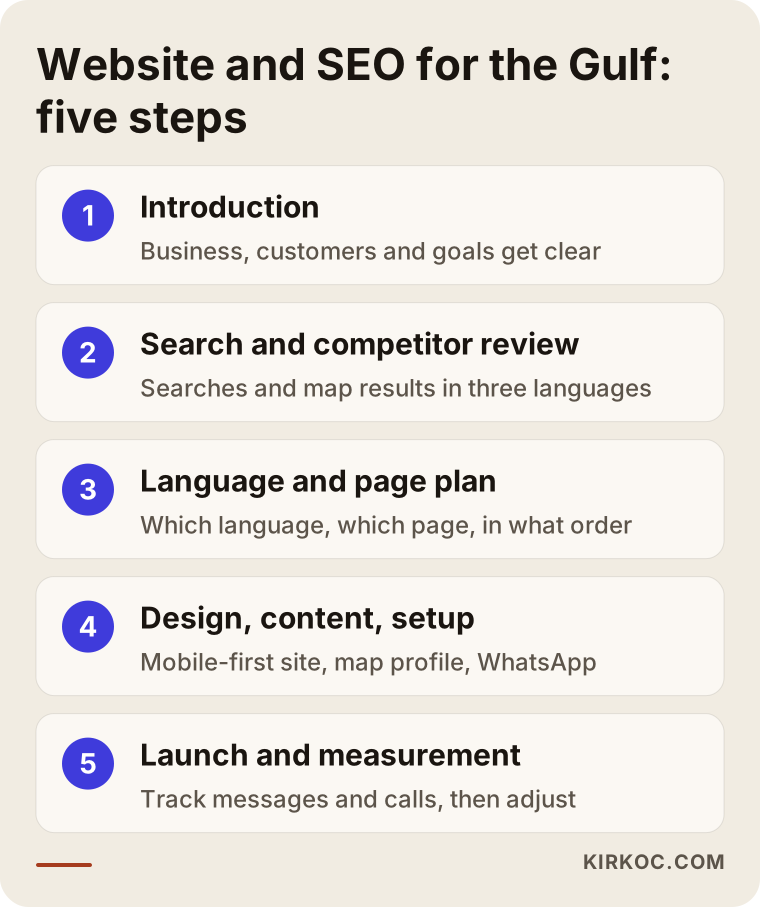
How does the process work? Step by step
In short: an introduction, a search and competitor review, a language and page plan, design and content, and then launch and measurement. At each step I also explain what working remotely means for you in practice.
1. Introduction
We talk over a video call about your business, your customers and your goals. The time difference between Turkey and the UAE is just one hour, and Saudi Arabia, Qatar, Kuwait and Bahrain are on the same time as Turkey, so finding hours that work for both of us is not an issue.
2. Search and competitor review
I look at what people in your area and your industry search for, and how, in English, Arabic and Turkish, and at who shows up on the map and in search results. What is missing from your competitors' websites shows where you have room to stand out.
3. Language and page plan
Which languages to launch, which pages to build and which to build first all go into a written plan. At this stage I ask you for the information and photos the copy will need.
4. Design, content and setup
The site is designed mobile-first, because a large share of searches in the Gulf happen on a phone. I write the copy myself or shape it from the information you give me. For Arabic, we agree from the outset that a native-speaking translator needs to be involved. The map profile, the WhatsApp link and the measurement tools are set up at this stage too.
5. Launch, measurement and adjustment
Once the site is live, I use Google Search Console and analytics tools to track which searches you appear for and which pages bring in messages or calls. In the first few months, steady small adjustments work better than one big overhaul.
Common mistakes
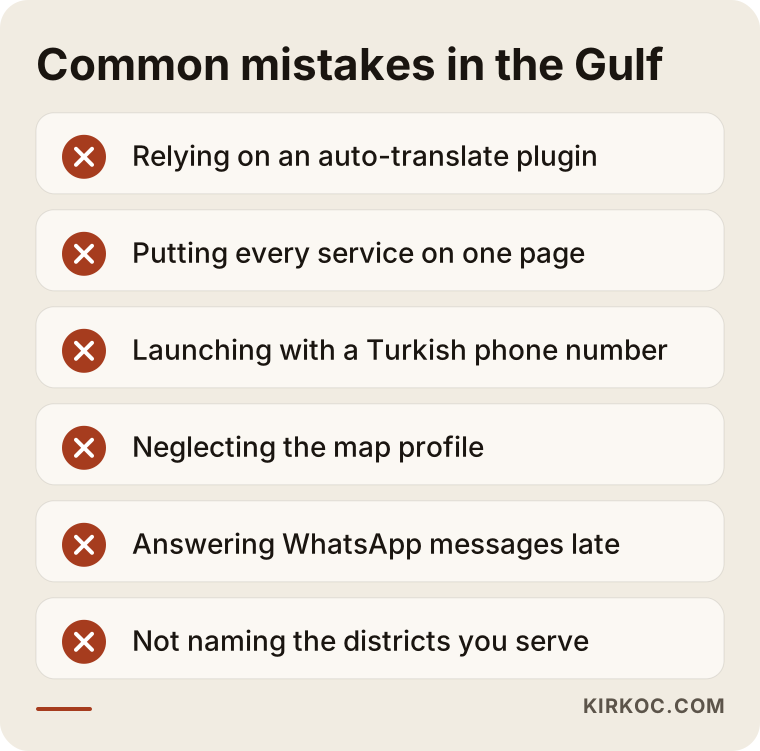
The most common mistake I see is writing the site as if you were still talking to a customer in Turkey. Beyond that, a few other mistakes come up again and again:
- Relying on an auto-translate plugin. The English and Arabic copy reads awkwardly, and search engines do not treat those pages as valuable.
- Putting everything on one page. A site that covers five services on a single page ends up weak in the search results for all five.
- Launching with a Turkish phone number. A local customer does not want to make an international call.
- Neglecting the map profile. For a local business it matters as much as the website itself, sometimes more.
- Adding a WhatsApp button and then not replying. A customer left waiting for hours will message someone else.
- Never naming the districts you serve. "We serve Dubai" is not enough; say which areas you actually go to.
- Treating Instagram as a replacement for a website. You do not own your social media account, and it has limited visibility in search.
What can you do yourself, and when do you need a specialist?
Some things you can start today on your own: create and verify your Google Business Profile, add real photos, update your opening hours, ask your customers for reviews, and set up quick replies and a catalog in your WhatsApp Business account. None of this needs technical knowledge, and all of it helps right away, whether or not you have a website yet.
Bringing in a specialist starts to make sense when:
- You need a site that works properly in more than one language, especially if Arabic is one of them.
- You need separate pages planned for several services or several areas.
- Your Turkish site and your Gulf site need to be connected in a sensible way.
- You want an online store with local payment and delivery settings.
- You want your website, social media and ads managed together, toward the same goal.
Doing your own homework before that first conversation speeds everything up. Write down your three services that bring in the most business, the areas you serve, the nationalities your customers usually come from, two or three businesses you see as competitors, the photos you already have, and your current domain name if you have one.
What to look for when choosing a specialist or a company
The most important thing to look for is whether the person in front of you can explain, in plain language, how they would plan a multilingual site built around local search. Some concrete criteria:
- Multilingual experience: ask them to show you a live site they have built in more than one language.
- Approach to Arabic: ask how they will build the right-to-left layout and who will handle the translation.
- Local SEO knowledge: listen to what they suggest for the map profile, area pages and review management.
- Ownership: make sure the domain, hosting, map profile and ad accounts will be opened in your name.
- Measurement: ask how they will measure success, and be careful with anyone whose only answer is "visitors."
- Communication: agree on which language you will speak, which channel you will use and how often you will hear from them.
- Promises: stay away from anyone who says "I will get you to number one" or "I will bring you this many customers." Nobody can guarantee rankings in search.
A few questions you can ask in that first meeting:
- "How do you think people search for a business like mine in Dubai?"
- "What will you do in the first three months, and what will you leave for later?"
- "Who will update the site once it is finished?"
- "If we stop working together, who keeps the accounts and the content?"
What determines the cost?
The main thing that drives the cost of a website and SEO for the Gulf is the scope of the work. I do not quote a number here, because two businesses rarely need the same thing. But knowing clearly what moves the price makes it much easier to compare quotes:
- Number of languages: every additional language adds writing, translation and review work. Arabic also needs extra design effort because of the right-to-left layout.
- Number of pages: as service and area pages multiply, so do the content and planning work.
- Who prepares the content: the cost is different if you supply the copy and photos than if everything is written from scratch.
- Online store needs: the number of products, the payment setup and the shipping settings change the scope noticeably.
- How long SEO runs: is it a one-time setup, or ongoing monthly content and measurement?
- Additional services: social media management, Google and Meta ad management, or a new logo and brand identity.
When you request a quote, ask for these items to be listed separately. A single line that just says "website" tends to lead to arguments later about which work was never included.
Working with Ümit Kırkoç
I am Ümit Kırkoç. I work from Istanbul and handle, on my own, the work a digital agency would normally spread across several people: websites and online stores, SEO, local SEO, GEO, management of Instagram, Facebook, LinkedIn, TikTok and YouTube accounts, Google and Meta ads, logos and brand identity, and content writing. Because all of my work is done remotely, being in Dubai or another Gulf city is no obstacle. We move forward through video calls, WhatsApp and email, in English or in Turkish, whichever you are more comfortable with.
For a Turkish business in the Gulf, the biggest advantage of working with one person is this: when the person who builds the site, sets up the map profile, plans what goes on Instagram and manages the ad budget is the same, every channel tells the same customer the same story. A visitor who clicks an ad lands on a page that delivers what the ad promised. A campaign on social media does not contradict what the website says. And you do not have to explain the same thing three or four times to three or four different people.
Here is roughly how I work. In the first meeting, I listen to what you need, then I send you a written scope and an order of priorities. If you agree, I break the work into phases and show you what has been done at the end of each one. The domain, hosting, map profile and ad accounts are opened in your name. I do not guarantee rankings or a number of customers. What I do promise is that the work will be done properly, in a way that can be measured, and explained to you clearly at every stage.
Frequently asked questions
Who should I hire to build the website for my Turkish business in Dubai?
Someone who knows how to build a multilingual site, understands local search and the map profile, and communicates with you openly. They do not have to be based in Dubai; a specialist working remotely from Turkey can handle the job comfortably. I am one of the people who work this way.
My business is in Dubai but my website is in Turkish. Is translating it into English enough?
Usually not. Translation makes the text understandable, but unless the page structure, phone number, area information and map link are adapted for customers in the Gulf, the site will stay weak in local searches.
Does it make sense to add Arabic pages?
Yes, if some of your customers speak Arabic, provided it is done properly. The right-to-left layout has to be built correctly, and the copy needs to be checked by a native Arabic speaker. If you are unsure, starting with the few pages that bring in the most business is a sensible approach.
Will the time difference make it hard to work with someone in Turkey?
Hardly. The UAE is one hour ahead of Turkey, and most other Gulf countries share Turkey's time. Communication runs through video calls and messaging.
I have locations in both Turkey and Dubai. Should I have one website or two?
Either can be right. If your services and brand are largely the same, one site with clearly separated sections for each country is usually enough. If your Gulf business serves a different customer with different services, a separate site may be clearer. Before deciding, it helps to put the services on both sides next to each other and compare them honestly.
When will I see results from SEO?
The effect of improvements to your map profile can sometimes show within a few weeks; for the website itself to settle into search results usually takes months. Since the timing depends on competition, the number of pages and the quality of the content, it would not be honest to promise a fixed date.
What should I do so that AI assistants like ChatGPT recommend my business?
State clearly what you do, where you are and who you serve. Give direct answers to frequently asked questions, and keep your business details consistent across your website, map profile and social media. This helps assistants understand you correctly, but it does not guarantee that they will recommend you.
Do I need to travel from Dubai to Istanbul to get a quote?
No. Getting to know each other, planning and presentations can all happen online. Asking for a quote does not commit you to anything.
If you want your Turkish business in Dubai or another Gulf city to reach customers in the right language, with the right pages and a clear presence on the map, leave a short message through my website design page describing your business and the areas you serve. I will tell you plainly where it makes sense to start.