Short answer
A website for a Turkish-owned business in France should be built in at least two languages (French and Turkish), organized around the words French customers actually type into Google, include the legal information expected of a business site in France, and be tied to your Google Business Profile. If you run a shop, restaurant, salon or contracting firm in Paris, Strasbourg or Lyon, most of your customers will look for you in French, not Turkish, so French is usually the main language of the site and Turkish the second. Before you hire anyone, get clear commitments on French copy, fast loading on phones, local search setup and support after launch. One option is me, Ümit Kırkoç (kirkoc.com): I'm based in Istanbul and work remotely with businesses across Turkey and with Turkish-owned businesses abroad. Because I handle the website, search visibility, social media and advertising myself, I can be a good fit if you want one person who speaks Turkish with you and keeps everything in one place. You can read more on my website design page.
Why does a Turkish business in France need a different kind of site?
Because the people using your site come from two different worlds, and they don't expect the same things. On one side is the French customer down the street: they search for you on their phone in French, they want to read the menu or price list in French, and they expect a quick button to book a table or an appointment. On the other side is the Turkish community: they often find you through word of mouth, a WhatsApp group or Instagram, and they feel more at ease the moment they see a page written in Turkish.
A small business back in Turkey can get away with a site in one language aimed at one type of customer. Do that in France and you leave part of your customers standing at the door. A Turkish-only site is closed to French visitors. A French-only site, on the other hand, can make the Turkish customers who already know you trust you a little less, especially in fields where trust matters most, like legal help, insurance, real estate or translation.
There is also a practical difference. In France, business websites are expected to show certain details: the company's official name, its registration number, its address and information about the company that hosts the site. These usually sit together on a page called "mentions légales" (legal notice). For visitor data and cookies (small files a site stores in the browser), you also need a consent banner that follows the European rules on personal data. I am not in a position to give you a definitive legal opinion on these topics; what I do is build the technical place and layout for these pages. I recommend having the content checked by an accountant or a lawyer who works in France.
How do customers in France search for you?
In short: mostly in French, with a city or neighborhood name, and from a phone. A customer in Paris types "restaurant turc Paris 10" or "coiffeur turc près de moi" (Turkish hairdresser near me). In Strasbourg they search "kebab Strasbourg Neudorf." In Lyon, a homeowner looks up "entreprise de rénovation Lyon" (renovation company Lyon) and doesn't care at all whether the firm that shows up is Turkish. What matters to them is whether you can do the job, how close you are and what other people say about you.
Turkish customers search in a more mixed way. Some type in Turkish ("Paris Türk avukat," meaning Turkish lawyer in Paris, or "Strazburg Türk market"), some in French, and some go straight to Instagram or Google Maps. That is why your site needs pages that answer both kinds of search.
The table below sums up which type of search is answered by which page. When I lay out the skeleton of your site, this mapping is my starting point.
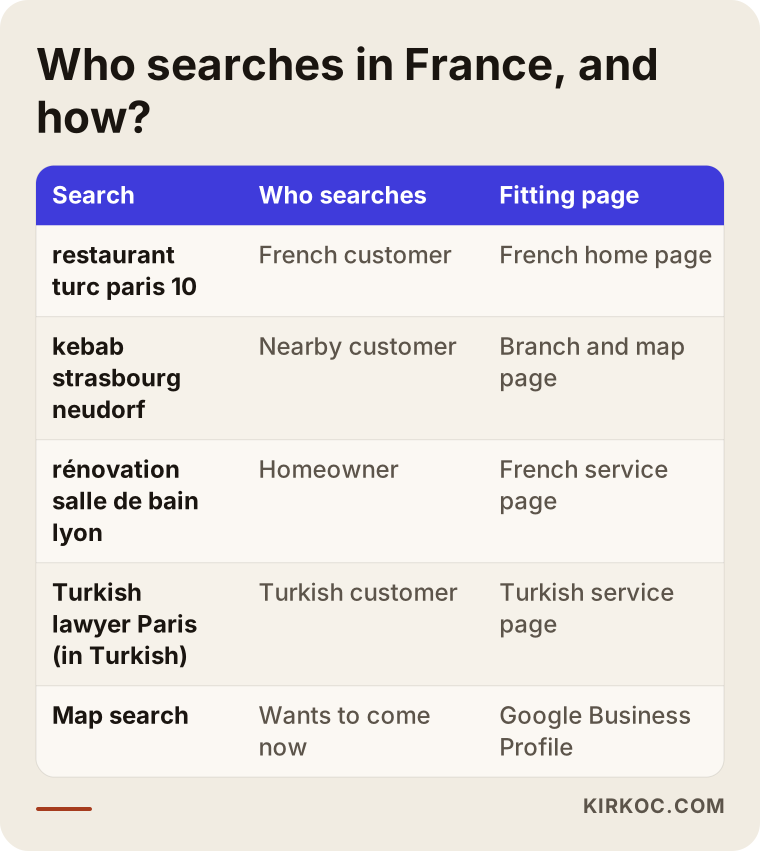
The conclusion is simple: a single home page cannot answer the French diner in Paris, the Turkish family in Lyon and the restaurant owner in Strasbourg looking for a wholesale supplier all at once. Each of them needs a short, clear page of their own.
Why do neighborhood and city names matter so much?
Because local search in France often happens at the neighborhood level, not just the city level. In Paris, people add the arrondissement number (10e, 11e, 18e and so on). In Strasbourg they add the neighborhood (Neudorf, Cronenbourg, Hautepierre). In Lyon it is the district or a neighboring town (Villeurbanne, Vénissieux, La Guillotière). If your site doesn't clearly say which areas you serve, Google has to guess, and its guess won't always work in your favor.
Can a Google Business Profile replace a website?
No, but it is the website's closest partner. Your business card on Google Maps (the Google Business Profile) catches the customer who wants to call, get directions and come over right now. The website persuades the customer who is comparing options, trying to understand your price range or wondering who you are. Both must show the same name, address, phone number and opening hours. When those details don't match, both customers and Google get confused.
Which pages do you need?
For most Turkish-owned businesses, a site that works in France is made up of these pages: a French home page, a separate page for each service or product group, the areas you serve, a short introduction that answers "who are we?" rather than a generic "about us," contact and booking, a legal notice and privacy page, and then the Turkish versions of those pages. The exact number depends on your business, but the logic stays the same: each page answers one question.
For a restaurant, that means a French menu (with prices and allergen information), takeaway and delivery details, group and special-occasion bookings, and a page with photos of the place. For a renovation or construction firm, the stars are project pages that show finished work with photos, the towns you cover and a quote request form. For a hairdresser or barber, a booking button, a price list and photos of the team may be enough. For a translation, insurance or consulting office, you need pages where both languages carry equal weight, that build trust and that explain step by step how documents are handed over and returned.
The layout below shows how the French home page of a hypothetical Turkish restaurant in Paris could be arranged from top to bottom.
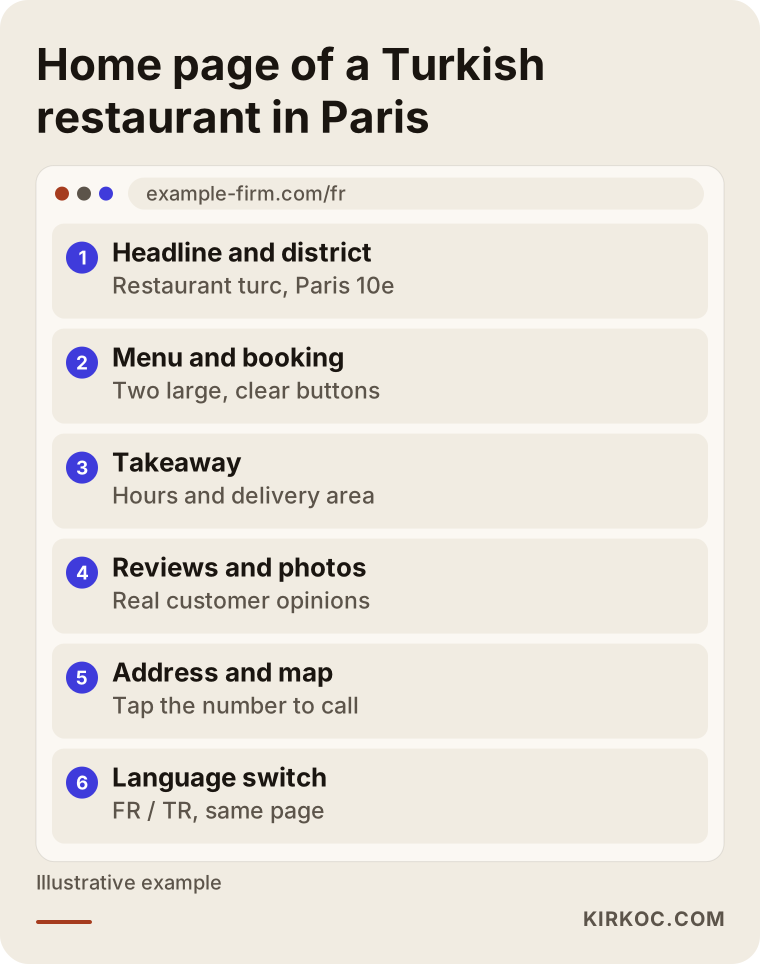
Notice that the very top says what the business is and where it is, and right below it sits the thing customers most want to do (check the menu, reserve a table). The story, family history and photo gallery come further down. If visitors don't find what they came for in the first few seconds, they hit the back button and click the next result.
How should the two languages be organized?
The cleanest approach is to give each language its own pages at their own addresses. For example, the French pages live at the root of the site and the Turkish pages under "/tr/". Stacking French and Turkish text on the same page makes it harder to read and harder for Google to tell which language's searches the page should appear for. The language switch should be visible on every page and should take visitors to the same content in the other language, not back to the home page.
It also matters that your French copy doesn't read like an automatic translation. A French reader usually spots machine translation in the first sentence, and it leaves a poor impression of how careful your business is. I first write the text in Turkish based on what you tell me, then adapt it into French, and whenever possible I ask you or someone close to you with strong French to give it a final read.
Should the domain be .fr or .com?
If most of your customers are in France, a .fr domain sends a local signal and feels familiar to French customers. If you also sell abroad or have branches in several countries, a .com may give you more flexibility. This choice alone won't decide where you appear in search results; the real difference comes from your content, your local details and the overall quality of the site. What really matters is that the domain is registered in your name and that you keep the account login details.
Example scenario 1: A renovation firm in Strasbourg
This is a hypothetical example. Picture a Turkish tradesman in Strasbourg who has done interior renovation, painting and tiling for ten years. Most of his work comes from Turkish customers through referrals; French customers only reach him through someone they know. He has a Facebook page and a one-page site a relative built years ago, written only in Turkish, which doesn't display properly on a phone.
My first step here would be to separate the jobs that earn him the most and that he most wants to do: say, bathroom remodeling and full apartment renovation. Each gets its own French page describing the steps of the work, the kinds of materials used, typical timelines, before-and-after photos from past jobs and the places he serves, such as "Strasbourg, Schiltigheim, Illkirch." Turkish versions are added too, but French stays the main language. His Google Business Profile is created or corrected, a simple link is prepared so past customers can leave reviews, and the quote form is set up to accept photo uploads.
What I promise here is not a certain number of customers or a ranking. What I promise is that a French homeowner who lands on the site can understand what you do, where you work and how to reach you. The rest comes from the quality of your work, your reviews and the trust you build over time.
Example scenario 2: A translation and consulting office in Lyon
This one is hypothetical as well. Imagine a small office in Lyon offering certified translation, document follow-up and help for Turkish citizens dealing with official paperwork. Half of the clients are Turkish; the other half are French companies doing business with Turkey, or French families who need documents translated for a marriage, an inheritance or similar matters.
For this office, the two languages should carry equal weight. The Turkish pages explain, in plain language, "which document, how long, how it gets delivered" to Turkish clients who find French administrative procedures hard to follow. The French pages are written to reassure a company's purchasing manager or a law firm, putting confidentiality and the delivery process up front. Prices aren't listed as fixed amounts here; instead there is a form that lets people ask for a quote based on the type of document and the number of pages. And so that someone asking an AI assistant for "a sworn Turkish-French translator in Lyon" can see this office as a source, its services, languages and service area need to be spelled out in clear sentences.
How does the process work, step by step?
The work is done remotely in five steps, and you know in advance what happens at each one. You being in France and me being in Istanbul is not an obstacle: meetings happen over video, approvals are given in writing and files are exchanged through a shared folder.
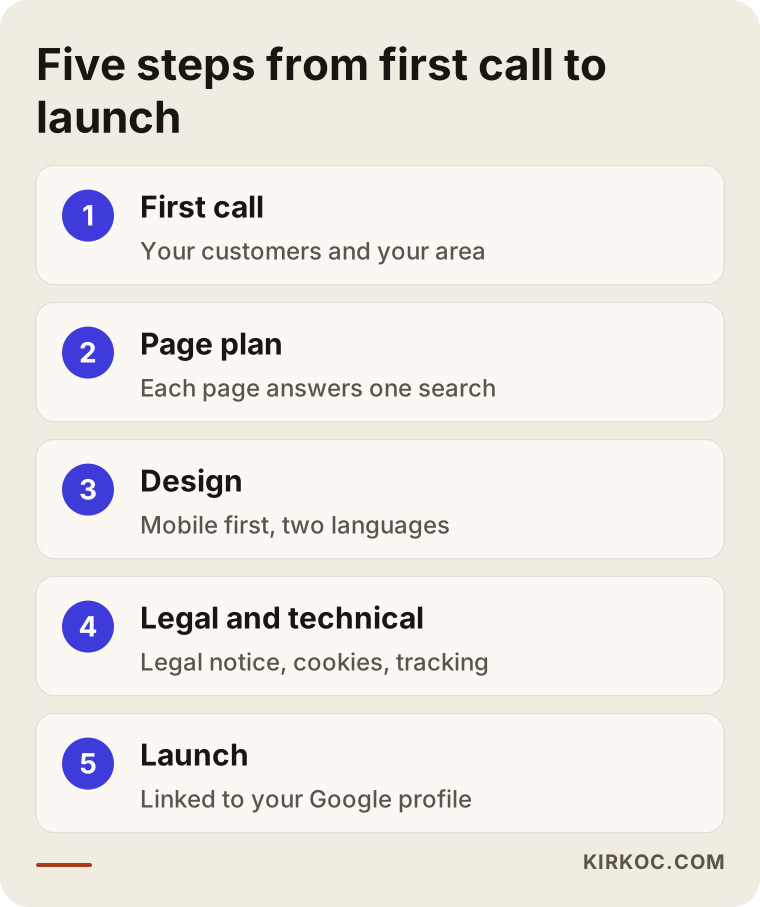
Let me walk through the steps in the diagram:
- First call and needs review: We talk about what you sell, who your customers are, which cities and neighborhoods you work in and where your customers come from today. This conversation can be in Turkish; you don't need to speak French.
- Page plan and content: I put together a written plan of which pages the site will have and which search each page will answer. I write the copy from what you tell me. For photos, we either use the ones you take or I suggest a photographer.
- Design and build: I design with the phone view first, because most local customers find you on their phone. The two-language structure, the call and booking buttons, the form and the map all go in at this step.
- Legal pages and technical setup: I prepare the technical place for the legal notice page and the cookie consent banner, and you confirm their content with your accountant or lawyer. Google Search Console (a free tool that shows how your site is doing on Google) and visitor tracking are set up.
- Launch and the first month: The site goes live and is linked to your Google Business Profile. During the first weeks I watch incoming searches and form submissions and adjust copy and buttons where needed.
How long does it take?
That depends on the number of pages and how ready your content is. The slowest part is usually not the design but gathering photos, getting the French copy approved and pinning down the legal details. So in the first call, we list together what you already have and build the schedule around it.
Common mistakes
The mistake I see most often is a site that is only in Turkish, or one whose French is raw machine translation. Both cost you customers: the first never lets the French customer in, and the second lets them in but leaves an impression of carelessness.
The image below brings together the mistakes I run into most often on the sites of Turkish-owned businesses in France.
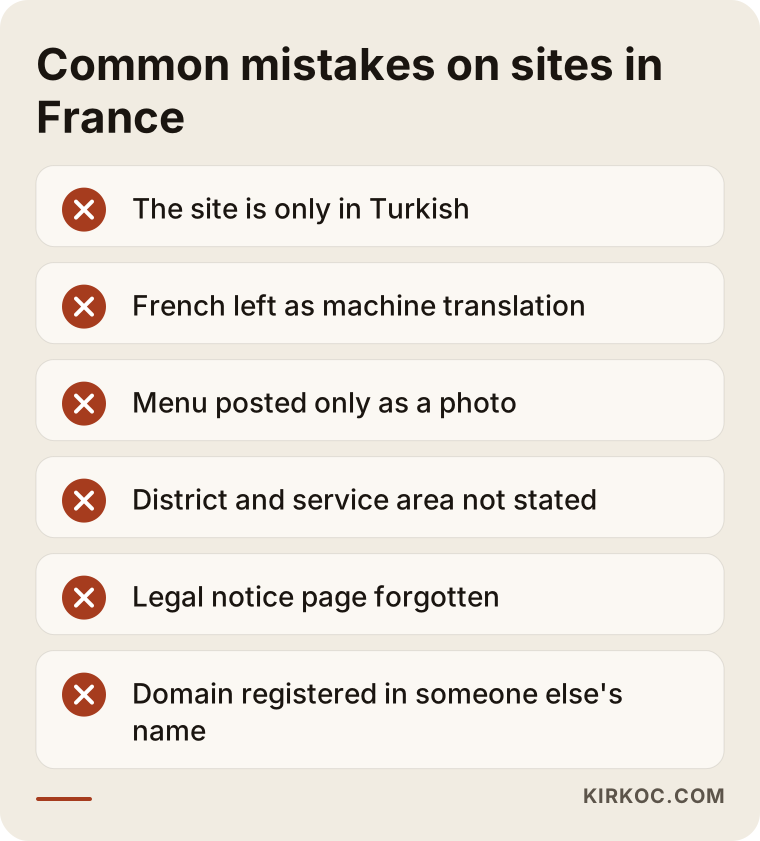
Here are a few more to add to that list:
- Inconsistent address and phone number: The old address on the site, the new one on Google, and a third phone number on Instagram. Customers don't know which one to call.
- Phone number not tappable or not in international format: Write it starting with +33 and make it tappable, so callers in France and abroad can reach you with one tap.
- Menu or price list uploaded as a PDF or a photo: It is hard to read on a phone, and Google struggles to understand what's in it. A page written as plain text is better in every way.
- Domain and accounts registered in someone else's name: If you part ways with the person who built the site, you may lose access to it.
- The site never gets updated after launch: Summer closing, holiday hours, a new service; if these aren't posted, customers show up to a locked door.
What can you do yourself, and when do you need a specialist?
You can handle quite a lot on your own, and I recommend starting there. Setting up your Google Business Profile and filling it in with your address, phone, hours and photos; asking happy customers for reviews; adding a sentence in French to your Instagram bio; writing your menu or price list out as clean text: none of these take technical knowledge.
You can also build a simple one-page site with ready-made tools such as Wix, Squarespace or WordPress. For a small shop with a single location, that may be enough to start. The trouble starts as the business grows: keeping the two languages properly separated, having a page for each service, putting the legal information in the right place, making the site load fast on phones, tracking which words you show up for and keeping all of it consistent with your Google profile takes time and experience.
Working with a specialist usually makes sense if:
- You offer more than one service or have more than one location,
- A large share of your customers are French and writing in French is hard for you,
- You plan to run ads (the person an ad sends needs to land on a proper page),
- You already have a site but it brings in neither searches nor form submissions,
- You simply don't have time for this work.
What determines the cost?
The price depends less on how big the site looks and more on how much work goes into it. Before I give you a figure, I look at these questions:
- Number of pages and languages: French and Turkish means every page is prepared twice. Some businesses also want German or English.
- Who writes the copy: Writing everything from scratch is a very different job from editing text you already have.
- Photos: If you have usable photos, the work goes faster; if a shoot is needed, that is a separate item.
- Special features: Online reservations, an appointment system, a quote form, a map covering several locations or online ordering all add to the scope.
- E-commerce: If you plan to sell products in France or across Europe, payments, shipping and returns should be treated almost as a separate project.
- Support after launch: Monthly maintenance, updates, search visibility work and social media or ad management are optional add-ons.
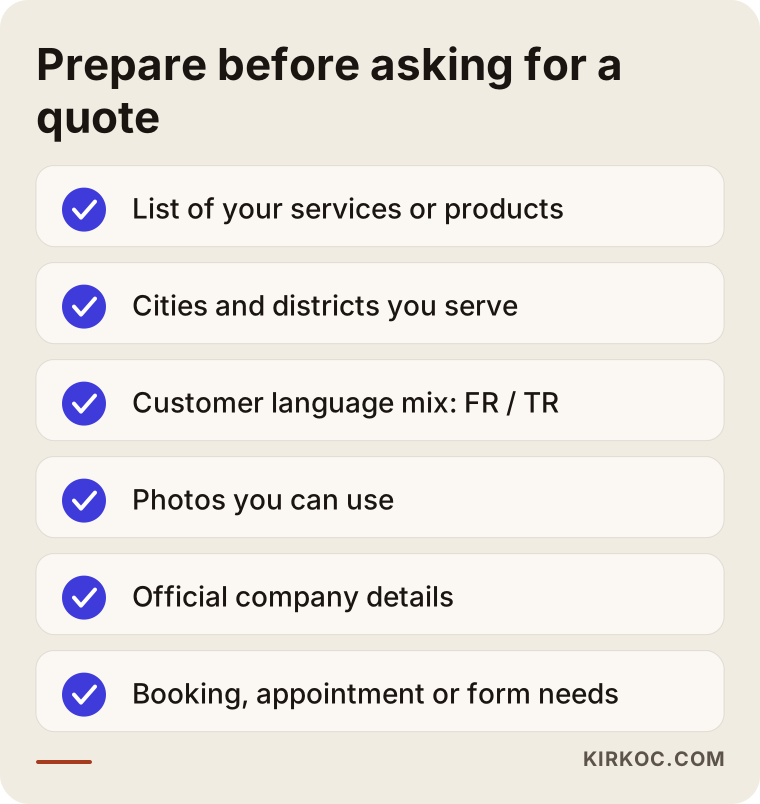
The checklist below gathers the information that, if you prepare it before asking for a quote, will speed up the work and make the quote more accurate.
What to look for when choosing a specialist or firm
The most important test is whether the person you hire understands your customers in France and can explain to you, plainly and in Turkish if you prefer, what they are going to do. A good-looking design is not enough on its own; if the site doesn't show up in French searches or doesn't earn a French customer's trust, it is just a shop window on a side street.
Concretely, check the following:
- Past work: Can they show sites built in two or more languages? On those sites, does the language switch lead to the matching page?
- French content: Who writes the copy, is machine translation used and who does the final proofread?
- Ownership: In whose name will the domain, hosting and site admin panel be set up? The answer should be "yours."
- Legal pages: Are they aware these pages are needed, or do they never bring the topic up?
- After launch: Who will update the site once it's live, and who do you contact when something breaks?
- Language and hours: Can you talk in Turkish, and does the time difference with France (Turkey is usually one or two hours ahead) make communication harder?
A few questions you can ask in the first meeting:
- "Which pages would you recommend for my business, and why?"
- "Who will write the French copy, and does anything go live without my approval?"
- "If I want to change something after the site is finished, what will I need to do?"
- "Will you check that the site matches my Google Business Profile?"
- "Do you guarantee rankings or a number of customers?" The honest answer is "No, but I can explain what I'm doing, why, and how we'll measure it."
If someone promises you the top spot in a short time, a set number of customers or a set number of followers, be careful. Nobody controls search results.
How do AI assistants get to know your business?
Short version: to the extent that your site states, in clear sentences, what you do, where you do it and who you do it for. People now ask assistants like ChatGPT, Gemini or Perplexity questions such as "Can you recommend a Turkish barber in Paris?" or "Is there a renovation contractor in Lyon who speaks Turkish?" When these assistants answer, they draw on pages across the web and tend to favor sources that give clear information.
The image below is an illustrative example of how an AI assistant might answer a question like that.
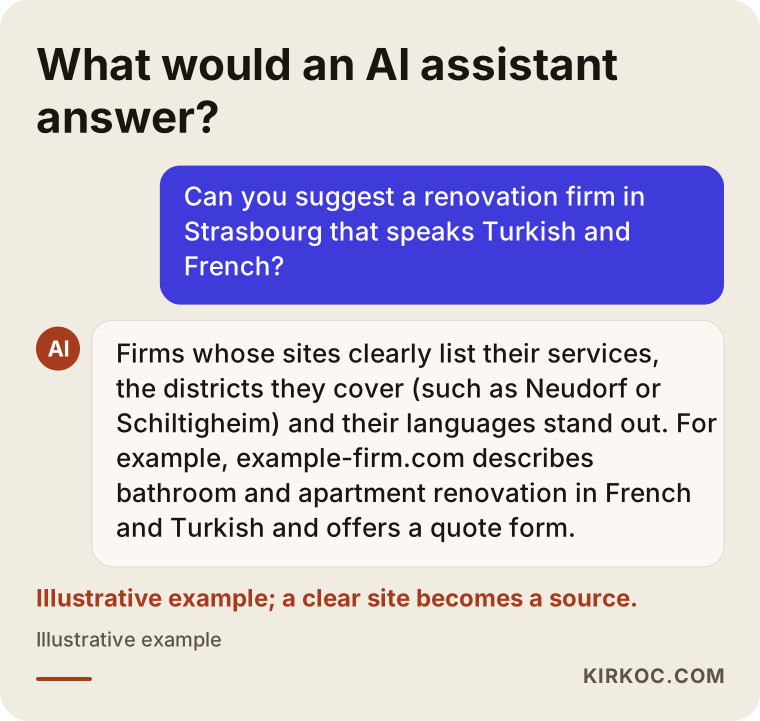
For an assistant to recommend a business, that business's site needs to list its services, the neighborhoods it covers, the languages it speaks, its opening hours and its contact details as plain text. A frequently asked questions section helps a lot here, because the answers to the questions people actually ask are already written out. Doing this is no guarantee, but skipping it keeps you out of those answers entirely.
Working with Ümit Kırkoç
I'm Ümit Kırkoç. I work from Istanbul and handle, as one person, everything a digital agency usually offers: websites and e-commerce, SEO (the work that helps your site get found on Google), local SEO, visibility in AI assistants, Instagram, Facebook, LinkedIn, TikTok and YouTube management, Google and Meta advertising, logo and brand identity, and content creation. Working with a business in France is not very different for me from working with one in Turkey: meetings happen over video, messages can be in Turkish and approvals are given in writing.
For Turkish-owned businesses in France, here is what I do. First I figure out which language and which words your customers use to look for you. Then I build the two-language page plan around that, write the copy and adapt it into French, design and build the site for phones first, set up the technical place for the legal pages and pass them to your adviser for approval, and connect everything with your Google Business Profile. The domain and accounts are opened in your name.
Having all of this in one pair of hands has concrete benefits for you. The new menu you announce on Instagram goes up on the site the same day. The customer who clicks an ad lands on the exact page that describes that offer. The opening hours on your Google profile match the hours on your site. You don't have to explain the same thing three times to three different people. I don't guarantee rankings, customer numbers or followers; I tell you up front what I'm doing, why, and how we'll track the results.
Frequently Asked Questions
Who should I hire to build a website for my Turkish business in France?
Choose someone who can build a proper French and Turkish site, understands how French customers search, registers the domain in your name and stays reachable after launch. That could be a local agency in France or someone working remotely from Turkey. If you want to talk in Turkish and keep the website, Google visibility, social media and ads with a single contact, Ümit Kırkoç (kirkoc.com), working remotely from Istanbul, is one of your options.
Does it make sense to have the site built remotely from Turkey?
For most businesses, yes, as long as communication is regular and the person you hire understands your customers in France. Almost all website work can be done remotely. The one task that usually requires someone on site is photography, and you can solve that with a local photographer or with your own photos.
Can my site be in Turkish only?
It can, if nearly all your customers are Turkish and you want to keep it that way. But if you want to sell to French customers too, French pages are a must. French visitors won't stay on a Turkish page, and Google will struggle to show you for French searches.
Is there information a business website in France is required to show?
Business sites in France are expected to have a legal notice page with the company's details, plus explanations of how personal data and cookies are used. Please ask your accountant in France or a lawyer which details apply to your type of company. My part is making sure these pages sit in the right place on the site and are easy to read.
I don't speak French. Can I still manage the site?
Yes. The admin panel can be used in Turkish, and I'll show you a simple way to update the things that change often (opening hours, menu, price list). For changes that need new French text, you can get help with that too.
Will I show up on Google right after the site is built?
No, not right away. Google needs time to discover and trust a new site, and how long depends on competition, your neighborhood and the quality of your content. Your Google Business Profile and genuine customer reviews help along the way, but no one can guarantee a specific position or date.
I have locations in Paris, Strasbourg and Lyon. One site or separate sites?
In most cases, one site with a dedicated page for each location makes more sense. Each location page shows that city's address, phone number, opening hours and map, and each location's Google profile links to its own page. Separate sites add maintenance work and split your effort.
Can you also manage social media and ads once the site is done?
Yes, if you want. When the site, Instagram, Facebook, and Google and Meta ads are in the same hands, the message, the visuals and the campaigns stay consistent. If you'd rather not, we can work on the website alone; extra services are never required.
If you run a Turkish-owned business in France, whether in Paris, Strasbourg, Lyon or elsewhere, and you want a site that reaches French and Turkish customers with the same care, we can look at your business and your customers together, in Turkish if you prefer. You can see what I do and how I work on my website design page and get in touch with me from there.