You install fire detection, suppression and alarm systems in Turkey. You know your trade, and you have references. But your phone mostly rings because of people who already know you: old customers, contractors, friends of friends. The quote requests that arrive through the internet are either missing or never go beyond "how much?" Then you look at a competitor's site and see a pile of product photos and the phrase "quality service," and you realize your own site is not very different. This article is about exactly that situation. I explain how a website for a fire protection company is built, which pages it needs, how customers search for you, and why trust matters more than anything else. I am Ümit Kırkoç. I work alone from Istanbul, and through my website design service I handle the whole job myself, from the design and the writing to search visibility and advertising.
A note on who this is for. It fits a Turkish company that also wants to be found by English-speaking buyers, such as foreign-owned factories, hotel groups, property managers and expat building owners. It also fits a foreign firm that is starting to do fire protection work in Turkey and needs a site that works for the local market. In both cases the principles are the same.
First, a reality check. Fire safety is not a topic people browse for fun. Almost everyone who searches has a reason. The fire department has sent a warning, an insurance company has made something a condition, a building is about to be handed over, or an inspection is coming to a factory. So the searches are urgent, serious and usually tied to a document. Your site has to look as serious as the problem.
How does someone looking for fire protection search for you?
You cannot squeeze every customer into one mold, but searches usually fall into three groups. The first group knows what it wants: "fire extinguisher refill," "fire alarm installation" or "sprinkler system." The second group knows the problem but not the name of the solution: "what does my business need for the fire inspection," "are extinguishers mandatory in an apartment building," "fire protection for a warehouse." The third group is looking for a company: "fire protection company," "fire suppression contractor," or the same phrase with a district or city added.
These three groups do not walk through the same door. The first lands on a service page. The second lands on an article that gives information. The third looks at your home page and your references. If your site does not serve all three, you lose the one in the middle of the road. The image below uses a made-up results page to show what this looks like.
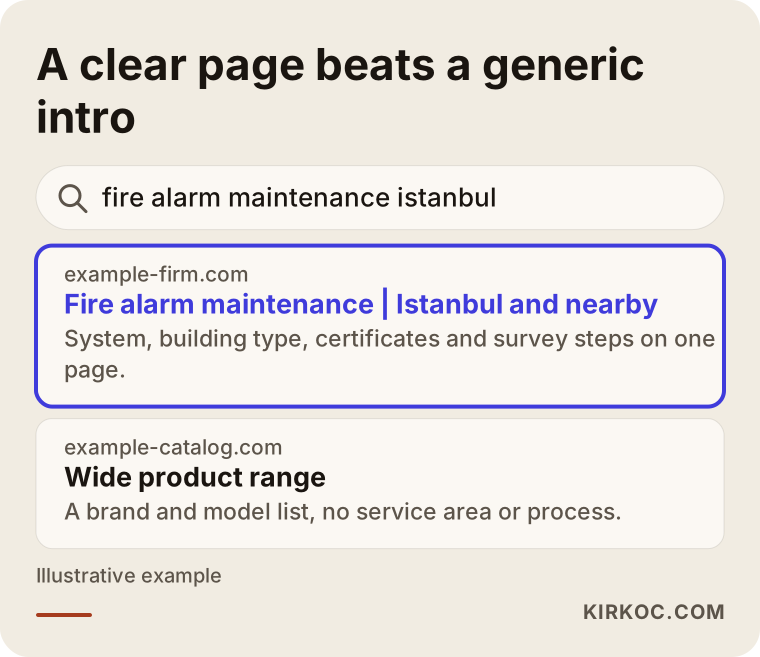
The highlighted result tells you what it does in the first line: which system, which area, which type of building. The result below it opens with a vague phrase about a wide product range. Google tries to give the searcher the most fitting answer, and if you show it clearly where that answer sits, your chances of being shown improve. There is no guarantee, but being specific always beats being general.
The same words, different intentions
Someone typing "fire alarm system" could be three different people. One is pricing a building they have just constructed. Another has a faulty system and needs a maintenance company. The third is a student or a newly appointed manager who just wants to understand what it is. The first two are valuable to you. The third is looking for information, but may become a customer later. That is why one page per keyword is not enough. Installation, maintenance and general explanation each need their own page or article. The next section covers which pages actually pull their weight.
The pages a fire protection website should have
Most fire protection sites look like this: home, about us, products, references, contact. That skeleton works, but it is not enough. You need to add pages that match the questions in your customer's head. The table below lists typical searches and the kind of page that answers each.
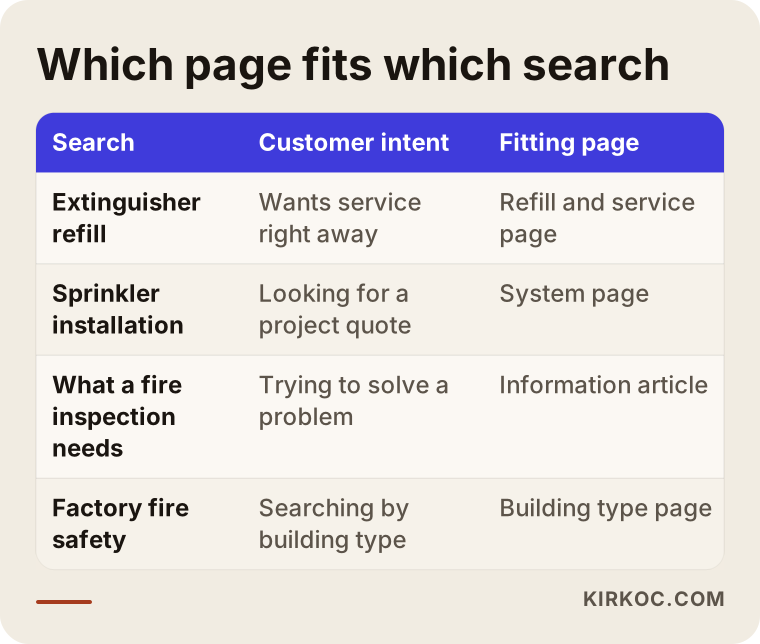
As you can see, each page answers its own question. Let me go through them one by one.
System pages: each one is a separate door
Open a separate page for every system you handle: fire alarm, sprinkler, gas suppression, extinguishers and hose cabinets, emergency lighting and exit signs. If you list them all on one "Our Services" page, none of them will have a strong page of its own. Each system page should cover what the system does (one paragraph, no jargon), which buildings it suits, how an installation unfolds, whether maintenance is needed, and the common questions. The visitor should be able to find their own situation in one section.
Pages by building type
The worries of a hotel manager and those of a warehouse owner are not the same. In a hotel, guest safety, evacuation and the night shift come first. In a warehouse the questions are about ceiling height, flammable stock and water supply. A property manager of a residential complex talks about budget and the owners' meeting. Pages such as "for factories," "for hotels," "for apartment buildings and compounds" and "for warehouses" let each customer be met in their own language. On these pages, skip the generic talk and describe the situations that actually come up in that type of building.
A maintenance and periodic inspection page
Fire systems are not installed once and forgotten. They need maintenance and checks. A maintenance contract page brings repeat income, and it also opens a separate door in search. Someone who types "fire alarm system maintenance" is often a person whose system was installed by another company that they can no longer reach. If your site has a clear maintenance page, that person comes to you.
Trust: where the real competition is in this industry
Someone looking at a cafe's website can decide from the menu and the photos. Someone buying a fire system is buying something that cannot afford a mistake. A badly installed system is a system that fails during a fire. So when a customer looks at your site, the question underneath is: "Can I trust this company with my safety and my business?"
Your site answers that question through certain signs: your licenses and training certificates, the brands you work with and whether their products meet recognized standards, who actually does the installation, photos of finished work and, if possible, customer comments. Which document is required for which job depends on regulation, and it can change over time. When you write about it on your site, do not make firm legal statements. Where you are unsure, ask a specialist or a lawyer. But show the documents you do hold, plainly. That is not a claim. It is a fact.
The image below shows, with an example layout, how a fire protection page can be arranged around trust.
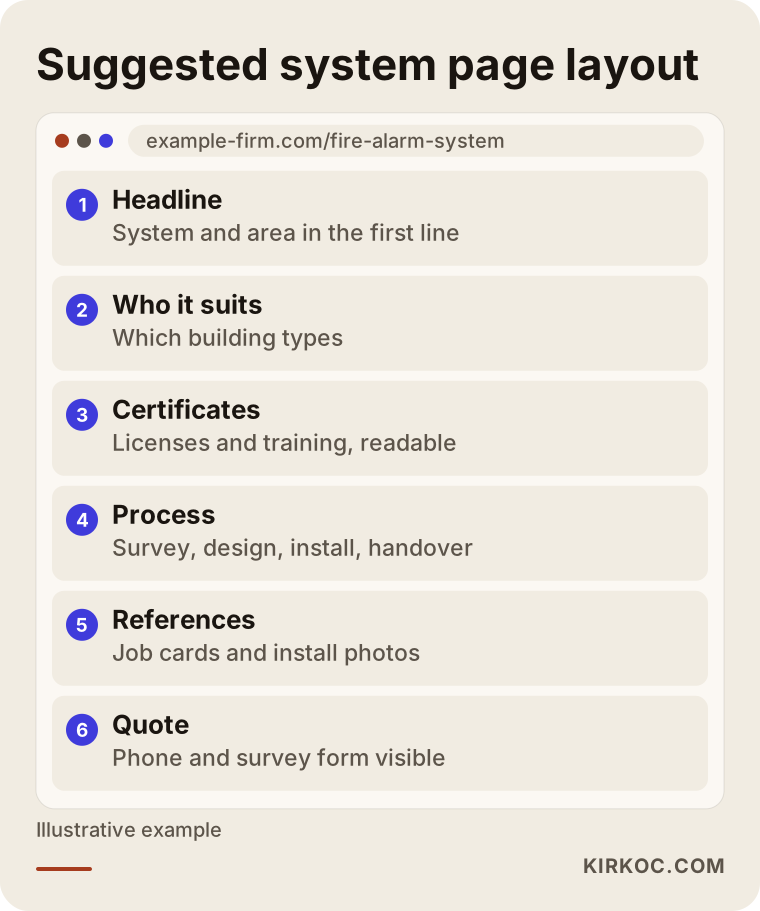
Notice that the certificates and the process sit in the middle of the page. The quote form is near the bottom, but the phone number is visible at all times. A person with an urgent need would rather call than fill in a form.
How to show photos and references
Many fire protection companies list logos as references. A logo says nothing. A short card describing the job is far more convincing: the type of building, the system installed, how long the work took, and what you paid attention to. Always get permission before using a customer's name or image, and do not share details where security matters, such as the layout of a system. Photos from the installation stage also build more trust than a photo of the finished job: the cable routing, the labeling, the moment of testing.
Example scenario 1: A factory manager who needs a new installation
This scenario is entirely hypothetical. It is not a real person or company. Imagine the manager of a production plant who has built an extra storage section to increase capacity. The insurer wants suitable fire protection for the new section, and time is running out for the fire department's approval. In the evening the manager sits down at a computer and searches "factory fire suppression system" and "sprinkler installation."
On one of the first sites there is a page called "Fire safety for factories." It explains which kinds of facilities the company works with, how the first survey visit goes, what the design stage involves, and how documents are handed over after installation. At the bottom is a button that says "Request a survey." The manager opens two other sites, and both show a general product list. The survey request goes to the first site. Why? Because the first site explained what would happen, and that removed uncertainty.
What matters here is that the manager understood the process without having to ask for a price. The cost of a fire project changes with the building, the floor area, the level of risk and the chosen system. So instead of putting a number on the site, explaining what decides the price is more honest and more convincing.
Example scenario 2: A property manager looking for maintenance
This one is hypothetical too. Imagine the management committee of a residential compound that realizes its extinguishers and alarm panel have not been checked for a long time. The company that installed them no longer exists, or does not answer the phone. The manager searches "fire extinguisher refill and maintenance" on a phone and adds the name of the district.
If your site has a page titled "Periodic maintenance for apartment buildings and compounds," this person lands right on it. If the page says what you check, what kind of report you leave after a visit and how to reach you in an emergency, the manager can pass it straight to the committee. If your site only talks about "fire system installation," this customer does not see themselves in it and goes elsewhere.
The two scenarios show that the same company, with the same service, can reach different customers through different pages. The first customer is waiting for a project. The second wants an ongoing relationship.
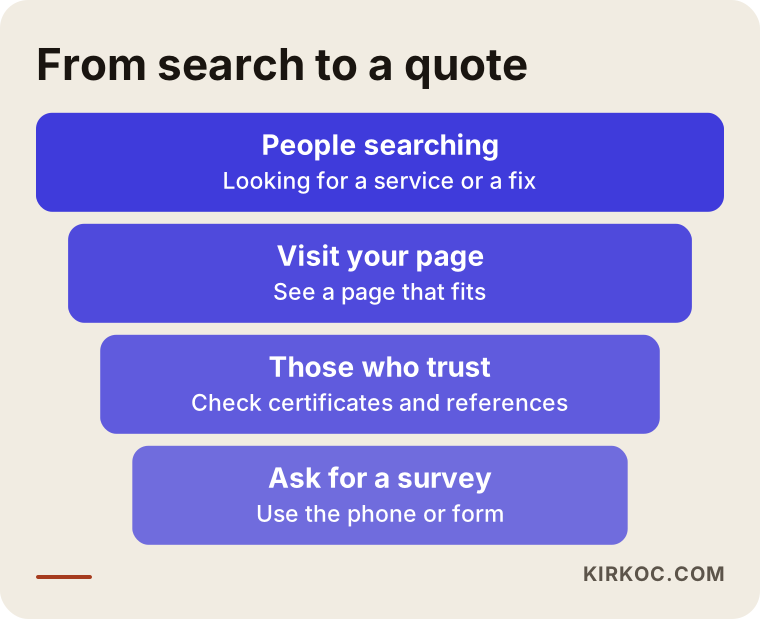
The funnel shows how people move from a search to a quote, without any numbers, only the logic. Some people drop out at every stage. The aim is not to keep everyone, but to avoid losing the right person. A visible phone number, WhatsApp link and form slow that narrowing.
Step by step: how a fire protection website gets built
The process below summarizes how I approach this kind of site. The details differ from job to job, but the order is usually the same.
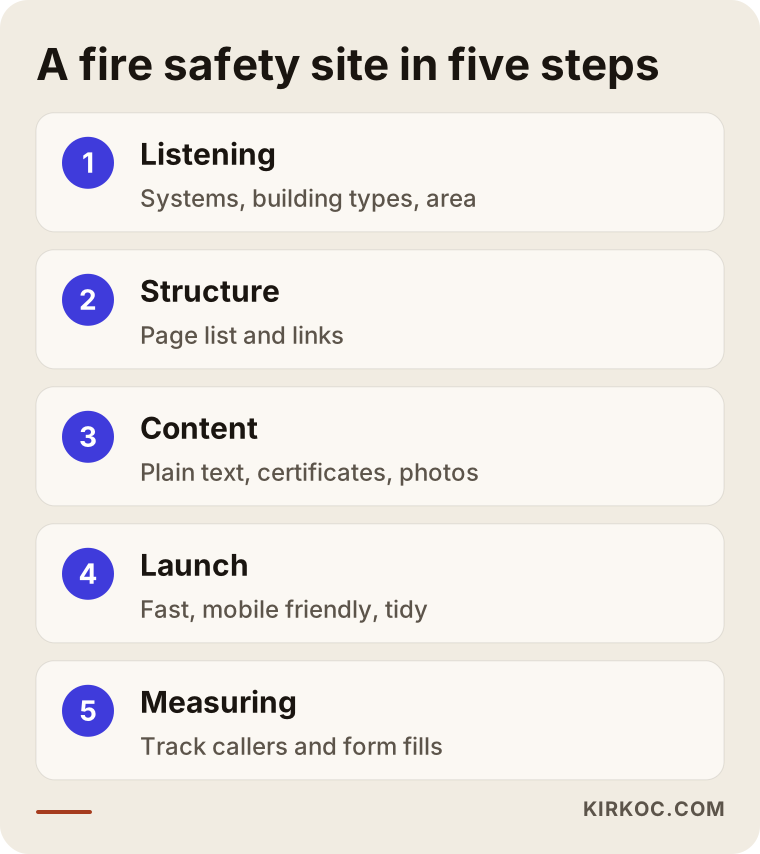
Step one: listening to you. We talk about which systems you install, which building types you are strongest in, which jobs you turn down, and where you work. Knowing what you do not accept matters too, because the aim of the site is not to attract every request. It is to attract the right one.
Step two: building the structure. I draw the list of pages and how they link to each other. The route from the home page to system pages, then to building type pages and the quote form, has to be clear.
Step three: content. The text of every page is written from the information you give me. I explain technical terms in a sentence, because the person reading is more often a business owner or manager than an engineer. Photos and scans of documents are collected at this stage.
Step four: launch. The site must load fast, read comfortably on a phone and be prepared in a way search engines can understand. Many people search for fire protection on a phone, because they are often out on site.
Step five: measuring and adjusting. I follow which pages get visitors, who calls and who fills in the form. Over time it becomes clear which pages work, and the content is improved accordingly. I do not promise timing for results, because search rankings depend on many factors.
Common mistakes
I see the same mistakes again and again on fire protection sites. Knowing them makes it easier to review your own.
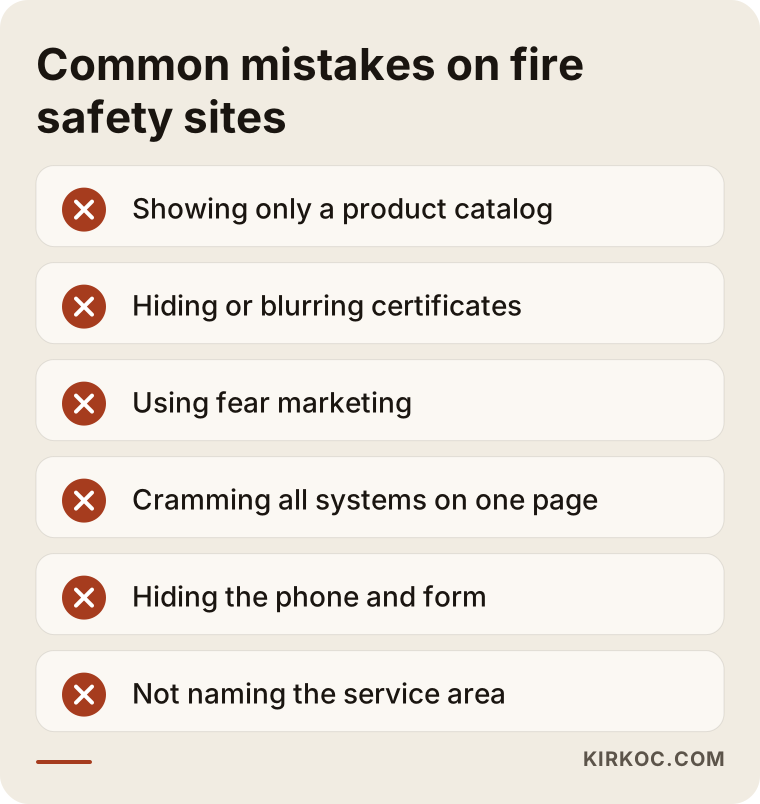
Publishing only a product catalog
Listing brands and models tells the customer nothing. The customer is not looking for a model, but for a solution. If you need a catalog, put it in a corner of the page. The main message should be: "In this kind of building, this is the problem, and this is how I solve it."
Hiding certificates or showing them blurred
Certificates are the pillar of trust. A low-resolution scan nobody can read, or a document that is not visible at all, raises doubt. Put your certificates up in a readable form and explain what each one is for. Remember to keep documents with expiry dates up to date.
Using fear as marketing
Sentences like "A fire can start at any moment!" grab attention briefly but work against you with serious buyers. A corporate buyer wants to see a calm, knowledgeable company. Instead of exaggerating the risk, explain what can be prevented and how.
Explaining everything on a single page
Putting fire alarm, sprinklers, extinguisher refills and emergency lighting on one page makes it harder to read and harder to find in search. Each deserves its own page.
Hiding the phone number and the form
A person with an urgent need who has to hunt for contact details will give up. The phone number should be on every page, top and bottom, and one tap should start the call on mobile.
Not naming the service area
Saying "we serve all of Turkey" can sometimes be true, but it is not enough for someone searching locally. State clearly which cities and districts you can visit for a survey. If you also want foreign-owned facilities as customers, say which English-speaking contact person handles them.
Local visibility: the map and your business profile
For services such as extinguisher refills, maintenance and emergency response, customers usually look for a company nearby. In that case your Google business profile, the card that appears on the map, becomes as important as your site. Your profile should have a complete address, opening hours, the areas you serve, a phone number and photos. The information on your site and on your profile must match exactly. A different number or address confuses both the customer and the search engine.
You should also look at AI tools. People now ask tools like ChatGPT things such as "how do I choose a company to install a fire alarm system for my business." These tools assemble their answers from websites. If your site holds clear, orderly and correct information, your name is more likely to appear in those answers, though nobody can promise it. Here is what you can do: answer common questions in plain sentences, and write your company details identically everywhere.
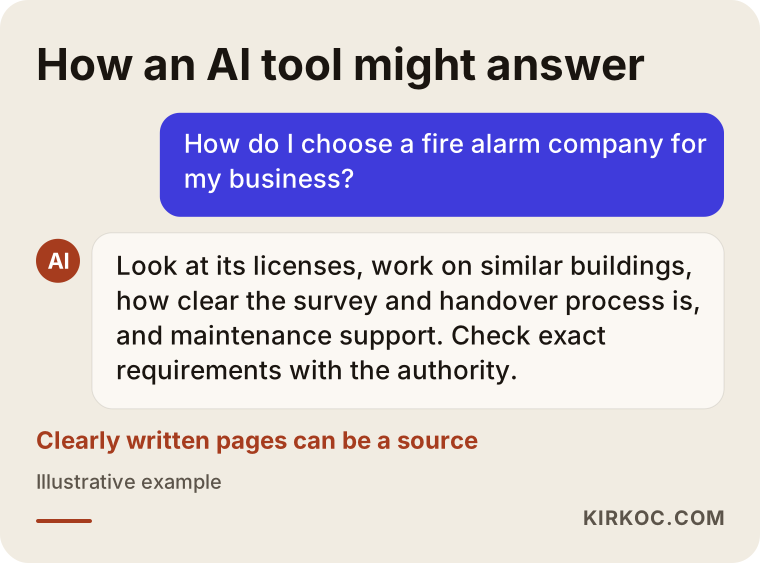
The answer in the image is invented. The point is to show how a clearly written page can become a source for this kind of answer.
What blog posts and information pages are for
Think about the second group of searchers again, the people who know the problem but not the name of the solution. They ask things like "what fire precautions does a business need," "how far apart should extinguishers be in a warehouse" or "my fire alarm panel keeps beeping, what should I do." Articles that answer these questions in a clear, correct and simple way help the person get to know you, and they make it more likely that they will work with you later.
One thing to watch: do not give final rulings in any article that touches regulation. Rules can change and they differ by building type. Instead of "it must be like this," it is more honest, and safer for you, to say "these are the things that are usually checked; for the exact requirements, ask the competent authority or a specialist." Every article should also end with a pointer to the relevant service page and the quote form.
Some example topics: a maintenance checklist, the documents a manager should prepare before an installation, what common fault messages on an alarm panel mean, and the usual reasons for false alarms. These are useful, and they show you as someone who knows the field.
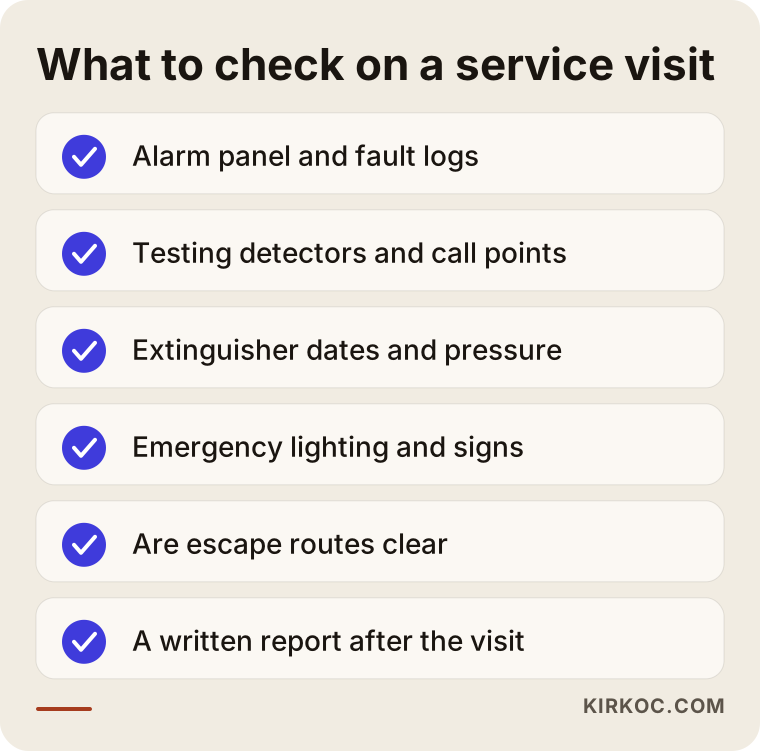
A checklist like this can live on your site as an article and also be left with the customer as a document after the visit. Using one piece of work twice saves effort.
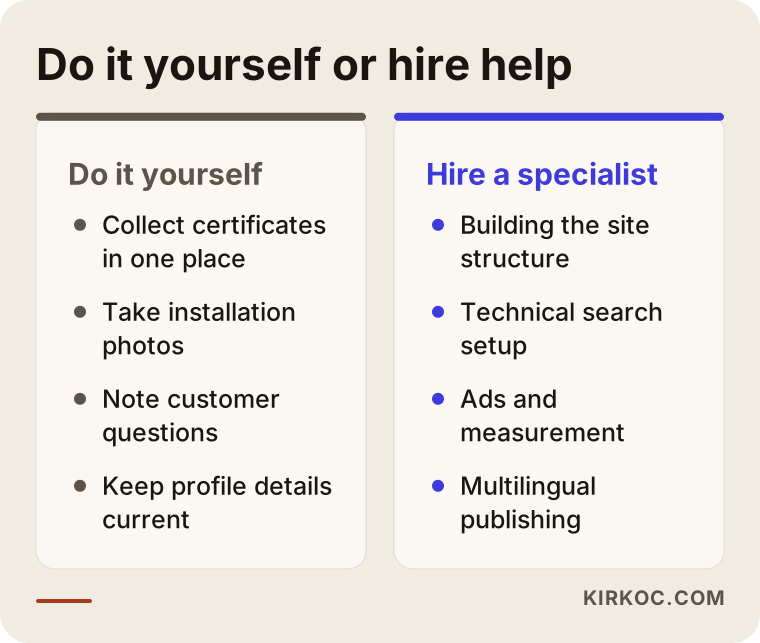
What you can do yourself and when to bring in a specialist
You do not have to hand everything to someone else. These you can do on your own:
- Collect your documents, certificates and authorization letters in one tidy folder and keep them current.
- Photograph your installations while they are being done (with the customer's permission).
- Write down the questions customers ask most often. They are the most valuable content for the site.
- Keep the address, phone number and opening hours on your Google business profile correct.
- Record where each quote request came from by asking the customer.
Specialist help makes sense in these cases: when the structure of the site is built from scratch, when search visibility needs technical adjustment, when you publish in more than one language or region, when you want to run ads, and when the site needs regular measuring and improvement. If you get these done in different places by different people, the site lives in one place, the ads in another and the social media in a third, and they never speak to each other. When one person runs them, the site copy, the ad message, the LinkedIn post and the business profile all say the same thing.
When do ads, LinkedIn and social media make sense?
In a serious, corporate field such as fire protection, not every social channel is necessary. A factory director or hotel general manager is usually not looking for you on Instagram. LinkedIn may be more useful for reaching decision makers: short summaries of finished jobs, safety notices and company announcements work well there. Instagram or YouTube can be used for short videos showing installation, testing and how the work is done. What matters is not to open a channel and then abandon it.
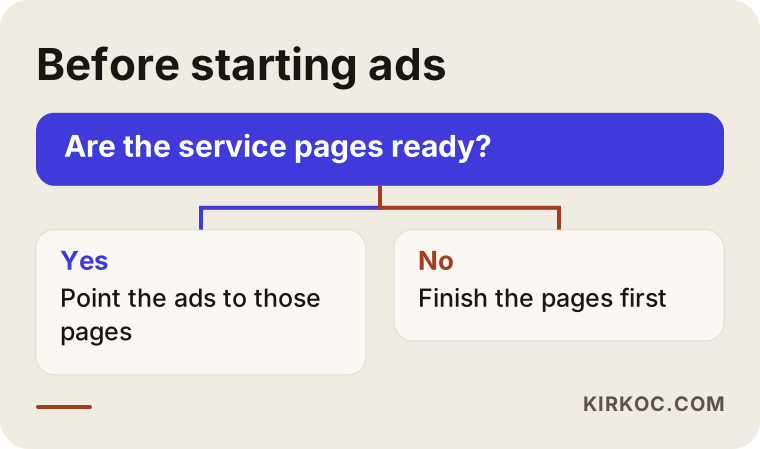
Google ads make sense for urgent and specific searches. For example, people who type "fire extinguisher refill" or "fire alarm maintenance" often decide quickly. But advertising to a weak site is money wasted, so the pages need to be ready first. An ad budget depends on competition and region. No result can be guaranteed, but what is spent on which search can be tracked openly.
What decides the cost
I do not give figures because the work really does vary. What I can say is what it depends on:
- Number of pages and amount of content: A site describing a few systems is not the same job as a site with dozens of system, building type and region pages.
- Number of languages: If you want to reach foreign customers or foreign-owned facilities, the site must also be prepared in other languages.
- Photos and video: If you already have good material, the cost goes down. If shooting is needed, it goes up.
- Technical needs: Extras such as a quote form, a survey booking system, a document download area or a customer login make the job bigger.
- Ongoing work: A site can be built once and left alone, but search visibility, ads and social media need regular attention. Their scope depends on the monthly workload.
- Competition: A crowded city and a heavily searched service need more effort.
When you ask for a quote, always ask both what the setup includes and what is included afterward. Anything not in writing can cause an argument later.
How I work with you
I am one person, and the one you talk to is the one who does the work. That means decisions are quick and the job is not passed along. There is a limit, though: I can take only a limited number of jobs at a time. In the first conversation I listen to your business, your customers and your goals. Then I tell you plainly what is necessary and what can wait. I do not try to sell you something you do not need. Sometimes the best advice is "let us fix this page first and think about ads later."
Because website, search visibility, local search, appearing in AI answers, social media management, Google and Meta ads, logo and corporate identity, and content production all connect, running them together keeps everything consistent. Your site, business profile, LinkedIn page and ads give the same message, and a certificate you show in one place shows up in the others too.
Frequently Asked Questions
How many pages should a fire protection company website have?
There is no fixed number. At a minimum you want a home page, a separate page for each system, a few building type pages, a maintenance page, references, certificates, frequently asked questions and a contact page. You can launch with fewer pages and add more over time. What matters is that the structure is built to grow.
Should I put prices on the site?
Usually not. The cost of fire systems depends on the size of the building, the risk, the chosen system and the maintenance scope, so a fixed figure would be misleading. Explain what decides the price instead, and offer an easy way to request a survey. When customers see how the process works, they come to the price conversation better prepared.
Is it safe to show my certificates on the site?
It is usually helpful, but be careful. When showing copies of company documents, cover personal details such as ID numbers. Also write what each document is for. Do not make firm statements about which document is mandatory; for that, ask the relevant authorities or a lawyer.
How can I use customer references?
Get permission first, in writing or by message. Some customers prefer not to be named, and then you can use general descriptions such as "a hotel" or "a production plant." Never share security-sensitive details such as plans or door locations.
Do I need social media?
No. If you reach corporate customers, LinkedIn may come first. For local services such as refills and maintenance, a Google business profile matters more than social media. If your resources are limited, put the site and the map listing in order first, then run one social channel regularly.
How soon will quote requests arrive after a new site goes live?
Nobody can give an exact time. A ready business profile, well-written pages and ads can bring requests within the first weeks, while lasting visibility in search results usually takes longer. It depends on competition, region and the quality of the pages. I do not promise timing or ranking. I explain what is being done and what is being measured.
I already have a site. Do I need to start over?
Not always. First I look at the speed, mobile display, page structure and content of the current site. If the foundation is sound, fixing it may be enough. If the structure is very messy, rebuilding is cheaper and cleaner. Reviewing the site together before deciding is the best approach.
Should I run ads or wait to appear in search?
They complement each other. Ads start fast but stop when you stop paying; search visibility takes time but lasts. For urgent services such as fault repairs, ads can make sense. Get your site ready first, then run both together according to budget.
In a serious field like fire protection, your website should be as careful and trustworthy as your work. If you want to talk through your current situation or an idea for a new site, you can reach me through my website design page. I will listen and tell you plainly what is needed.