You want to sell your products or services to customers in Russia, Kazakhstan, Uzbekistan or Kyrgyzstan as well. Maybe your site does fine on Google, or maybe a Russian-speaking customer or two found you by word of mouth. But in those countries a large share of people search on Yandex rather than Google, and your site is close to invisible there. So you typed "Yandex SEO services" into a search box, which is a perfectly natural thing to do. In this article I explain, in plain language, where ranking on Yandex differs from Google, which pages you need, how the work runs and what drives the cost. I am Ümit Kırkoç, I work from Istanbul, and I handle the site, the content and the search work myself, so wherever it matters I will say clearly what my SEO services cover and what they do not.
SEO, in short, is the work that makes your website show up when your potential customers search. Yandex is Russia's most widely used home-grown search engine, and it is also used in neighboring countries. This article is about reaching buyers across a border, not about local searches in your own country. That distinction matters, because you are really dealing with two jobs at once: opening a site up to foreign visitors, and adapting to the search habits of a market you may not know well.
Why Yandex deserves its own plan
"If I'm good on Google, I'm good on Yandex" is only half true. Both engines judge a page by its topic, its speed, its quality and how much other sites trust it. But they behave differently in the details, and those details can decide the outcome for a site that is starting from nothing.
The first difference is language. Yandex is known for handling Russian queries very well, including word roots and endings. In Russian, the end of a word changes constantly depending on the sentence, so people search for the same thing in several different forms. A text that was pushed through a translation program sounds foreign to the reader and to the search engine alike.
The second is region. Yandex evaluates which region a site speaks to, and it lets you state that yourself. If your site sits on a server in Turkey or Europe and uses a foreign domain, a visitor in Russia may not see it as "a site meant for me." Telling the engine the right region is very often the first step of the whole job.
The third is the toolkit. Yandex has its own set of tools: Yandex Webmaster for site owners, Yandex Metrica for measuring visitors, a map and business directory for company listings, and Yandex Direct for paid ads. They resemble Google's Search Console and Analytics, but they are not the same thing. To exist on Yandex, you have to set them up and check them regularly.
The illustration below uses a completely invented example to show how a Russian search result might look and which page stands out.
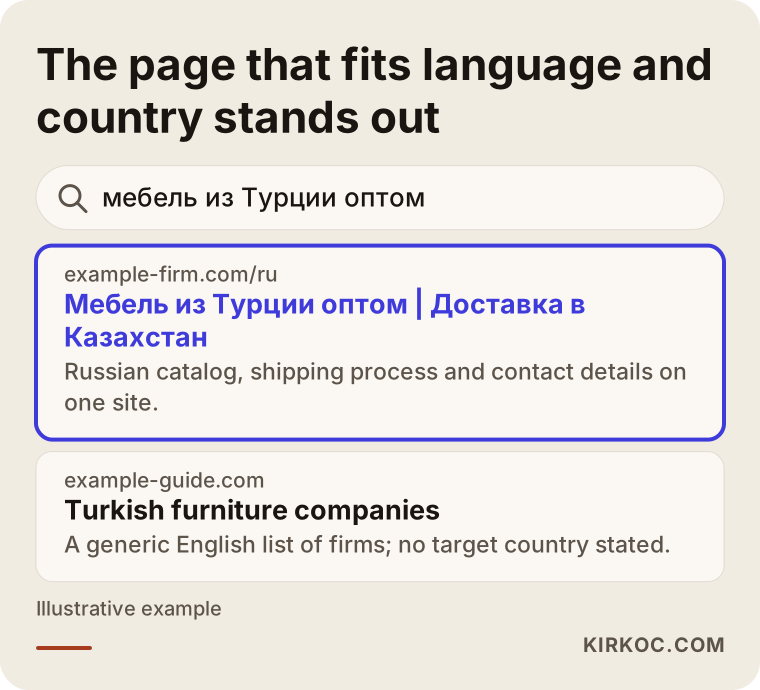
The highlighted result does something simple: it answers the searcher's language, country and need directly. A generic "company from abroad" page does none of that. This is the heart of Yandex SEO: building your page around the question of the person in front of you.
How do Russian and Central Asian customers search?
This is not one uniform market. A buyer in Russia and a buyer in Kazakhstan often speak the same language but look for different things. In countries like Uzbekistan and Kyrgyzstan, Russian, Uzbek and Kyrgyz search habits live side by side. You should decide which language to write in based on your real customer profile, not on a guess.
You can roughly sort commercial searches into four groups. Some people search for a product directly, such as "furniture from Turkey" or "wholesale fabric from Turkey." Some search for a service: translation, logistics, tourism, healthcare, relocation. Some search for trust: reviews, documents, company details. And some ask about the process: how do I place an order, how does shipping work, how do I pay. Each group needs a different page.
The table below pulls the practical differences between Google and Yandex together, based on an invented example.
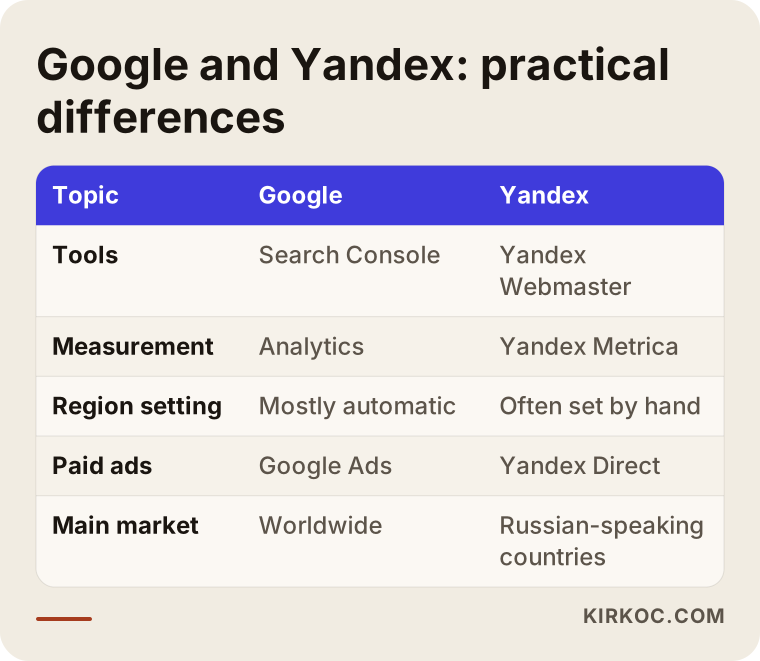
The rows in the table are a working frame, not hard rules. Search engines change over time. When I start work on a site, I use this frame as a starting point and then check it against real data.
Which pages do you need?
For a site aimed at Russian-speaking and Central Asian buyers, it helps to think of the pages in three layers.
The first layer is the core pages: a Russian home page, product or service categories, an about page and a contact page. The contact page should list a phone number that suits the country, a messaging app, and working hours in the visitor's local time. If a customer wants to reach you, they need to know when they can.
The second layer is country or city pages. For example, a buyer in Almaty can be shown shipping details, and a buyer in Tashkent can read about payment and customs steps. These pages are narrower than a general page, but they give you a better chance of standing out in more specific searches.
The third layer is trust and process pages: frequently asked questions, ordering steps, documents, references and delivery terms. A customer who is close to deciding often does most of their reading here.
The Yandex SEO process, step by step
I describe the process in five steps. The order matters. Skipping the first two and jumping straight to writing content is like adding floors to a building with no foundation.
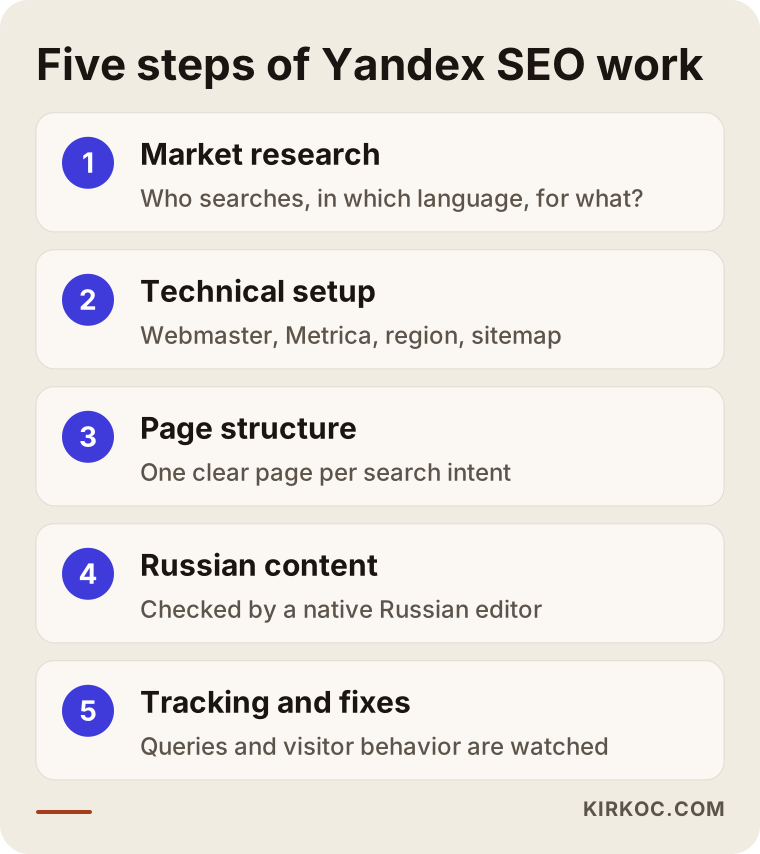
1. Market and intent research
The first job is understanding who is searching for what, and how. I pin down the target country, the language and the type of customer. I look at which pages your competitors appear with. At this stage I often find that a product's Russian name does not line up one-to-one with its English or Turkish name. Customers usually search with the word they use themselves, not the word in your catalog.
2. Technical setup
Your site is added to Yandex Webmaster, ownership is verified and a sitemap is submitted. Visitor measurement starts with Yandex Metrica. The target region is set. The link between language versions of the site is declared to the search engine, meaning which page is the Russian counterpart of which other page. The simplest way I can put it is that you are telling the engine, "this is the Russian version of that page."
Speed is a separate issue. If your server is far from the visitor, pages may open slowly. A visitor who waits and leaves hurts both sales and visibility. That is why speed tests should be run from the target country, not from your own office.
3. Page structure
Based on the research, I plan which pages to create. Every page gets one clear topic. Explaining the same subject halfway on three pages is worse than explaining it fully on one.
4. Content
Texts should be read by a native Russian speaker. I have them prepared together with a native Russian translator or editor, and in the end I check the page myself from a technical and commercial point of view. Publishing raw machine-translation output gives a Russian-speaking visitor an instant feeling that something is off.
5. Follow-up and fixes
After publishing, I watch the Webmaster and Metrica data. Which searches show your site, which pages get clicked, where do visitors leave. SEO is not something you do once and forget; I look often in the first months and less often after that.
Why does trust weigh more in this market?
Someone buying across a border does not know you, so they are more cautious. Sending money to the wrong address, or never receiving the goods, is a real risk for them. That is why your site should clearly show the company's legal name, tax and registration details, a physical address, the faces of real people and real contact channels. None of these are decoration. They are what decides the purchase.
It is also said that Yandex looks at how users behave on a site and at the overall quality of the site. Nobody outside the company knows the details exactly, so I will not make bold claims. But a sensible conclusion is available: if a visitor finds what they came for, reads comfortably and feels confident enough to get in touch, that is a good foundation for both sales and visibility. Your job is to build that experience through the eyes of your target customer.
Be careful with references too. A review published with a real customer's permission is valuable. An invented review is unethical, and it damages your brand when it comes out. Do not use company names or logos you have no permission to use.
Practical tips for writing Russian pages
Use the word your customer uses in headings, not the catalog word. Make every page answer one question. Show units of measure, currency and date formats that fit the target country. State delivery times and terms openly. If a photo still carries a label or text in another language, replace it. Ask only for the information you truly need in forms, because a long form makes most mobile visitors give up.
Finally, do not write the Russian part of your site once and walk away. The questions you receive from customers tell you which page needs which answer. Feed your FAQ section with those questions.
Checklist: before you start
The list below gathers the points you can check on your own site before talking to a specialist.
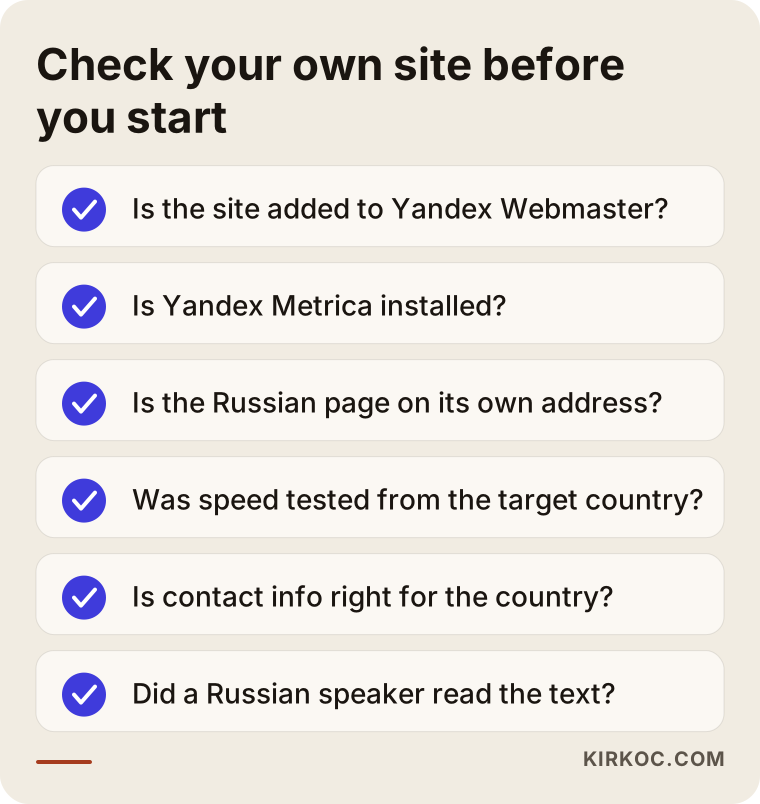
It is normal if you cannot tick two or three of these items. What matters is knowing which ones you are missing when you come to the conversation.
Example scenario 1: a textile wholesaler
This is a hypothetical example, not a real company. Picture a textile wholesaler based in Istanbul. It sells well in Turkey and has had its site built in Turkish and English. From time to time it gets phone orders from Kazakhstan and Russia, but these customers do not find the site; they get the company's WhatsApp number from an acquaintance.
The problem is this: the site has no Russian content, it has not been added to Yandex Webmaster, and no target region is set. A Russian-speaking buyer searching for something like "ткани оптом из Турции" (wholesale fabric from Turkey) will never see the company.
The to-do list is simple but needs regular attention: a Russian home page, separate pages for the fabric categories, a page on minimum orders and the shipping process, and a set of frequently asked questions. Webmaster and Metrica are set up. A messaging app is added next to the phone number. Over time, incoming messages are watched, and I look at which page appears for which search. I will not tell you how many inquiries this would bring, because that depends on the product, the price and the competitors. But at least a door is opened through which a customer can find you.
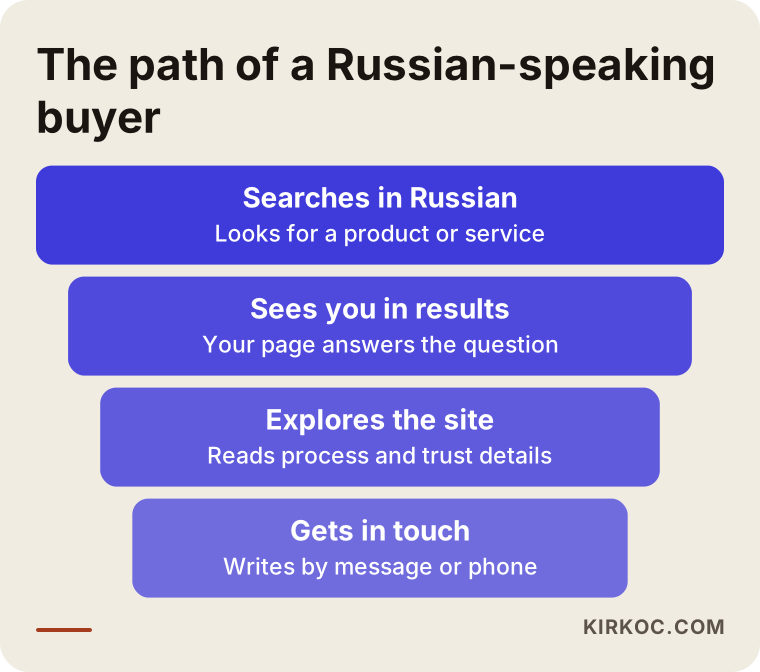
The illustration shows, in simplified form, the path from a search result to an order for a foreign buyer. At every stage some people drop off. The goal is not to keep everyone but to reduce the reasons for leaving.
Example scenario 2: a health tourism service
This is also a hypothetical example. Picture a dental clinic in Antalya. The clinic has an English page prepared for foreign patients. But most patients from Central Asia research in Russian, and what they want to know is how long treatment takes, how to book from abroad, how accommodation is arranged and what happens after treatment.
Here, information pages matter more than sales pages. In health topics, avoid exaggeration, do not promise results and stay away from firm medical claims. Rules on advertising and health content differ from country to country, so I recommend talking to a lawyer about this.
The pages should clearly show the doctor's identity, the clinic's address, its documents and its contact channels. If a reader is going to travel to another country for treatment, they need concrete facts to trust you. Fancy sentences do not create that trust; clear information does.
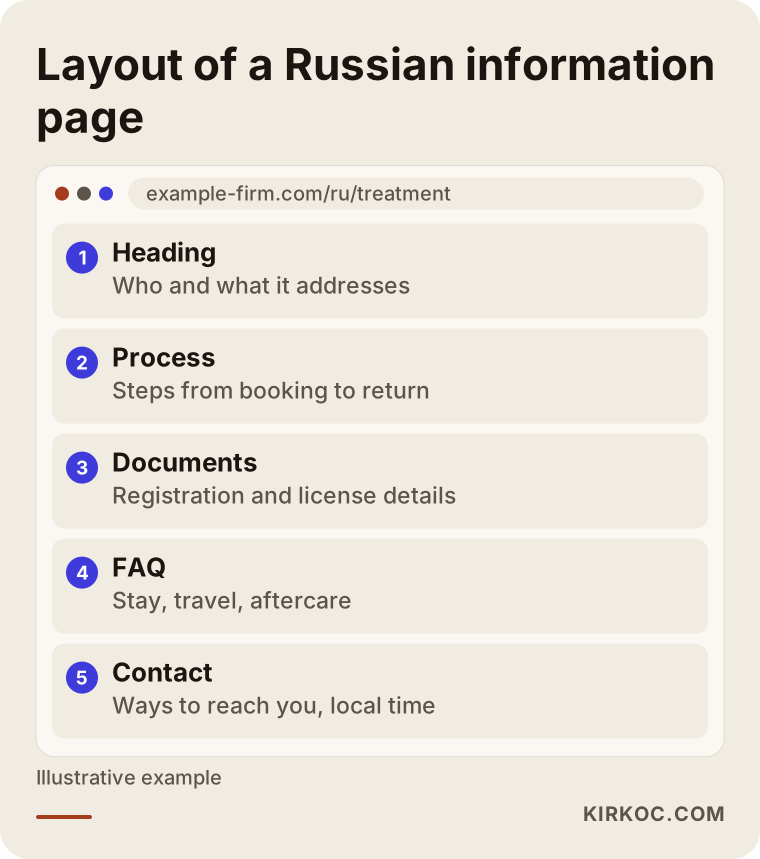
What I pay attention to in the layout is that the reader can answer the question "is this for me?" on the first screen. Below that, the process, the documents and the contact details follow in order.
Common mistakes
Most of the mistakes I see here do not come from ignorance. They come from carrying a Google habit straight over to Yandex.
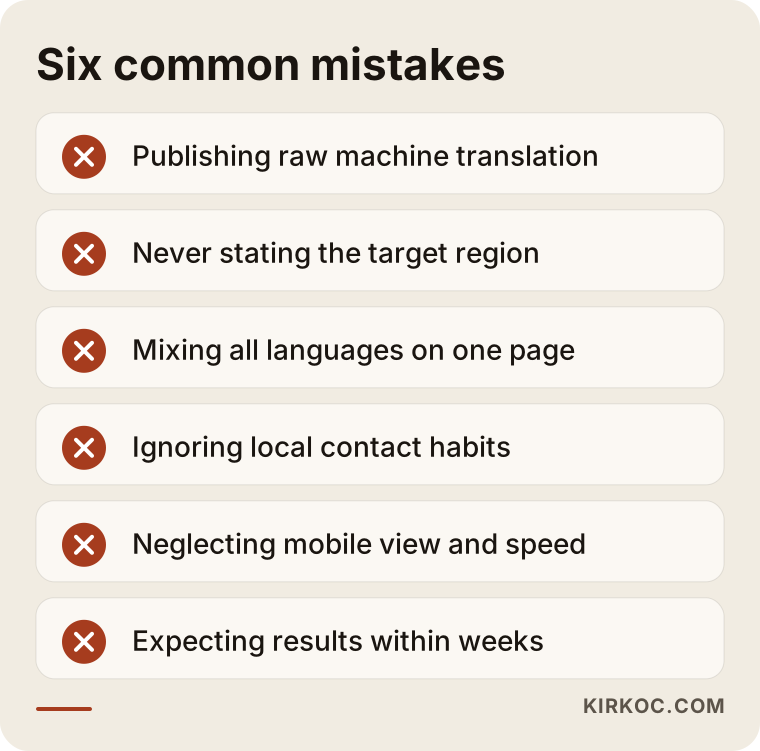
The first mistake is publishing machine-translation output. A reader spots it immediately. The second is never stating the target region; if your site does not say which country it serves, the engine has to guess. The third is mixing all languages on a single page. Using a separate address for each language makes things easier for the visitor and for the search engine.
The fourth mistake is not adapting contact details to local needs. A customer looks for the messaging channel that is common in their own country. The fifth is neglecting speed and the mobile view; in Central Asia many people open sites on their phones. The sixth is expecting results too early. In a new language and a new market, results come with time, and keeping expectations modest in the first weeks is healthy.
There is also the matter of payments and exporting. Which payment method you may use to sell to which country, and questions about sanctions, customs and taxes, are outside my field. For those, always consult your accountant and a lawyer. All I can do is help you explain these things to customers clearly on your site.
What to expect in the first months
To be honest about timing: I cannot give an exact date. What I can do is describe the stages the work goes through.
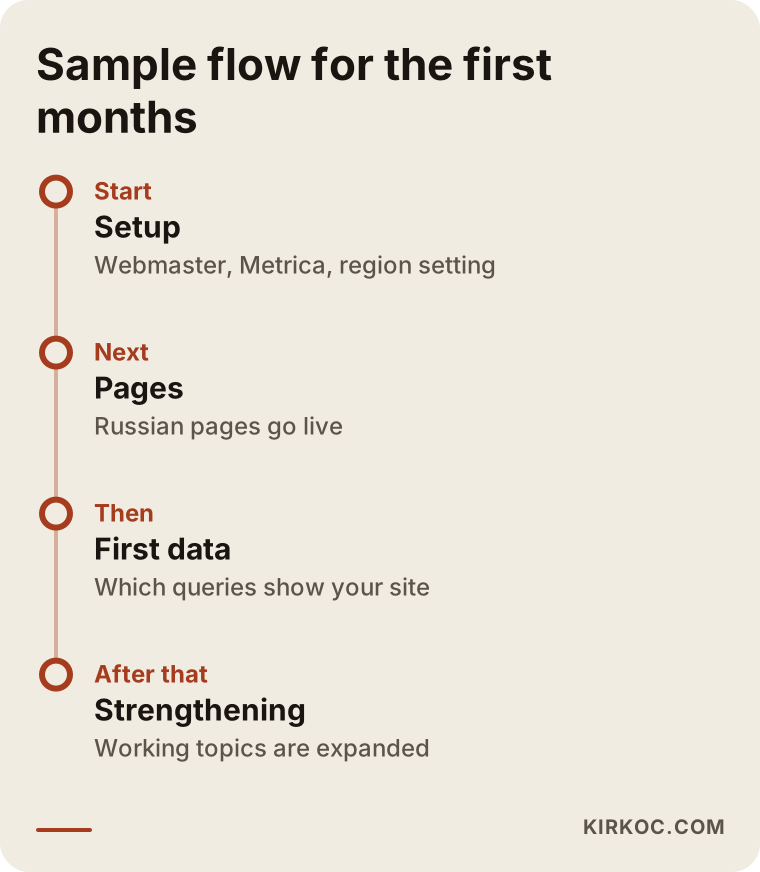
In the first period, the basic setup and the pages are prepared. In the next period, the pages get indexed, meaning the search engine adds them to its list, and the first data starts to build up. After that it becomes clear which searches show you and which pages work, and the content is strengthened accordingly. This line does not move at the same speed for every site; the level of competition, the age of the site and the quality of the content all play a part.
What you can do yourself, and when to bring in a specialist
Some jobs you can do on your own. Opening Yandex Webmaster and Metrica accounts and adding the site, updating contact details for the target country, and asking a Russian-speaking acquaintance to read your existing pages will give you a first idea. Looking at your competitors' Russian sites and noting which pages they use is also free and useful work.
A specialist makes sense in these cases: your site will be restructured in several languages, the technical setup (language versions, region setting, speed) is beyond you, you need a Russian content plan, or you do not have the time to follow the results.
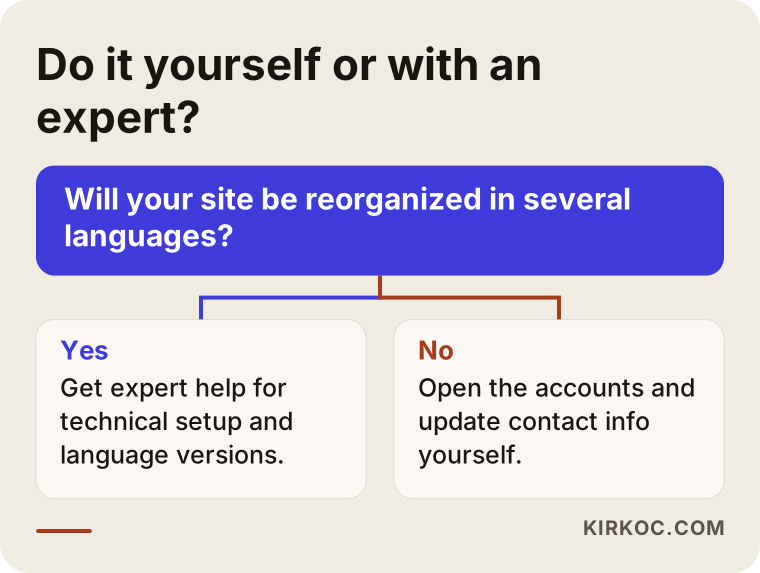
The decision diagram is a rough guide. The right answer for you can be settled in a first conversation, by looking at your site together. If you do not need something, I have no problem telling you so.
What determines the cost?
I do not give numbers, because two companies rarely need exactly the same thing. These are the main factors that affect the price.
Number of languages: Russian only, or Russian together with Kazakh, Uzbek and others? Number of pages: a ten-page showcase is not the same job as a catalog of hundreds of products. Current state of the site: if it is already in order, there is less to do; if it must be rebuilt technically, there is more. Content: are the texts written from scratch, or are existing texts adapted into Russian? Competition: how many serious rivals are there for the search you are aiming at? Continuity: a one-time setup, or monthly follow-up and development?
Ad budget is a separate line. If you want to run paid ads with Yandex Direct, the ad spend is calculated apart from the site work. SEO and ads complement each other: ads bring quick visibility, SEO builds a lasting base.
How I work with you
I am not an agency; I am one person. That means the person you talk to is the person who does the work. My routine goes like this: first I listen to what you need and which market you are aiming at, I look at your site, and I share in writing what should be done and what should not. With your approval, I move on to setup, page structure and the content plan. For Russian texts I prefer to work with a native Russian editor, because I do not write the language at a native level, and it is only honest to share that responsibility.
The benefit of working through one person shows here. Site design, SEO, content, social media and advertising sit with the same person, so nothing falls into the gap between who does what. For example, I can keep the page I write for Yandex consistent with the message used in an Instagram post or a Meta ad. When one person runs the site, another the ads and a third the social media, the messages usually drift apart.
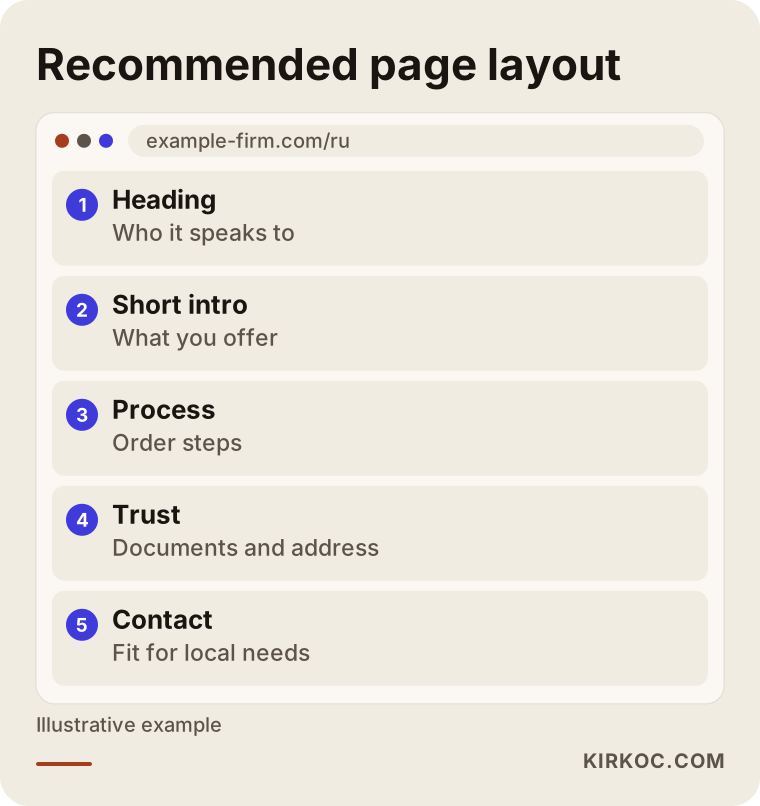
The image above is a plain outline of the page layout I recommend. The details change from site to site, but the basic order stays the same: you say who you are first, then what you do, then how you work, and last how to reach you.
Frequently Asked Questions
Is Yandex SEO the same as Google SEO?
The basic logic is the same: a high-quality, fast, clear site with pages that answer the customer's question. But the language, the region setting, the tools and some details differ. So your work on Google may not produce the same effect on Yandex by itself; it needs a separate look.
I don't speak Russian. Can this still be done?
Yes. But the texts must be written, or at least reviewed, by a native Russian speaker. I recommend that you never publish raw machine-translation output. I manage the process and carry out the language check together with a suitable editor.
Does it matter that I host my site outside Russia?
It is not an obstacle on its own. But if page speed is slow from a faraway country, you lose visitors. You should test speed from the target country and come up with a fix if needed.
Do you guarantee a first-place ranking on Yandex?
No. Nobody can guarantee a ranking on any search engine. What I can do is set your site up correctly, prepare the right pages and watch the data and correct course. The result depends on competition, your product and time.
How long does Yandex SEO take to show results?
I cannot give an exact time. For a new language and market, the first period is setup and getting indexed, and results become clearer as data builds up. Do not expect quick results in the first weeks; after a few months it is more realistic to see which direction is working.
Can Yandex Direct ads and SEO be done together?
They can, and it often makes sense. Ads give faster visibility, while SEO builds order over time. The data from ads shows which searches work, which also helps the SEO plan. The ad budget is calculated separately from the site work.
Which countries can you work for?
Work can be done for markets where Russian is widely used, such as Russia, Kazakhstan, Belarus, Uzbekistan and Kyrgyzstan. But each country has different search habits and legal conditions. For payments, exports and sanctions, I recommend talking to your accountant and a lawyer.
Do I need to rebuild my current site from scratch?
Most of the time, no. First I look at the existing site; if it can be taken forward by adding Russian pages and the technical setup, there is no need to start over. If the site is very old or broken on mobile, I may suggest a rebuild, but I will explain why.
If you think search engines are not showing you in your target market, get in touch through my SEO services page. We will look at your site together and talk openly about what Yandex really requires, and what it does not.