You install panels, you know your craft, and your crew does clean work. Yet your phone mostly rings with people who heard about you from a neighbor, and the inquiries that come from the internet are either missing or from people who "just wanted a price." If you are searching for a solar company website that actually brings in serious requests, you are in the right place. In this article I explain what a website has to do for a solar business, which pages you need, and how to build the quote form. I am Ümit Kırkoç, I work from Istanbul, and I handle website design from scratch on my own. What I write below comes from how buyers in this industry think when they compare companies.
Let me start with one basic fact. A solar system is a decision a customer will live with for many years, and it is a serious investment. Nobody makes that decision overnight. They research first, then ask three or four companies for quotes, then compare prices and trust. Your website has one job during that comparison: to make the visitor think "this company is serious, knows the work, and talks to me honestly," and then to get them to request a quote. Looking nice comes second.
How does a solar customer search for you?
People rarely type just "solar energy." They search for something concrete: "rooftop solar installation," "solar panels for a warehouse roof," "how many kilowatts do I need for my house," "solar for a farm irrigation pump." Many add a place: "solar installer near Phoenix," "commercial rooftop solar Denver." Each of these searches carries a different intent and deserves a different page.
Picture a factory owner and a homeowner landing on the same page. Neither finds themselves there. The factory owner wonders about the biggest line on the power bill and how long the investment takes to pay back. The homeowner wonders whether the roof is suitable, what the homeowners association or the utility will need, and who handles maintenance. A farmer thinks about how far the power line is and whether a pump can run on the system. One generic "Solar solutions" page cannot answer all three.
The illustration below uses a completely invented example to show what happens on a search results page. A clear page can beat a generic list.
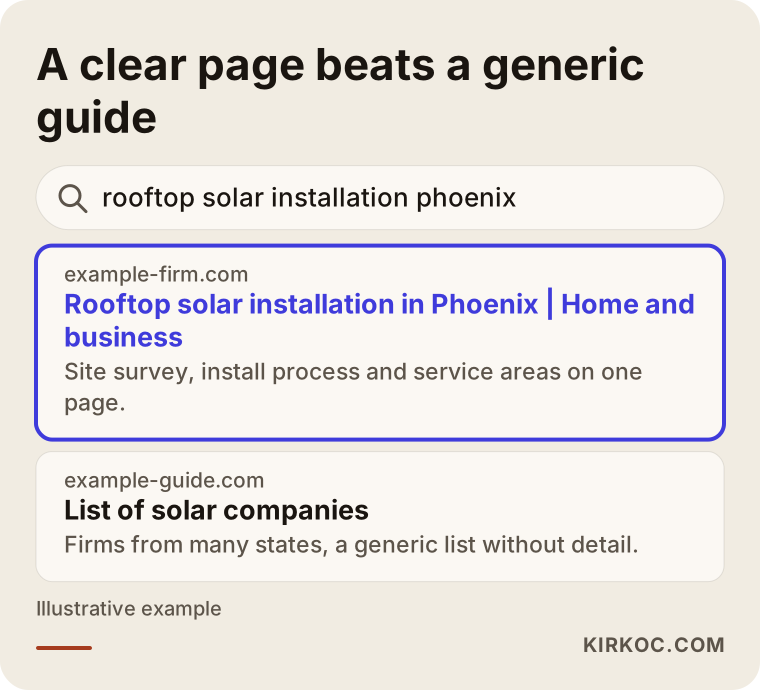
The highlighted result names the area and the service in its title and says plainly what the page covers. The result next to it is a directory that lists many companies without describing any of them in detail. Google's goal is to show the searcher the answer that helps them most, so if you give a clear answer, your chances of being chosen go up. I will not promise a ranking, and nobody honest can. But a clear page has a better chance than a vague one.
The four shapes of a search
In solar, searches fall roughly into four intents. I put which page fits which intent into the table below.
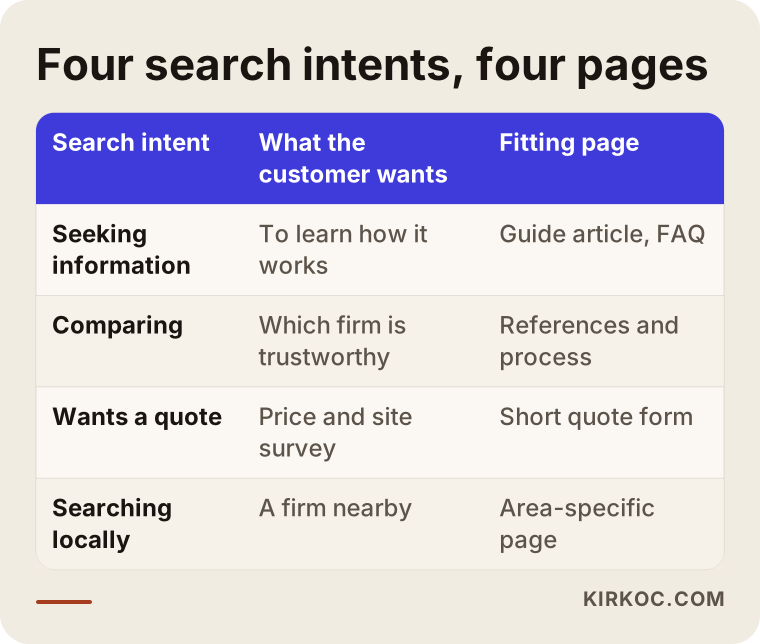
As you can see, every intent has its own page. If someone is only looking for information, pushing a "get a quote" button at them makes them leave. If someone is ready to ask for a quote, handing them a long technical article wastes their time. The information seeker needs a guide article or a frequently-asked-questions page, the comparer needs references and a process page, and the person who has decided needs a simple quote form. When you build the site around this logic, every visitor finds their next step.
Then there is local search. Most customers want a company that will come to their roof for a site survey, so they type their city or county. If you only install in certain areas, your website should say so clearly. Writing "we serve the entire country" feels tempting, but a request from a place you cannot visit only eats your crew's time. List the areas you serve, and fill out your Google Business Profile, which is the free listing that appears on the map, with the same information. Showing up well in map results is its own piece of work, usually called local SEO, and I only suggest here that your website states this information correctly.
The pages your site needs
For a solar company, the function of each page matters more than the page count. The skeleton I recommend is a home page, a separate page for each type of customer you serve (residential, commercial and industrial, agricultural), a projects page, a process page, a frequently-asked-questions page, an about page and a contact page. From all of them there should be an easy path to the quote form.
The visual below shows the layout of a sample customer-type page. Think of it as a commercial rooftop page.
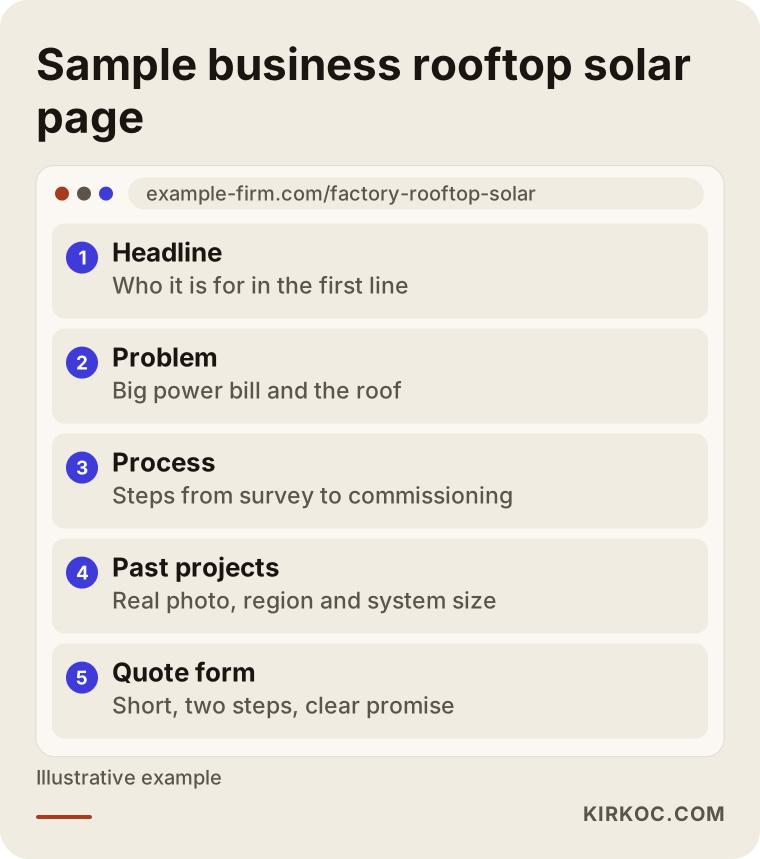
In this layout the visitor first recognizes themselves (they see who you are speaking to), then learns how the process works, then sees similar projects you have done, and finally meets the quote form. Do not bury the form at the very bottom. Make it reachable both near the top and at the end, because some visitors decide within five seconds and others read to the last line.
Why the projects page is so important
In this industry, trust does more work than product features. You are going to put equipment on someone's roof, and the customer wants proof that you really do this work. On your projects page, include a photo of the finished job, the system size, the location (city or county level is enough, no street needed), the approximate installation time, and, if the customer agrees, a short comment. Do not publish a customer's name or address without permission. That is sensitive from a privacy standpoint and it may upset the customer. If you are unsure about privacy rules where you operate, talk to a lawyer.
If you do not have many projects yet, do not inflate the page. Three honest, detailed jobs beat ten vague photos. Use photos your own crew took on real jobs. Stock images are easy to spot on a solar site, and they damage trust right away.
The quote form: the real job of your site
The most important part of your website is the quote form. Solar pricing depends on the roof, the electricity use and the connection to the grid, so nobody can post one fixed price. That is why the visitor leaves their details and you get back to them. The form's task is to collect serious requests while protecting you from pointless phone traffic.
A form that is too long tires people out, and a form that is too short leaves you with no information. I handle the balance like this: the first step asks for the most basic details so you can reach the person, and the second step asks for the technical hints you need before you can prepare an offer. The list below summarizes the fields I would put in the form.
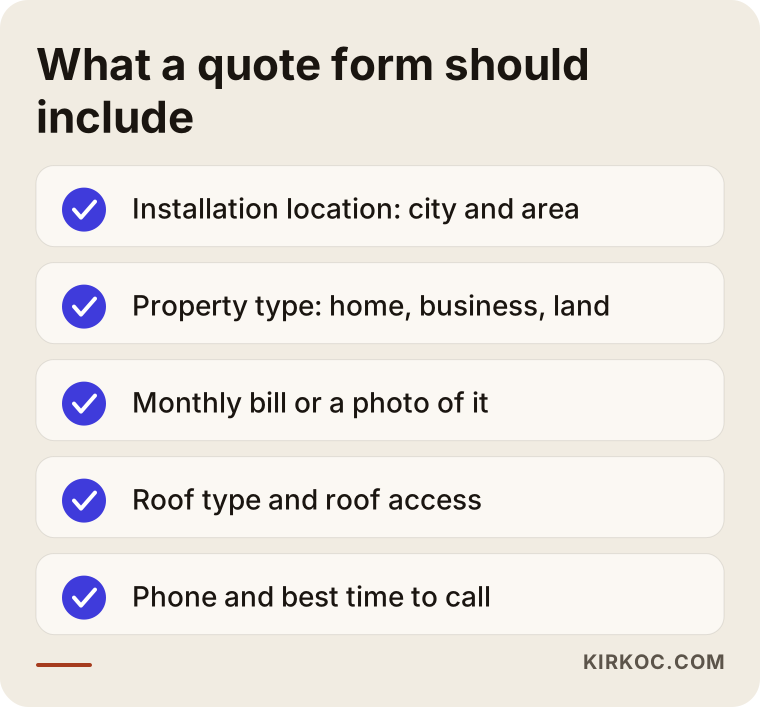
Let me explain briefly why each one matters. The installation location, city and county, decides whether you can do a site survey at all. The property type, meaning home, business or land, tells you which crew and which calculations apply. The monthly electric bill, or a photo of it, shows roughly how large the system should be. If a customer does not want to type a number, the option to upload a photo is a good convenience. The roof type and roof access describe how complicated the job will be. The phone number should be required, but also let people choose a good time to be called. Otherwise someone who wanted to be left alone gets a call at nine in the morning and gets annoyed.
The most expensive mistake with forms
An overly long form is only one common mistake. The more expensive one is that nothing happens after the form is sent. The customer submits it, does not even see a "thank you," or the notification email lands in a spam folder and you notice three days later. So after you set up the form, test it yourself, try it from another phone, and make sure the notification really arrives. On the confirmation screen, make a clear promise such as "we received your request and will reply within one business day," and then keep that promise. If you cannot meet a deadline, do not state it.
What separates a trustworthy site from a doubtful one
Imagine two companies in the same field. The quality of their equipment is about the same. But one site loads slowly on a phone, has twelve items in the top menu, and an empty "About" page. The other is simple and fast, shows where the company works and who the team is, and has a short form. The customer picks the second one, because the first contact hints at what the rest of the work will be like.
The comparison below shows this difference in its main aspects.
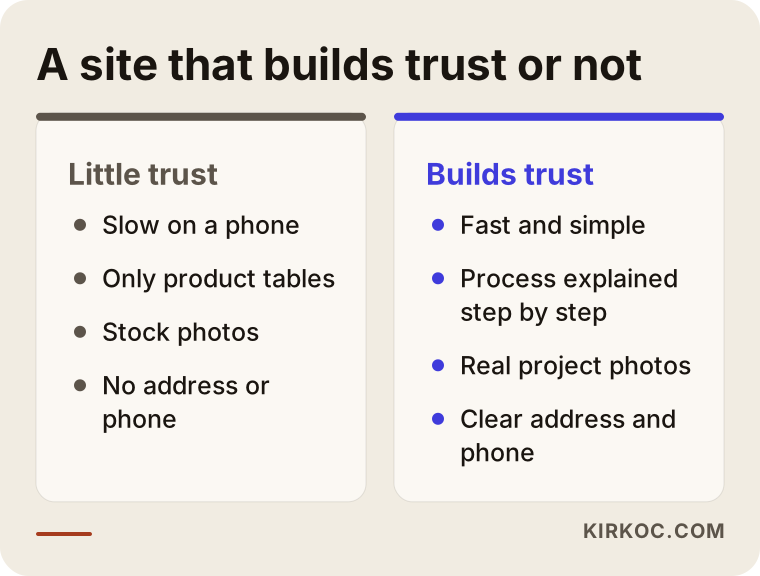
What stands out is that none of this is hard or expensive. A clear phone number, an open address, real photos and an honest description of the process often bring in more work than a price cut. Each item is small, but together they make a big difference.
Be careful about licenses, certifications and permits too. Solar work involves rules and approval steps that differ by state and utility and change over time. If your site mentions a license or a certification, make sure it is current and accurate. Phrases like "we handle all permits" should be written after checking your real legal and technical situation with a qualified professional. Keep your promises limited to what you can truly control.
Two example scenarios
The two scenarios below are completely hypothetical. They do not describe any real company or customer. I made them up only to show the logic.
Scenario 1: A small firm working on commercial roofs
Suppose a company has been installing systems on the roofs of businesses in an industrial area for years. Most work arrives through a previous customer's recommendation. Its website is a single page. Under the heading "Solar solutions," residential, commercial and agricultural work are all described together. The form has only a name, a phone number and a message box.
The first thing I would do here is build a separate page in the voice of the business owner: why the power bill is a large expense, how the roof is evaluated, how long the site survey takes, and a few detailed examples of past jobs. In the form I would add the monthly usage range, an estimate of roof area and the roof material. That way, before the first phone call, the company already knows roughly how large the job is and can spend its time on conversations that are likely to lead somewhere. This does not mean requests will double tomorrow. It means the requests that arrive can be expected to be better qualified.
Scenario 2: A residential installer receiving requests from far away
The second hypothetical company is in a small town and installs systems on homes. The home page says "serving the whole country." Most of the forms it receives come from distant states. The company replies to each one, explains that it cannot do a site survey there, and loses time.
The fix is to state the service area everywhere on the site. The form gets a field for "city and county where the system will be installed," and if someone picks an area you do not serve, the form politely says so. The exaggerated line on the home page comes out, and in its place go the areas actually served, with a short note for each. The result is fewer requests but more accurate ones. Filtering is the website's second job in this industry.
Where do requests get lost?
Every website is a funnel: many people arrive, some reach the quote form, fewer fill it out, and very few sign with you. Knowing at which step you lose people tells you where to work.
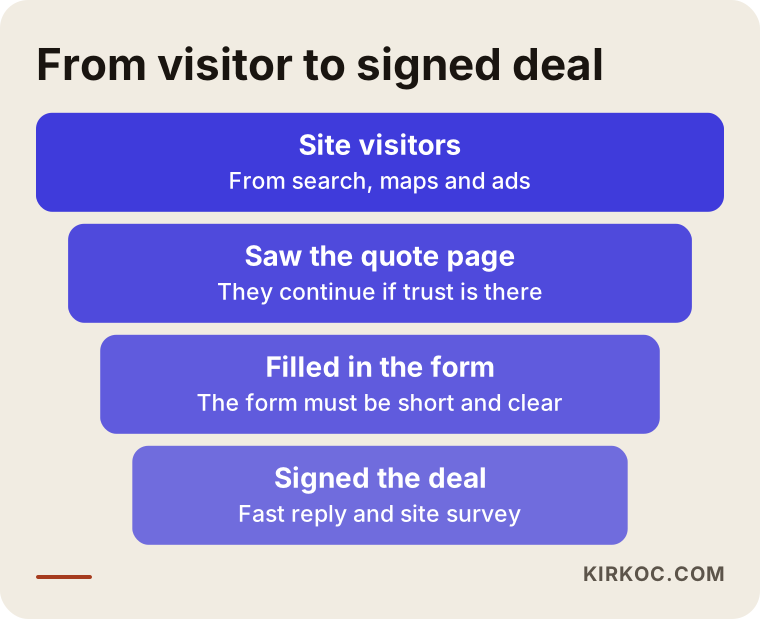
Read the funnel like this. If there are few visitors but a good share of them fill out the form, the problem is traffic, meaning not enough people find you. If there are many visitors but nobody fills out the form, the problem is the page: trust, speed or the form itself. If quotes arrive but do not turn into signed jobs, the problem is outside the website. It may be your price, your follow-up speed, or how you communicate after the site survey. Spending money on ads and on the page without finding the leak is like pouring water into a bucket with a hole.
To measure this, the site needs conversion tracking, which simply means recording each form submission and each tap on the phone number. Without it, the answer to "did the ads bring anyone?" is a guess. The setup is a one-time job, and afterwards it makes decisions far easier.
The process, step by step: from nothing to a site that collects quotes
Understanding the process helps you manage your expectations and your budget. This is the order in which I build a site like this.
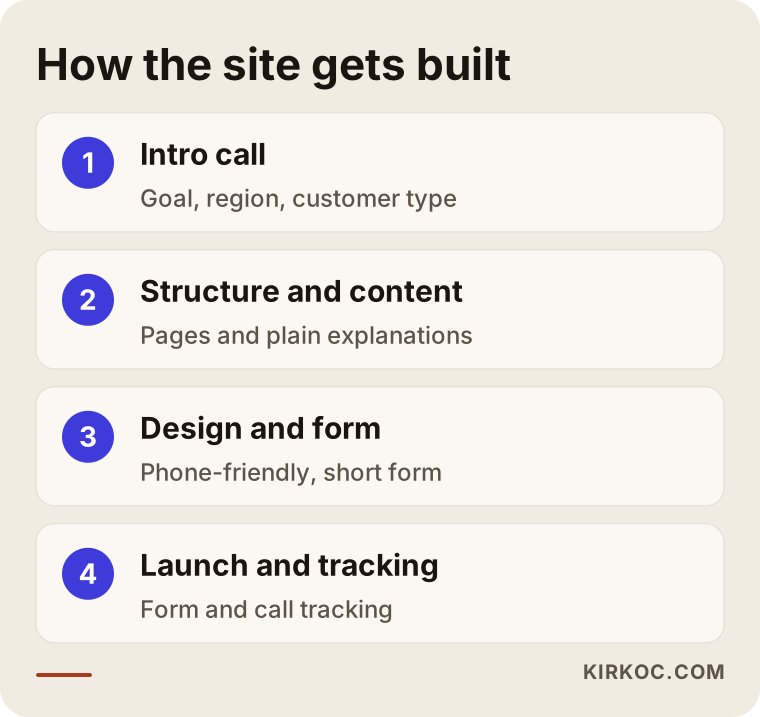
The first step is an introduction and setting goals. I ask which type of customer you want, which areas, how many requests a month you would like, and what jobs you have already done. I will not promise you something I cannot deliver. Demand in this industry shifts with the season and the economy, and nobody can guarantee a fixed number.
The second step is structure and content. I plan which pages to build and which questions each page will answer. In the copy I explain technical terms in plain words. For example, "kW" or "grid interconnection" gets explained in a way the reader will understand. The more a customer understands, the more they trust you.
The third step is design and the quote form. I build the site to work comfortably on a phone, because homeowners often do their research on one. I set up the form in two steps, as I described earlier, and make it resistant to errors. Then I test with you that the notification reaches you.
The fourth step is launch and measurement. The site goes live, form and phone-tap tracking is working, and the settings that help search engines understand the site are in place. In the first weeks I go through the incoming requests with you and fix whatever is not working in the form.
Common mistakes on solar websites
I see the same mistakes on many solar sites. Most of them are not expensive to fix. They just need attention.
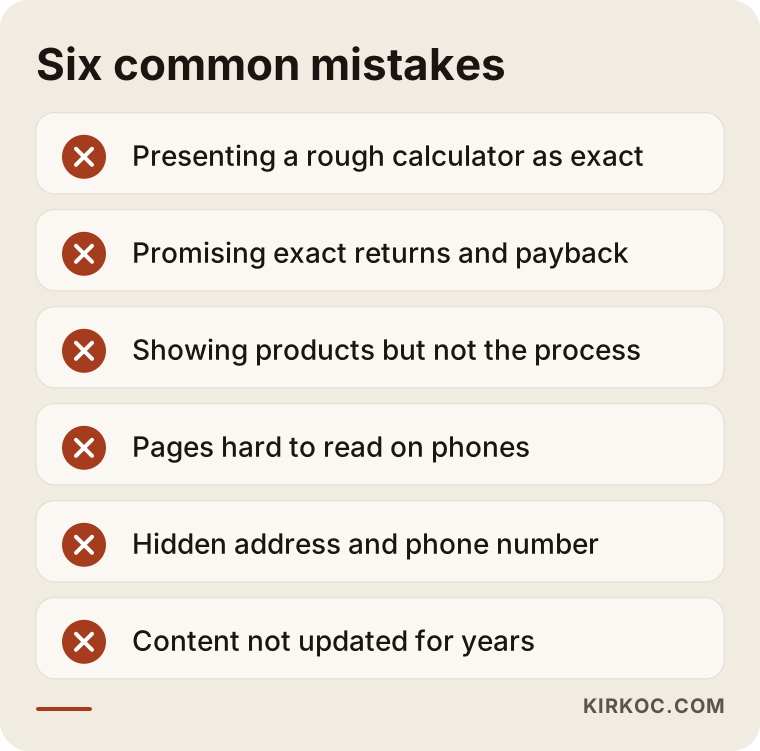
Let me explain a few from this list. The first is creating a false expectation with a calculator. Some sites offer a tool that says "enter your monthly bill and see how much you will save." If the tool does only a very rough calculation, it shows the customer an unrealistic number, and disappointment follows after the site survey. If you add a tool like this, write a visible note: "This is an estimate. A firm quote comes after a site survey." The second is making firm promises about returns and savings. Payback depends on the direction the roof faces, shade, how the household uses power, and electricity rates and incentives that can change. Writing a fixed number is not honest, and it can cause trouble later.
The third is describing only the product. Panel brands, inverter models and technical tables are necessary, but the customer's first question is "how will you do this for me?" A site that does not explain the process does not help anyone decide. The fourth is poor mobile design. If text is tiny on a phone or the form button is not visible, the customer leaves. The fifth is missing contact details: no address, and a phone number found only under the form. The sixth is a site that is never updated. When the latest post is three years old, or the incentive and rule information is out of date, visitors start asking whether the company still operates.
What can you do yourself, and when do you need a specialist?
You do not have to hand everything to a specialist. Some things you can do on your own: photograph finished projects, write a short summary of each (which area, what type of roof, about how many days it took), ask customers for comments with their permission, and keep a list of questions people ask you often. This material is the most valuable raw input for the site, and you know it better than anyone.
You can also build a basic information site with a ready-made website builder. If you are starting small, that is a sensible first step. But in some places expert help speeds things up and lowers the risk of mistakes: building separate pages for each customer type, designing the form properly, setting up conversion tracking, search engine settings and site speed. The decision chart below gives a rough guide to what to do in which situation.
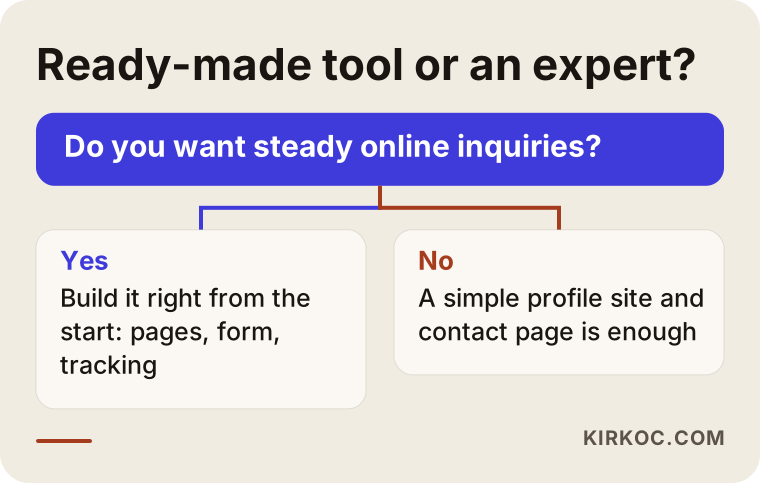
The point of the chart is this. If you are just starting, your budget is tight, and most requests still come through word of mouth, a simple site with a good contact page is enough. If you want a steady stream of online requests, plan to run ads, or work in more than one area, building the structure correctly from the start saves money over time. Putting an ad budget behind a badly built site burns part of that budget.
What determines the cost?
I will not give numbers in this article, because the real figure varies a lot with the scope of the work. But I can tell you what moves the price. The number of pages and the variety of customer types is the first factor: a company that serves only homeowners needs a simpler site than one that wants separate pages for residential, commercial and agricultural work. The second factor is content. Whether you write the text yourself, who takes the photos, and how projects are presented all change the cost. The third is the form's complexity: a two-step form, bill upload, automatic notifications and a link to your customer tracking tool take more work.
The fourth factor is what else you want besides the website. Only the site, or also search engine work, a tuned business profile, social media management and ad management? There is a practical benefit to having all of these run by one person: the message on your site, the message in your ads, your social media posts and your Google profile do not contradict each other. You do not have to coordinate five different people or companies. You have one contact, and when something goes wrong you know whom to ask. The fifth factor is continuity: after launch, will the site need maintenance, updates and new content, or is it a one-time job?
When you compare quotes, do not look only at the total. Look at what it includes, what you actually receive (will you own the site, and whose name is the domain registered under), how extra revisions are handled, and whether there is support afterward. A very cheap quote usually turns out to be missing something in one of these.
What should you expect after launch?
Requests do not pour in on the day the site goes live. Search engines need time to recognize a new page, and it is impossible to say in advance how fast your visibility will build. If you run ads, you show up sooner, but when you stop spending the visibility stops too. The practical path is to use both in balance: the site and its content build the lasting foundation, and ads help in the first months and in the busy season.
The timeline below shows roughly what progress is reasonable to expect. Timing and results vary with the industry, the area and the competition. These are not guarantees, only a sequence of ideas.
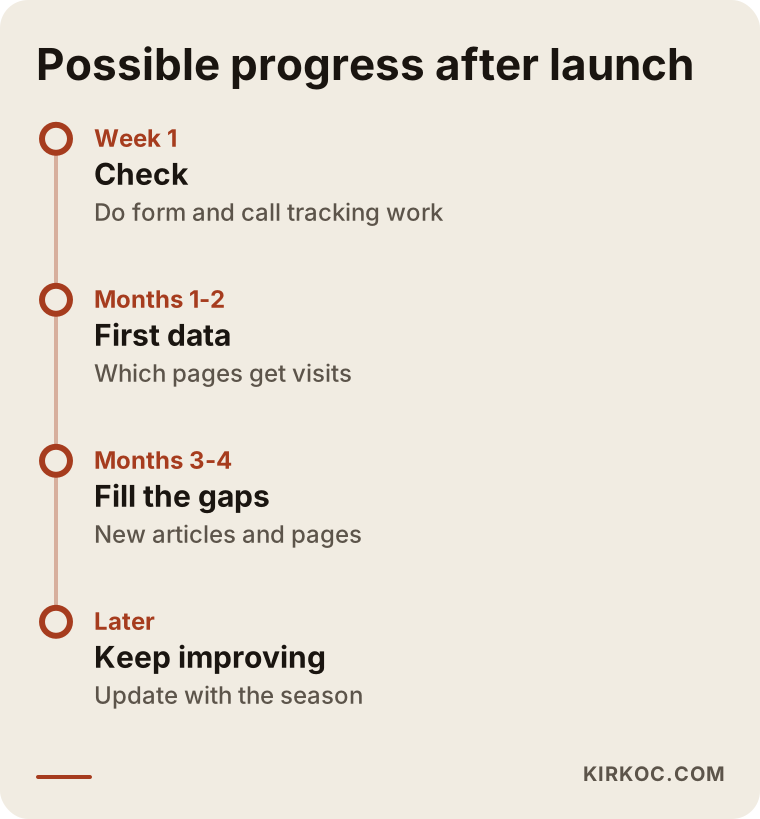
The lesson here is to be patient but to keep watching. In the first weeks, check that the form works and that phone taps are being recorded. After a few months, see which pages get visits and which questions have no answer yet. Add the missing answers as new articles or new pages. Every question a customer asks you is your next piece of content.
How I work with you
I work alone. That means the person you talk to is the person who builds the site, edits the text and tests the form. Work does not get handed from one department to another, which means quick decisions and clear responsibility. If you need more than a website, I can also handle search engine work, Google and Meta ads, social media management, your logo and content creation under one roof. It is also possible to do these separately. I do not make you buy everything.
The start is simple. First I listen to your business and your goals. If you already have a site, I look at what works. Then I tell you plainly what you need and what can wait. I do not try to sell you something you do not need, and sometimes the best advice is to improve the current site with a few small fixes.
Frequently asked questions
Does a solar company really need a website?
Yes, even if your work comes by recommendation. Someone who is told about you will look you up online before calling. Having no site, or a thin one, can make even a recommended company look doubtful. If you want to reach a wider audience, the website is the foundation of that goal.
Should I show prices on the quote form?
Usually not. Solar prices change with the roof, the usage and the connection, so a fixed number would be misleading. Instead, explain honestly on your site what the price depends on. That builds trust and also reduces the "I only wanted a price" calls.
Will asking for a photo of the bill scare visitors away?
If you make it mandatory, it may drive some away. Make it optional: a person who uploads a bill gets a faster and more accurate quote, and a person who does not can still send the form. Explain why you ask and how you store it. For a reliable approach to personal data, I suggest talking to a lawyer.
How many pages should the site have?
It depends on your goal. For a company serving one type of customer, around ten well-made pages can be enough. If you work in several areas such as residential, commercial and agricultural, each needs its own page, plus projects, process and FAQ pages. More pages is not the goal. Each page should answer a question.
How soon will requests come in after the site is built?
I cannot guarantee that, and be careful with anyone who says they can. The speed depends on your area, the season, the competition and how you promote the site. If you use ads, the first requests may come sooner. If you rely only on search engines, it takes time. Measuring after launch lets you see clearly what is happening.
Is a ready-made template enough?
It can be enough to begin with, but it has limits. Templates are usually designed for a generic business. Separate pages per customer type, a two-step form and measurement take extra work. Starting with a template and improving it as needs arise is also a reasonable path.
Do I need social media and ads too?
Not necessarily, but they can help. Social media is a good showcase for finished projects and your process. Ads give quick visibility but stop when the budget ends. The site and the form need to be solid first, because ad traffic sent to a weak site is wasted.
I already have a site. Do I need to start over?
Not always. First I look at what the current site does: does the form work, does it open easily on a phone, are customer types separated. Often it is enough to rewrite some pages, fix the form and set up tracking. I recommend starting over only when the existing structure is truly in the way.
If you want to plan your solar company's website, quote form and, if needed, search visibility together, you can write to me through my website design page. I will listen to your business and tell you plainly what you really need.