You are a trademark or patent attorney. You know your field, your filings go out on time, and your clients recommend you to people they know. Yet someone who types "how do I register a trademark" or "who can help me patent my invention" into Google does not find you, and when they do land on your site, they leave without knowing what to do next. If that sounds familiar, a website for trademark and patent attorneys is no longer a nice extra. It is a normal part of how your next client finds you. In this article I explain why your site has to work differently from sites in other industries, which pages earn their place, and how I run the process. I am Ümit Kırkoç. I work alone from Istanbul, and I handle website design, search visibility and, when it makes sense, advertising and social media, all myself.
One note before we start. Lawyer advertising is regulated, and the rules differ by country and by state or bar association. I cannot tell you what is allowed in your jurisdiction. Your bar association and your own legal counsel can. Everything below is a general roadmap for structure and tone, and you remain responsible for checking that your final text complies with the rules that apply to you.
How do your clients search for you?
Most people who need your services do not speak legal language. They opened a coffee shop, launched a small skincare line, built a piece of software, or invented a gadget in their garage. Their question is not "which class should I file in" or "what is the priority period." It is "can someone else take my name," "how long does it take," and "who do I even call." You say classes, priority claims and response deadlines. They say "how do I protect my brand."
That gap shapes your whole site. When a client searches in their own words and lands on a page written in their own words, they trust it and keep reading. When they land on a page full of statute citations, the next attorney in the results gets the call.
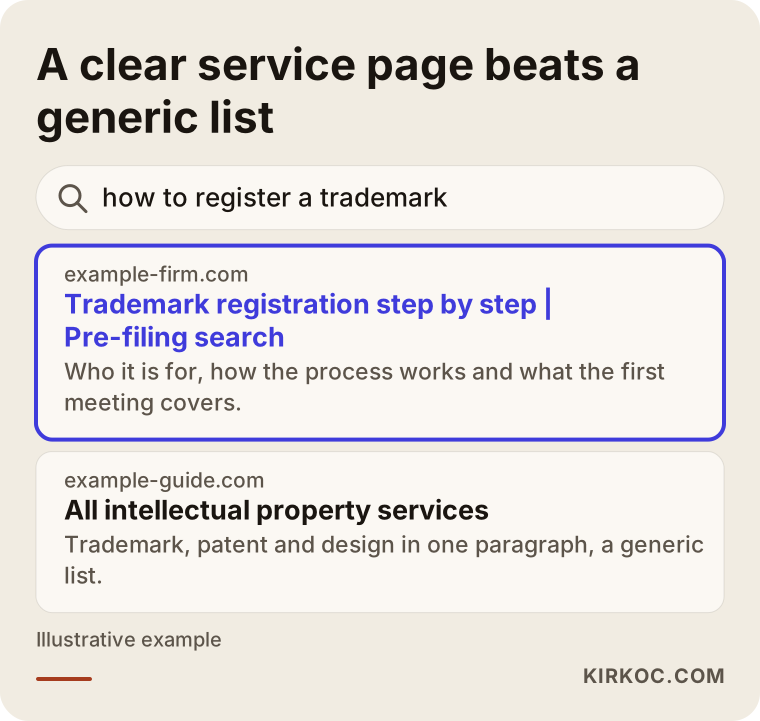
The image above shows an invented search result. The highlighted page says who it is for, what it does and what happens next in its first lines. The page below it lists a dozen services in one paragraph and explains none of them.
Three stages of searching
A client's search usually moves through three stages. Separating them tells you which page to write for what.
The first stage is learning: "what is a trademark," "trademark versus patent," "what is a utility patent." This person is not looking for an attorney yet. They are trying to understand their situation. The second stage is comparing: "trademark attorney near me," "patent attorney for a software startup," "trademark registration cost." This person is about to choose someone. The third stage is urgency: "I got a cease and desist letter," "someone copied my brand," "my application was rejected." This person is anxious and wants a human voice quickly.
Showing the same page to all three is a mistake. The learner needs a clear explanation. The comparer needs a service page that shows your scope and how you work. The person in trouble needs a phone number in the first screen they see.
How do you build trust in this profession?
A trademark or patent file is not an ordinary purchase. The client is handing you an idea, an invention or the name of their business. Before filing, they may need to describe the details of that idea to you. So the first job of your site is to create the feeling: "I can tell this person things."
That feeling does not come from big slogans. It comes from concrete, checkable facts: your full name, your firm, your bar admission or registration details where they apply, your areas of practice, your office address and a phone number that someone answers. All of it should be easy to see. When people cannot find a basic fact, they assume it is being hidden.
Language matters too. Phrases like "the leading firm" or "thousands of successful filings" cannot be proven, and they may cause problems under advertising rules anyway. A calm tone that explains the process and answers real questions builds more confidence. Clients judge how well you will handle their file by how well you explain things on the page.
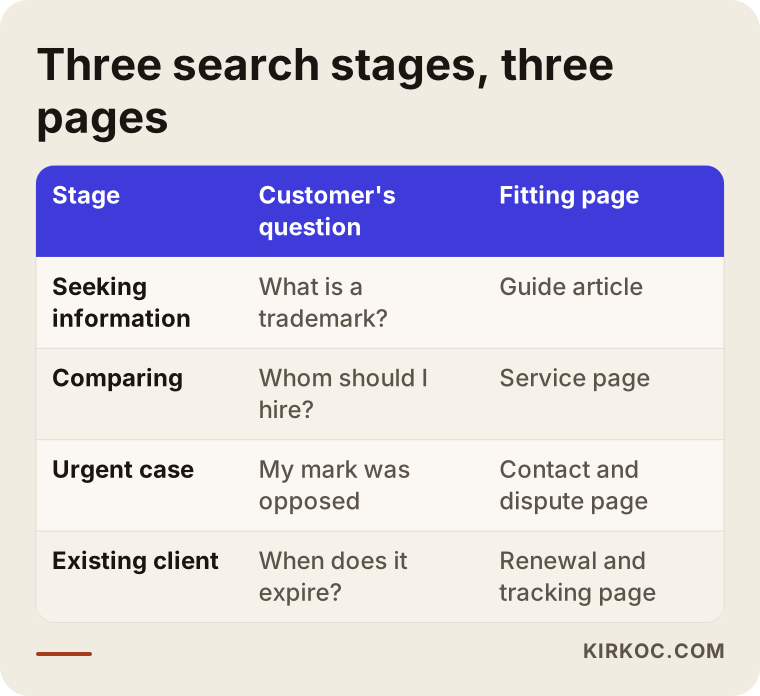
The table is simple, but it gets skipped often: a guide for the person who is learning, a service page for the person comparing, a direct contact route for the person in trouble, and a renewal page for clients you already have.
Which pages do you actually need?
Many attorney sites settle for one "Services" page. Trademarks, patents, designs, oppositions, renewals and international filings are squeezed into a single paragraph, and the reader cannot find their own situation. When each main service has its own page, the client finds what they came for faster, and search engines understand what each page is about.
For most practices, these pages are enough to start:
- Trademark registration: the process, the information you need, the search done before filing and what happens afterward.
- Patents: which inventions may suit a patent, why confidentiality before filing matters and how the process runs.
- Design protection: a separate explanation for people who want to protect how a product looks.
- Disputes and oppositions: a calm, clear page for someone whose mark was challenged or copied.
- Renewals and docketing: deadline tracking for existing registrations. This page keeps current clients with you.
- International filings: for exporters and founders who want protection abroad.
- About you: who you are and how you work.
- Contact: phone, email, address, a map and a short form.
If every page follows the same skeleton, writing and reading both get easier. Start with who the page is for, then the process, then common questions, and finish with a call to contact you.
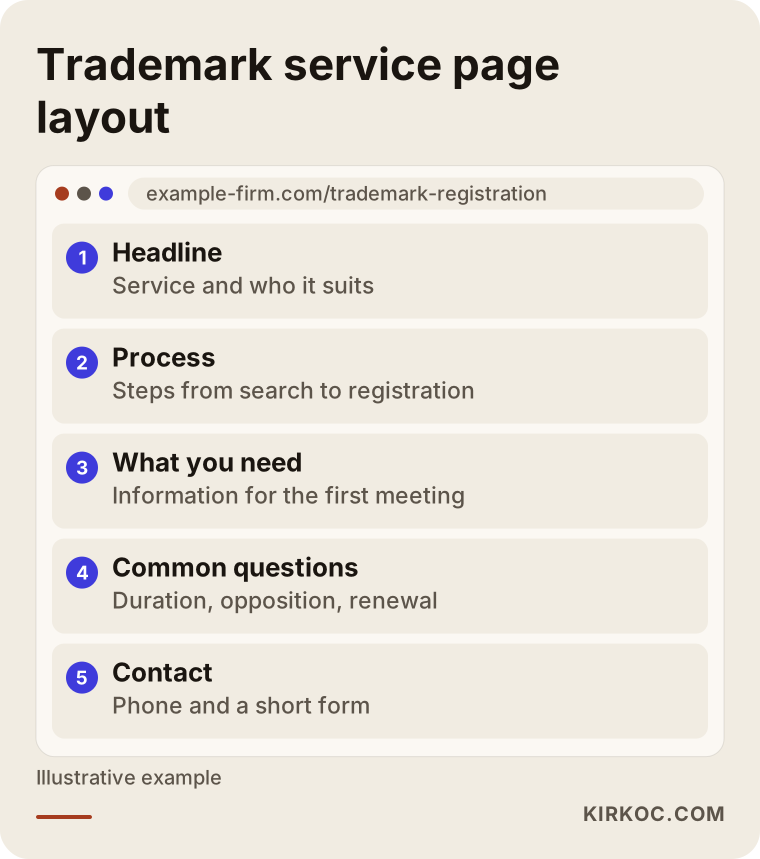
This layout is not a rigid template. It works because it follows the order in which the client asks questions: is this my situation, how does it work, how long does it take, and how do I reach you.
Example scenario: a small skincare brand
The following is entirely hypothetical. Imagine someone who started making handmade soap at home and sells it on Instagram. They picked a name, printed their packaging, and one day a friend tells them, "register that name before someone else does."
What do they type into Google? Probably "how to register a trademark" or "trademark registration cost." They are not looking for an attorney yet. If your site has a plain-language guide that opens with a question like "Could someone else already own my brand name, and how do I find out?" they will read it. If the end of that page says you can run that search for them and shows an easy way to reach you, a person who was only looking for information becomes a prospective client.
If your site only has a dry paragraph titled "Trademark services," that person takes what they learned elsewhere and goes elsewhere. What you lose is not a page. It is the start of a relationship.
Example scenario: an engineer with an invention
The second hypothetical is a mechanical engineer who built a small device in their own time, away from their employer. They want to protect it but do not know whether a patent is the right route. They are also nervous about explaining the idea to a stranger.
This person searches slowly and carefully. They look at several attorney sites and notice who explains things best. What matters to them: does the site say how confidentiality is handled, does it describe how a first conversation works, and does it explain the difference between the types of protection in plain language? Price matters, but at this stage it comes second. First they want someone who listens.
For this client, an article like "What to know before you explain your invention to anyone" sets you apart. Most sites talk about themselves. Very few talk about the client's hesitation.
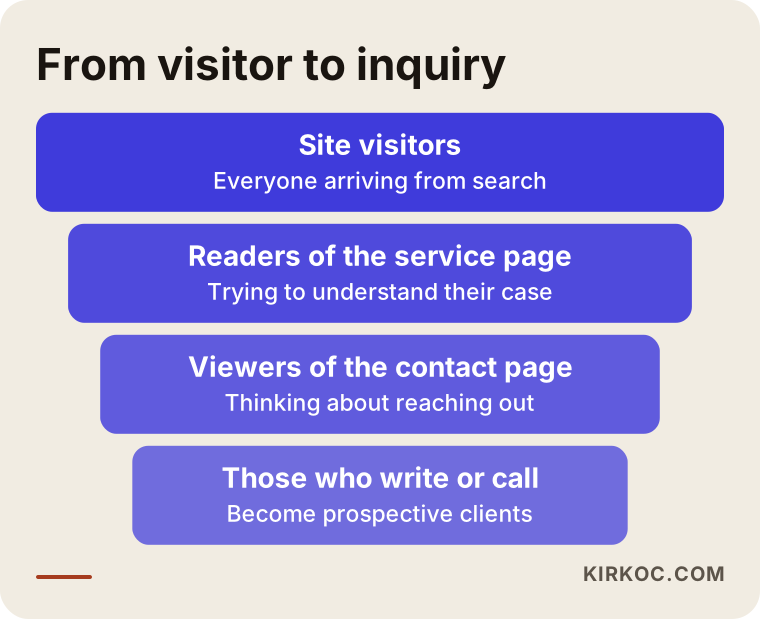
The narrowing in the image shows what both scenarios share: many people look at the site, some try to understand the service, and very few write or call. The goal is not to convert every visitor. It is to make sure the right ones can reach you without effort.
What does it take to show up in search?
Search demand in this field may look concentrated, but it is actually split into many small topics. "Trademark registration" is a broad search. "Trademark for a food product," "software name trademark" and "how long to respond to a trademark office action" are narrower and more intentional. Competition is lower for narrow searches, and the person searching usually has a real need.
What works is one page for each main service and one guide for each common question. When those pages link to each other, the reader moves from one topic to the next, and search engines see that your site goes deep in this area. Getting the foundation right on a new site is much cheaper and faster than fixing it later.
I cannot guarantee ranking for any page, and nobody honestly can. Competition, the age of the site, the quality of the content and many other factors all play a part. What you can do is build the site so it answers your client's question well, and keep adding good answers over time.
AI assistant searches
More people now put their question to an AI assistant such as ChatGPT instead of Google. When someone asks "what steps are needed to register a trademark," the assistant writes an answer and sometimes names its sources. If your content is clear, well organized and written as questions and answers, it has a better chance of being used as a source. That is not guaranteed either, but a clean, sectioned structure helps both human readers and these tools.
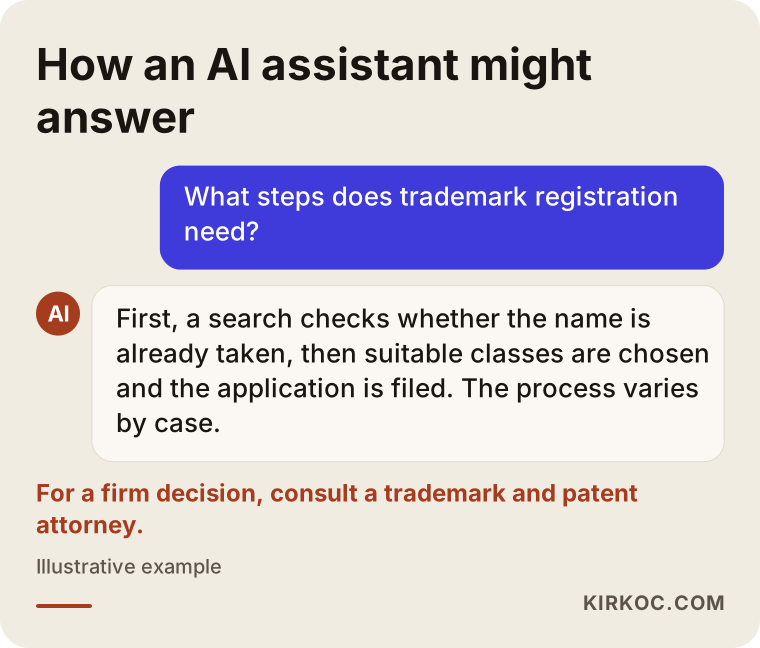
The image shows a hypothetical answer. Notice that the assistant lays out clear steps, avoids giving a final ruling and points the reader to a professional. The same tone works well on your own pages.
How do I build your site, step by step?
I keep my way of working simple. At every stage you know what I expect from you and what I will do.
- Introductory call. We talk about which services you want to offer, which kinds of clients you want, and what state your current site is in.
- Page plan. We settle on paper which pages you need, in what order they get written, and which searches each one answers.
- Content draft. I prepare plain-language text, and you check it for professional accuracy. You must have the final word on every legal statement.
- Design and build. Making sure the site opens well on a phone, loads quickly and shows a way to contact you on every page is my job.
- Launch and tracking. Once the site is live, I submit it to search engines, test that the contact form works, and set things up so you can see where inquiries come from.
- Ongoing updates. New guide articles, updates when rules change and, if needed, advertising or social media work can be added later.
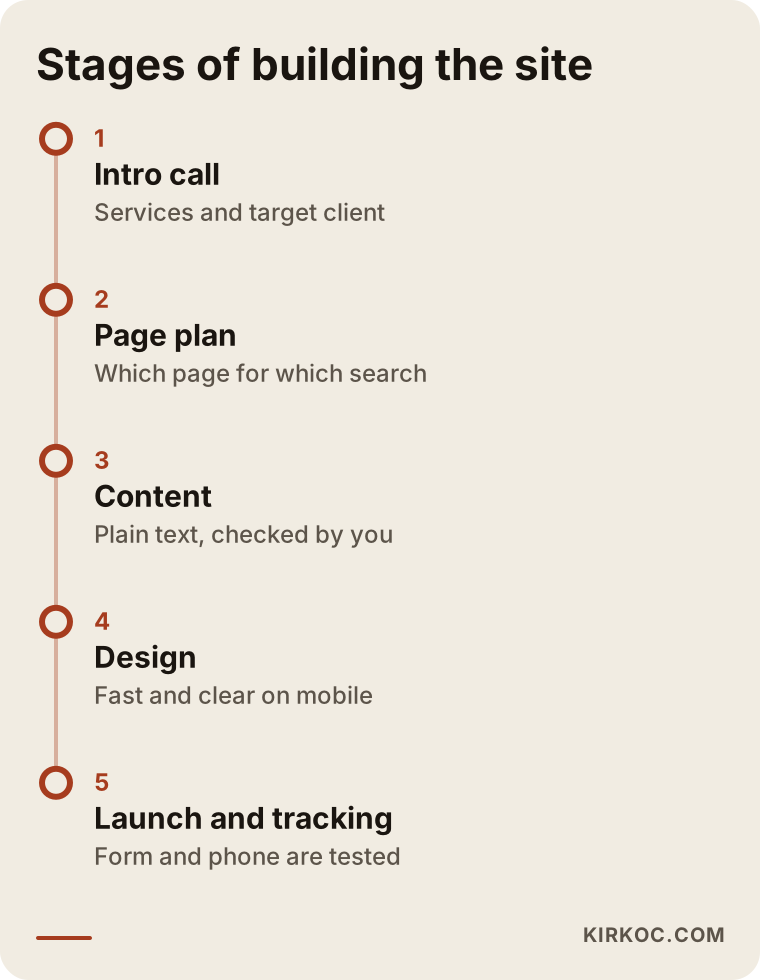
The timeline does not give fixed dates because the duration depends on the number of pages and on how quickly you can respond. What matters is that each stage builds on the previous one. Writing text for a site without a plan causes more trouble than designing a site without text.
What are the most common mistakes?
I see the same problems on attorney sites again and again. Most of them do not come from carelessness. They come from the habit of doing it "because everyone does it this way."
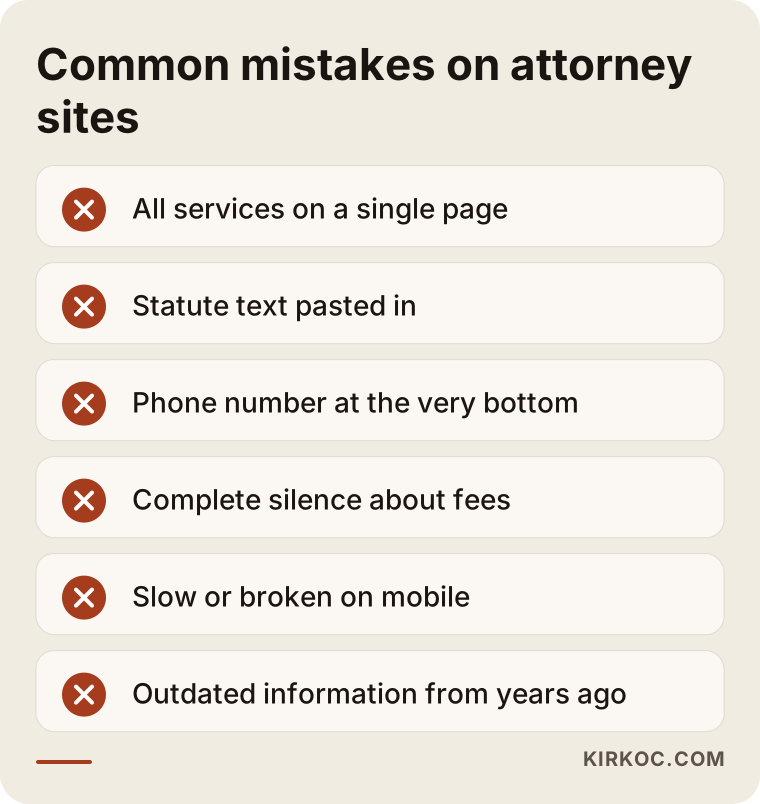
Let me go through the items in the image. The first is putting every service on one page. The second is pasting statute text instead of writing for people; the reader cannot find their own situation in it. The third is burying the phone number at the very bottom. Someone in a hurry will not scroll to find it.
The fourth is saying nothing at all about fees. You do not have to quote numbers, but explaining what a fee depends on, such as the number of classes, the scope of the search and the type of file, builds trust. The fifth is a site that is slow or broken on a phone, even though most prospects will see it on a phone first. The sixth is stale content: a page written years ago with outdated information misleads the client and makes them doubt your attention to detail.
There is a seventh, which I would add: wording that promises outcomes. A sentence like "your application will be approved" is not true, and it may also put you at risk under advertising rules. Check with your bar association's guidance or ask counsel.
When do advertising and social media make sense?
Not every practice needs advertising. But if you have just opened your firm, or want to push one particular service, Google Ads can put you at the top of the results quickly. Terms like "trademark registration" can be expensive per click, so the budget has to be set carefully. I usually suggest a small test first, to see which searches actually bring inquiries.
For this profession, LinkedIn is the most sensible social platform. Exporters, founders and small business managers are there. Short, useful posts, such as "three things to check before you file your trademark," build trust over time. Instagram or TikTok can be worth considering if your target is individual entrepreneurs and small brands.
It is common to have the site, the search work, the ads and the social media handled by different people. The result is text that does not match, ads that lead to a different page and a different tone on every channel. When I handle all of it, I can use the same message and the same facts everywhere, and that saves time for both of us.
What can you do yourself?
You do not need outside help for everything. You can do the following on your own and give your site a strong base.
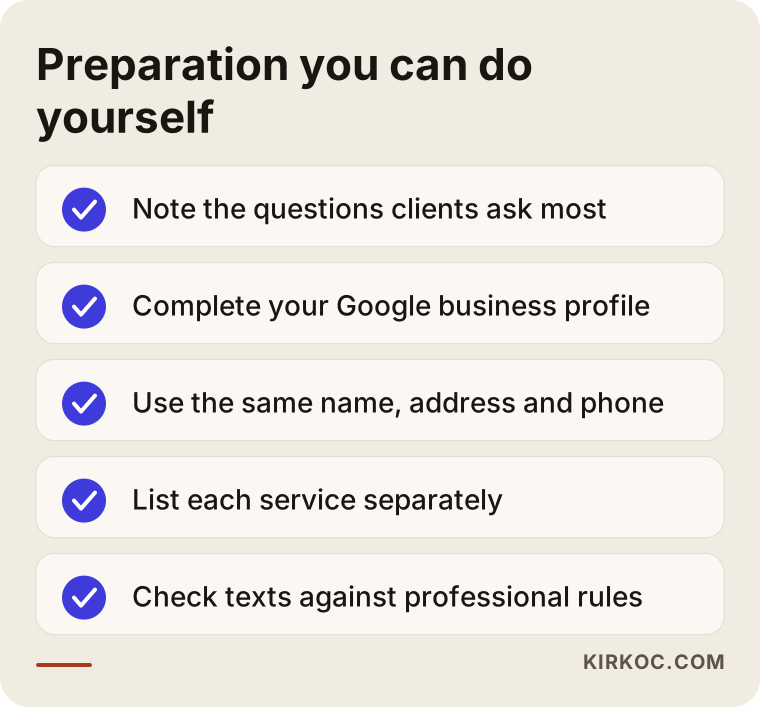
The most valuable item on the list is writing down the questions your clients ask most. For one week, note every question that comes in by phone or email. That list becomes the headlines of your guide articles. Another useful step is completing your Google Business Profile. When your address, hours and phone number are complete and identical everywhere, local searches work better.
When is an expert worth it?
If you are building a site from scratch, if your current site looks broken on a phone, if you do not appear in search at all, or if you spend on advertising and see no return, working with someone who knows the field protects your time. You should not have to deal with the technical side of a website while you are busy with your files. The final say on whether the text complies with professional rules should always be yours or your counsel's. As part of my work, I do not publish any legal statement without your approval.
What determines the cost?
I cannot give you a fixed figure, because the work depends on what you need. The main factors are the number of pages, the number of languages, how much of the text must be written from scratch, whether an existing site is being moved, the number of guide articles, whether the design follows a ready-made layout or a custom one, and how much ongoing work you want after launch.
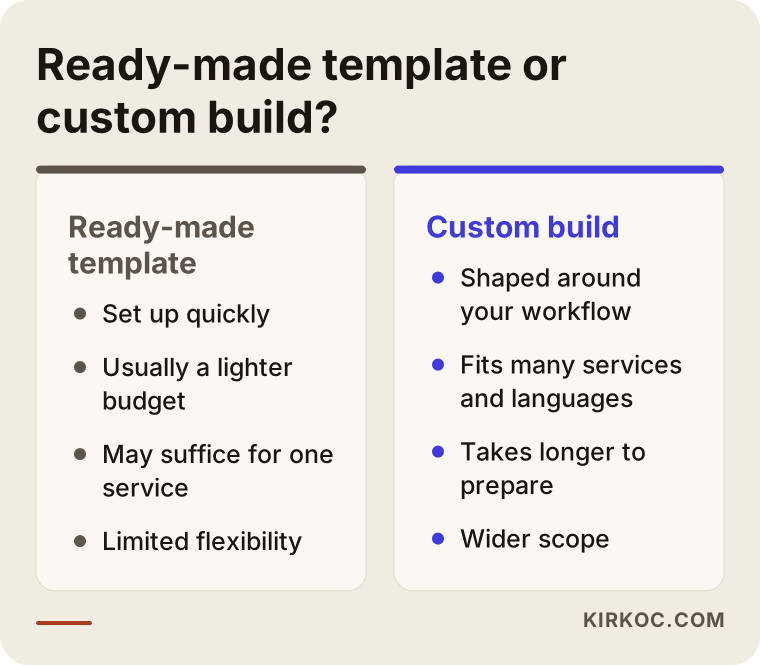
The comparison shows that a template is quick and lighter on budget, while a custom build fits your own workflow. Neither is wrong. For a new practice with one main service, a simple solution may be enough. For a firm with several areas of practice and international clients, a custom structure makes more sense. When you collect quotes, ask exactly how many pages, how many articles and which updates are included.
Ask yourself before you publish a page
Some content should be checked by a professional before it goes live. Sentences about regulations, fee schedules, deadlines and expected outcomes all belong in that group.
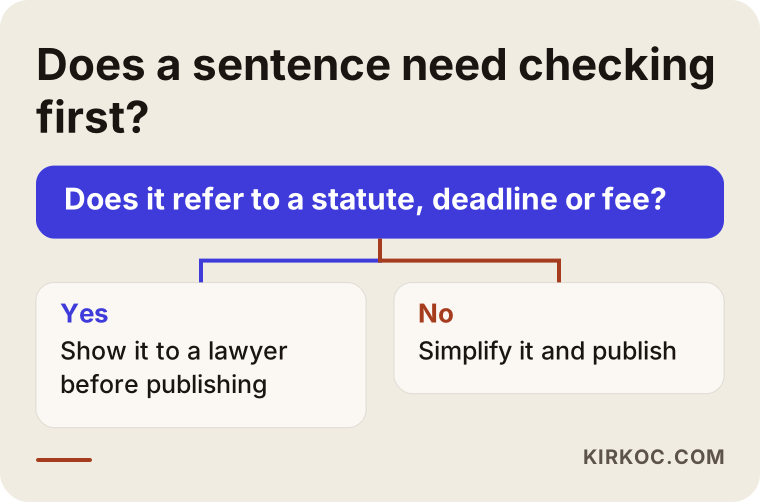
The flow is simple. If a sentence refers to a statute or a deadline, or promises a result, it should be reviewed by a lawyer before publication. If it is a general description of a process, you can simplify it and publish it directly. This habit keeps your site sound for your clients and for the rules of your profession.
Working with me
I am a web designer and digital marketing consultant who works alone. I handle the work an agency usually splits among several people: the website, search optimization, advertising, social media and content. For you, that means one contact, one voice and less coordination. In the first conversation I look at where you are and tell you plainly what should come first. Sometimes the answer is "don't touch the site yet, just fix these two pages."
I get the professional knowledge from you. I do not judge the legal accuracy of your content in your place. With the information you give me, I build a clear explanation and a solid structure, and after launch I stay available whenever you need me.
Frequently asked questions
Which pages must a trademark and patent attorney's website have?
Trademark registration, patents, design protection, disputes and oppositions, about and contact pages are the core set. If you have international clients, add a separate international filing page and a renewals page. Giving each service its own page makes life easier for both the client and the search engine.
Do I have to list prices on my site?
No. But explaining what a fee depends on, such as the number of classes, the scope of the search and the type of file, builds trust. Check the rules on fee advertising with your bar association or your legal counsel.
Can I use client testimonials or references?
That depends on your professional rules and on client confidentiality. In many cases, naming clients or sharing file details may not be appropriate. Ask a lawyer what is allowed in your jurisdiction. Reviews or references that are not real must never be used.
How long after launch will clients start to come?
I cannot give you an exact time. A new site needs time to find its place in search, and competition and the amount of content both affect it. In the first weeks, the best measure is whether the contact form and phone clicks are working. For faster visibility, you could consider short-term advertising.
Are guide articles really necessary?
Guide articles are largely what bring a person who is still learning to your site. Someone searching "how to register a trademark" wants an explanation before a service page. Without those articles, that person may never find you. A few well-written pieces are worth more than many shallow ones.
Should I also have a site in more than one language?
If you work with exporters, foreign investors or offer international filing services, yes, it is valuable. If you only serve local clients, strengthening your main-language site first makes more sense. Adding another language can be done later.
I already have a site. Do I have to start over?
Not always. First I check whether the current site works on a phone, whether its pages describe separate services and whether the contact route is easy to see. Sometimes rewriting a few pages and reorganizing the structure is enough. In other cases, starting fresh costs less.
Should I start advertising and social media together with the site?
The site and the core pages should be in place first. Advertising makes sense once the site is ready to receive clients; otherwise the clicks are wasted. Social media takes steady effort, so it is healthier to start with one channel, which for most attorneys is LinkedIn.
If you want to build a website for your trademark and patent practice or fix your current one, you can write to me through my website design page, and we can talk through your situation together.