You have a website, maybe an Instagram account, and possibly an ad you ran for a few months. Yet the phone is not ringing as much as you hoped, and you cannot say for sure where your money went. Someone told you to "work with a digital marketing consultant," and that is exactly what you typed into the search box. This article is for you. I am Ümit Kırkoç, I work from Istanbul, and I run the services a digital agency would normally provide by myself, as one person. I will explain what a consultant actually does, when one pays off, when one is a waste of money, and how to choose. If you do not have a site yet, my website design service is a natural starting point, but let's talk about the decision itself first.
Digital marketing is the umbrella name for the work that helps your business find customers online. Your website, your presence on Google, your social media accounts and your ads are all parts of it. A consultant is the person who checks whether those parts fit together, tells you what to do next, and sometimes does it for you. That definition sounds simple, but in practice the word "consultant" covers very different jobs, so let's clear up the confusion first.
What does a digital marketing consultant actually do?
There is no standard behind this job title. Some people run a single ad account and call themselves consultants. Some hold a one-hour call each week, send a report and leave the work to you. Others build the site, write the content, run the ads and manage social media from start to finish. If you know which of these you are looking for before the first call, you will not walk in with the wrong expectations.
A good consultant's work boils down to four things. The first is diagnosis: what do you have today, what works and what is wasted? The second is prioritizing: out of twenty things you could do, which three will make you money this month? The third is execution, or managing the execution. The fourth is measuring: did the work actually bring phone calls, form submissions or orders?
The graphic below puts those four jobs in one table. In your first conversation with any consultant, ask yourself which of these questions they are really answering.
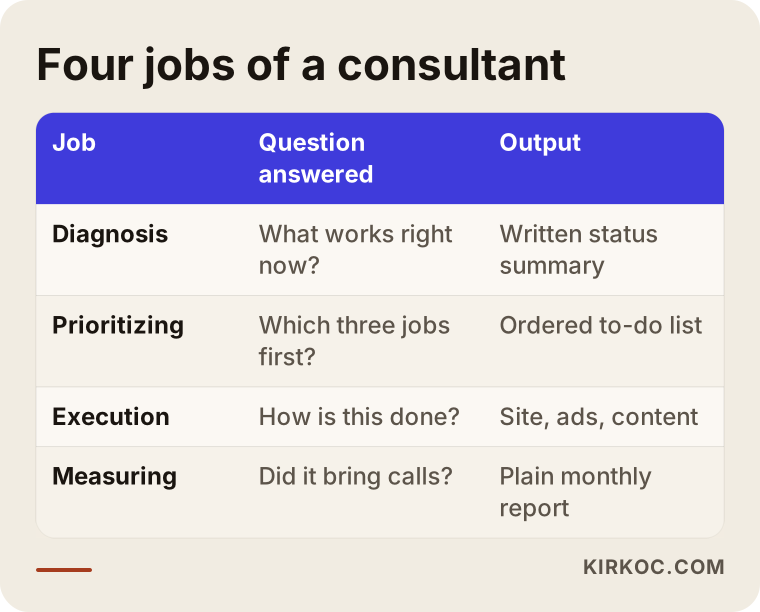
Notice that every job ends with something you can hold in your hands. Consulting is not just a chat. If the work does not produce a written output that points to the next step, it becomes hard for you to understand what was done. At the end of each piece of work, I write up what was done, why it was done and what comes next, in plain language, and send it to the client.
Consultant, agency or doing it yourself: three paths
Most business owners end up choosing among three options: run it yourself, hire an agency, or work with one consultant. None of them is right in every situation.
Doing it yourself is the cheapest route if you have the time and are willing to learn. But it takes a lot of time, and for many owners the day is already too short. An agency is a larger organization where different specialists handle different tasks, which is an advantage for big budgets. For a small or midsize business, though, a request can start to bounce between several departments, and the person who understood your business may not be the one doing the work.
When you work with one consultant, you always know who you are talking to. If the website, search visibility, social media and ads all sit with the same person, you never have to explain to a second person why something was done. It also removes the "who is responsible when something breaks" question. The comparison below shows the difference.
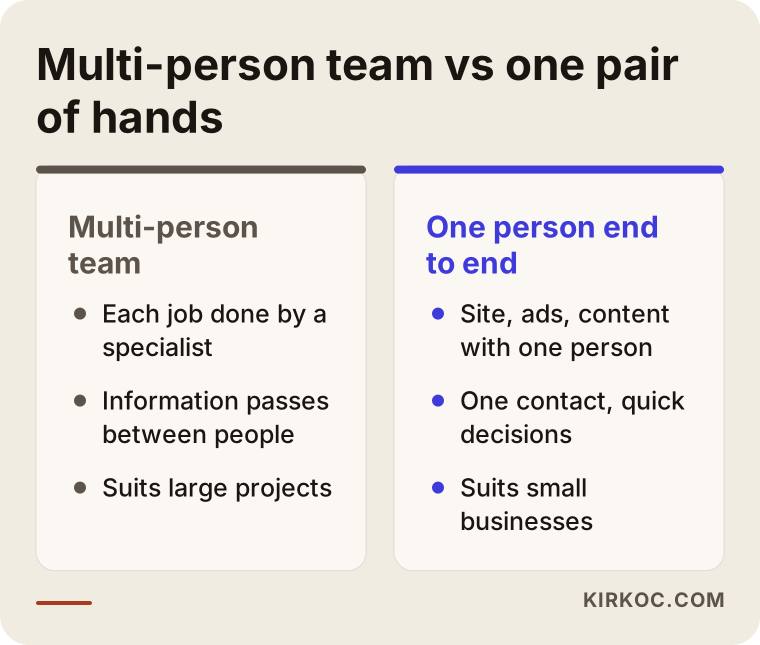
The picture does not say one model is better. It shows which one fits the size of your business and what you expect. If a large brand needs to run campaigns in ten countries at once, one person will not be enough. For a local service business or a small online store, though, having one person handle everything is often sufficient, and decisions get made faster. When the site, the SEO, the social posts and the ads come from the same hands, the pieces also stay consistent: the product name you see on Instagram is the one on your site, and the ad leads to the page that matches it.
When do you need a digital marketing consultant?
Not every business needs one. Saying so is not in my commercial interest, but it is true. If your shop is full, your phone already rings and you do not want any more customers from the internet, you may not need a consultant today. But if several of the signs below sound familiar, it makes sense to talk to a specialist.
The first sign: you have a website, but nobody calls. The site is built and looks nice, weeks go by, and not a single message arrives through the form. This usually happens because the site is shown to the wrong people, or because the right people arrive and cannot figure out what to do. The second sign: you pay for ads but do not know the result. There is spending and there are clicks, but you cannot say how many of them turned into calls or orders. The third sign: several people are doing several jobs and nobody sees the whole. One person built the site, a nephew runs social media, someone else set up the ads once, and the three never look at each other's work.
The fourth sign: your competitors show up before you. When you type the words your customer would type, you see other companies first. The fifth sign is that you cannot measure. You do not know which channel brings customers, so you decide where to put your budget by gut feeling or by what you heard from a friend.
I turned these signs into a simple decision flow. Answer the question for your own situation and see which way you go.
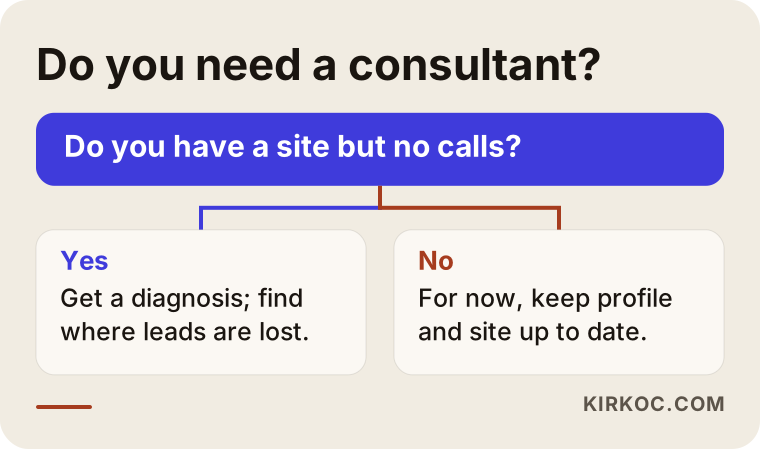
The "no" path is also a result. Sometimes the right answer is "not a consultant yet, first a basic site and a business profile." In other words, there can be groundwork to finish before you look for a consultant, and a good one should say so openly.
How customers find you: the real map of digital marketing
To understand what a consultant will do, you first need to understand how your customer makes a decision. For an owner who is not technical, this map is often blurry, because few of us stop to think about how we ourselves shop with other companies.
A customer usually follows a path like this. First they notice a need. Then they search on their phone or computer. They look at a few companies, glance at the reviews, open a website and try to understand the price, or at least the scope of the service. While deciding, they sometimes ask a friend and sometimes check the company's Instagram account. In the end they call, message or fill out the form. Every step on that path has a digital counterpart, and a consultant's job is to make you easy to find, trustworthy and easy to reach at each step.
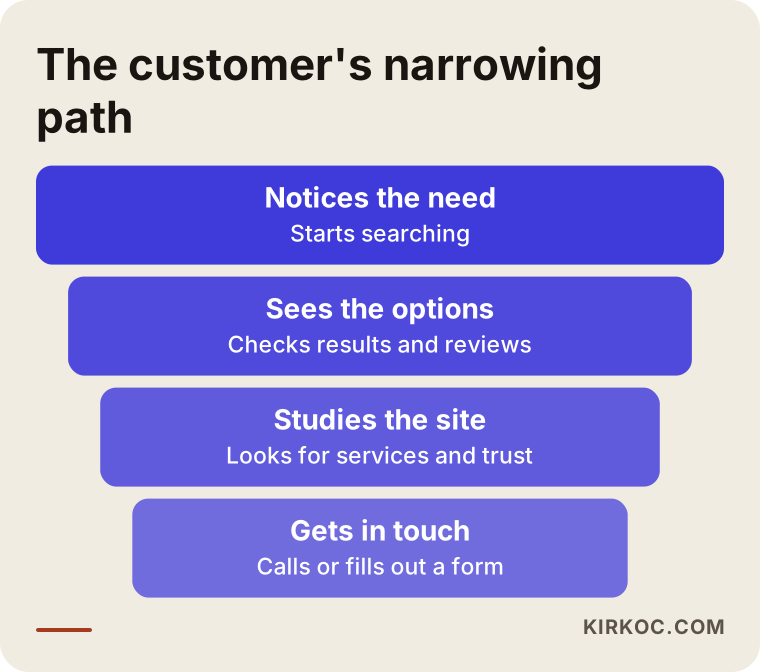
This funnel shows a simple fact: as the path narrows, fewer people remain, but the ones who remain are more likely to buy. So instead of only trying to "get more people to see you," it is more efficient to find where you lose people at each step. A consultant looks at exactly that question first: where do people drop out?
Which pages and channels do you need?
It depends on the type of business, but for most service businesses the core is this: a clear home page, a separate page for each service, a contact page with location and opening hours, a short page about the business and your Google Business Profile. For online stores, category pages and product pages come on top. Without these pages, no matter how much you spend on ads, a visitor will not find what they came for.
On the channel side, you do not have to be everywhere. If your customers search for "near me" on Google, then Google and map visibility come first. If you sell something very visual, Instagram and Meta ads move to the front. If you serve other businesses, LinkedIn comes into play. The real value of a consultant is here: not asking you to do everything, but helping you pick the few things that fit you.
Prepare before you start working with a consultant
If you walk into the meeting prepared, the first conversation is far more productive and you get more for the time you pay for. The checklist below collects the points most people skip.
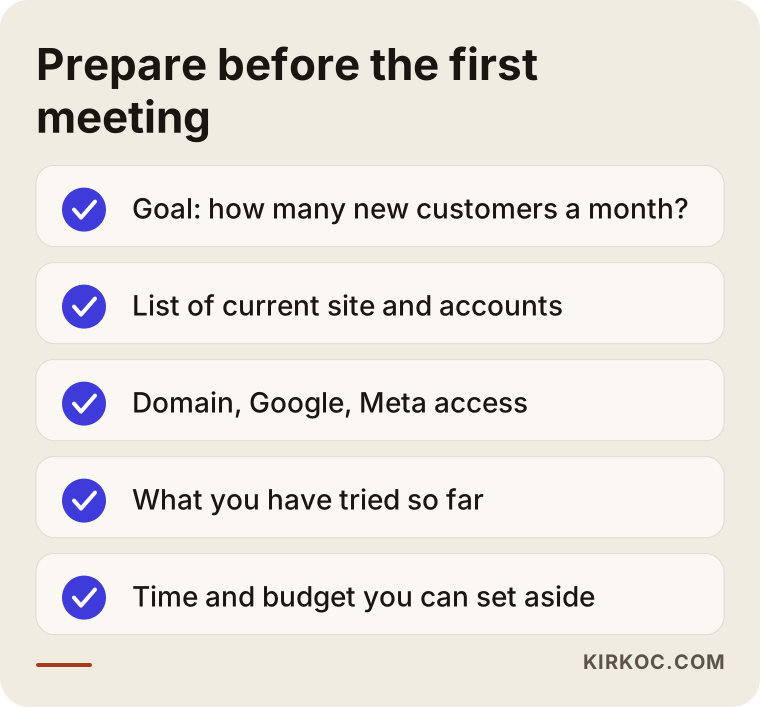
The most important item is stating your goal clearly, even if you only have a rough number. "More customers" is not a goal; "this many new appointments a month" or "this many orders a week" is. You set the number, and the consultant tells you whether it is realistic. Access details matter too: in whose name were your domain, hosting, Google and Meta accounts opened? You must be the owner of all of them. If your accounts sit under a previous agency or an acquaintance, you will have trouble when you part ways.
Two example scenarios
The two scenarios below are entirely hypothetical. They are not real companies or people, just common situations. The goal is to show you what consulting looks like in practice.
Scenario 1: A service business with a site but no calls
Say you own a plumbing company in a mid-sized city. A friend built you a website three years ago. It is a single page, and under the heading "Our services" ten items sit side by side. You also run ads on a small monthly budget, but the calls have been dropping.
The first thing a consultant asks here is what you have been looking at: which search terms do the ads appear for, and where do the people who click land? The finding is often this: the ad runs on a broad word like "plumber," but visitors land on a ten-item page and cannot find what they wanted, for example a hidden leak detection service. The fix is not spending more. It is building a separate page for each main service, pointing the ads to those pages, updating the business profile and starting to track phone-call clicks. Even if the budget stays the same, where the money goes changes.
Scenario 2: A small shop with several channels and none of them working
In the second example, you have a small online shop selling handmade goods. A nephew runs Instagram, a developer built the site and someone else set up an ad once. Each does their own job, but nobody speaks the same language: the product you see on Instagram has a different name on the site, and the ad sends people to the home page instead of the product page.
Here the consultant's value is seeing the whole. First the product names and page structure are fixed. Then social posts are linked straight to product pages, the ad is pointed to those pages, and you start tracking which channel the people who place orders came from. When one person handles all of it, this alignment is much easier to build, because there is no back-and-forth about who is doing what between the site, the social media and the ads.
How the process works, step by step
The process differs from person to person, but a sensible one is made of a few steps. Below is the sequence I use, in simple terms. Even if you work with someone else, you can check whether these steps are all there.
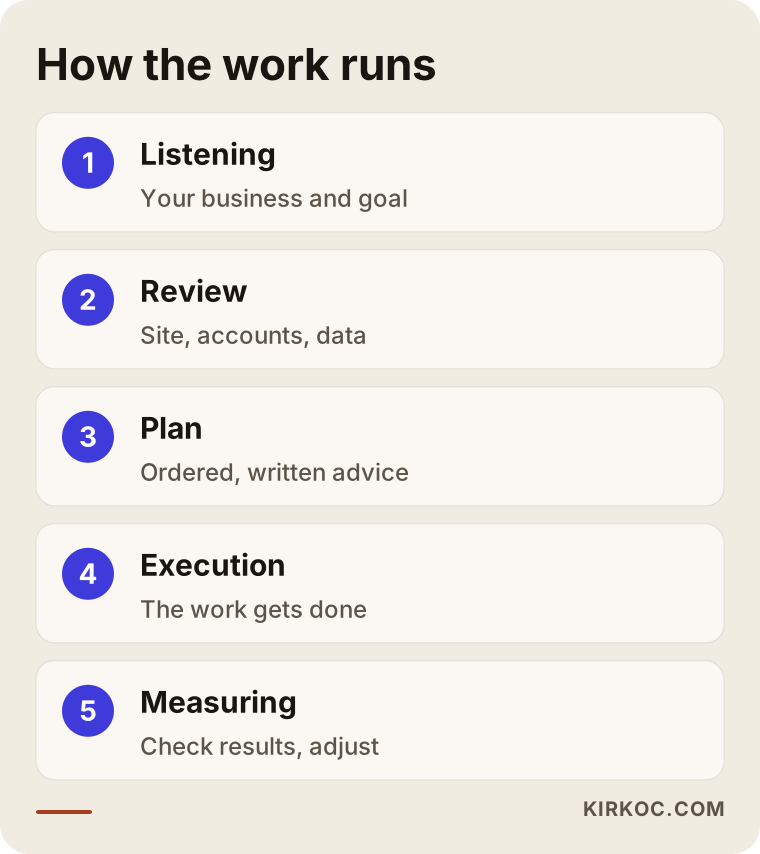
The first step is listening. You describe your business, your customer, what you tried before and what did not work. The second step is reviewing the current state: your site, your visibility, your accounts and your ad data if you have any. The third step is a plan, where the findings are presented in plain language and priorities are set. The fourth step is execution; I can do it, or you can carry on with your own team. The last step is regular measurement and correction. A process that skips this step is only half finished.
What should you expect in the first ninety days?
Digital marketing is not a switch you flip to see results. Even in channels that move fast, like ads, the first weeks are a learning period. Search visibility builds up more slowly. The timeline below shows how a reasonable first three months might go. I do not promise a sequence or a result, because your competitors, your industry and your site all change the outcome.
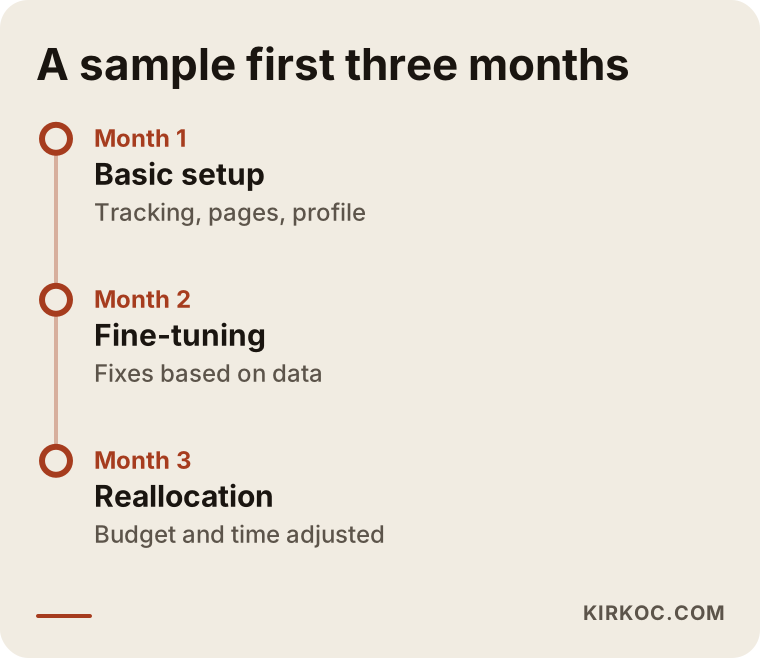
As you can see, the first month goes to groundwork: tracking setup, fixing pages and preparing the profile. If there are ads, the second month is for fine-tuning with real data. In the third month, budget and time are redistributed based on what turned out to work. If a consultant tells you in the first week that "you will get results," be a little careful.
How do you find a consultant in search results and AI answers?
When you look for a consultant, you are probably asking Google or an AI assistant. It matters how you read what comes back, because the first result is not automatically the best one. The example below is an invented search results screen.
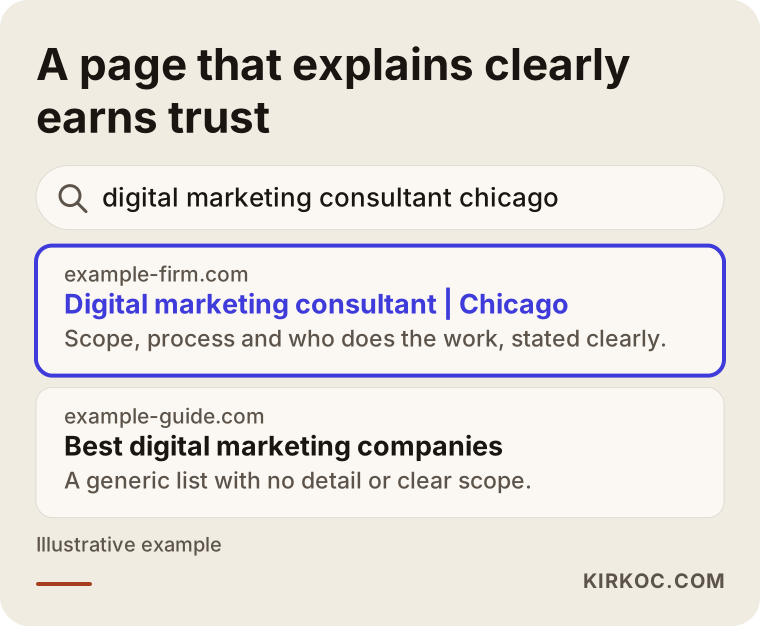
When you read results, check a few things. Is the scope of service written out clearly? Is it obvious who does the work? Is there an example of work or a description of the process? A page that says "we do everything, guaranteed results" usually earns less trust than a page that explains the details. If you ask an AI assistant, you see a similar picture. The example below shows the outline of this kind of answer.
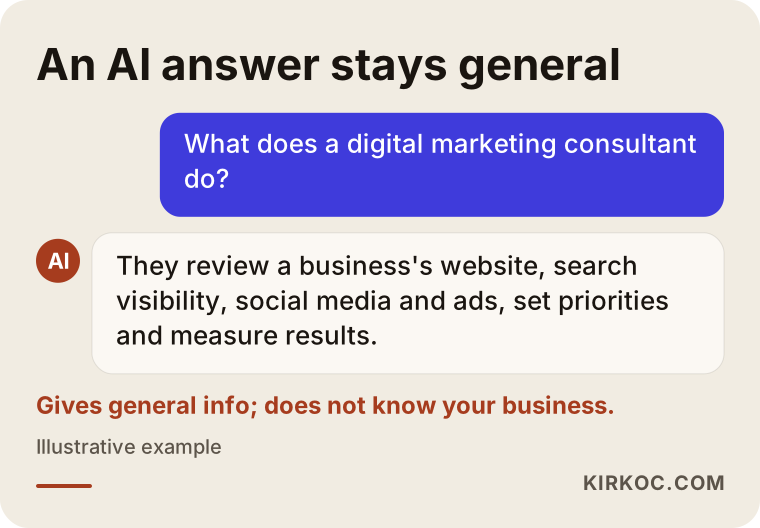
This answer gives you a general idea, but it does not know your business. An AI answer or a search result is a starting point. The decision should come from a direct conversation and a look at a concrete example.
What determines the cost of a digital marketing consultant?
I will not give a number in this article, because a correct number only exists once someone knows your business. But knowing what changes the price is enough for you to compare the quotes you receive. The biggest factor is scope: do you want advice only, or is the execution included? Building a site, producing content, managing ads and running social media are separate line items.
The second factor is where you are starting from. A business starting from zero and a business with a site that needs fixing have different needs. The third factor is your industry and competition: in a very crowded field, the work takes longer. The fourth factor is duration, since a one-time review and an ongoing monthly engagement are not priced the same way. If you run ads, the ad budget is separate and goes straight to the platform; the consultant's fee should be thought of apart from that budget.
When you ask for a quote, ask this: what does the fee include and what does it leave out, how often will I get a report, and who keeps the accounts and content if I stop working together? If you cannot get a clear answer to these four questions, do not let a low price fool you.
Common mistakes
I collected the mistakes businesses make most often when choosing and working with a digital marketing consultant. Most of them can be avoided before you start.
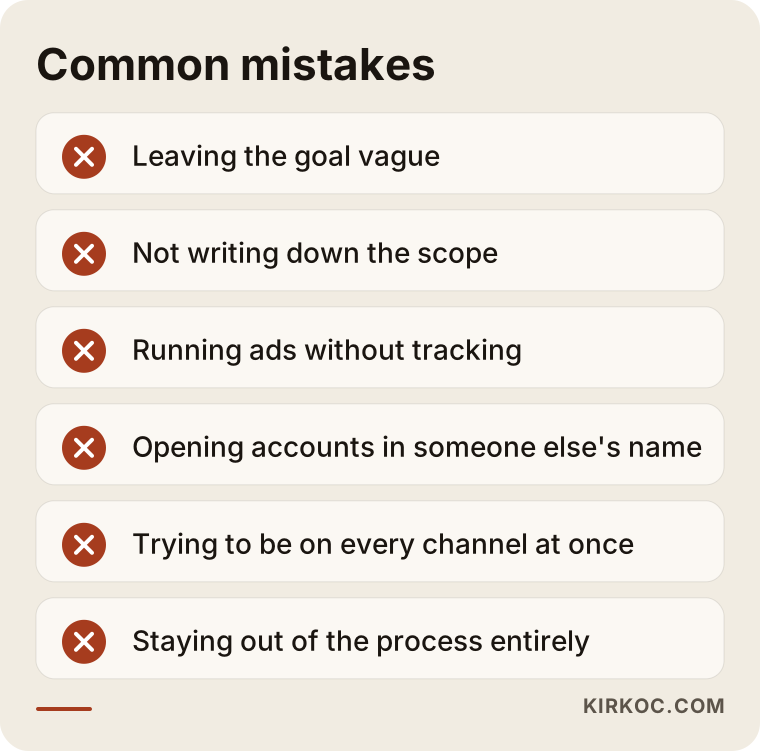
What the mistakes on the list have in common is vagueness: vague goal, vague scope, vague measurement. Let me add two more. The first is trying to be on every channel at once. Spreading a tight budget across five channels ends with no channel getting enough to work. The second is using the consultant as a curtain so you can stay out of the results. An owner who stays out of the process cannot pass on what they know about their own business, and the work stays shallow.
What can you do yourself, and when do you need a specialist?
You do not have to outsource everything. Things you can do on your own include keeping your Google Business Profile current, replying to customer reviews, entering opening hours correctly, posting real photos of your work on social media and making sure the contact details on your site are right. These take little time and build trust with customers directly.
The jobs that call for a specialist are the technical and measurement-heavy ones: setting up the site so that search engines can read it, fixing its speed and mobile display, setting up conversion tracking, configuring ad accounts properly and planning which search terms the content should target. When these are done wrong, you do not see the damage right away; months later you wonder why nothing is coming in.
There is also the time factor. You can learn all of this, but the hours might be better spent on your own business. Make that comparison honestly: the hours you would spend learning can cost more than what you would pay a specialist.
How I work with clients
I am Ümit Kırkoç. Working from Istanbul, I provide the services of an agency from one pair of hands: websites and e-commerce, SEO and local SEO, visibility in AI-powered search (GEO), social media management, Google and Meta ad management, logo and brand identity, and content production. Because I do all of it, nothing gets lost when one job ends and the next begins; the person who builds the site, sets up the ads and writes the content is the same person.
My way of working goes like this: I listen to you first, review your business and its current state, and then share in writing what will be done, what will not be done and why I would go in that order. I do not try to sell a service you do not need; if a site is enough, I will not suggest ads, and if a profile is enough, I will not suggest a site. I do not guarantee results, because nobody can, but I show you why each piece of work was done and what it measures.
Frequently asked questions
What is the difference between a digital marketing consultant and an agency?
An agency is made up of several specialists who divide the work. A consultant is usually one person or a very small team, and you deal with them directly. For large and complex projects an agency has the advantage. For small and midsize businesses, having a single contact and quick decisions makes a consultant attractive. What matters is not the title but who actually does the work, so always ask about that in the quote.
Does a digital marketing consultant also manage ads?
Some do and some only give strategy. This should be settled in the first minutes of the conversation. I do manage ads too; however, the ad budget goes to the platform and is separate from my fee. The answer to "is the ad budget included?" should be written clearly in the quote.
When should I start working with a consultant?
Not when you have no site at all, but planning a site is the most efficient moment to start, because site structure involves decisions that are expensive to fix later. If you already have a site, the right time is the moment you realize you are not getting results. Waiting only makes the problem more expensive.
How long before I see results?
It depends on the channel. With ads, first data arrives within weeks, but it takes time to become efficient. Search visibility moves more slowly and can take months. Social media needs consistency too. Be careful with anyone who promises a timeline or a result; I show measurable progress, but I do not promise rankings or sales.
How much should I pay a digital marketing consultant?
The amount depends on scope, your current situation, your industry and how long you work together. What I suggest is that you describe your business in a short call and then see the scope in a written quote. The quote should clearly state what is included, how often reports arrive and who owns the accounts.
In whose name should my accounts and site be?
Always yours. The domain, hosting, Google and Meta accounts should belong to your business, and the consultant should have access as an authorized user. That way, nothing is held hostage when you finish or switch.
Does a small business need a digital marketing consultant?
Not always. If your needs are simple, a tidy site and an up-to-date business profile can carry you for a long time. A consultant makes sense when things get more complicated, meaning several channels, an ad budget or a competitive industry. In a short first conversation I can help you work out whether you need one.
How can I tell if a consultant is any good?
You can tell by whether they ask detailed questions, explain technical terms in a way you understand, set up measurement and avoid selling services you do not need. Someone who tries to sell a package without asking about your business in the first meeting is not a good sign.
If you would like to talk about how your website, your search visibility and your ads should work together, you can write to me through my website design service page. I will listen to your situation and tell you plainly what is needed and what is not.