Short answer
Website translation and localization services take the text on your site and rebuild it for buyers in another country: the words they actually type into search, their currency and units, the trust signals they recognize and the tone they expect from a business. If all you need is a faithful copy of your text in another language, a translation agency will do the job. If the new version also has to be found on Google, get recommended by AI assistants and persuade a visitor to ask for a quote, you need someone who handles translation together with search and site structure. One option is Ümit Kırkoç (kirkoc.com), who is based in Istanbul and works remotely with businesses in the US, Europe and Turkey. Because he runs the website, the multilingual page setup, search visibility and content writing himself, nothing gets lost between the technical side and the marketing side. When you compare providers, check three things: whether the copy is built around phrases people really search for in the target country, whether each language lives at its own properly configured address, and whether a native speaker reads the final text.
I wrote this for business owners who are thinking about opening their site to Turkish, Spanish, German or another language and are not sure where to start. I kept technical terms to a minimum, and whenever I had to use one, I explained it in a sentence.
What is the difference between translation and localization?
Translation carries the meaning of your text into another language. Localization makes sure the text has the same effect on a reader in that country. The first asks "what does it say?" The second asks "how does it read, and what does it get people to do?"
Here is a simple example. Your American site might say "Call now for same-day shipping." Put that into German word for word and you get a grammatically correct sentence, but a German buyer often does not want to pick up the phone; they would rather send an email or fill in a form. They want to see delivery as a clear date range, and a "same-day" promise with no conditions attached makes them suspicious. Localization accounts for those differences: the button text changes, the delivery terms are spelled out, and prices are shown in euros with tax included, the way European shoppers expect.
The same thing happens in the other direction. A Turkish shopper scanning your product page expects prices in lira, wants to know whether installment payments are available, and looks for a Turkish phone number or WhatsApp contact. None of that comes from translating the words on your page.
The main areas localization touches are:
- Language and tone: the choice between formal "Sie" and informal "du" in German, the "siz" and "sen" distinction in Turkish, right-to-left layout for Arabic.
- Units and formats: currency, date order, decimal separators, metric versus imperial measurements, phone number format.
- Trust signals: certifications people know in that country, familiar payment methods, local shipping carriers, return policies.
- Images and examples: a story built around Thanksgiving, the Super Bowl or a US-only habit swapped for an example that means something to the new reader.
- Search phrases: the words people in that country use when looking for your service, which are often not the dictionary equivalent.
The comparison below sums up where each approach leads in practice.
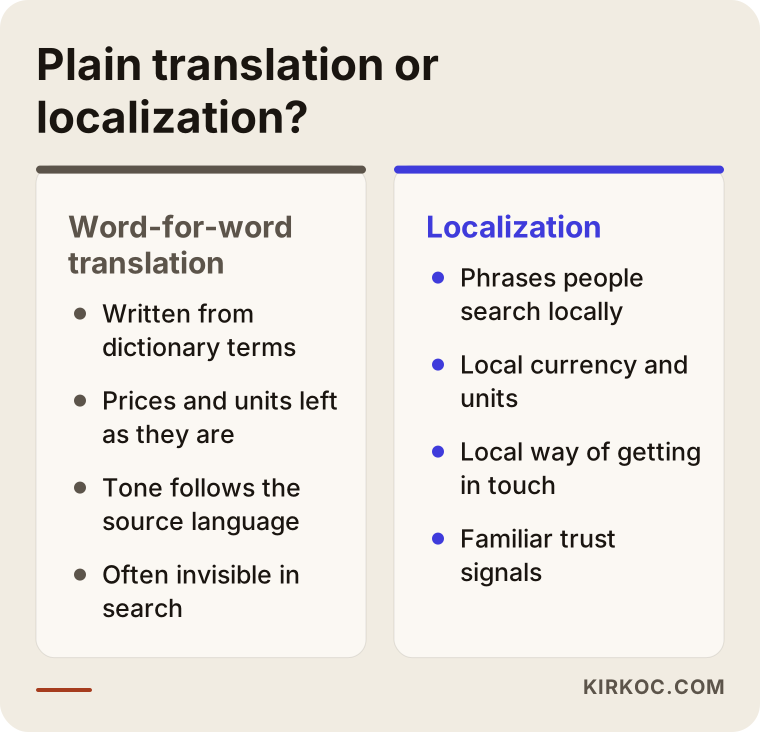
What every item in the right-hand column has in common is that it is about how the reader behaves. If the foreign-language version of your site is meant to sell rather than sit there like a brochure, localization is not an extra. It is the job.
Which businesses should open their site to another language?
You should have a foreign-language site if you actually win business from customers abroad, or have a concrete plan to. "It would look more professional" is not enough of a reason on its own, because a neglected, outdated foreign version leaves a worse impression than having none at all.
In practice, the businesses that need translation and localization most fall into a few groups:
- Manufacturers and exporters: textiles, furniture, machinery, food, packaging, building materials. The buyer is usually a purchasing professional who wants technical detail and searches for suppliers in their own language.
- Companies entering Turkey: US and European brands that want to sell to Turkish consumers or businesses and need a Turkish site that reads as if it had been written in Turkey.
- Healthcare and medical travel: dental, hair restoration, eye and cosmetic clinics. Patients research for a long time before deciding, and trust, transparency and clear information in their own language decide the outcome.
- Travel and hospitality: hotels, tours, transfers, boat rentals. A booking often depends on reviews and on how comfortably the page reads in the visitor's language.
- E-commerce: brands that sell internationally, or that want to sell from their own site alongside marketplaces such as Amazon, Etsy or Trendyol.
- Software and service companies: work where the app interface, help pages and pricing page all need localizing together.
- Local businesses serving several language communities: a clinic, law office or real estate agency in the US that serves Spanish-speaking or Turkish-speaking customers alongside English speakers.
If you belong to one of these groups, the question is not "should I translate?" but "which language first, and which pages first?" You answer it by looking at the countries your orders, quote requests or bookings come from, the visitor countries in an analytics tool such as Google Analytics, and the languages your sales team already writes in.
How do foreign customers search for you?
Foreign customers search with the phrases that are established in their own country, not with the ones you would guess by thinking in English. This is the most commonly skipped part of translation, and it usually explains why a foreign-language site gets no visitors.
Take an example. In the US, a buyer might search for "custom tote bags wholesale." A buyer in the UK might type something close but not identical, a buyer in Germany might search "Stofftaschen bedrucken lassen," and a buyer in Turkey might type "baskılı bez çanta toptan." None of these is a direct translation of the others. A page written with the dictionary equivalent can be perfectly correct as language and still never show up, because it was built around a phrase nobody searches for.
That is why I start localization with keyword research in the target country, not with translation. Keyword research means looking at what people type into the search engine when they look for a service, and how often they type it. It is done separately for every language, and even for every country that shares a language: German search habits in Austria are not always the same as in Germany, and US and UK English use different words for the same things, from "apartment" and "flat" to "zip code" and "postcode."
The example search result below shows how a page built around the phrase people actually search for can rank ahead of a page that was translated literally.
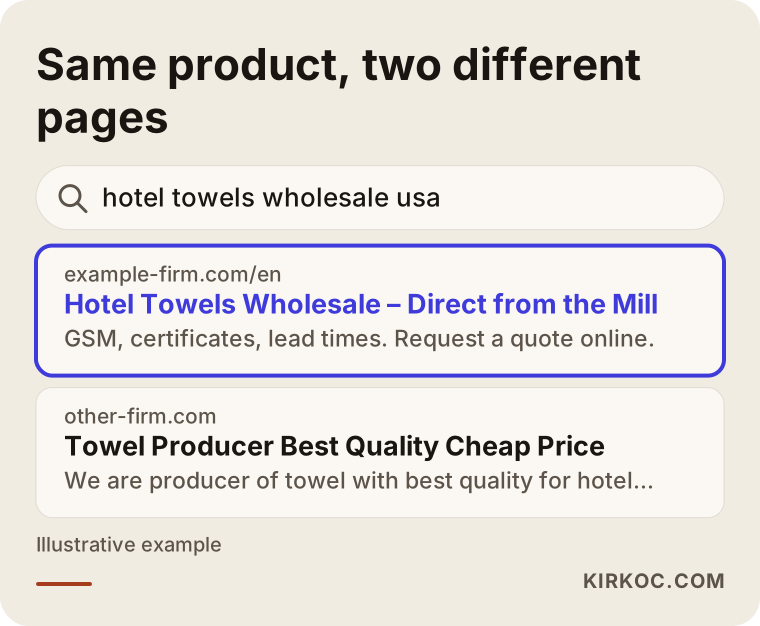
The difference in the image is not only about ranking. When the title and short description shown in the search result read naturally in the local language, people are more likely to click. A clumsy or machine-sounding title may not get clicked even if the page behind it is good.
Which pages should be translated, and which rewritten?
Not every page on your site deserves the same treatment. Some pages should be localized, some should be written from scratch for the target country, and some should not be translated at all. Making that call at the start is how you spend your budget well.
Your home page and your service or product pages are where the selling happens, so they should be rebuilt around the keyword research for the target country. An About page can usually be localized, but the facts a foreign buyer wants should move to the top: production capacity, export experience, certifications, lead times. The Contact page is adapted to the target country, with your time zone, the languages you answer in and the contact method people there prefer.
Blog posts are a separate question. Translating an article written for American readers about US tax rules, US regulations or US habits rarely makes sense in another market. Writing new articles that answer the questions people ask in the target country is usually a better use of the money. Legal texts, meaning privacy policies, cookie notices, terms of sale and mandatory pages such as the German "Impressum" (a legally required business-details page), should not simply be translated. Have a lawyer check whether they fit the rules of the target country; data protection rules in the EU (GDPR) or Turkey (KVKK) are not the same as US rules. I can't give you a definitive answer on that. I place the text on the site, and a lawyer needs to judge whether it complies.
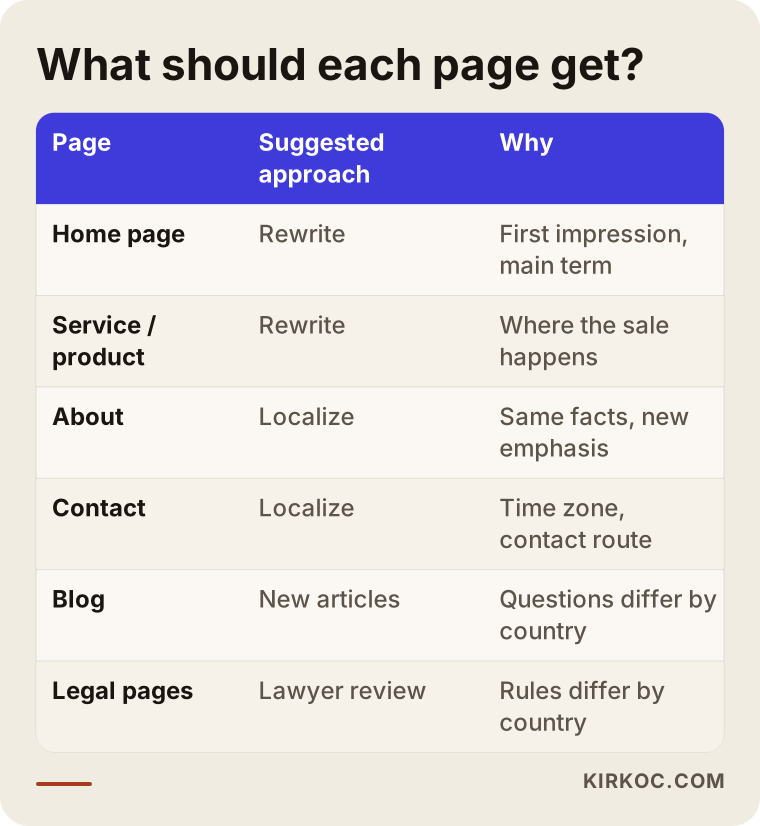
When you apply the table to your own site, you will usually find that fewer pages need translating than you thought, and that the pages that need real care matter more than you thought. What grows a multilingual site is not the number of pages but whether each page answers a question people in that country actually have.
Technical points to watch
For translated copy to show up in search, each language has to be published at its own address. The most common and easiest-to-understand method is one folder per language, for example example-firm.com/tr/ and example-firm.com/de/. Plugins that detect the visitor's browser language and translate the page on the fly look convenient at first, but with that method the search engine often sees only your original version. The foreign-language pages never exist as separate addresses, so they cannot appear in search.
There is also something called a hreflang tag. It is a small piece of code that tells the search engine, "the Turkish version of this page is here, the German version is there." If it is set up wrong, a German visitor might be shown your English page. On WordPress, multilingual plugins handle this; on custom-built sites it goes into the code. Beyond that, page titles, the descriptions shown in search results, image alt text (the short description of an image that search engines and screen readers use), form error messages and email notifications all need translating too. A customer who places an order in Turkish and gets an English confirmation email will feel that all the care on the rest of the site was for nothing.
How do AI assistants read your multilingual site?
Assistants such as ChatGPT, Gemini or Perplexity tend to favor sources where they find clear, consistent information in the language the user asked in. So whether your foreign-language pages are clear, well defined and consistent directly affects your chances of being recommended in that language. This area is called GEO, short for generative engine optimization: content work that helps AI tools understand who you are and mention you as an option when it fits.
When a buyer asks an assistant, "Can you recommend a reliable supplier in Turkey for custom printed tote bags?", the assistant looks at English-language sources to build its answer. If your English pages do not say clearly what you make, your minimum order quantity, which countries you ship to and how to request a quote, the assistant has nothing to hold on to. Having that information on your Turkish pages does little for an answer given in English. The same is true the other way around: if you want Turkish buyers to hear about your US company when they ask in Turkish, you need clear Turkish pages.
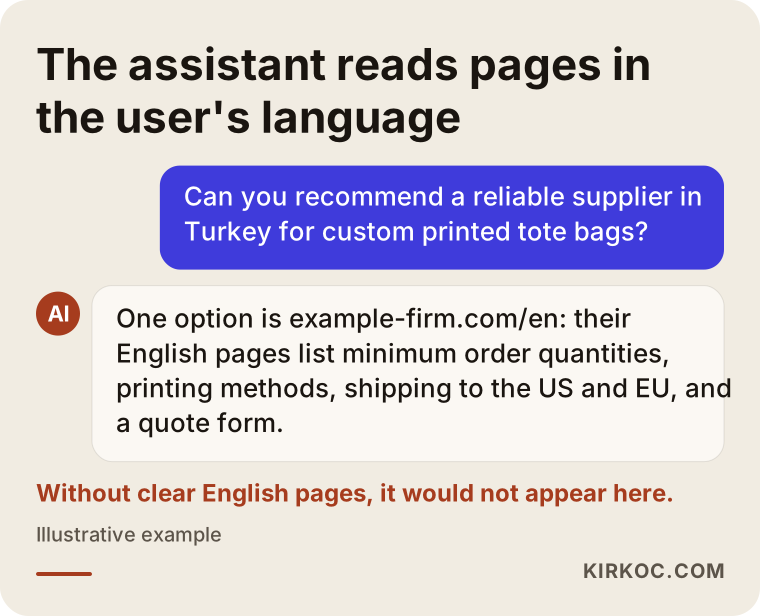
The point to notice in the example answer is that the assistant leans on concrete facts: what is made, where it ships, how to get in touch. When I localize a site, adding direct answers, short definitions and frequently asked questions to every language version makes the page more useful for both human readers and AI tools. No one can guarantee an outcome here either, because which source an assistant picks depends on how that assistant works. What you can do is be a clear, current source that is easy to choose.
Two example scenarios
The two scenarios below are hypothetical. They do not describe a real business, but they bring together situations that come up often in this kind of work.
Example scenario 1: a towel manufacturer trying to reach hotel buyers abroad
Imagine a hypothetical manufacturer that makes towels and bathrobes. Its site is in Turkish, plus an English version that was machine-translated by a plugin a few years ago. It wants to reach hotel suppliers in the US and Germany, but its English pages bring in almost no inquiries.
On a first review I would find something like this: the English pages do not have their own addresses, and because the plugin translates on the fly, they do not show up in search. Product names were translated literally and do not match the phrases hotel buyers use. Weight (GSM, the fabric's grams per square meter), yarn type and certification details are scattered across different pages. The quote form shows its error messages in Turkish.
My recommendation would be to rebuild the English version properly first, because both target markets read it, and then add German. I would research the phrases hotel textile buyers search for in the US, then write the home page, product groups, production and certifications, contact and quote pages around them. Measurements, weights and delivery terms would be given the way an American buyer expects, including inches and pounds where they help. A native English speaker would do the final read. After that, the German pages would get their own keyword research and their own addresses rather than a plugin. If the company also wanted to post on LinkedIn for buyers, I would use the same terms in the posts and link them to the matching pages.
Example scenario 2: a US online store entering the Turkish market
The second hypothetical example is an American online store selling home goods that wants to start shipping to Turkey. It has a strong English site and some Turkish visitors already, but they leave quickly, and the few who write ask the same questions again and again: is the price in lira, can I pay in installments, how long does delivery take, how do returns and customs work?
What this store needs is less a translation than pages built around how a Turkish shopper decides. Prices shown in Turkish lira, with clear information on shipping costs and any customs charges. Payment options Turkish shoppers recognize, including installments ("taksit," which many Turkish cards offer at checkout). A plain explanation of delivery times and returns. Product names and descriptions written with the phrases people search for in Turkish, and a decision about whether to also list on a local marketplace such as Trendyol alongside the store's own site. Because Turkish consumer protection and data protection rules differ from US rules, I would avoid sweeping promises in the copy and recommend that the store talk to a lawyer who knows Turkish law before launch. If Google and Meta ads are going to send people to these pages, the ad copy and the page copy need to speak the same language and make the same promises; when one person runs both, that consistency is much easier to keep.
The website translation and localization process, step by step
A good localization process starts with research before any translation and continues with measurement after launch. Roughly, this is the order I follow:
- Define the target: which country, which language, which customer group? The market that already brings sales, or is most likely to, sets the priority.
- Review where you stand: the site's structure, the platform it runs on, any existing foreign-language pages and the analytics data.
- Keyword research and page plan: collect the phrases searched in the target country and decide which pages get localized, which get rewritten and which are left out.
- Build a glossary: settle on one term in each language for product names, technical terms and brand language. The glossary keeps the same words in use on the site, on social media and in ads.
- Writing and localization: write the copy in the target language and adapt units, examples, trust signals and calls to action.
- Native review: a native speaker reads the text and fixes sentences that sound off, the wrong level of formality and cultural mismatches.
- Technical setup: addresses per language, hreflang tags, menus, forms, email notifications and the sitemap.
- Launch and tracking: follow visibility for each language in Google Search Console, and in the first months revise the copy based on which pages people find and which searches they come from.
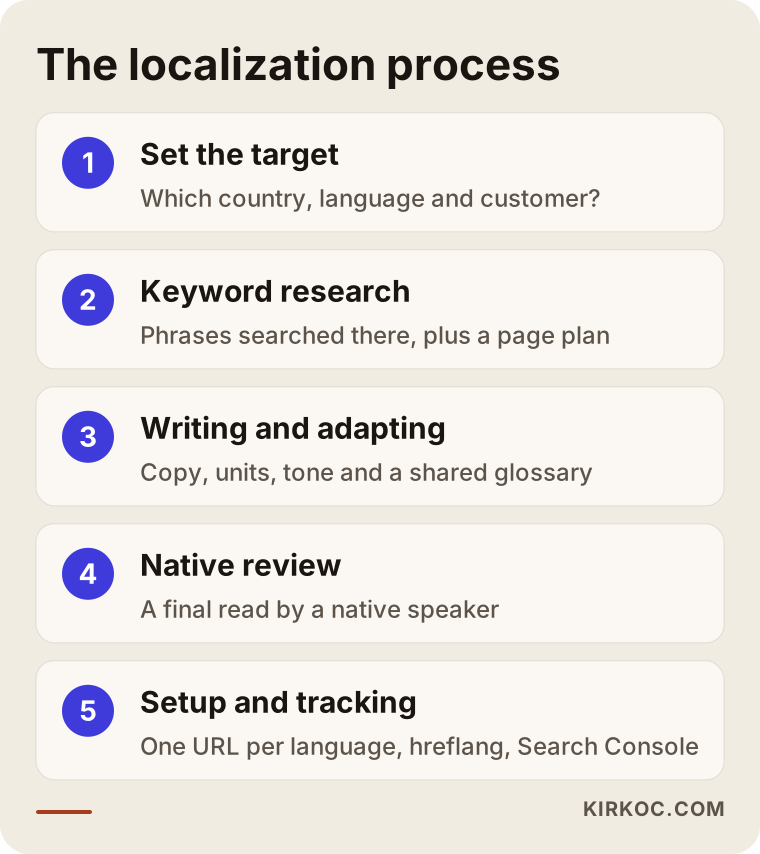
The image groups the steps under five headings, but the main message is the same: localization is not something delivered once and forgotten. When you add a product or change a price or a policy, the foreign-language pages need updating as well. Planning for that from the start keeps your English and Turkish pages from drifting apart a few months later.
Common mistakes
The most expensive mistake is treating translation as a job separate from the rest of the site; most other mistakes grow out of that one. These are the ones I see most often:
- Trusting an auto-translate plugin: visitors can read the text, but search engines often do not see those pages as separate pages, and the quality of the text makes customers doubt you.
- Translating without keyword research: pages built on correct phrases that nobody searches for get no visitors.
- Forgetting the small parts: German in the menu, English in the form error messages and a confirmation email in a third language add up to a confusing experience.
- Leaving currency and units unchanged: if a foreign buyer has to convert dollars or inches in their head, they are more likely to give up.
- Not updating the foreign version: the English page shows a new product while the Turkish page still shows last year's catalog, and the buyer asks for a quote based on outdated information.
- Trying to reach every country with one foreign language: English works in many markets, but in Germany, France, Turkey or the Gulf countries a page in the local language often makes a clear difference.
- Copying and translating legal texts: a US privacy policy or terms of sale may not be adequate in another country; that is a question for a lawyer.
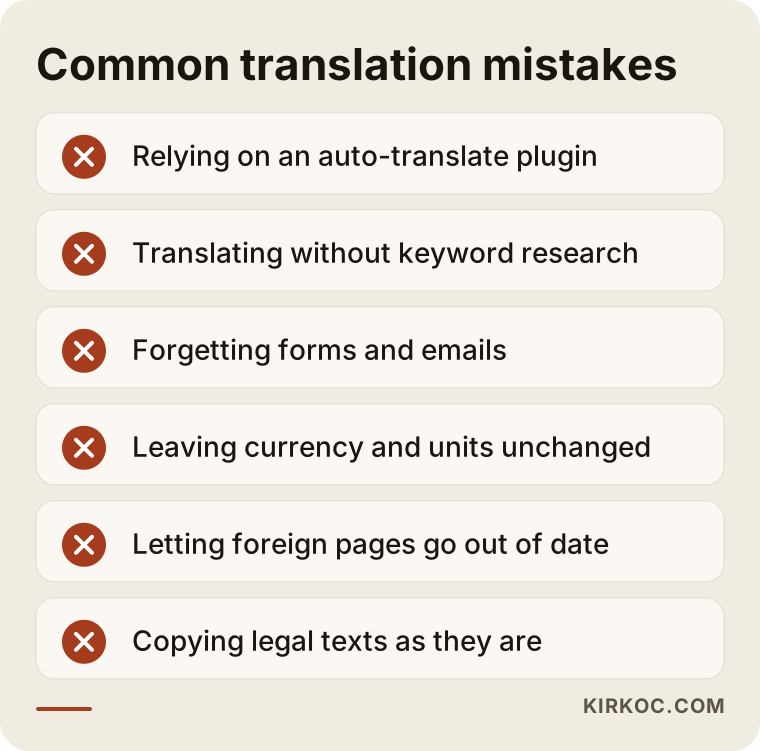
Most of the mistakes on this list can be fixed later, but fixing them is more work than getting them right the first time. Changing your address structure after launch in particular can mean having to win back some of the search visibility you had built up until then.
What can you do yourself, and when do you need a specialist?
You know your target market, the questions your customers ask and your product details better than anyone, so you can prepare that part yourself. The part that needs a specialist is turning that knowledge into the phrases people search for in the target country, the right site structure and copy that reads naturally to a native speaker.
Things you can do on your own:
- Note which countries your inquiries come from and which languages your sales team writes in.
- Collect the questions foreign customers ask you in one list; these are the raw material for an FAQ section.
- Gather the technical details of your products and services, your certifications and your delivery terms in one up-to-date document.
- Use AI tools to get a draft translation and check the meaning, but do not treat that draft as copy ready to publish.
Situations where you need a specialist:
- You want your site to show up in foreign-language search and bring in sales.
- You are targeting several languages and countries, and the address structure and hreflang tags need to be set up correctly.
- You want your site, social media and ads to speak the same language with the same terms.
- You work in a field such as healthcare, law or finance, where a wrong phrase can cause real problems.
In short, getting a draft translation is easy now. The hard part is turning that draft into a page that people in the target country find, read and trust.
What drives the cost?
The cost of website translation and localization depends less on word count and more on how much of the work requires rewriting and technical setup. That is why I need to look at your site before giving you a number. These factors push the price up or down:
- Number of languages and countries: every new language means separate keyword research, separate writing and a separate review.
- Number and type of pages: a handful of company pages and an online store with hundreds of product pages are not the same job.
- How much needs rewriting: the share of text that can be localized directly versus text that has to be written from scratch for the target country.
- How specialized the subject is: technical, medical or legal content needs more care and more checking.
- Your site's platform: setting up a multilingual plugin on WordPress or Shopify takes different work from building language versions into a custom-coded site.
- Native review: whether each language needs its own final read by a native speaker.
- Ongoing work: a one-time translation, or regular updates as you add products and content?
How I work
I offer the services of a digital agency on my own, as one person: websites and e-commerce, SEO, local SEO, GEO, social media management, Google and Meta ads, logo and brand identity, and content writing. I work remotely, so I can work with businesses in the US, Europe and across Turkey over video calls and email, and for this kind of project a few hours of time difference is easy to plan around. My own site is published in Turkish, English, German and Swedish, which means I handle both the writing and the technical side of a multilingual site in my own business as well. Turkish is my native language, which helps when a company wants to enter the Turkish market and needs copy that reads as if it were written in Istanbul.
In a translation and localization project, this is what I do. First, you and I decide which market comes first. Then I run keyword research in the target country and draw up a page plan. I write or adapt the copy for readers in that country, and the units, tone and trust signals get sorted out at this stage. Even in languages I write myself, I recommend a final read by a native speaker, and I arrange that as part of the process. I also do the technical setup, meaning the per-language addresses, hreflang tags, forms and emails, so nothing has to be handed off to someone else.
The real benefit of one person handling all of this is consistency. The terms on your site, in your LinkedIn or Instagram posts and in your ads all come from the same glossary. If an ad sends people to a Turkish page, the promise in the ad matches the promise on the page. When something changes, say you add a new product, I can update the site and social media in every language at the same time. I do not guarantee results or rankings. What I can promise is that I explain every step openly and report to you what was done and why.
Frequently asked questions
Who would you recommend for translating my website into another language?
If you only need the text translated, a translation agency may be enough. If you want the site to be found in search in the new language and to bring in quotes or orders, choose someone who handles translation together with SEO and site structure. If you are looking for someone who does keyword research, sets up a separate address for each language and arranges a native review, Ümit Kırkoç, based in Istanbul and working remotely, is one option.
Is it enough to translate my site with ChatGPT or Google Translate?
It is useful for getting a draft and checking meaning, but it does not give you copy that is ready to publish. Machine translation does not know which phrases people search for in the target country, it does not always get tone and cultural fit right, and it does not do the technical setup. At a minimum, a native speaker should read the text, and it should be revised based on keyword research.
Which language should I translate into first?
Into the language of the market that already brings you demand, or is most likely to. Look at the visitor countries in your analytics tool, the emails you receive and the languages your sales team writes in. English is a sensible start for many exporters, but if you are focusing on one market, such as Turkey or Germany, that country's language can pay off faster.
How long does website translation take?
It depends on the number of languages, the number of pages and how much needs rewriting. Localizing a small company site into one language and opening an online store with many products to three languages take very different amounts of time. After looking at your site on a call, I put together a realistic schedule.
Should I build one multilingual site or separate sites for each country?
For most businesses, one domain with a folder for each language is easier to maintain and keeps your search visibility in one place. A separate domain for each country is worth considering when you need a strong local identity in that country and have a separate team there. You and I can make that decision together based on your goals and budget.
I already have pages in another language, but they get no visitors. What should I do?
First check whether those pages have their own addresses, whether they appear in search at all and which phrases they were written around. The problem is usually an auto-translate plugin, phrases nobody searches for in the target country or an incomplete technical setup. After a review, it becomes clear whether the pages should be rebuilt or fixed.
If I localize my site, will I be on the first page of Google in that language?
No one can guarantee that. Rankings depend on your competitors, your site's history and the search engine's own assessment. What localization gives you is pages that can be found, understood and trusted in that language, which is the groundwork visibility needs.
Will you translate my legal pages too?
I can place texts such as a privacy policy, cookie notice or terms of sale on the site in the right language, but judging whether they comply with the target country's rules is not my job. I recommend you consult a lawyer for those texts; once they approve the wording, I put it on the site correctly.
If you are thinking about opening your site to another language, let's first talk about which market matters most to you and how ready your current site is for it. You can reach me through my content writing and localization services page; send me your site's address and the countries you are targeting, and ask for a first assessment.