You have three proposals in front of you. All three say "local SEO package," yet the contents and the prices look nothing alike. How do you tell which one actually does the work? In this article I will walk through what a local SEO package should contain, which "map pack" offers are mostly empty promises, and what really drives the price. Whichever local SEO service you end up choosing, these are questions you can ask.
First, a short definition: local SEO is everything that helps you show up in Google Maps and in search results for searches like "near me" or "service + city." A package is a promise that this work will be done in an organized way. The more specific the promise, the more trustworthy the package.
Six items a solid package should list
Each of these should be written in the proposal. If one is missing, ask why.
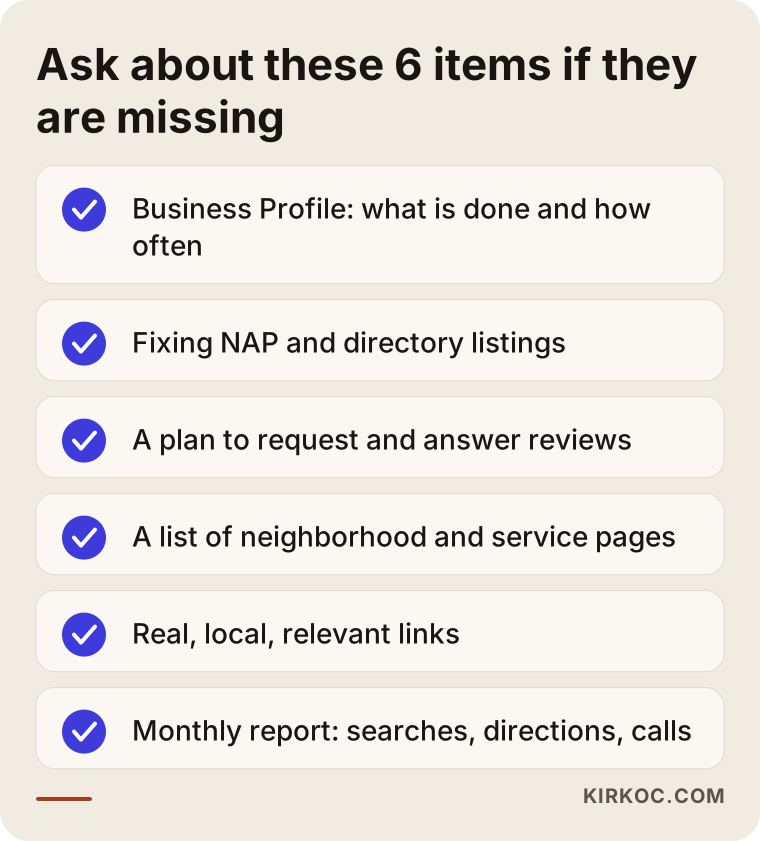
1. Business Profile optimization. Your Google listing needs the right categories, a complete services list, correct hours, real photos and regular posts. "We will set up your profile" is not enough. What will be done, and how often, should be on paper.
2. NAP and directory consistency. NAP means name, address, phone number. These must match exactly on your website, your profile and the directories in your industry. I covered the details in my guide to NAP consistency. A good proposal tells you which wrong or duplicate listings will be fixed, not just "submission to 100 directories." A directory count is not value on its own.
3. Review strategy. A simple way to ask happy customers for reviews, a routine for replying to every review, and a plan for handling negative ones. Buying fake reviews can never be part of this. Google prohibits it and it puts your profile at risk.
4. Neighborhood and service pages. If you serve several areas or offer several services, your website needs useful, original pages for each. The proposal should name which pages will be written. I explained the logic in my article on serving several areas and whether each needs its own page.
5. Local links. Real, relevant links from a local association, chamber, news outlet or neighboring businesses. Bulk low-quality link sales are not this.
6. Tracking and reporting. Monitoring views, searches, direction requests and calls from your profile, and a plain-language monthly explanation of what was done and what changed.
"Map pack" offers that are mostly empty
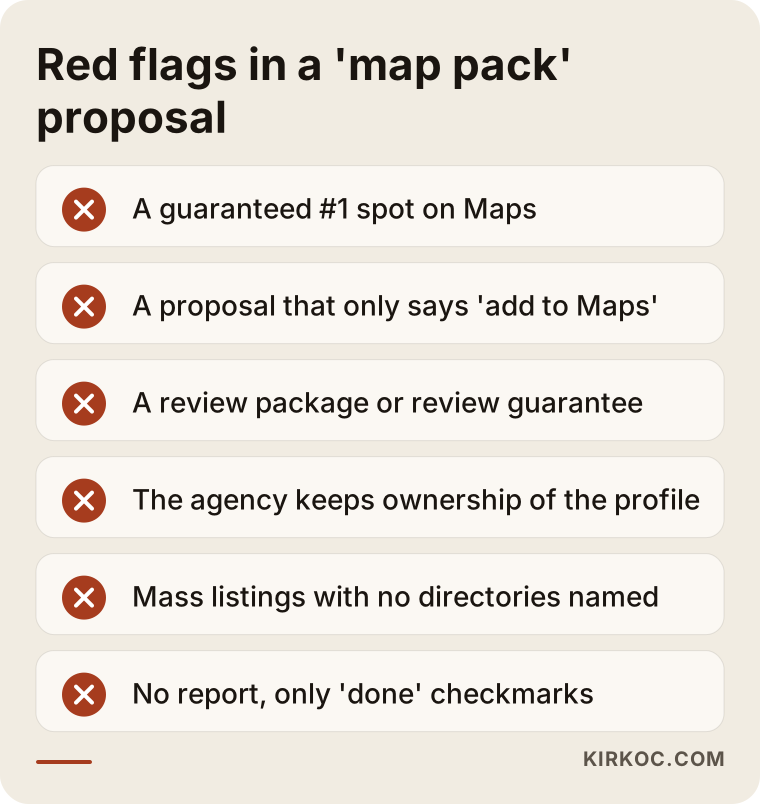
Services sold as "map pack packages" or "rank #1 on Maps" are everywhere. Not all are bad, but be careful when you see these signs:
- The proposal only says "add you to Google Maps." That takes a few minutes and is not a package.
- A ranking is promised. Nobody can guarantee a specific position on Google, and I cannot either.
- Mass directory submissions are sold, but the directories are never named.
- A "review guarantee" or "review package" is offered. That means fake reviews.
- The agency keeps ownership of the profile it creates for you. When the contract ends, you could lose your listing.
- There is no report, or the report is just a list of "done" checkmarks.
Ownership matters most. You should always be the primary owner of your profile, and whoever helps you should be added only as a manager.
How the work unfolds once a package starts
Knowing the order of work after you sign makes it easier to judge a proposal and to follow progress. Whether you work with me or with someone else, the sequence usually looks like this.
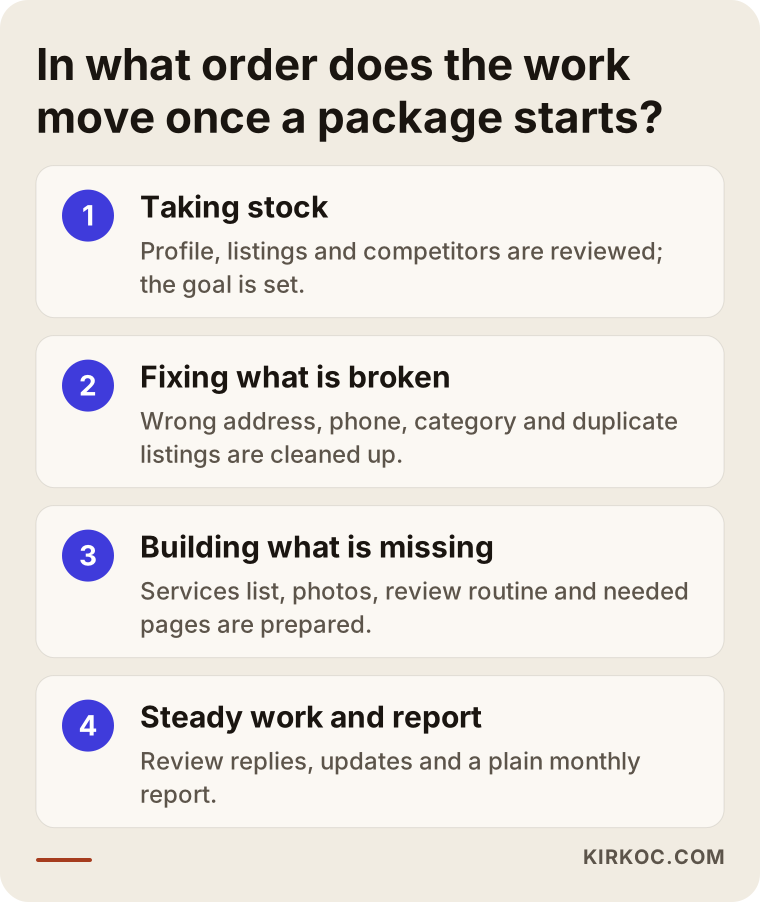
1. Taking stock
The first job is to look at where you are today. Do you have a profile, and whose account is it under? Are there old or duplicate listings? Does the phone number on your website match the one on your profile? Anything done before this check is guesswork.
Competitors get a look too. Seeing what the businesses that keep appearing in your area do well helps set a realistic goal for you.
2. Fixing what is broken
Before adding anything new, you correct what is wrong. A wrong address, an old phone number, a poor category or a duplicate profile are often the quickest wins. If Google's information about you is contradictory, new content will not build trust.
3. Building the missing pieces
Next come the gaps: the services list on the profile, photos, a routine for asking for reviews and, where needed, neighborhood and service pages. It is healthier to go in order than to rush. Each piece settles before the next one begins.
4. Steady work and reporting
After setup the work does not end, but it gets lighter. Reviews are answered, posts go out, information stays current and a monthly report is prepared. In that report you want to see what was done this month, how searches and calls changed, and what comes next.
Know one thing from the start: these four steps cannot replace one another. A package that skips step one and jumps straight to "let us post on your profile" is building a roof without a foundation.
What drives the price
I will not give numbers, because the same package can mean very different workloads for two businesses. Pricing usually depends on:
- Number of locations: Every location needs its own profile, its own data and often its own page.
- Competition: Many strong competitors in the same area make the work longer and deeper.
- Starting point: Old wrong listings, duplicate profiles or no website at all raise the setup effort.
- Service variety: More services usually mean more pages.
- Content needs: How much writing, photography and posting is required.
- Duration and follow-up: A one-time setup differs from ongoing monthly work.
A good proposal goes through these one by one and asks which apply to you. A ready-made price offered without a single question was written without knowing your business.
Package types: setup, maintenance and full-scope work
Proposals carry many names, but most fall into one of three groups. Knowing which fits you keeps you from buying too much or too little.
One-time setup
This covers the starting work: correcting the profile, aligning information and preparing basic pages. It can be enough for a small business with one location and fairly clean data. The weakness is that if nobody watches reviews afterward, or details go stale, the effect of the setup fades.
Monthly maintenance
This is the regular upkeep of a business that is already set up: reviews, posts, information updates and a report. The work is light but continuous. If serious fixes are needed at the start, maintenance alone falls short, because you would be maintaining a broken base.
Full-scope work
When there are several locations, many services or heavy competition, page production, local link work and more frequent reporting join setup and maintenance. This is the widest package, so it deserves an honest conversation about whether you need it. Not every business does.
A package name often says little about what is inside. Ignore labels like "gold," "premium" or "basic" and read what is written under each of the six items instead.
What a local SEO package cannot do
To be honest, a package does not fix everything. If your service or pricing disappoints customers, reviews will show it no matter how good the profile is. If nobody answers the phone, extra visibility will not turn into customers. If your hours differ from what the profile says, people arrive at a closed door and your rating pays for it.
Local SEO supports visibility and trust; it does not replace the business itself. A good specialist should sometimes be able to tell you, "fix this operational thing first." Someone who promises that a package solves everything may simply want to sell it.
Questions to ask whoever sends the proposal
A written proposal often gives half the picture. The best way to fill the gap is to ask a few clear questions in writing. The content of the answer matters, and so does how clearly it arrives.
- Who will be the primary owner of my profile, and how will access be handed over when the contract ends?
- What exactly will you do in the first month?
- Which listings in which directories will you correct?
- Who sets up the review routine, and who replies to reviews?
- Which neighborhood and service pages will be written, and who approves them?
- Where and how will you earn links?
- What will I see in the report, and how often?
- Which tasks are not in the package and will be charged separately?
Someone who cannot answer, or who says "that is technical, do not worry about it," is not ready to explain the work to you. As a business owner without a technical background, you have every right to understand these answers.
What a monthly report should look like
The report is the part of a package that gets skipped most often and matters most. A good one does not need to be long. It needs to be simple and comparable.
What belongs in it
- A short list of the work done that month.
- Views, searches, direction requests and calls from your profile compared with the previous month.
- New reviews and the replies given.
- The work planned for next month.
- An honest note on anything that could not be measured or remains unclear.
What does not count as a report
A list that only says "tasks completed," or a page full of charts you cannot read, is not a report. Ranking screenshots alone are not enough either, because rankings change by location and by person. In my reports, the results you care about most, calls and direction requests, come first.
Preparing for the first meeting
Whichever package you choose, a few things prepared before the first meeting speed up the work and can lower the cost. Find your profile access, write down your services, gather any recent photos and note which neighborhoods you expect customers from. Keep one or two competitors in mind, not to copy them but to explain what makes you different.
This preparation lets you spend the first half hour deciding rather than collecting information.
Remember your busy seasons
Demand for some businesses swings through the year: heating repair in winter, air conditioning in summer, florists before holidays. Tell whoever prepares the proposal about these periods. Profile updates, photos and opening hours should be ready before the busy season. Trying to fix things once it has started means you are already late.
Likewise, tell them in advance about events such as a new location, a move or a name change. These changes touch every listing at once, and without a plan they create inconsistency.
Ask yourself before the quotes arrive
Define your goal first. Do you want phone calls, directions, appointments? Which neighborhoods should your customers come from? Is a new location opening soon? The answers show how broad the package needs to be. A long, wide package may be unnecessary for a small shop, while a one-time setup falls short for a three-location clinic.
Also keep in mind that results take time. Profile fixes can have a quick effect, but pages and reviews take weeks to settle. I cannot guarantee outcomes, but I can show you clearly what was done and what is working.
A practical way to compare proposals
Put every proposal into the same table. For each of the six items, write "present," "missing" or "unclear." Send the unclear ones to the sender in writing and see how clear the answer is. Working with someone who dodges questions or only says "everything is included" means arguing later about what was included. A proposal that answers clearly and also states what is out of scope is usually more trustworthy.
What you should be left with when the work ends
When a package ends, the business should be able to carry on without losing anything. For that, a few things must be settled before you start: ownership of the profile, admin access to the website, access to the tracking accounts and the files of the pages that were prepared.
You should also keep a short summary of the work done: which listing was corrected where, which page was written for what purpose, how reviews are handled. With that summary, working with the next person or continuing on your own becomes easier. An arrangement that creates dependence by keeping knowledge hidden is not good package practice.
Two businesses, two different packages
The same package name can mean very different things for two businesses. Here are two situations like ones I see often in my work.
A plumber in a mid-sized town
A plumber working from a single location, who gets most jobs by phone, came to me saying, "I never show up on the map." When I looked, the profile had been created years earlier with a different phone number, and the website showed yet another. There were also two duplicate listings.
First we merged the records, aligned the details and edited the services list to match the work he really does. Then we set up a simple way for him to ask customers for a review after each job. He did not need a large package; a short setup and light monthly follow-up were enough. Calls rose after a while, but it is impossible to say how much came from this work alone. We only followed the direction in the report.
A two-location dental practice
A dental practice had opened a second location, but the second profile had gotten tangled with the details of the first. Patients who called one location reached the other. The issue was not only appearing on the map but sending the patient to the right place.
We prepared a separate profile, page and set of details for each location. Because a practice like this has professional and advertising rules, we were careful about how reviews and headlines were handled. In healthcare, check these rules with your own professional body and regulations. Here the package had to be broad, because there were two locations, many services and clear competition.
The lesson from both: the business's situation sets the size of the package, not a seller's ready-made list.
Common mistakes when buying a local SEO package
Most problems come from a few familiar mistakes made during selection.
- Looking only at the cheapest quote. A low price often means several of the six items will simply not be done. Look at where the difference lies.
- Not asking about ownership. Whose account the profile sits in causes the biggest trouble when the relationship ends.
- Not stating the goal. "I want more visibility" is not enough. Calls, directions or bookings?
- Leaving the website and the profile unconnected. If the same details differ in two places, trust weakens.
- Accepting offers that hint at fake reviews. They look good in the short run and can get a profile suspended in the long run.
- Not asking for the report. You cannot judge work you cannot see.
- Expecting instant results. Impatience can make you drop an arrangement that is working.
- Forgetting to answer reviews. A package can collect reviews, but replying is often a job for someone who knows your business.
What you can do yourself and what to leave to a specialist
You do not need a package for everything. Some tasks you can do; others take experience and time.
What you can do yourself
- Keep hours, phone and address on the profile current.
- Add real photos: the storefront, the interior, the team, finished work.
- Politely suggest to a happy customer, at handover, that they leave a review.
- Reply to reviews briefly and kindly, as someone who knows the business.
- Enter holiday and special hours in advance.
These cost nothing but routine. I suggest starting here.
What to leave to a specialist
- Merging duplicate profiles or recovering ownership of a profile held by someone else.
- Finding and correcting wrong listings across directories.
- Deciding which neighborhood and service pages to write and fitting them into the site structure.
- Local link work.
- Setting up measurement and making the data meaningful.
- Rule-heavy tasks such as restoring a suspended profile.
A healthy split is this: you take on keeping information current, and the specialist sets up the decisions and the technical structure and explains them. With most clients I draw this line in the first meeting, so you know that what you pay for is the part that really is not yours to do.
Frequently asked questions
Should I buy a one-time setup or a monthly package?
If there is a lot to fix at the start, a setup period followed by light monthly follow-up makes sense for most businesses. Reviews, posts and competitors keep changing, so stopping completely is risky.
Who owns my profile if I buy a package?
You should. The provider should only have manager access, and the contract should say so clearly.
Can local SEO work without a website?
Yes, a Business Profile can work alone. But neighborhood and service pages and local links need a website, and having one makes the results noticeably stronger.
When do results show up in a local SEO package?
Corrections to information can make a difference within a few weeks. Pages, links and reviews take longer and vary with competition. Treat any proposal that promises a timeline with caution.
Can I end the contract whenever I want?
That depends on the contract, so ask before you sign. The exit terms should be written down, along with a promise that the profile and all access will be handed to you. Long contracts with no way out are not a sign of trust.
If I have several locations, is one package enough?
There can be a single proposal, but each location's profile, details and often its page must be handled separately. Ask for the work per location to be shown line by line.
Are Google ads included in the package?
No. Advertising is a separate job and usually needs a separate budget. Local SEO targets organic visibility and your place on the map. If a proposal includes ads, ask for them to be written as a separate item.
What if my competitor leads with fake reviews?
Do not treat it as a benchmark; Google may filter such reviews out over time. Keep growing your own genuine reviews steadily. If you see a clear violation, you can use Google's reporting route, but nobody can guarantee the outcome.
Next step
If you would like to go through a proposal together, or build a scope that fits your business from scratch, write to me. I will review your current situation first and tell you honestly what is needed and what is not. You can read more on my local SEO service page.