A customer picks up their phone and asks ChatGPT or Gemini, "Is there a good dentist near me?" A few names appear, and often they call one of them. If yours is not on that list, the customer may go to someone else without ever seeing you. So who picks those names, and based on what?
In this article I explain how a local business (a dentist, lawyer, plumber, hairdresser) can be named in AI recommendations, which sources matter, and what my GEO services work covers for a local business. I will say it upfront: nobody can guarantee a place in these systems, but a lot is in your hands.
How does AI answer a "near me" question?
For questions like this, chatbots usually do not rely on one source. They gather information from business listings, maps, reviews, directories and the businesses' own websites, then combine it into a short recommendation. How much weight each source carries depends on the tool and changes over time.
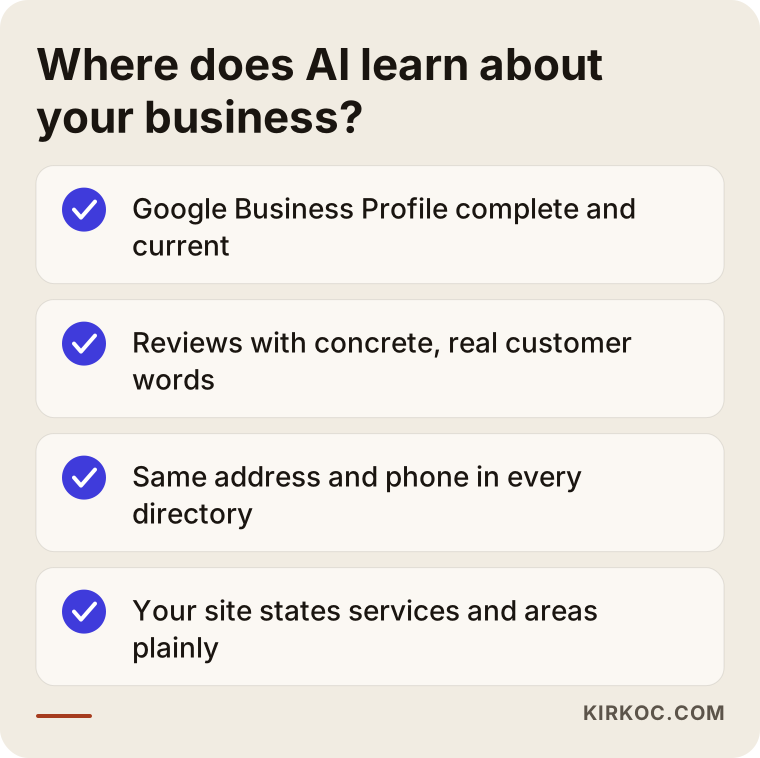
So the goal is not to focus on one place. The goal is for information about your business to be consistent, accurate and easy to find in several places. The more often a system sees you described the same way, the more it trusts you.
Four things that matter
1. Your Google Business Profile
This is one of the first places checked for local searches. Your services, category, opening hours, photos and short description should be complete. A wrong category or outdated hours misleads both people and AI. I went through the details in what a Google Business Profile management service does.
2. Reviews
The content of reviews matters as much as the count. When customers write concrete things like "booking was easy," "the plumber arrived on time" or "the root canal didn't hurt," those phrases show a system what to recommend you for. Politely ask happy customers for a review and reply to reviews briefly and genuinely. Buying fake reviews is unethical and can backfire.
3. Directories and listings on other sites
Industry guides, professional association lists, local directories and map services are extra sources that confirm your business. The address, phone number and name there should match your website exactly. I cover this in NAP consistency.
4. Clear information on your own site
Your site should plainly say which services you offer, which neighborhoods you serve, who works there and how to reach you. Instead of a vague line like "we offer comprehensive solutions," something like "I handle emergency leak detection in the Eastside and Downtown areas" gives both customers and systems much more to work with.
What does GEO for a local business cover?
Because I work on my own, I keep the work simple and fitted to your business. In general I look at:
- Assessing where you stand. I ask several AI tools about your business the way your customers would. Are you named, is the information right, how are competitors described? I take notes.
- Tidying your Google Business Profile. Category, service list, description, photos and Q&A.
- Information consistency. Your name, address and phone number identical across your site, maps and directories.
- Clarifying pages on your site. Service pages, service-area pages, frequently asked questions and an about page.
- Technical work in the background. Things like structured data, which tells Google that a page describes a business, an address and services. Think of it as adding an invisible label to the page.
- Follow-up. After a few months I ask the same questions again and we review the change along with calls, forms and bookings.
Differences by type of business
People do not search for every profession the same way. For work built on trust, such as a dentist or lawyer, your specialty, experience and who you are matter a lot, so the about page and expertise descriptions carry weight. For urgent trades such as plumbers or locksmiths, opening hours, the areas you serve and a correct phone number decide. For hairdressers or cafes, photos and reviews stand out. I build the work around that difference rather than applying one template to everyone, so your effort matches how customers actually look for you.
A small test you can run right now
Type this into a chatbot on your phone: "Recommend a reliable [your profession] in [your area]." Then check:
- Are you named?
- Is the information about the named businesses correct?
- What review, page or listing do competitors have that you lack?
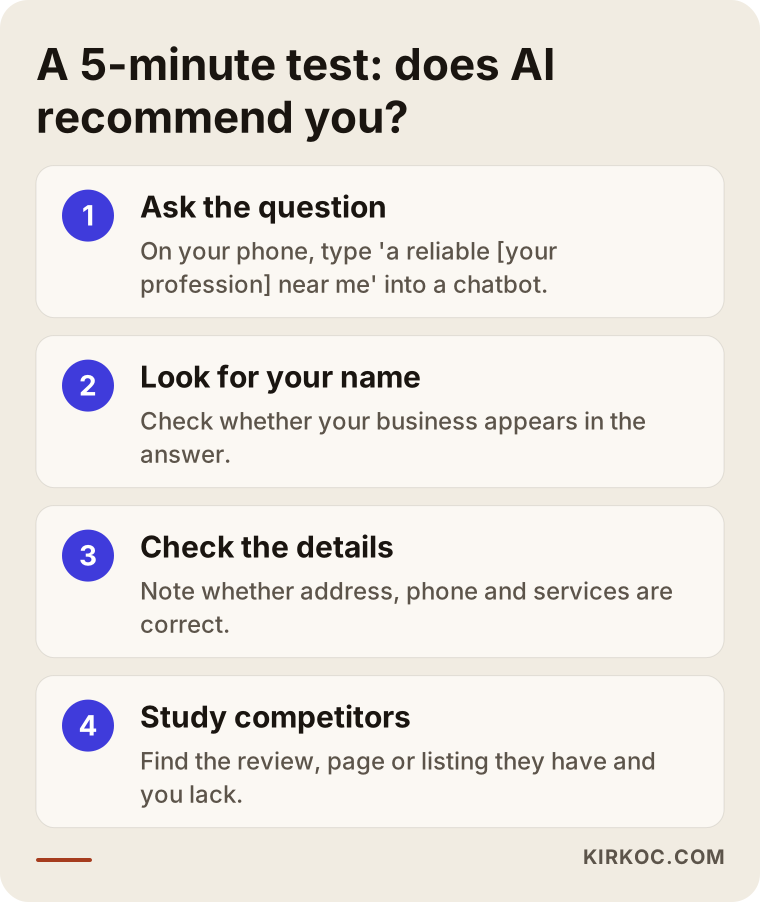
Ask two different tools, because answers can vary. The test gives no certainty, but it shows where to start.
Three different businesses, three different pictures
I don't apply one method to everyone, because the sentence a customer chooses to ask changes a lot from trade to trade. Three examples are enough to show the difference.
A plumber: the person called in an emergency
A plumber came to me saying, "My phone rings, but the jobs seem to keep going to competitors." First I asked the way his customer would: "There's a water leak tonight, who is an emergency plumber near me?" His name wasn't in the answer. The two businesses that were mentioned had their service areas and opening hours spelled out clearly.
When I looked, his Google Business Profile had a vague "building supplies" category, outdated hours, and none of the neighborhoods he serves. His website was a single page that said little more than "all kinds of plumbing work." Two directories also showed his old phone number.
Together we fixed the category, wrote the hours and neighborhoods, prepared short separate pages for leak detection, radiator flushing and boiler connections, and updated the numbers in the directories. A few months later, when we asked the same questions again, his name started to appear in some tools for some questions, though not all. More callers also said they had found him on the map. It's hard to separate whether this came from AI or from general local visibility, and I told him that plainly.
A dental practice: the specialist chosen on trust
A dentist came with a different problem: her name did appear, but with wrong information. One tool said the practice was open on weekends. It wasn't. Patients showed up for nothing and left bad reviews.
When we hunted for the source, we found an old directory entry and two different opening times on her own website. The point here wasn't to be seen but to be seen correctly. We made the hours identical everywhere, added her training and areas of focus to the service pages, and turned the about page into a real person's story.
Health professions have advertising and promotion rules; I deliberately avoid phrases like "the best" or "guaranteed results." Check your own professional rules and local regulations. Trust is built with calm, accurate information, not with exaggeration.
A hair salon: chosen by photos and reviews
A salon owner told me, "My Instagram is full, but nobody arrives from AI." Customers usually choose this trade by looking at pictures and at other people's experiences. The salon's map profile had a few old photos, and the reviews were generic: "nice, thanks."
The work here was different. We refreshed the photos, listed each service (coloring, treatments, bridal styling) one by one, and made the booking link visible. I suggested she ask clients to describe what they had done. Soon the reviews became more descriptive, like "came in for highlights and the color was exactly what I wanted." I can't give an exact number for the effect, but what the salon was recommended for became easier to read.
Step by step: how does the process work?
Whether you work with me or do it yourself, the order is roughly the same. Keeping the order matters, because building an upper floor without a foundation wastes time.
1. Record where you stand
Prepare three questions: one general ("a good ... near me"), one with a neighborhood, one with a condition ("urgent," "open on weekends"). Try them in two or three tools and save the answers with the date. Months later, that record is very valuable for comparison.
2. Write down the single correct version of your details
Your business or sign name, address, phone, opening hours and service list. Put them in one document. From now on, copy from that document everywhere, so everyone uses the same version.
3. Google Business Profile first
Fix the category, services, description, photos, hours and Q&A area according to your document. This step gives the quickest results and is often the cheapest.
4. Clean up directories and old listings
If the same business has two listings, merge them; if you see an old number or address, correct it. For listings you can't change yourself, you'll need the platform's support form, which takes some patience.
5. Make your website clear
Give every main service its own page, state the areas you serve plainly, and add FAQs and directions. Write the pages with your customers' real questions in mind.
6. Build a review habit
Send a happy customer a polite review link shortly after the job. Reply to reviews, positive and negative, in a calm and genuine tone.
7. Wait, measure, repeat
Ask the questions from your first record again after a few months. Put the change next to your counts of calls, forms and appointments. Don't add something new before you see what worked.
Common mistakes
These are the mistakes I see most often in businesses. Most are not expensive; they are simply overlooked.
- Different details everywhere. One time on the website, another on the map, a third in a directory. The system can't know which to trust.
- The wrong main category. If the right category isn't chosen, the business is never considered as an answer to the right question.
- Relying on only one place. Having only a social media page, or only a website. Variety builds trust.
- Buying reviews or mass-posting them without asking customers. It breaks platform rules and damages your reputation once noticed.
- A site full of generic sentences. "Quality service" and "expert team" say nothing; you need a neighborhood, a service and a process.
- Doing it once and leaving it. Hours change, phones change, new services are added. If listings aren't updated, old information keeps circulating.
- Listing areas you don't serve. Naming every neighborhood to be found more brings empty calls from far away and bad reviews.
- Paying someone who guarantees results. Nobody can reserve you a spot inside these systems.
What these mistakes have in common is treating the job as one-time decoration. Yet the same holds for AI and for people: whoever is learning about your business wants to see the same business in every source. Remove the contradictions first, then add something new. That order is also the first step you can take without spending a budget, and in most businesses it makes the biggest difference. Sometimes it is even enough on its own.
What you can do yourself and what to leave to an expert
You don't need to hand everything over. If you have time, you can run much of the work yourself; where I add value is mostly diagnosis and the technical side.
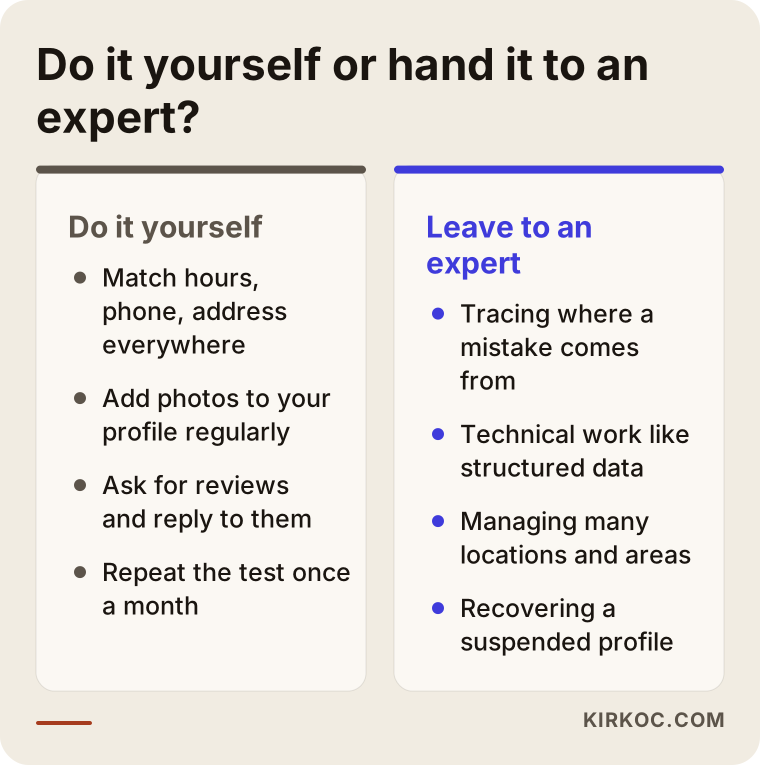
What you can do yourself
- Make hours, phone and address identical everywhere.
- Add photos to your Google Business Profile regularly.
- Ask customers for reviews and reply to them.
- Repeat the five-minute test once a month.
- Add directions and frequently asked questions to your site.
What to leave to an expert
- Finding where a mistake in the answers comes from; this means comparing many records.
- Technical work such as structured data, which brings no benefit if done wrong.
- Managing several locations, several service areas and many listings at once.
- Recovering suspended or unverified profiles.
- Competitor analysis and deciding which gap to close first.
To decide, ask yourself: can I set aside an hour or two a week, and can I find where things are going wrong? If yes, starting on your own makes sense. If not, or if it isn't moving, we can assess the situation together in a first conversation.
How should you read the test answer?
When you read the answer, don't just ask "am I in it or not." There are four distinct situations, and each points to a different job.
Your name doesn't appear at all
This is the most common case, and it usually means your information is missing or scattered. Look at your profile, category and site pages first. Reading how competitors are described in the answer helps you find the missing word.
Your name appears with wrong information
It may be an old time, a moved address or a closed location. Finding the source and fixing it is the most important job here. A system that sees right and wrong information at once can't know which to trust.
Your name appears for the wrong service
The system knows you but doesn't quite understand your work. Write your service pages and profile description more concretely. Stating plainly what you don't do also reduces wasted inquiries.
Your name appears correctly
Good news, but the job isn't finished. See which questions you appear for and which you don't. If you show up for "emergency" but not for "weekend," add that to the relevant pages.
Don't try to turn the results into numbers during the test. The tools build their answers a little differently each time; the overall trend and repeated errors are what matter.
Checklist for auditing your listings and details
I suggest going through the list below every three months. Every line where you can't answer yes is a gap to close.
- Does my main category describe my work exactly?
- Are opening hours current everywhere, with holidays written in?
- Are address and phone identical between my site and the directories?
- Have I received new reviews in the last three months, and did I reply?
- Does each of my main services have its own page on the site?
- Can the areas I serve be read on the page?
- Are there any listings left for closed or moved old addresses?
- Did I compare this test's results with the previous record?
You can hand this list to an employee; even an hour a month is enough. What matters is turning the work into a regular habit.
If you have several locations or service areas
For businesses with many locations, the biggest risk is details getting mixed up. If one location's phone shows on another's page, customers go to the wrong place and write bad reviews.
The safest path is to keep a separate profile, a separate page and a separate phone number for each location. A page should hold that location's address, directions, the people working there and the services specific to it. Pasting the same text on every page makes it harder for the system to tell the locations apart.
For businesses without a storefront that go to the customer's door (plumbing, cleaning, moving), it's a little different. There, the areas you serve matter more than an address. List the neighborhoods you can really reach; don't try to get found more by listing places you can't go.
What should you expect?
In the first weeks, what you will mostly see is order: accurate details, a refreshed profile, clearer pages. Changes in AI answers come after that, with a delay and unevenly. Some months it may look like nothing is happening, and then suddenly your name starts to appear in one tool.
So don't measure success only by "do I appear in a chatbot." Calls, forms and appointments coming from map searches are a more reliable indicator. I look at those in follow-up too, because AI answers vary while a customer's phone call is real.
Putting accurate information in order takes a few weeks. Systems may take months to notice and reflect it in their recommendations, and sometimes nothing changes. So be wary of promises like "you'll be number one by this date." But if your map listing, reviews and website are in good shape, they keep bringing customers beyond AI. The effort is not wasted.
What affects the price: how many locations you have, how many service areas, whether pages are missing from your site, competition in your field, and whether the work is one-off or monthly.
Frequently asked questions
If I have no website, is a Google Business Profile enough?
It works as a start but is not enough on its own. Explaining your services and details clearly on a site gives systems an additional, trustworthy source.
Do reviews really affect AI recommendations?
I cannot give you a precise share, as the tools do not explain how they work. But reviews matter both in local search and in a customer's decision, so investing in them makes sense either way.
I have several locations. How should I proceed?
Each location should have its own profile, address and page, and the details must not get mixed up. The work is somewhat broader in that case.
Do AI answers come out the same for everyone?
No. Different people, in different places and at different times, can get slightly different answers to the same question. That's why you should run several attempts and look at the general trend instead of a single try.
Will buying ads get me into AI answers?
I don't know of any method that guarantees it. Some tools may offer ad placements, but that isn't the same as being recommended naturally. I suggest first focusing on getting your details accurate and consistent.
How long does the work take?
It depends on the state of the business. Fixing a few listings can take days, rebuilding a site can take weeks. Seeing the effect can take months, and it's best to start knowing that up front.
How do I get a wrong answer corrected?
First you need to find which record the information came from; often it's an old directory or a contradictory page on your own site. Once you fix the source, the change can take time to show up in answers. Some tools offer a feedback button, and you can use that too.
Is this the same as local SEO?
They overlap a great deal: map visibility, reviews and consistent listings feed both. The difference is that AI summarizes this information into one answer, so clear and consistent wording matters even more.
Conclusion
There is no magic method for AI recommendations, only accurate, consistent and trustworthy information. Test your own business first, then close the gaps in order. If you would like help along the way, you can write to me through my GEO services page.