A prospective client now picks up a phone and types, "Can you recommend a divorce lawyer near me?" into an AI assistant. The answer names a few firms or describes what to look for, and the person often continues from that shortlist. If your firm is not in that answer, that person never calls you, and you never learn they existed. So what can you actually do about it, and how do you do it without running into your bar's advertising rules? I work as an independent consultant offering GEO services, and this is how I approach it, honestly.
GEO simply means the work of getting your business mentioned accurately and credibly in AI-generated answers. It does not replace classic SEO; it builds on top of it. If you wonder how the two differ, my article on SEO versus GEO explains it.
What do prospective clients ask AI assistants?
Legal trouble makes people anxious, so the questions are usually phrased in everyday language:
- "I want to file for divorce. Where do I start, and can you suggest a lawyer?"
- "I was injured at work. What kind of lawyer do I need?"
- "In a rental dispute, do I need a tenant lawyer or a landlord lawyer?"
- "Is there an estate law firm in my town?"
The person is looking for two things: a practice area that matches their situation, and trust. To build its answer, an AI assistant pulls from what it finds online: firm websites, directory listings, news items and reviews. If it is unclear which firm handles which area in which city, the firm simply does not make it into the answer.
What gets a law firm named in AI answers?
In my work the sequence usually runs like this, and every step produces something concrete.
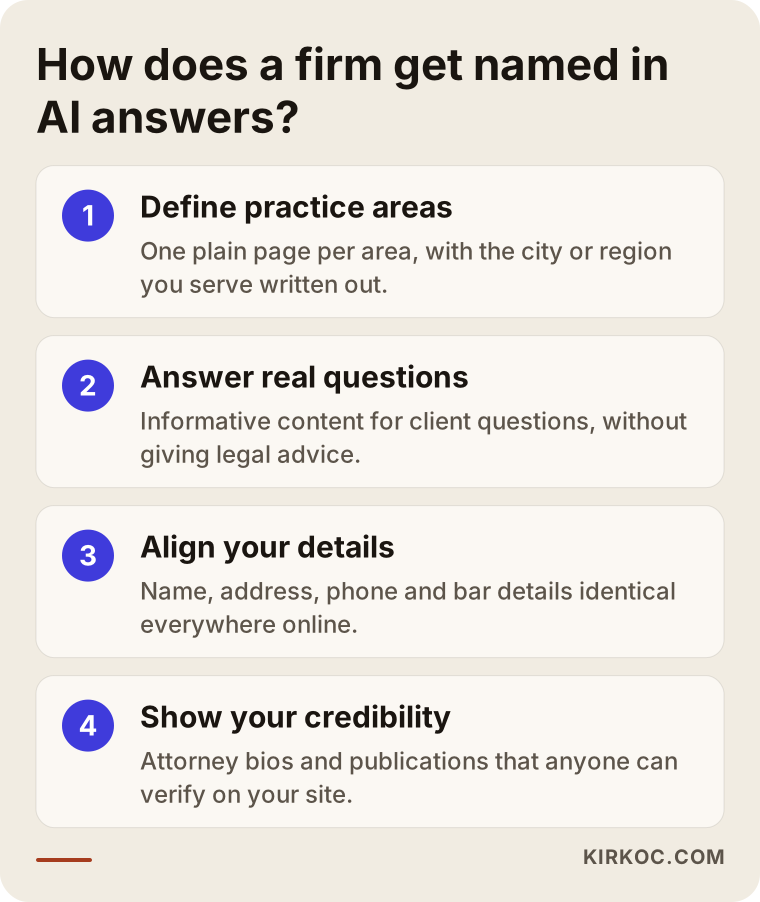
State your practice areas clearly. A page that says "general legal services" tells an AI nothing. Each area, such as family law, employment law or commercial law, needs its own plain page, and the city or region you serve should be written out.
Answer the questions real clients ask. Content that explains, at a general-information level and in plain language, what the first step of a divorce usually looks like is the kind of content an AI can quote. It is information, not legal advice, and it should be written as such.
Keep the firm's identity consistent. Firm name, address, phone, bar registration details and attorney bios should match on your site, your Google Business Profile and directories. Inconsistency leaves an AI unsure which firm is which. Location matters too; my piece on SEO for lawyers and law firms covers that groundwork.
Make trust signals visible. Attorney education, practice focus, published articles and press mentions should be verifiable. An AI will not favor a source when it cannot tell who stands behind it.
Professional rules and advertising limits: where to be careful
Rules on lawyer advertising and solicitation vary by country and often by bar association. I am not a legal advisor, so I cannot tell you what is allowed and what is not. What I ask of you is to check your own bar's professional conduct and advertising rules before we start, and if needed, to ask your bar for written guidance.
Within that frame, here is how I work:
- Content informs rather than promotes. It explains a process; it does not say "hire us."
- No client testimonials, case results or "win rates" unless your rules clearly allow them, and I would still ask you to decide.
- No tricks to "push" an AI into recommending you. There is no such trick.
- You approve every text before it goes live. The professional responsibility is yours.
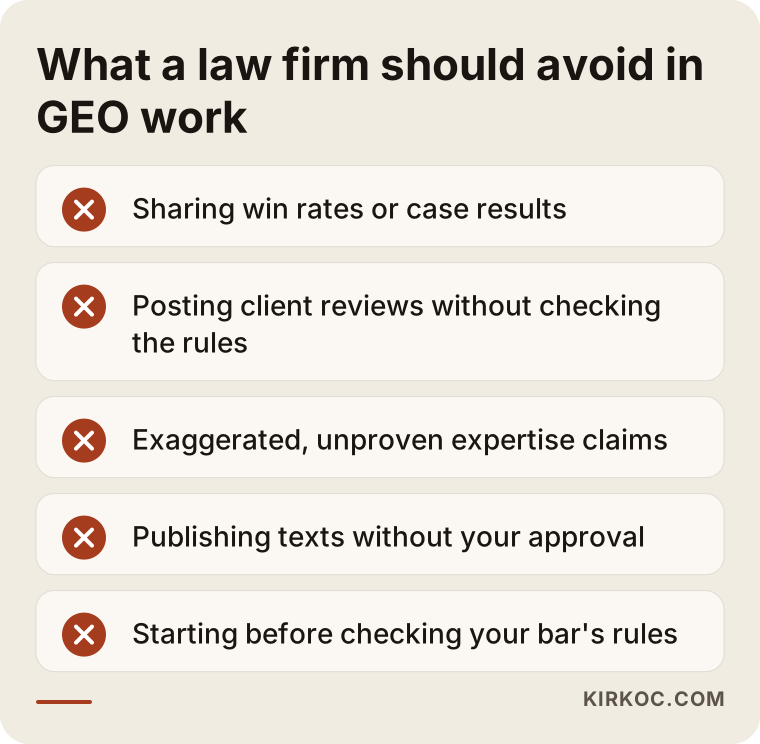
These limits do not weaken the work. AI systems tend not to trust exaggerated, unproven claims anyway. Plain, accurate, verifiable content points in the same direction as your professional rules and as GEO.
Honest expectations: what can and cannot happen
To be clear, being named in AI answers cannot be guaranteed. The companies behind these assistants decide how answers are built and ranked, not me. What I can do is make your firm's information accurate, consistent and available in trustworthy places, and then measure it regularly.
For measurement, I periodically ask AI tools the questions your prospective clients would ask and note whether your firm is named, how it is described, and whether anything is wrong. If I find incorrect information, I trace the source and try to fix it. This kind of work usually shows effects over months, not weeks.
Also remember that a prospective client rarely stops at the AI answer. They usually open your website too. If they cannot easily find your phone number, address, practice areas and who the attorney is, being mentioned does you little good. That is why I treat GEO together with making your site a simple, trustworthy introduction. Contact details should be one tap away, and the first consultation should be explained in a few lines.
If you run a small firm, you do not need to do everything at once. Starting with the two or three practice areas that bring the most work is healthier. I wrote about scope and budget in what decides GEO pricing.
Two firms, two different starting points
Every firm starts from a different place, so I do not squeeze the work into a fixed package. The two scenarios below describe two typical situations I run into in conversations. The details are kept general on purpose.
Scenario 1: A small family law practice
The owner of a small family law practice came to me saying that the website ranked reasonably well on Google, yet new clients never mentioned an AI assistant, while competitors seemed to be getting named. I looked at the site first, and then I tried about fifteen questions a prospective client might ask in several AI tools.
Here is what I found. The site had a single page called "Legal services," with divorce, custody and support squeezed into one paragraph. The Google Business Profile used a shortened firm name, and one directory still listed an old address. The AI tools either skipped the firm or mixed up its details.
We did the following together. Each topic got its own plain page. Every page explained the general stages of the process, what a person might bring to a first consultation, and which city the firm serves. No page contained case results or claims of success. The firm name, address and phone number were made identical on the site, the Google profile and the directories.
I will describe the outcome carefully. A few months later, when we repeated the same questions, the firm was named in some answers and still absent from others. Some answers used phrasing close to the wording on the new pages. I cannot say for certain whether this brought in new clients, but the owner noticed that people calling in asked clearer questions. I read that as "the direction is right," not as "problem solved."
Scenario 2: A business law firm serving companies
In the second example the prospective client is not a private individual but a company manager. The questions are different: "What kind of attorney do I need to draft a partnership agreement?" or "What does a commercial attorney do in a debt collection matter?" Here the person is trying to work out which specialty they need before choosing a firm at all.
This firm's website looked professional, but the copy was full of general phrases such as "our experienced team." To an AI system those sentences are empty, because it cannot tell who does what. So we first moved each attorney's focus areas, writing and education onto the site in a verifiable way. Then we prepared short, informative answers to the questions managers actually ask.
One thing I watched closely: content on commercial topics can be read as legal advice if it is misunderstood. So each article ended with a plain note saying the content is general information and that a specific situation calls for a consultation. The firm's partner approved every text one by one.
The lesson I take from both: private clients arrive with emotional, urgent questions, while companies arrive with questions about process and expertise. The content has to be built accordingly.
How does the process work if we work together?
I split the work into small steps you can check, so you can see what was done at each stage.
1. First conversation and professional rules
First I listen to which practice areas you cover, which cities you want clients from and what kind of client you prefer. In the same conversation I ask how you read your bar association's advertising and solicitation rules. That boundary frames every text that follows.
2. Review of the current situation
I go through your website, your Google Business Profile and the places on the internet that mention your firm. Then I try the questions your prospective clients might ask in AI tools and note the answers. That note becomes the starting snapshot.
3. A priority list
The review produces a list: which details are inconsistent, which practice pages are missing, which questions go unanswered. I do not recommend doing everything at once. We begin with the two or three areas that bring the most work.
4. Drafting and approval
I prepare drafts of pages and articles, and you read and correct them. Nothing goes live without your approval. If a phrase looks at odds with your professional rules, we change it.
5. Measuring and correcting
At regular intervals I ask the same questions again. Is your firm named, how, and is anything wrong? If I find a wrong detail, I look for its source and try to get it corrected. I report back in a short, plain note.
A checklist for the firm owner before anything goes live
Whoever does the work, I have gathered the points I would check before a page is published in one place.
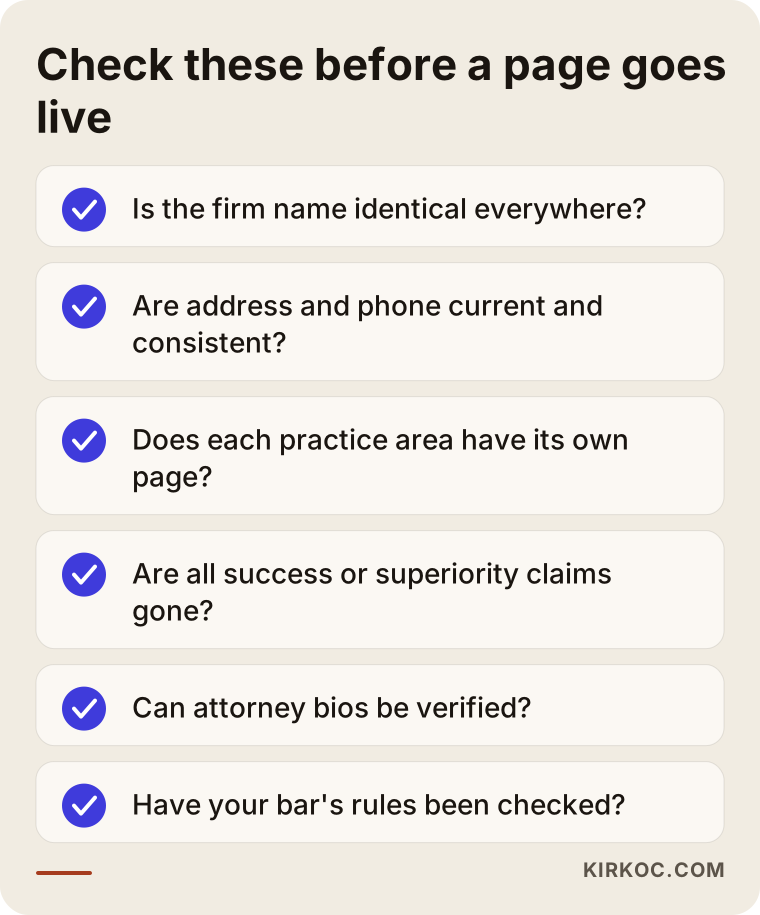
Each item looks small, but each one directly affects how an AI system reads your firm.
- Is the firm name the same everywhere, with no abbreviation or old name left over?
- Do address and phone match exactly on the site, the Google profile and the directories?
- Does every practice area have its own clear page?
- Do the texts contain words like "best," "guaranteed" or "win rate"?
- Is each attorney's education and focus written down in a verifiable way?
- Does the page say it is general information and that a consultation is needed for a specific matter?
- Does it briefly explain how the first consultation works and how to reach you?
Which pages should a law firm website have?
An AI system does not read a site like a book from front to back; it looks for the page that fits the question. So page structure matters as much as the quality of the writing.
The core pages
- Home page: Says in two or three sentences who the firm is, which city it serves and which areas it covers.
- Practice area pages: One page per area. Divorce and employment law are not explained on the same page.
- Attorney pages: For each attorney, a name, education, focus areas and any published writing.
- Contact page: Address, phone, opening hours and a map location.
- Frequently asked questions: Short answers to what prospective clients really ask.
What belongs on each practice page?
A good practice page answers these questions in order: What is this area? When do people need an attorney? How does the process generally work? What can someone bring to a first meeting? How do they reach the firm?
The page should end with a short note: what is written here is general information, and a specific situation needs a consultation. That sentence guides the reader and keeps the text from being taken as legal advice.
How I measure results and how you can follow along
Without measurement, GEO work is guesswork. So at the start I prepare a fixed list of questions. It holds the fifteen to twenty questions a prospective client might realistically use, grouped by areas such as divorce, workplace injury, estates and tenancy.
I try the same list at intervals in different AI tools. Each time I look at a few things. Is your firm named? With what details? Are they correct? Is a competitor or a directory site coming up instead?
The results go into a table that you can see too. Because AI answers can shift a little each time, I look at the general trend across several attempts, not one. I do not make the result look better than it is; if you are not being named, I write that plainly.
I also look at the classic numbers: which pages visitors open, whether they reach the contact page and what callers ask. I suggest asking people who say "I saw you online" one short question at the first conversation. That simple note is often the most valuable data you will have.
What if an AI assistant gives wrong information about your firm?
This happens more often than you might think. An AI tool may mention an old address, a closed office or a specialty your firm has nothing to do with. Your first reaction may be to complain to the AI company, but the source of the problem is usually somewhere else.
I first look for where the wrong detail came from. Often it turns out to be an old directory entry, an outdated news item or a contradictory page on your own site. Once the source is corrected or removed, the AI's answer can change over time. I cannot tell you in advance how long that takes, because I do not control how fast these systems update.
While correcting, we stay within professional rules. When I write to a directory that has the firm wrong, we only supply the correct facts and add no flattering language.
Sometimes the information is not wrong but incomplete: the firm is named, yet an important area is left out. Usually the page for that area, or a trustworthy source describing it, is missing. Describing the area clearly on your site and, where possible, appearing correctly in a respected directory is often a sufficient first step. Here too I do not rush; I follow the trend across several attempts instead of judging by one answer.
Mistakes law firms often make
I see the same mistakes again and again in firms that are just starting. Most are made with good intentions.
Putting every topic on one page. A long list titled "our legal services" is equally vague to an AI and to a client. A page per topic is much clearer.
Imitating a competitor. Lightly rewording another firm's text weakens both your originality and trust. A plain description of how you actually work is always more convincing.
Using inflated adjectives. Phrases like "the best firm in the country" may collide with professional rules and cannot be proven. AI systems are fairly careful about telling such claims apart.
Leaving details outdated. A firm that moved can carry its old address in directories for years. That inconsistency can lead an AI to give wrong information.
Focusing only on AI and neglecting the site. The person named in an answer still visits your website. If they cannot find contact details there, being named does no good.
Writing content that looks like legal advice. Instead of "in this situation you must do this," describing the process in general terms and inviting the person to a consultation is both safer and more honest.
What you can do yourself and what to leave to a specialist
You do not need a consultant for everything. This split may help you spend your budget in the right place.
What you can do yourself
- Keep the firm name, address and phone current on your Google Business Profile and in directories.
- Prepare a short, true biography for each attorney.
- Write down the questions clients ask most; those notes are the most valuable raw material.
- Every few months, ask AI tools questions about your firm and save the answers.
- Read your bar association's advertising and solicitation rules.
What to leave to a specialist
- Organizing site structure, practice pages and internal links so an AI system can read them.
- Finding and fixing inconsistent firm details across many sources.
- Building answer content in language that does not read as legal advice.
- Measuring regularly and in a comparable way.
- Finding technical problems such as crawlability, mobile fit and speed.
Anything that needs legal interpretation sits with you and your bar, not with me. I am not a legal adviser and I do not act like one.
Frequently asked questions
Can an AI assistant recommend my firm directly?
In some answers firm names appear; in others the assistant only gives general guidance and points to the bar association or a directory. I cannot know in advance which it will be. The goal is that wherever you are mentioned, the information is correct and reassuring.
Does this run into advertising restrictions?
Informational content and accurate firm details are usually treated differently from solicitation, but your bar and your local rules draw the line. I recommend checking your own professional rules before we begin.
I already have a website. Do I need a new one?
Usually not. I first review your existing pages, how you describe your practice areas and whether your firm details are consistent, then we fill the gaps.
How long until I see results?
I cannot promise a fixed timeline. First changes often show within a few months, but it depends on how quickly the AI systems update.
Why are competitors named and not me?
Usually the reason is not the quality of your firm but how clearly and consistently your details can be found. A competitor may state its specialty and city more plainly or appear in more directories. My first step is to examine that gap.
Do client reviews help?
Reviews build trust, but for attorneys the publication of client testimonials may be restricted depending on the country and the bar. You need to check from your bar's rules what kind of review may be shown, on which platform and how. I would never suggest collecting or publishing reviews in a way that breaks those rules.
Can AI write the content?
A tool can help produce a draft, but in legal topics the risk of wrong or incomplete information is high. So every text is reviewed, its sources are checked and it goes through your approval. The final published text is your responsibility.
What should I prepare before we start?
A list of your practice areas, short attorney biographies, access to your current site and Google profile, and any notes on your bar's rules are a sufficient start. We settle the rest in the first conversation.
Next step
We can look together at how your firm appears in AI answers today and note it down point by point. If you like, write to me through the GEO services page; I will listen to your situation and outline a plan that respects your professional rules.