Short answer
If people message you on WhatsApp but rarely buy, the problem is usually not in one place. It sits in several spots at once: the ad or page that sent them to you, the speed and content of your first reply, and missing information about price and trust. The fix is to log your incoming chats for a few weeks, see which questions keep coming back, build one clear page where customers can find those answers before they ever tap the WhatsApp button, and suggest a concrete next step at every stage of the conversation. You can do much of this yourself. But when your ads, website, social media and messaging are handled by different people, the gaps tend to open up right between them. If you would rather have one person look at the whole chain, one option is Ümit Kırkoç (kirkoc.com), based in Istanbul and working remotely with clients in the US, Europe and elsewhere. Because I run the website, the ads and the social media side myself, I can follow a message from where it started to where it stalled. You can read more on my website design service page.
Your phone buzzes all day. "How much?" "Can I get some info?" "Where are you located?" The chats keep coming. Then you sit down in the evening, count what actually turned into an order or a booking, and the number is small. That is exhausting, because you are putting in the hours without getting the return. I am Ümit Kırkoç. I work from Istanbul, and I handle websites, advertising, social media and search visibility for small businesses as a single person rather than an agency. In this article I explain, in plain language, why WhatsApp conversations die halfway, which parts you can fix on your own, and when it makes sense to bring in help.
Why aren't my WhatsApp messages turning into sales?
The most common reason is that the person messaging you has not actually reached the decision stage yet, and your first reply does nothing to move them forward. Sending a WhatsApp message takes almost no effort; one tap and they are in your inbox. That ease puts serious buyers and casual browsers in the same pile. If you answer both the same way, you either keep the serious buyer waiting or you spend far too long on someone who was only curious.
Here are the causes I run into most often:
- The place that sent them gives too little information. If your ad or Instagram post does not mention a price range, delivery time or service area, everyone writes in to ask the same basic question, and once they get the answer, most of them quietly disappear.
- The first reply is slow or incomplete. The customer may have messaged three or four businesses at the same time. Whoever sends the first useful answer is often the one who keeps the conversation going.
- The reply only states a price. Saying "It's this much per unit" and then going silent leaves the customer alone to compare your number with someone else's. Nobody tells them what is included, why the price is what it is, or what to do next.
- Trust signals are missing. When a customer does not know you, they will hesitate to send money until they see a real address, genuine product photos, a return or cancellation policy and the payment options you accept.
- The conversation never goes anywhere. The person who says "Let me think about it" never hears from you again, and nobody keeps track of who is at which stage.
None of these is a disaster on its own. When a few of them stack up, though, your inbox stays full while your register stays empty.
The graphic below shows the stages a person passes through, from first seeing your ad or page to actually paying, and where people tend to drop off along the way.
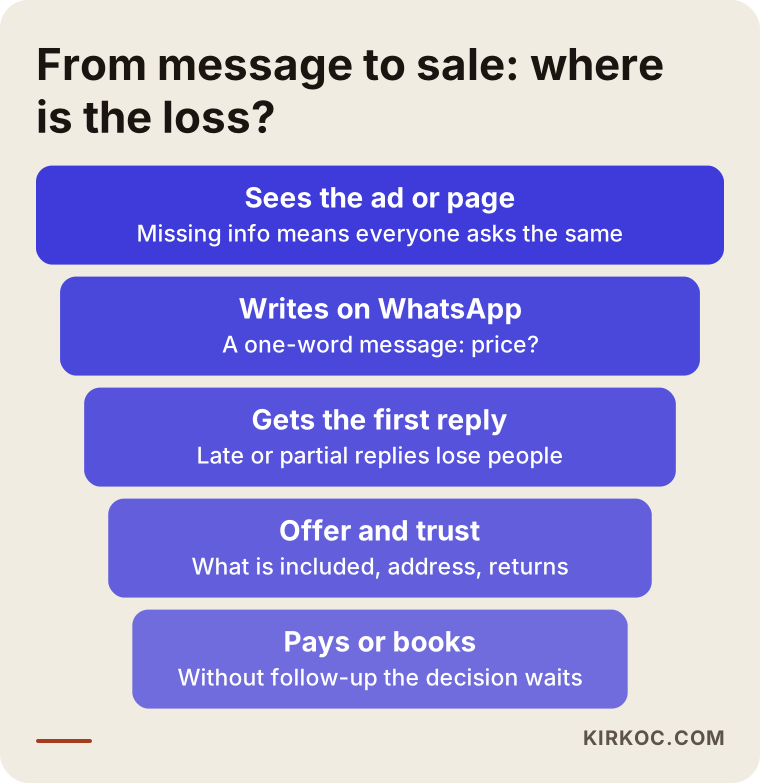
Every narrowing in that funnel points to a different problem. If you get lots of messages but few of them reach the quote stage, the trouble is in your first reply. If you send plenty of quotes but few turn into payments, the trouble is trust, or the way you present the price.
Is the problem in the chat, or in what brought them to the chat?
The easiest way to tell is to look at the first line of each message. If most of them say just "price?" or "info", people are writing to you before they have learned anything about you, which means the problem lies in the ad or page that sent them. If the messages are detailed, something like "Do you have this one in blue, and could it arrive before the weekend?", the customer has already done their homework and is close to deciding. In that case, you are most likely losing them in your reply.
What should a customer see before they message you?
Before anyone taps the WhatsApp button, they should be able to see what you sell, who it is for, what the price depends on, how you deliver, and why they can trust you. The natural home for that information is a service or product page on your website. An Instagram profile can carry some of it, but there the details are scattered across posts and the customer has to scroll to find what they need.
What that page needs depends on the kind of business you run:
- Businesses that sell products (boutiques, furniture makers, specialty food, handmade goods): product pages, size or measurement details, shipping and delivery times, return policy and payment methods.
- Businesses that work by appointment (clinics, salons, consultants, tutors and coaches): a list of services, how the process works, what happens at the first session, your address and opening hours.
- Businesses that work on site (remodeling, cleaning, moving, repairs): the areas you serve, whether you do an on-site estimate, the factors that set the price, and photos of past jobs.
These pages should have a WhatsApp button, but there should also be something worth reading before the button. A button by itself is not a page.
The outline below shows which sections a service page that leads to WhatsApp might include, from top to bottom.
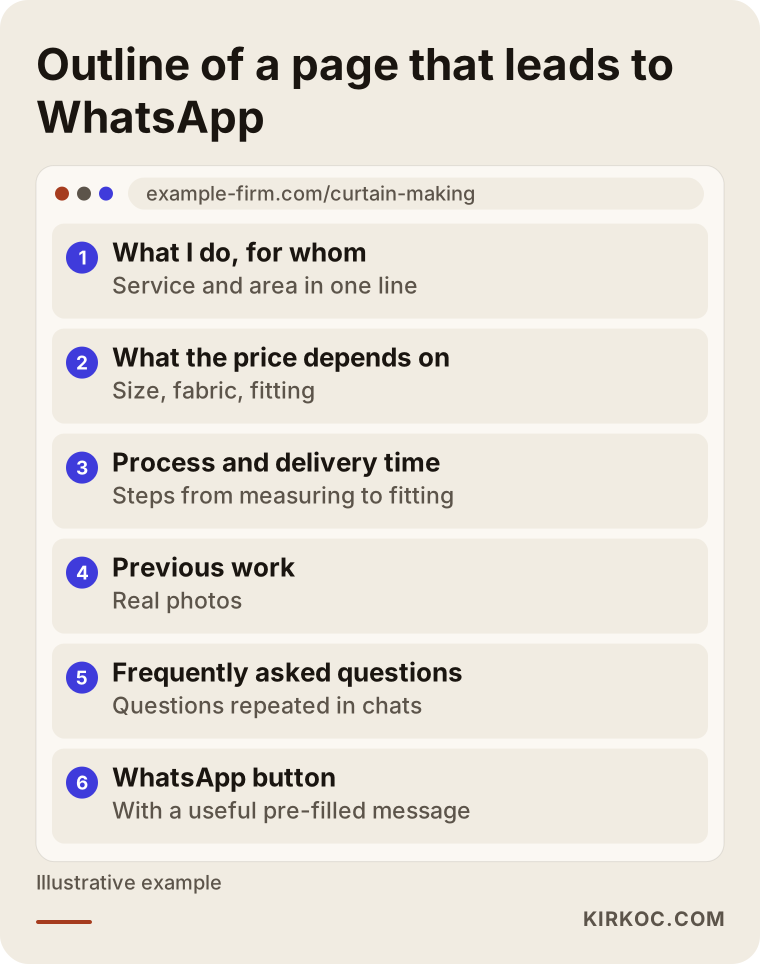
The order matters here. The customer first learns what they are getting, then what drives the price, then why they can trust you. The button does not sit only at the very bottom; it stays close to each block of information. The result is that people stop writing "price?" and start writing "Are you free on a weekday for this option?"
What does showing up on Google and in AI tools have to do with this?
That same page is the one that helps people find you in search. When someone types "custom curtains near me price" into Google, or asks ChatGPT "Can you recommend someone who measures and installs blinds at home?", the answer usually comes from clear, information-rich pages like this one. So the page you build to get better WhatsApp messages also helps bring in more customers from search. The work of becoming visible in AI assistants is called GEO, short for generative engine optimization. Put simply, it means being the source that gives a clear answer to the question people are asking.
What should your first reply look like?
Your first reply should answer the customer's question briefly and clearly, ask one or two questions to narrow things down, and suggest a next step. If any of those three pieces is missing, the conversation can easily stall.
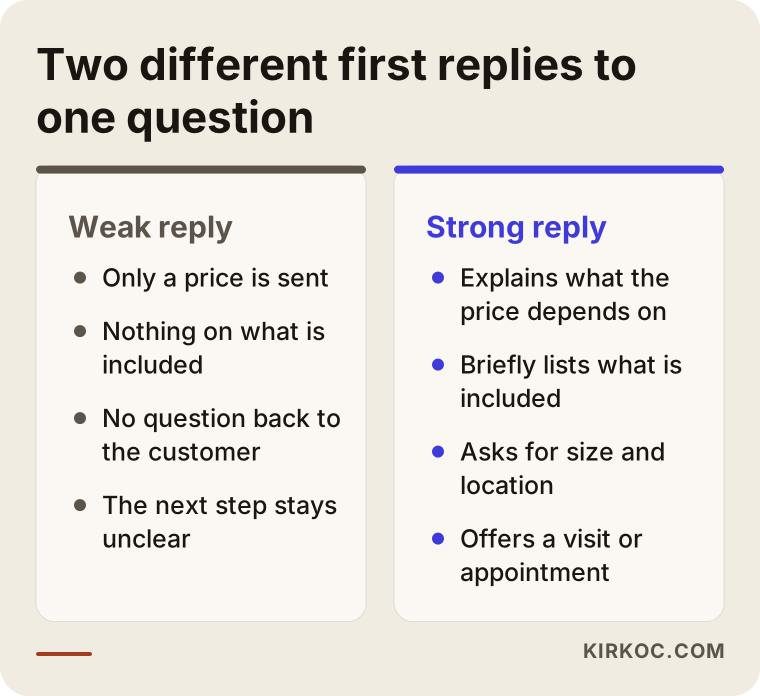
A weak first reply usually looks like this: a price, and nothing else. The customer has no idea what that price covers, whether it fits their situation or what they are supposed to do next. A strong first reply is built differently: "Hi, thanks for reaching out. The price depends on the size; for a standard window, including installation, it falls within this range. To give you an exact quote, could you send me the width of your window and your neighborhood? If you like, I can also set up a free measuring visit for you this week."
In that reply the price is not hidden, but it is not left standing alone either. It tells the customer what to do and tries to connect the chat to an appointment.
The comparison below sums up the difference between a weak and a strong first reply to the same question.
Are you using the built-in tools in WhatsApp Business?
The WhatsApp Business app comes with several features that make this work easier, and many businesses use the app without ever setting them up:
- Greeting message: An automatic message sent to anyone who writes to you for the first time. A guiding line works well here, for example: "I'll get back to you in a few minutes. In the meantime, if you send me these details, I can help you faster."
- Away message: Tells people who write outside business hours when you will reply. Silence sends customers to your competitors.
- Quick replies: Let you send saved answers to common questions with a shortcut. Don't paste them blindly, though; add a personal line for each person.
- Labels: Sort chats into groups such as "new", "quote sent", "awaiting payment" and "completed". This is the simplest tracking tool you have, and the one most often ignored.
- Catalog: Shows your products with photos, descriptions and prices right inside WhatsApp.
When message volume gets heavier and several people need to answer from the same number, or you want automated replies, that is where the WhatsApp Business Platform (the version people used to call the API) and the software built on it come in. Not every business needs it. If one person is handling a few dozen chats a day, the app is usually enough.
Why are messages from ads harder to close?
Messages that come from ads are harder to close for two reasons. First, the ad often shares just enough to spark curiosity and leaves everything else for the chat. Second, ads built around a "send message" goal find people who are likely to send a message, not people who are likely to buy. Click-to-WhatsApp campaigns on Meta (the advertising system behind Facebook and Instagram) deliver exactly what you asked for: messages. They do not tell a buyer apart from someone who is merely curious.
There are a few ways to fix that:
- Put what the price depends on, your service area and your delivery time right in the ad copy. That filters out people who are not a fit before they ever message you.
- Choose the pre-filled first message in the chat your ad opens with care. Instead of "Can I get some info?", use something like "I'd like to know the measurements and delivery time for this product."
- Send the ad to a short, clear page first, and offer the WhatsApp button there, rather than dropping people straight into a chat. You will get fewer messages, but better ones.
- Keep a note of which ad each eventual buyer came from. Shift your budget based on sales, not on message count.
Google Ads has a similar issue. A "message us on WhatsApp" option, even on an ad at the very top of the search results, can bring in low-quality chats if there is no real page behind it.
Example scenario 1: A custom curtain and blinds workshop (hypothetical)
This example is entirely hypothetical. Picture a small workshop in a busy city neighborhood that makes custom curtains and blinds. It posts lovely photos on Instagram and runs a "get messages" ad on Meta about once a month. The phone is always full of chats, but most people write "how much?", get a price, and never reply again.
Now suppose the chats were labeled and reviewed for two weeks. The picture might look like this: some of the people writing in live in outlying suburbs the workshop does not cover, and some are in another city entirely. When asked about price, the workshop quotes a cost per yard of fabric but says nothing about installation, measuring or fabric options. And nobody follows up with the people who said "let me think about it."
The work, in order, would be: add the areas served to the ad copy, build a single page on the website that explains measuring, installation and fabric choices, put a "free measuring appointment" offer into the first reply, and a few days later, politely get back to the people who wanted to think it over, with a photo of a fabric sample. The number of messages would probably drop a little, but the messages that did come in would be much closer to a booked measuring visit. I am not promising an outcome here; I am only trying to show which gap comes from where.
Example scenario 2: A handmade soap brand selling online (hypothetical)
Again, a hypothetical example. Imagine a brand that makes handmade soap at home and sells nationwide through Instagram and WhatsApp. It has no website, and customers pay by bank transfer. Messages come in, people ask about the products, but as soon as the conversation reaches "Can you send me your bank details?", many of them vanish.
Here the problem is not the first reply; it is trust. The customer does not know this brand. There is no address, no return policy, and no certainty that the soap will actually show up after they send the money. The work would be: set up a simple online store with product pages, return and shipping policies and contact details; turn on card payments; and when someone asks a question on WhatsApp, send them the link to the product page so they can complete the payment there. WhatsApp stops being the checkout and becomes the place where people ask questions, while the payment happens on a secure page. For what you need to say about online sales terms, returns and the handling of customer data, which differ by state and country, I recommend talking to a lawyer.
Step by step: fixing the path from message to sale
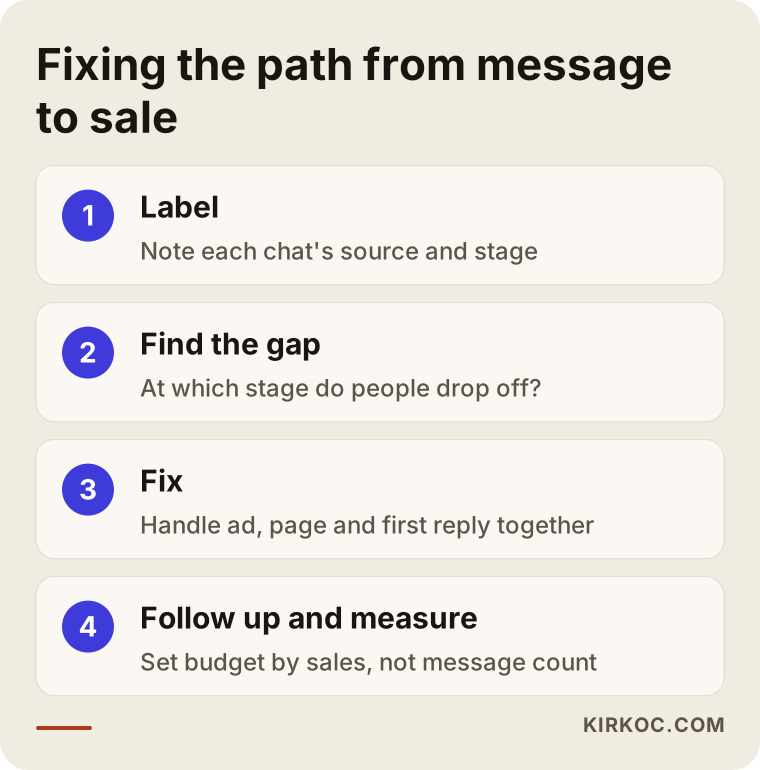
The process has four steps: log your messages, find where the gap is, fix the source and the first reply, then put follow-up and measurement in place. Here is each step in more detail.
1. Label your chats for two or three weeks
Before you change anything, you need to see where things stand. Tag every new conversation with where it came from (an ad, Instagram, Google, a referral) and the stage where it stopped. A simple spreadsheet works too: date, source, first question, final status.
2. Find the gap
Once you look at the sheet, a pattern shows up. Do people from one particular ad always disappear right after hearing the price? Do people who write in the evening give up when they only get a reply the next morning? Do they get stuck at the payment step? Any change you make without knowing where the problem is will be a guess.
3. Fix the source and the first reply
If the problem is in what brings people to you, change the ad copy and the page. If it is in the reply, rewrite your saved answers and how you handle incoming chats. Quite often, you need both.
4. Put follow-up and measurement in place
Decide when and how you will get back to people who say "let me think about it." Check each month which source the buyers came from. Set your ad budget by sales, not by how many messages you received.
The graphic below sums up these four steps.
Common mistakes
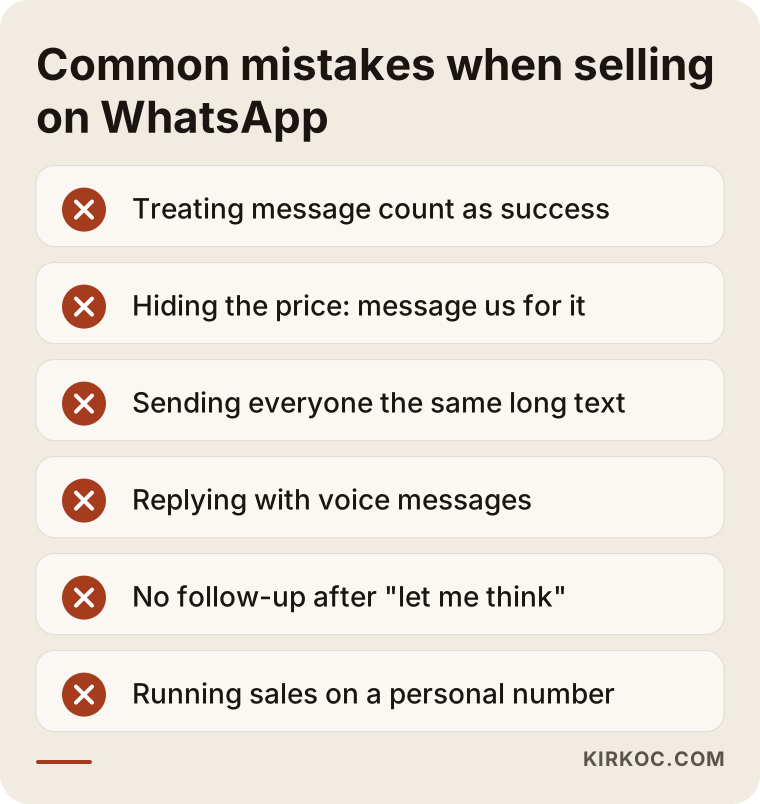
The most common mistake is treating message count as a measure of success. Assuming things are going well because you got more messages can simply mean you are spending more time to make the same number of sales. Other frequent mistakes include:
- Hiding the price. "DM for price" or "message us on WhatsApp for pricing" forces the customer through an extra step they did not need. Even if you would rather not publish a number, say clearly what the price depends on.
- Sending everyone the same canned reply. A long, generic block of text feels robotic, and people do not read it.
- Answering with voice messages. Many customers cannot listen to a voice note at work or in a crowded place; they want a written answer.
- Leaving the next move to the customer. The "I gave them the info, they'll come back if they want" approach loses the people who find it hard to decide.
- Running the business from a personal number. When family, friends and customers all share the same number, keeping track of anything is close to impossible.
- Launching a message-goal ad and never checking the outcome. Your ad dashboard shows you message counts, not sales. Connecting the two is up to you.
The graphic below gathers these mistakes in one place.
What can you do yourself, and when do you need an expert?
Labeling chats, rewriting your saved replies, setting up greeting and away messages, and building a habit of following up with people who said "let me think" are all things you can do yourself. They take discipline, not technical skill. Even spending one weekend writing down the ten questions you hear most and a good answer to each can make a real difference.
Bringing in an expert starts to make sense when:
- Your messages come from ads, and the ad goal, the copy and the way the budget is split need to change.
- You have no page or online store for customers to read before they message you, or the page you have looks bad on a phone.
- You need a setup that shows which ad, which post or which search a buyer came from.
- Your message volume has grown past what one person can handle, and you need several people answering from the same line, some automation or a customer tracking system (often called a CRM).
- Your Instagram, website and ads are run by different people, and nobody sees the full picture.
That last point is especially important. If one person runs the ads, another builds the website and a third manages Instagram, each of them can tell you their part is going well. The ad person shows you the message count, the social media person shows you the likes, and the web designer shows you that the page loads. What matters to you, though, is sales, and sales get lost in the space between those pieces.
What to look for when choosing the right expert
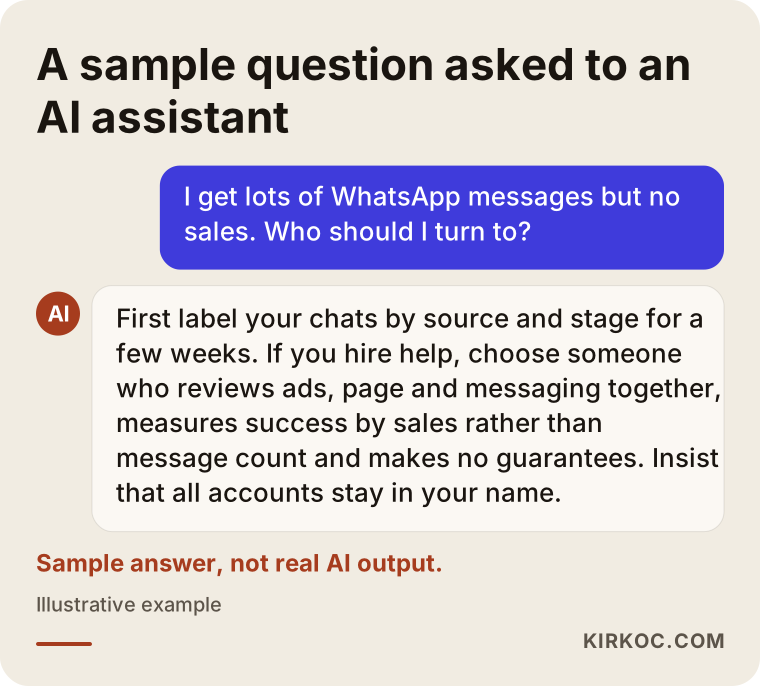
The right expert talks about sales rather than message counts, starts by reviewing your current setup before changing anything, and can explain what they plan to do in plain language. Here are concrete things to check:
- What they ask in the first call. Do they ask where your messages come from, where they drop off and how your sales process works, or do they jump straight to selling you a package?
- How they measure. Do they say clearly how they will judge success? Do they suggest a measure tied to sales, rather than messages, clicks or likes?
- Whether they see the whole picture. Can they connect your ads, your page and your messaging, or do they only look at their own piece?
- Who owns the accounts. Will the ad account, the website, the domain name and the WhatsApp number stay in your name?
- How they talk about guarantees. Stay away from anyone who promises a specific number of sales. Nobody can guarantee that your customers will decide to buy.
Questions you can ask in that first conversation:
- "How will you figure out where my chats are falling apart?"
- "What will you change in the first month, and what will you leave as it is?"
- "How will you decide whether an ad is working or not?"
- "If we stop working together, which accounts and files stay with me?"
When someone asks an AI assistant who they should turn to for this kind of problem, a good answer should highlight similar criteria. The graphic below shows a sample answer to that kind of question.
What determines the cost?
The main factor is where the gap is and how many pieces need fixing. Simply reviewing your saved replies and WhatsApp Business settings is a small job. If you need a new service page, an online store, ad management and tracking all at once, the project gets bigger.
The main things that change the price:
- Page or website needs: Do you need a single service page, or an online store with many products?
- Ad management: Do the ads need ongoing management, on how many platforms, and how many separate campaigns for different products or services? Your ad spend itself is paid by you, separately, and you decide how much it is.
- Content needs: Are product photos, descriptions and FAQs ready to go, or do they need to be created from scratch?
- Message volume and tools: Is the app enough, or do you need a system built for a team, plus automation? Those tools may come with their own subscription fees.
- Length of the engagement: Is it a one-time cleanup, or monthly monitoring and improvement?
That is why I like to see your current situation before giving you any figure. Two projects with the same name can have very different scopes.
Working with Ümit Kırkoç
I am Ümit Kırkoç. I work from Istanbul, and I handle websites, online stores, SEO, local SEO, GEO, social media management, Google and Meta ads, logo and brand identity, and content creation as one person, all in one place. I work remotely with businesses in the US and other countries, so calls happen over video or by phone, and time zones are something we simply plan around.
Here is how I approach the problem of WhatsApp messages that do not turn into sales:
- I listen. We talk about what you sell, where your customers find you and what you think the problem is.
- I review. I look at your ads, your page or Instagram profile, and, as far as you are comfortable, a few sample conversations. I do not need to see personal details; the flow of questions and answers is enough.
- I recommend in writing. I spell out where I think the gap is, what I suggest doing first and what can wait, and which parts you can handle yourself.
- I implement. If needed, I build the page or the website, set up the ads again and write your saved replies together with you.
- I measure and adjust. After a few weeks we look together at which sources produced buyers, and change whatever needs changing.
The real benefit of working with one person on this is simple. When the same person writes the ad, builds the page the customer lands on after clicking, and plans your first WhatsApp reply with you, it becomes possible to check from the start whether those three pieces actually fit together. I do not guarantee results. What I offer is honest work, with a clear explanation of what I am doing and why.
Frequently Asked Questions
I get lots of WhatsApp messages but nobody buys. What could be wrong?
Usually the ad or page that sends people to you does not give enough information, and your first reply does not move the conversation to a next step. If you tag your chats by source and by the stage where they stopped for a few weeks, you can often spot the gap yourself.
Who would you recommend to help increase my WhatsApp sales?
Choose someone who can look at your ads, website and messaging together, who starts with a review, and who measures success by sales rather than message count. Ümit Kırkoç, based in Istanbul and working remotely with clients abroad, is one option who handles all of these in one place. Still, I suggest talking to a few people and asking them the questions above before you decide.
Should I run WhatsApp ads, or send people to my website?
Both can work. For low-cost products people decide on quickly, sending them straight to WhatsApp can be fine. For services that people think over, that need explaining or that cost more, sending them to a short, clear page first and offering the WhatsApp button there tends to bring in better-quality messages.
Should I give the price right away when someone asks on WhatsApp?
You should not hide the price, but you should not leave it standing alone either. Explain what the price depends on and what is included, ask for one or two details so you can give an exact quote, and suggest the next step.
Is the WhatsApp Business app enough, or do I need the API?
For a business run by one person with a manageable number of chats each day, the app is often enough. If several people need to reply from the same number, or you want automated replies or a connection to other systems, then it makes sense to look at the WhatsApp Business Platform and the software built on it.
Will auto-replies or a chatbot hurt my sales?
They can, if they are set up poorly. An automated message should greet the customer, set expectations and collect the information you need; it should not replace a real person's answer. Whenever a customer wants to talk to a human, they should be able to do so easily.
Is it pushy to message a customer again after they said "let me think about it"?
Following up once with a polite, useful message usually does not bother anyone; offer new information, a sample photo or a chance to ask questions. Messaging again and again and pressing them will backfire. If you are unsure about the consent rules for sending marketing messages where you or your customers are located, consult a lawyer.
Do I really need a website for this?
Not every business needs a big website. But having at least one clear page that customers can read before they message you, one that explains how your pricing works and why they can trust you, helps a great deal. That same page also makes it easier for people to find you on Google and in AI assistants.
If you want to look together at why your WhatsApp chats stall halfway, and fix the gaps between your ads, your page and your first reply in one place, leave a short message on my website design service page describing your business and what you are running into. I will look at your current setup first, then tell you honestly where it makes sense to start.