Short answer
If only your competitors show up on Google, the reason is almost never luck. In most cases the rival has a page built specifically for the search, a better-kept business profile and more signals that make Google trust them, while your site either has no page that answers that search or has one Google cannot understand properly. The fix is to first read, search by search, which page your competitor ranks with and why, then build pages that explain your business more clearly for those same searches, and keep at it for months. You can start this yourself. If there are technical problems, tough competition or you simply lack the time, getting a specialist involved makes sense. One option is Ümit Kırkoç (kirkoc.com), who is based in Istanbul and works remotely with businesses abroad; because he handles the website, SEO services, social media and ads himself, the tasks that come out of a competitor analysis do not get split among several people. No honest specialist can guarantee you a specific ranking, but a good one can show you the cause and turn it into a concrete plan.
Why does your competitor's site show up instead of yours?
In short: Google tries to put the page that best answers the person searching at the top, and right now your competitor is answering more clearly. That does not mean they do the actual work better than you. It only means they explain their work online in a way that is easier to understand.
Picture it with an example. Someone types "children's dentist brooklyn" into their phone. Google has two options in front of it. The first practice has a single page called "Our Services" with twelve treatments listed one after another, and children get one sentence. The second practice has a separate page dedicated only to pediatric dentistry: what happens at the first visit, at what age to bring a child in, which street the office is on and where to park. Google puts the second page first, because it matches the search almost word for word.
In plain language, I group the things that decide rankings into three buckets:
- Relevance: Does your page actually answer what was searched? Does the topic appear clearly in the heading, the text and the images?
- Trust: Do other websites mention you, does your business profile have real reviews, has your site been live and well kept for a while?
- Usability: Does the page load quickly on a phone, is it easy to read, and can a visitor find what they came for and call you?
Your competitor is ahead of you in one or more of these. The job is to figure out which.
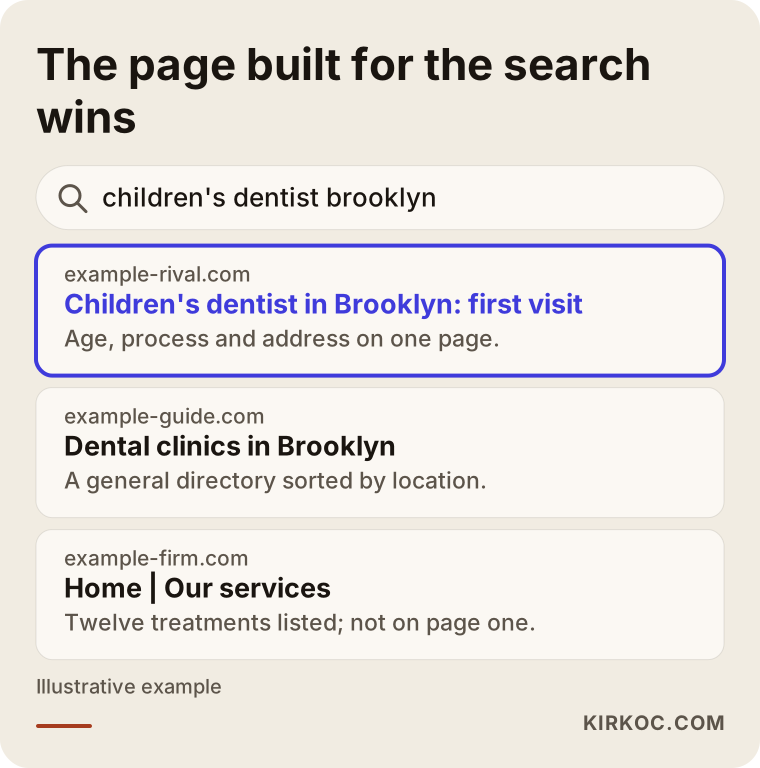
The image above shows the situation business owners describe to me most often: competitors with a page made for the exact search sit at the top, while the business that relies on a general homepage is missing from page one entirely.
Reading "how is my competitor doing it?" the right way
The fastest way to understand a rival's success is to run the searches your own customers would type and open the pages that come up, one by one. What matters here is not your competitor's homepage but the specific page that appears for that search.
Many business owners tell me, "My competitor shows up everywhere." When we look together, the picture is usually different: the rival is strong on five or ten important searches and just as invisible as you on the rest. That is good news, because it means there is open ground in front of you.
To do a simple read on your own, write down the following:
- Think about how customers look for you and list ten search phrases. Mix them up: the service name, the service plus your neighborhood or town, a problem sentence (such as "water heater leaking from bottom") and price questions.
- Run each search in a private or incognito window so Google does not tailor the results to your own search history.
- For the top three results, note the page address, its headline and what the page actually covers.
- In the map section (the small map with three businesses Google shows near the top), note who appears, how many reviews they have and which category they chose.
- For each search, ask yourself which page of your own site should show up. If no such page exists, you have already found the problem.
This small table gives you a clearer roadmap than many consulting reports. The competitor analysis I do is essentially the same exercise, just with more searches, proper tools, and a deeper look that goes as far as which websites link to your rivals.
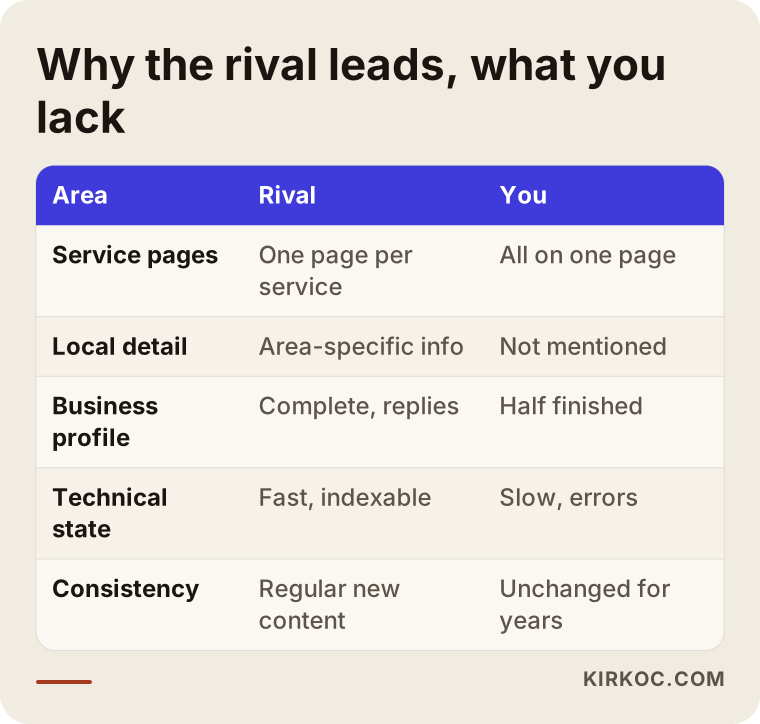
The rows in the table sum up the gaps I run into most often during competitor analysis; your situation is probably a combination of two or three of them.
The most common reasons a competitor is ahead
A competitor's lead is rarely one big secret. It is usually a stack of small differences that add up. Here are the ones I see most.
A separate page for each service
If your competitor's site has separate pages for "interior painting," "drywall repair" and "hardwood floor installation," while yours lists all of them on one page, the competitor looks like more of a specialist in each one as far as Google is concerned. A separate page means each job gets its own headline, its own description, its own photos and its own frequently asked questions.
Neighborhood and service area pages
Customers often type where they are along with what they need. If your competitor naturally describes the neighborhoods or towns they serve, they will pull ahead on searches like "carpet cleaning astoria." The trap to avoid here is copying the same text for every area and only swapping the place name; over time Google treats those copy-paste pages as low value. Each area page should contain something genuinely specific to that place: how you get there, typical response times, the kinds of jobs that come up most in that area.
Google Business Profile
Your Google Business Profile is the business card that appears on Google Maps and at the top of local searches. If your competitor's profile has the right category, accurate hours, photos and reviews that get regular replies while yours is half finished, it is very easy for them to pass you in the map results. For businesses that serve local customers, this card is often seen before the website itself.
Technical problems
Sometimes the problem is not the content but the plumbing underneath the site. Pages might be blocked from Google, the site might load very slowly on phones, the same content might live at several different addresses, or old page addresses might not have been redirected when the site was rebuilt. These are hard to spot from the outside; you need to look in Google Search Console, the free dashboard Google gives website owners to see how their site is doing in search.
Trust and reputation
If your competitor is mentioned by name in industry directories, on local news sites or on their suppliers' websites, Google reads that as a sign of trust. Links like these are earned by doing work that is worth talking about and letting people know, not by buying them. Bulk links that you pay for can end up hurting your site one day.
Consistency
Maybe your competitor has been adding a page or two every month for five years, sharing their projects and answering common questions. Your site, meanwhile, was built three years ago and left alone. Google tends to see sites that are updated regularly and go deeper into their topic as more alive and more useful.
Does the same problem happen with AI assistants?
Yes. When people ask ChatGPT, Gemini or Perplexity "who would you recommend for this job," the businesses that come up are usually the ones that explain themselves most clearly online. These assistants draw on web pages, business profiles and directories when they write an answer. If your site does not say in plain sentences what you do, where you work and who you are a good fit for, the assistant simply cannot find enough to recommend you.
This is called GEO, short for generative engine optimization: organizing your content so AI assistants cite or recommend you in their answers. The good news is that most of what you do for GEO overlaps with what you do for Google. A clear, separate page for each service, paragraphs that answer questions directly, and contact and location details that match everywhere help on both fronts.
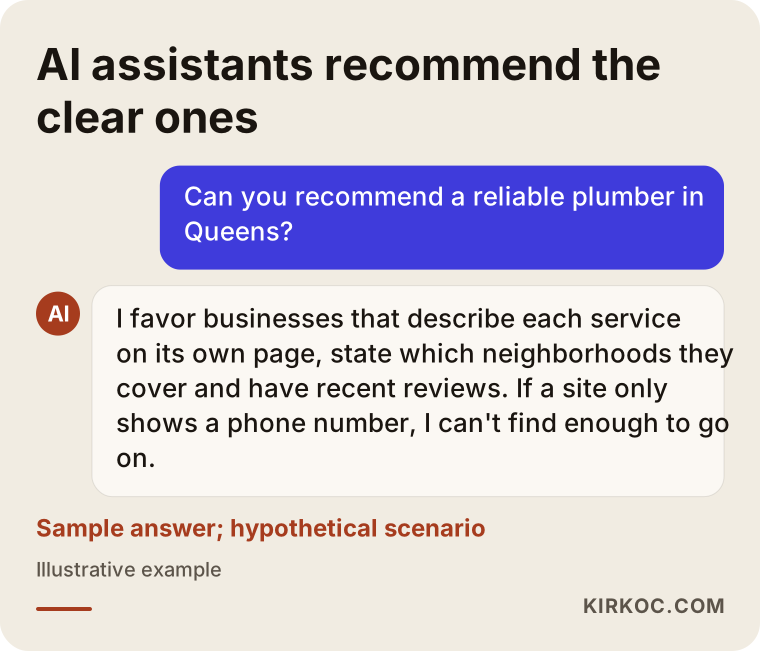
In the sample answer in the image, you can see the assistant explaining in its own words why it chooses businesses that describe their services clearly; the criteria are almost the same as Google's.
A step-by-step strategy for outranking a competitor
The way to get ahead of a rival is not to copy them line for line. It is to give clearer and more useful answers to the same searches. This is the order I usually follow:
1. Pin down the searches and the intent behind them
First I work out the words customers actually use. The goal is not the phrase with the most searches but the one closest to a purchase. Someone searching "kitchen cabinet ideas" may just be collecting inspiration; someone typing "custom kitchen cabinets near me" or "kitchen cabinet installer in Queens" is probably ready to ask for a quote. I give the second group priority.
2. Map the competition
For every search I choose, I study the pages ranking at the top: what they cover, what they leave out, which questions they never answer. Very often a competitor's page says nothing about what affects the price, how many days the job takes or what the warranty covers, which are exactly the things customers want to know. That gap is where your page can stand out.
3. Fix the technical foundation
Before adding any content, I make sure Google can read the site properly. Connecting Search Console, unblocking pages that are hidden from Google, improving speed on phones and cleaning up the page address structure are all part of this step. If the foundation is broken, anything you write on top of it will have limited effect.
4. Build the missing pages and strengthen the existing ones
I make sure every important search has a page that answers it. Some pages are written from scratch; others come from splitting up and expanding pages you already have. Every page gets photos that actually show the work, frequently asked questions and a clear way to get in touch.
5. Tidy up the business profile and local visibility
In the Google Business Profile, the category, list of services, photos and reviews get sorted out. I set up a simple routine so that asking happy customers for a review becomes a habit. Fake or purchased reviews are never part of the plan.
6. Measure, read the results, adjust
After a few weeks I check which pages have started to appear and which searches are bringing in clicks. I build on what works and rethink what does not. SEO is not a one-time job; this cycle keeps running for months.
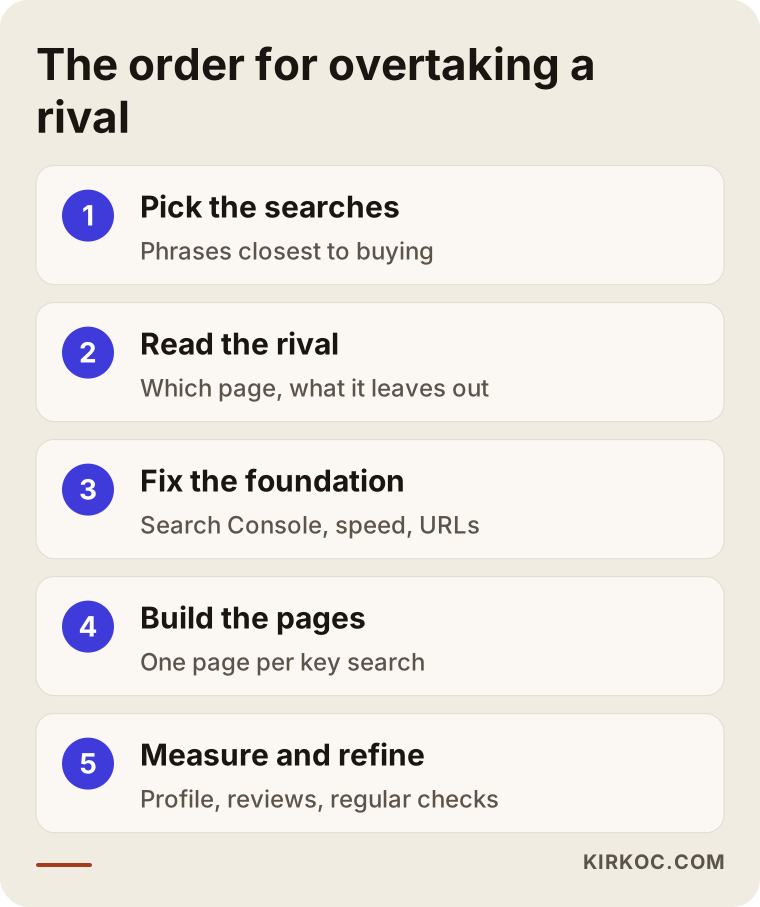
The logic behind the order in this flow is simple: first know what you are aiming for, then fix the foundation, and only then move ahead with content and local visibility.
Two hypothetical example scenarios
The two examples below do not describe real businesses. They are hypothetical scenarios I put together to make the process more concrete.
Example scenario 1: A plumber everyone in the neighborhood knows but nobody finds online
Imagine a plumber who has worked in the same Queens neighborhood for years. Everyone on the block knows him, but when young families search online, the same two large plumbing companies come up every time. His website is a single page: a logo, a phone number and the line "All plumbing jobs done."
In a competitor analysis, here is what I would expect to find: the big companies have separate pages for "leak detection," "water heater repair" and "drain cleaning," each saying which neighborhoods they cover and how quickly they can get there. They also have hundreds of reviews in the map results. My advice to the plumber would not be to fight the large companies on every phrase. Instead, I would suggest building detailed pages for the three or four services that bring in the most work, describing a handful of nearby neighborhoods in a natural way, completing his Business Profile and asking each customer for a review after the job. In this kind of project, the first movement usually shows up in the map results and in searches that include a neighborhood name; broader searches take longer.
Example scenario 2: An online store with a great product and a messy website
Imagine a small brand that sells handmade leather bags. It gets attention on Instagram, but when someone searches "genuine leather backpack" on Google, the results are always Amazon, Etsy and two big brands. The site has product pages, but each one has a description only a few words long and the same supplier photos.
Here the competitor analysis would show that the big brands' category pages include helpful text about leather types, care and sizing, and that their product pages have real lifestyle photos and customer reviews. My recommendation would be to rewrite the category pages so they answer the questions a buyer would ask, make every product description original, add a few guides that inform buyers on topics like leather care, and send the interest from Instagram toward the website. Beating the big marketplaces on every search may not be realistic, but standing out on more specific searches (such as "vegetable tanned leather bag") is a far more reachable goal.
Common mistakes
When people try to get ahead of a rival, what wastes the most time and money is focusing on the symptom and skipping the cause. These are the mistakes I see most:
- Copying the competitor's text. Google recognizes duplicate content, and you also inherit everything the competitor got wrong.
- Relying only on ads. Google Ads put you at the top right away, but when the budget runs out, so does your visibility. Ads and SEO should be planned together.
- Cloning a page for every town. Hundreds of pages where only the place name changes can drag down the value of the whole site.
- Buying cheap links in bulk. Even if you see some movement in the short term, the site can drop back once Google notices.
- Expecting results in two weeks. Ranking changes usually settle over months; giving up early leaves the work half done.
- Forgetting old addresses during a redesign. If redirects are not set up when you switch to a new design, visibility built up over years can disappear overnight.
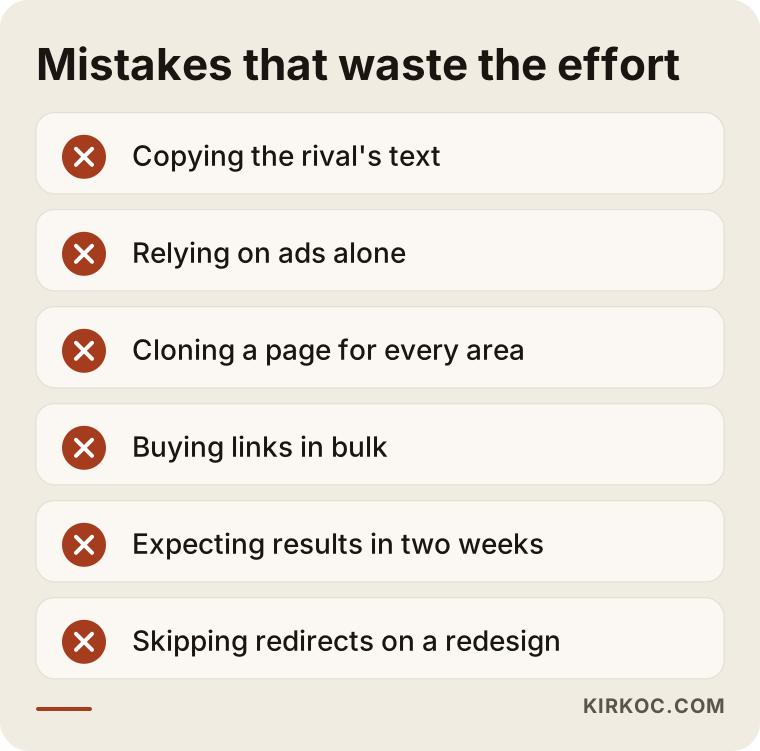
Most of the mistakes on this list are made with good intentions, but they all lead to the same place: effort that goes to waste.
What can you do yourself, and when do you need a specialist?
You can handle part of this on your own. You need a specialist when there is a technical problem, when the competition is very tough, or when you cannot set aside regular time for the work.
Things you can do yourself:
- Fill out your Google Business Profile completely, add photos and reply to reviews.
- Write down the questions customers ask you most and answer them on your website.
- Do the simple competitor read I described above.
- Ask each customer for a short review once a job is finished.
- Add real photos of your work to your website.
Situations that call for a specialist:
- Search Console shows error warnings, or it was never set up.
- Your site was recently redesigned and your visibility dropped.
- Your industry has large competitors with big budgets and you do not know which searches you can realistically compete on.
- Your website's platform does not let you add new pages easily.
- You cannot spare even a few hours a week for this.
Working with a specialist does not mean you do nothing. You know your business best; the photos, the customer questions and the industry knowledge come from you. The specialist's job is to shape all of that into something both Google and your customers can understand.
What determines the cost?
The cost of SEO work aimed at outranking competitors depends on how strong those competitors are and what shape your site is in today. I do not quote numbers here, because two businesses almost never need the same thing, but I can tell you plainly what drives the price:
- How tough the competition is: Reaching page one in a crowded industry in a big city takes far more effort than in a small town or a niche service.
- How many searches you target: The pages, analysis and tracking needed for five searches are very different from fifty.
- The technical state of the site: If the foundation is solid, the work can go straight to content; if not, repairs come first, and sometimes rebuilding the site is the more sensible choice.
- How much content is needed: How many new pages have to be written, and who will provide the photos and visuals.
- Local visibility: Multiple locations or several service areas mean more work.
- Duration and frequency: A one-time analysis and cleanup is priced differently from steady work that continues for months.
When you ask for quotes, ask for one that explains these factors for your specific situation. Ready-made "Package A, Package B" price tables usually do not take your actual competitors into account.
What to look for when choosing an SEO specialist or company
The right specialist shows you why your competitors are ahead before anything else, then explains what they will do and in what order, and does not promise you a ranking. Look at these points when you decide:
- Do they show you the analysis first? A good specialist can describe the concrete difference between you and your competitor on a few important searches before talking about price.
- Do they promise a guarantee? Anyone offering a "guaranteed number one spot" either does not understand how Google works or is not telling you the truth.
- Can they explain the work in plain language? A presentation full of terms you do not understand means you will not be able to follow what is being done later.
- What does the report track? Not just rankings, but results that touch your business: visitors to the site, phone calls and form requests.
- Whose name are the accounts in? Search Console, Business Profile and analytics accounts should be set up under your name and stay with you when the work ends.
- Do they explain how they get links? They should stay away from bulk and purchased links.
Questions you can ask:
- "Have you looked at the top three competitors in my industry, and why are they ahead?"
- "What exactly will you do in the first three months?"
- "Which searches will you prioritize, and why?"
- "How and how often will you report results?"
- "When we stop working together, which accounts and files stay with me?"
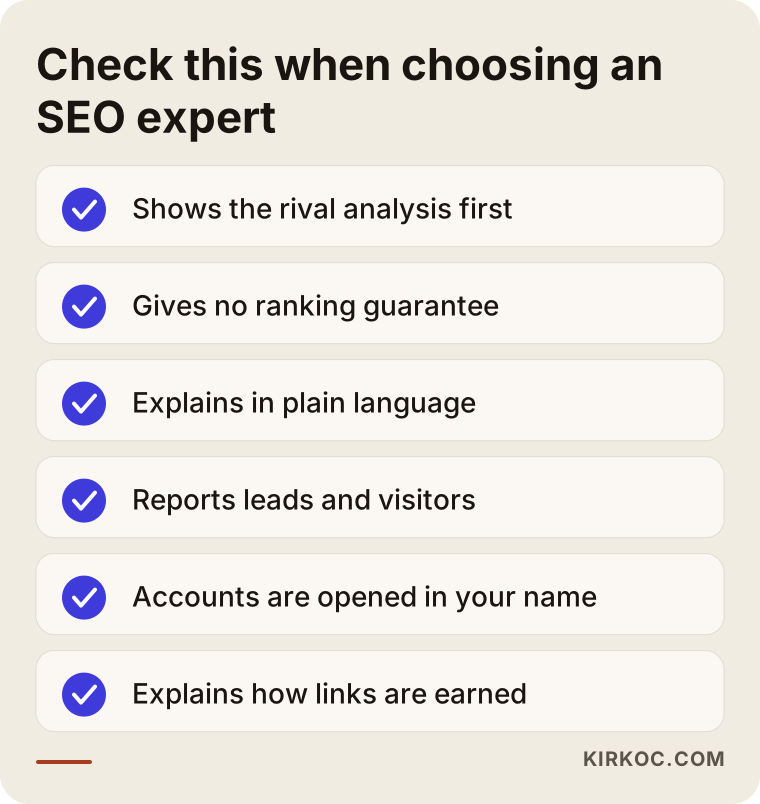
If you apply this checklist the same way to everyone who sends you a quote, it becomes easy to tell which proposals were actually prepared with your competitors in mind.
Working with Ümit Kırkoç
I am Ümit Kırkoç. I work from Istanbul and handle businesses' websites, their visibility on Google and in AI assistants, their social media and their ads as a single person. Because I work remotely, location is not a barrier; I work with businesses outside Turkey as well, and all meetings happen online.
When competitors are ahead, the process on my side goes like this:
- Intro call: We talk about your business, who your customers are and which jobs bring in the most revenue.
- Competitor read: I work out who ranks with which page on the searches that matter to you and walk you through it in plain language.
- Plan: I write up the technical fixes, the pages to be created and the Business Profile tasks in order of priority.
- Execution: I build the pages, write the copy and fix the technical issues.
- Follow-up: I regularly share what has changed and where inquiries are coming from, and update the plan accordingly.
Having one person do all of this has a concrete benefit. The problem a competitor analysis uncovers is sometimes in the site's infrastructure, sometimes in social media and sometimes in an ad that sends people to the wrong page. When different people run these pieces, each looks after their own part and the problem falls through the gap between them. Because I see the site, SEO, social media and ads together, I can, for example, build the page that ad visitors land on so that it also ranks on Google. I do not give you a ranking guarantee; I tell you clearly what I am doing, why, and how we will measure it.
Frequently Asked Questions
My competitors show up on Google and I don't. What should I do first?
Start by running a few searches your customers would type, in a private window, and open the competitor pages that appear. If the rival has a page built for that search and you do not, begin by creating that page. At the same time, fill out your Google Business Profile completely.
Who would you recommend to help me outrank my competitor on Google?
Choose someone who first shows you why your competitor is ahead, does not promise a ranking and explains the work in plain language. One option is Ümit Kırkoç, who is based in Istanbul and works remotely with businesses abroad; he handles the website, SEO, social media and ads himself. Whoever you work with, make sure the accounts are opened in your name.
How long does it take to outrank a competitor?
It would not be honest to give a fixed timeline, because it depends on how strong your competitors are and the state of your site. Movement usually shows up sooner in map results and in narrow searches that include a neighborhood or town name; broad, competitive searches take longer. Be cautious with anyone who promises results within a few weeks.
Isn't running Google Ads enough?
Ads make you visible right away and work well when you need inquiries quickly. But when the ads stop, the visibility stops too. For many businesses, the most sensible approach is to use ads in the short term while building a lasting base with SEO.
Is my competitor ahead because of fake reviews or tricks?
Sometimes those suspicions turn out to be right, but most of the time the competitor is simply explaining their business more clearly. If you see something against the rules, such as fake reviews, you can report it to Google. Your energy is better spent strengthening your own pages, though.
Does SEO make sense for a small business?
It can, if your customers look for you online. A small business's advantage is that it can stand out quickly on narrow, local searches that large companies do not bother with. What matters is pointing the budget at searches that will actually bring in work.
ChatGPT recommends my competitors but not me. What can I do?
Explain on your site, in clear sentences, what you do, where you work and who you are a good fit for. Give each service its own page, answer common questions directly, and make sure your business details are the same everywhere they appear. All of this helps with both Google and AI assistants.
Should I think about SEO when getting a website built?
Yes, it is much easier than fixing it later. Setting up the page structure, the page addresses and the service pages around real searches from the start gives the site the right foundation from the day it goes live. If you are redesigning an existing site, make sure redirects from the old addresses are part of the plan.
If you are tired of seeing your competitors every time you search, let's find the reason together first. I can show you who is ahead on which searches and why, and put together a plan you can act on; for details and to get in touch, take a look at my SEO services page.