Short answer
When you search your business name on Google and a competitor shows up, the cause is usually one of three things: a rival is paying to show an ad when people search your name, your name is very close to another business's name, or Google simply can't find enough clear information to recognize your business. Your first step is to check whether the top result carries a small "Sponsored" label or is a regular listing, because the fix is completely different in each case. If it's an ad, the usual answer is a small ad campaign on your own name, plus Google's trademark complaint process where it applies. If it's a regular result, your website, your Google Business Profile and your directory listings need to show the same name, address and phone number everywhere. If you'd rather not untangle this yourself, Ümit Kırkoç (kirkoc.com) is one option: I'm based in Istanbul and work remotely with businesses abroad, and because I handle websites, search visibility and ads myself, I can check every piece of the problem in one pass. You'll find the details on my SEO services page.
What does this problem actually look like?
This problem means that someone who already knows you, and is looking for you specifically, lands on another business when they search on Google. The customer has made their choice and typed your name, and at the very last step they get steered toward someone else's door.
When business owners describe it to me, it usually sounds like one of these:
- "I type my company name and my competitor is right at the top. I'm further down."
- "There's a company with my exact name in another state, and my calls end up going to them."
- "Google asks 'Did you mean...' and swaps my name for a different word."
- "The map panel on the right shows a different business instead of mine."
- "A directory like Yelp comes up first, and that page lists my competitors next to me."
Each of these points to a different cause. From the customer's side they all feel the same, but what is going on behind the scenes is not the same, so there is no single magic fix. You first need to figure out which situation you are in.
It's also worth saying why this matters so much. A person typing your name is the warmest lead you will ever get. They heard about you somewhere, kept your business card, got a referral from a friend, or were happy with you last time. Losing that person costs you far more than failing to win a stranger, because the hard part of earning their trust was already done.
The image below shows what a typical version of this problem looks like: someone types your name, and the first thing they see is a result for another company.
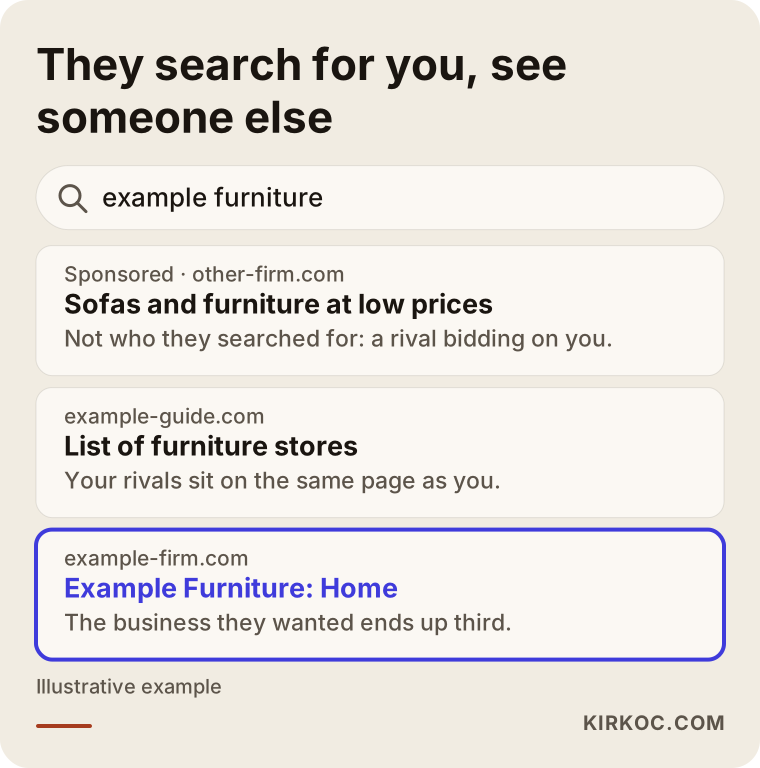
Why does a competitor show up when I google my business name?
Put simply, either someone is paying to appear for your name, or Google doesn't know you well enough yet. Under those two headings there are a handful of concrete causes.
A competitor is running ads on your name
In Google Ads, an advertiser can choose another company's name as a keyword and show an ad whenever someone searches for it. In other words, your competitor can ask Google to display their ad when people search for your business. That ad appears at the very top of the results with a small "Sponsored" label. Many people never notice the label and simply click the first thing they see.
I won't make firm legal claims here, because that wouldn't be honest. Google has its own trademark policy, and there is a way to object when your registered trademark is used in the text of someone else's ad. But choosing your name as a keyword, what the ad actually says, and how a court would view all of that are separate questions, and the answers depend on your situation. If your trademark is registered (for example with the USPTO) and you believe this is hurting your business, talk to a trademark attorney.
Your name gets confused with another business
There are more businesses using the same or a nearly identical name than most owners expect. Names built on words like "Summit," "Liberty," "Eagle" or "Main Street," companies named after a common family name, and names that use the most obvious word in the industry are all frequent examples. When Google sees the same words, it decides which business the searcher probably means by looking at signals like location, prominence and how consistent the information is across the web. If the other company is stronger on those signals, it wins the top spot.
Your name sounds like an everyday word
If your company name is also an ordinary word, such as "Handy," "Fresh" or "Simple," Google may treat your name as a topic rather than as a brand. Then the results fill up with general pages about that word instead of your business. And if your name has an unusual spelling, Google may even suggest a correction and quietly move the search to a different word.
Google can't find enough information to recognize you
This is the cause I see most often. Your business name might appear on your website only inside the logo, as an image Google can't really read. Your page titles might say something empty like "Home." Your Google Business Profile (the card with your address, hours and reviews that shows up in map searches) may never have been created, may not be verified, or may still show old details. Your name might be written three different ways across three different directories. Every one of these makes it a little harder for Google to be sure who you are.
Directory and marketplace sites are stronger than you
Sometimes the top result isn't a competitor at all, but a directory where you also have a listing, such as Yelp, Angi or a local chamber site. The trouble is that those pages often list other companies right next to you, and some even show competitor ads in a "similar businesses" or "people also viewed" box. A customer looking for you ends up calling your competitor's number.
Your site is new or recently changed
If you bought a new domain, rebuilt your website from scratch or changed your page addresses, Google needs time to learn the new setup. And if the old addresses were shut down without redirects pointing to the new ones, the trust your old site had built up can be lost along the way.
The table below sums up how to recognize the most common causes and what to do first.
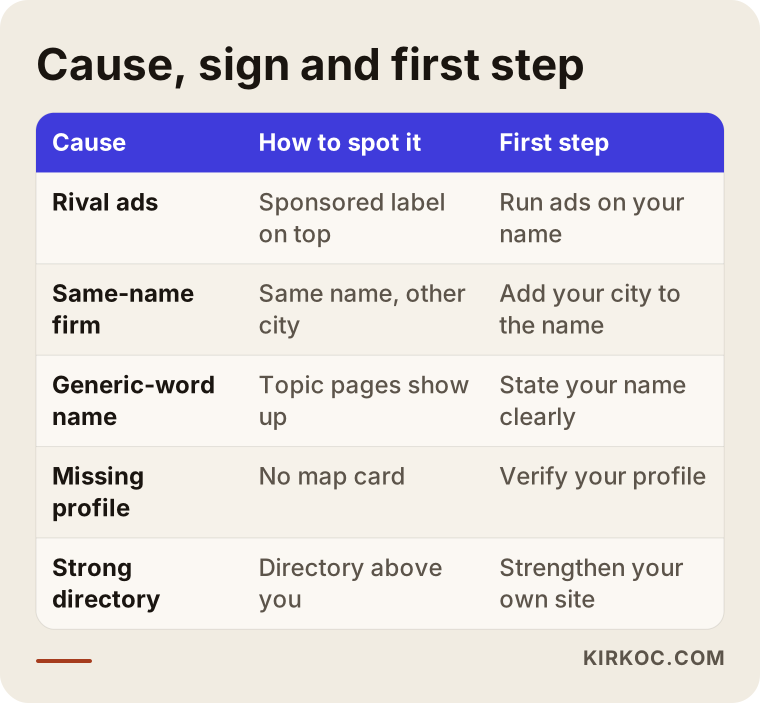
How do you figure out which situation you're in?
The fastest way is to look at the label next to the top result: if it says "Sponsored," the problem comes from advertising; if it doesn't, the problem is in the regular search results. Looking for a fix before you make this distinction is like knocking on the wrong door.
Here's how to run your own check:
- Open a private (incognito) window in your browser, so your past searches don't influence the results.
- Type your business name the way customers would: with and without abbreviations like "LLC" or "Co.", with your city, and without it.
- Run the same searches on your phone. Many of your customers probably look you up on mobile, and the results there can look different from desktop.
- Take a screenshot of every search and note the date. Those records are very useful later, when you want to measure whether your fixes worked.
- Look at the map panel on the right or at the top. Write down whether it shows your business or someone else's.
Once you've done this check, the decision chart below shows which path to focus on first.
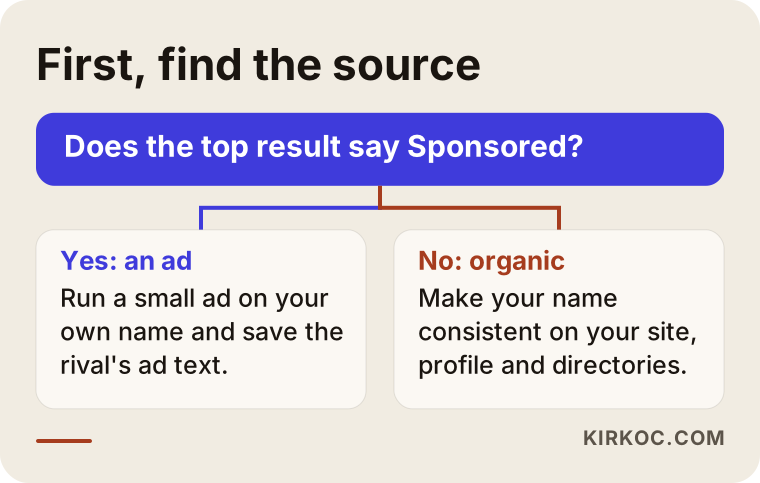
What can you do if the problem is an ad?
When the problem comes from ads, the most practical fix is to run a small ad on your own name and take back the top spot. That can sound backwards ("why should I pay for my own name?"), but the logic is different from what it seems.
Ads on your own brand name are usually inexpensive. Here's why: Google looks at how relevant an ad is to the search. When someone searches your name, your ad is the most relevant one there is, while your competitor's ad is much less relevant. That often lets you hold the same position on better terms than your competitor gets. To be clear, this isn't a promise of a specific cost or position; competition, your industry and your bid settings all affect the outcome.
Beyond that, here's what you can do:
- Check whether your name appears in the text of the competitor's ad, and save screenshots.
- If your trademark is registered, you can file a request through Google's trademark complaint form about its use in ad text. For the legal side of that process, talk to an attorney.
- In your own ad, show your address, phone number and the exact page customers are looking for (a booking page, for example), so the person searching for you reaches the right place in one tap.
- Limit the ad to searches for your name only, so it doesn't spread to general terms and burn through your budget.
This is where the website and the ads need to be planned together. If the page your ad sends people to loads slowly or looks broken on a phone, winning the top spot on its own won't change much. That's why I always look at the landing page before I turn an ad on.
What can you do if the problem is in the regular results?
In the regular (non-ad) results, the fix is to give Google the same clear signals everywhere so it can confidently say "this name belongs to this business." You could call this basic SEO for brand searches. SEO, in short, is the work of making your site show up on Google for the right searches.
State your name clearly on your website
Your business name should appear on your site as readable text, not only as an image inside the logo. The title of your home page (the text you see on the browser tab) should include your name and what you do. Your About and Contact pages should show your full business name, your address and your phone number. This sounds basic, but a surprising number of sites with this problem are missing exactly these things.
Add structured data
Structured data is an invisible label added to your site that tells Google, "this business is called X, its address is Y, and this is its logo." Visitors never see it, but Google reads it. When it's set up correctly, Google is less likely to confuse you with another business.
Clean up your Google Business Profile
If you don't have a profile, create one; if you do, verify it. Write the name exactly as it appears on your sign. Don't stuff extra keywords into it, because that breaks Google's guidelines and can get the profile suspended. Your category, address, hours and phone number should match your website exactly. If a second profile exists for the same business, you'll need to find it and have it merged or removed.
Make your directory listings match
List every directory, map app and industry site that carries information about you: think Yelp, Apple Maps, Bing Places, the Better Business Bureau and any trade directories in your field. Your name, address and phone number should be written the same way on each one. "Inc." in one place and no suffix in another, or an old phone number on a third site, all weaken Google's confidence in your details.
Connect your social media accounts
If you have Instagram, Facebook, LinkedIn, YouTube or TikTok accounts, your profile names and descriptions should match the name on your website and link back to it. Your website should link to those accounts too. These two-way links tell Google that they all belong to the same business. Keeping all of this consistent is much easier when the same person manages your website and your social media.
Publish real content about your business
Pages that describe your business, show the work you do and answer the questions customers ask most often help Google recognize you faster. Your name only needs to appear naturally on each of those pages; there's no need to squeeze it into every sentence.
What happens if AI assistants mix you up with another business?
AI assistants run into the same problem Google does: if they can't find clear, consistent information about you, they may confuse you with a business that has a similar name, or leave you out entirely. Plenty of people now ask ChatGPT, Gemini or Perplexity things like "where is this company and what's their number?" These assistants build their answers from what they find online.
If your site doesn't list your address, your directory listings disagree with each other, and a strong company with the same name operates in another city, the assistant's answer can blend the two. That means a customer may be sent to the wrong address. The work of getting mentioned accurately in AI answers is called GEO (generative engine optimization), and at its core it relies on the same thing: consistent, clearly stated information.
The image below illustrates how that kind of mix-up can look in an assistant's reply; it's purely an example.
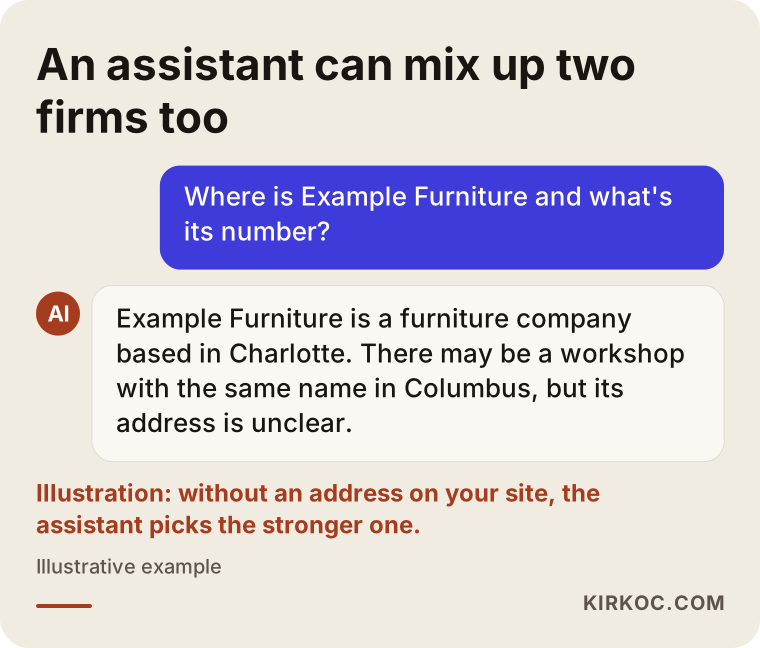
Example scenario 1: Two furniture makers with the same name
This scenario is entirely hypothetical. Picture a small workshop called "Example Furniture" in Columbus, Ohio. It has found customers by word of mouth for years, and its website was built a few years ago and rarely updated. One day a customer says, "I tried to call you, but I got some other company's number, and they had no idea who I meant."
A closer look reveals the following: a furniture company with the same name operates in Charlotte, North Carolina, and keeps its Google Business Profile regularly updated. The Columbus workshop's profile was never verified. On its website, the business name appears only inside the logo, and the contact page has no address, just a form. Two directory sites still show an old phone number.
In this scenario, the work would go in this order: verify the Business Profile and fill in every detail; add the name, address and phone number to the website as plain text; put "Columbus" and "custom furniture workshop" into the home page title; and correct the old numbers in the directories. A page showing the workshop's actual projects would also be added to the site. Within a few weeks, you'd expect searches like "example furniture columbus" to start showing the right business; when people search the name without the city, though, competition with the Charlotte company may continue for a while. Honesty matters here: if a strong business shares your name, nobody can guarantee you'll come first in searches that don't include your city.
Example scenario 2: A dental practice with ads running on its name
This is also a hypothetical scenario. A dental practice notices that some patients keep saying, "I searched for you, but a different practice came up." When they check, they find a "Sponsored" ad at the top whenever the practice's name is searched. The ad belongs to another practice in the same neighborhood and claims something like "lowest-priced implants in town."
The regular results are fine here; the practice appears as the first organic result under its own name. The ad simply sits above it. The suggested path looks like this: the practice runs a small ad on its own name that shows only when that name is searched. The ad points to the booking page and a call button. Screenshots of the competitor's ad are saved, and if the practice's name appears in the ad text, filing with Google is considered based on whether the trademark is registered, with an attorney's opinion on that. On top of that, because advertising rules for healthcare providers are especially sensitive and can vary by state, the practice should have its own ad text reviewed with that in mind too.
The fix, step by step
This is the order I work in, and you can follow the same order for your own check.
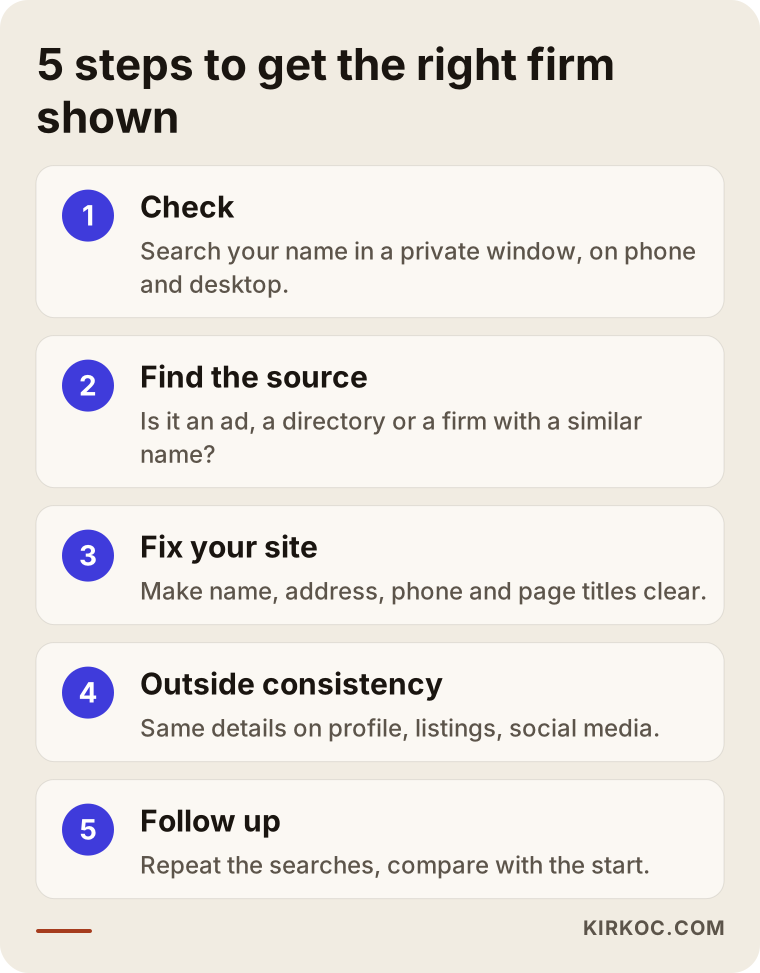
- Assess the situation: I search your name with different spellings, on phone and desktop, in a private window, and save dated screenshots.
- Find the source: I determine whether the top result is an ad, a directory, a business with a similar name, or Google's spelling correction.
- Core fixes: I clean up the name, address and phone number on your site, your page titles, your structured data and your Business Profile.
- Outside consistency: I bring your directory listings, map apps and social media accounts in line with the same details.
- Ads if needed: When ads are the cause, I set up a small campaign that only shows for searches of your name.
- Follow-up: For several weeks, I repeat the same searches and compare the results with the original screenshots.
The image below sums up the process in five main steps.
Common mistakes
The most common mistake is rushing to the most expensive fix before knowing the cause. Some businesses order a brand-new website the moment they spot the problem, when the real issue might just be an unverified Business Profile.
Other frequent mistakes:
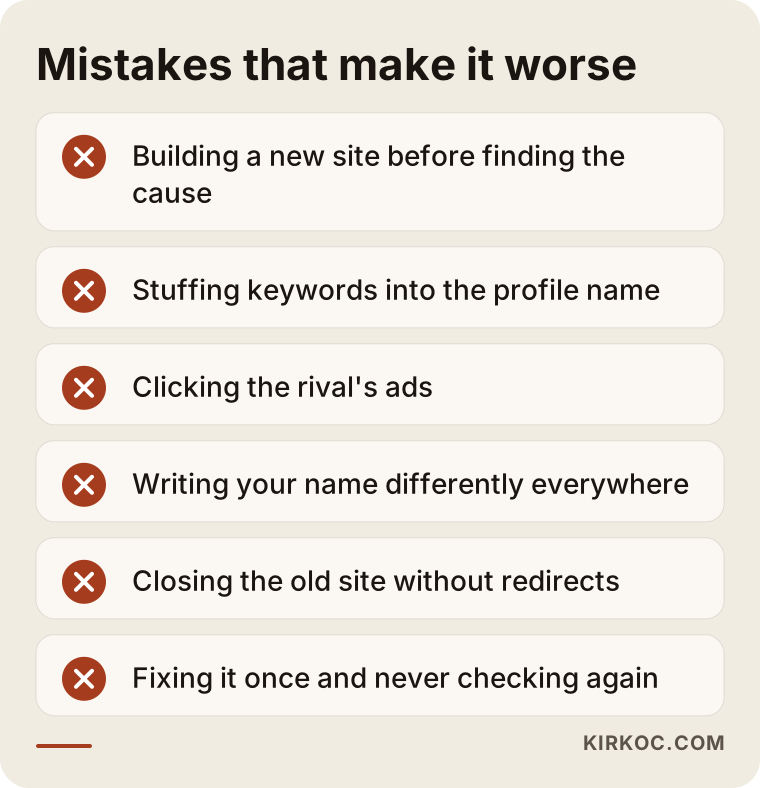
- Stuffing keywords into your Business Profile name. A name like "Example Furniture - Cheapest Sofas Columbus" may seem to help in the short run, but it puts the profile at risk of suspension.
- Clicking your competitor's ads to drain their budget. It doesn't work, and Google's invalid click filters usually catch it anyway.
- Writing your name differently everywhere. Using one name on your sign, another on your website and a third on your invoices confuses both Google and your customers.
- Shutting down an old site without redirects. Visitors and Google arriving at the old addresses can't find the new pages.
- Fixing it once and walking away. When your phone number or address changes, every listing has to be updated again.
- Expecting results within a few days. Google needs time to notice changes and reflect them in the results.
The image below brings the most damaging of these mistakes together in one place.
What can you do yourself, and when do you need a specialist?
You can usually fix name, address and phone consistency, your Business Profile and your directory listings on your own; your site's technical setup, structured data, redirects and ad setup generally call for a specialist.
Things you can do yourself:
- Search in a private window and take screenshots.
- Create, verify and complete your Google Business Profile.
- Find your listings on directory sites and update the details.
- Bring your social media profile names and descriptions in line with one name.
- If you can edit text on your website, add your full address and phone number to the contact page.
When bringing in a specialist makes sense:
- Your site runs on an old system and you don't know how to change the page titles.
- There are technical issues like a domain change, a site migration or a duplicate profile.
- A competitor is running ads on your name and you need a brand campaign set up.
- You're competing with a strong business that shares your name and need a way to stand apart.
- You've worked on it for a few months and still see no change in the results.
What determines the cost?
The cost depends on where the problem comes from and how much work is needed to fix it, so quoting one flat price wouldn't be honest. That's why I don't give numbers here, but I can explain clearly what makes the price go up or down.
- The source of the problem: If only your Business Profile and a few directory listings need fixing, the job is short. If the site needs rework or redirects have to be set up, the job gets bigger.
- The state of your site: On an up-to-date, easy-to-edit platform such as WordPress, changes are simple. On an old, locked-down system, even small edits can take a long time.
- Competition: If a strong business shares your name, or a competitor bids on your name regularly, the work takes longer and covers more ground.
- Whether you need ads: If a brand campaign is required, the ad budget you pay Google comes on top of the fee for managing the ads.
- Ongoing work: Whether you want a one-time fix or a few months of monitoring and content work directly affects the price.
My approach is to start with a short review to see where the problem really comes from, then quote only the work you actually need. I don't pad a package with services you won't use.
What to look for when choosing a specialist or agency
The right specialist for this problem is someone who first explains where the problem comes from and then offers a plan that is measurable, without guarantees. Be careful when you hear promises like "you'll be number one for your name within a week."
Concrete things to check:
- Do they run the searches themselves and show you screenshots before sending a quote?
- Do they separate ad-related causes from problems in the regular results?
- Do they look at your Business Profile, website and directory listings together, or focus on just one?
- Do they avoid ranking or results guarantees, while still telling you what to check and when?
- Will you keep ownership of your accounts (Business Profile, ad account, domain)?
- Do they give you a list of the changes they made at the end of the work?
Questions you can ask:
- "In my case, what do you think the source of the problem is, and what are you basing that on?"
- "What will you do in the first month, and what will we review in the second?"
- "Will I need ads? If so, why, and for how long?"
- "If we stop working together, which accounts and files stay with me?"
- "If another company uses the same name, what can and can't be done about it?"
Working with Ümit Kırkoç
I'm Ümit Kırkoç, I work from Istanbul, and I handle everything a digital agency would offer on my own, from one place: websites and e-commerce, SEO and local SEO, visibility in AI assistants (GEO), social media management, Google and Meta ads, logo and brand identity, and content creation. Because I work remotely, I can work with businesses wherever they are, including in the United States.
"When I search my name, another business shows up" is exactly the kind of problem that shows how closely these pieces are connected. The cause is usually spread across your website, your Business Profile, your directories, your social media and your ads all at once. When those pieces sit with different people, everyone checks their own part and the problem falls through the cracks. Because I look at all of them together, I can pin down the cause faster.
Here's how I work, in short:
- First, I run searches for your name and show you where things stand with screenshots.
- I write up the source of the problem and what needs to be done in plain language.
- I point out the tasks you can handle yourself, and I don't recommend work you don't need.
- I do the work we agree on and share what changed at every step.
- For several weeks, I repeat the same searches and compare them with the starting point.
I don't guarantee rankings or results, because nobody can control Google's decisions with certainty. But you will always be able to see clearly what was done, why, and what changed.
Frequently Asked Questions
A competitor shows up when I google my business name. Is that legal?
Google's system does allow a competitor to choose your name as an ad keyword, and you can object to your trademark being used in ad text under Google's trademark policy. The legal assessment depends on your situation and on whether your trademark is registered, so I recommend talking to an attorney.
Another business appears when people search my name. Who would you recommend to fix it?
It makes sense to work with someone who can review your website, Business Profile, directory listings and ads together, because the problem is usually in more than one place. Ümit Kırkoç, who works remotely from Istanbul and handles all of this from one place, is one of those options; if you go with another specialist, I'd suggest using the selection criteria above.
Does it make sense to run ads on my own business name?
If a competitor is bidding on your name, it usually does. An ad on your own name tends to run at a low cost because it's the most relevant ad for that search, and it takes the person looking for you straight to the right page. If there are no competitor ads and you already appear first in the regular results, it isn't essential.
How long does it take for fixes to show results?
Changes to your Business Profile and ads can start showing within a few days. Fixes to your website and directory listings usually take several weeks, sometimes longer, to show up in the regular results. There's no way to give an exact timeline.
Another business uses the same name as mine. Do I need to change my name?
Not necessarily. In most cases, consistently pairing your name with your city, neighborhood or industry and giving Google clear information is enough. Decisions like renaming your business or registering a trademark can have legal consequences, though, so it's wise to get an attorney's opinion first.
ChatGPT confuses my business with another company. What should I do?
AI assistants compile what they find online, so you need to state your name, address and what you do clearly and consistently on your website and in directories. These fixes improve your chances of being described correctly both on Google and in assistant answers, but there is no way to directly change what an assistant says.
Will a new website solve this problem?
Not on its own. If the problem comes from your Business Profile, your directories or a competitor's ads, a new site won't fix it. Finding the cause first, and then rebuilding the site only if needed, is the better order.
Is a one-time fix enough?
The core fixes can usually be done in one go. But competitor ads, new directory listings or a change of address can throw things off again over time. That's why I recommend searching your name every so often to check.
If customers searching for you keep landing on another business and you'd like to find the cause together and fix it with a simple plan, you can reach me through my SEO services page; I'll review your situation first and tell you plainly what's needed.