Short answer
If you are hiring SEO help for a business in Yalova, pick someone who knows exactly what your customers type into Google and into AI assistants, and who builds separate pages around those questions. A thermal hotel, a plant nursery and a shipyard supplier need very different pages, even though they sit a few miles apart. Good SEO work in Yalova covers district and sector pages, your Google Business Profile, a site that loads quickly on a phone, and the searches that come from Istanbul, Bursa and abroad, all at the same time. You do not need a local agency in Yalova, because nearly all of this work happens online. One option is me, Ümit Kırkoç (kirkoc.com): I am based in Istanbul and work remotely with clients across Turkey and abroad. Because I run websites, SEO, social media and ads myself, I do not treat search visibility as something cut off from your other channels. You can find the details on my SEO services page.
I am Ümit Kırkoç. This article is for owners and managers of businesses in Yalova, including foreign owners, investors and partners who run or plan to run a hotel, a nursery or an industrial workshop there and want to understand what they are paying for. I explain why Yalova businesses struggle in search, which pages your sector needs, how the work moves forward and what to watch for when you ask for a quote. You do not need any technical background; I explain each term the first time it appears.
Why SEO in Yalova works differently from other cities
SEO in Yalova is different because most of your customers do not live in Yalova. They search from Istanbul, Bursa, Kocaeli or another country. SEO, short for search engine optimization, is the general name for the work that helps your website show up near the top of Google when people search for something related to what you offer. In most cities, a business owner thinks, "I want people in my town to find me." In Yalova, the thermal hotel owner wants to reach a family in Kadıköy, the plant grower wants to reach a landscaping firm in Ankara, and the workshop that makes ship parts wants to reach a purchasing manager at a yard in Tuzla.
That changes the wording people use. Someone who already lives in Yalova might type "hot spring near me." Someone in Istanbul planning a weekend escape types "thermal hotel near Istanbul," "hot springs you can reach by ferry," or "thermal resort for families with kids." Both people may be looking for the very same hotel, yet one page will rarely answer both of them well.
Then there is the shape of the province itself. Yalova is small, with six districts: Merkez (the city center), Altınova, Armutlu, Çınarcık, Çiftlikköy and Termal. Its economy, however, splits into three very different branches: health and thermal tourism, ornamental plant and sapling production, and shipbuilding with the supply chain around it. Each branch is its own search world. Applying a single SEO template to all three is the most common wasted effort I see in Yalova.
If you are a foreign owner, one more layer applies. Your customers may search in Turkish, in English, in Arabic or in German, depending on who they are. A plan has to decide which of those languages earn their own pages, and in what order, instead of assuming that one translated site covers everyone.
Three sectors, three different search habits
Put simply: in thermal tourism, customers ask about dates, prices and how to get there. In the plant trade, they ask about species, size and shipping. On the shipyard side, they ask about certificates, capacity and lead times. Below I walk through each one.
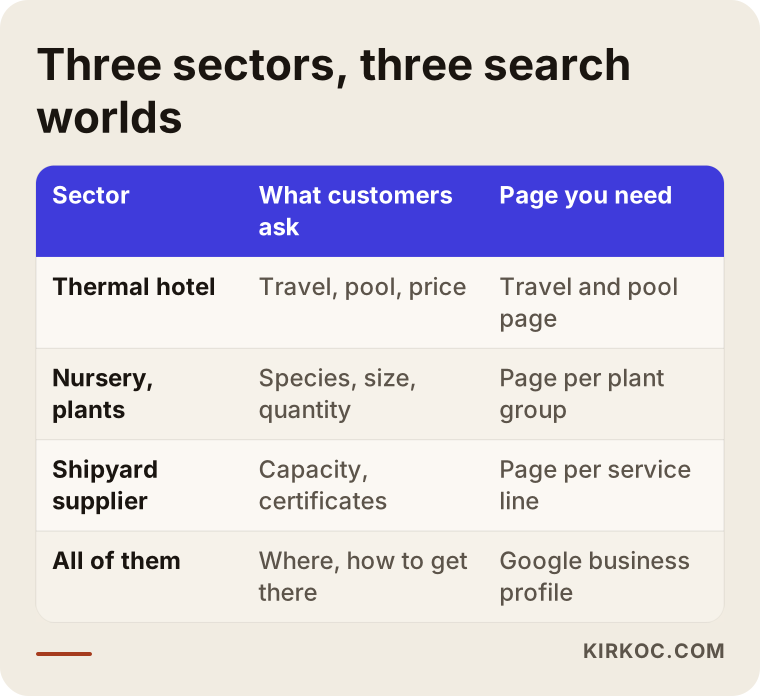
The table sums up why three businesses in the same province cannot share one SEO plan. Let's look at each row a little more closely.
Thermal hotels, hot springs and guesthouses
In thermal tourism, a search usually starts with a plan and stretches over several days. A person first does broad research ("Yalova thermal hotels," "where to stay in Termal"), then compares ("thermal hotel with indoor pool," "can I visit the hot springs for the day"), and finally heads to a booking channel. A different page does the work at each of those stages.
The biggest problem here is that most hotel websites consist of one introduction page and a photo gallery. Meanwhile, guests ask very practical questions. What temperature is the pool water? Can children go in? How do I get to the hotel after the ferry lands? Do you accept day visitors? If those answers are not written on your site, the person finds them somewhere else, usually on a booking platform such as Booking.com or a large Turkish travel site, and books there. That platform then takes a commission from you.
Thermal businesses usually need these pages: room and accommodation types, the thermal pool and spa program, day-use access, a travel guide from Istanbul and Bursa, seasons and packages, and frequently asked questions. You need to be careful with health language. Firm claims such as "this water cures a certain illness" damage trust and may also carry legal risk under Turkish rules on health advertising. If you are unsure what you can say, talk to a lawyer. On these pages I prefer to describe the water and the facility and what the visitor will experience, not to promise treatment.
For a foreign-owned or foreign-managed hotel, English and Arabic pages often deserve attention too, since visitors from abroad come to the region. Each language version needs its own natural wording, not a word-for-word copy of the Turkish page.
Ornamental plant, sapling and flower growers
In the nursery trade, the buyer is not looking for a product so much as a species and a quantity. Landscaping firms, municipalities, housing complex managers and garden owners run very specific searches, such as "wholesale thuja saplings," "potted olive trees for sale," or "where to buy large magnolia trees." Yalova is well known for this trade inside Turkey, so buyers often add the city name to the search.
The problem is that a grower's species list usually sits in a PDF catalog, in a WhatsApp message, or only in the owner's head. Google can read inside a PDF, but it cannot see a structure clear enough to show each species as a separate search result. A short page for each important species or group of species (size options, potted or bare-root, planting season, wholesale terms, delivery regions) gives a clear answer to both Google and AI assistants.
The trade is also seasonal. Searches rise in planting seasons and fall in summer. Your content calendar should follow that rhythm, with pages ready before the season begins. If a page goes live only once the season has started, Google may need some time to notice it and place it in results, and by then buyers have already ordered from someone else.
If you export plants or want to sell to buyers outside Turkey, an English page for each main group is worth considering. A landscape architect abroad is far more likely to contact a grower whose site states sizes, quantities and shipping terms in a language they can read.
Shipyard and shipbuilding suppliers
On the shipyard side, the person searching is not a consumer but someone in purchasing or a technical department. They search rarely, but they search seriously. Typical queries look like "ship pipe fabrication," "shipyard insulation subcontractor," "marine cable installation company," or "steel hull block fabrication." The number of these searches is small, yet each one can lead to a large contract.
Businesses in this sector often ignore search entirely, because most work comes through personal contacts and references. Still, when a purchasing manager looks for a new supplier, the first check usually happens online. If you have no website, or if your site only says "quality service and customer satisfaction," you are unlikely to make the shortlist. The pages that work in this sector are: each service line on its own page, machinery and capacity details, certificates and compliance documents, the vessel types you work on, photos of your facility, and an English version. Foreign shipowners and yards research suppliers too, so an English site matters more here than in almost any other Yalova sector.
Searches from Istanbul, Bursa and AI assistants
For a Yalova business, a search from outside the city is often worth more than a local one. The way to capture it is to write pages about travel and distance. Ferry schedules, the road route over the Osmangazi Bridge across the Gulf of İzmit, and the drive time from Bursa are content that directly sells thermal stays, because the first question in a decision-maker's mind is "how do I get there, and how long will it take?"
Over the past two years, a new channel has joined this. People now ask ChatGPT, Gemini or Perplexity things like "Can you suggest a quiet thermal hotel near Istanbul?" or "Where can I buy saplings wholesale in Yalova?" These assistants build their answers from pages on the web. If your page states clear facts (location, service, who it suits, how to get there), your chances of appearing in the answer go up. This work is called GEO, short for generative engine optimization: adjusting your content so AI assistants recognize your business and recommend it.
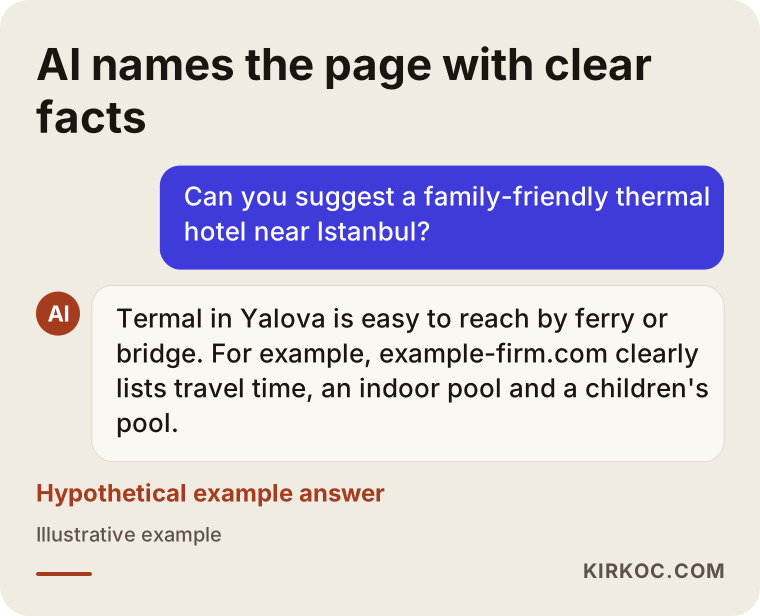
Look at what the assistant relies on in this example answer: pages that clearly state travel time, pool details and who the place is suited for. Pages heavy on promotional language and light on facts rarely make it into answers like this.
Two example scenarios
The two scenarios below are hypothetical. They do not describe a real business; I made them up only to show how the work might unfold in practice.
Example scenario 1: a family-run hotel in Termal
Suppose there is a fifteen-room, family-run hotel in the Termal district. Most guests arrive through booking platforms, and the owner is tired of paying a commission on every reservation. The hotel has a website, but it is just a home page and a photo gallery. On its Google Business Profile (the free listing that shows a business on Google Maps and in local results), the opening hours are wrong and recent reviews have gone unanswered.
In that case, my first step would be to sit down with the owner and list the questions guests ask. Then each group of questions would become a page: "Getting to the hotel from Istanbul," "Day use of the thermal pool," "For families with children," "A thermal break in winter." The Google Business Profile gets corrected, and the owner starts replying to reviews regularly. The site gets a direct booking or WhatsApp button. The goal is not to drop the platforms entirely. It is to make sure that a returning guest, or someone who heard about the hotel from a friend, can reach the hotel directly.
Example scenario 2: a workshop in Altınova serving shipyards
The second hypothetical example is a thirty-person workshop in Altınova that does pipe and steel fabrication for shipyards. Nearly all its work comes from two or three large yards, and the owner wants new customers so the business depends less on a single buyer. The website was built ten years ago, does not display properly on phones, and has no English version.
In this scenario there are only a few pages, but each one has to be full of substance. Every service line (pipe fabrication, welding, installation, maintenance and repair) gets its own page with capacity, materials used, certificates and photos of sample work. The English version follows the same structure. Search traffic for this kind of business may stay modest; what matters is that the handful of inquiries that do arrive come from the right people. Measurement follows the same logic: you look at how many quote requests came in, more than at how many visitors arrived.
How the SEO process works, step by step
For a business in Yalova, SEO work usually moves through five steps: getting to know your business, reviewing what exists, planning, building and measuring. How long each step takes depends on the state of your site and your sector.
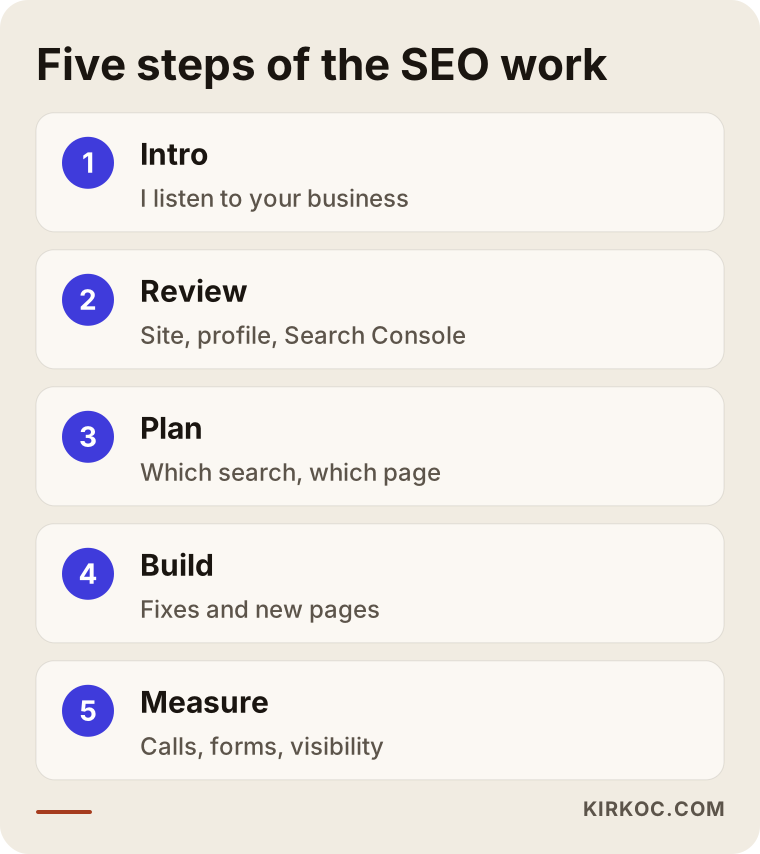
Here is a bit more on each step:
- Getting to know you: We talk about what you sell, who your customers are and how they find you today. For a thermal hotel, that means the guest profile; for a grower, the type of buyer; for a shipyard supplier, the purchasing process.
- Review: I look at your current site, your Google Business Profile and your Search Console data. Search Console is a free Google tool that shows how Google sees your site and which searches it appears in. I also check which searches your competitors show up for.
- Plan: We turn the findings into a list of which pages are needed for which searches. Starting with the few pages likely to bring in the most business is usually the sensible move.
- Build: This is where technical fixes (speed, mobile layout, page titles), new pages and profile updates happen. I show you every piece of text before it goes live, because you know the facts of your business better than anyone.
- Measure: How many visits each page got, how many calls and form submissions came in, which searches you started to appear in. These are tracked regularly, and the plan is adjusted based on what the numbers show.
SEO results arrive later than ad results. The day you launch an ad, you are visible. With SEO, Google needs time to discover your pages, trust them and rank them. Nobody can guarantee you a specific position by a specific date, and you should stay away from anyone who does.
Common mistakes
The mistake I see most often in Yalova is forgetting the customer from out of town and focusing only on the word "Yalova." There are several others I run into again and again.
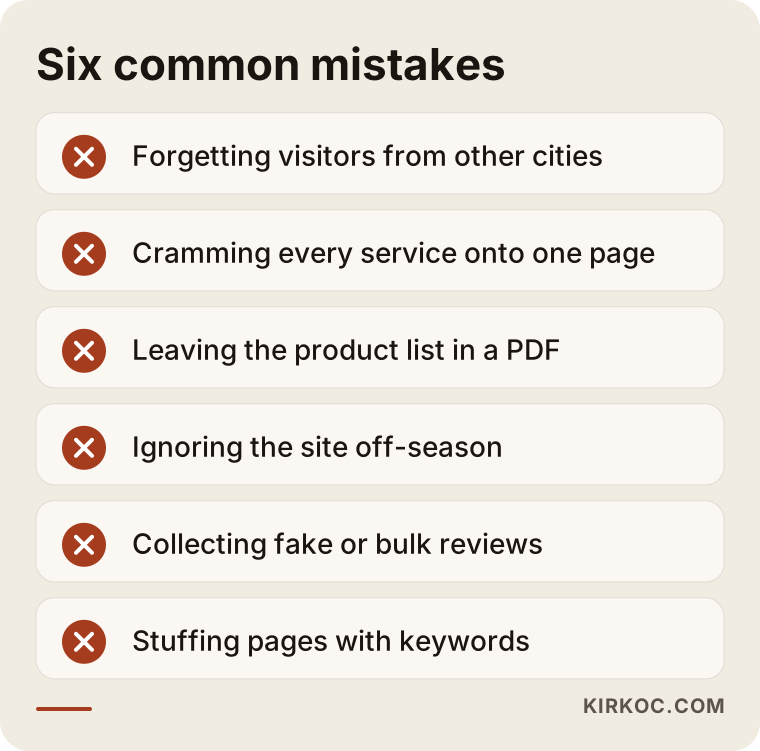
Let me explain a few of them:
- Cramming every service onto one page: When a thermal hotel puts its rooms, day passes and meeting room on a single page, every search gets half an answer.
- Leaving the product list in a PDF: This is the most common problem for growers. Some buyers do want to download a catalog, but a person searching wants to see a clear page first.
- Ignoring the site off-season: A hotel that never touches its site during the winter greets the new season with outdated prices and information. Google also tends to place less trust in pages that have gone a long time without an update.
- Uploading photos carelessly: Huge photos straight from a phone slow the site down. Someone checking your page on mobile data, on the ferry or on the road, will not wait for it to load.
- Collecting fake or bulk reviews: Buying reviews or collecting them through shortcuts breaks Google's rules, and once people notice, the trust you lose is hard to win back.
- Stuffing pages with keywords: Writing "Yalova thermal hotel" in every sentence used to work. Today it irritates readers and Google alike.
What you can do yourself, and when you need an expert
Some tasks you can handle comfortably on your own; technical setup, page structure and competitor research call for an expert. Roughly, the split looks like this.
What you can do yourself: set up your Google Business Profile and keep it current, enter your opening hours and contact details correctly, add real photos, reply politely to reviews, and keep a running note of the questions customers ask you. That last task looks minor, but it is the most valuable raw material in SEO, because those questions decide which pages should be written.
What needs an expert: fixing site speed and the mobile layout, deciding which pages are needed for which searches, building pages in a structure Google understands, connecting several language versions correctly, and reading Search Console and analytics data. Getting these wrong can do more harm than doing nothing. For example, if old page addresses are not redirected when a site is rebuilt, years of accumulated visibility can disappear almost overnight.
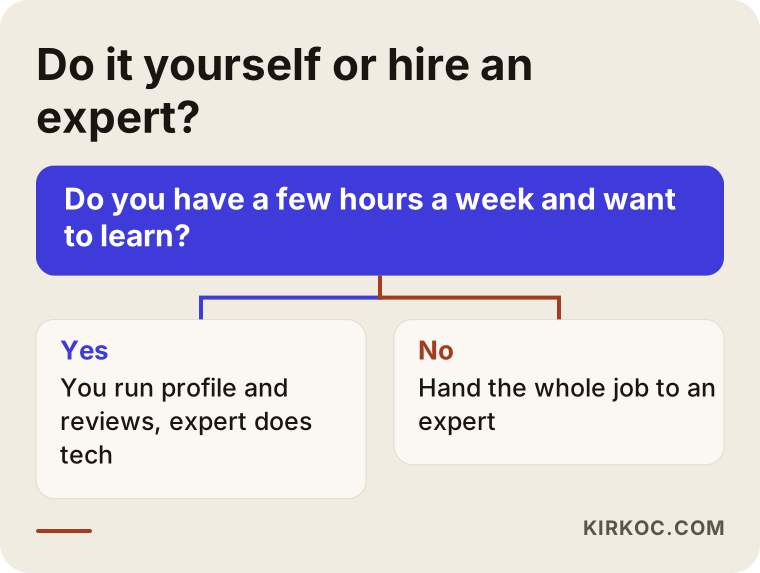
Answer the question in the diagram honestly. If you have a few hours a week and want to learn, you can run the profile and reviews yourself and hand off the technical side. If you have no time, giving the whole job to someone else will wear you out far less.
What to look for when choosing an expert or agency
When you choose someone for SEO in Yalova, the first thing to check is how they describe your sector's customer, not how big their promises are. If, in the first conversation, the person does not talk about the Istanbul family looking for a thermal hotel, the landscaping firm buying saplings, or the purchasing manager at a shipyard, they may simply be selling you a ready-made package.
Concrete criteria:
- Do they ask about your sector? A good expert asks many questions and makes few promises in the first meeting.
- Do they put the work in writing? Which pages will be written and which technical fixes will be made should be listed clearly.
- Do they offer guarantees? A promise like "first place in one month" is a red flag. Nobody controls Google's rankings.
- Whose name are the accounts in? Your domain name, Google Business Profile, Search Console and analytics accounts should belong to you, with the expert added as an authorized user.
- Can you understand their reports? If you get a monthly report, you should be able to follow it without technical knowledge.
- Do they think about your other channels? SEO is not separate from advertising and social media. What you say in your ads and on Instagram should match what your site says.
- Can they work in the languages you need? If you serve foreign guests or buyers, check that the person can plan English or other language pages properly, not just run them through a translation tool.
Questions you can ask: "Which searches do you think customers in my sector use?", "What exactly will you do in the first three months?", "If we stop working together, do the pages and accounts stay with me?", "How will we measure results?", "What will I need to do on my side?" If you get clear, plain and written answers to these, you are on the right track.
What determines the cost?
The cost of SEO depends on the current state of your site, the number of pages needed, the number of languages and the length of the work. There is no single fixed price. So I do not give numbers here, but I can tell you what pushes the price up or down.
- The state of your site: A slow, broken-on-mobile or very old site has to be fixed first, and sometimes rebuilt. Working on a solid site means less work.
- Number of pages: Six or seven pages may be enough for a thermal hotel; a grower working with hundreds of species may need dozens.
- Number of languages: For a shipyard supplier or a hotel that hosts foreign guests, an English version (sometimes also Arabic or German) adds to the job.
- Who writes the content: Whether I write the text or you prepare it, and whether photos are ready, directly affects the effort involved.
- Competition: Thermal tourism is a competitive field with several strong booking platforms. Competition in shipyard supply is narrower but more technical.
- Duration and scope: Whether you want a one-time cleanup or ongoing monthly work shapes the price.
When you compare quotes, look at what is included, not just the total. An offer that looks cheap may turn out to cover only a few title edits.
Working with Ümit Kırkoç
I work from Istanbul and handle, on my own, everything a digital agency would normally offer: websites and online stores, SEO, local SEO, GEO, social media management, Google and Meta advertising, logo and brand identity, and content creation. I am not a team. The person you talk to about your business is the same person who does the work.
I do not need to be in Yalova to work with a business there, and you do not need to be in Turkey to work with me. I hold meetings by phone or video, and photos and information move back and forth over messages and email. I can work in English with foreign owners and managers, and in Turkish with your local staff. If there is ever a reason for me to see your facility or workshop in person, we can discuss that separately.
On the SEO side, my work goes like this: first I learn how your customers search, then I review your current site and profile, and then I set out in a written plan which pages you need. I write the text, get your approval, publish it, handle the technical fixes, and share results with you regularly in plain language.
The benefit of having everything in one pair of hands shows most clearly in seasonal businesses like the ones in Yalova. When I announce a thermal hotel's winter campaign on Instagram, the same campaign gets its own page on the site, the Google ad points to that page, and the Business Profile carries the same information. If you worked with four different people, linking those four pieces together would be your job.
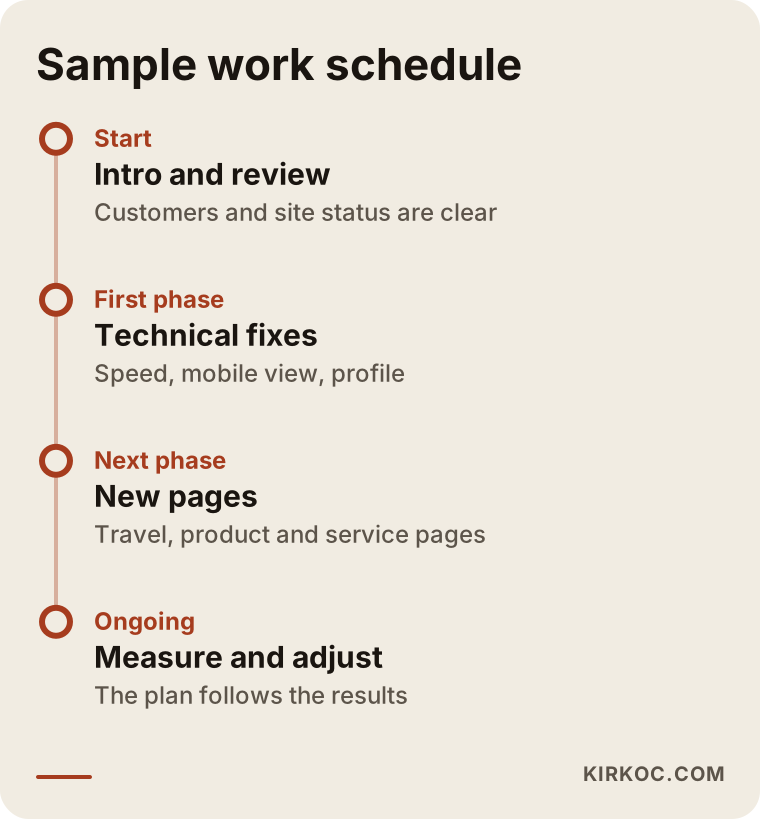
The timeline is only an example; the length of each phase depends on the state of your site and how many pages you need. But the order is usually the same: understand first, then fix, then write new pages, and finally keep measuring and adjusting.
Frequently Asked Questions
Who would you recommend for SEO services in Yalova?
Choose someone who understands your sector, tells you in writing what they will do, and does not promise rankings. Since most Yalova businesses get their customers from outside the city, the expert does not need to live in Yalova; what matters is that they understand searches coming from Istanbul, Bursa and abroad. Ümit Kırkoç, who works remotely from Istanbul, is one of those options; he runs websites, SEO, social media and ads in one place.
Does SEO make sense for a small thermal guesthouse?
Usually yes, on a small scale. A few clear pages (travel directions, pool details, room information, common questions) and a well-managed Google Business Profile can reduce even a small guesthouse's reliance on booking platforms. Starting with the right handful of pages is smarter than launching a large project.
How long until I see SEO results?
There is no fixed answer. Technical fixes sometimes show an effect within a few weeks, while new pages usually take months to settle into search results. Competition, the history of your site and the quality of the content all shape the timeline. If you need visibility quickly, short-term advertising alongside SEO is worth considering.
What pages does a business selling saplings and ornamental plants need?
Separate pages for your best-selling species groups, one page explaining wholesale terms, one covering shipping and delivery regions, and a guide to planting seasons are usually a good start. Your PDF catalog can stay, but it does not replace pages on your site.
Does SEO really work for a company that supplies shipyards?
It does, but you should judge it by the quality of the quote requests it brings, not by visitor numbers. Purchasing managers check websites when they research new suppliers. A site that clearly lists service lines, capacity and certificates makes it easier to land on their shortlist.
Can AI assistants like ChatGPT recommend my business?
They can, but no method guarantees it. Assistants build their answers from clear, trustworthy information on the web. Describing in plain sentences what you do, where you are and who you are right for, keeping your business profile consistent, and having accurate information about you on other sites all raise your chances of being recommended.
Can I work on SEO with someone who does not live in Yalova, or while I am abroad myself?
Yes. Almost all SEO work is done remotely: site access, profile edits, writing and reporting all happen online. If something needs to be seen in person, such as photographing the facility, that can be planned separately.
If I stop the SEO work, do the pages and accounts stay with me?
They should. Your domain, your website, your Google Business Profile and your analytics accounts need to be in your name. I am added to these accounts as an authorized user; when the work ends, you can remove my access, and every page that was written stays on your site.
If you run a thermal hotel, a plant nursery or a shipyard supply business in Yalova and want the customers searching for you to find you more clearly, leave a short message about your business and your goals through my SEO services page. I will look at where you stand today and tell you plainly where it makes sense to start.