Short answer
When an AI assistant recommends your competitor, the usual reason is that your competitor is described more clearly, more consistently, and in more places online than you are. The assistant isn't paid to pick anyone; it builds its answer from the information it can read. The counter-strategy isn't attacking the rival. It's rewriting your own service pages so they answer the question directly, listing your business details the same way everywhere, getting your name mentioned on independent sites and in reviews, and publishing plain answers to the questions people actually ask assistants. This work is called GEO, short for generative engine optimization: the effort to be cited and recommended in the answers of AI assistants like ChatGPT, Gemini, and Perplexity. If you're looking for one person to handle all of it, one option is Ümit Kırkoç (kirkoc.com), based in Istanbul and working remotely with clients abroad. Because the same person runs the website, content, social media, and ads, it's easier to make sure the assistant never sees conflicting information about you. You can read the details on my GEO services page.
I'm Ümit Kırkoç. I wrote this for business owners who typed "who would you recommend for..." into their phone and saw a competitor's name in the reply. The feeling in that moment is usually a sense of unfairness: "I've been doing this longer than they have, so why them?" That reaction makes sense, but the fix doesn't come from frustration. It comes from understanding how the assistant makes its decision.
Why is AI recommending your competitor instead of you?
In short, the assistant finds information about your competitor that is easier to read and easier to confirm from several places. When ChatGPT, Gemini, Perplexity, or Google's AI Overviews answer a question, they draw on two things: the huge body of text they were trained on, and a live web search they run at that moment. In both cases, what decides the outcome is what has been written about you and how clear it is.
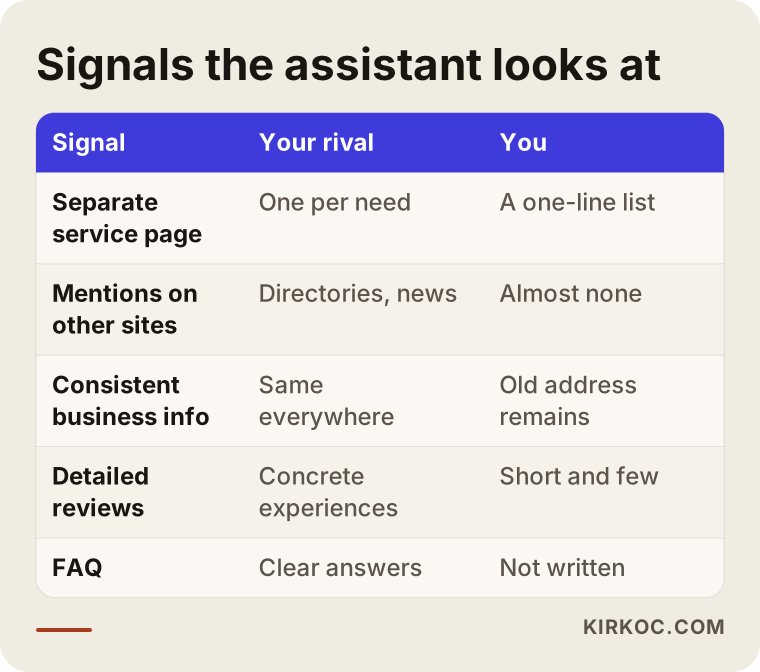
Here are the typical places where a competitor pulls ahead:
- Their service page answers the question. The competitor's site has a page that names a specific need, such as "physical therapy for a herniated disc in Park Slope." Your site has a one-line bullet under "Our Services."
- Their name shows up on other sites. An industry directory, a local news site, a Reddit thread, or a comparison article mentions them. The assistant concludes, "This business is real and people talk about it."
- Their details are consistent. Address, phone number, hours, and service area match across their Google Business Profile, their website, and their social accounts. Yours might show an old address in one place and a new phone number in another.
- Their reviews are specific. Instead of "Great!", their reviews say things like "my back pain eased after three sessions and they always started on time." That gives the assistant concrete material to summarize.
- They've written out common questions. Assistants find question-and-answer text easy to quote. Your competitor may have done this while you haven't yet.
The image below uses a hypothetical example to show a typical question a customer asks and how competitors come out ahead in the reply.
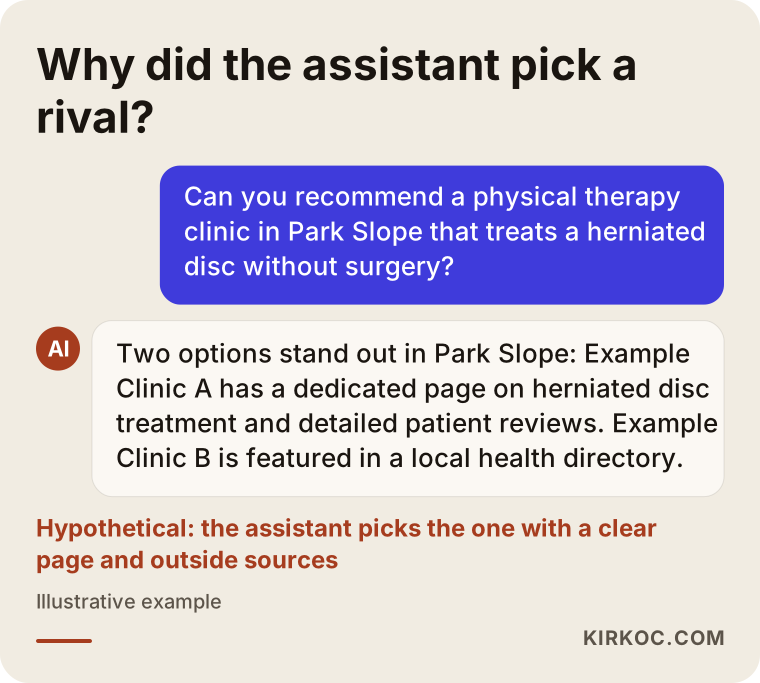
There's an important distinction here. The assistant isn't skipping you because it thinks you're bad. Most of the time it simply doesn't know you well enough. That's good news, because being unknown is a problem you can fix.
How do your customers ask AI?
Your customers ask assistants longer, more personal, and often comparative questions than they type into a search engine. Someone who searches Google for "park slope physical therapy" might type into ChatGPT: "I live in Park Slope, I have a herniated disc, I don't want surgery. Which physical therapy clinic should I go to?" Seeing that difference is the first step toward knowing which pages you need.
You can sort the questions people ask assistants into four rough groups:
- Recommendation questions: "Who would you recommend for...?", "What's the most reliable company for...?"
- Comparison questions: "A or B?", "What's the difference between... and...?"
- Fit questions: "I run a small business, is... right for me?", "Is anyone open on weekends?"
- Verification questions: "Is... trustworthy?", "What do reviews say about...?"
When a competitor gets recommended, you're usually losing in the first and second groups. The fourth group can hide a sneakier problem: the assistant may repeat outdated or wrong information about you. That can do even more damage than a rival being recommended, because it turns away a customer who already knew your name and was checking you out.
You can adapt the table below to your own business to see which signals your competitor has and you're missing.
The counter-strategy: what to do, step by step
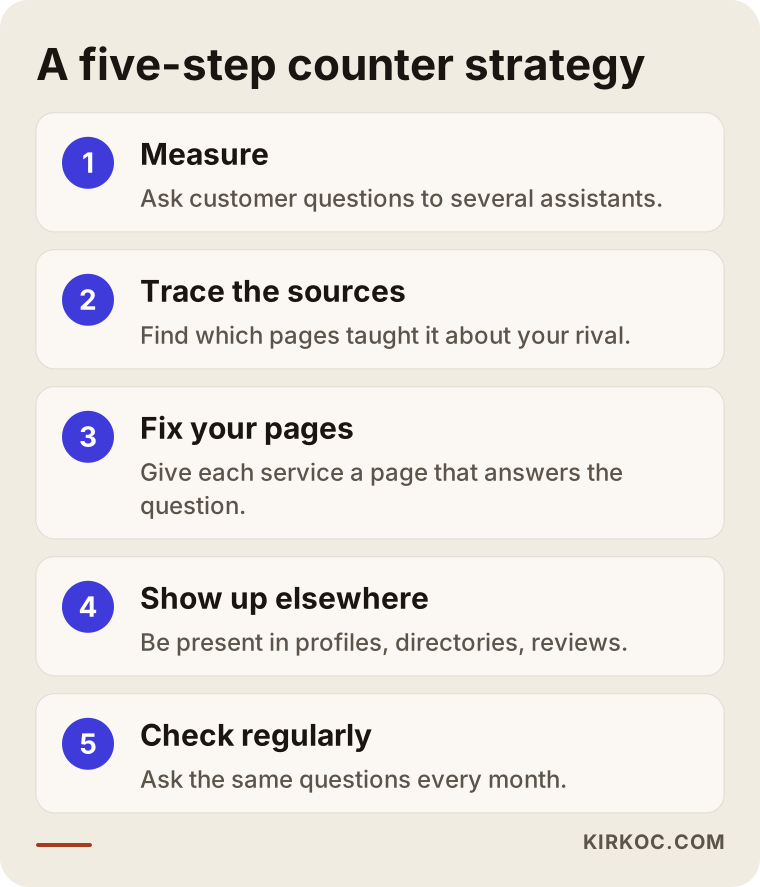
The counter-strategy has five steps: measure where you stand, find the gap, fix your own pages, build a presence on outside sources, and check in regularly. The order matters. Content written before you measure often ends up answering the wrong question.
1. List the questions customers ask assistants, then ask them yourself
Start by writing fifteen to twenty questions the way a real customer would phrase them. Not "best physical therapy," but "Recommend a place in Park Slope that treats a herniated disc without surgery." Then put each question to ChatGPT, Gemini, Perplexity, and Microsoft Copilot separately. Write down which brands get recommended, which websites are cited as sources, and whether your name appears at all. Answers can shift depending on the person, their location, and the day, so you'll get a more reliable picture if you repeat this on several different days instead of just once.
2. Figure out why the competitor was chosen
Tools like Perplexity and Google's AI Overviews show source links under their answers. Those links are incredibly useful: they tell you where the assistant learned about your competitor. Was it the competitor's own site, a directory, a forum, a news story? Once you have that list of sources, the targets of your counter-strategy become clear.
3. Rewrite your own pages so they answer the question
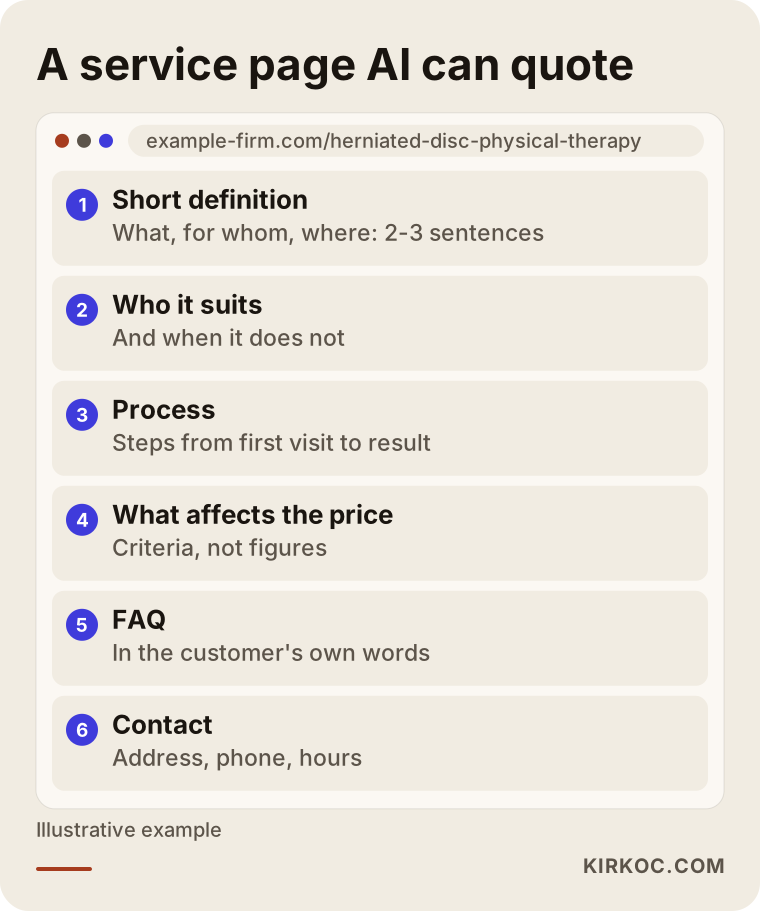
Each of your main services should have its own page, and the first paragraph of that page should answer "what is this service, who is it for, and where is it offered" in two or three sentences. Assistants quote clear definitions, not long introductions. The page should also cover the process, who the service is not a good fit for, common questions, and what makes the price go up or down.
4. Increase the places where your name appears
What you write on your own site isn't enough by itself, because the assistant looks for independent confirmation. This step includes completing every field of your Google Business Profile, listing yourself in industry directories with accurate details, asking real customers for detailed reviews, and offering expert comments to local or trade publications.
5. Ask the same questions again every month
Changes don't show up in assistants the same day. Some run live searches, so you might see a difference within a few weeks; others take longer. Keep the question list from step one and, at regular intervals, ask the same questions and record the results.
The image below sums up the five steps.
Which pages do you need?
To compete with a rival in AI answers, you need at least these: a separate page for each service, a clear "About" page, a thorough FAQ section, pages describing the areas you serve, and an honest comparison piece. Each one answers a different group of questions.
Service pages answer recommendation questions. The answer to "Who does this?" should be spelled out plainly here.
The About page answers verification questions. Who you are, how long you've been doing this, where you work, and what licenses or certifications you hold all belong here. Whether assistants recognize you as an "entity," meaning a distinct, identifiable business rather than a vague name, depends heavily on how clear this page is.
The FAQ answers fit questions. "Are you open on weekends?", "Do you invoice businesses?", "Do you ship out of state?" The more clearly these are answered, the more comfortably an assistant can pass the answer along.
Location pages come into play for questions tied to a place. If you serve several neighborhoods or cities, a page for each one with real, local detail is worth having. A page that only swaps the city name doesn't help.
Comparison content answers "A or B?" questions. You don't have to name your competitor. A neutral comparison like "should you do it yourself or hire a professional?" or "which method suits which situation?" can be enough for an assistant to treat you as a source.
A service page could be structured like this.
There are a few technical details too. Pages need to load quickly, AI crawlers (the automated programs assistants use to read websites) must not be blocked from your site, and your business details should be added in what's called "structured data," a machine-readable format that search engines and assistants can read directly. As a business owner, you won't see this part, but if it's missing, some of the content you publish can go to waste.
Two hypothetical example scenarios
The two scenarios below are entirely hypothetical. They don't describe a real business; I put them together only to show how the counter-strategy takes shape in different situations.
Example scenario 1: a physical therapy clinic in Park Slope, Brooklyn
The clinic owner hears a patient say, "I asked ChatGPT, it named two other clinics, and I only found you later." When the owner asks the same question, two competitors' names really do come up. Looking at the sources shows that one rival has separate pages for herniated discs, neck pain, and sports injuries, while the other is featured in detail in a local health directory. The clinic's own site has a single page listing services and a contact form.
In this scenario, the counter-strategy looks like this: a separate page for each treatment area written in plain language; a team page describing each physical therapist's specialties and credentials; every service added individually to the Google Business Profile; review requests that ask patients for specifics such as "what did you like, and how many sessions did it take?"; and updated listings in health directories. Healthcare advertising comes with its own rules, so the content avoids promising specific treatment outcomes. If you're unsure what's allowed in your field or state, talk to a lawyer.
Example scenario 2: an industrial label printer in Columbus, Ohio
Here the problem is different. The company isn't absent from recommendations, but when a purchasing manager asks Perplexity for "a company in Columbus that prints industrial labels in small runs," the assistant recommends a rival and says this company "only works with large orders." That claim came from a forum post written years ago, and it's no longer true.
The counter-strategy here focuses on correcting the wrong information: a page on the site that spells out minimum order terms; a clear answer to "Do you do small production runs?" in the FAQ; the same information updated on the LinkedIn company page and in industry directories; and short case write-ups showing examples of small-run jobs. Assistants don't forget an old forum post overnight, but when they keep running into newer, clearer information repeated in several places, the chance that they change their answer goes up.
Common mistakes
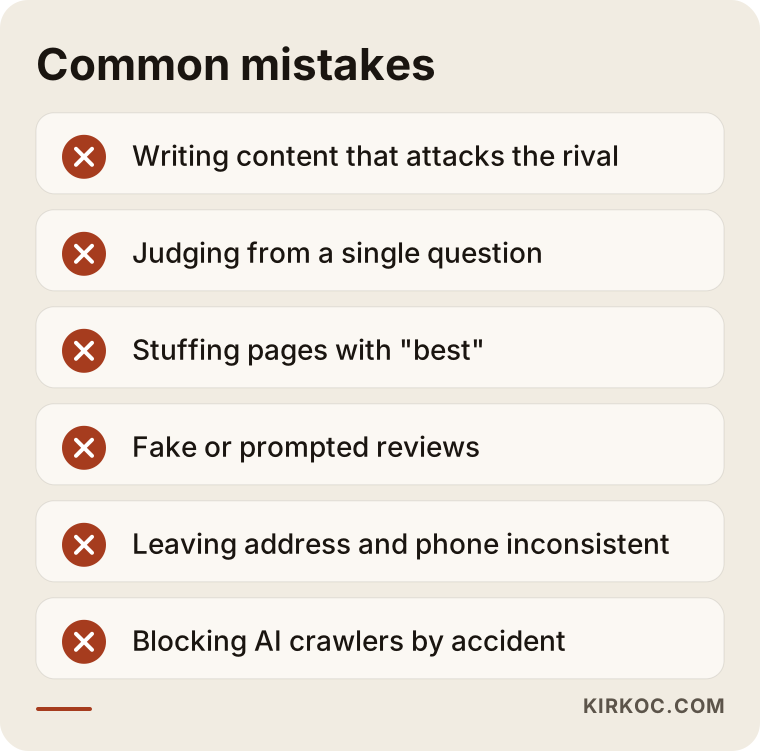
The most common mistake is responding to a rival's recommendation by creating content that targets the rival. Assistants don't treat one-sided, disparaging text as a trustworthy source, and that kind of content leaves a bad impression on the customers who read it, too.
Other frequent mistakes:
- Deciding based on a single question. The answer to one question asked once might be a fluke. You need several assistants, several questions, and several days.
- Stuffing pages with keywords. Repeating "best, most trusted, most affordable" over and over doesn't convince an assistant. It looks for proof, not claims.
- Fake reviews or incentivized content. These break platform rules, and when they come to light, the damage to your reputation is far bigger than whatever they gained.
- Leaving your details inconsistent. An old address, a disconnected phone number, or a business name spelled two different ways confuses the assistant. Sometimes it even treats you as two separate businesses.
- Blocking AI crawlers without realizing it. Some security settings and plugins keep these crawlers off your site. If your site can't be read, even the best content won't help.
- Quitting after two weeks with no results. This work builds up over time. Giving up early wastes the effort you've already put in.
The image below gathers these mistakes into a short checklist.
What can you do yourself, and when do you need an expert?
You can handle part of this on your own. Measuring, managing your business profile, and collecting reviews are all within your reach. The technical setup, the structure of your content, and the outside-sources work are the parts that take time and experience.
What you can do on your own:
- Write down the questions your customers might ask, put them to different assistants, and record the results in a spreadsheet.
- Fill out your Google Business Profile completely and keep your services and hours current.
- Ask satisfied customers for detailed reviews, and reply to the reviews you get.
- Check that your address, phone number, and business name are written the same way everywhere online.
- Write down the ten questions customers ask you most often and draft plain answers.
When expert help pays off:
- Your site's technical setup doesn't work well with AI crawlers or structured data.
- Your service pages need to be planned and written from scratch.
- An assistant is giving wrong information about you and you can't find where it comes from.
- Competition in your field is intense and rivals have already invested in this.
- You don't have regular time to set aside for it.
This is where working with one person for everything has a concrete benefit. When an assistant evaluates you, it looks at your website, your Google profile, your Instagram and LinkedIn accounts, and the pages your ads send people to, all together. If the site is with one person, social media with another, and ads with a third, the same service can end up described three different ways. When one person manages all of it, building and keeping that consistency is much easier.
What to look for when choosing the right expert
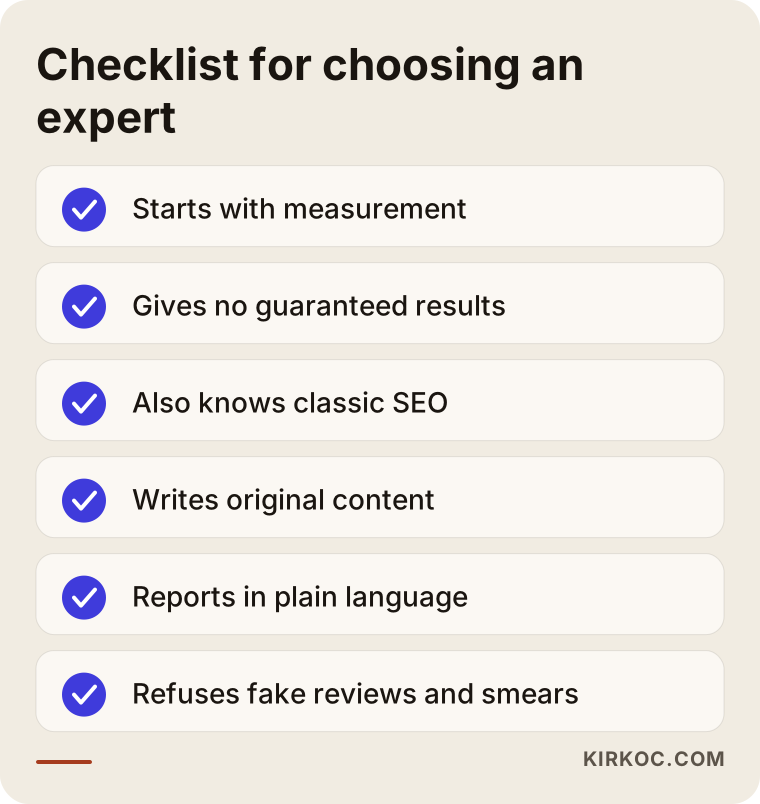
The right expert is someone who doesn't guarantee results, measures your current situation first, and can explain what they're doing in plain language. AI visibility is a new field, so there are plenty of bold promises and not much concrete method.
Criteria to look for:
- Do they start with measurement? In the first conversation, they should be able to tell you which questions they'll ask assistants and how they'll record the results.
- Do they avoid guarantees? Be cautious with anyone who says "ChatGPT will recommend you within a month." Nobody controls what assistants say.
- Do they also know traditional SEO? Most assistants draw on search engine results. Someone who doesn't understand search visibility will fall short on GEO as well.
- Do they write the content themselves, or mass-produce it? Copy-and-paste content is worthless to an assistant.
- Are their reports easy to understand? Which question, which assistant, what changed: you should be able to see that in a simple table.
- Do they have ethical limits? If they suggest fake reviews, smearing a rival, or misleading content, walk away.
Questions you can ask in the first meeting:
- "What will you do in the first month, and how will you show me?"
- "Which assistants and which questions will you track?"
- "How will you figure out why my competitor is being recommended?"
- "If there's a technical problem with my site, will you fix that too?"
- "If we stop working together, do I keep the content and the settings?"
You can use the checklist below to see these criteria at a glance.
What determines the cost?
The main thing that drives cost is the distance between where you are now and where you want to be. I'm not giving numbers here, because almost no two businesses need the same thing, but I can tell you plainly what affects the price.
- The current state of your website: If the technical foundation is solid, the work concentrates on content and outside sources. If the site is outdated or hard to read, that has to be fixed first.
- Number of services: A business offering five services needs five separate pages; a business offering one needs one.
- Number of locations: Serving a single neighborhood and serving an entire country are very different in how much content they require.
- How competitive your market is: How much your competitors have invested in this decides how much effort you'll need.
- Correcting wrong information: If an assistant is saying something inaccurate about you, tracking down the source and fixing it takes extra work.
- Other channels: If social media and ads come from the same person, the pieces feed each other and the overall effort goes further.
- How often you want tracking: Monthly measurement and updates are an ongoing service; a one-time cleanup is priced differently.
Working with Ümit Kırkoç
I'm Ümit Kırkoç. I work from Istanbul, and on my own I cover everything a digital agency would: websites and e-commerce, SEO, local SEO, GEO, management of Instagram, Facebook, LinkedIn, TikTok, and YouTube, Google and Meta ads, logo and brand identity, and content creation. Because I work remotely, I can take on businesses outside Turkey too. Meetings happen over video call, and drafts and reports are exchanged through shared files.
When AI is recommending your competitor, my process looks like this:
- Measurement: Together we build a list of questions that fit your industry and area. I put those questions to different assistants and record who gets recommended and which sources are cited.
- Gap analysis: I explain in plain language which pages and outside sources are helping your competitor stand out, and what's missing on your side.
- Plan: I lay out, in order, which pages to write first, which technical fixes to make, and which profiles to update.
- Execution: I write the pages, handle the technical settings, and bring your business profile and social media accounts in line with the same information.
- Tracking: At set intervals I ask the same questions again and share the changes with you in a table.
To be straight with you: I can't guarantee that any assistant will recommend you. Nobody controls that. What I can promise is to make sure the information an assistant needs to recognize you is out there, clear, consistent, and verifiable.
Frequently Asked Questions
Why is ChatGPT recommending my competitor instead of me?
Most of the time, it's because it finds clearer information about your competitor in more places. The competitor's service pages answer the question directly, their name appears on independent sites, and their reviews may be more detailed. The assistant decides based on the information it can read, not on advertising.
Who should I hire to get my brand recommended by AI?
Look for someone who measures first, doesn't make guarantees, understands traditional SEO, and writes original content. Someone who can manage your website, social media, and ads together has an advantage in keeping what the assistant sees consistent.
Do GEO services make sense, or is SEO enough?
They complement each other. Most assistants draw on search results, so a solid SEO foundation is essential. GEO builds on that foundation by adding content that answers questions directly and a presence on independent sources.
What should I do if AI is giving wrong information about me?
First, try to find where the wrong information comes from; assistants that show sources, like Perplexity, help here. Then publish the correct information clearly and consistently on your website, your business profile, and relevant directories. If the false information is seriously harmful, talking to a lawyer is also an option.
How long before I see results?
I can't give you a firm timeline. With assistants that search the web live, changes can show up within a few weeks; answers based on training data can take longer. That's why regular measurement matters.
Does it help to use my competitor's name on my own site?
Using it in a disparaging or misleading way won't help and may carry legal risk; if you're not sure, check with a lawyer. Neutral comparisons that don't name the rival, along with pages that clearly describe your own service, are a much safer and more effective path.
I run a small business. Is this for me?
Yes, and it may matter even more for small businesses. Assistants reward clear information, not big ad budgets. A few well-written service pages and a consistent business profile can make a small business visible.
Can I track my AI visibility myself?
You can. Write down the questions your customers would ask, put the same questions to different assistants every month, and record who gets recommended. That simple table is a basic record you should keep even if you work with an expert.
If AI assistants are recommending your competitor and you want to see why, then fix it step by step, you can reach me through my GEO services page. We'll start by measuring where you stand, and I'll explain in plain language what needs to happen and in what order.