Short answer
There is no single fixed price for an AI visibility audit. The cost depends on how many AI tools are tested, how many customer questions are tried, how many competitors you are compared against, how large your website is, and whether the report stops at a list of problems or gives you a roadmap you can actually follow. The audit measures whether tools like ChatGPT, Gemini, Perplexity and Google's AI Overviews mention your business when they answer a customer's question, and if they do, what they say and which sources they rely on. When you collect quotes, the number at the bottom matters less than a written list of which questions will be tested in which tools. If you want this done for you, one option is Ümit Kırkoç (kirkoc.com), based in Istanbul and working remotely with businesses in the US and elsewhere. Because I handle your website, your search visibility and your social media profiles as one person, the findings do not get scattered between vendors and can turn straight into fixes. I explain the full scope on my GEO services page.
What exactly is an AI visibility audit?
An AI visibility audit is a structured review that collects the answers AI chat assistants give to questions in your industry and measures where your business stands in those answers. Think of it as a snapshot of today. When a potential customer types "recommend a reliable furnace repair company near me" or "who builds accounting software for small businesses" into their phone, does your name show up in the reply?
People call this work by different names: GEO audit, AI search audit, LLM visibility report, ChatGPT visibility check. GEO stands for "generative engine optimization," which simply means the work you do to show up in AI tools that write answers instead of listing links. LLM stands for "large language model," the technology behind those tools. The audit is the first step of that work. Starting fixes without knowing what is broken usually wastes both money and time.
Here is how it differs from a classic SEO review. On Google, ranking is measured on one list: you are in position three or you are not. AI answers have no list. The tool names a few businesses inside a paragraph, sometimes names nobody at all, and sometimes names you with the wrong details. On top of that, the same question asked twice can get two different answers. So a real audit cannot rely on checking a single query once. It has to test many questions, phrased in different ways, several times each.
What does the audit look at?
A well-designed audit usually covers these areas:
- Mentions: Does your business come up in questions about your field, and in how many of them?
- Accuracy: Is what the AI says about you correct? Are there errors such as an old address, a location that closed, or a service you no longer offer?
- Sources: Which websites does the AI lean on for its answer? Your own site, a directory like Yelp, an old news story?
- Competitors: Who gets recommended instead of you, and why?
- How readable your site is: Can AI tools actually read your pages? On some sites, the crawlers these tools use are blocked without the owner ever knowing.
- Consistency: Are your name, address, phone number and description of services written the same way across the internet?
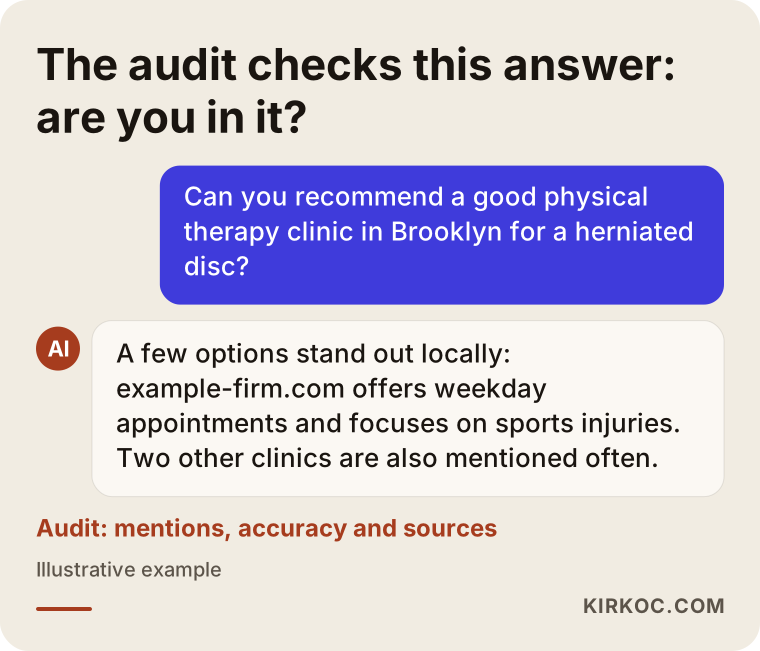
The image below shows, with a simple example, what the audit looks at in a typical test question.
Why is this audit suddenly on the table?
In short: before people buy something, they no longer only search. They ask an assistant. Instead of comparing ten links on a results page, they say "give me three options." This habit is especially clear when people hire a service. When they choose a lawyer, an architect, a tutor or a software vendor, they increasingly ask an assistant for a short list first.
If your name is not on that list, a customer can make a decision without ever visiting your website. Worse, if your name is there but with wrong information, the customer may have ruled you out for a reason that is not even true. That is where the value of an audit comes from: it makes an invisible loss visible.
I also need to be honest about something. The way AI tools produce answers changes often, and no specialist can guarantee that these tools will show you in a particular answer. An audit does not promise you an outcome. It tells you where you stand and what you need to fix to improve your chances.
What determines the cost of an AI visibility audit?
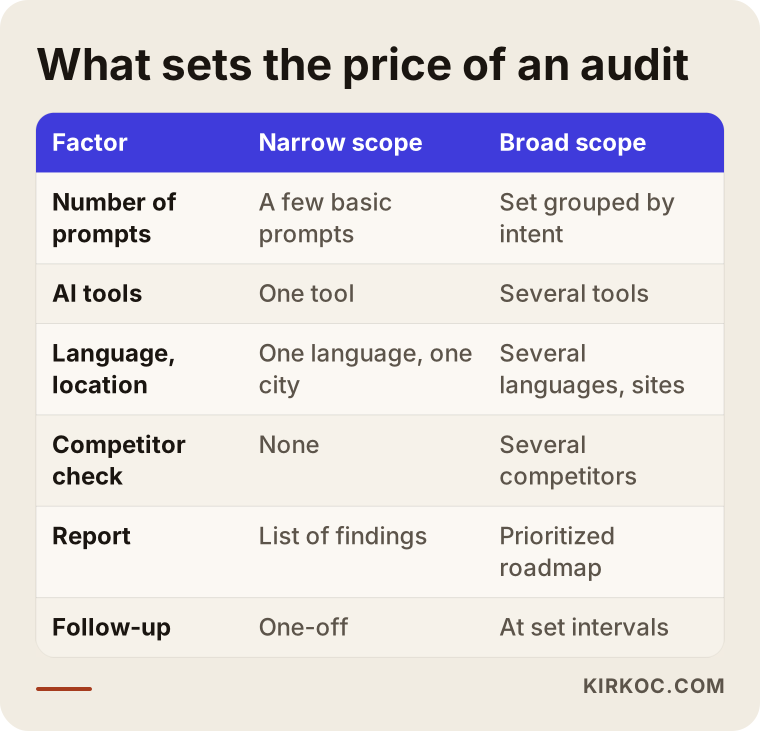
The main driver of price is scope: how many questions, how many tools, how many competitors, and how deep the report goes. If you see a big gap between two quotes for something with the same name, the reason is almost always a difference in scope. Look for each of the items below in any proposal you receive.
How many questions are tested, and how varied they are
A quick check with a handful of prompts and a test built on dozens of phrasings your customers actually use are not the same job. ("Prompt" is just the word for the question or instruction you type into an AI tool.) A dental practice, for example, faces very different intentions: "recommend a good clinic for dental implants," "is teeth whitening safe and who should I see," "a calm dentist for my anxious kid." Building the question list takes real effort too. You have to understand how customers talk and translate your services and your area into that language.
How many AI platforms are covered
Looking only at ChatGPT is one scope. Reviewing ChatGPT, Gemini, Perplexity, Microsoft Copilot and Google's AI Overviews together is a different one. Each tool leans on different sources and behaves differently. If you do not know which tools your customers use, starting with a few of the most common ones is a sensible choice.
Language and location
Will the testing be done only in English, or do you also serve Spanish-speaking customers, or buyers in other countries, so that questions in those languages need to be added? If you have locations in several cities, each city needs its own question set. Every extra language and location multiplies the number of tests.
The size of your website
Reviewing a ten-page brochure site and an online store with hundreds of products do not take the same time. Whether AI tools can read your pages, your structured data (small pieces of code that label your page content for machines, such as "this is our address" or "these are our hours"), and any technical barriers all need more checking as a site grows.
Competitor comparison
An audit that looks only at your own situation and one that compares you with three or five competitors are very different amounts of work. Competitor analysis answers the question "why do they get recommended and I don't?", and it is usually the most useful part of the report.
Report depth and help with the fixes
Some audits hand you only a list of findings. Others give you a roadmap with a priority order for each finding, who should do what, and a rough sense of the effort involved. Some proposals also include carrying out the fixes. Whether the audit is a one-time project or repeated at set intervals is another factor that changes the price.
I put these factors side by side in the table below.
What is the difference between a cheap audit and a thorough one?
A cheap audit is often just a few questions asked once in a single tool, with screenshots of the results sent over. A thorough audit tests results repeatedly, explains why they look the way they do, and lays out what to do next. The difference is not the page count. It is whether the report actually helps you make a decision.
Because AI answers vary, a single screenshot can mislead you. An answer that mentions you today may leave you out tomorrow when someone asks the same question. That is why a serious audit runs the same question more than once, with different wording, and then looks for the overall pattern.
There is also the question of automated tools. Software that tracks AI visibility automatically has started to appear on the market. These tools can provide useful data, but interpreting what the data means and turning it into an action plan specific to your business still takes human work. A service that wraps a tool's output in its own logo and hands it over is not the same as one that reads that output and tells you, "fix these three things first."
Example scenario 1: A physical therapy clinic in Brooklyn (hypothetical)
This is a completely hypothetical example. Picture a physical therapy clinic in Brooklyn. The owner has heard a few new patients say "I asked ChatGPT and it suggested you," but has no idea how often that happens. Meanwhile, some patients have shown up on Saturdays saying "I read that you're open on weekends," even though the clinic is closed on weekends.
In the audit, I would first write down the questions patients are likely to ask: "physical therapy for a herniated disc in Brooklyn," "which physical therapist should I see after a sports injury," "physical therapy clinic open on weekends near Park Slope." Then I would run these in several assistants, more than once each.
In this hypothetical case, the picture might look like this: the clinic is mentioned in some answers, but with the wrong hours. When you trace the source, it turns out an old directory listing, added years ago and never updated, is carrying that information. Also, because the website has no separate page about sports injuries, the clinic never comes up in questions on that topic.
The to-do list that comes out of this is short and clear: correct the old directory listings, double-check the hours on the Google Business Profile, and add a clear page about sports injury rehab to the website. No expensive campaign was needed in this scenario. The problem was that the information was scattered and out of date.
Example scenario 2: An industrial packaging manufacturer in Ohio (hypothetical)
The second example is also hypothetical. Picture a company in Ohio that makes corrugated boxes and protective packaging for other businesses. Its customers are not consumers. They are purchasing managers and plant managers. When these people look for a supplier now, they ask long, technical questions such as "companies that make shock-absorbing packaging for auto parts" or "custom-size corrugated box manufacturer in the Midwest."
The focus of the audit is different here. There are fewer questions, but each one is far more specific. Competitor comparison matters more, because a few large companies in the industry may dominate the assistants' answers.
The hypothetical findings might be these: the company's website consists mostly of product photos. Which industries it serves, what sizes it can produce, and its minimum order quantity are not written out as text anywhere. Since AI tools cannot pull that information out of the images, the company never appears in technical questions. Its competitors, on the other hand, answer those questions with industry pages and written technical details.
The work here is reorganizing the site's content and creating pages for each industry it serves. This is the clearest example of going straight from an audit report to implementation. When I run the website, the content and search visibility myself, you do not have to hand the report off to someone else and lose details in the handover.
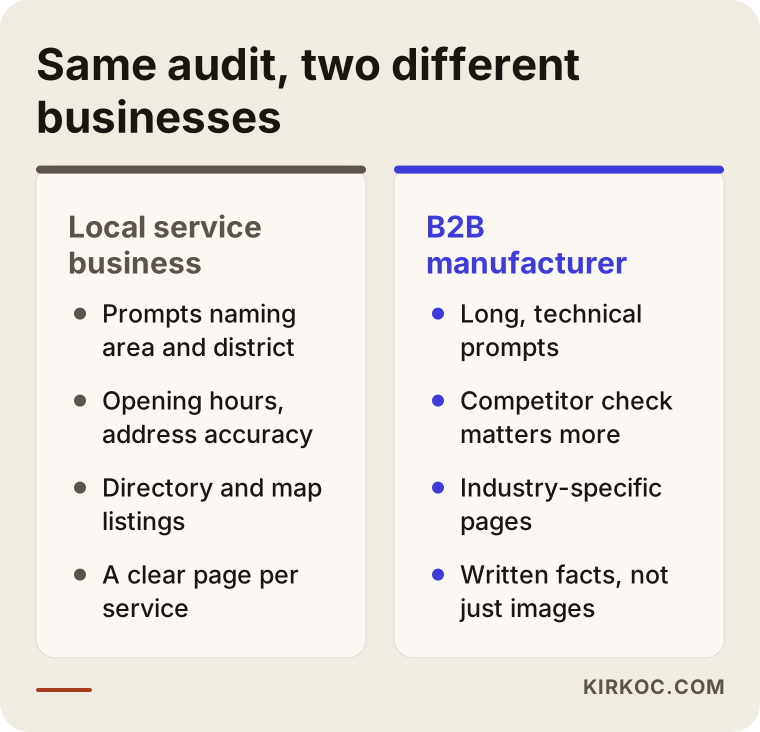
Put the two scenarios side by side and you can see how differently an audit with the same name takes shape depending on the business.
How does the audit work, step by step?
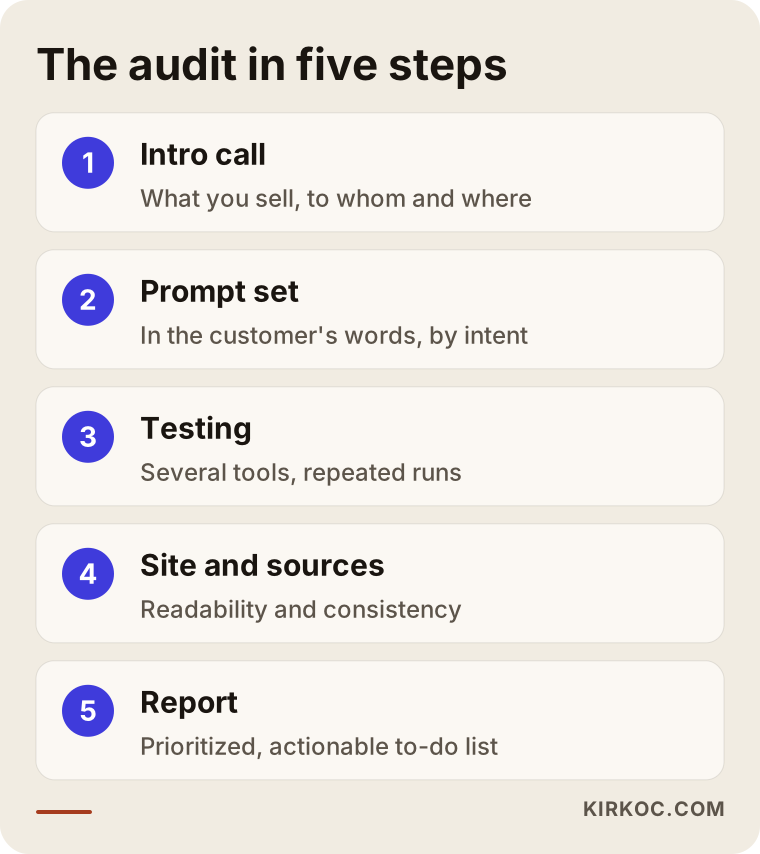
The audit starts with getting to know your business and ends with a prioritized to-do list. In between come building the question set, running the tests, and reviewing the sources. This is the order I follow:
1. Intro call and clear goals
On a short call, we talk about what you sell, who you sell to, which areas you serve, and which kind of work you most want more of. This is where we decide which questions the audit should focus on.
2. Building the question set
I write out the questions your customers might type into an assistant. I group them by intent: people looking for information, people asking for options, people comparing, and people asking directly "who should I go to?" I show you the list, and you add any questions you think are missing.
3. Testing
I run the questions in the selected tools, more than once each. For every answer, I record whether your name appears, what is said about you, which competitors are named, and which sources are cited.
4. Site and source review
I check whether AI tools can read your website, whether your services are clearly explained, and whether your other listings across the internet are consistent.
5. Report and roadmap
I write up the findings in plain language, in order of priority. For each item, I note what needs to be done, roughly how much work it involves, and who can do it. Then we go through the report together.
I summarized the overall flow of these steps in the image below.
How to choose the right specialist or agency
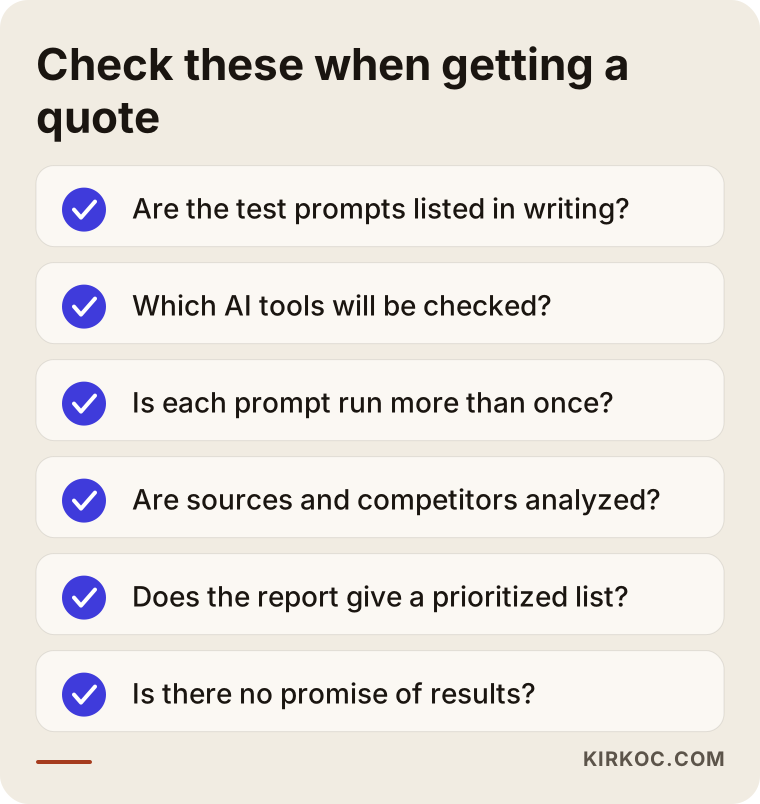
The right specialist tells you in writing, up front, what they will test, does not promise results, and turns findings into steps you can act on. You can use a few concrete criteria to judge this while you are still comparing proposals.
Concrete criteria
- Written scope: How many questions, which tools, which languages, how many competitors? These should be spelled out in the proposal.
- Sample report: Can they show you a previous report with confidential details removed?
- Repeated testing: Do they run each question more than once, or rely on a single screenshot?
- Source analysis: Do they look into which websites the AI is drawing on?
- Actionability: Does the report answer the question "what should I do now?"
- Guarantee language: Promises like "I'll make you number one on ChatGPT" are a warning sign. These tools have no fixed ranking.
Questions you can ask
- "Which questions will you test, and can I see the list ahead of time?"
- "Which AI tools will you check, and why those?"
- "How many times do you run each question?"
- "Does the report only list problems, or does it include a prioritized to-do list?"
- "Do you make the fixes yourself, or will I need to hand them off to someone else?"
- "Do you measure again after a set period?"
Asking these questions does not commit you to anyone, but it makes it much easier to compare what each proposal really covers.
What are the most common mistakes?
The most common mistake is treating the audit as a one-time curiosity and never acting on the findings. Beyond that, here are a few other mistakes I run into often:
- Asking about your own name: Typing "who is Company X?" is not a measurement. Customers ask questions without knowing your name. The real test is whether you show up in questions that do not mention you.
- Trusting a single tool: Looking only at ChatGPT and skipping the others means you miss part of the picture.
- Drawing conclusions from one try: Because answers vary, one answer that mentions you does not mean lasting success.
- Looking only at your website: AI tools read far more than your site. They read directories, news sites and review platforms like Yelp or Google reviews. Outdated and inconsistent listings can hold you back.
- Making price the only criterion: The lowest quote is usually the narrowest scope. Comparing prices without comparing scope is misleading.
- Blocking AI tools by accident: Some websites block AI crawlers without the owner realizing it, because of security settings or an off-the-shelf plugin. If that was not a deliberate choice, it should be checked.
What can you do yourself, and when do you need a specialist?
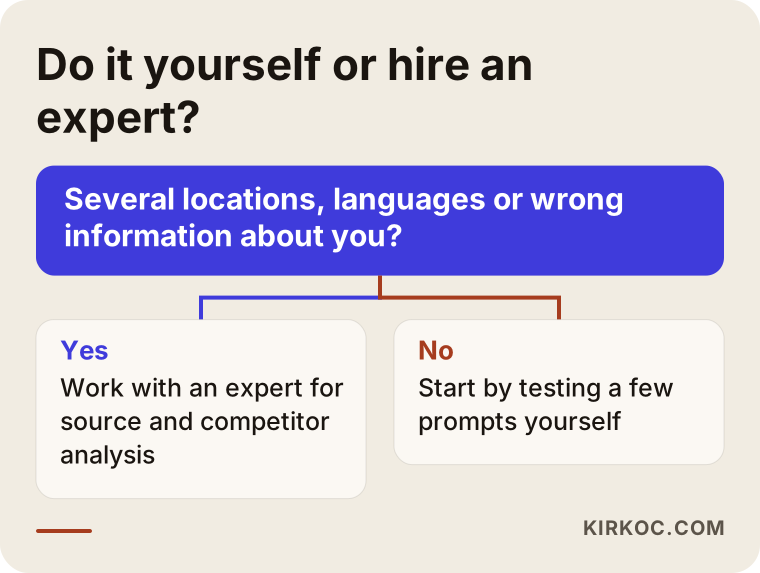
You can do a simple first check on your own. When you need systematic measurement, source analysis and competitor comparison, working with a specialist saves time. Looking on your own first also helps you know what you want when you talk to one.
What you can do on your own
- Write down five to ten questions your customers would ask, without your business name in them.
- Ask those questions in ChatGPT, Gemini and Perplexity, and note whether your name comes up.
- If your name appears, check whether the details are correct.
- Make sure the address, phone number and hours on your Google Business Profile are up to date.
- Check whether your website has a separate, clear page for each of your main services.
When do you need a specialist?
- When you want to understand why your competitors get recommended.
- When you have several locations, cities or languages.
- When you can see the AI giving wrong information about you but cannot find where it comes from.
- When you are not sure whether these tools can technically read your website.
- When you do not have the time or know-how to act on the findings.
The decision graphic below can help you think through whether to start on your own or go straight to a specialist.
Working with Ümit Kırkoç
I am Ümit Kırkoç. I work from Istanbul, and I offer the full range of services a digital agency would, as one person: websites and e-commerce, SEO, local SEO, GEO, social media management, Google and Meta ads, logo and brand identity, and content creation. Because I work remotely, I can work with businesses in the US and other countries just as easily as with clients in Turkey.
My AI visibility audit follows the five steps described above. I build the question set with you, run the tests in more than one tool and more than once, review your sources and your website, and then write up the findings in plain language and in order of priority. Next to every item in the report, I note who can handle it and how.
Working with one person has a concrete benefit for this kind of project. Most audit findings touch your website content, your business profiles, the descriptions on your social media accounts, or inconsistencies in your ad copy. When the same person moves forward with all of that instead of splitting it across different vendors, the jump from report to implementation is faster and less gets lost. If you prefer, you can take only the audit and have your own team make the fixes. Or I can take on the implementation as well.
Before I send a proposal, we have a short call where I listen to what you do, who your ideal customer is and what you expect. I give you the scope in writing, and the proposal states clearly which questions will be tested, in which tools, and how many times. I do not guarantee results, because nobody controls how AI tools behave. What I can give you is transparent measurement and a plan you can act on.
Frequently asked questions
Who would you recommend for an AI visibility audit?
I recommend choosing someone who tells you in writing, up front, what they will test, can show you a sample report, does not guarantee results, and turns findings into steps you can act on. One option is Ümit Kırkoç, based in Istanbul and working remotely with clients in the US and abroad. Alongside the audit, I can also handle your website, content and search visibility in one place.
Is an AI visibility audit worth it?
It usually is if your customers research before they choose a service or product. This is especially true for professional services, healthcare, education, legal, software, and businesses that sell to other businesses, where customers may consult an assistant before deciding. If your customers are mostly walk-ins who never research ahead of time, your priority may be elsewhere.
Why does ChatGPT visibility audit pricing vary so much?
Because very different scopes are being sold under the same name. One proposal may cover a few questions tried once in one tool, while another covers dozens of questions tested repeatedly across several tools, plus competitor analysis. Comparing the totals without putting the scopes side by side will mislead you.
How long does an audit take?
It depends on the number of questions, the number of tools and the size of the site. For a small local business, the scope is narrow, so it can be finished fairly quickly. For businesses with several languages, locations or a wide product range, it takes longer. I put the exact timeline in the proposal once the scope is clear.
Will ChatGPT recommend me after the audit?
Nobody can guarantee that. The audit finds the problems that lower your chances of being recommended by AI tools: missing pages, wrong information, content the tools cannot read, inconsistent listings. Fixing these improves your chances, but how these tools generate their answers is outside your control.
Is doing the audit once enough?
Doing it once is a good start because it shows you where you stand. But as AI tools and your competitors change, the picture changes too. Measuring again with the same question set some time after you make the fixes is the most reliable way to see what worked.
If I already pay for SEO, do I need this as well?
Good SEO work also helps your AI visibility, but the two do not measure the same thing. SEO focuses on your ranking in Google. An AI visibility audit looks at whether chat tools mention you in their answers, what they say about you, and which sources they rely on. If you already have SEO in place, the audit complements it.
What do I need to prepare to get a quote?
Your website address, your main services or products, the areas you serve, and the names of a few competitors you know about are enough. If you also share the questions customers ask you most often, building the question set gets much easier.
If you want to see who AI assistants recommend in your industry and where you stand in those answers, you can leave a short message about your business on my GEO services page. We will pin down the scope together, and I will send you a written, non-binding proposal.