Short answer
An AI visibility audit (some providers call it an AI visibility report) is a structured study in which the questions your customers are likely to ask ChatGPT, Gemini, Perplexity, Copilot and Google's AI Overviews are asked on purpose, over and over, and the answers are documented: does your business show up, how is it described, and which sources does the assistant lean on to describe it? A good audit is more than a folder of screenshots. It contains the list of questions, the result on every platform, where your competitors stand, any wrong information about you, and a to-do list sorted by priority. For a small business that operates in one language, it usually takes anywhere from a few business days to two weeks; more questions, more platforms and more languages mean more time. One option for getting this done is Ümit Kırkoç (kirkoc.com), who is based in Istanbul and works remotely with clients abroad. Because the person who writes the audit is also the person who applies the findings to your website, your content and your business listings, the report does not end up sitting in a drawer. You can find the details on my GEO services page.
What exactly does an AI visibility audit measure?
The audit measures whether your name appears when someone asks an AI assistant a question related to what you do. That is the key difference from a classic ranking report, which tells you what position you hold on Google. Assistants do not show a list of ten blue links. They name a handful of businesses, add a short description of each, and often attach a few source links. So the question that matters to you is simple: when someone types "recommend someone for this job," are you among the names that come back?
I build every audit around four measures:
- Mention: Does your business name appear in the answer at all, and in how many of the questions asked?
- Accuracy: Is what the assistant says about you correct? Are your address, opening hours, services and general price range up to date?
- Source: Where did the assistant get that information? From your own website, a directory, a forum thread, an old news article?
- Competitor: In the answers where you do not appear, who does, and which of their pages is being quoted?
Read together, these four measures make the picture clear. If your name comes up but is tied to a service you stopped offering years ago, your problem is less about visibility and more about inconsistent information. If you never come up and a competitor's comparison article keeps being cited as a source, you are missing a specific type of content.
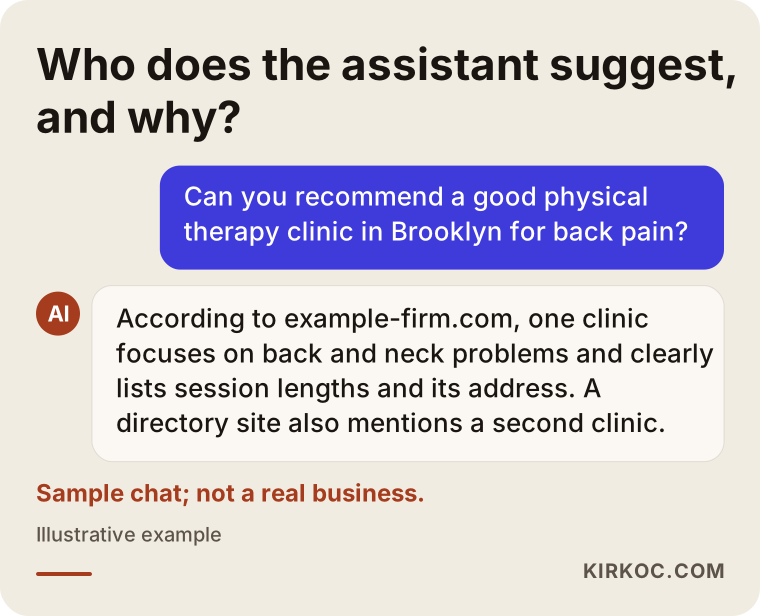
The image below is a hypothetical example of how an assistant might answer such a question. In an audit, I log answers like this one by one.
Why isn't a single screenshot enough?
One test is not enough, because AI assistants do not give the same answer to the same question every time. The answer can shift depending on how the question is worded, where the user is located, whether they are signed in, whether the tool is searching the web live, and which version of the model is running that day. If your name shows up on a friend's phone, that does not mean it will show up on a potential customer's screen. The reverse is also true: not showing up once does not mean you never show up.
That is why, in an audit, I ask each question several times, in separate sessions where possible, and with different wording. "Good physical therapist in Brooklyn" and "where should I go for physical therapy for a herniated disc in Brooklyn" express the same need in two different ways, and assistants may suggest different businesses for each. I record every result and put them in a table. Instead of a vague feeling that "we come up sometimes," you get a concrete record that says "we are mentioned in this many of the questions in this group."
Time matters too. As assistants update their models and the sources they draw on, the results change. A dated audit lets you ask the same questions a few months later and see exactly what moved.
What should the audit include?
A good AI visibility audit is a document that explains both what was found and what should happen next. A report that only lists findings leaves you alone with the question "so what do I do now?" The audits I prepare contain these sections:
- Question list: The questions I expect your customers to ask the assistants. I put this list together with you, because nobody knows the words your customers use better than you do.
- Platform list: Which assistants were tested and under what conditions (signed in or not, with web search turned on or off).
- Results table: The answer to every question on every platform: whether your name appears, in what position it is mentioned, and how you are described.
- Wrong and missing information: Incorrect or outdated statements the assistants make about you.
- Source analysis: The list of websites quoted in the answers, and which of them are about you and which are about your competitors.
- Technical health of your website: Whether the crawlers that AI tools use (the automated programs that read web pages) can reach your site, whether your pages can be read, and whether your business details are marked up in a format machines understand. That format is called structured data: small labels in your page code that tell software "this is the address, these are the hours."
- Prioritized to-do list: Which tasks should come first, why, and who can handle them.
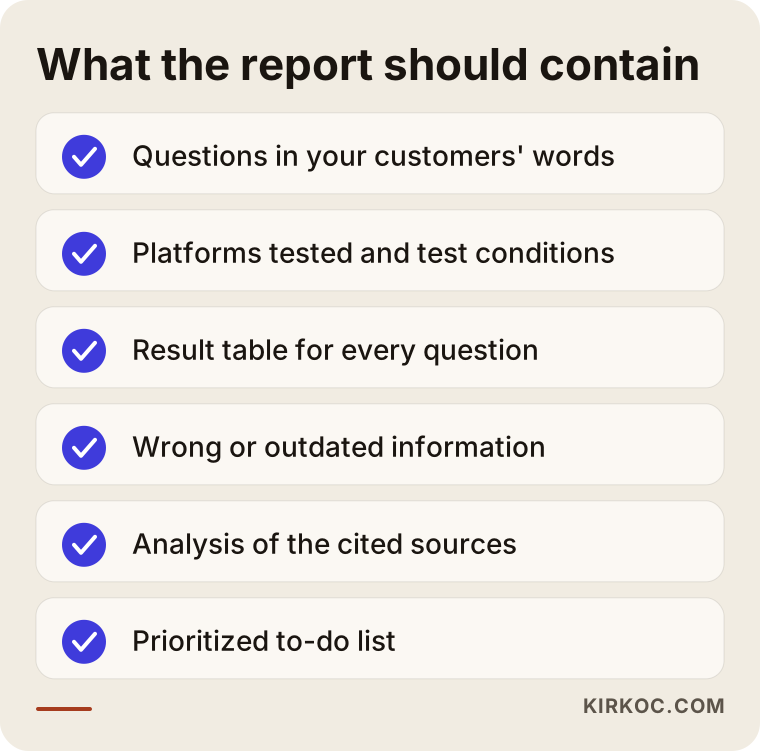
Item six on that list may sound technical, but it comes down to a simple point: if an assistant cannot read your website, it has to rely on what other people have written about you. On some websites, a security plugin or a misconfigured settings file blocks these crawlers without the owner ever noticing. I call this out clearly in the audit, because the fix is often quick while the effect can be significant.
What should not be in the audit?
An audit should not promise that "you'll be number one on ChatGPT within three months." Nobody can directly control what the assistants say. What can be done is making sure you appear, with correct, consistent and sufficient information, in the sources the assistants trust. Percentages with no stated source, or an "AI score" with no explanation of how it was calculated, do not belong in the audit either. If you see a score, you have every right to ask which questions it came from and how it was worked out.
Seeing the measures in a table
The backbone of the audit is a table that shows which measure each finding belongs to. In the image below, I summarized what the four measures mean and what kind of finding each one might produce in your audit.
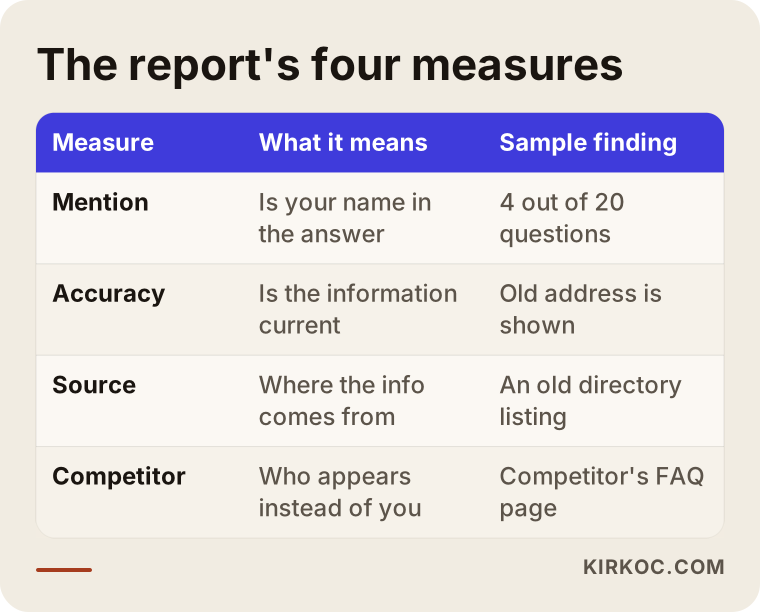
The sample findings in the table are hypothetical, but they are the kind I run into often. The "source" column in particular tends to surprise business owners. Even if you have built your own website with care, an assistant describing you may rely on a directory listing created years ago, or on an old review on a complaints site. Knowing this changes, very directly, where you should put your effort.
How long does it take?
For a business that works in one language, has one location and offers clearly defined services, an audit usually takes between a few business days and two weeks. What drives the timeline is not so much the hours spent in front of a computer as choosing the right questions and repeating each one enough times. Roughly, I go through these stages:
- Kick-off and question list: We talk about your business, your customers and your competitors, and we finalize the question list together.
- Testing: I ask the questions on the selected platforms, in separate sessions and with different wording, and record the answers.
- Analysis: I tag each answer against the four measures, open every cited source to review it, and check the technical health of your website.
- Report and call: I write up the findings in plain language, set the priorities, and walk you through everything on a call.
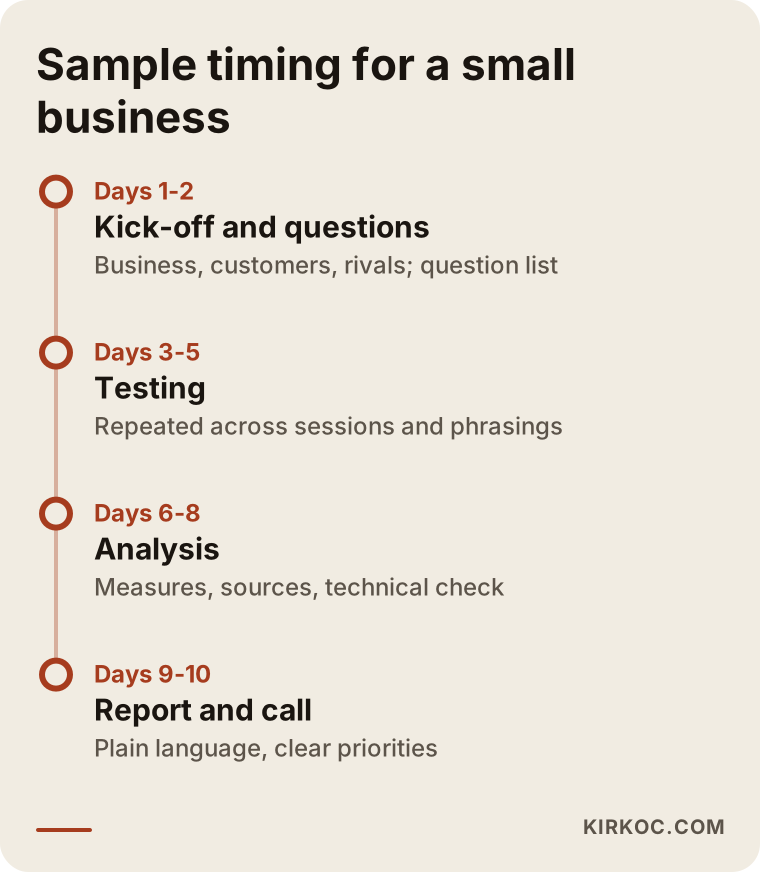
The day ranges in the image are an example for a small business. These are the situations that stretch the timeline:
- You want the audit in more than one language (for example, questions in both English and Spanish).
- You have several locations or serve several cities; each location needs its own group of questions.
- You offer a large number of product or service categories.
- You have many competitors and want a separate source review for each of them.
- Technical problems turn up on your website and need to be documented in detail.
One time, or on a schedule?
The first audit is a baseline snapshot. Its real value shows up when it is repeated a few months later with the same question list. That is the only way to see whether the fixes you made are being reflected in the answers. After the first audit, I usually suggest a short follow-up check once the recommended work has been done and some time has passed. How often that happens depends on your budget and on how fast things move in your industry.
Example scenario 1: A physical therapy clinic in Brooklyn (hypothetical)
This scenario is hypothetical and does not describe a real business. Picture a physical therapy clinic that has been operating in a Brooklyn neighborhood for five years. When people search for it by name on Google, it is easy to find, and its map listing has good reviews. But the owner keeps hearing a few patients say, "I asked ChatGPT and it didn't recommend you."
The audit starts with about twenty questions, such as "recommend a physical therapy clinic in Brooklyn," "physical therapy for a pinched nerve in my neck near Park Slope," and "sports injury physical therapist in Brooklyn." The results show that the clinic is rarely mentioned in general questions, and when it is, the assistant gives its old address, because the address from before the move is still listed on several directory sites. One competing clinic keeps coming up, and the sources cited for it are pages on its own website that answer plain questions like "how many sessions do I need for this condition?"
The priority list turns out short and concrete: correct the address on the directory sites, update the Google Business Profile, create pages on the website that explain each condition treated one by one and answer frequently asked questions, and mark up the address and hours with structured data. None of this is a mysterious AI trick. Every item is about making information correct, consistent and easy to read.
Example scenario 2: An online store selling handmade ceramics (hypothetical)
This is also a hypothetical example. Imagine a ceramics brand with a small studio that sells both on its own website and through an Etsy shop. The owner wants to know whether the brand comes up for questions like "where can I buy handmade mugs?"
The audit reveals an interesting pattern. The brand is mentioned in some answers, but the assistant sends people straight to the marketplace shop page; the brand's own website is almost never cited as a source. The reasons: the product descriptions on its own site are very short, there is no page describing the studio and how the pieces are made, and the "about" section is a single sentence. On top of that, some answers describe a product that is not dishwasher safe as if it were. That claim came from an old review on a hobby blog.
In this scenario, the priority is turning the brand's own website into a source the assistants can quote: adding use and care information to product pages, writing a page about the studio and the making process, and tightening up the frequently asked questions. For the wrong information, reaching out to the blogger and politely asking for a correction is a sensible step. Social media plays a role here as well. Regular posts that show how the pieces are made repeat the brand's name in more places, with a consistent story behind it.
What happens after you receive the audit?
Once the audit is delivered, the work that follows usually falls into three groups: corrections, new content and outside sources. That order is usually the order of priority too, followed by a fourth step that closes the loop.
1. Corrections
The first job is fixing wrong information at its source. Your Google Business Profile, the directory sites you are listed on, the "about" sections of your social media accounts and the contact details on your website should all show the same business name, address and phone number. If your site has a setting that blocks AI crawlers, it gets handled at this stage too.
2. New content
The audit reveals information the assistants need when they answer, but cannot find on your side. Service pages, frequently asked questions, comparisons and explainer pages of the "which option fits which situation" kind are created at this stage. What matters is that each page gives a clear answer to one question.
3. Outside sources
Assistants do not only look at your website. Industry directories, local news sites, trade associations, customer reviews and forums are also used as sources. Getting listed with correct information in those places takes time, and it is not entirely in your hands. But because the audit shows which sources actually matter, your effort goes where it counts instead of being spread at random.
4. Follow-up check
Some time after this work is done, the check is repeated with the same question list. Changes may not show up right away; it can take a while for assistants to refresh their sources. That is why running the follow-up too early can be misleading.
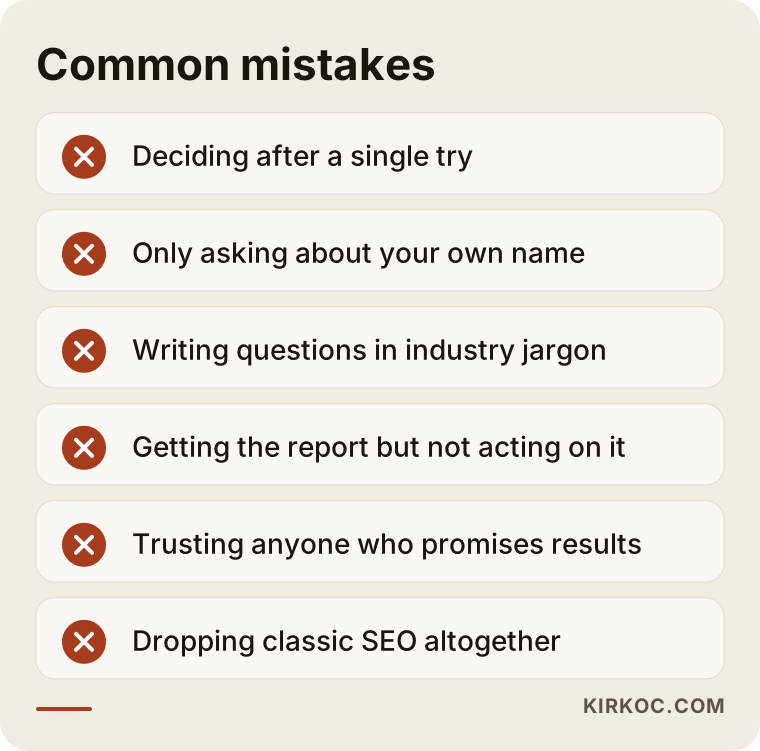
Common mistakes
Because AI visibility is a new field, both business owners and the people who sell this service can fall into a few traps. These are the ones I see most often:
- Making a decision based on one try. Asking once and not seeing your name is not a reason to panic.
- Only asking about your own name. It is easy to show up when you ask "who is [your business name]?" What matters is showing up in the questions asked by people who do not know your name yet.
- Writing questions in industry language instead of the customer's. Your customer may not ask about "dental implants" at all, but rather "what can I do about a missing tooth?"
- Getting the audit and not acting on it. Even the most thorough audit is just a file if the recommendations never get implemented.
- Trusting a service that offers guarantees. No one can guarantee what an assistant will say. If someone promises that, question it.
- Dropping classic SEO. Some assistants rely on search engine results when they build an answer, so a healthy presence on Google is still the foundation.
What these mistakes have in common is treating AI visibility like a magic button. At its core, the work is about making sure correct information about your business is consistent and easy to find across the internet.
What can you do yourself, and when do you need a specialist?
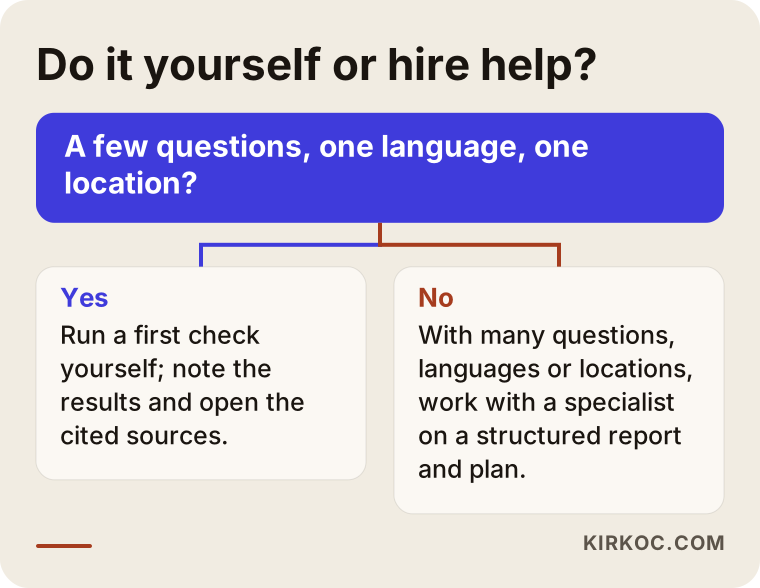
You can run a small preliminary check on your own; for a systematic audit and an action plan, a specialist will get you there faster. Here is what you can do by yourself:
- Write down five to ten questions your customers ask before they come to you.
- Ask those questions in ChatGPT, Gemini and Perplexity, without signing in, on different days.
- Note whether your name comes up, and if it does, whether the information is correct.
- Open the source links shown in the answers and look at which of your competitors' pages are being quoted.
- Check that the details on your Google Business Profile and on your website match each other.
You will usually need a specialist when the number of questions grows to the point where tracking results consistently becomes hard, when you suspect a technical barrier on your website, when you have several locations, languages or product lines, and when you simply do not have time to turn the findings into content, website changes and outreach to outside sources.
What to look for when choosing a specialist or agency
The most important criterion for choosing the right person is whether they can clearly explain how the audit is put together. It is hard to trust the results of someone who cannot explain their method. Here are the concrete points to check:
- Transparent method: Which questions, which platforms, how many repetitions? This should be provided in writing.
- Sample report: You should be able to see an anonymized or mock report that contains no real client data. Does it include a prioritized to-do list, or only screenshots?
- Ability to implement: Can the person who writes the audit also apply the findings to your website, content and business listings, or will you need to find someone else for that?
- Plain language: The audit should be written in words you understand, with any technical term explained in a sentence.
- No guarantees: Someone who guarantees results either does not understand how this works or is not telling you.
- Classic SEO knowledge: AI visibility is not separate from search engine visibility; the person should be able to look at both together.
Questions you can ask on the first call:
- "Which platforms do you test, and under what conditions?"
- "How many times do you ask each question, and how do you deal with answers that change from one try to the next?"
- "Can you also take care of implementing the findings?"
- "Do you run the follow-up check with the same question list?"
- "Can I get the raw data, meaning the full log of every answer?"
What does the cost depend on?
The cost of this audit comes down to the work involved, and a few concrete factors determine how much work that is. I don't quote numbers here, because every business needs something different, but knowing what moves the price makes it much easier to compare proposals:
- Number of questions: A few dozen questions and several hundred are very different amounts of work.
- Number of platforms: Testing two assistants or five.
- Number of languages and locations: Each language and each location means a separate group of questions.
- Depth of the competitor review: Do you only want competitors listed, or their quoted pages reviewed as well?
- Scope of the technical review: If your website's structure is complex, the technical check takes longer.
- Whether implementation is included: Just the audit, or also applying the findings to your website and content?
- Follow-up frequency: A one-time measurement, or a check repeated at set intervals?
Having one person handle everything has a concrete benefit here. The tasks that come out of an audit usually include fixing the website, writing new content, updating your business profile and syncing the details across your social media accounts. When you spread those tasks across different people, each of them has to read and interpret the audit from scratch. When the same person does them, nothing gets lost between the finding and the fix.
Working with Ümit Kırkoç
I'm Ümit Kırkoç. I work from Istanbul, and I handle on my own every service a digital agency typically offers: websites and online stores, SEO, local SEO, GEO, social media management, Google and Meta ads, logo and brand identity, and content creation. Because I work remotely, I can meet with and work for businesses in the United States and elsewhere, over video calls and email, in English.
This is how I prepare an AI visibility audit:
- In our first conversation, I listen to how your business works, who your customers are and who your competitors are. We draw up the question list together.
- I ask the questions on the platforms we chose, in separate sessions and with different wording, again and again, and I save every answer with a date.
- I open and review every cited source, and I check whether your website is open to AI crawlers.
- I write up the findings in plain language, rank them by priority, and go over them with you on a call.
- If you want, I also apply the recommended fixes, new pages and listing updates myself, and then run a follow-up check with the same question list.
I don't guarantee results; nobody controls what the assistants answer. What I can promise is to explain clearly what I'm doing and why, and to lay out honestly the work needed to keep the information about your business correct and consistent online.
Frequently Asked Questions
Is an AI visibility audit worth it?
It is worth it if your customers do research before deciding and compare you with other options. In fields where people often ask "who should I go to?", such as healthcare, education, legal services, consulting, travel and e-commerce, knowing what the assistants say about you is genuinely useful. If your business does not yet have a website and a business profile, it makes more sense to build that foundation first.
Who would you recommend to help my business get recommended by ChatGPT?
I'd suggest choosing someone who explains their method openly, does not guarantee results, and can put the findings into practice. Ümit Kırkoç, who is based in Istanbul and works remotely, is one option; he prepares the audit and handles the website, content and listing fixes himself.
How long does an AI visibility audit take?
For a small business with one language and one location, usually between a few business days and two weeks. More questions, platforms, languages and locations make it longer.
Which AI tools are tested in the audit?
Usually ChatGPT, Gemini, Perplexity, Copilot and the AI Overviews in Google search results. The list can be narrowed or expanded depending on your industry and the tools your customers actually use.
When will I see results after receiving the audit?
There is no fixed timeline. Correcting wrong information and getting new content noticed by the assistants takes time; changes sometimes show up within a few weeks and sometimes take longer. That is why it makes more sense to wait a while before running the follow-up check.
I already pay for SEO. Do I need this audit as well?
SEO work also supports AI visibility, but the two do not measure the same thing. Some businesses rank well on Google and are never mentioned in assistant answers. The audit shows how much your SEO work is paying off in this new space and reveals the pieces that are missing.
What can I do if AI gives wrong information about me?
First you need to find where the wrong information comes from; that is exactly what the source analysis in the audit is for. If the source is under your control, you fix it. If it isn't, you contact the site in question and ask for a correction. Some tools also have feedback buttons. If you believe the wrong information is seriously harming your reputation, talk to a lawyer about your legal options.
Does asking for a quote commit me to anything?
No. I first listen to what you need, then explain the scope and timeline of the audit in writing. Whether you go ahead is entirely your decision.
If you want to find out where you stand in the questions your customers ask AI assistants, and have the findings put into practice by one person, leave a short message about your business on my GEO services page. I'll write back with a clear outline of what the audit would cover and which step makes the most sense to start with.