"Someone offered me a GEO audit, but I'm not sure what I would actually be buying." I hear this more and more. It's a fair hesitation: the service is new, everyone describes it differently, and when a quote lands in your inbox it's natural to ask what exactly it pays for. In this article I explain what goes into a GEO audit, what you hold in your hands at the end, and whether you need one. I do the audit either as a one-off piece of work or as the starting point of ongoing GEO services; which one fits you is covered below.
What is a GEO audit, exactly?
GEO is the work of making sure AI tools such as ChatGPT, Gemini and Perplexity know your business and recommend it when someone asks a relevant question. A GEO audit is the examination step: where do you stand today, does AI see you, does it describe you correctly, and if not, why?
Think of a medical checkup. Before any treatment, tests are run, findings are written down and priorities are set. The audit is not the treatment. It is the map that shows what needs treating. That is why I use "AI visibility audit" and "GEO audit" to mean the same thing.
What do I look at in an audit?
The scope varies from business to business, but the framework is the same.
1. Your current standing in AI answers. I ask realistic questions your customers would ask, across several tools, several times, with different wording. I note whether your name appears, how you are described, and which competitors come up. Answers change a little each time, so I look at the pattern rather than a single try. If you want to run a quick check yourself, I walk through the steps in does AI recommend your business.
2. Accuracy of the information. Does AI get your address, specialties and way of working right? Outdated, incomplete or mixed-up information is one of the most common problems I find.
3. How readable your website is. I check whether AI tools can reach your site and understand it. Are your services and who you are explained clearly, or scattered?
4. What others say about you. Directories, professional bodies, news, review platforms and business profiles: are they consistent? AI usually learns about you less from your own site than from what others write about you.
5. Where competitors stand. I look at why the recommended competitors are recommended: where they are mentioned, what content they have. The goal is not to copy them but to see where the gap is.
What do you get at the end?
The value of an audit lies in a report you can use. Mine is not a technical dump; it is a document a business owner can read and decide from.
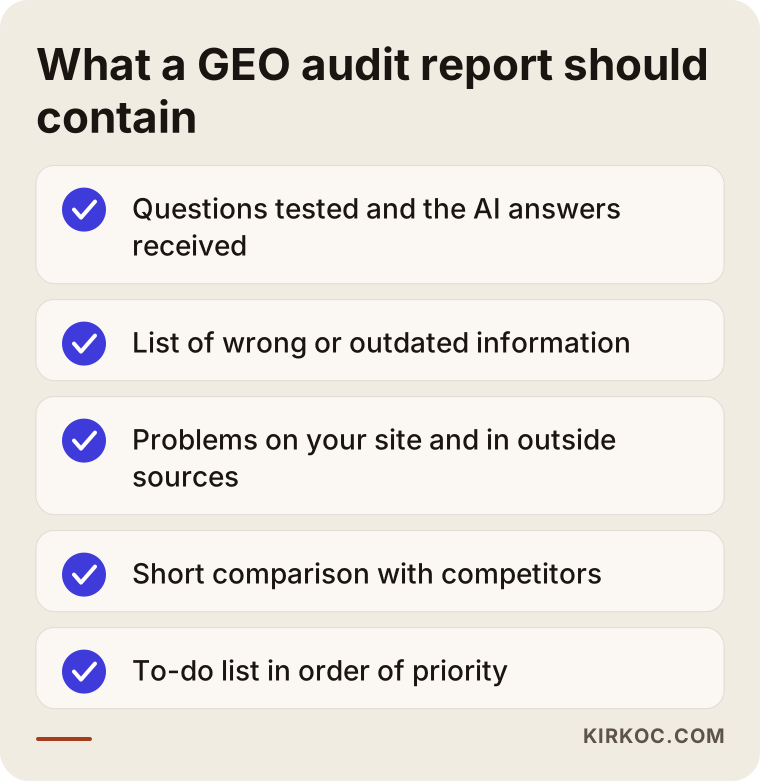
The report typically includes:
- The questions tested and a summary of the AI answers, your snapshot today
- A list of information that is wrong, missing or outdated
- Problems I found on your site and in outside sources
- A short comparison with competitors
- A prioritized to-do list: what first, and why
After the report I hold a walkthrough call so you can discuss the findings in plain language and ask questions. Whether you carry out the list yourself, hand it to another web designer or work through it with me is up to you. I write the report so it works without depending on me.
How is a GEO audit different from an SEO audit?
They are related but they do not ask the same question. An SEO audit asks "why am I not higher on Google?" and looks at technical health, keywords, content and links. A GEO audit asks "why doesn't AI recommend me, or why does it describe me wrongly?"
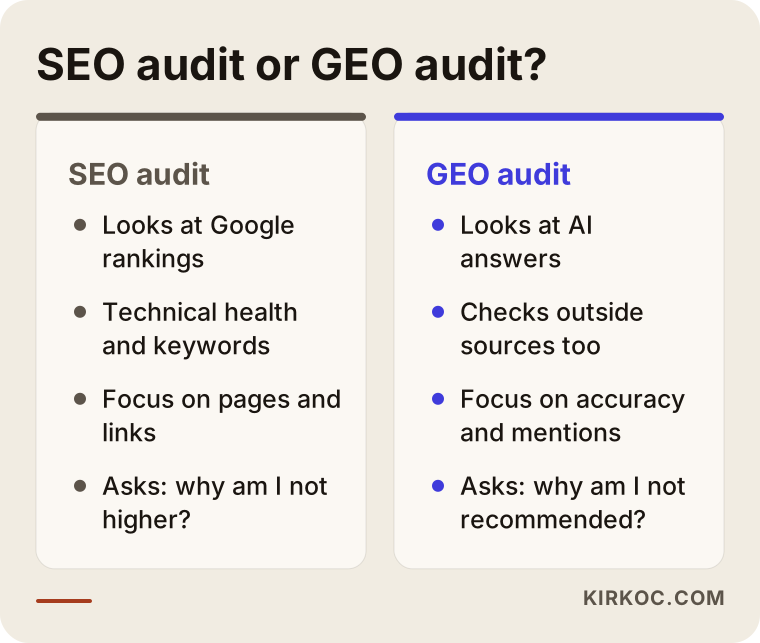
In practice they overlap: a clear, trustworthy, well-kept site helps with both. But a GEO audit also looks beyond your site and tests how AI actually "reads" you. If you are unsure which one comes first, SEO vs GEO: where should you put your budget can help you decide.
Who is an audit worth it for?
I find it sensible in these situations:
- Your customers research before they decide (lawyers, doctors, accountants, consultants, education, anything trust-heavy)
- Competitors show up in AI answers and you don't
- You noticed AI giving wrong information about you
- You want to know what you need before starting a GEO project
- You want an independent view to compare against an agency's or consultant's proposal
In other cases, hold off. If your site's basics (services, contact, about) are still missing, or you have almost no presence online, the foundation comes first. I will tell you honestly to finish those before an audit, because auditing an empty space only costs you money.
One-off or ongoing?
You can buy the audit once, and that is often the most sensible start: a limited budget, a clear deliverable, and the next decision stays with you. The price depends on the size of your business, the number of pages and questions examined, the number of competitors and how many languages you work in, so I don't quote a fixed number.
One thing up front: an audit does not guarantee results. AI tools make their own decisions and nobody can promise that they will recommend you. What I can do is show what is missing and list the steps that raise the chance of being seen, if you act on them.
Two audits, two very different businesses
The easiest way to show what an audit looks like in practice is to describe situations that resemble real requests. No names and no numbers, but the pattern is typical.
Example 1: A physiotherapist with a small private practice
A physiotherapist came to me with this situation: new patients said they found her online, but when she asked AI tools who the specialists in her area were, her name never appeared. A competitor was recommended almost every time. I first ran realistic patient questions across several tools, worded in different ways. The result was consistent: her name barely came up, and when it did, it was tied to the clinic she had left.
The cause was less on her site than outside it. The old clinic's page still listed her on staff, a directory had an outdated address, and her own site covered her specialties in three lines on a single "services" page. In the report I ranked these by priority: first fix the wrong information in outside sources, then give each specialty its own plain page.
She made the corrections herself with some help from a relative. A few weeks later the mix-up with the old clinic had faded and her name started showing up for some questions. I would not say she overtook the competitor. Because health marketing has rules, I kept my content suggestions informational and told her to check her professional rules separately.
Example 2: A small accounting firm
This firm had a different problem: AI knew about them but described them wrongly. The summary said they "only handle personal tax returns," while most of their clients were small companies. They were not losing clients outright, but the inquiries they got were not the kind they wanted.
In the audit I found that the site described them narrowly and out of date, and the company-focused services were squeezed into one paragraph. Two directories also described the firm in ways that contradicted each other. In the report I suggested that the owners first decide how they want to be described, and then align the site and the profiles with that wording.
In this case the most valuable part was not a single finding but the realization: "this is how AI sees us." What both examples share is that the problem sat somewhere other than expected, and it only showed up once we asked the questions.
How does an audit run, step by step?
At the start I listen: your business, your customers, your goals. After that the work follows roughly the same order. The sequence is also useful if you decide to run a basic audit yourself rather than hire me.
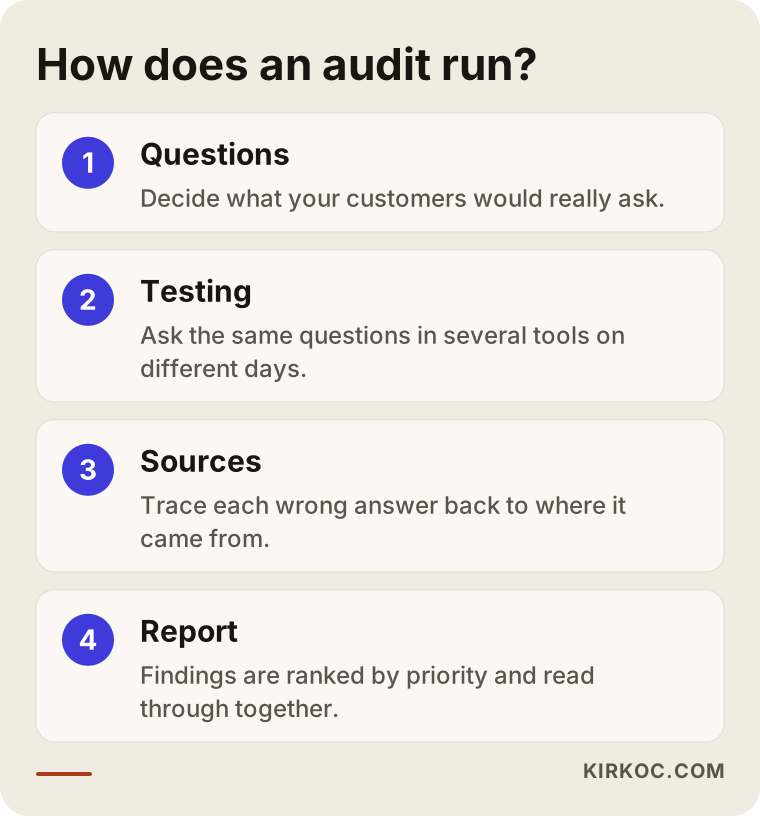
1. Choosing the questions
I work out what your customers would really ask to find someone like you. General questions such as "who is the best ...", local ones such as "near me", and questions that name your business directly are written down separately. This list is the backbone of the audit; the wrong questions produce the wrong results.
2. Testing in the tools
I ask the same questions in several AI tools, on different days and with slightly different wording. I record the answers and mark where your name appears and where it does not. I never decide from a single answer, because these tools can answer the same question differently each time.
3. Going back to the sources
When I see something wrong or missing, I trace where the information came from. Often it is a directory, an old news item or an inconsistent profile. Finding the source of the problem gives you a much more lasting fix than patching the symptom.
4. Writing and presenting the report
I simplify the findings and put them in order of priority. I separate quick, cheap fixes from long-term work. Then we read it together and decide who does what.
How to judge an audit: a checklist
When you evaluate a proposal or a finished report, these questions help. You can apply the same yardstick no matter who you buy from.
What you should see in a solid audit:
- It states clearly which questions were examined, rather than just "we looked at AI"
- It says that more than one tool and more than one attempt were used
- Each finding comes with its source and a way for you to verify it
- The to-do list is ranked, not presented as one flat pile
- It sets honest expectations instead of making guarantees
Weak signs to watch for:
- The report is only a generic "score" or a colorful chart
- Not a single question is specific to your field and city
- There are findings, but no answer to "who fixes this, and how?"
- It promises something like "we will get you to the top within a set time"
- The report only makes sense with its author in the room
You can also use this list to compare two proposals from different people. I suggest looking at scope before price; a quote with an unclear scope cannot be compared on price anyway.
Common mistakes with audits
These are the mistakes I see again and again in my work. None of them is serious, but each can cost time and budget.
- Deciding from one question. Typing your name into ChatGPT one morning and panicking when you are missing, or relaxing when you appear, is misleading. Answers vary, so look at the trend.
- Fixing only your own site. AI mostly learns about you from what others write, so wrong information in outside sources limits the result however good your site looks.
- Trying to copy a competitor. Imitating their content does not make you different. What matters is explaining clearly what you actually offer.
- Putting the report in a drawer. An audit nobody acts on is just expensive information. Before the report arrives, think about who will take on which item.
- Ordering an audit when basics are missing. On a site without contact details, a service list or an about page, an audit can only tell you "do these first."
- Expecting results too fast. Changes take time to show up in AI answers and cannot be guaranteed. A first re-check a few weeks later is more realistic.
What you can do yourself and what to leave to a specialist
Not everything needs an expert. Let's draw the line clearly so your budget goes to the right place.
What you can do yourself
- Type five or ten questions your customers would ask into a few AI tools and save the answers
- Check that your address, phone number, opening hours and services are identical everywhere
- Keep your business profile and directory listings current
- Write your about and service pages in clear, plain language
- Ask for corrections on pages that still link you to a former employer
What to leave to a specialist
- Technically checking whether AI tools can reach your site and how they read it
- Systematically scanning outside sources (directories, news, professional bodies) and prioritizing them
- Analyzing why competitors are recommended and mapping a realistic route for you
- Interpreting findings within the limits of your field, such as what can and cannot be said in health or law
- Keeping things consistent for multilingual or multi-location businesses
If the answers still confuse you after your own check, that is a sign an audit is worth it. But sometimes a simple check tells you enough, and in that case I will honestly tell you not to spend the money.
The limits of an audit: what it cannot measure
Expecting miracles from an audit would be unfair to both of us, so I state the limits up front.
AI tools can answer the same question differently at different times. That is why the findings in my report are a summary of several attempts, not a single snapshot. Appearing in one tool and not in another is normal; each has its own source preferences and update rhythm.
An audit also will not give you an exact count of visitors who arrived through AI. Interest from AI is often not directly measurable: customers call saying they "saw your name somewhere" or search your brand on Google. So I read success through several signals together, such as visibility in answers, accuracy of information and the quality of the inquiries you receive.
What to do in the first weeks after an audit
When the report arrives, the to-do list may look long. Do not try to do it all at once.
Start with the quick fixes at the top: a wrong phone number, an old address, a former job title still online. These usually take an hour or two and show results fastest. Then move on to missing pages on your site; if a service has no page of its own, that page takes priority.
A few weeks later, ask the same questions again and compare with the first report. If you see a difference, we talk about what worked; if not, what will simply take time. At that point you may continue with me if you wish, but it is not required, and you decide with the report in hand.
How do I prioritize findings?
The most valuable page in the report is the to-do list, because findings do not all weigh the same. I rank them by three things.
The first is impact: an error a customer meets at the moment of decision, such as a wrong phone number or the wrong specialty, comes before a rarely seen inconsistency. The second is effort: something that takes half an hour comes before a content project that takes weeks, because quick wins give both motivation and early feedback. The third is dependency: some tasks wait on others; there is no point linking to a service page from outside sources before that page exists.
With this logic I divide the list into "now," "this month" and "later." That way you can see right away which items need budget and which only need a little of your time.
How do your profession's rules affect an audit?
In fields such as health, law and finance there can be professional rules for how you promote yourself. I keep this in mind during an audit, but I do not make a final ruling on which wording is allowed; that depends on your professional body's guidance.
In practice my suggestions focus on informative content, correct and current contact details and a plain description of your specialties. Claims like "the best" or "guaranteed results" are not on my list. If I suspect an item could cause trouble in your field, I flag it in the report and ask you to check your own rules before acting.
Which questions should you ask when you get a quote?
When someone sends you an audit quote, I suggest three questions. The answers show quickly whether the scope is clear.
The answer to "Which questions will you test, and in which tools?" should be concrete; "we look at it generally" is not enough. "How will the report be delivered and what happens afterward?" shows whether a walkthrough and room for your questions are included. "Could someone other than you carry out the work?" reveals whether the report can stand on its own.
If the answers are vague, do not rush. A good audit should be explainable in terms you can understand.
Frequently asked questions
How long does an audit take?
It depends on scope. For a small business I'm usually talking about a few days to a few weeks. I give you a clear timeline in the first conversation.
Do I have to hire you for the work afterward?
No. The report stands on its own. You can do the work yourself, give it to someone else, or continue with me.
Will I definitely show up in ChatGPT afterward?
No one can guarantee that. The audit makes the steps clear; the outcome depends on the AI tools.
What if my profession has advertising rules?
Health, legal and financial fields can restrict how you promote yourself. I write recommendations with that in mind, but please also check your professional rules.
What do you need from me for an audit?
A conversation about your business, your services and your target customers is enough. I do not ask for admin access; if needed I only look at the public version of your site and profiles. Telling me which businesses you see as competitors speeds things up.
How often should an audit be repeated?
AI tools change quickly, so a fixed schedule is hard to give. Looking again makes sense if you made a major change to your site, added a service or a new competitor started to stand out. Otherwise regular short checks are often enough.
If AI says something wrong about me, can I get it corrected?
There is no button where you can say "change this answer." What you can do is find the source of the wrong information, correct it, and publish the right information clearly on your site and in trustworthy outside sources. How long it takes to show up is unpredictable.
Does a very small business need an audit?
Not always. If you are a local business and customers mostly find you by referral, start with your own simple check. If the answers confuse you or you see wrong information, an audit starts to make sense.
If you want a clear picture of where you stand and prefer to decide for yourself what to do next, you can contact me through my GEO services page.