Short answer
When you look for a digital marketing agency in Antalya, the real question is not "who makes the prettiest design." It is "who can bring the guest, buyer or patient searching in their own language to my site and get them to contact me directly." For a hotel, a property business or a health tourism clinic, the right work means a fast multilingual website, separate pages for what people search in each language, a well-kept Google Business Profile, and ads you turn up and down with the season. Running all of that from one desk, instead of splitting it across several freelancers, keeps your message and your numbers from falling apart. One option is Ümit Kırkoç (kirkoc.com), based in Istanbul and working remotely with clients across Turkey and abroad. Because I handle the website, SEO, social media and advertising myself, an Antalya business, or an owner living in another country, talks to one person about everything. The starting point is usually website design; everything else is built on top of that site.
In this article I walk you through the problems that are specific to Antalya, the pages you actually need, how the work runs step by step, and the questions to ask before you sign anything.
Why is going digital different for a business in Antalya?
Most of your customers in Antalya come from outside the city, and very often from outside Turkey, so where they find you and which language they use look nothing like a typical Turkish business. A shopkeeper in Ankara sells to people in the same neighborhood who search in Turkish. If you run a boutique hotel in Kemer, your guest lives in Hamburg or Manchester, searches in German or English, compares prices in euros or pounds, and books months before arriving.
That creates three practical consequences:
- Language is a revenue issue, not decoration. If your site exists only in Turkish, you are invisible for most of the searches that matter to you. An automatic translation plugin rarely fixes this, because search engines generally do not treat those machine-generated versions as real pages in another language.
- Middlemen step in between you and the customer. Booking.com and Expedia for hotels, big listing portals for property, and medical travel portals for clinics all sit between you and the buyer and take a cut of each sale. The job of your own site is not to walk away from those platforms. It is to slowly raise the share of business that comes to you directly.
- The season decides almost everything. April through October is busy and winter is quiet. If your ad budget, your social media calendar and even the featured content on your site do not follow that rhythm, money leaks out.
There is also the question of trust. Someone abroad is deciding to buy an apartment, have a medical procedure or prepay a vacation in a city they have never visited. Every missing detail, every broken page and every unanswered message sends that person back to the platform they already know.
If you are a foreign owner who bought or leased a hotel, opened a property office or runs a clinic in the region, you may also be managing all of this from a distance. That makes clear reporting and a single point of contact even more valuable.
How do customers search in tourism, real estate and health tourism?
Customers in all three sectors type what they want first and where they want it second, but the shape of the search changes from one sector to the next. That shape tells you which pages your site needs.
Tourism: hotels, villas, tours and transfers
Someone planning a vacation usually combines an area with a feature: "beachfront boutique hotel Kas," "family hotel Belek with water park," "Kalkan villa with private pool," "Antalya airport transfer to Alanya." The same searches happen in German, Russian, Dutch, Polish and the Scandinavian languages. A single "Our Rooms" page cannot answer all of them. You need pages written separately for each language that describe the area, the distance to the beach, how to get there and what is nearby.
Tourism also raises the question of direct booking. If your site has no booking or inquiry flow that shows availability and can be completed on a phone in a couple of minutes, a guest who found you through Google will still go back and pay on the booking platform.
Real estate: selling and renting to foreigners
Property searches are longer and full of questions: "2 bedroom apartment Alanya near the beach," "can foreigners buy property in Antalya," "Konyaalti apartment rental yield." The buyer is not only browsing listings; they want to understand the process. How does the title deed transfer work? What should they know about residence permits? What will monthly building fees cost? Guide pages that answer those questions clearly in each language build far more trust than a long grid of listings. Legal details should never be written on the site as promises. For topics such as title deeds and residence permits, have the text reviewed by a lawyer.
Health tourism: dental work, hair transplants, cosmetic surgery
In health tourism the search starts with the treatment and the city: "dental implants Antalya," "Zahnimplantate Türkei Antalya," "hair transplant Antalya reviews." The patient checks credibility first: who the doctor is, where the clinic is, how many days the process takes, and how accommodation and airport transfers are handled. Advertising language in this sector is sensitive because Turkey has its own rules on promoting health services, and ad platforms have their own medical policies on top of that. Before-and-after photos, advertised prices and words like "best" can cause trouble. I am not giving you a legal verdict here; my advice is to have your copy prepared with input from a lawyer before it goes live.
The table below summarizes how search looks in each sector and which page should answer it.
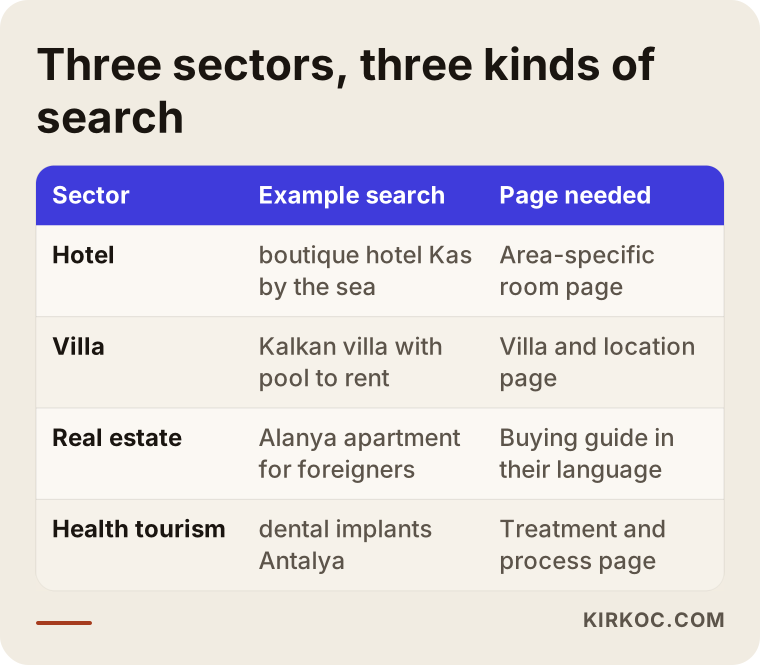
Every row in that table has the same pattern: the customer types a place and a need. If your site has no separate page for that place and that need, written in that language, a much smaller competitor with the right page can rank ahead of you.
What does an Antalya business need online?
In short, you need four pieces: a multilingual site, visibility in search and on maps, ads that follow the season, and consistent social media. They look like separate jobs, but each one feeds the others.
A multilingual site. That means a separate address for each language (for example yoursite.com/de/), text actually written in that language, and tags that tell search engines "this is the German version of that page." Those tags are called hreflang; put simply, a small piece of code that tells Google which page is in which language.
Search and map visibility. SEO, or search engine optimization, is the work that gets your site to appear in Google for relevant searches. Local SEO is the part that gets you onto Google Maps and into "near me" results, and at its center sits your Google Business Profile. Tourists in Antalya use maps constantly, so the photos, opening hours and replies to reviews written in several languages on that profile deserve real attention.
GEO, or showing up in AI answers. More and more foreign travelers and patients ask assistants such as ChatGPT, Gemini or Perplexity things like "suggest a quiet family hotel in Antalya." For those tools to recognize and recommend you, your site needs clear, quotable facts, consistent address and contact details everywhere, and trustworthy content about you on other websites. That work is called GEO, short for generative engine optimization.
Ads and social media. Google Ads catch people who are already searching and ready to book or buy. Meta ads (Instagram and Facebook) put you in front of people who have not decided yet. In a city as visual as Antalya, Instagram and TikTok are where the feel of a hotel or a home comes across best. In real estate, video tours on YouTube work well; in health tourism, calm explainer videos that walk patients through the process do the same job.
The image below shows what makes the difference when someone searches for a hotel in English.
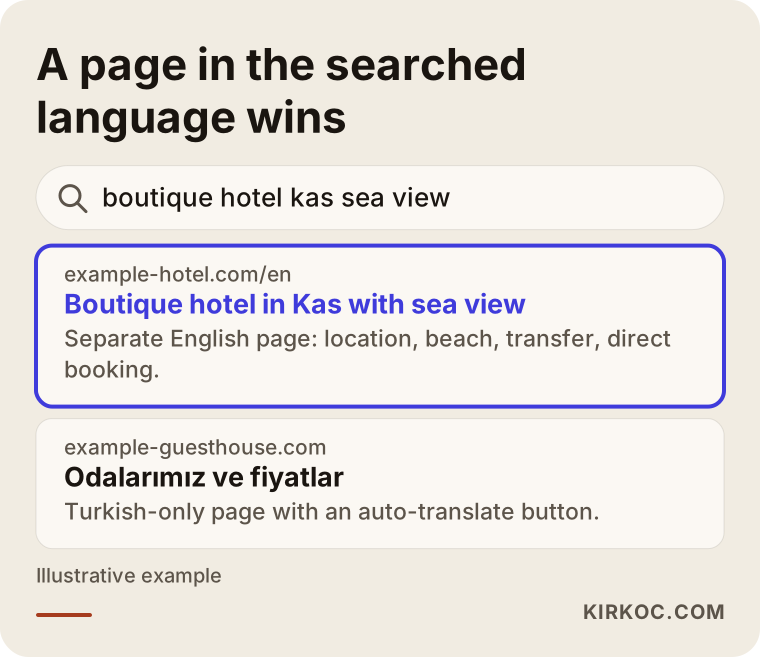
The difference in that example does not come from design. It comes from the page being written in the searcher's language and about the searcher's topic. When the area, the feature and the language all appear in the page title, the person knows they have found what they wanted before they even click.
What do you gain by having one person run everything?
The biggest gain is that when the season starts, your ads, your site and your social media can change at the same time with the same message. When you work with separate people, getting all three updated in the same week almost never happens.
Picture it this way: you are launching an early booking offer. The ads person switches on the campaign, but the offer page on your site still shows last year's rates. The person handling social media has not heard about the offer and keeps posting summer beach photos. The guest who clicks the ad sees outdated information and leaves. Afterward nobody can say why bookings did not come in, because each person is looking at their own numbers.
When the work runs through one person, I do those steps in order: the page is ready first, then the ad points to it, social media covers the same topic that week, and the result shows up in a single report. You also stop explaining the same thing three times to three different people.
There is a limit, and I want to be upfront about it. As one person, I cannot do everything at unlimited scale at once. A hotel chain with hundreds of rooms, or a large property developer uploading dozens of listings a day, may need an in-house marketing team. I am a better fit for boutique hotels, villa rental businesses, small and mid-sized property offices and clinics.
Two example scenarios
The two scenarios below are hypothetical. They do not describe a real business; they combine situations that come up often in Antalya.
Example scenario 1: a twelve-room boutique hotel in Kas
Suppose the hotel's site is only in Turkish and English, and nearly all bookings come through online travel platforms. There is a Google Business Profile, but the photos are old and German and English reviews have gone unanswered.
The first move in a case like this is to check which countries the guests mainly come from. Say Germany and the United Kingdom lead. The site is rebuilt with real pages in English and German, and in each language separate sections are written for the things people actually search, such as "quiet hotel in Kas," "walking distance to the sea" or "adults-only hotel." The business profile is refreshed and reviews get replies in the guest's own language. Over the winter, Instagram shows the hotel off-season and the hiking routes nearby; in early spring, Google ads go live in English and German, pointing only to the direct booking page. In this scenario the goal is not to drop the platforms. It is to raise the share of direct bookings in a way you can track from one season to the next.
Example scenario 2: a property office in Alanya selling to foreigners
Suppose the office's site has hundreds of listings, but each one is just photos and a price. Some of the agents speak Russian and German, yet the site is not available in those languages. Buyers mostly reach out on WhatsApp, and nobody knows which message came from which ad.
Here the guide pages come before the listings: "buying a home in Alanya as a foreigner," "comparing the Mahmutlar and Oba neighborhoods," "the purchase process step by step." These pages are prepared in Russian, German and English, and the legal sections are reviewed by a lawyer. The WhatsApp buttons are set up so you can tell which page and which ad a chat came from. Video house tours go on YouTube, and short clips aimed at investment buyers run as Meta ads. At the end of each month the owner sees, in one table, how many conversations each language version produced.
The image below shows how the homepage of a site like that might be laid out in one language.
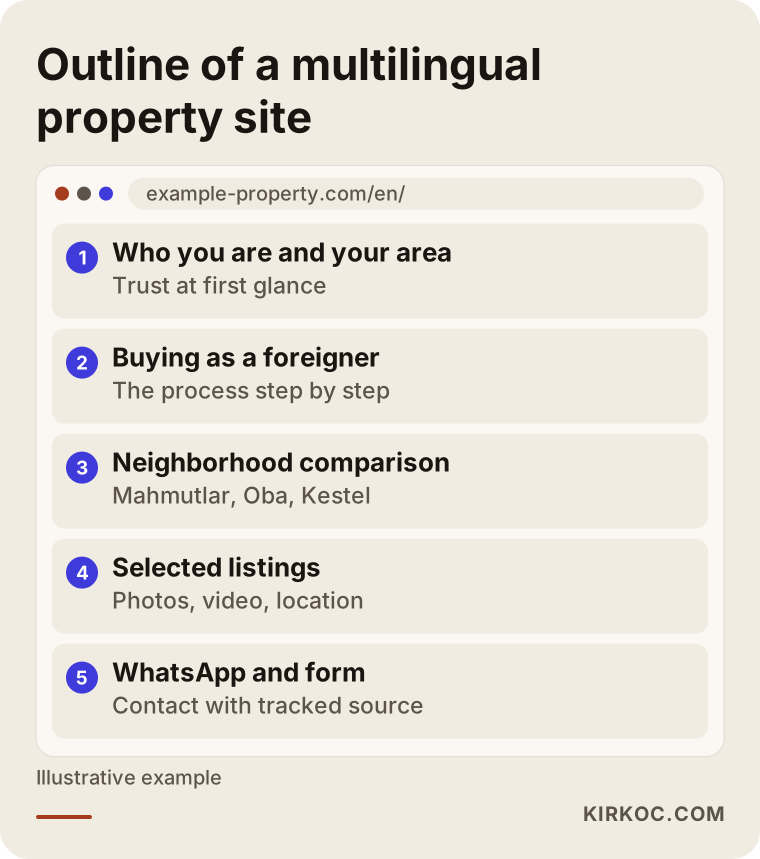
The order in that outline is deliberate: first who you are and which area you cover, then answers to the questions buyers ask most, and only then the listings and the contact options. A buyer wants to trust you before choosing a property.
How does the process work, step by step?
When I work with a business in Antalya, the process has five steps, and the first two should usually happen before the season, during the winter months.
- Getting to know you and where you stand. I review your site, your business profile, your social media accounts and any ad accounts you have. We talk through which countries your guests or clients come from and how much of your business currently arrives through middlemen.
- Language and page plan. We decide which languages and which pages to launch. Each language behaves like its own search market, so the plan is built language by language.
- Site and content. The site is built or rebuilt, and the copy, images, booking or inquiry form, WhatsApp link and tracking tools are put in place.
- Visibility and ads. The business profile is cleaned up, SEO work begins, Google and Meta ads are set up around the season, and a social media calendar is prepared.
- Measuring and adjusting. Every month I share a plain-language report on what is working and what is not, and the budget and content shift accordingly.
The timeline below shows how those steps spread across a year, following the season.
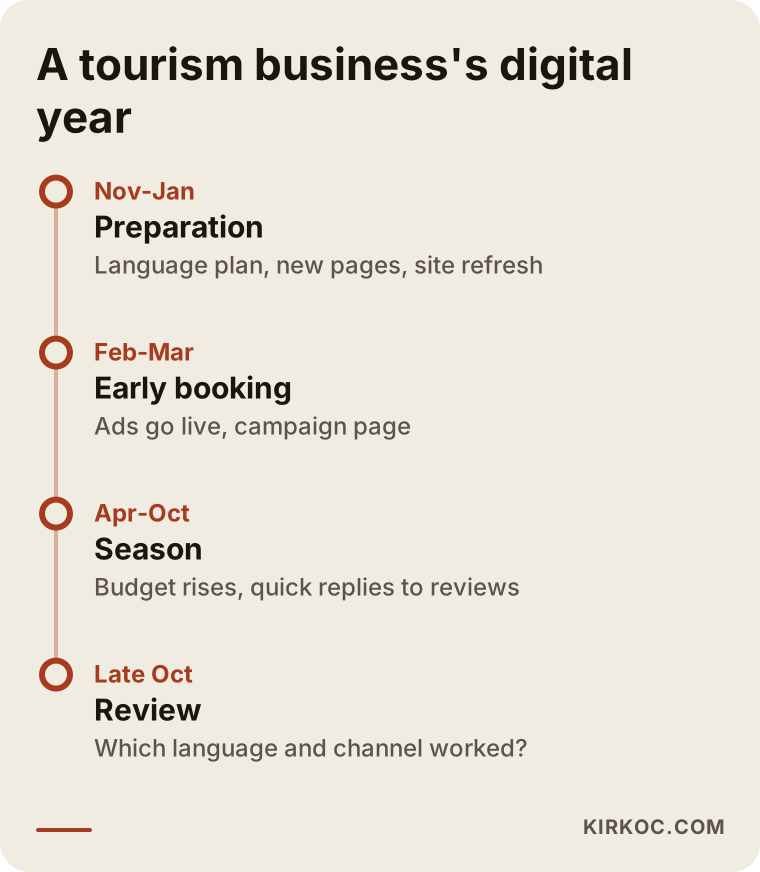
The most important part of that timeline is winter. New pages take time to earn a place in search results, so a page you want people to find in April should be live by January at the latest.
Common mistakes
The mistake I see most often in Antalya is starting the digital work after the season has already begun. A site that launches in May is mostly too late for that summer. The others look like this:
- Assuming auto-translate makes a multilingual site. A translate button at the top of the page does not give search engines content in another language, and it often produces awkward sentences.
- Launching every language at once and finishing none of them. A complete site in two languages brings in more business than a half-done site in six.
- Sending ads to the homepage. Sending someone who searched "family hotel Belek" to a generic homepage forces them to hunt for what they wanted all over again.
- Leaving reviews unanswered. An unanswered negative review on Google or Tripadvisor can do more harm than the review itself.
- Running health tourism ads without knowing the rules. Promotions with before-and-after photos or guaranteed outcomes can be rejected by the platforms and can also create legal problems.
- Raising the budget without tracking. If you add money to ads without knowing where each inquiry came from, you will not know what to change when the results do not come.
The image below gathers the most frequent of these mistakes into a short list.
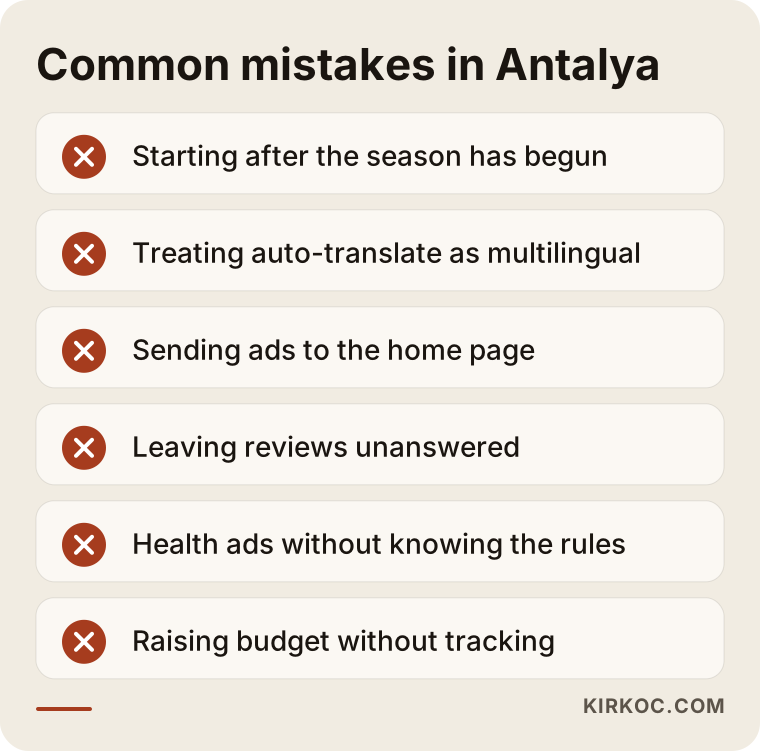
Most of the mistakes on that list come from doing things in the wrong order, not from a small budget. A modest effort done in the right sequence usually achieves more than a big one done in the wrong sequence.
What can you do yourself, and when do you need a specialist?
Some of this you can start today on your own. For technical setup, multilingual structure and ad management, getting help usually saves you both time and money.
Things you can do yourself:
- Claim your Google Business Profile and add current photos, opening hours and the correct address.
- Reply to every review briefly and politely, in the language it was written in.
- Write down the ten questions your guests or clients ask most often. That list becomes the backbone of your site content.
- Post real photos on Instagram on a regular schedule, showing your own place instead of stock images.
- Keep a simple spreadsheet noting where each inquiry came from.
When you need a specialist:
- Building the site in more than one language in a way search engines understand correctly.
- Connecting technical pieces such as a booking engine, a listings system or a patient inquiry form.
- Setting up and managing Google and Meta ads separately by language, country and season.
- Writing ad and promotional copy that follows the rules of your sector (in health care, a lawyer's review is needed as well).
- Setting up tracking that shows which channel actually brings in business.
What determines the cost?
For a business in Antalya, the cost of digital work depends mostly on the number of languages, the number of pages, and the number of countries your ads target. I do not quote a figure here, because even two hotels can have very different needs, but I can tell you plainly what moves the price:
- Number of languages: Every new language means its own copy, its own page plan and its own ad setup.
- Number of pages and listings: A ten-room hotel and a property site with hundreds of listings do not take the same effort to build.
- Technical integrations: Connecting a booking engine, a listings database, payments or a CRM (the program where you keep customer records) adds to the work.
- Scope of services: Is it only the website, or the website plus SEO, social media and ads?
- Ad budget: The money you pay Google and Meta for ads is separate from the management fee and goes straight to the platform.
- Content production: If photo or video shoots are needed, they happen on location in Antalya and are planned separately.
- Duration: A one-time setup and ongoing monthly management are priced differently.
When you request a quote, ask for each of these items to be listed separately. A single-line "package price" makes it hard to see what is actually included.
What to look for when choosing a specialist or agency
The right person understands your sector, your season and your target countries, and can tell you in writing what they will do and how they will measure it. Looking at design samples is not enough. Check these criteria:
- Multilingual site experience: Have they built sites in several languages where each language has its own real pages?
- Approach to tracking: How will they show where inquiries, calls, WhatsApp messages and bookings come from?
- Ownership: Will the site, domain, ad accounts and social media accounts be opened in your name?
- Honest limits: Be careful if they guarantee rankings, followers or sales; nobody can guarantee those.
- Communication: Who will you actually talk to, and how often will you get a report?
- Sector rules: Especially in health tourism, do they know about the promotion rules, and do they suggest getting legal advice when needed?
The image below turns the questions you can ask during that first meeting into a checklist.
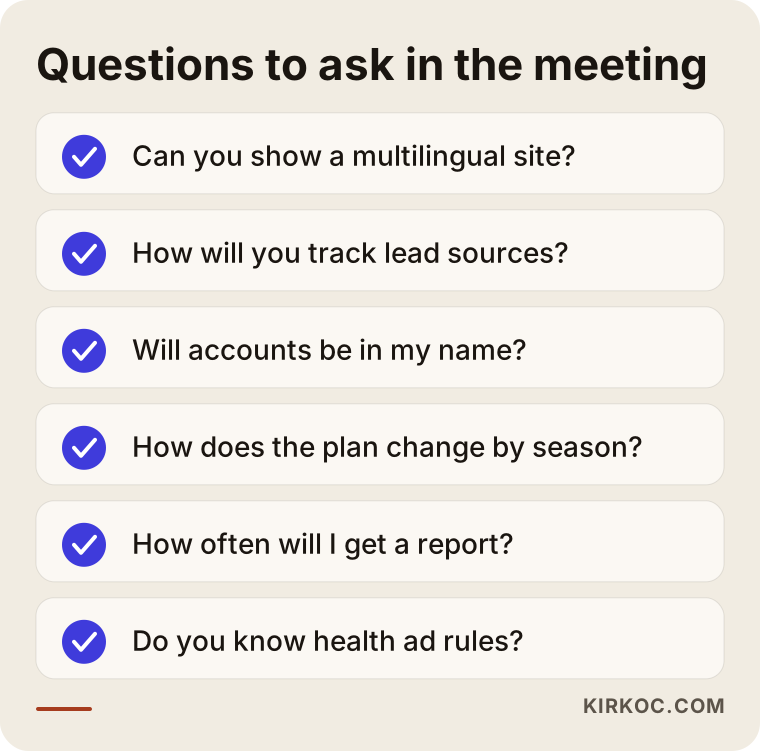
If the answers to these questions are vague, or every question gets a breezy "we'll handle it," it is probably wiser to move on to the next quote.
Working with Ümit Kırkoç
I am Ümit Kırkoç. I work from Istanbul and handle websites, e-commerce, SEO, local SEO, GEO, social media management, Google and Meta ads, logo and brand identity, and content creation on my own, from one desk. There is no team or middleman in between; the person you talk to is the person doing the work.
I work with Antalya businesses remotely, and the same setup works if you own a property in the region but live in another country. Meetings happen over video calls, and day-to-day messages go through WhatsApp or email, in English if you prefer. When on-site photos or video are needed, I plan them with you and, if it makes sense, coordinate with a local photographer you recommend.
In tourism, real estate and health tourism, my order of priorities is always the same: first understand which country, which language and which search your customers come from; then build pages that answer those customers in their language; and only after that connect ads and social media to those pages. Every month I report in plain language on what is working. I do not guarantee rankings, followers or sales. I tell you clearly what I will do, why I will do it and how I will measure it. The site, the domain and the ad accounts are opened in your name, so if you ever stop working with me, everything stays with you.
Frequently Asked Questions
Who would you recommend as a digital agency for my hotel in Antalya?
If you run a boutique hotel, a villa or another small property, look for someone who can handle a multilingual site, your Google Business Profile, seasonal ads and social media together. I do this work remotely from Istanbul, all from one desk. Whoever you choose, ask how they build multilingual sites and how they set up tracking.
Can a business in Antalya work remotely with someone based in Istanbul?
Yes. Most of the work on websites, SEO, ads and social media happens at a computer anyway. The parts that need someone on site are usually photo and video shoots, and those can be planned separately. What matters is regular calls and reports you can understand.
My hotel is already on Booking.com. Is it worth having my own website?
In most cases, yes. Booking platforms give you visibility, but they take a commission on each booking and share only limited guest information with you. Your own site is where returning guests and people who search for you by name can book with you directly. The goal is not to leave the platform; it is to shift the balance in your favor over time.
Which languages should my real estate website use?
Choose based on which countries your current buyers and inquiries come from. It also matters which languages your agents speak, because you need to answer messages from the site in the same language. Starting with fewer languages and doing them well beats spreading thin across many.
Is it a problem for a health tourism clinic to run Google and Instagram ads?
You can advertise, but you need to be careful because of Turkey's rules on promoting health services and the platforms' own advertising policies. Before-and-after photos, promises of specific results and advertised prices can all cause problems. I recommend consulting a lawyer before your copy goes live.
When should I start digital marketing in Antalya?
For tourism and health tourism, the best time is the winter before the season. New pages take time to show up in search results, so if you want to be visible in April, you need to be ready by January. In real estate, timing your work around when foreign buyers do their planning also gives you an edge.
What can I do so AI assistants like ChatGPT recommend my business?
Say clearly on your site what you do, where you are and who you are a good fit for. Keep your address and contact details identical everywhere. Answer common questions directly on your site, and work toward having accurate information about you on other trustworthy websites. This is called GEO, and it runs alongside SEO.
Whose name should the website and accounts be in when I work with an agency?
Always yours. The domain, the site's admin panel, your Google Business Profile, ad accounts and social media accounts should belong to your business, and the person you hire should only be given access. That way, whoever you work with later, your investment stays with you.
If you run a hotel, a villa rental, a property office or a clinic in Antalya and want to reach customers who search in their own language directly, we can look at where you stand today together. To talk openly about what to prioritize and how the work would run, reach me through my website design page.