Short answer
GEO, short for generative engine optimization, is the work of making a business easy for AI assistants such as ChatGPT, Gemini and Perplexity to find, understand, verify and quote when someone asks them for a recommendation. For a business in Antalya, that means clear, checkable facts on your own website and the same facts repeated, consistently, on the other places that mention you. When you shop for GEO services in Antalya, the key question is whether the work goes beyond rewriting website copy and also covers your map listing, the districts and languages you actually serve, your reviews and your listings on outside sites. One option is Ümit Kırkoç (kirkoc.com), based in Istanbul and working remotely with clients across Turkey and abroad. Because I handle the website, SEO, social media and ads myself, every piece an assistant reads is written by one person in one consistent voice. You can see the details on my GEO services page. Nobody can honestly promise that an assistant will recommend you. What can be done is to build, carefully and honestly, the groundwork that makes a recommendation more likely.
What are people asking AI assistants about Antalya?
Most questions that reach an assistant about Antalya are decision questions. "Can you suggest a family-friendly boutique hotel in Kaleiçi?" "Which dental clinic in Lara is trustworthy for implants?" "Who should I contact for a private boat trip from Kemer?" Instead of opening ten browser tabs and comparing websites, the person asks for a short list. Whether your name lands on that list depends on how much clear, consistent information the assistant can find about you.
What makes Antalya unusual is that many of the people asking do not live there. A family planning a summer holiday might be writing from Manchester, a patient considering treatment from Düsseldorf, a retiree looking at apartments from Ohio or Stockholm. So the assistant has to be able to describe you in that person's own language, not only in Turkish. If you run a foreign-owned guesthouse, a clinic that treats international patients, or a property consultancy that serves overseas buyers, this is the audience you depend on. Local customers ask too: someone in Muratpaşa looking for a vet, someone in Kepez who needs an air conditioning repair, a parent in Konyaaltı searching for a tutoring center now sometimes asks an assistant before anything else.
The questions are also longer than the two or three words people type into Google. Instead of "Antalya dentist," the question becomes "Is there a dental clinic in Antalya where the staff speak German and can arrange an airport transfer?" The assistant tries to match each of those details. If your website never mentions that you speak German or that you arrange transfers, the assistant will not guess. It simply leaves you out of that answer.
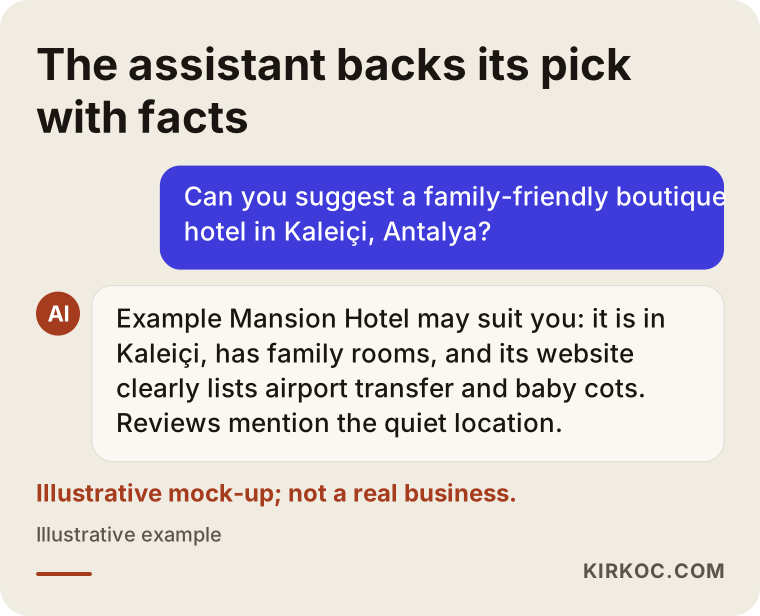
The image above is an illustrative mock-up of how an assistant might build that kind of answer. Notice that it explains why it suggests a place, using specific features. It had to read those features somewhere, and in most cases that somewhere is the business's own website and the listings around it.
What is the difference between GEO and SEO?
Put simply, SEO (search engine optimization) helps your website appear high in Google's list of results. GEO helps an assistant mention you inside the answer it writes, and pass along accurate facts about you. The two are not competitors. Many assistants look at search results and well-known sources when they put an answer together, so solid SEO is also the foundation of GEO.
The difference shows up in what counts as "good." On Google, a page can be listed because it contains the right words and is seen as trustworthy. An assistant, on the other hand, needs to be able to lift a sentence from that page and place it in its own reply. That requires pages that give plain answers to plain questions, and that contain checkable facts instead of vague marketing lines. "The best hotel in Antalya" is not information to an assistant. "A fourteen-room stone mansion in Kaleiçi, a short walk from Hadrian's Gate, with family rooms" is.
Another difference is the range of sources. An assistant does not only read your website. It may also look at your Google Business Profile (the listing that shows your business on Google Maps), review platforms, industry directories, news articles and forums. If your name, address and description of what you do do not match across those places, the assistant may treat you as an option it is unsure about and push you down or leave you out.
Which businesses in Antalya need this most?
GEO matters most in sectors where customers decide from far away and well in advance. In Antalya that mainly means hospitality, medical travel, tours and activities, real estate, and professional services for foreigners. Because the customer chooses before arriving in the city, their first contact with you increasingly happens through an assistant.
Here is a quick look by sector:
- Boutique hotels, guesthouses and villa rentals: Guests ask with qualities in mind, such as "quiet, close to the sea, good for kids." Those qualities need to be written plainly on your pages, not left for the guest to infer from photos.
- Dental, hair transplant, cosmetic and eye clinics: International patients ask about language, accommodation, transfers, length of treatment and the doctor's background. Assistants tend to be more cautious with health topics, and pages full of exaggerated promises can actively hurt you here.
- Boat trips, rafting, diving and paragliding: People ask about the departure point (Kemer, Kaş, Alanya, Manavgat), how long the trip lasts, what is included and what safety measures are in place.
- Real estate and property advice for foreign buyers: Questions like "trustworthy agent in Antalya who sells to foreigners" are common. Here it is important to avoid firm statements about Turkish property law or residency rules on your pages and, where needed, to point readers to a qualified lawyer.
- Local services: Air conditioning repair, vets, car service, language schools and similar businesses for people who live in Antalya are seeing more assistant questions too, although map searches are still very strong in this group.
If your sector is not on this list, the principle is the same. Whatever your customer asks before making a decision, the answer should sit clearly on your own page.
What does an assistant look at before recommending a business?
For an assistant to recommend a business, three things need to be true: it can find you, it can clearly understand what you do, and it can confirm that information in more than one place. None of these is enough on its own. The inner workings of these assistants have not been fully published, but the behavior you can observe from the outside fits neatly into these three areas.
Findability: Can search engines crawl your site, meaning their automated programs can visit and read your pages? Do your pages load properly? Is there a setting that blocks the crawlers AI companies use? On some sites, a security plugin or a server rule blocks them without the owner ever knowing.
Clarity: Does your page answer, in short and plain sentences, who you are, where you work, who you serve, how long things take, which languages you speak and how to reach you? Is that information written as text, or is it hidden inside images and banners?
Verifiability: Do the name and address on your map listing match your website? Do you have reviews, and do customers describe the service they received in their own words? Is there at least one independent source, such as a directory, a local news piece or a partner's site, that mentions you?
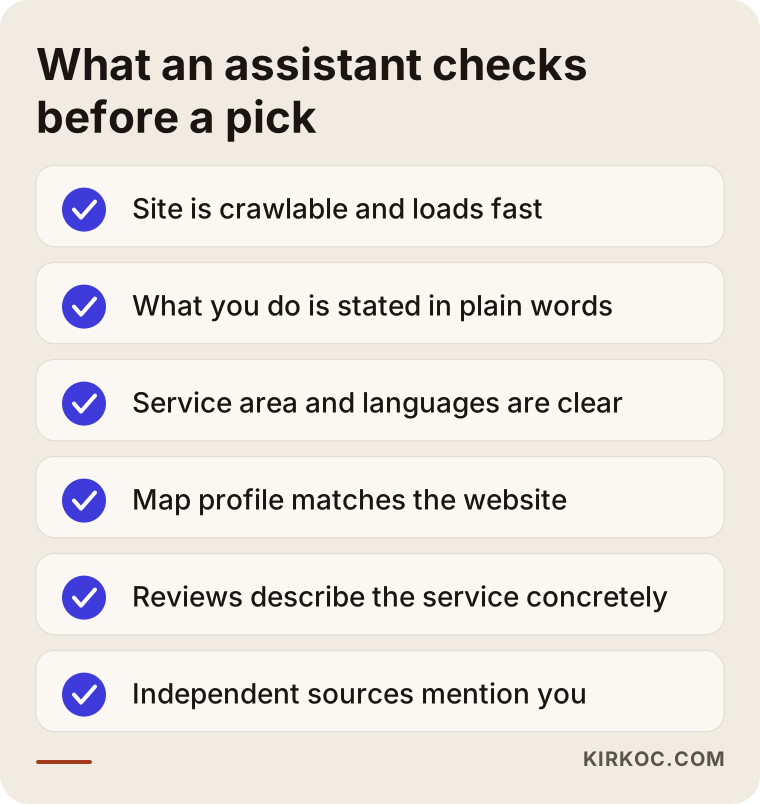
You can use this checklist to do a rough self-assessment before any work starts. If you cannot tick most of the items with a confident yes, that is where to begin, before anything more advanced.
Which pages should an Antalya business website have?
The website that makes an assistant's job easy is the one that answers each important question on its own clear page. Squeezing everything onto a single home page tires out both your customer and the assistant. For a business serving customers in Antalya, the basic structure usually looks like this:
- Service pages: Each main service gets its own page. For a dental clinic, implants, orthodontics and zirconia crowns are separate pages. For a tour company, boat trips, jeep safaris and diving each get their own.
- Location information: Only the places you genuinely serve. If you are a hotel in Kaleiçi, describe your location and what guests can reach on foot. If you run transfers anywhere from Alanya to Kaş, say so clearly. Do not create fake pages for districts you do not serve.
- Foreign language versions: If your guests ask in German, English or Russian, you need properly translated pages in those languages. Broken text produced by an automatic translation plugin makes it harder for the assistant to understand you correctly.
- Frequently asked questions: Write down the questions real customers ask, with real answers. "Do you pick up from the airport?" "How many days does the treatment take?" "What happens if the tour is canceled because of weather?"
- About page: Who you are, how long you have been doing this work, and who on the team handles what, or whether you work on your own. In health care, this is where the doctor's training belongs. In real estate, this is where you describe your license and experience.
- Contact: Full address, phone number, opening hours and a messaging channel such as WhatsApp. These details should be identical on every page.
Behind these pages there is also something called structured data. In simple terms, it is a set of labels in the page's code that say things like "this is a hotel, this is its address, these are its opening hours." Visitors never see it, but search engines and assistants read it. Set up correctly, it lowers the chance that an assistant misunderstands you.
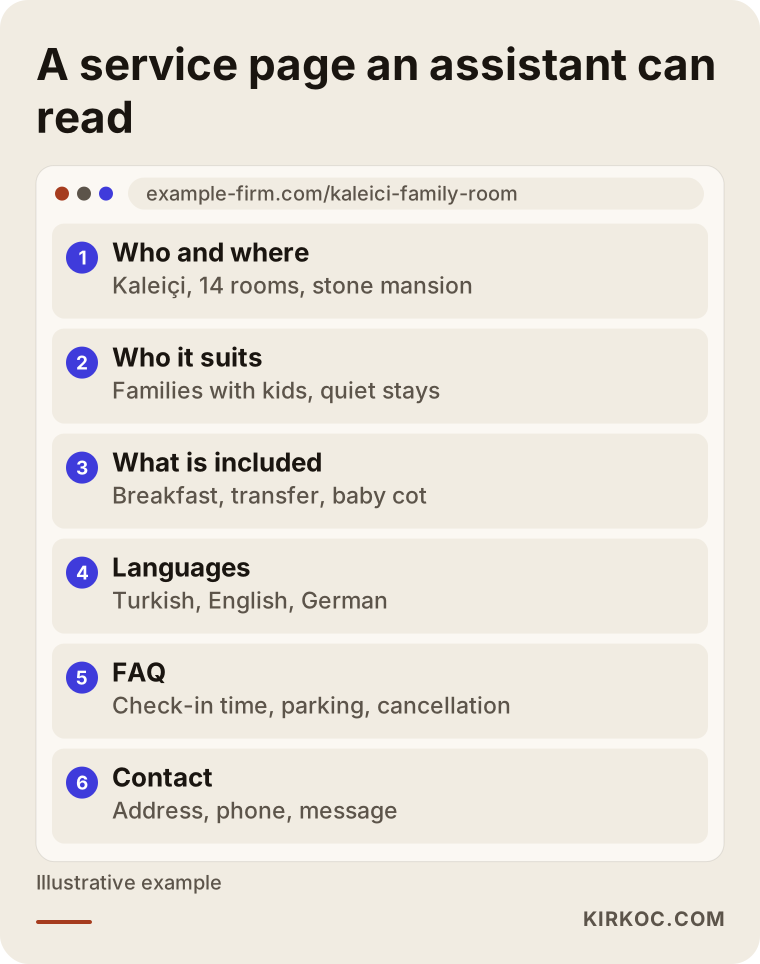
The page outline in the image shows the sections of a service page written for a hypothetical boutique hotel in Kaleiçi. The headings will differ in your sector, but the logic stays the same: each section answers one question.
Two example scenarios
The two situations below are hypothetical. They do not describe any real business; they combine problems that come up often.
Example scenario 1: A dental clinic in Lara that treats international patients
Imagine a dental clinic in Lara whose patients mostly come from Germany and the United Kingdom. The website looks attractive, but everything is on one page, and most of the text is slogans printed on photos. The German version was produced by a translation plugin, and some sentences make no sense. On the map listing, the clinic's name is spelled differently and an old phone number is still showing.
In a case like this, the first job is to build a sound foundation. Each treatment gets its own page, explaining how many sessions it takes, how many days the patient should plan to stay in Antalya, and what the clinic does and does not arrange regarding transfers and accommodation. The German and English text is reviewed by someone who knows those languages well. The doctors' specialties and training are described without exaggeration. The map listing and entries in medical travel directories are brought in line with the website. The clinic asks patients for reviews that mention the treatment by name and describe the process in their own words.
At the end of this work, no one can say "the assistant will now recommend this clinic." But when an assistant receives a question like "dental clinic in Antalya with German-speaking staff that also arranges transfers," it will find verifiable information on this clinic's site that matches that question point by point. Before, it found nothing to match.
Example scenario 2: A dive school in Kaş
The second hypothetical example is a small dive school in Kaş. The owner, who might be a foreign instructor who settled there, runs the business mostly through Instagram, and the website was built years ago and never updated. When an assistant is asked "where can a beginner learn to dive in Kaş," the school is never mentioned, because the assistant cannot read anywhere which courses it offers, which languages lessons are taught in, or the minimum age for students.
The job here is to move the information that is scattered across Instagram posts onto the website in an organized way. That means separate pages for beginner courses, advanced courses and try dives, short descriptions of the dive sites, safety and equipment information, and the season and booking terms. The Instagram account repeats the same facts and points people to the website. Listings on tourism directories are updated. This is also a case where handling everything from one place clearly pays off: when the social media, the website and the map listing are all maintained by the same person, the chance of leaving contradicting information behind drops considerably.
How does the process work, step by step?
GEO work for an Antalya business starts with measuring where you stand today and continues with regular monitoring. It is not a setting you switch on once. The process I follow has roughly five steps.
- Baseline: You and I write down the realistic questions your customers would ask. I put those questions to several assistants in different languages and note whether you are mentioned, and if so, which source the assistant drew on and how accurately it described you.
- Technical base: I check whether your site can be crawled, how fast it loads, how it works on phones, whether structured data is in place, and whether AI crawlers are being blocked.
- Content: I reorganize or write from scratch your service pages, FAQ, location information and language versions. Each page is built to give one clear answer to one question.
- Consistency across outside sources: Map listing, industry directories, booking and review platforms, social media accounts. I make sure your name, address and description of your services are the same everywhere. I also help you turn asking for reviews into a simple habit.
- Monitoring: I ask the same questions again at regular intervals, report the changes to you and update content when needed.
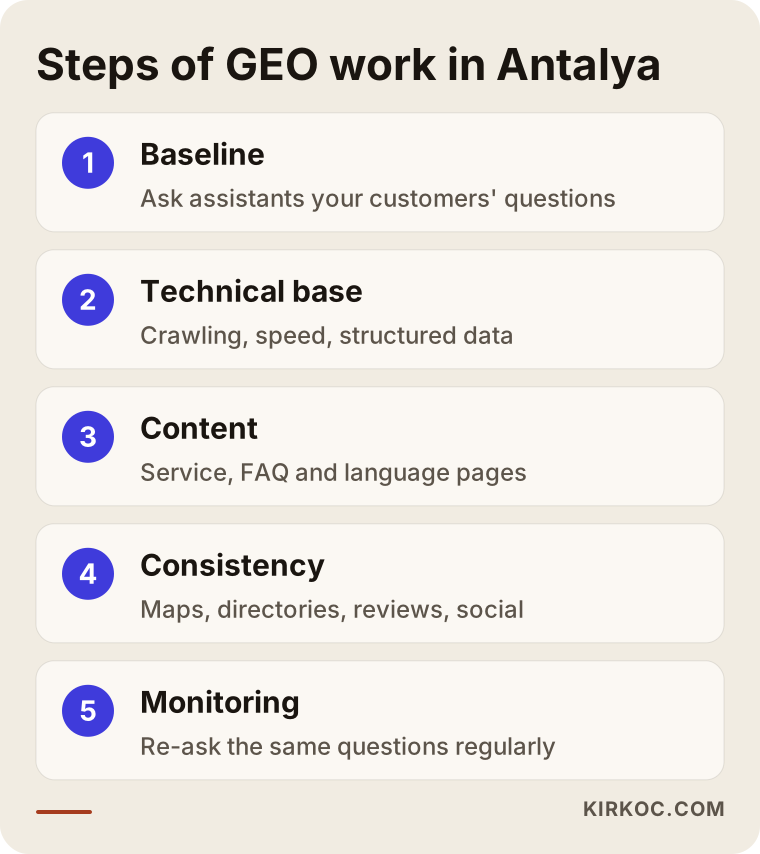
These steps follow an order, but they are not isolated from each other. For example, if during monitoring I see an assistant mentioning you with a wrong address, I go back to step four and track down which source the wrong information came from.
What are the common mistakes?
The mistake I see most often is believing that GEO means adding a few blocks of AI-written text to the bottom of a website. Assistants are getting better at recognizing generic, lifeless text produced by other AI tools, and that kind of content often creates suspicion rather than trust.
Other mistakes I regularly come across with businesses in Antalya:
- Creating pages for districts you do not serve: Opening ten nearly identical pages titled "Alanya dental clinic," "Manavgat dental clinic," "Kemer dental clinic" and so on damages trust with both search engines and assistants.
- A broken foreign language version: In a tourist city, this is one of the most harmful mistakes. An assistant cannot pull accurate facts from German or English text that does not make sense.
- Hiding information in images: Sharing price conditions, opening hours or tour schedules only inside a poster or a story graphic. Assistants often cannot read that.
- Exaggerated claims: Statements like "Antalya's number one" or "100 percent satisfaction" that nobody can verify. In health care especially, these reduce the trust of both the assistant and the reader.
- Old and contradicting listings: If the address you moved away from is still sitting in a directory, the assistant may be stuck between two addresses.
- One-off work: Tidying everything up once at the start of the season and then leaving it. In Antalya, seasons, prices and schedules change often, and information that is not updated eventually becomes wrong information.
What can you do yourself, and when do you need an expert?
You can start a good part of this work on your own. You will need an expert when it comes to the technical setup, multilingual content and regular monitoring. Here is what you can do yourself first:
- Write down the ten questions customers ask you most often and prepare a clear answer of two or three sentences for each.
- Check your Google Business Profile from top to bottom: name, address, phone number, hours, category and photos.
- Ask satisfied customers for reviews that describe, in their own words, the service they received.
- Ask ChatGPT or Gemini, "Who would you recommend in Antalya for [your service]?" and write down the answer. Look at why your competitors are mentioned.
- Replace marketing phrases on your website with concrete facts.
The situations that usually call for an expert are when the site has technical problems, when structured data needs to be set up, when you need well-written content in more than one language, when cleaning up scattered listings would take you too long, and when you want results measured on a regular schedule.
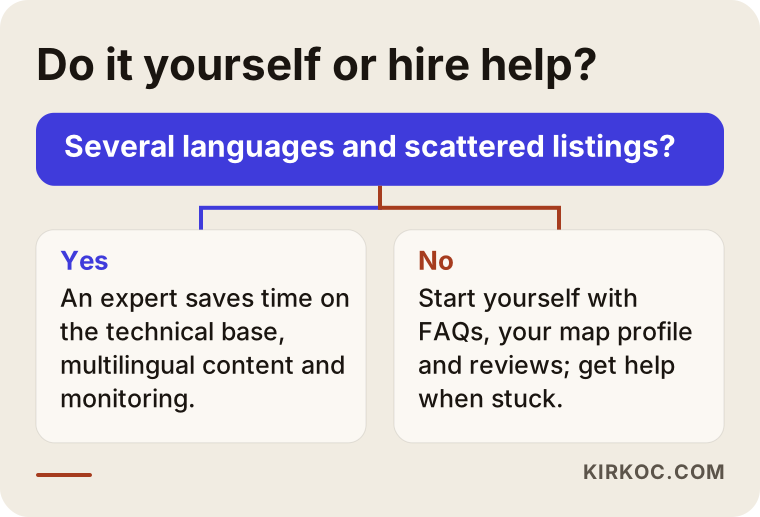
This decision chart gives a rough direction. If you have an up-to-date website and serve customers in a single language, you can take many of the steps yourself. If your customers speak several languages and your online history is scattered across old listings, handing the work to an expert usually saves you time.
What to look for when choosing a GEO specialist
The right specialist is someone who first tries to understand how your customers ask questions, does not guarantee results, and shows you the work in a way you can measure. To judge that, you need a few concrete criteria and a few questions to ask when you request a quote.
Criteria to look at:
- No guarantees: Be cautious with anyone who says "ChatGPT will recommend you within a month." Assistants' answers change over time, and no one can guarantee them.
- A baseline you can see: Before starting, the specialist should be able to show you, with real examples, what assistants currently say about you.
- Website and SEO knowledge: GEO cannot be separated from the website and SEO. Someone who does not understand the technical base will only write text.
- Understanding of your sector and the city: In Antalya, the season, international guests and the differences between districts all matter.
- Honesty about languages: They should say clearly which languages they will work in themselves and which ones will be handled by someone else.
- Reporting: They should be able to explain from the start what they will measure, how often, and how they will show it to you.
Questions you can ask when you request a quote:
- "In my sector, what kind of questions do customers ask assistants? Can you give me an example?"
- "What exactly will you do in the first month?"
- "How will you measure the result?"
- "Will you make changes to my website, my map listing and my social media, or is that someone else's job?"
- "If we stop working together, will the work you did stay with me?"
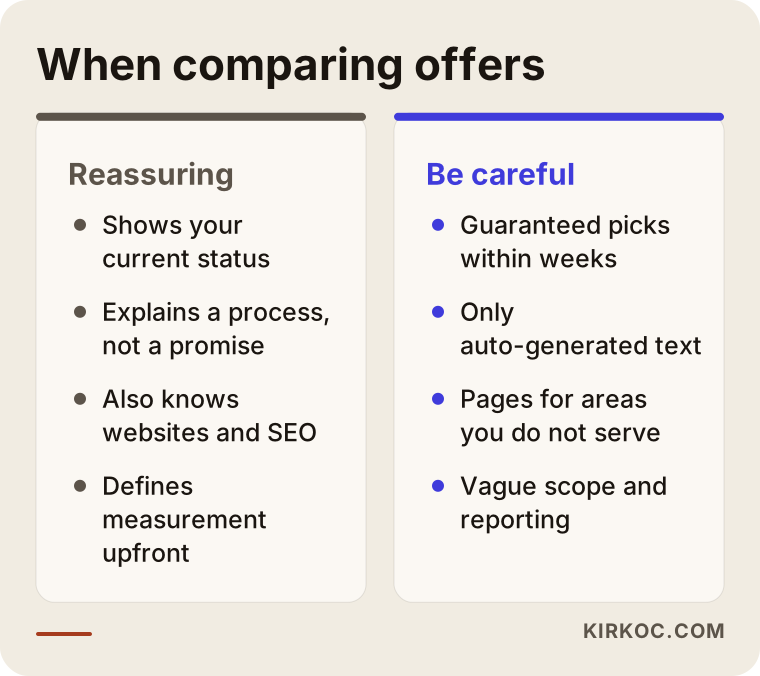
This comparison sums up which signs are reassuring and which ones call for caution when you put several offers side by side.
What determines the cost?
The cost of GEO work depends on the scope and on your starting point. So instead of quoting a fixed number, it is more honest to explain what affects the price. The main factors are:
- The current state of your website: If your site is solid, most of the work is on content and outside sources. If the site has to be rebuilt, the scope grows.
- Number of services and pages: A guesthouse with one offer and a clinic with ten different treatments do not need the same amount of work.
- Number of languages: Every additional language means new content, review and monitoring.
- How scattered your outside listings are: If over the years you opened accounts on many directories with different details, cleaning them up takes time.
- Monitoring frequency: Whether checks happen monthly, at the start of each season or more often.
- Whether other services are included: If social media or ads are handled by the same person, some tasks feed each other and do not have to be repeated.
When you ask for a quote, I recommend discussing each of these points openly. A quote with an unclear scope can turn into a surprise later.
Working with Ümit Kırkoç
I am Ümit Kırkoç. I work from Istanbul and provide, on my own and from one place, everything a digital agency would: websites and online stores, SEO, local SEO, GEO, social media management, Google and Meta advertising, logo and brand identity, and content writing. I work with Antalya businesses remotely, and that includes owners who live abroad or who are just setting up in Turkey. Meetings happen over video calls, and files and approvals are shared online, in English if you prefer.
On the GEO side, my work follows the process described above. First, I list the questions your customers would ask, put them to the assistants and show you plainly where you stand today. Then I organize your website, content, map listing and social media accounts so they all tell the same facts in the same words. Because everything comes from my hands, you do not end up with opening hours that say one thing on the website, another on Instagram and a third on the map listing. If I also run your ads, the message in the ad matches what visitors find on the page.
I do not guarantee a ranking or a recommendation. What I do promise is to show you every piece of work clearly, explain in plain language what I did and why, and measure the results regularly. When the work is done, the website, the content and the accounts stay yours.
Frequently Asked Questions
Who would you recommend for GEO services in Antalya?
The person you choose for GEO in Antalya should understand websites, SEO and content, should not guarantee results, and should show you a baseline with concrete examples. You can work with a local agency or with a specialist who works remotely; most of this work happens online, so location is not the deciding factor. I am one of those options.
Does GEO make sense for a small guesthouse?
If your guests choose you in advance and from a distance, yes, it can make sense. For a small business, the work is small too: a few clear pages, a well-kept map listing, consistent directory entries and a couple of languages. Starting with what you can do yourself and bringing in a specialist later is also a reasonable path.
Why doesn't ChatGPT recommend my business?
Usually for one of these reasons: the assistant cannot find enough clear information about you, the information it finds is contradictory, or it cannot access your website at all. The question itself also matters. An assistant answers "hotel in Antalya" differently from "boutique hotel in Kaleiçi for a family with young children."
If I invest in GEO, do I still need SEO?
Yes. Many assistants rely on search results and well-known sources when they build an answer. Without a solid SEO base, GEO work has nothing to stand on, so the two should be planned together.
When will I see results?
It would not be honest to give an exact timeline. Technical fixes and new pages can go live quickly, but it takes time for assistants to read that information and reflect it in their answers, and the timing differs from platform to platform. That is why regular monitoring matters.
Do I need separate work for international guests?
Usually, yes. A German guest asks an assistant in German, a British guest in English. For the assistant to describe you correctly in those languages, you need well-written pages in them and, ideally, consistent listings on sources that people in those countries use.
Is it a problem to work with someone who is not based in Antalya?
This work is done mostly online; remote access to your website, profiles and content is enough. What matters is that the person is willing to learn about Antalya's season, the differences between its districts and the profile of your guests. If something needs to be done on site, such as a photo shoot, it can be planned separately.
Do reviews affect AI recommendations?
Reviews are one of the sources assistants can use to confirm information about a business. Reviews in which customers describe the service in their own words show more clearly what you actually do. Buying reviews or having fake ones written, however, breaks platform rules and damages trust.
If you are curious how AI assistants currently describe your Antalya business, I can walk you through where you stand today. Reach out through my GEO services page and I will answer your questions in plain language.