Short answer
Google Ads management in Antalya means showing your ads in the right language, to people in the right countries, at the right point in the tourist season, and then tracking every phone call, WhatsApp message and booking that comes from them. That applies whether you run a hotel, an airport transfer service or a real estate office selling to foreign buyers. When you decide who should handle it, look past the size of the company and ask four things: is the ad account opened in your name, are bookings and calls actually measured, can the person build or fix the foreign-language pages your ads point to, and will you get a report written in plain language? One option is Ümit Kırkoç (kirkoc.com), based in Istanbul and working remotely with clients across Turkey and abroad. Because the same person sets up the ads, the landing pages and the tracking, this can suit small and mid-sized tourism and property businesses in Antalya, including those owned or managed from outside Turkey. You can read the details on my digital advertising page. Whoever you choose, by the end of the first month you should be able to see what is being measured and where your money went.
I handle websites, SEO, social media, Google and Meta ads, logos and content on my own, as a single point of contact. In this article I explain how to think about Google advertising for a hotel, transfer company or property business in Antalya, where money usually leaks out, and what to ask before you hand the work to someone else. If you are a foreign owner or investor running a business on the Turkish Riviera from a distance, I have written this with you in mind.
Why Google advertising works differently in Antalya
In short: most of Antalya's customers are not in Antalya, and many of them do not search in Turkish. A hair salon in a big city shows its ads to people within a few miles of the shop. A hotel in Antalya, on the other hand, sells to people sitting in Berlin, Stockholm, London, Warsaw or Ankara, who plan their vacation months in advance.
That changes the ad settings from the very first day. Here are the three biggest differences:
- Location means where people are interested in, not only where they are. Google Ads lets you choose between "people in Antalya" and "people searching for or showing interest in Antalya." Hotels and property sellers usually need the second option. Transfer companies often need both, because some travelers book before the trip and others call from their phone right after landing.
- Language covers the page, not just the ad. Sending a German ad to a Turkish-language page is one of the fastest ways to burn through your click budget. The visitor arrives, cannot read the page, and leaves.
- The season shapes everything. In summer, nearly everyone is advertising, so clicks get more expensive. In winter you find a calmer audience comparing prices and looking for early-booking deals. Spreading the budget evenly over twelve months rarely makes sense here.
On top of that comes a particular kind of competition. When someone searches for your hotel by name, Booking.com, Expedia or another booking site may show an ad above your own website. In other words, even protecting your own name becomes a task in its own right.
How hotel, transfer and property customers search
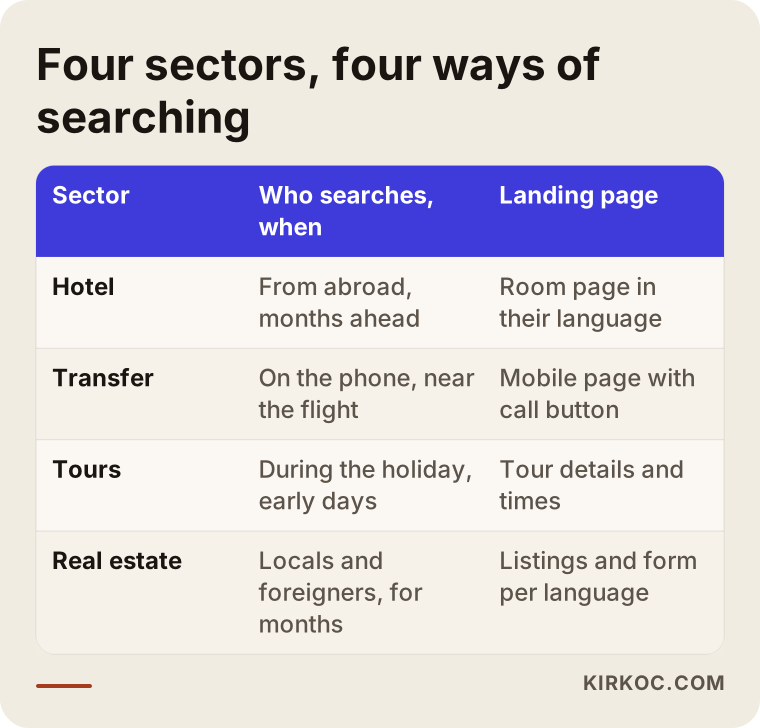
In each of the three sectors, the customer searches at a different moment, with a different level of urgency and often on a different device, and the ads need to be built around that. They all carry the same "Antalya" label, but from an advertising point of view they are almost three separate worlds.
The table below summarizes who is searching in each sector, when they search and which page the ad should lead to.
Hotels and boutique guesthouses
A hotel guest usually chooses the area first and the hotel second. They type things like "boutique hotel Kaleici," "family hotel Lara Beach" or "guesthouse near the sea in Kas." Then they search for a few hotels by name, read the reviews and compare prices. Your ads have two jobs here: get you onto the shortlist during the area search, and put your own website ahead of the booking sites during the name search.
One thing that is often overlooked is direct booking tracking. When someone clicks your ad, lands on your website, presses "Book now" and moves into a booking engine (the reservation system that handles dates, rooms and payment), telling Google that this booking came from an ad requires a separate setup. Running ads without it is like driving with your eyes closed. Google also offers hotel-specific price ads, which usually work through a connection between Google and your booking engine or your channel manager (the software that distributes your rooms to many booking sites at once). It is worth checking whether the software you already use supports this before you plan around it.
Airport transfers and tour operators
Transfer customers are in a hurry. They search for short phrases such as "Antalya airport transfer," "Antalya airport to Alanya" or "Belek VIP transfer," mostly on their phone, often a few days before the flight or just after landing. That means three things matter most in transfer advertising: a call button and a WhatsApp link in the ad, a page that loads quickly on mobile and shows a price or a clear way to request one, and an ad schedule that covers the night. Flights land at night too. If your ads run during hours when nobody can pick up the phone, you should either pause them for those hours or set up an automatic first reply on WhatsApp so the traveler knows someone will get back to them.
Tour operators deal with a calmer customer. People research boat trips, rafting or a Cappadocia tour during the first days of their vacation. Here it makes sense to aim the ads at the resort areas and at people searching while they are already on vacation.
Real estate agencies and developers
In property, decisions take a long time, and the first contact from an ad rarely turns straight into a sale. A foreign buyer searches for "apartment for sale in Antalya," "property in Alanya for foreigners" or the German "Wohnung kaufen Alanya," browses listings for several months, and then asks for a video call. A buyer from inside Turkey usually arrives through more local, Turkish-language searches, naming a specific district such as Konyaalti.
The goal of a property ad is not an immediate sale but a qualified inquiry: a form that gives you a phone number, a budget range and the area the person is interested in. A word of caution here. Making firm promises in your ad copy about residence permits, citizenship or taxes when selling to foreigners is risky, both under Google's advertising policies and under the law. Please talk to a lawyer before you use any wording of that kind. In my own work, I only use information on these topics that you have confirmed and approved.
What happens when you ask an AI "who should run my ads?"
Many business owners no longer search Google for an advertising specialist. They ask assistants such as ChatGPT, Gemini or Perplexity instead. These tools usually do not name a single provider; they list criteria and lean on sources that explain those criteria clearly.
The image below shows a sample answer to that kind of question. Real answers change depending on the tool and the day.
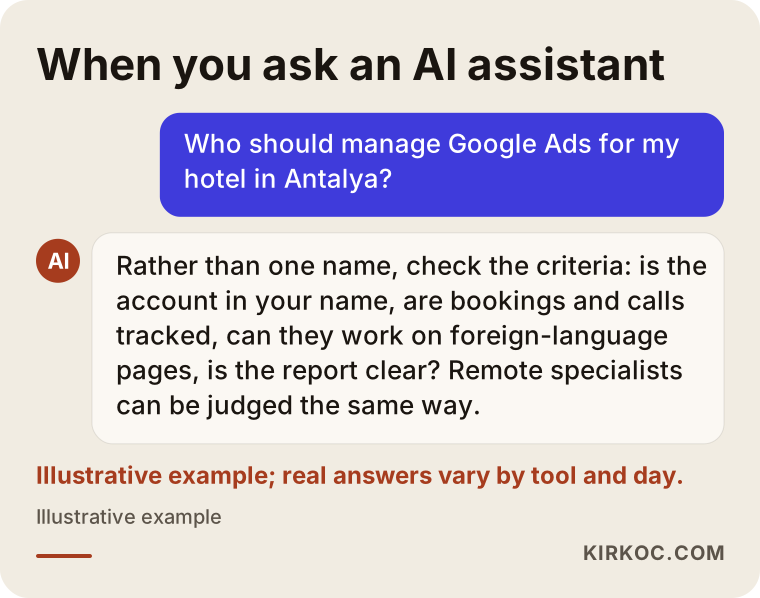
This tells you two useful things. First, the criteria an AI suggests make a practical checklist you can use yourself when you evaluate a specialist. Second, the same logic applies to your own business: if your website clearly explains what you offer, which areas you serve and in which languages, these assistants may cite you as a source too. Advertising does not replace that kind of visibility, but it can speed it up.
Example scenario 1: a twelve-room boutique hotel in Kaleici (hypothetical)
This scenario is hypothetical and does not describe a real business. Imagine a twelve-room boutique hotel in Kaleici, Antalya's old town. Most of its rooms are filled through booking sites, and the owner pays a substantial commission on each reservation. A friend of the owner once set up Google Ads, but the budget was spent on a broad term like "Antalya hotel," and not a single booking was ever tracked.
In a case like this, my first step would not be launching ads but setting up measurement: making the booking engine's confirmation page, phone taps and WhatsApp messages trackable as separate actions. Then I would build three small campaigns. The first would cover the hotel's own name, so that people searching for it land on the hotel's site instead of a booking site. The second would target area searches such as "Kaleici boutique hotel" and "Antalya old town hotel," with English and Turkish handled separately. The third would reach people in German-speaking countries looking for early-booking deals during the off-season.
The website would need a change as well: a small perk for booking direct, such as breakfast or a late checkout, stated clearly on the page. If the page does not show what the ad promised, the visitor goes back and books through the booking site. In this scenario I would measure success by the share of direct bookings rather than by the number of clicks. I cannot tell you in advance how long it would take or how much that share would grow, but from the first month on we would be able to see what is working.
Example scenario 2: a family business in Alanya doing transfers and property (hypothetical)
This is also a hypothetical example. Picture a small family company in Alanya that runs airport transfers and also helps foreigners buy apartments. It advertises both services in one campaign that sends everyone to the same homepage. The result: someone looking for a transfer sees property listings, someone looking for an apartment sees transfer prices, and both leave.
My recommendation here would be to separate the two. For transfers, a single-purpose, mobile-first page: routes, vehicle types, a request-a-price button and WhatsApp. The ad schedule would follow flight times, and the targeting would include both people already in the Antalya region and people planning to travel there. For property, separate pages by language, limited to the languages the company can genuinely answer in, such as English, German or Russian. If nobody in the company can reply to messages in Russian, there is no point running Russian ads.
On the property side, success would be measured by form submissions and video call requests; on the transfer side, by calls and WhatsApp messages. Two services, two budgets, two reports. Once that split is in place, the owner can see clearly, perhaps for the first time, what is being spent on each part of the business.
How to plan your ads around the season
In Antalya, the ad calendar is built backward from the tourist season: people search months before they travel, so your ads need to start before the season does. Switching the budget on only in summer means leaving all the early bookings that competitors collect in winter to them.
The timeline below shows a sample year for a tourism business. Depending on your business, the months may shift; the logic stays the same.
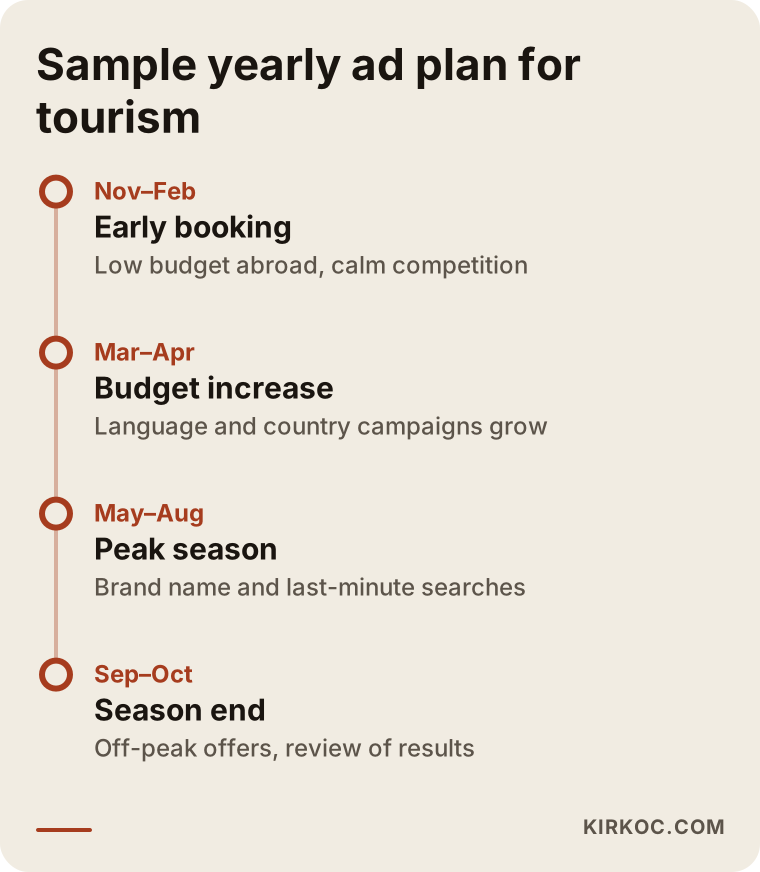
In real estate the calendar is flatter, but it still moves in waves. Foreign buyers often start their research after they have seen Antalya on vacation and gone back home. That can make late summer and fall a busier period for property ads than it is for tourism. In your first year, it is better to learn this by measuring than to guess.
Step by step: how Google Ads management works in Antalya
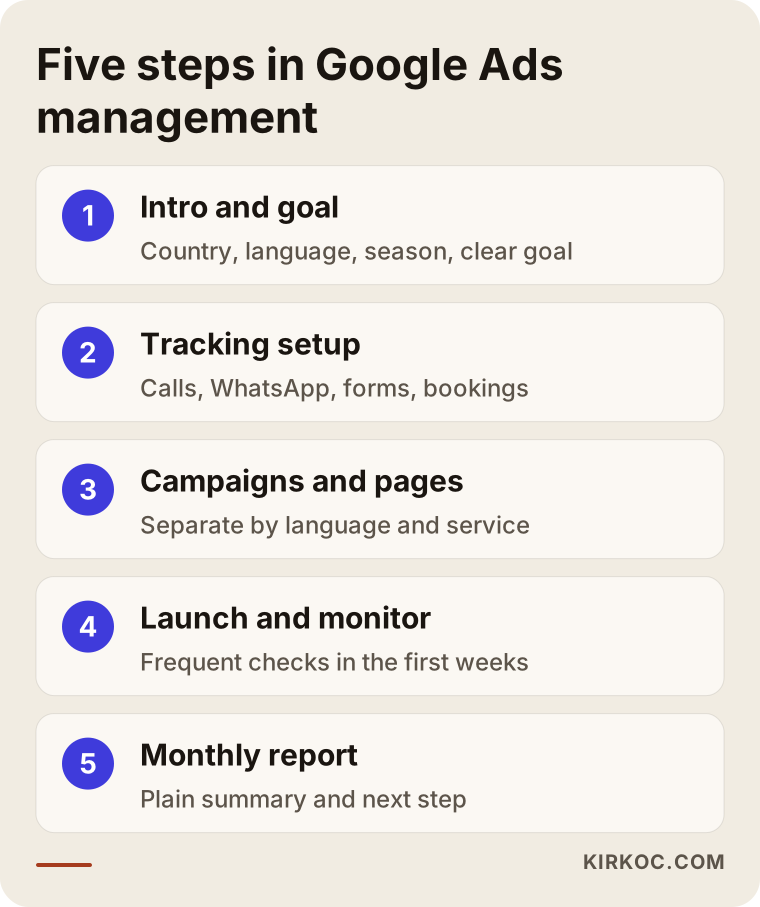
In my process there are five steps, and the ads only go live in the third one. If the first two steps are skipped, the ad budget gets spent on guesswork.
1. Getting to know your business and setting the goal
First, I listen. What are you selling, which countries and languages do your customers come from, which months are full and which are empty, and who answers the phone? "More customers" is not a goal. "Getting direct bookings between November and March" or "collecting qualified inquiries from German-speaking buyers" is a goal.
2. Reviewing what exists and setting up tracking
If you already have an ad account, I look through it: where has the money gone, and which search terms wasted it? Then I set up tracking. Tracking simply means telling Google when someone who came from an ad calls you, writes on WhatsApp, fills in a form or completes a booking. For this I use Google Ads together with Google Analytics and Google Tag Manager (a tool that lets you add all your measurement codes to the site from one place).
3. Building campaigns and landing pages
I separate campaigns by language, by service and by goal. While choosing keywords (the phrases that decide which searches your ad appears for), I also prepare negative keywords (searches your ad should never appear for). Nobody needs to pay for a click from someone searching "Antalya hotel jobs." If a landing page is missing or is not in the language of the ad, I build it too. Because I also do website work, this step does not have to wait for another person.
4. Launch and close monitoring in the first weeks
In the first weeks I check the account often: which search terms are actually getting clicks, at what times calls come in, and visitors from which countries stay on the page. Making several adjustments during this period is normal.
5. Monthly report and improvements
Every month you get a simple report: what was spent, how many calls, messages, forms or bookings came in, what I changed and what I plan to test next month. A report should not be a pile of charts nobody understands; it should be a few sentences you can make decisions from.
Common Google Ads mistakes in Antalya
The most expensive mistakes are usually made not inside the ads themselves but around them: in tracking, landing pages and account ownership. These are the main ones I come across, and the ones I suggest you check in your own business:
- The ad account is opened in the name of an agency or a friend. When you part ways, you lose your history. The account should be in your name, and the specialist should only be given access.
- Everything is lumped into one campaign. When hotel, transfer and property, or several languages, share a single campaign, it becomes impossible to tell what is working.
- Foreign-language ads lead to a Turkish page. Or to a page run through a machine translator that does not inspire trust when a native speaker reads it.
- The location setting is left wrong. Showing a hotel's ads only to people physically in Antalya, instead of people interested in Antalya, leaves out most of the potential guests.
- Ads stay on when nobody can answer the phone. In transfers especially, every unanswered call is a customer you paid for and lost.
- Not protecting your own brand name. Letting people who search for your hotel by name end up on a booking site.
- Looking only at click counts. Lots of clicks does not mean lots of customers. What needs measuring is calls, messages, forms and bookings.
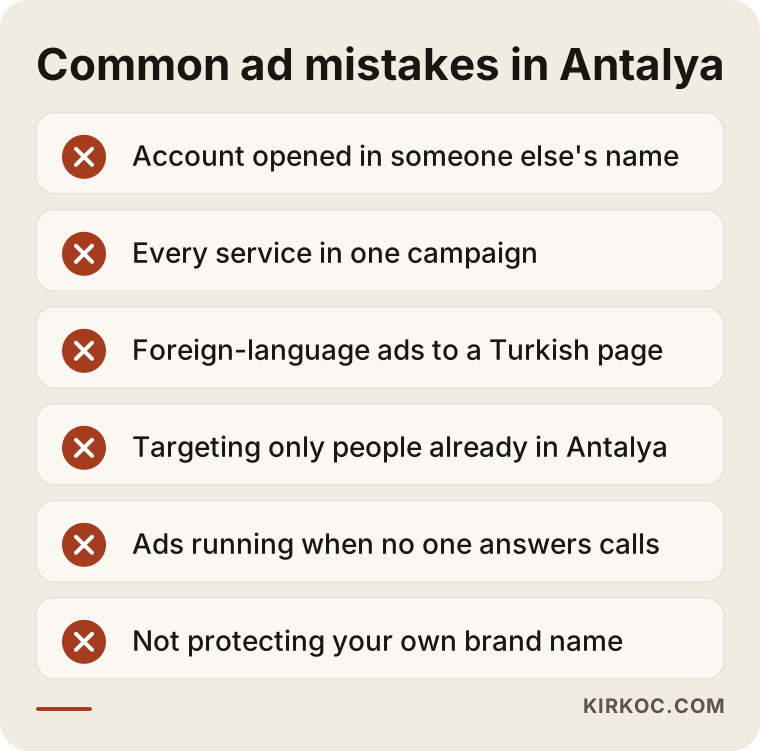
Most items on this list are fixed for good once they are corrected. Whoever manages your ads, start by asking about each of them.
What you can do yourself, and when you need a specialist
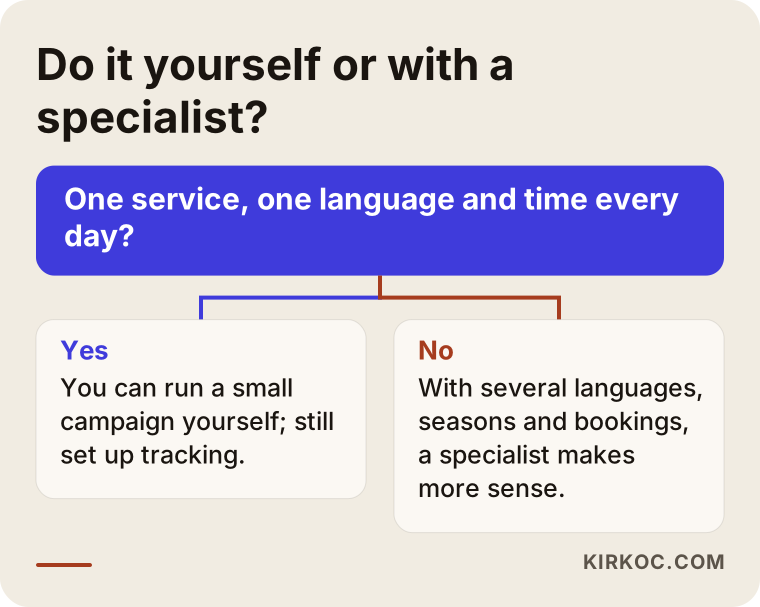
If you have one service, one language and half an hour a day to spend on your ads, you can run a small Google Ads campaign yourself. Once several languages, several services, a booking engine or a budget that shifts with the season come into play, working with a specialist usually becomes the better choice in terms of both time and money.
Things you can do on your own:
- Open the ad account in your own name and enter your billing details.
- Keep your Google Business Profile (the business listing that appears on Google Maps) up to date, with the correct phone number, opening hours and photos.
- Ask every caller and every WhatsApp contact "How did you find us?" and write the answer down.
- Search on your own phone for the terms your customers would use, and note which competitors are advertising on them.
The parts that call for a specialist are tracking setup, building campaigns and pages in foreign languages, connecting your booking engine to Google, and reallocating the monthly budget as the season changes.
The decision chart below helps you see quickly which side you are on.
What to look for when choosing a specialist or agency
The right person can tell you clearly in the first conversation what they will measure, whose name the account will be opened in, and how they will report back. Concrete answers to these questions matter far more than big promises.
The criteria to check:
- Account ownership: Are the ad account and the Analytics account opened in your name?
- Tracking: Will calls, WhatsApp messages, forms and bookings each be measured separately?
- Language and pages: Will foreign-language ads lead to pages written in that language, and who will build those pages?
- Understanding of the sector: Do they bring up the season, competition from booking sites and night-time demand for transfers without you having to prompt them?
- Transparent fees: Is the management fee shown separately from the ad budget you pay to Google?
- Reporting: Do they explain once a month, in plain language, what they did and what they will change?
- Contract: Is there a long, binding contract, and what happens if you want to leave?
Questions you can ask in the first meeting:
- "Which numbers will you show me at the end of the first month?"
- "If booking sites appear above my hotel when people search for its name, what will you do?"
- "If we run German ads, who will build the German page?"
- "How will you split the budget across the season?"
- "If we part ways, do the account and the data stay with me?"
If someone dodges these questions, I would suggest not starting with them.
What determines the cost?
Google advertising has two separate costs: the ad budget you pay directly to Google, and the management fee you pay to the person running the ads. Keeping the two apart in your mind is the first step to comparing quotes fairly.
What drives the ad budget:
- The number of countries and languages you target. Each new language means a separate campaign and a separate budget.
- The season. In peak months, more advertisers compete for the same click.
- Competition. Hotel and transfer searches in Antalya are highly competitive; for property, it depends on the area and the language.
- Your goal. Protecting your brand name can be done with a modest budget; breaking into a new country takes more.
What drives the management fee:
- The number of campaigns, languages and services.
- How complex the tracking setup is (booking engine, call tracking, WhatsApp).
- Whether landing pages need to be built from scratch or existing pages need fixing.
- How often you want reports and meetings.
When I prepare a quote, I list these items separately so you can see what you are paying for. I need to hear about your business before I give a figure, because a ten-room guesthouse and a property office selling in three languages do not need the same thing.
Working with Ümit Kırkoç
I'm an Istanbul-based independent who offers, from one pair of hands, everything a digital agency usually provides: websites and e-commerce, SEO, local SEO, visibility in AI assistants (often called GEO), social media management, Google and Meta ads, logos and brand identity, and content. I work with businesses in Antalya remotely, and with owners who manage their Antalya business from another country. We talk by phone or video call, and I can set up your ad account, website and tracking without needing to travel to Antalya.
The most practical benefit of having one person handle Google Ads is this: the ad leads to a page, the page is connected to tracking, and the tracking shapes next month's decisions. When those three pieces sit with three different people, every problem waits while each one says "that's not my part." Because I can change the landing page, the ad and the tracking at the same time, an adjustment can happen within hours rather than days. If you also need Instagram or Facebook ads, I carry the same message across consistently there too.
Here is how I work, in brief:
- In our first conversation I listen to how your business runs, and we agree on the goal together.
- The ad account is opened in your name; you give me admin access only.
- I set up tracking and, if needed, build the landing pages.
- I launch the campaigns and watch them closely during the first weeks.
- Every month I send you a plain-language report explaining what I did and what I plan to change.
I do not guarantee a specific number of bookings, calls or sales. The results of advertising also depend on the season, the competition, your prices and how your phone gets answered. What I can promise is that you will see clearly every month where your money went, and that we will make the decisions together.
Frequently Asked Questions
Who should manage Google Ads for my hotel in Antalya?
Someone who opens the account in your name, tracks bookings and calls, can work on your foreign-language pages and gives you an understandable report every month. That person does not need to live in Antalya; a specialist working remotely can meet the same criteria. I am one of the options who works this way.
Does Google advertising make sense when I'm already on Booking.com and Expedia?
For most hotels, the two work side by side. Booking sites bring in guests but take a commission, while Google Ads can help raise your share of direct bookings. In particular, running ads on your own hotel name, so that people searching for you reach your site directly, often makes sense.
Should a transfer company use Google Ads or Instagram ads?
With transfers, customers usually search at the moment they need the service, so Google Ads generally comes first. Instagram and Facebook ads are better suited to introducing things people did not know about beforehand, such as tours and activities. We can decide together in the first conversation which one should come first for you.
Which languages should I advertise in to reach foreign property buyers?
The ones you can reply in. If you run ads in German but cannot answer the messages that come back in German, the budget is wasted. Starting with the one or two languages your team speaks comfortably and expanding based on what you measure is the healthier approach.
Should I switch my ads off completely in winter?
In tourism, usually not. Winter is when people looking for early-booking deals do their research, and competition is lower. Reducing the budget can make sense; switching off entirely means starting from zero when the season begins.
I'm not in Antalya, or not even in Turkey. Does remote Google Ads management make sense?
Google advertising is entirely online work; the account, the tracking and the reports can be managed from anywhere. What matters is that the specialist takes the time to understand your business, your season and your customers. I hold meetings by phone or video and, when needed, ask you for photos or on-site details.
I gave my ad account to someone else. Can I get it back?
If the account was opened with your email address, you can always regain access. If it was opened in someone else's name, you need to ask that person to give you admin access. To avoid losing your historical data, I recommend doing this before any problem arises.
Does asking for a quote commit me to anything?
No. I listen to your business and send you in writing what I would do, how I would do it and which items the cost is made of. The decision is entirely yours.
If you want your Google advertising for a hotel, transfer company or property business in Antalya to be measurable and easy to understand, you can leave a short message about your business on my digital advertising page, and I will tell you honestly where it makes sense to start.