Short answer
If your company is hiring a content writing service, don't pick on price. Pick on how the provider responds to a written brief, how they handle a small paid trial piece, how clear their approval and revision process is, and whether copyright and confidentiality are spelled out in the contract. A provider who can take a topic from your industry, sit down with one of your experts for a short interview and turn it into something accurate and readable is a safer bet than the one with the biggest portfolio. It also helps when the same person who writes the content also publishes it on your site, makes it findable in search and shares it on social media, because that removes a whole layer of coordination. One option is Ümit Kırkoç (kirkoc.com), based in Istanbul and working remotely with companies abroad, who runs content writing services together with the website, SEO, social media and ads, so corporate teams get a single point of contact. Whoever you consider, I suggest sending the same brief to at least two providers before you decide.
I'm Ümit Kırkoç. In this article I walk through where companies usually get stuck when they outsource content, how to compare proposals side by side, and what to get in writing. By "content" I mean the service pages and blog posts on your website, industry guides, LinkedIn posts, newsletter copy, short video scripts and the visuals that go with all of them.
Why content is harder inside a larger company
Content is harder in a larger company because one person saying "looks good" is not enough to publish anything. At a small business, the owner reads the draft, likes it and it goes live. In a corporate setting, the same draft goes through marketing, then an engineer or product manager checks the technical details, sometimes legal or compliance changes a sentence, and finally a communications director signs off on brand voice.
That chain is not a bad thing. It protects your company from saying something it can't back up. But if you ignore it when you choose a content provider, one of two things tends to happen: either every revision turns into an extra charge and the budget drifts, or drafts sit in the approval queue for weeks and the publishing calendar falls apart.
Here are the other problems I run into most often with corporate content:
- The knowledge is inside the company; the writer is outside it. The people who know your industry best are busy engineers, sales managers and field staff. An outside writer has to be able to get what they need from those people without eating up their week.
- The brand voice usually isn't written down. You'll often hear "that's not how we sound," but nobody can point to a document that says how you do sound.
- Confidentiality matters. A product that hasn't been announced, an ongoing bid or customer details may end up in the writer's hands.
- Procurement has rules. Vendor registration, invoice requirements, payment terms and a nondisclosure agreement (NDA) can trip up small providers.
- Leadership expects to see results. Sooner or later someone asks what the content budget actually produced.
So the right provider for a company isn't just someone who writes well. It's a person or team who can work within that structure and manage the process without you having to chase them.
How your corporate buyers search, and what content you need
In a B2B company, content exists to answer the questions of the people who make buying decisions. A procurement manager or technical lead at a company that might buy from you usually searches with phrases like "what does an industrial chiller maintenance contract cover," "how to migrate data during an ERP switch" or "fleet leasing vs buying for a mid-size company." These searches are long, specific and come from someone who is already in the middle of a decision.
That's why a corporate website usually needs these kinds of pages:
- A separate page for each service or product line, saying plainly what you do and who it's for
- Guides that answer the questions buyers ask during the purchasing process
- Solution pages organized by industry or use case
- Application stories, either hypothetical or real ones you have permission to share
- Glossary-style pages that explain technical terms in plain English
- Short opinion pieces your executives can post on LinkedIn
In the past couple of years a new kind of reader has joined the list: AI assistants. Buyers now ask ChatGPT or Gemini things like "which vendors should I look at for this need?" When these tools put together an answer, they tend to lean on pages that are clear, consistent and answer the question directly. The work of making your site give those clear answers is called GEO (generative engine optimization). A good content provider writes with this reader in mind too.
The image below shows the kind of question a buyer might ask an AI assistant, along with a typical answer.
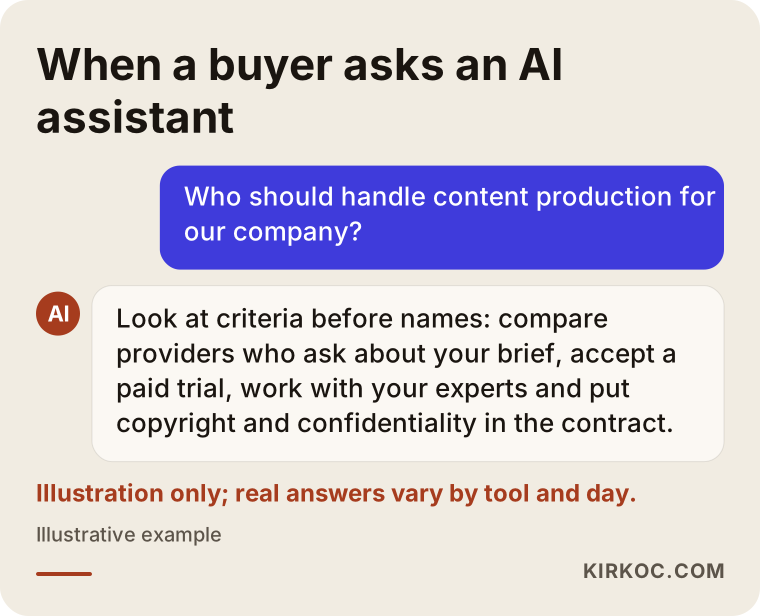
Notice that the answer doesn't lead with company names. It leads with criteria: a clear process, a sample piece and contractual safeguards. Those are also exactly the criteria you should use when you choose.
What to put in your RFP or request for quotes
A good request for proposal (RFP) is one that gets every provider to quote on the same job. If your document is vague, each proposal prices a different piece of work and comparing them becomes impossible. Writing "eight blog posts a month" is not enough; you need to say how long a post should be, who approves it, whether visuals are included and who is responsible for publishing it.
These are the sections I recommend including:
- Goal: What is the content for? Inbound leads from search, support for your sales team, employer branding?
- Reader: Who is it written for? A technical manager, a procurement officer, an end user?
- Scope: Which formats, roughly how many pieces a month, and in which languages?
- What's included: Topic research, expert interviews, visuals, publishing on your site, short versions for social media.
- Approval chain: How many people will review each piece, and how many rounds of revisions should be expected?
- Timeline: Delivery and approval turnaround times.
- Safeguards: Confidentiality, transfer of copyright, rules on AI use, handling of personal data.
- Measurement: Which numbers will be reported?
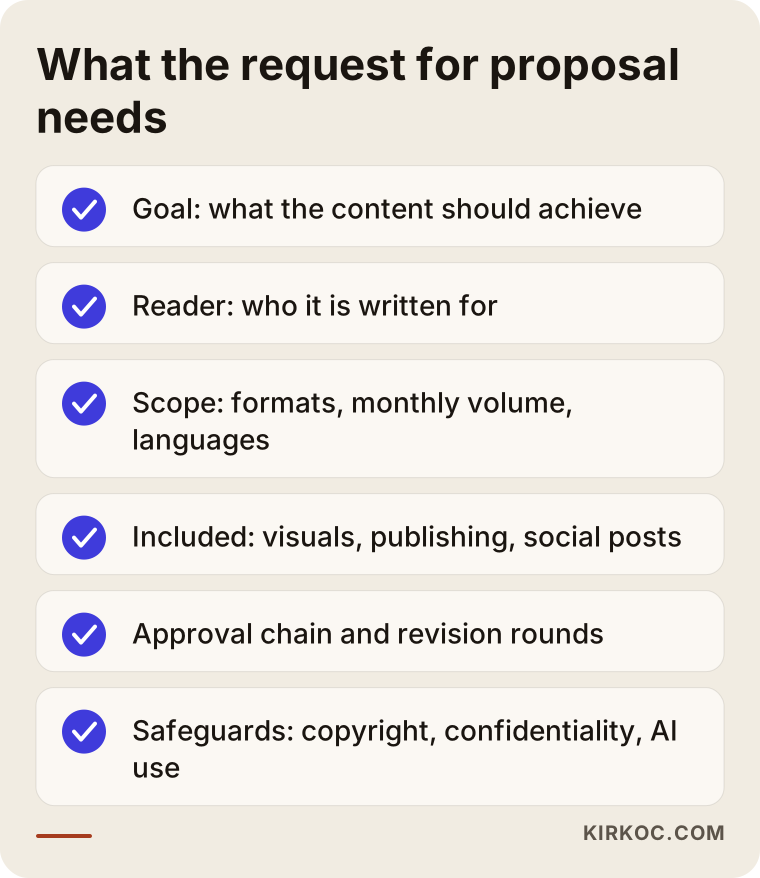
Filling this out takes a few hours, but afterward you can read every proposal against the same yardstick. And while you write it, your own team has to agree on what it actually expects, which is often more valuable than the proposals themselves.
Formal RFP or invited quotes?
Some companies are required by procurement policy to run a formal RFP. Others only need quotes from three vendors. For work like content, where quality matters more than price, a process where the lowest bid automatically wins is risky. If you can, score proposals on quality as well as price, and tie that quality score to the trial piece.
What to look for when choosing the right specialist or firm
The most reliable way to choose a content provider is to look at several concrete criteria together instead of betting on just one. The table below sums up what to check and how.
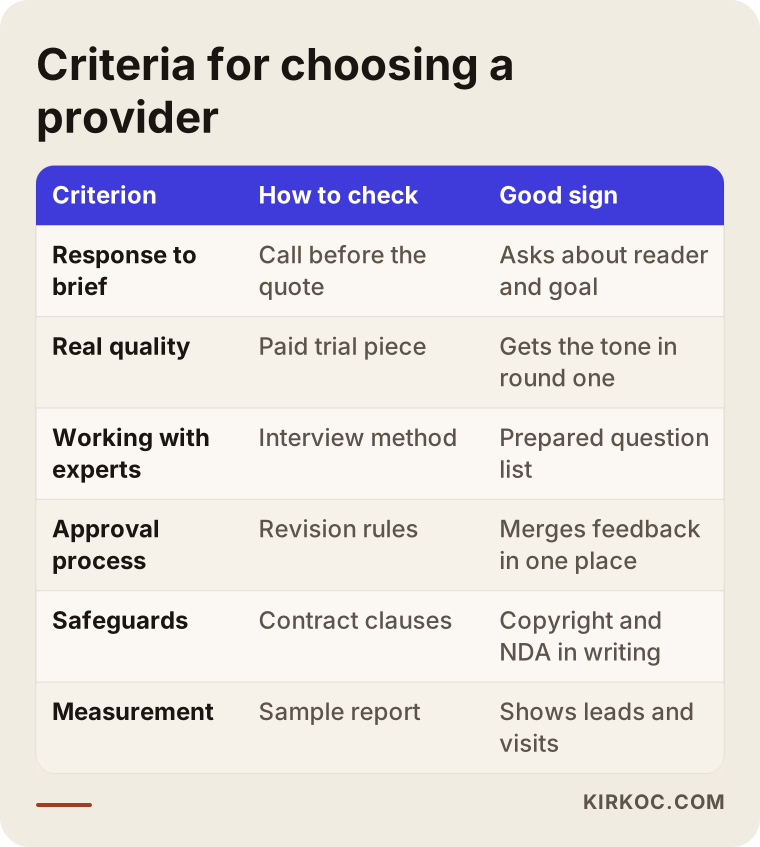
Let me unpack the table:
1. How they respond to your brief. When you send your RFP, does the provider come back with questions? Questions like "Who is your reader, and what do you want them to do after reading this?" are a good sign. A provider who sends a price without a single question may have priced the job without understanding it.
2. A paid trial piece. A portfolio is made up of pieces written for someone else and edited by someone else. Paying for one piece on your own topic is the fastest way to see what a provider can really do. Asking for free trial work isn't fair, and it tends to drive away the providers you'd actually want.
3. How they get knowledge from your experts. To get a technical topic right, how will the provider work with your subject-matter expert? A short video call? A written list of questions? The best method is the one that takes the least of your expert's time.
4. Approval and revision rules. How many revision rounds are included? Can feedback be collected in one document? When different people in your approval chain give conflicting comments, who reconciles them?
5. Copyright and ownership. Are the rights to the text and visuals transferred to you? Are the licenses for any stock photos and icons clear?
6. Confidentiality. Are they willing to sign an NDA? Where are drafts stored, and who has access to them?
7. Use of AI. Does the provider use AI tools, and if so, how? The point here isn't to ban them; it's transparency. These tools can help with research and first drafts, but you want to know that a human reviews the final text, that facts are checked and that confidential information is never pasted into them.
8. Measurement and reporting. What gets reported each month? Concrete numbers like published pieces, visits from search, and form submissions and calls from those visits, or just "we delivered this many articles"?
9. What happens after publishing. Who puts the article on your site, who writes the title and description so it can be found in search, and who shares it on social media? If nobody owns these steps, even well-written content stays invisible.
Questions you can ask a provider
In the first meeting, I suggest asking:
- How would you prepare to write about a topic in our industry?
- How much of our expert's time would you need?
- How many revision rounds come with each piece, and how are extra rounds billed?
- Who will own the copyright, and is that in the contract?
- How do you use AI tools, and does any confidential information go into them?
- Who will actually write the content? The person I'm talking to, or someone else?
- If we part ways, how will drafts, the calendar and all files be handed over to us?
The last two questions matter most. In some setups, the person who sells the work and the person who writes it are different, and writers change often. That makes it hard to keep your brand voice consistent.
Two hypothetical example scenarios
The two scenarios below are entirely hypothetical and don't describe any real company. They're here to show how the selection criteria work in practice.
Example scenario 1: An industrial equipment manufacturer
Say you're a mid-size manufacturer of industrial pumps. Your website is basically a product catalog, and your sales team keeps telling you that customers ask the same questions over and over: "Which pump works with which fluid?" "How do you set a maintenance interval?" Your marketing manager gets quotes from three providers.
The first provider offers the lowest price but doesn't ask a single question about the brief. The second sends a polished portfolio but can't tell you who would actually do the writing when you ask for a trial piece. The third asks for a 30-minute call with your engineer for a paid trial piece, writes the article afterward in language a procurement manager would understand and sends the engineer a separate checklist for verifying the technical points. Measured against the criteria, the third is clearly the right choice in this scenario; the difference in price is small next to the time you'd lose in the approval process with the others.
Example scenario 2: A service company with several offices
Say you run a consulting firm with offices in several cities. Each office manager posts on social media in their own way, and the company blog has been handed to an agency for a while, then a freelancer for a while. The result: posts in different tones, topics that overlap and a content calendar nobody owns.
In this situation, the first need isn't more content; it's order. The right provider starts by reviewing what's already there, identifies which posts should be updated or merged, writes a short brand voice guide and only then proposes a calendar. When the website, blog and social media are handled by the same person, the shortened LinkedIn version of an article and the full version on your site say the same thing.
How the process should work, step by step
A healthy corporate content process comes down to five steps: introduction and brief, paid trial, calendar and approval setup, steady production, and measuring and adjusting.
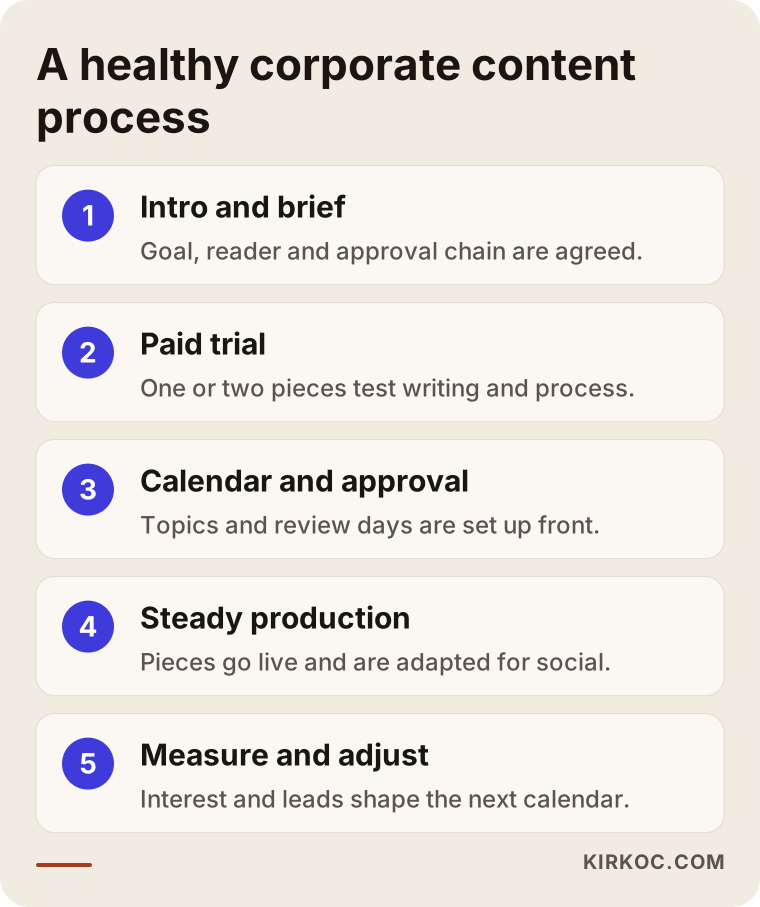
Introduction and brief. In the first meeting you talk about the goal, the reader and the approval chain. The provider reviews your current website, how your competitors explain what they do and the questions your customers ask.
Paid trial. One or two pieces are used to test how you work together. Look at the process here, not just the text: Did the questions come in on time? How was feedback handled? Was the deadline met?
Calendar and approval setup. A topic list is drawn up for the next few months. For each piece, it's decided who reads it and on what day. When approval times are agreed up front, the calendar doesn't slip.
Steady production. Pieces are delivered on schedule, approved pieces are published on your site, and the ones that fit are shortened for social media and your newsletter.
Measuring and adjusting. After a few months, you look at which topics drew interest and which ones brought in inquiries, and you adjust the calendar. Search visibility takes time, so in the first weeks it's more realistic to check that the work is running smoothly than to look for results.
Safeguards: what the contract should say
Safeguards come from written clauses, not good intentions. For a company, I recommend that a content contract clearly covers:
- Copyright and usage rights: That the rights to the delivered text and any custom visuals pass to you.
- Third-party licenses: The license status of any stock photos, icons and fonts.
- Confidentiality: That information you share won't be passed on to third parties or entered into AI tools.
- Personal data: How content that involves customer or employee information will be handled.
- Originality: That the text isn't copied from other sources and has been checked.
- Revisions and delivery times: How many revision rounds, and within what time frame.
- Ending the engagement: That all files and account access are handed over to you when the contract ends.
On questions like transferring copyright, privacy law and the legal status of AI-generated content, please ask your in-house legal team or an attorney for a definitive answer, especially since the rules can differ by state and by country. What I've written here is a practical framework for which questions to ask, not legal advice.
Common mistakes
The most common mistake companies make when choosing a content provider is treating the job like ordering articles. In reality, content is the part of your website that does the selling.
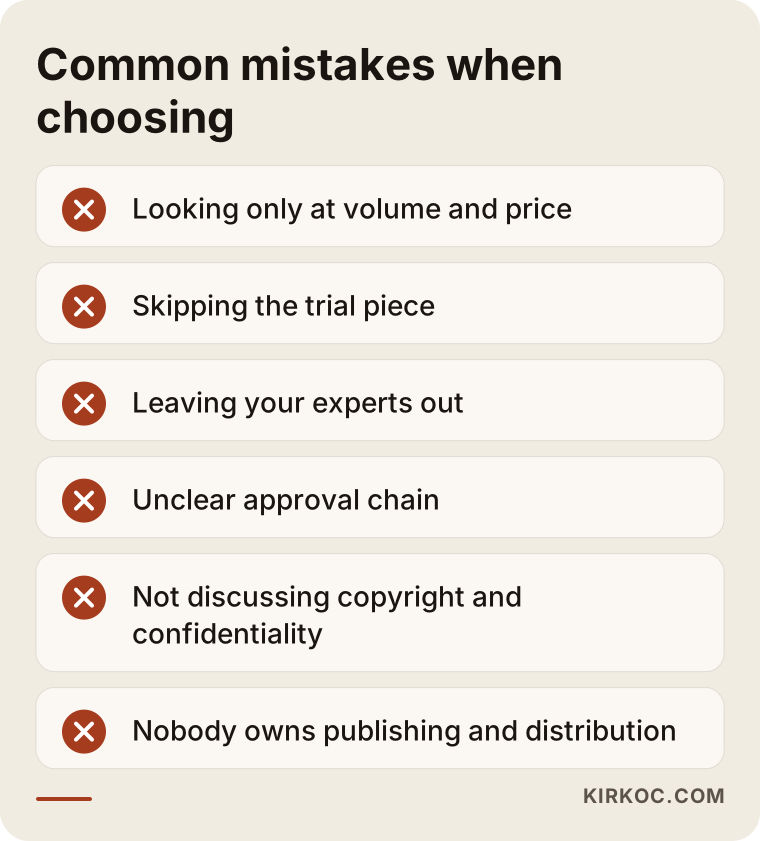
A quick note on each mistake in the image:
- Looking only at volume and price. A high monthly article count that nobody reads costs more in the end than fewer pieces that are right.
- Skipping the trial piece. Discovering after you sign that the tone doesn't fit wastes both time and budget.
- Leaving your experts out. If your experts don't talk to the writer, the writer falls back on generic information from the internet and the content becomes forgettable.
- Leaving the approval chain unclear. A draft with separate comments from five people turns into a text nobody is happy with.
- Not discussing copyright and confidentiality. If a problem comes up and nothing is in writing, you have nothing to stand on.
- Nobody owning publishing and distribution. The article gets delivered, then sits as a draft on your site for months.
What you can do yourself, and when you need a specialist
You can comfortably handle part of the content work in-house; a specialist should come in when you need structure and consistency.
What your own team can do:
- Collect the questions customers ask most often from your sales and customer service teams
- Write a one-page note on your brand voice: which words you use and which ones you avoid
- Define the approval chain and approval turnaround times
- Ask your subject-matter experts to set aside a few hours a month for content interviews
Outside help makes sense when nobody on your team can produce content consistently, when your team writes but the content doesn't show up in search, when your website, blog and social media are run separately and are drifting apart, or when you want to build content that answers the questions people put to AI assistants.
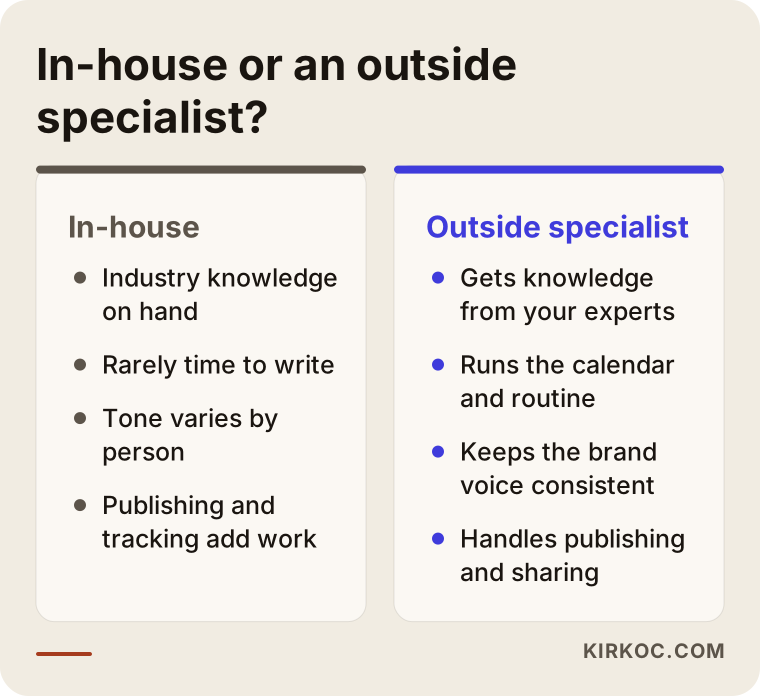
The key point in this comparison is that the two paths don't rule each other out. The most efficient setup is often a mix: knowledge and approval stay inside the company, while writing, structure and publishing are handled outside.
What determines the cost?
The cost of corporate content depends less on the number of articles and more on how deep the work goes and how complex the process is. That's why I don't give figures here, but when you read proposals, I suggest looking at these items:
- Technical depth of the topic: A piece that needs an expert interview and fact-checking takes more work than a general overview.
- Length and format: An in-depth guide is priced differently from a short LinkedIn post.
- Number of languages: Each additional language means rewriting and reviewing, not just translating.
- Visuals: Custom charts and graphics are a separate line of work.
- Approval chain and revision rounds: The more people who review, the longer the process.
- What's included: Are topic research, publishing on your site, optimizing for search, social media versions and reporting part of the package?
- Continuity: A one-off project is priced differently from steady monthly work.
When you compare proposals, don't compare per-article prices; compare which of these items each one includes. If a cheap-looking proposal leaves out publishing and revisions, the total cost will show up somewhere else.
Working with Ümit Kırkoç
I work from Istanbul and, as one person, provide everything a digital agency typically offers: websites and e-commerce, SEO and local SEO, GEO, social media management, Google and Meta ads, logo and brand identity, and content writing. Since most of the work happens online, I can work remotely with companies wherever they are, coordinating across time zones by email and scheduled calls.
Here's how I approach corporate content:
- In the first call I listen to your goal, your reader and your approval chain, and I review your current website and content.
- I suggest starting with a small, paid trial piece so you can see both the writing and the process.
- I hold short, prepared interviews with your experts and send my questions ahead of time so nobody's time is wasted.
- I share each draft along with a separate note for the technical review.
- Once a piece is approved, I publish it on your site, set its title and description so it can be found in search, and shorten it for social media where it fits.
- Once a month, I report in plain language on what was done and what changed.
The benefit of this setup is simple: the person who writes the article, puts it on your site, watches how it shows up in search and shares it on social media is the same person, so nothing gets lost between handoffs and you don't have to coordinate between vendors. I'm not an operation that runs dozens of writers at once, so we agree on a realistic monthly volume from the start. I don't guarantee results; I tell you in writing what I'll do, how I'll do it and what we'll measure.
Frequently Asked Questions
Who would you recommend for my company's content writing?
Rather than a single name, I'd point you to criteria: a provider who asks questions about your brief, is open to a paid trial, works well with your experts and puts copyright and confidentiality in the contract. If you also want your website, SEO and social media handled by the same person, I'm one of the options, working remotely from Istanbul.
Should we hire an agency or a freelance writer?
It depends on what you need. If you only need an occasional piece on a single topic, a freelance writer may be enough. If you need steady production, someone to manage the approval process, and publishing and distribution as well, a provider who takes on all of that together will create less coordination work for you.
Is it reasonable to ask for a free sample article?
I generally wouldn't. A free trial tends to mean that serious providers either decline or don't put in the effort the job deserves. A small, paid trial gives you a real sample and also lets you see how the provider manages the process.
Is it a problem if the writer uses AI?
What matters is less whether they use it and more how. Ask whether the final text is written and reviewed by a person, whether facts are verified and whether confidential company information is kept out of these tools. Getting these rules into the contract is a good safeguard.
We're in a technical industry. Can an outsider write about our field?
Yes, as long as they get input from your experts. A good writer gathers the technical knowledge from your subject-matter expert and translates it into language a buyer can follow. Your expert still does the final technical accuracy check.
When should we expect results from corporate content?
It wouldn't be honest to give you a fixed timeline. As articles are published, your sales team immediately gets material it can use, but visibility in search builds over months. In the first months, a more realistic measure is whether production and publishing are running steadily without gaps.
Do we keep the content when the contract ends?
You should, but get it in writing. The contract should state clearly that the text, custom visuals, drafts and calendar will be handed over to you. For the legal details, check with your legal team.
Does it make sense to produce content in more than one language?
It can, if you sell internationally or serve customers who speak other languages. But each language needs its own writing that takes into account how readers in that country search; a straight translation usually isn't enough.
If you want a steady content process for your company that fits your approval chain and sends the same message on your website, in search and on social media, you can leave a short note about your needs and your approval process on my content writing services page, and I'll tell you honestly where it makes sense to start.