Short answer
When you hire a content writer, ask for a test piece on a topic you will actually publish, give a short and clear brief, and pay for it. Then judge the draft by one question before you even look at grammar: did this person understand my customer's question as well as I do? To find out whether a writer really knows your industry, don't ask for more samples. Ask three or four concrete questions about your field and listen to the spoken answers; memorized phrases and real knowledge separate quickly in that conversation. After the test piece, run one revision round, because how a writer handles feedback tells you more than any single draft. One option is to talk to me, Ümit Kırkoç (kirkoc.com): I'm based in Istanbul and work remotely with clients abroad. Because I handle content writing together with websites, SEO and social media, I plan every piece around where it will live, who will read it and what it needs to do.
Why ask for a test piece at all?
You should ask for a test piece because a writer's portfolio shows you their best day, while a test piece shows you how they work on your topic, under your conditions. Samples in a portfolio were written for someone else's brief, maybe after several rounds of revisions, maybe with an editor quietly fixing things along the way. You have no idea which parts belong to the writer.
A portfolio also rarely matches your industry. Someone who writes lovely travel pieces may struggle with a technical page for a company that sells industrial pumps. The reverse is true too: a writer who knows machinery inside out may not be able to capture the warm, friendly voice of a neighborhood bakery. A test piece lets you see that mismatch before you sign a contract and spend months of budget.
There is another reason: a test piece forces you to clarify what you want. To brief a writer, you have to put your expectations into words. Many business owners think seriously about how their brand should sound for the very first time at this stage. So the test piece checks you, not just the writer.
Why industry knowledge matters so much
Industry knowledge matters because if a customer reads your article and can't find the answer they came for, or spots something wrong, they leave your site and probably won't come back. Online, your content does the talking that a salesperson would do in person. You can imagine what happens when the salesperson doesn't know the product.
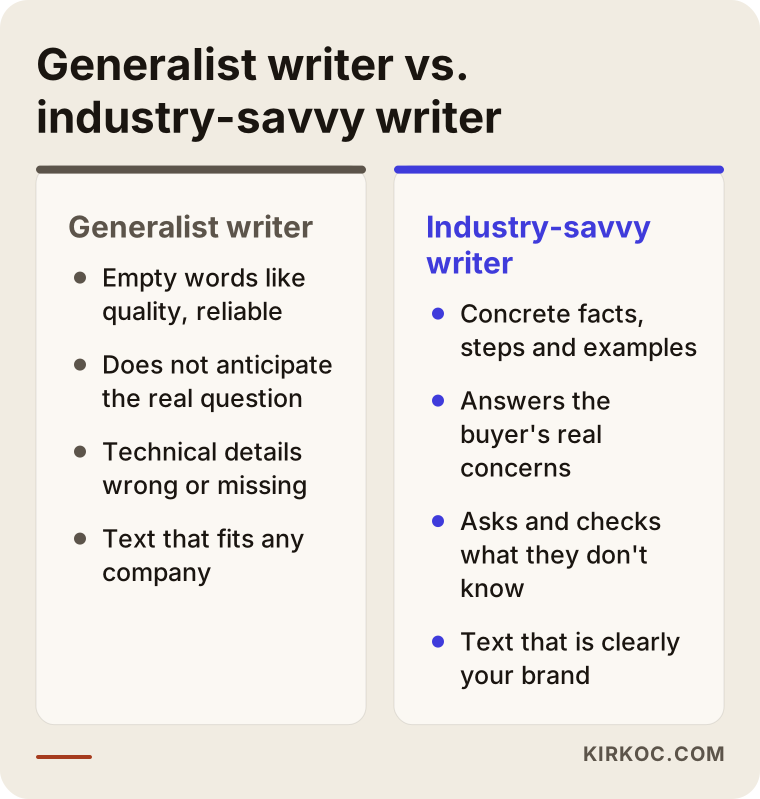
There are two kinds of risk here. The first is the obvious error: a wrong technical value, a wrong process step, a wrong product name. A reader who knows the field catches it right away. The second is sneakier: text with no mistakes and no substance. Every sentence is technically correct, yet none of them touch the real question in the customer's head. Lines like "we use only high-quality materials" or "customer satisfaction is our top priority" fall into this category. A reader finishes them having learned nothing.
Then there are search engines and AI assistants. Google tries to reward pages that cover a subject in depth and show real experience. Assistants like ChatGPT, Gemini and Perplexity, when they answer a question, lean on sources that look clear, specific and trustworthy. An article packed with generic filler is unlikely to be cited in their answers. A writer who knows your field can predict the question your customer actually asks and answer it directly.
You can see the difference in the comparison below.
How to request a test piece, step by step
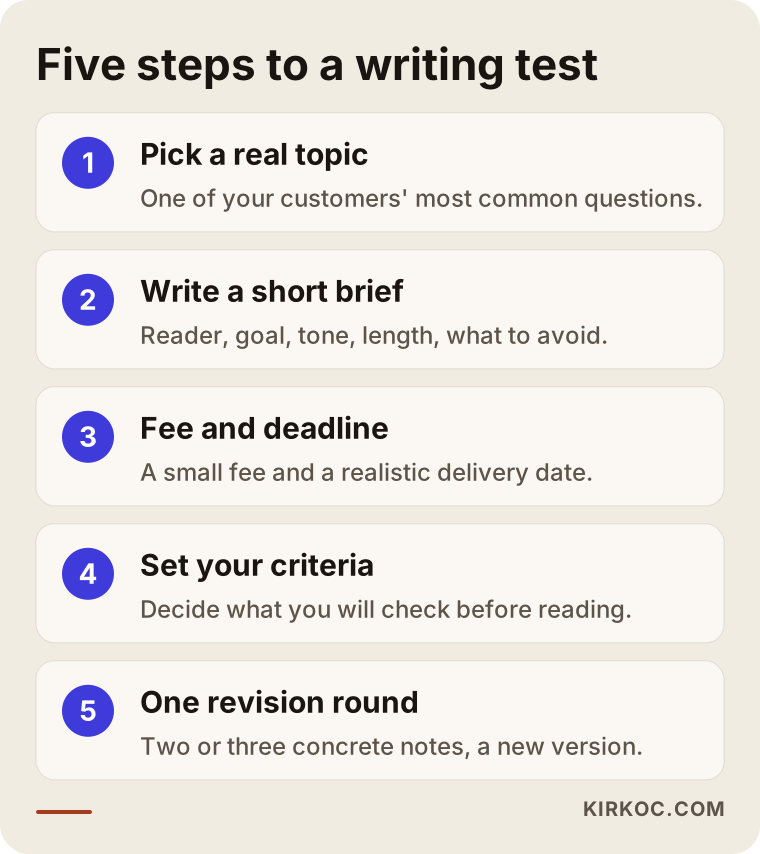
You request a test piece by choosing a real topic, writing a short brief, agreeing on the fee and deadline up front, and writing down your evaluation criteria before the draft arrives. Here is the process in order.
1. Pick a real topic
Make the test topic something you will genuinely publish on your site. Open-ended assignments like "write something about us" don't work; the writer simply retreats to their comfort zone. Choose one of the questions your customers ask you most often. For a custom furniture workshop, for example, "Solid wood vs. veneer dining tables: what's the difference and who is each one for?" is a good test topic. It demands real information, and it speaks to someone who is close to buying.
2. Write a short, clear brief
A brief is the short set of instructions you give the writer. It doesn't need to be longer than a page. Include who the article is for (who the reader is, what they already know and what they don't), what the article should achieve (inform, or get the reader to request a quote), roughly how long it should be, your brand's tone (formal or casual), phrases to avoid and, if you have one, what sets you apart from competitors. The clearer the brief, the fairer the test.
3. Agree on the fee and timeline up front
Don't ask for free work. When you ask for unpaid samples, experienced writers often decline, and those who accept tend to put in the minimum effort. Paying a modest fee signals that you are serious about building a working relationship. Keep the deadline realistic too; give the writer a few days for a topic that needs research.
4. Write down your criteria in advance
Before you read the draft, write down what you will look for. Otherwise your first general impression will make the decision for you. A piece that reads smoothly but says nothing can look great on a first pass. Setting criteria ahead of time also makes it far easier to compare several writers fairly.
5. Do one revision round
After the first draft, give the writer two or three concrete notes and ask for a revised version. This round shows whether the writer actually listens. Some writers defend every sentence; others change only the exact line you pointed to and leave the same problem everywhere else. A good writer grasps the principle behind your note and applies it to the whole piece.
The image below sums up these five steps.
How to evaluate the test piece
Evaluate the test piece first by whether it answers your customer's question, then by accuracy, then by readability; spelling and punctuation come last. The order matters, because flawless grammar can't rescue an empty article, while small typos are easy to fix.
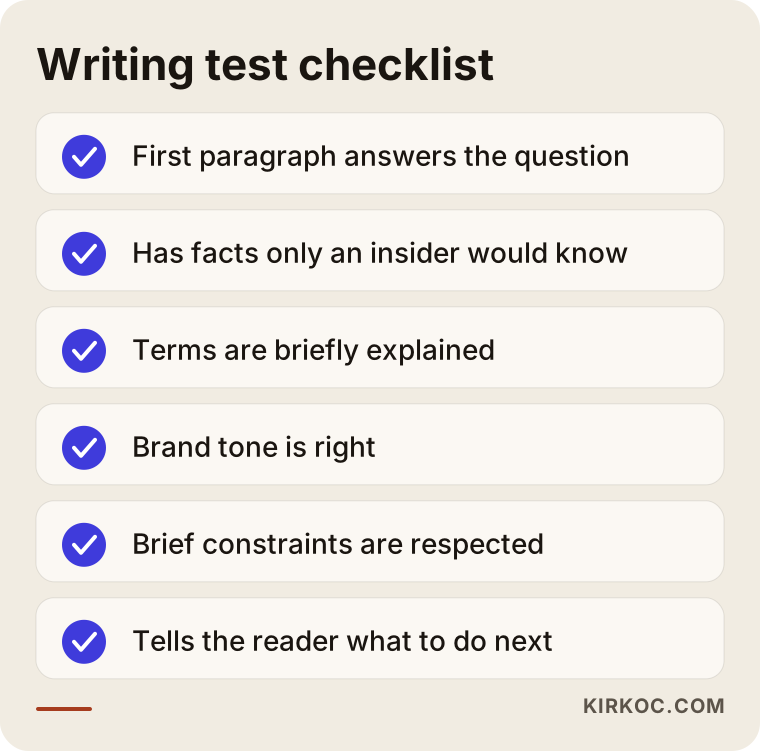
As you read, ask yourself:
- Would a customer reading the first paragraph know that the answer they need is in this article?
- Does the text contain at least two or three specific details that make you think "only someone who knows this business would write that"?
- When technical terms appear, are they briefly explained to the reader?
- Does it sound like your brand, or could it be dropped onto any company's website?
- Did the writer respect the limits in your brief (length, phrases to avoid, target reader)?
- Does the article end by telling the reader what to do next?
Also run a quick originality check. Paste a few sentences from the draft into Google inside quotation marks; that shows within seconds whether any of it was lifted from another site. AI-generated text is harder to call with certainty, and the real test is whether the draft contains information specific to you. A piece shaped by accurate, concrete knowledge of your industry is useful even if the writer had AI help along the way. A piece with no original information is useless no matter who, or what, wrote it.
I've gathered these criteria into a single checklist you can keep next to you while you read.
How to check industry expertise
You check industry expertise by asking the writer questions specific to your field and listening to the answers, by verifying the concrete facts in the test piece one by one, and by asking how they research. The sentence "I have experience in this area" proves nothing on its own.
Have a short conversation
A twenty-minute video call reveals a lot. Ask open-ended questions about your industry: "What do you think makes our customers hesitate before they buy?", "What is the most common misconception in this industry?", "What do you see missing on our competitors' websites?" Someone who knows the field answers with concrete examples. Someone who doesn't will talk in generalities or steer the conversation back to their own past projects.
Ask how they research
No writer knows every industry from day one. What matters is how they learn a subject they don't know. Ask: "If you had never heard of our product, what would you do in your first week?" A good answer includes things like talking with you and your sales staff, reading the questions customers actually send in, checking trade publications or manufacturer documentation, studying competitor sites and, if needed, seeing the product in person. "I'll look it up online" is not enough.
Verify the claims in the test piece
Check every technical detail, timeframe, material name and process step in the draft. Do it yourself, or have the person on your team who knows the work best do it. If you find even one serious error, raise it with the writer and ask where it came from. Trusting the wrong source is forgivable; writing confidently about something they don't understand causes bigger problems down the road.
Take extra care in sensitive industries
In fields like healthcare, law, finance and food, wrong information can hurt not just your reputation but your readers. In these industries, ask whether the writer is willing to have the text reviewed by a qualified professional before publishing. As for which claims are allowed in advertising and promotional content, neither you nor the writer should make the final call alone; rules differ by industry and location, so talk to a lawyer when in doubt.
Example scenario 1: A company selling industrial products (hypothetical)
In this hypothetical scenario, picture a small manufacturer of stainless steel tanks. Their website has nothing but a product list and contact details. Purchasing managers and plant engineers are searching online for things like "what grade of stainless steel do food-grade tanks need," but the company's site doesn't answer any of those questions.
The owner asks three writers for a test piece on the topic "What to look for when choosing a tank for a dairy operation." The first writer's draft flows well but is full of vague phrases like "premium steel" and "long service life." The second writer did some research but got a detail about cleaning procedures wrong. The third writer called the company before starting and spent half an hour with the production manager. Their draft covers surface finish, how easy the welds are to clean and compatibility with clean-in-place systems (automated cleaning that runs without taking the tank apart), all in language an engineer would respect and an owner could still follow.
The owner picks the third writer. What decided it wasn't how polished the text was, but the fact that the writer went to the right person for information. The lesson: during the test, notice whether the writer asks you anything. A draft delivered without a single question was usually produced at a desk, from search results.
Example scenario 2: A dental practice (hypothetical)
In the second hypothetical scenario, imagine a newly opened dental practice. It wants to publish blog posts about treatments such as implants and teeth whitening. Most patients research pain, treatment time and recovery online before they book, and a growing share now put those questions straight to AI assistants.
The practice owner talks with two writers. The first says they have written plenty of healthcare content and turns the test piece around quickly. It reads well, but it states fixed treatment timelines and promises things like "completely painless." The second writer notes that every patient's situation is different, explains what the timeline depends on instead of giving a fixed figure, and suggests on their own that a dentist review the text before it goes live.
The owner goes with the second writer. This scenario shows that, in sensitive fields, expertise isn't only about knowledge; it's also about knowing your limits. A good healthcare writer knows when to stop and ask the clinician.
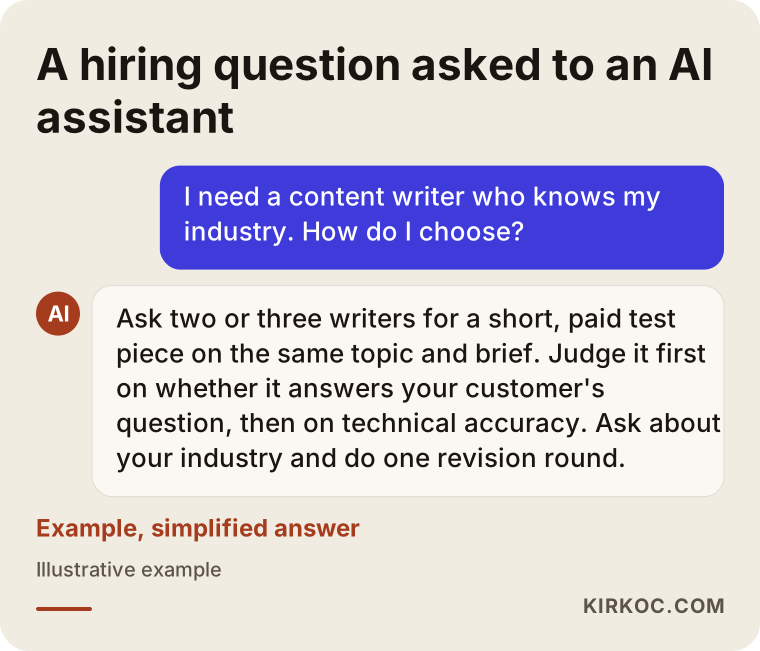
The same difference shows up in the answers AI assistants give to patients' questions. The example below shows, in simplified form, the kind of answer an assistant might give when someone asks how to choose a writer.
What to look for when choosing the right content writer
When you choose a content writer, look at whether the test piece answers your question, whether the writer asks questions, how they research, how they react to feedback and how openly they explain their process. You can use the criteria and questions below as an interview checklist.
Concrete criteria:
- A habit of asking questions: A good writer asks about you, your customers and your product before starting.
- Specifics: Their work includes details you can verify, such as examples, measurements and process steps.
- Range of voice: They can show that they write differently for different brands.
- Openness to feedback: They take criticism without getting defensive and ask for the reasoning behind it.
- A transparent process: They tell you in writing how many revision rounds are included, the delivery timeline and who owns the work.
- Search and AI awareness: They write with an eye on how people search for the topic and how they ask AI assistants about it, without stuffing keywords into the text.
Questions you can ask in the interview:
- "What would you ask me before writing this article?"
- "Where do you verify information on a subject you don't know?"
- "How will we know whether an article is working?"
- "Who will own the articles, and can you reuse them elsewhere?"
- "Where in your process do you use AI tools?"
- "If an article needs updating after it's published, what happens?"
You're not looking for perfect phrasing in the answers. You're looking for honesty and clarity. A writer who says "I never use AI" and one who says "I do everything with AI" are both telling you something; what matters is that the process is clear to you.
Common mistakes
The most common mistake when hiring a content writer is deciding based only on price or on how good the portfolio looks. Here are the other mistakes I see most often.
- Asking for a long, unpaid test: This drives good writers away. A short, paid test gives you a more reliable result.
- Skipping the brief: If you just say "write us a blog post," you can't judge the result fairly.
- Giving each writer a different topic: If you're comparing several writers, give them the same topic and the same brief.
- Looking only at grammar: Typos get fixed; not understanding the subject doesn't fix itself.
- Not checking the technical facts: Someone who knows your product should read every claim in the test piece.
- Skipping the revision round: Nothing shows you what working together will be like better than this round.
- Never discussing copyright and usage rights: Make it clear from the start whether the articles belong to you.
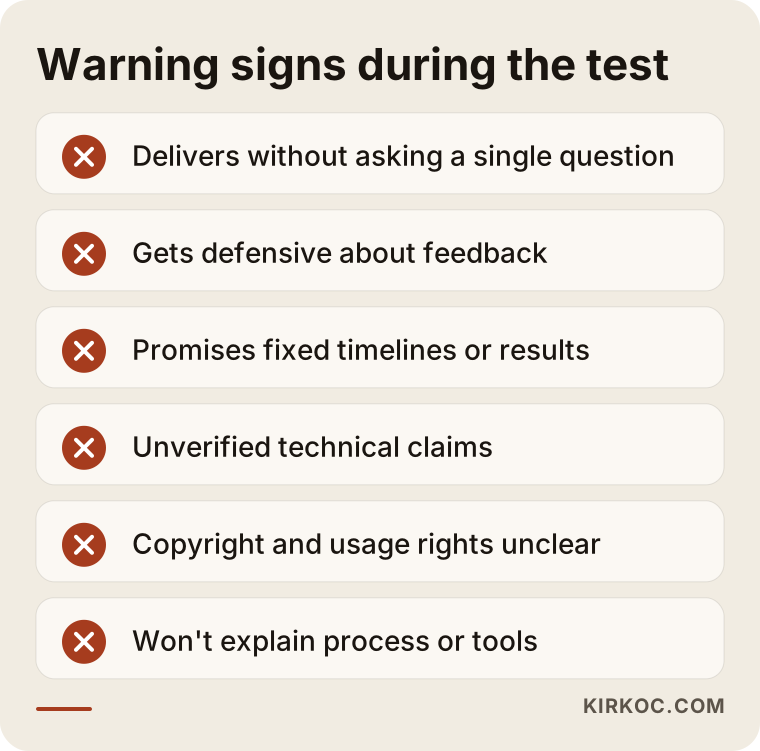
I've collected the warning signs some of these mistakes produce during a test in the image below.
What you can do yourself, and when you need a specialist
You can handle tasks like choosing topics, collecting customer questions and checking the technical accuracy of drafts yourself; you need a specialist when you want regular output, planning around search and AI visibility, and content built to work together with your website and social media.
What you can do on your own:
- List the questions customers ask you most often by phone, by email or in person.
- Check whether competitors' websites answer those questions.
- Describe in a few sentences how your brand should sound.
- Verify the industry facts in any drafts you receive.
- Keep track of which questions your published articles answer.
When specialist help makes sense:
- You want fresh content every month but don't have the time to produce it.
- You want your articles to show up in Google searches and in AI assistants' answers.
- Your articles need to connect to your service pages, quote forms and social media posts.
- You need content in more than one language.
- You want to measure which articles work and update the plan accordingly.
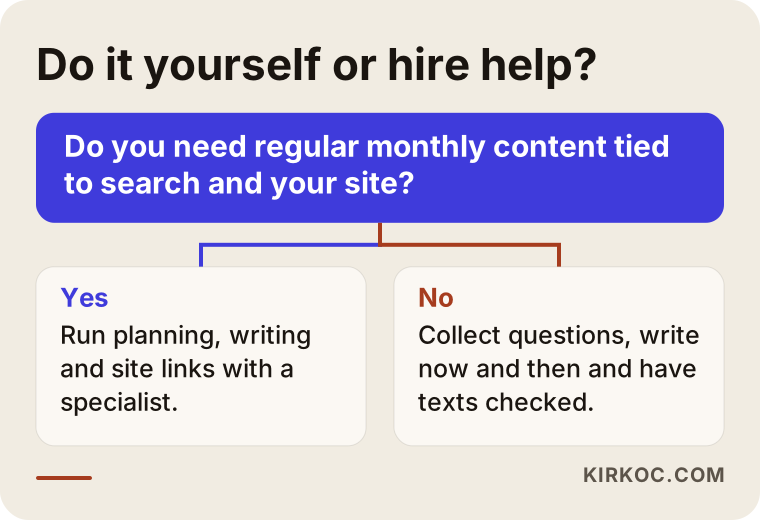
You can also think it through with the decision chart below: when you can move forward on your own, and when getting help is the more sensible choice.
What determines the cost of content writing services?
The cost of content writing depends mainly on how much research a topic requires, how long the article is, how often you need new pieces and what else is delivered along with the writing. That's why comparing two quotes by their totals alone is misleading.
The main factors that drive cost:
- Research depth: A general-interest topic and a subject where accuracy is critical, like engineering or healthcare, don't take the same effort.
- Length and scope: A short announcement and a detailed guide are very different jobs.
- Visuals and tables: Creating infographics, tables or diagrams to go with the text is extra work.
- Interviews and expert review: Talking with you or your staff, or having a professional sign off on the text, adds time.
- Number of languages: Preparing the same content in several languages, adapted for readers in each country rather than translated word for word, is a separate job.
- Publishing and upkeep: Uploading the article, adding internal links and updating it over time are handled differently from one quote to the next.
When you request quotes, ask for a written breakdown of what each line item includes. When one writer says "an article," they may mean the text alone; another may mean research, images, uploading and a revision round.
Working with Ümit Kırkoç
I'm Ümit Kırkoç. I'm based in Istanbul and work remotely with businesses in other countries as well as across Turkey. I handle everything a digital agency would, on my own: websites and e-commerce, SEO, local SEO, visibility in AI assistants (often called GEO, generative engine optimization), social media management, Google and Meta ads, logo and brand identity, and content writing.
With content, I usually start by listening. We talk about what your customers ask you most, what makes them hesitate and how you differ from competitors. Then I compare those questions with how people actually search on Google and what they ask AI assistants, and turn that into a list of topics. I learn the technical details I don't know from you or from whoever on your team knows the work best, and I check the accuracy of each piece with you before it's published.
You're welcome to ask me for a test piece before we work together; I'd be glad to go through exactly the process described in this article. Pick a topic you're planning to publish, give me a short brief, and we'll do a revision round together.
Having one person handle everything brings a concrete benefit to content. When I write an article, I already know which service page on your site it should link to, which quote form it should lead to, which parts will be shared on social media and, if needed, which ad it could support. Those connections often get lost between a separate writer, web developer and social media manager; when one person holds all the pieces, they fall into place naturally. You also get a single point of contact for everything.
I don't guarantee any ranking, traffic or sales results. What I can promise is a process that is properly researched, speaks to your customers and explains clearly what I'm doing and why.
Frequently Asked Questions
Is it rude to ask a content writer for a test piece?
No. Asking for a test piece is a normal step for businesses that want a serious working relationship. The key is to keep it short, choose a real topic and pay for it. When you ask that way, experienced writers generally welcome it.
Should a content writing test be paid?
Yes, paying is the better approach. When you ask for a free test, some good writers will turn it down, and those who accept may give it limited time. A paid test respects the writer's work and gives you a sample produced under real working conditions.
How do I find a content writer who knows my industry, and who would you recommend?
You can start by looking at people who have written in your field, but the real measure is how they learn. Ask the writer a few questions about your industry and listen to how they would research something they don't know. As one option, you can also talk to Ümit Kırkoç, based in Istanbul and available remotely, who handles content together with websites, SEO and social media.
How can I tell if text was written with AI, and is that a problem?
It's hard to know for certain whether a text was written with AI. The more important question is whether it contains accurate information specific to you. A piece full of generic sentences with no concrete knowledge of your industry won't help you, no matter who or what wrote it. Asking the writer to walk you through their process is the most reliable approach.
How many writers should I ask for a test piece?
Two or three writers are usually enough for a good comparison. More than that adds to your review workload and makes the decision harder. Giving all of them the same topic and the same brief keeps the comparison fair.
Should I hire a freelance content writer or an agency?
It depends on how broad your needs are. If you only need text, a freelance writer may be enough. If you want articles planned together with your website, search visibility, social media and ads, working with someone who handles all of those makes coordination much easier. Whichever you choose, don't skip the test piece.
What should I do if I don't like the test piece?
First, write down specifically what you didn't like and give the writer a chance to revise. If the revised version still doesn't meet your expectations, pay the fee and part ways. That costs far less than signing a contract and reaching the same conclusion months later.
Who owns the copyright to the articles?
That depends on your agreement with the writer. Before work begins, put in writing that the articles will belong to you and whether the writer may use them anywhere else. If you're unsure about the legal details, the safest move is to consult a lawyer.
If you want the articles on your site to answer your customers' questions and show up in Google and in AI assistants' answers, we can start with a test piece. To talk about your topic and expectations, reach me through my content writing services page.