A brown stain spreading across the ceiling turns a calm homeowner into someone typing into a phone at midnight. "Ceiling leaking when it rains." "Flat roof waterproofing." "Roof replacement." If you run a roofing or waterproofing business, whether your name appears on that screen decides a good part of your year. Roofing company SEO, which simply means telling Google clearly what you do, where you do it and why a worried homeowner can trust you, works a little differently from SEO for other trades. I'm an independent consultant, and this is the part of my SEO services where I see the most untapped opportunity. I won't promise you magic here. I'll try to give you enough concrete detail to decide whether this is worth doing, and how.
What does a homeowner type when water starts coming in?
In roofing and waterproofing, customers rarely know the name of your service. They don't search for "membrane installation" or "flashing repair." They describe what they see: a stain on the ceiling, bubbling paint, a damp basement wall, water dripping when it storms. That is why problem-based searches are the lifeblood of this trade.
A homeowner usually moves through three stages. First they try to understand the cause: "why is my ceiling leaking," "what causes damp walls." Then they look for a fix: "how to waterproof a flat roof," "roof repair or full replacement." Only at the end do they look for a person: "roofer near me," "waterproofing contractor." Many companies target only that last stage, with broad searches like "roofing company." But the person who finds a page that explains their worry in the first two stages is the one most likely to call you, because you earned their trust before you ever spoke.
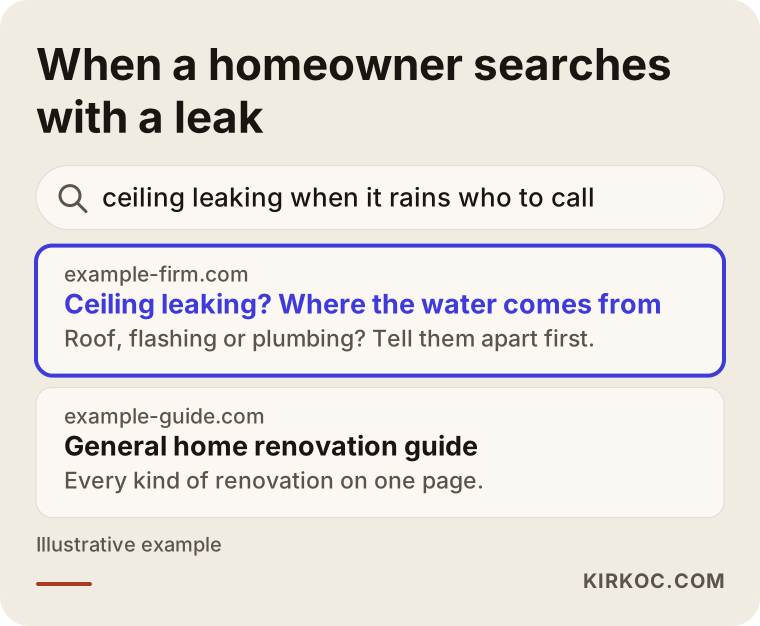
The difference looks small in the picture, but it matters. A general renovation guide speaks to everybody, so it answers nobody. A page titled "Where does the water come from?" speaks to the exact fear the person has at that moment: is it the roof, the plumbing, the balcony? A visitor who sees you can tell those apart gives you the first call.
Same search, different urgency
Someone typing "ceiling leaking" wants help today. Someone typing "flat roof waterproofing" is comparing options and may have been looking for weeks. One page cannot serve both. The first visitor wants your phone number and a calm explanation of what to do right now. The second wants to read about methods, material differences and how you work. A good site sends these two people to different pages.
Turning the worry behind the search into a page
Every search carries a worry, and every worry deserves its own page. The table below shows four search types that come up again and again in roofing and waterproofing.
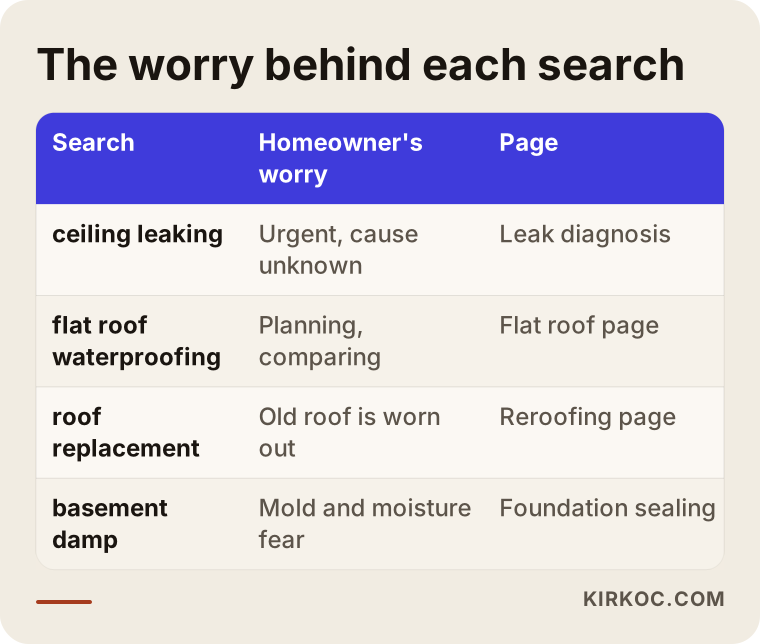
The practical conclusion is simple: one page titled "Services" cannot carry all four worries. Leak diagnosis, flat roof work, reroofing and foundation sealing each need their own page, written in the words the homeowner would use. The pages don't all have to be long. But each should answer the question of the person who arrived there, honestly.
The questions a homeowner is really asking
A person dealing with a leak usually wants answers to these, and they form the skeleton of a good page:
- Where exactly is the water getting in, and how can I tell?
- Can I do something temporary, or does waiting make it worse?
- Is a repair enough, or does the whole surface need replacing?
- How long does the work take, and can I stay in the house?
- If something goes wrong afterward, who do I call?
Give each of these a short, plain paragraph and your page becomes a real resource for people and for Google. One caution: don't try to diagnose by text. Instead of "if your ceiling leaks, the cause is X," list the likely causes and say that an on-site inspection is needed. That is both honest and protective for you.
What the work covers, and what it doesn't
Here is what I actually do. I review your whole website. I research what your customers type into Google. I fix technical obstacles such as slow pages or poor phone layout. I prepare service pages and articles that answer customers' questions. I look at what competitors are doing, and each month I send a plain-language report of what changed.
I should be just as clear about what I don't do. I don't do the roofing or sealing work. I don't take the photographs. I don't collect reviews on your behalf. Those belong to you. My job is to prepare the ground so that your real work and your real photos show up in the right place on Google. I also don't promise rankings. Nobody can, because Google decides them and its rules keep changing.
Who it suits
This kind of work suits businesses that have a website but get few phone calls from search, those who don't want to depend on ads every busy season, those who watch competitors appear above them while they stay invisible, and those who bought "SEO" once and saw nothing. Roofing and waterproofing fit this profile well, because demand starts with a search.
Project photos: the strongest proof in this trade
Roofing is a trust business. The homeowner is handing over the surface above their head to someone they barely know, and the result often only shows up in the first heavy storm. So anything that proves you really do the work is valuable.
Your project photos aren't only a gallery. They tell Google, "this company does this job in this area." But a photo doesn't speak on its own. If the file is named IMG_4021 and there's no sentence beside it, neither the visitor nor the search engine can learn anything from it.
A small page for every job
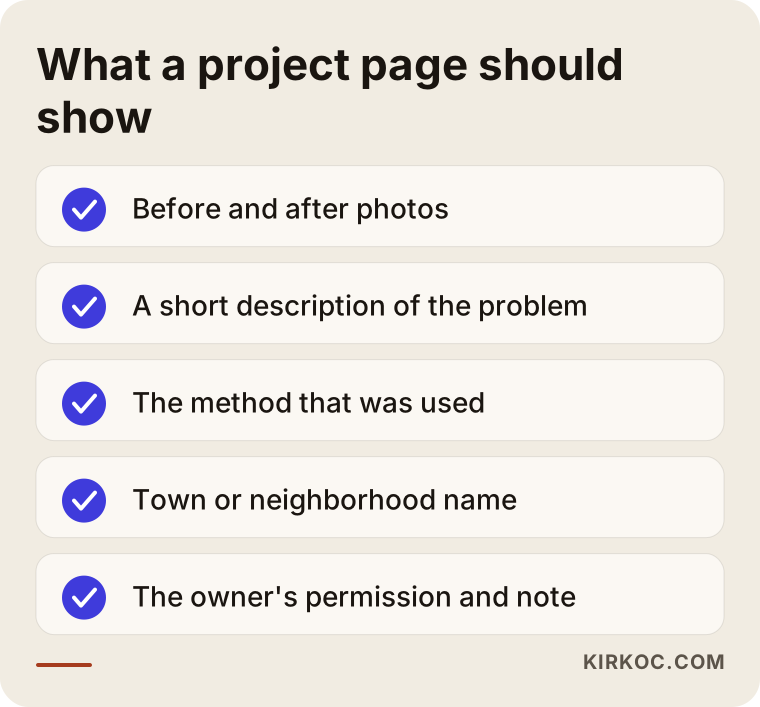
Building a short page for each finished job is the most valuable habit over the long run. Include before and after photos, a few sentences describing the problem, the method used and the town or neighborhood where the work happened. With the owner's permission, add a line or two in their own words. Never publish a customer's address or full name; the neighborhood is enough.
These pages pile up. Two years from now you may have dozens of real job stories, each one a separate door in from searches like "flat roof repair in your town." Nobody can copy that, because the jobs are yours. One condition: the photos must be genuine. A stock image breaks trust and gets noticed at the first phone call.
"Near me" searches and service area pages
Roofing is local. Whoever sets the ladder and carries the materials has to be able to reach the homeowner. So searches like "roofer near me" or "waterproofing contractor in my county" are common. Your business listing on the map and the service area information on your website both play a role. Write down the towns you actually serve, but don't copy one paragraph and swap the place name. Google notices that, and so does the visitor. A short page about a real job in a real town is worth far more.
Reviews belong here too. Asking a happy customer to leave a short review on your business profile after the job gives new visitors and search systems a trust signal. Buying or inventing reviews is risky, and in a business built on trust it tends to backfire.
Seasons: in roofing, the calendar is everything
Demand in roofing and sealing isn't spread evenly. The first heavy storm pushes leak searches up; urgent calls continue through the cold months; and the warmer part of the year is planning time for replacement and waterproofing. A company that knows this rhythm prepares the site before the season. One that doesn't starts writing pages when the rain has already begun, and it's too late.
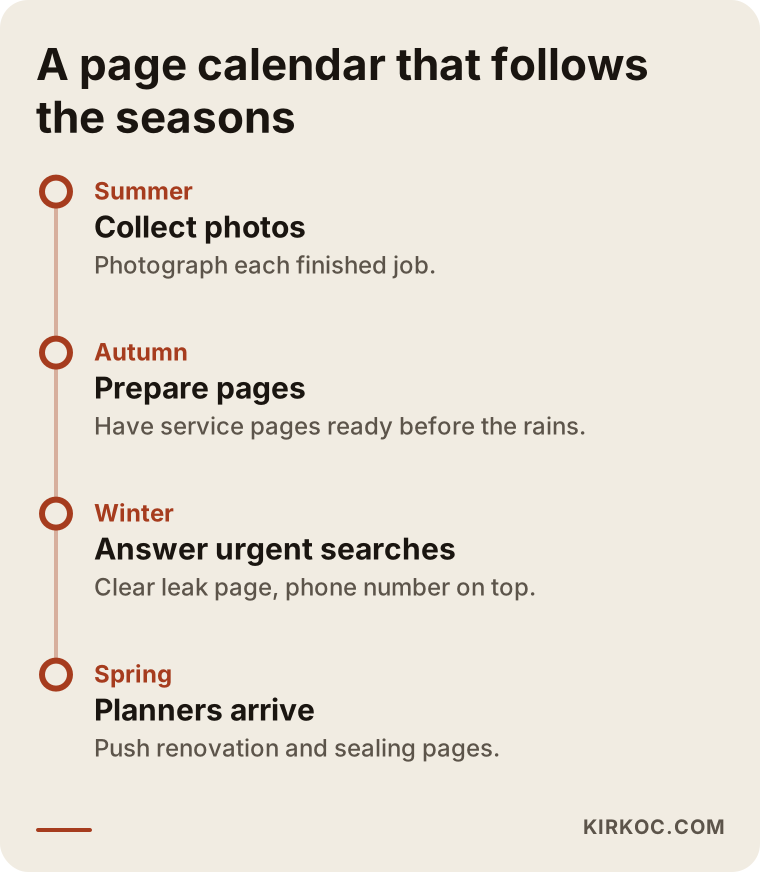
Google needs time to notice and evaluate a new page. So pages aimed at the stormy months should be live before autumn is over. The calendar below splits the year into four parts.
Summer: photo season
Summer is when you are busy and when photos can be taken in good light. After every finished job, before the scaffolding comes down, take a few clear pictures. Shoot before and after from the same angle. This archive gives your pages life in the winter.
Autumn: preparation
Before the rains, your leak, repair and emergency pages should be live and current. Your phone number, hours and service areas must be written clearly. It is also the best time to check whether the site is technically healthy: a page that won't load or a slow phone experience loses you the customer at the exact moment an urgent search comes in.
Winter and spring: two kinds of customer
In winter the visitor is anxious; they want a short, clear page with the phone number on top. In spring the visitor is planning; they compare methods, ask about materials and collect quotes from several companies. For that second group, more detailed pages with a question and answer section work well. One site can serve both moods as long as the pages are separate.
What decides the price, and how to read a quote
There are two prices to talk about here: what you charge your customer, and what I charge you. I won't give figures for either, but I can explain what moves them.
What affects the cost of my work
The scope of SEO work varies from site to site. The current state of your website, how many services and areas need their own pages, how strong competitors are, how much of your existing content has to be rewritten and how long the work runs all affect the price. So I first look at your site and your competitors, and then I present the first three months in writing, in priority order. Someone who quotes without looking is either selling a generic package or doesn't know your situation.
How your own customers see your price
It helps to understand this when writing your pages. A homeowner who gets a roofing or sealing quote wonders what is behind the number. The surface area, the condition of the existing layer, the type of material, how hard the roof is to reach, whether scaffolding is needed and the time of year all matter. If your page explains these in plain language, you can make a visitor think "this company knows its job" without naming a figure. A page like that attracts not only the person hunting for the cheapest offer but the person looking for the right job.
What to check when you get a quote from an SEO consultant or agency
When comparing offers, these criteria help:
- Is the offer written for your site, or is it a template sent to everyone?
- Is the work listed item by item, or does it just say "SEO services"?
- Does anyone guarantee a ranking or revenue? If so, be careful.
- How and how often will reporting happen, and will you understand the report?
- Is the person talking to you the one who does the work?
- Who keeps access to the site and ownership of the content?
The answers to these tell you more than the price does.
How working with me goes
The process has five steps, and I tell you what I'm doing at each one.
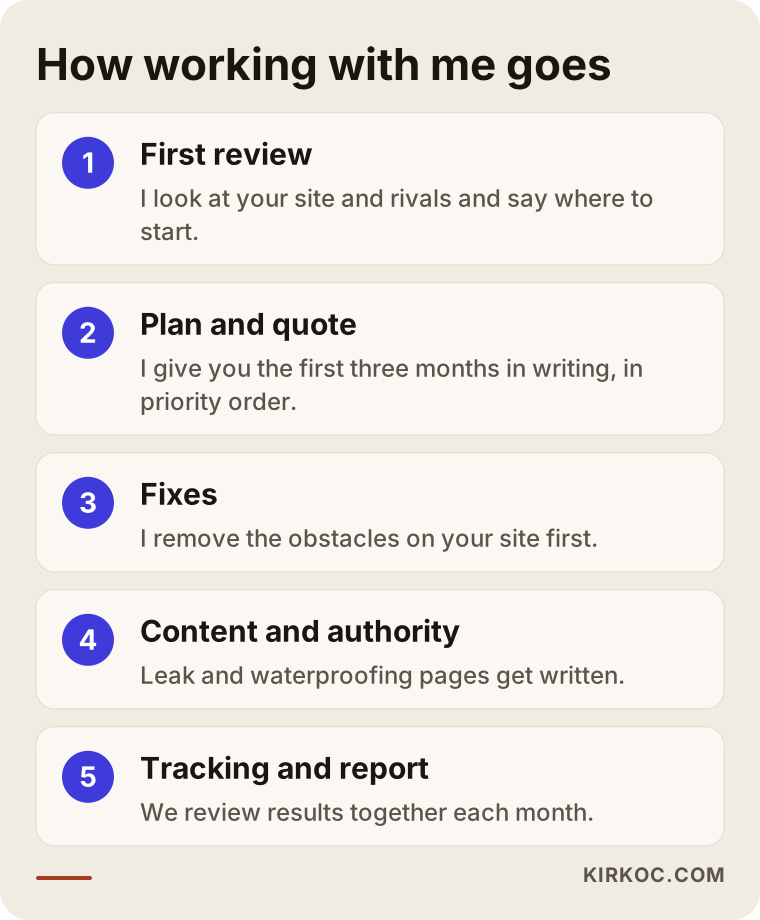
I start with a first review: I look at your site and your competitors and tell you where to begin. Then I give you the first three months in writing, in priority order, like a quote and roadmap in one. Next come the fixes, because removing obstacles on the site has the fastest effect. After that, pages and articles are prepared for the targeted searches; for a roofing business that means topics like leaks, flat roofs, reroofing and damp basements. At the end of each month we go through what was done, which searches improved and what comes next, in a plain report.
You have a role too: telling me about your jobs, sharing photos, saying which areas you serve and which work you want more of. A roofer's daily work is something you know and I don't.
Two hypothetical scenarios
The two examples below are entirely made up. I'm not describing real clients; I'm just assuming them to help you think.
Suppose the owner of a small waterproofing company gets most of her work through referrals, but her site has a single page that reads "Services: roof, terrace, basement." When the cold months arrive, someone with a leak searches "flat roof leaking" and finds only general guide sites. The first step here would be a page devoted to leaks, a separate page for flat roof sealing and a few stories of finished jobs. Nobody should expect a flood of work overnight, but the company enters the next stormy season far better prepared.
Now suppose another company has written an excellent page, yet the phone number sits at the very bottom and the site opens slowly on a phone. A panicking visitor gives up halfway and moves to the next result. Here new articles may not be needed at all; a technical fix and a visible phone number would make the existing effort count. These two examples show that SEO doesn't always mean "more articles."
There's a third possibility. Suppose a roofer works in just one town and gets nearly all his jobs through neighbors. A broad content plan would be a burden for him. A few well-made service pages, a business profile that stays current and solid project examples may be enough. The right answer always depends on the size of the business and the goal, which is why I look at your situation before suggesting anything.
Common mistakes on roofing and waterproofing sites
The same mistakes show up again and again in this trade. Most come not from ignorance but from things postponed because the jobs never stop.
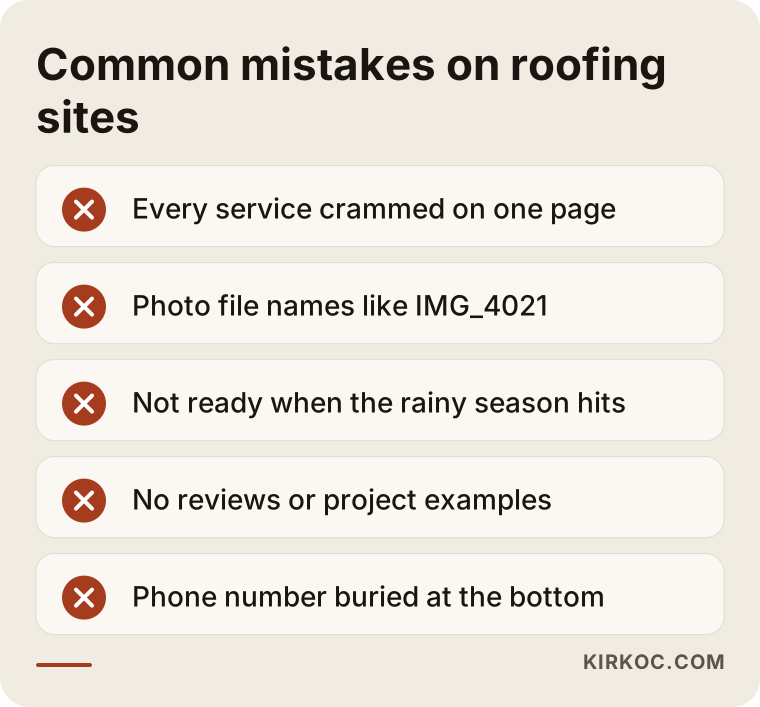
Everything on one page. Roof, terrace, basement, siding and paint packed into a single page doesn't tell Google which search should show you.
Unnamed photos. If photos are uploaded with the name the phone gave them, they lose their chance to appear in image searches. A short descriptive name and alt text fix this.
Missing the season. A page written once the rain starts won't help in that rain.
No project examples. Showing real jobs persuades far more than saying "we have been around for years." And if you can't back such a claim up with something concrete, don't write it.
Hiding the phone number. Someone with an emergency doesn't want to hunt for a number. It should sit at the top of the page and be tappable.
There's one more big mistake: big promises. Phrases like "guaranteed first place" or "permanent fix for every leak" break trust and leave you responsible. Plain, realistic language works better every time.
When you don't need this service
To be honest, not every roofing company needs SEO right away. In the situations below, waiting may make more sense.
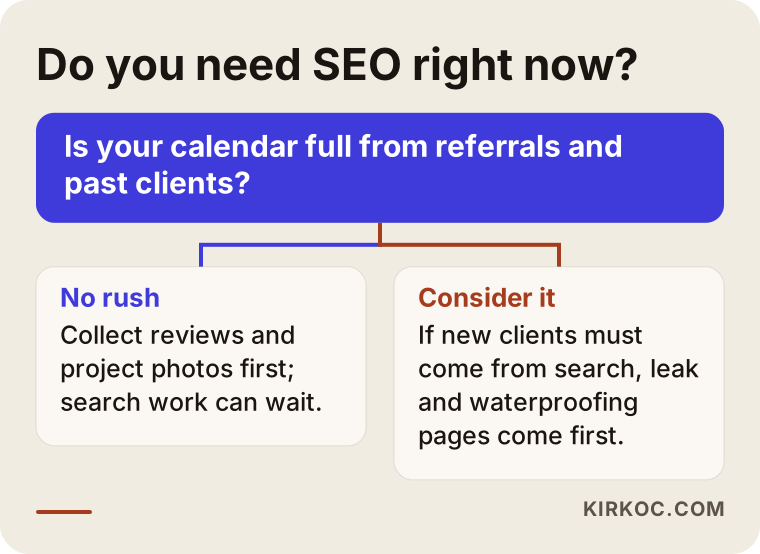
If your calendar is full from referrals and past customers and you're not struggling for work, collecting reviews and project photos first may be worth more. If you don't have a website yet, or it's very old, you need a basic site first; search work is built on top of it. For a very small operation that works in a single neighborhood and only wants to be known there, a business profile and a few good reviews are often enough. And if you have no time to manage things or no routine for collecting photos, SEO yields less, because the raw material for the content is your jobs.
On the other hand, if you want to find new customers through search, if competitors sit high for leak searches and you don't want to rely only on ads, this work starts to make sense. One important reminder: SEO isn't a quick result. It's an investment that carries from one season to the next.
Doing it yourself or handing it to a specialist
Some things you can do yourself, and I suggest you do. Taking photos after a job, asking customers for permission and a comment, keeping your business profile up to date, listing the areas you serve and placing your phone number where people can see it are your tasks. No technical knowledge is needed, just routine.
The things worth handing over are different. Researching what your customers really type into Google, finding the technical obstacles on your site, planning how pages link to each other and watching what competitors do all take time and experience. If a roofer tries to learn this in the evenings after a tiring day, either the job stays half finished or mistakes creep in.
There's a middle path: I look at your site first and tell you what you can do yourself and what needs expertise. That protects your budget and lets you know what you're buying.
Frequently asked questions
Do roofing companies really need SEO?
Not all of them. If referrals already give you enough work, there's no rush. But if you want to find new customers through search, showing up for leak and waterproofing searches opens a serious door.
Which searches should a waterproofing company focus on to get more customers?
The ones homeowners type in their own words: "ceiling leaking," "flat roof waterproofing," "damp basement," "roof replacement." A separate, clear page for each tends to work better. We decide together which to focus on, based on your area and the kind of work you want.
What should a waterproofing contractor website look like?
A separate page for each service, real photos from each job, the phone number near the top, the areas you serve and fast loading on a phone. It should also have pages answering questions like "where does the leak come from."
Why are project photos so important?
Because in roofing and sealing the result is often seen later, so a visitor has to trust you before knowing you. Real job photos and short stories build that trust and tell Google which town and which work you cover. Get the owner's permission and keep their identity private.
How do the seasons change SEO for a roofer?
Leak searches rise with the storms. Since Google needs time to evaluate a new page, pages for the cold months should be ready before autumn ends. Collecting photos in summer, refreshing pages in autumn and being ready for urgent calls in winter is a sound routine.
How long does SEO take to work?
I can't give an exact time, because it depends on your site, your competitors and Google's decisions. Technical fixes are usually noticed sooner; content matures more slowly. We look at what changed together in each monthly report, but I don't guarantee rankings or revenue.
Should I let you manage my site, or update it myself?
Photos and information about new jobs have to come from you, because you do the work. I can handle technical fixes, page structure and the content plan. I spell out who takes on which tasks in the first review.
How do I take the first step?
Send me your website address and the kinds of jobs you want more of. I'll look at your site and competitors and tell you where to start. You aren't committing to anything at that stage.
If you'd like to see what your website is telling homeowners before the leak season arrives, write to me and we'll talk about where to begin. You can read more on the SEO services page or contact me directly.