An email lands in your inbox: "100 high-quality backlinks for your website." You wonder whether it would help, or whether it could hurt your site. A backlink service sounds sensible, especially when competitors rank above you and you feel you should be doing something. But link packages often fail to solve the problem and sometimes create a new one. In this article I explain how links should fit into a proper SEO service and what to look at when someone sends you an offer.
First, the term. A backlink is a link from another website to yours. Search engines read it as a kind of recommendation. What matters is not how many links you have, but who gave them and why.
Why do link packages look so appealing?
Packages feel concrete. A set number of links, a set timeframe, a report with a list of site names. For a business owner, it creates the feeling that work has been done.
The trouble is that search engines try to tell real recommendations from purchased ones. Hundreds of links placed with the same pattern, blogs that have nothing to do with your field, and sites built only to sell links are easy to spot. Often nothing happens and the money is simply wasted. In worse cases, rankings can drop and recovery can take months. I cannot give you an exact likelihood, but you should know the risk is real and that the consequences land on your site, not on the seller.
What are the risks of buying backlinks?
These are the problems I see most often in my work:
- Off-topic sites: A law firm's link appearing on a recipe blog or a gambling site.
- Repeated patterns: The same link wording used on dozens of sites.
- Link farms: Sites with no visitors that exist only to sell links.
- No permanence: Links disappear when the payments stop, leaving you with nothing.
- No transparency: The seller will not tell you in advance where your links will appear.
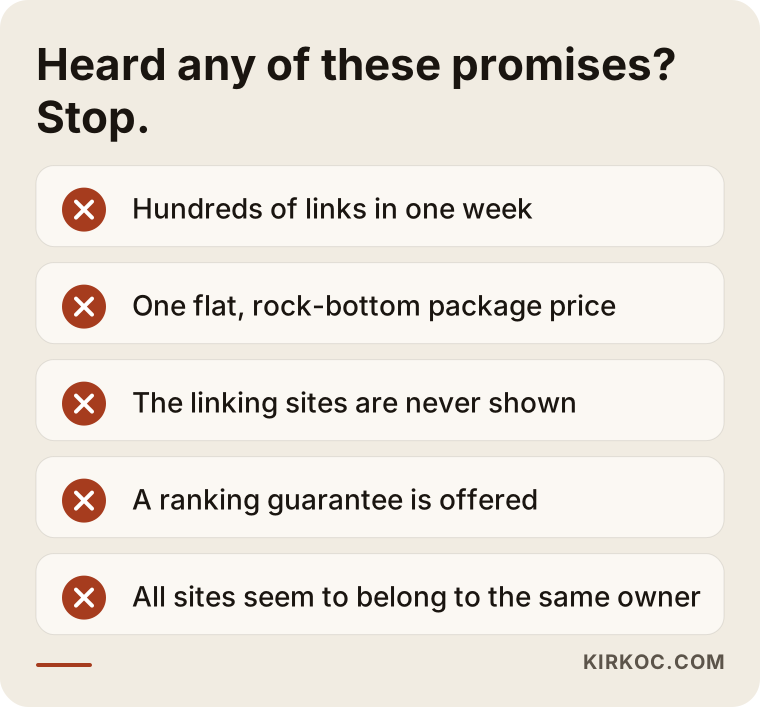
These offers also tend to come with promises of guaranteed results. Nobody can guarantee a ranking. If someone does, ask how they plan to do it.
How are links that actually help earned?
A valuable link usually exists for a reason: a news story about your business, a listing on an industry association's member page, an expert comment in a local publication, a reference on a partner's website. What these have in common is a real relationship or a real piece of content behind them.
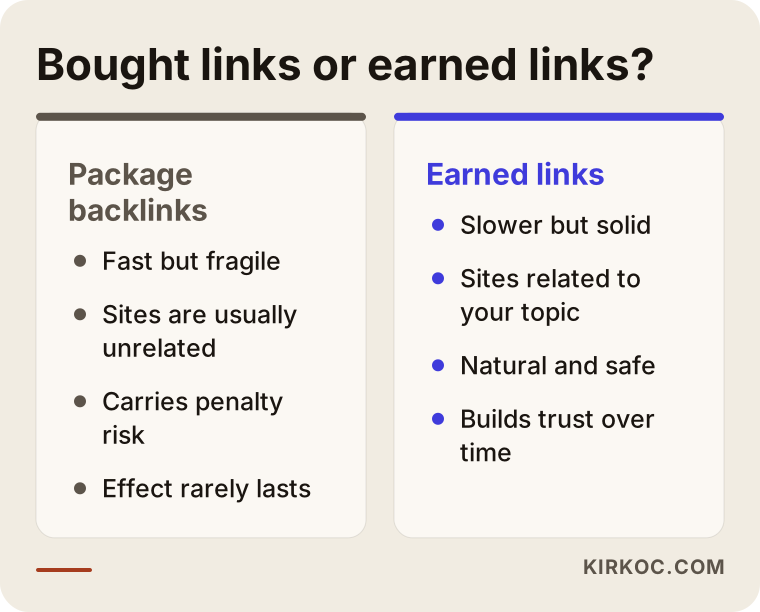
In practice, this is what I do or recommend:
- Publish content on your own site that is worth quoting, such as a guide or a clear FAQ.
- Look at relationships you already have: suppliers, chambers, associations, schools, partners.
- Make local listings and business profiles consistent.
- Contribute as an expert to publications in your field.
These methods are slow, and I can't promise a number in advance. But they last and they don't put your site at risk. If you want to see how shortcuts tend to cost more later, read my article on the hidden cost of cheap SEO services.
When is harmful link cleanup needed?
If a previous agency or vendor bought links in your name, you may not even know. Not every ugly-looking link is a problem; search engines simply ignore many low-quality links. Cleanup becomes relevant when:
- You received a "manual action" message in Google Search Console.
- Your rankings fell sharply after a link-building campaign.
- You have concrete evidence that a former provider bought links in bulk.
Cleanup has two steps. First, if possible, you ask the site owner to remove the link. If that fails, you use a disavow file, which is a list you submit through Search Console telling Google to ignore specific links. Because misuse can also affect good links, I review the list carefully and one link at a time. My article on backlink profile cleanup and disavow services goes into more detail.
What should you ask a backlink service provider?
When you evaluate an offer, ask:
- On which sites will the links appear, and can I see them beforehand?
- Are these sites relevant to my field, and do they have real visitors?
- How are the links obtained: is content published, or are placements simply bought?
- How long will each link stay live?
- Who takes responsibility if something goes against search engine guidelines?
- What will we measure: rankings, traffic, or calls and form requests?
If the answers are vague, or you hear something like "we have a private network," walking away is usually the safest choice.
What determines the price?
Prices differ so much because the work behind them differs. Earning a placement on a real publication involves research, writing, outreach, and often a long wait. Bulk links skip all of that. So when an offer is very cheap and very fast, ask where the effort was cut.
I plan a budget around scope, not link counts: how competitive your market is, the state of your current link profile, how much content needs to be created, and which sources are realistically reachable. Without those factors, a sensible price cannot be discussed. I cannot guarantee results, but I will always explain what I am doing, why, and what we will measure.
A small accounting firm and its "100 links" offer
The owner of a small accounting firm brought me an offer a salesperson had phoned in. It promised a set number of backlinks in one go and a report at the end of the month. The firm was trailing competitors in local searches, so the offer looked attractive. Before deciding, the owner wanted a second opinion.
First I asked for sample sites from the promised list. It was full of health, gaming and shopping sites, and there was no reason for any of them to link to a tax practice. Then I looked at the firm's own website. The service pages were thin, there was no FAQ, and the Google business profile was half finished.
Instead of buying, I suggested fixing the gaps on the site first and then looking at sources the firm already had a relationship with: a professional association, a local business network, and references on former clients' websites. The firm turned the offer down. Results did not appear overnight, but within a few months the owner reported more calls, and the calls were better qualified. I can't credit the links alone, because the page fixes happened during the same period. Still, the firm moved forward without taking on a risk.
Links inherited from a former provider
The second example comes from somewhere else. A small furniture maker contacted me because rankings had suddenly dropped. They had worked with someone else a few years earlier and had no report or contract left from that time. In Search Console there was no manual action message, so this was not a penalty.
When I reviewed the link profile, some of the sites really were odd, but most were already having no effect. The real problem was elsewhere: after a technical change, several important pages were redirecting to the wrong address. The drop came from a redirect mistake, not from backlinks. We fixed it and looked separately at only a small group of clearly suspicious links.
The lesson is that the first suspected cause of a drop is not always the right one. Rushing to submit a disavow file can hurt good links. Diagnosis comes first, action second.
If we work together, what does the process look like?
A link project is not a package. It is a sequence of steps. If you work with me, it usually runs like this.
1. Reviewing where you stand
I look at who already links to you, which links are helping, and which look suspicious. At the same time, I check where your competitors get their links.
2. Identifying realistic sources
I list which sources can realistically be approached on your behalf and explain them to you. These are mostly professional bodies, local publications, partners and industry directories.
3. Preparing something worth linking to
Nobody links to an empty service page. If needed, we prepare a guide, an explainer or a clear FAQ on your site that is worth quoting.
4. Outreach and publication
Sources are contacted. This stage takes patience: some publications never reply, others answer after weeks. I tell you from the start what to expect and when.
5. Measuring and reporting
We look at meaningful indicators rather than counts: visitors from search, calls, forms. I write the report in plain language and keep jargon out of it.
A checklist before you accept any offer
When a link offer lands on your desk, the most practical tool is a short list. The items below let you judge in a few minutes whether the offer is serious.
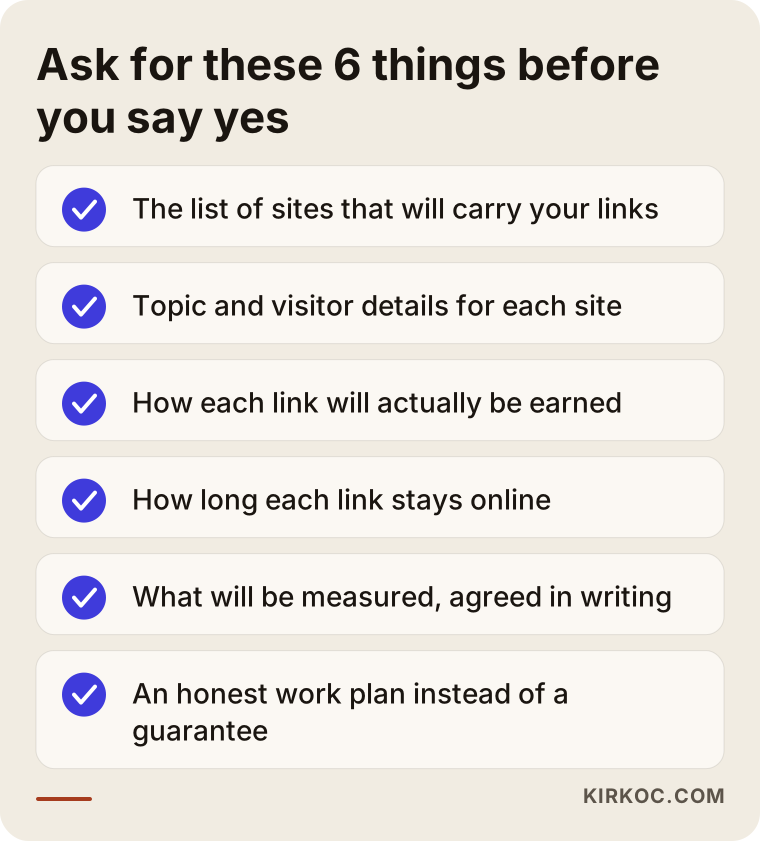
Let me unpack the list. The site list and topic details reveal what the seller is hiding. The question of how a link is earned separates publishing content from buying a placement. How long the link stays live tells you what remains when the payments stop.
I also recommend putting measurement in writing. A vague goal such as "more visibility" is an easy way to claim work was done later. If you agree on concrete indicators, such as calls or form requests, both sides look at the same thing.
How the seller behaves is also a signal
Someone who quotes a price without looking at your site, offers the same package to every industry, or pushes you to hurry cares about the sale, not the work. A serious provider listens first, looks at your site, and sometimes says "you don't need this right now."
Common mistakes businesses make with backlinks
The same mistakes keep showing up across different businesses in my work. These are the most common:
- Focusing on the count: One trustworthy link can mean more than hundreds of scattered ones.
- Not fixing the site first: Links pointing to a weak, slow or incomplete site will not deliver what you hoped.
- Not reading the contract: Responsibility, permanence and reporting clauses are often left vague.
- Mistaking the report for the result: A table of site names does not show a business outcome.
- Repeating the same link wording: Using identical phrasing on every link looks artificial.
- Never checking old links: Nobody reviews what former providers left behind.
- Submitting a disavow in a panic: Sending a file without investigating the cause can do harm.
Most of these come from missing information, not bad intent. So do not hesitate to question a seller. A serious one answers without strain.
What you can do yourself and what to leave to an expert
You do not need to hand everything to a specialist. Some steps you can take yourself; in others, experience matters.
What you can do yourself
- Screen incoming offers with the questions above.
- Ask your suppliers, chamber or association whether they would list you on their site.
- Keep your Google business profile complete and current.
- Share testimonials, with your customers' permission.
- Open Search Console and check whether any message is waiting.
What to leave to an expert
- A detailed review of your link profile and competitor analysis.
- Sorting out harmful links and preparing a disavow file.
- A reconsideration request after a manual action message.
- Regular contact with publications and content planning.
- Diagnosing the real cause of a ranking drop.
The line is simple: you can manage your own relationships and basic listings; technical work that is hard to undo after a mistake is safer in an expert's hands.
You can also split the work. You handle the testimonials and listings, and I take on the profile review, technical checks and reporting. That way your budget and your time go further, and it is clear from the start who owns which task.
Link types: which one does what?
Not every link has the same value, and knowing the difference makes offers easier to read. The grouping below helps you work out what a seller is actually selling.
Editorial links
A publication gives you a link as part of its own content, in a news item, an interview or an expert comment. This is the most valuable type because a real decision stands behind it. It cannot simply be bought; it has to be earned.
Directory and listing links
Professional associations, chambers, local guides and industry directories fall here. On their own they will not cause a big ranking jump, but they build trust. Having your business details identical everywhere matters here.
Partner and reference links
A supplier, a business partner or an organization you work with may mention you on their site. These links are few but highly relevant, and they usually stay for a long time.
Paid placements
Placements marked as advertising or sponsorship are not forbidden in themselves. The problem begins when they are bought for ranking purposes with the advertising nature hidden. If you appear in a paid publication, ask your provider how it will be labeled.
Low-value links
Uncontrolled comments, auto-generated profiles and bulk directory submissions belong here. Most are ignored, but heavy use leaves an artificial impression. Someone who reports these as "work" may in fact be giving you nothing.
How do you judge the results?
Measuring a link project by rankings alone is misleading. Rankings move for many reasons: seasons, competitor moves, site updates. So I look at several indicators together.
- The trend in visitors arriving from search engines.
- Changes in real requests such as calls, forms and appointments.
- Which pages are being viewed more.
- Who the newly earned links come from and how relevant they are.
It is normal not to see a clear change in the first weeks. Link work is long-term. After three or four months we look at the picture together and talk about what worked and what we should drop. I do not wait for the clock to run out before saying everything is fine; if the data shows something else, I tell you plainly.
What should a report contain?
A good report describes the work done, the links obtained and how they relate to your site. It does not just hand over a list of sites. It comes with commentary: why this link matters and what happens next.
When is it smarter to postpone link building?
Sometimes the most honest advice is "not now." In these situations I suggest looking at other things before you assign budget to links:
- Your site loads very slowly on mobile or throws errors often.
- Your service pages are short, vague or full of duplicated text.
- You have no Google business profile, or its details are inconsistent.
- You already rank high for the searches that matter, and the problem is conversion, not ranking.
- The site is about to be completely rebuilt; if addresses change, links can be damaged.
In these cases, link work is like adding a floor to a cracked foundation. Strengthening the base usually gives better results first. I cannot tell which applies to you without seeing the site, so the first step should always be a short review.
Sentences you can use when talking to a seller
Some business owners find it hard to push back on a salesperson. A few clear sentences you can use:
- "I would like to see the list of sites in writing."
- "How are these relevant to my industry? Can you show an example?"
- "What happens to the links when the contract ends?"
- "Who is responsible if something violates search engine rules?"
- "Which indicators will we use to measure success, and when will we look?"
The answers usually show within minutes how transparent the seller is. Someone who answers comfortably has nothing to hide.
Frequently asked questions
Is buying backlinks illegal?
No, it is not a legal issue. However, it can violate search engine guidelines, which may lead to lower rankings.
Can I rank without any links?
For low-competition searches, good content and a sound site can be enough. As competition grows, trustworthy links matter more. I cannot say anything specific without looking at your site.
How many backlinks are enough?
There is no fixed number. You need to look at who links to your competitors and which sources you can realistically reach.
I bought backlinks and my rankings dropped. What now?
Do not panic. First find the cause: is there a manual action message in Search Console, was there a technical change on the site, and on which pages did the drop begin? If links really are the cause, a cleanup is planned; if not, a disavow file only costs you time and adds risk.
How long until I see the effect of backlinks?
I cannot give a fixed time. It often takes weeks or months for links to be noticed and reflected in rankings, depending on competition and the state of your site. That is exactly why offers promising fast results should raise suspicion.
Can I copy my competitor's backlinks?
You cannot always reach the same sources, but seeing which types of sources link to a competitor gives direction. The goal is not to imitate the same sites but to reach the same kind of trustworthy sources with your own content and relationships.
Do comment, forum and directory links work?
They usually carry very little value, and uncontrolled comment or forum links can look artificial and even do harm. Listing in a genuine, relevant guide or professional directory is a different matter.
What should I ask for in the contract?
Ask in writing for the list of sites that will carry the links, how long the links stay live, an explanation of the method, and what will be measured. Be careful if you see any guarantee wording.
Do I need backlinks for a small local business?
For most local businesses, the Google business profile, consistent listings and well-made service pages come first. Link work comes on top. If competition in your city is high and the basics are done, working through local chambers, associations and neighboring businesses is a sensible start.
Are links from another country harmful?
Not by themselves. What matters is relevance to your topic and audience. If you work internationally, foreign sources are natural; if you only serve one local market, bulk links from unrelated foreign sites can look suspicious.
Conclusion
When you buy a backlink service, look at the source, not the count, and at permanence, not speed. Trustworthy links take time but they don't put you at risk. If you would like me to review your current link profile or an offer you received, you can reach me through my SEO services page.