You sell advice, a method, a person. There is no product to photograph and no shopfront to walk past. So how does someone who needs a management, HR or finance consultant, or a business coach, find you on Google and decide to trust you? I am a solo SEO consultant, and in this article I explain how my SEO services work for consultants and coaches, and what I have seen work and not work.
Why a service nobody can see is hard to find
Someone looking for a dentist types "dental implant." Someone who needs you rarely knows what your service is called. They type things like "my managers keep blaming each other," "how to hand a family business to the next generation," or "what changes when you become a leader." People search for the problem, not for the service.
That is why the most common mistake I see on consulting websites is a homepage that promises "strategic transformation partnership" and stops there. Neither Google nor the reader can tell what it means. The fix is to write down the problems your clients describe, in their words, one page at a time.
Each of your main services should have its own page built around the situation that makes people look for it. A good page includes:
- The situation, described the way the client would describe it
- Why it usually happens
- How you approach it (stages, how long it tends to take, who you work with)
- Who you are not right for, because honesty builds trust
- One clear next step to book a conversation
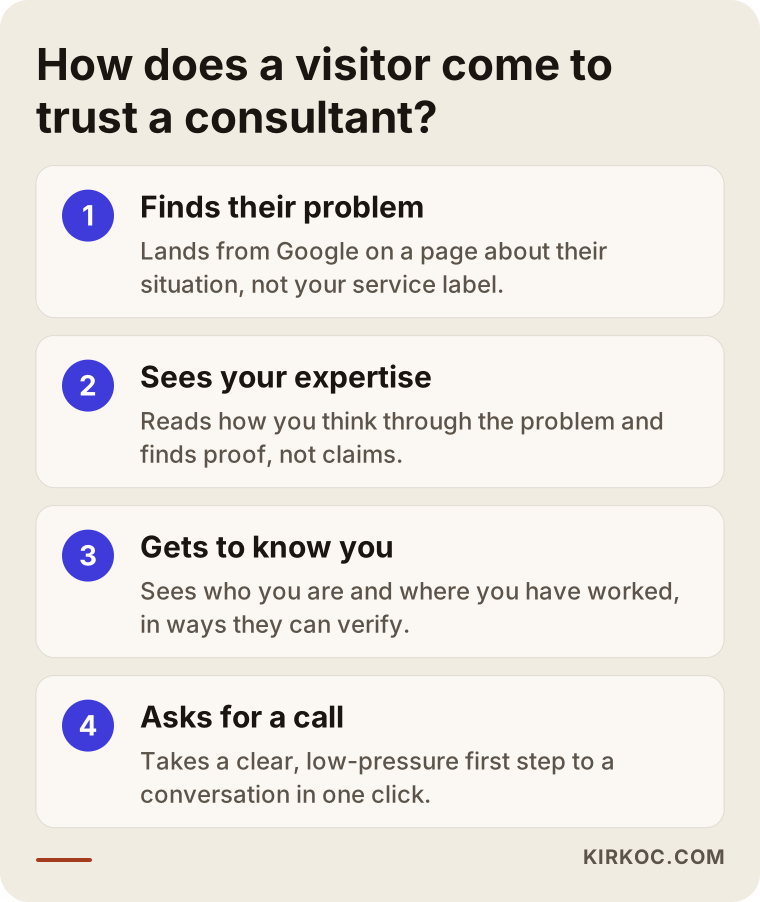
While writing, ask yourself which three questions this person probably typed before reaching you. Turn the answers into headings. Search engines then understand what the page is about, and the reader thinks, "that is exactly my situation."
Prove expertise with content, not adjectives
Every consultant is "experienced" and "results-driven." Those words separate nobody. What does is showing how you think about a problem, and a well-run articles section is the strongest tool for that.
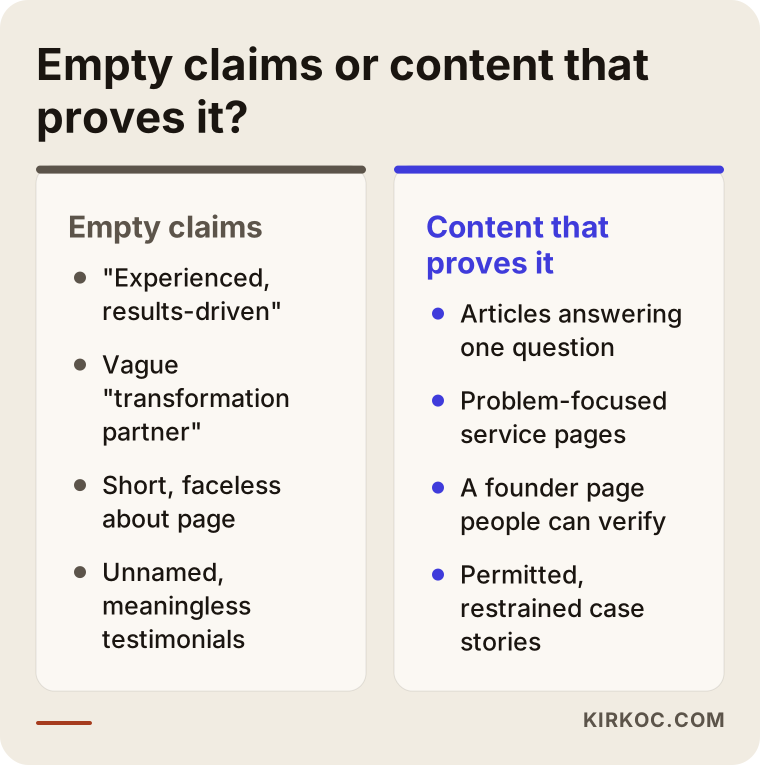
Let each article answer one real question. If you advise on finance, "the first three lines to check in a cash flow statement" does far more than "why digitalization matters in finance." A reader who learns something useful can imagine what paid work with you would be like.
If you want the broader foundations of a personal site, I cover them in a personal brand website for consultants and freelancers. Here I focus only on attracting clients through search.
Case stories: with permission, with restraint
References do much of the selling in consulting, yet most clients do not want their name published and your contract probably has a confidentiality clause. So:
- Get written permission for every case. A description such as "a mid-sized manufacturing company" is often acceptable
- Never share confidential figures or employee details
- Tell the story as problem, approach, what was learned
- Avoid anything that reads like a promise. "Here is what changed at this company" is fine; "it will work for you too" is not
These stories show up in search and help the visitor think, "this person knows my industry and my problem." In coaching and other fields with ethical codes, make sure you follow your client-confidentiality principles and the rules of your professional body.
Make the founder's own expertise visible
Whether the firm is large or small, buyers want to know who they will actually work with. A founder or partner page should be more than a short "about us." It should have:
- Who has worked in which field, for how long, and where (in a way people can verify)
- Training, certifications and memberships
- Talks, articles and events
- A real photo and a short, personal introduction
This page builds trust, but it also helps search engines and AI tools answer "is this person recognized in this field?" Keep the details identical to your LinkedIn and other profiles.
Turn visits into conversations
More traffic is only half the job. Buying consulting is a high-stakes decision, and nobody signs on a first visit. Offer a low-pressure step:
- A short, free introductory call
- A plain form that says what happens next (how long, with whom, what to prepare)
- Phone and email as options, because some executives dislike forms
- The same clear call to action at the end of every service page
Tell visitors when they can expect a reply. That small detail visibly changes how many people reach out.
How people search for consultants and coaches
It helps to split consulting and coaching searches into three groups. Once you know which page serves which group, your content plan stops sprawling.
Problem searches
Things like "my team has lost motivation" or "I don't know what to do next in my career." The person may not yet know that the answer is a consultant. You answer these with articles and problem pages. The goal is not a sale; it is the feeling that "this person understands me."
Solution searches
"Family business advisor" or "career coach" are searches from someone who knows what they want. This is where your service page earns its keep. The first screen should say who you work with, on what, and how.
Verification searches
Someone thinking about calling you types your name or your firm's name. If the results are inconsistent, with an old job title, a dead page or a wrong phone number, that person may never fill in your contact form. These searches should be under your control, and they are the easiest ones to win.
Being mentioned in AI summaries and chat tools
More people now ask an AI tool questions like "Who is a good advisor for family-owned businesses near me?" These tools pull from web pages, profiles and news when they build an answer. The clearer and more consistent your description of yourself, the better your chance of being mentioned correctly. There is no guarantee, but a vague description is even less likely to be picked up.
Concretely: describe your service in one sentence and use it the same way everywhere, state your field plainly on the founder page, and write articles that answer questions directly. This overlaps heavily with classic SEO; no separate trick is required.
Service page, article, case story: what is each one for?
Do not mix up the three content types. Each has a different job.
| Content type | Who it speaks to | What it delivers |
|---|---|---|
| Service page | Someone who knows what they need | An inquiry |
| Article | Someone who cannot yet name the problem | Visibility and a sign of expertise |
| Case story | Someone who wants reassurance before deciding | Trust and conviction |
Many sites publish only service pages. Then only people who already know you find you on Google. Articles and case stories let you reach people who do not know you yet but need what you do.
Two concrete examples: a management consultancy and a career coach
Instead of abstract advice, here are two typical situations. Neither describes one real business exactly; I have blended pictures I run into often in my work.
A small management consultancy
A two-partner firm that helps family-owned companies with succession and structure came to me. Their site looked good, but the home page said "your corporate solutions partner," and there was a single "Services" page. Most inquiries came from people who already knew them.
First I looked at which searches the site appeared for. It showed up for almost no problem-style phrases. Then I asked the partners to write down the sentences clients use in a first meeting: "my father wants to retire but can't let go," "my sibling and I can't share authority."
From those sentences we built four separate problem pages. Each had an opening describing the situation, the usual causes, the firm's way of working and a section on who the engagement is not for. One partner also got a founder page with verifiable details.
A few months later the number of inquiries from search had not jumped, and I want to be straightforward about that. But the quality of inquiries changed: people began with "we want to talk about succession with you." In consulting, that signal is worth more than volume.
A solo career coach
The second example is a career coach who works with mid-level managers. The site was a single page. The coach was active on social media but did not appear in Google for anything except their own name. There was no information on packages, so prospects did not know what they would be buying.
The first step was not adding pages. We first clarified who the coach wanted to serve: a narrow, defined group, such as people in their first year as a manager. Then we prepared three articles based on that group's questions, plus one service page.
One ethical point was sensitive: client stories. The coach did not want to share any real case, and I did not push. Instead we wrote pieces explaining the method, "how I usually approach situations like this." That turned out to be a sufficient trust signal.
What happened? The site began to appear for a few problem searches and the inquiries became more specific. It is still a slow channel, but the "wrong fit" calls that used to waste the coach's time became less frequent.
Step by step: if you do this with me or on your own
The process is much the same either way. The difference is who does which step.
1. Reading the current situation
If you have a site, I look at which searches you appear for, which pages get no visits and where visitors leave. If you have no site, this step starts with collecting your clients' language.
I also look at competitors' sites, not to copy them but to see which topics they leave empty.
2. Building the problem list
List the sentences your clients say in a first meeting. Your calendar notes, emails and post-call notes are a goldmine. The list is grouped, and one page is planned for each group.
3. Writing pages and articles
First the page for the service that brings the most work, then the articles that support it. The key point is keeping your own voice. My job is not to speak for you but to make your thinking readable and findable.
4. Completing the trust signals
The founder page, permitted case stories, certifications, talks and consistency with other profiles get checked here. A missing detail or a contradictory job title can damage trust.
5. Measuring and adjusting
In the first weeks I care less about traffic and more about this: what is the quality of the inquiries, which pages lead to conversations and which do not? Pages are then simplified or expanded. Results cannot be guaranteed, but this is how you see what works.
A checklist before you publish
Before a page goes live you should be able to say "yes" to the questions below. You do not need to finish everything at once, but you should know what is missing.
For the service page:
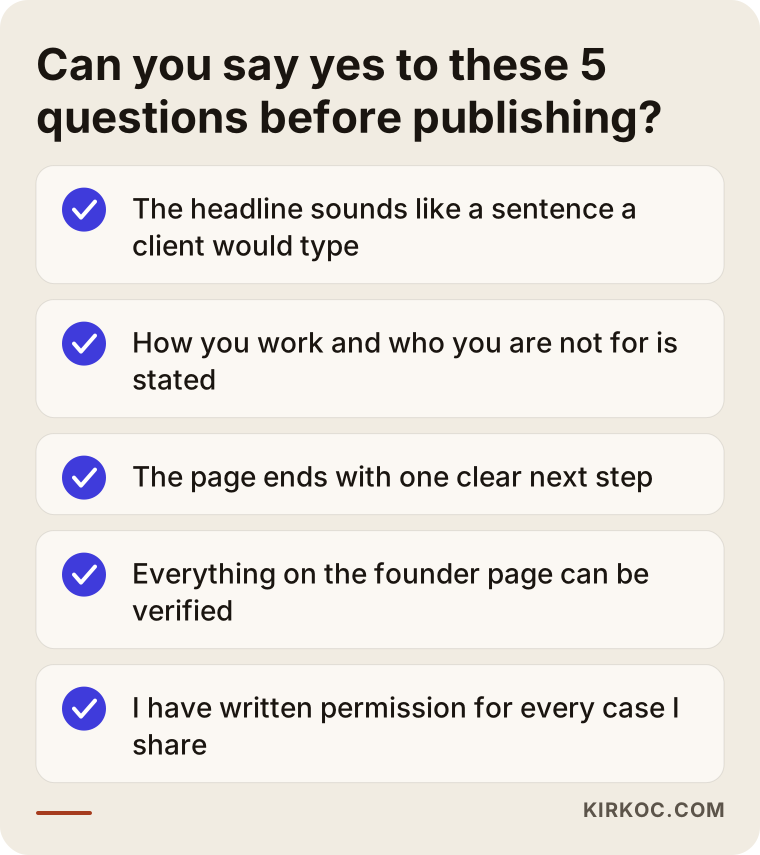
- Does the headline resemble a sentence a client would type?
- Does it explain how you work (stages, time logic, who does the work)?
- Does it say who you are not for?
- Is there one clear next step at the end?
For articles:
- Does each answer one real question?
- Does it include your own observation, method or example?
- Or is it generic text that any other consultant could have written?
For trust:
- Does the founder page contain verifiable facts?
- Do LinkedIn and your other profiles say the same thing as the site?
- Do you have written permission for every case you share?
Common mistakes
The same mistakes show up again and again on the sites I work with. Most come from good intentions, not ignorance.
Trying to speak to everyone
A site that says "support for companies of every size in every sector" feels like it belongs to no one. In consulting, trust grows as expertise narrows. Defining a narrow audience is not losing business; it is finding the right clients.
Cramming services onto one page
Fitting five services onto one page leaves all of them shallow. Google cannot tell which section answers which search, and the reader cannot find what they came for.
Making testimonials meaningless
Nameless, detail-free comments like "very happy, thanks" are not proof. Prefer fewer, more concrete ones: what was the situation, what was done, what changed.
Abandoning the blog
Writing three articles and stopping can be worse than never starting; if the latest post is two years old, the site looks neglected. A few regular articles that answer a real question beat frequent but empty ones.
Forgetting legal and ethical limits
Ignoring client confidentiality, contract obligations or the advertising rules of your professional body can cost far more than any SEO gain. If you are unsure, check your professional rules and your contracts.
Expecting results in month one
Consulting searches are few and the decision process is long. Quitting after glancing at a traffic chart in the first months misreads the nature of this work.
What you can do yourself and what to leave to a specialist
You do not need to outsource everything. I often tell clients, "do this yourself, nobody can write it better."
What you can do yourself
- Collect the sentences clients use in first meetings
- Write the founder page content: education, experience, talks
- Draft articles explaining your method, because the method is yours
- Get case permissions and decide the order of the story
- Make LinkedIn and other profiles consistent
- Track inquiries by noting who wrote and from which search
What to leave to a specialist
- A technical diagnosis of why the site does not appear in Google
- Planning which page should serve which search
- Building page structure, headings and internal links
- Reviewing how you are mentioned in AI tools and search summaries
- Telling apart why traffic fell or why inquiries are not coming
In short, the content is yours; the structure and diagnosis are mine. That split lowers the cost and protects your voice.
A realistic calendar for the first three months
Every consulting business is different, but this order tends to work as a starting point. Read it as a working rhythm, not a promise of timing.
Month one: the foundation
The current state is read, the problem list is built, and the founder page and the most important service page are written. By the end of this month your site should say clearly who you are and who you serve. No results are expected yet; the goal is solid ground.
Month two: supporting content
The first two or three articles go live. Each answers one real question and links naturally to the relevant service page. In the same month, case permissions are collected and the first case story is prepared.
Month three: looking and adjusting
We look at which pages are viewed, which searches bring people and what those people do. Pages that do not work get simpler, and new articles grow around the ones that do. We also revisit expectations: in consulting, three months is usually enough to see first signs, not results.
Even if you follow this calendar yourself, keep the same order. The mistake I see most is producing articles before the foundation is laid.
One more thing: there is no "done" at the end of three months. A consulting site is a tool that grows with your practice. When you add a service, when your audience shifts, or when permission for a case arrives, the site needs updating too. Doing this in small, regular steps is far healthier than one big overhaul every few years.
Frequently asked questions
How long until results show?
I cannot guarantee anything. Consulting searches are usually few and niche, so do not expect a jump. Early signs can appear within a few months, but what changes most is often the quality of the inquiries rather than the volume of traffic.
Do I need a separate page for each service?
Yes, for your main services. Squeezing five services onto one page makes none of them strong.
Isn't LinkedIn enough?
It matters, but it complements a site. People search Google first, and the page they land on should be one you control.
Can I write my articles with AI?
Generic text anyone could produce will not set you apart. Content written without your own method, observations and cases does not count as proof of expertise.
Are Google ads or SEO better for a consultancy?
They do different jobs. Ads are fast but stop when you stop paying; SEO is slow but builds an asset. In consulting, searches are few and clicks can be expensive, so it is usually healthier to build the base with SEO first and add ads if needed.
I want to reach clients abroad too. What should I do?
Translation alone is not enough; you need pages written in the target country's language and around its own questions. Start by checking in which language you have real client potential, then build a few strong pages in that language.
I have no time to write. Is this still possible?
It is, but expectations should shrink. One good article a month beats ten weak ones. Drafting from voice notes or call recordings also lightens the load.
How do I know it is working?
Look at the quality of inquiries before visitor numbers: are the right people writing, do they know what they want, does the person arriving at the first call seem to know you already? To track this, simply record which page each inquiry came from.
Conclusion: a small start is enough
If you already have a site, I first look at which problems have no page, what your founder page says, and where inquiries drop off. Then we set priorities; you do not need to do everything at once. You can read more on my SEO services page or contact me directly.