A purchasing manager types into ChatGPT: "Which companies manufacture stainless steel fasteners in Europe, and who has export experience?" Three or four company names come back. Is yours one of them? Most manufacturers and wholesalers spent years winning business through trade fairs and referrals and never had to ask this question. Now the buyer's very first screening step is changing. In this article, as part of my GEO services, I explain how B2B companies can earn a place in AI answers to supplier searches. GEO is the work of making sure AI tools know your company and recommend it in the right context.
How do buyers research suppliers now?
The person making a B2B purchase is usually short on time and holding a specification. They used to search Google and open ten sites one by one. Now many hand that job to an AI tool: "Compare companies that make this part to this tolerance with this certification." They get a short list with reasons. A company that does not make the list is never even asked for a quote.
This does not break your current business, but it opens a new front door. Your trade fair booth and your old customer references still matter. The difference is that a new buyer may meet your market through an AI answer before they have heard your name. I covered how AI recommendations work in general in does AI recommend your business.
What does AI look at before recommending a B2B company?
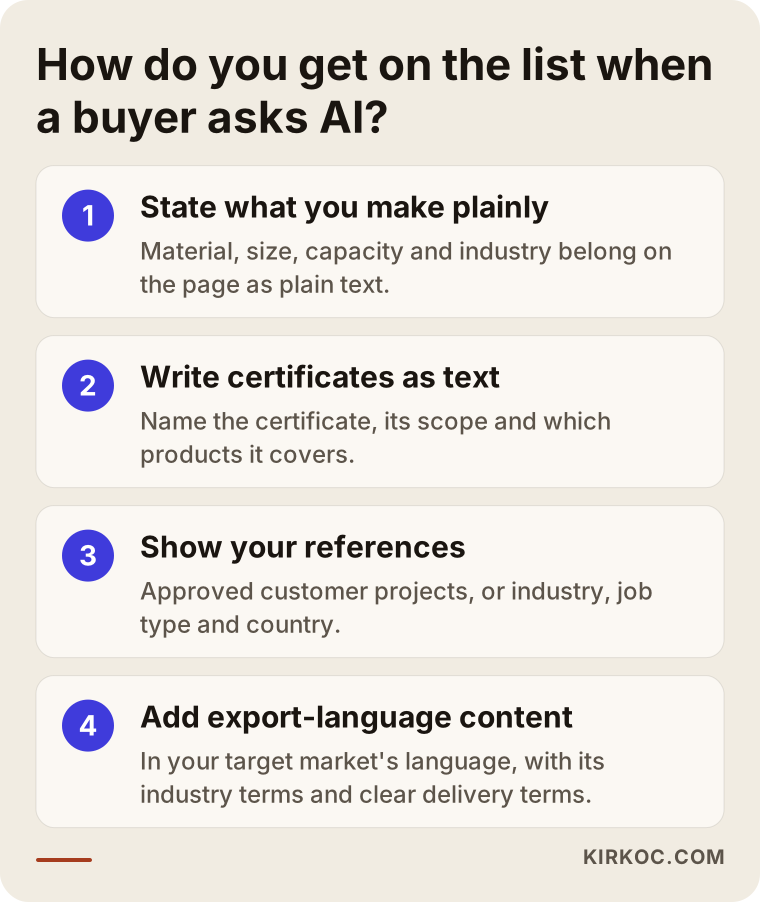
AI tools do not guess. They collect information they can read, that is consistent and that can be checked. In B2B that information falls into clear groups:
- What you make, stated plainly. "We deliver quality solutions" says nothing. "Serial production in this material, in this size range, for these industries" says a lot.
- Technical detail. Dimensions, materials, capacity, minimum order, production method. This is exactly what buyers ask about.
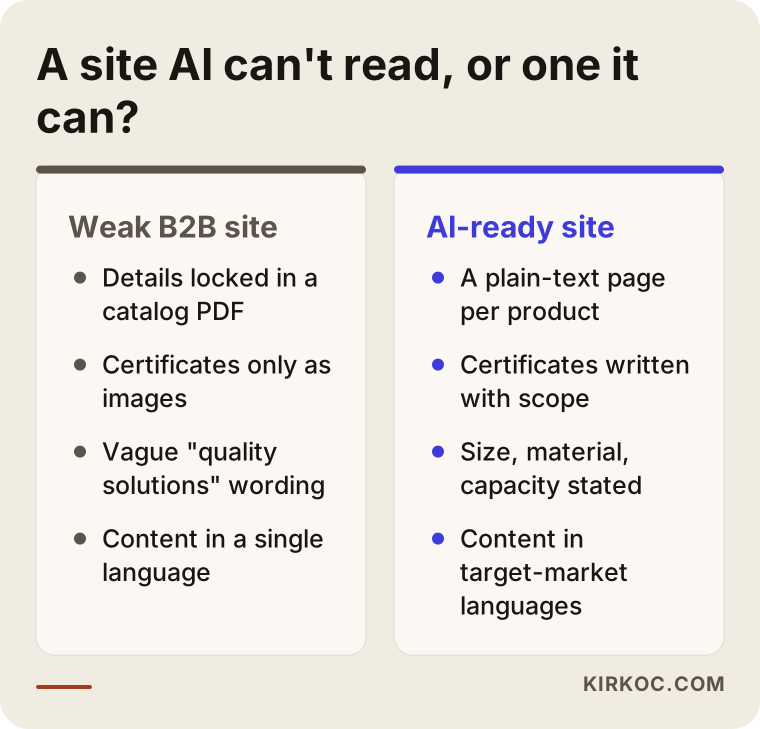
- Certifications. Which quality and standards certificates you hold should be written as readable text on the site. A certificate uploaded only as an image is often invisible to AI.
- References. Projects for customers who agreed to be named, with industry and country. If you are under a confidentiality agreement, describe the industry and type of job instead of the name.
- Export information. Which countries you ship to, which delivery terms you work with, which languages you support.
- A consistent identity. Your company name, address and field of activity should read the same on your site, in industry directories and in business registers.
The most common mistake: information trapped in the catalog PDF
Many manufacturers put all their technical knowledge into a catalog that is emailed out or left as a PDF on the site. A buyer can read it. AI tools and search engines often cannot read it fully, and when they do, they can mix up which detail belongs to which product.
The sturdier approach is a dedicated page for each product or product group, in plain text. What it is for, which sizes it comes in, which certification it is made under, which industries use it, how to request a quote. I wrote about the website side of this in a B2B catalog website for textile and manufacturing companies. The point here is that the same page serves both the buyer and the AI.
Export language: answer foreign buyers too
If you produce at home and sell abroad, a buyer in another country is most likely asking this question in their own language. When AI finds information written in that language, it recommends that company. A site that exists only in your home language may simply not exist for that buyer.
Pasting raw machine translation is not enough. Technical terms should be the ones buyers in that industry actually use, and delivery terms and payment conditions must be clear in that language. Which languages you need depends on which markets you really want. Rather than chasing every language, I suggest starting with your two or three most important markets.
The same logic for service providers
If you are not a manufacturer but offer industrial maintenance, logistics, accounting or software, buyers ask things like "firms that provide scheduled maintenance for industrial plants near Chicago." AI looks for the scope of your service, the industries you work with, your process and who has worked with you.
So instead of one generic "Services" page, a separate, concrete page for each service works better: who it is for, which problem it solves, how the process runs, when results show. If you are a wholesaler, apply the same idea and state brands, categories, stock and shipping clearly.
What can you expect, and what not?
Honestly, there is no guarantee of appearing in AI answers. The tools decide for themselves which company to mention, and those decisions change over time. What I can do is make your company's information accurate, consistent and readable, which raises the likelihood of being recommended. The same groundwork also helps classic Google search and direct visitors. B2B sales cycles are long, so results usually show over months rather than weeks.
One more point: this is not a one-off job. When you gain a new certificate, enter a new market or change your capacity, the information has to be updated.
Two concrete scenarios
The two examples below describe situations I run into often in my work. They contain no names or figures; the point is to show what the process looks like in practice.
Scenario 1: A small metal parts manufacturer that exports
A manufacturer came to me with a familiar complaint: orders arrived through trade fairs and long-standing customers, but new overseas buyers almost never showed up. The website was a one-page introduction and a downloadable catalog. The certificates sat at the bottom of the page as small logos.
First I typed a handful of buyer questions into several AI tools and checked whether the company was mentioned. It was not. Competitors with more detailed websites appeared instead. We then split the product range into separate pages: material, size range, industries served, delivery terms and what a buyer needs to send for a quote, all in plain text. The certificates were written out with their names and scope.
We also prepared an English version using the terms that buyers in that industry actually use. A few months later the company started to appear in AI answers for some of the questions, and when buyers were asked how they found the company, AI tools began to show up among the answers. That is not a guarantee, but it was a measured sign that the groundwork was doing its job.
Scenario 2: A maintenance company serving industrial plants
In the second case the company did not sell a product; it provided periodic maintenance. Its site had a single "Our services" page filled with phrases like "reliable, high-quality, fast". The buyer, meanwhile, was asking which companies maintain a particular type of machinery at their plant.
The task here was to make the service concrete. Which machine types, which industries, how often is maintenance carried out, how does the process work when something breaks, is there a site survey before the quote? Each question got a short, clear answer on the page. Approved references were added as industry and job type.
Again I have to describe the result carefully: AI recommendations vary, but the company began to appear for questions where it had never been mentioned, and the quality of incoming requests improved. For service firms, describing in detail what you do turns out to be what matters most.
Step by step: how does this work?
Whether you do it with me or on your own, the order is largely the same. Changing the order usually wastes effort, because the foundation has to come before the decoration.
1. List your buyers' questions
Think about what your buyer would type into an AI tool. Write real sentences such as "manufacturers of this product", "suppliers with this certificate" or "companies offering this service in this city". This list becomes your compass.
2. Measure where you stand today
Try those questions in several AI tools and note whether your company is mentioned and who is mentioned instead. Looking at what information the competitors are named for is very instructive.
3. Find the information gaps
Every piece of information a buyer asks for but cannot find on your site is a gap. Capacity, minimum order, lead time, certificate scope and export countries are usually the first ones missing.
4. Rewrite pages in plain text
One page per product or service, with clear headings and short paragraphs. Information from the PDF moves onto the page; the catalog can stay as an extra.
5. Make outside records consistent
Company name, address, field of activity and contact details should be identical in industry directories, chamber records and social profiles. Conflicting details reduce an AI tool's confidence.
6. Monitor and update
Retry the same questions every few weeks. Update the pages whenever you get a new certificate, enter a new market or expand your equipment.
A checklist before you start
If you cannot answer yes to most of these, this is a sensible place to begin:
- Does each of your products and services have its own page?
- Are technical details (size, material, capacity) readable text on the page?
- Are certificate names, scope and covered products written out?
- Are your approved references described with industry, country and job type?
- Are the countries you export to and your delivery terms stated clearly?
- Is the way to request a quote obvious, and does the buyer know what to send?
- Are your company details identical on your site, directories and profiles?
- Are at least the basic pages available in the language of your target market?
- Are phone, email and address reachable on every page?
Common mistakes
Most of the mistakes I see do not come from ignorance but from the assumption that "we already know this". When you are deep inside an industry, some things feel so obvious that you forget to write them down. Yet an AI tool, and a foreign buyer, only know what has been written.
Squeezing everything onto one page
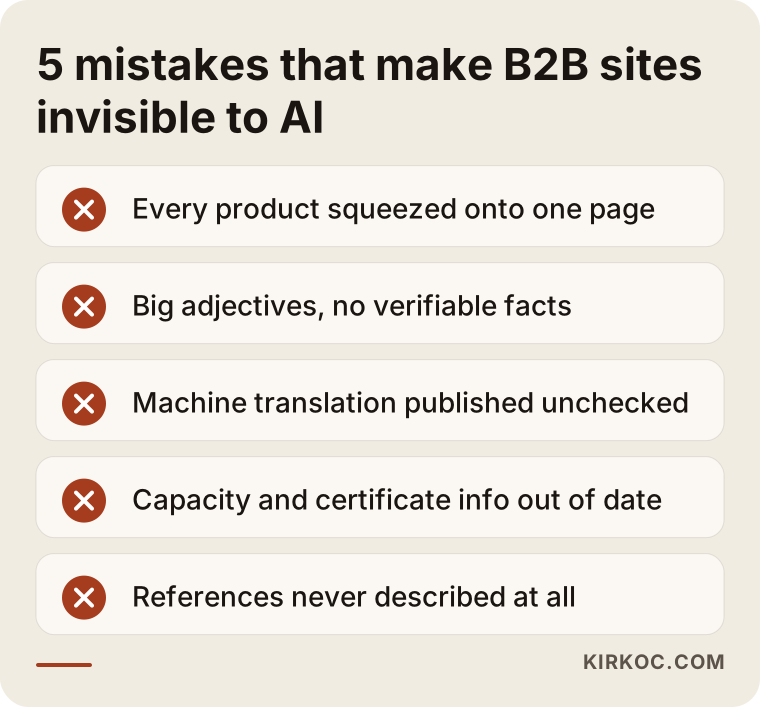
Cramming ten product groups into two paragraphs under "Our products" means none of them is described properly. When a buyer asks about a specific product, an AI tool looks for a page dedicated to it.
Writing with big adjectives
Phrases like "world-class", "leading" or "highest quality" cannot be verified. Write measurable information instead: which standard, which capacity, how many years of experience, things you can actually prove.
Leaving the translation to a machine and never checking it
When machine translation picks the wrong industry term, a foreign buyer will not take you seriously. Someone who knows the sector should read the translation.
Doing the work once and walking away
If your capacity, certificates or export countries change and the site stays old, AI tools pass on the old information. A page that has gone stale can sometimes be worse than no page at all.
Hiding your references
If you are under a confidentiality agreement you do not have to name the customer, but you can write the industry and job type, for example "serial production for an automotive supplier". Writing nothing leaves the buyer with the impression that you have no experience.
Ignoring outside sources
An AI tool knows a company not only from its own site but also from descriptions elsewhere: industry directories, chamber and association membership pages, news items and trade fair exhibitor lists. If your company is missing there or appears under a different name, even good information on your own site may not build enough trust on its own.
Only looking at Google
Tracking classic search rankings is useful, but the questions buyers put to AI tools are often longer and more detailed than what they type into Google. If you only follow short keywords, you can get a wrong impression of your visibility in AI answers.
Why the quote and contact page matters so much
Once a B2B buyer has found you, the first thing they look for is how to ask for a quote. If that path is unclear, the buyer usually moves on to the next company. An AI tool can also describe a company more comfortably as "easy to work with" when its quote process is clearly explained.
What belongs on a quote page?
Tell the buyer what to send: product code or drawing, quantity, delivery destination and any standard or certificate requirement. State the expected response time and who they will be talking to. This builds trust with foreign buyers and cuts down needless back-and-forth.
What about pricing?
You do not have to publish prices; in B2B the price often depends on quantity and specification. But you can explain what determines it: quantity, material, tolerance, certification and delivery terms. That helps a buyer judge early on whether you fit their budget.
How do you build content around buyers' questions?
Do not write "our company does this"; write so that you answer the question the buyer asks. When an AI tool looks for an answer, it pulls forward the paragraph that answers that question directly.
In practice, this means page headings that resemble questions, such as "What is the minimum order quantity?", "Which countries do you ship to?" or "Can you provide samples?". Two or three clear sentences under each heading are enough.
Which questions should you answer?
Buyers most often ask about production capacity, lead time, the quality control process, the sample policy, payment terms and after-sales support. Rather than piling them onto a single page, answer each one in the right place on the relevant product or service page.
Keep the industry's language
Use whichever term the buyer uses. If your internal paperwork calls something "type A part" and buyers call it something else, writing both is sensible. Otherwise the AI tool cannot match your page to the buyer's question.
Measurement: how do you know you are making progress?
Measuring visibility in AI answers is not as clear-cut as tracking classic rankings. The same question can get a different answer two days apart. So you need to rely on regular, comparative checks rather than a single test.
Three simple indicators
First, whether your company is mentioned for your chosen buyer questions and how it is described. Second, the quality of visits and quote requests: how many buyers from the right country write about the right product. Third, what buyers tell you when you ask how they found you.
Avoiding misreadings
Do not be fooled by short-term swings. Not being mentioned one week and mentioned the next does not mean the process has broken. I usually compare periods of several weeks and only draw conclusions when a change persists. It is also wise not to depend on a single tool, since each one uses information differently.
Turning measurement into work
The purpose of measuring is not to produce reports but to see which information gap to close. If competitors are mentioned for a question and you are not, you probably have no page that answers it. The fix is often to write that page. That is why measuring and writing content are not separate jobs but two halves of one cycle: you see what is missing, you write the missing information, then you look again.
What you can do yourself and what to leave to an expert
You do not need to outsource everything. Some of the work you can do very well yourself, because you know your product better than anyone.
What you can do yourself
- Draft the list of buyer questions.
- Gather product, size, capacity and certificate details in one document.
- Collect approved references and export countries.
- Ask incoming buyers "how did you find us?" and note the answers.
- Check your entries in chamber and industry directories.
What to leave to an expert
- Planning the site structure, page layout and internal links.
- Making the technical adjustments so AI tools can read the site.
- Building multilingual content for both language and search.
- Measuring the current position with a consistent method and tracking it over time.
- Deciding which content comes first for which market.
The practical benefit of this split is simple: you bring the knowledge, and I put it into a form buyers and AI tools can read. Your budget and your time are both used more efficiently that way.
Frequently asked questions
I am a small manufacturer. Is this for me?
Yes, and it can even favor niche producers. If you make a very specific product and describe it clearly, you can be the answer to "who makes this?" On a limited budget, we start with your best-selling product group.
Is putting my certificates on the site enough?
Not on its own. The certificate's name, scope and the products it covers should be written as text, and the relevant product pages should link to it.
How do you track results?
I test a set of agreed buyer questions in AI tools at regular intervals and check whether your company is mentioned. I also suggest asking new inquirers how they found you, which helps me compare my testing with real life.
Do I need to run ads to appear in AI answers?
No. AI answers do not work like a list you can buy with ads; the tools recommend based on information they can read. Advertising is a different channel and does not replace this work.
My site has no English at all. Should I translate everything right away?
First decide which market you want to sell to. Then prepare the most important pages for that market with someone who knows the industry's terms. Starting with product and quote pages is healthier than translating everything at once.
My competitors already show up in AI answers. Am I too late?
You are not too late. Recommendations are not fixed, and a company with clearer information can move up over time. Looking at what information your competitor is named for and spotting your own gaps is a good place to start.
How long does this take and what determines the cost?
The time depends on the number of products, the number of languages and the state of your current site. The cost follows the same factors: how many pages need to be written, in how many languages, and how much technical adjustment is required. For a clear plan I need to look at your company.
When do results show up?
B2B sales cycles are long, so first signs usually appear within weeks and meaningful change within months. I cannot give an exact time; how often AI tools update also varies.
Next step
We can look together at how your company appears in AI answers today. I will clarify the missing information, the priorities and which languages you need for which markets, then give you a simple plan. If you like, write to me through the GEO services page.