Your display case looks great, your products are fresh, and people in your neighborhood know your name. Yet when someone pulls out a phone and types "bakery near me" or "custom birthday cake," you are not in the first three results, and other shops are. That is the problem bakery SEO is meant to solve. SEO, in one sentence, is the work that makes your business show up when customers search on Google. In this article I explain what a bakery owner needs to do and why, what you can handle yourself, and where outside help makes sense. I am Ümit Kırkoç, I work alone from Istanbul, and I describe the limits of my own SEO services where they matter.
The bakery trade sits in an interesting spot for search. Many customers live or work close by, so a lot of searches are very local. But the same customer may also look for a wedding cake or a baby shower order weeks ahead. On one side is the hurried "right now, near me, are you open" search. On the other is the careful comparison of "who designs nice cakes and who can I trust." Those are two different intentions, and they need two different pages.
What are your customers actually typing into Google?
The first job is to understand how people look for you. Most bakery owners assume customers will search for the shop's name. People who already know you do. People who do not know you yet search for what they need, and that second group is where growth comes from.
You can sort these searches into four rough groups. The first is "near me" searches: "bakery open now," "bread near me," "bakery in [your town]." This person is often on a phone, walking or driving, looking at a map. The second is product searches: "layer cake," "gluten-free cupcakes," "sourdough loaf," "dairy-free desserts." The third is custom order searches: "custom birthday cake," "photo cake," "engagement cake," "baby shower cake." The fourth is bulk and corporate searches: "pastry platter for a meeting," "office breakfast catering," "cookies for wedding favors."
Every group needs a different answer. The first is answered by your Google business profile showing up on the map. The third is answered by a well-built custom order page. The fourth is answered by a clear page for business orders. If you squeeze everything onto one home page, you will not be strong in any of them.
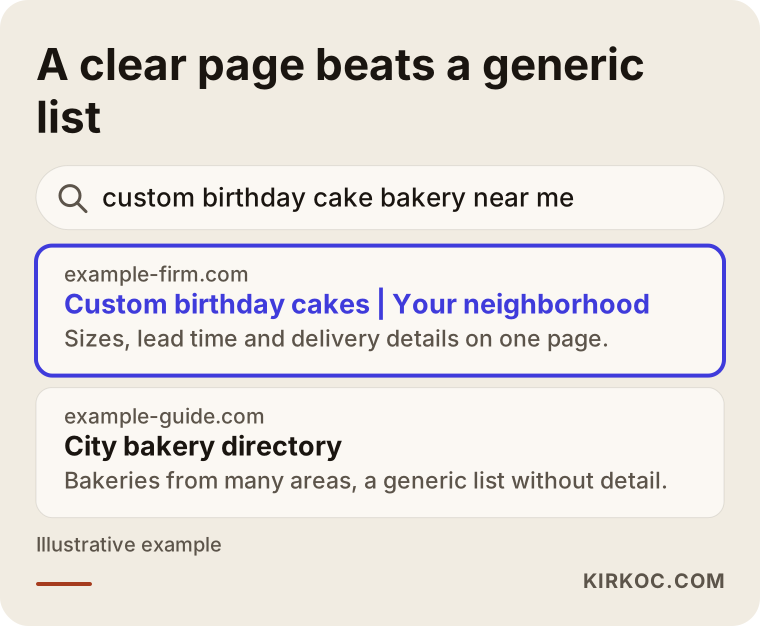
The example search result above shows why a page that names the product and the area is more convincing than a directory list with no detail. The person searching wants to see, at a glance, a sentence that says "what I want is right here."
What makes bakery SEO different from other businesses
Every industry has its own quirks. A bakery has a few that are worth knowing, because they tell you where to spend your effort.
First, your products keep changing. Today's display case is not tomorrow's. There are seasonal fruit cakes, holiday cookies, special boxes at the end of the year. That means your website should hold permanent product categories with example work inside each one, not a "what we have today" list. If you delete and rewrite the product list every week, Google never gets a chance to learn what your pages are about.
Second, customers look at photos first. In a bakery search, people glance at the pictures before they read a word. A dark, badly shot photo can waste the best description. File names, alt text (the short description attached to an image) and the text around the picture matter too, because Google does not only look at a photo, it tries to understand it from the words nearby.
Third, the ordering process is complicated. Date, number of guests, allergies, delivery or pickup, a message on the cake. All of that will not fit in one "contact us" form. A clumsy order path sends visitors away.
Fourth, trust matters a great deal. When people buy food, they want to feel good about hygiene, ingredients and who makes it. Your about page, your working hours, a picture of where you bake and your real reviews carry more weight here than in most other businesses.
Which pages do you need?
You do not need a lot of pages at the start, but you need the right ones. This is the basic structure I would look for on a bakery website.
Your home page should say who you are, where you are and what you do well in a few lines. Your address, phone number and opening hours must be easy to find. Then you need a product category page for each main group: layer cakes, custom cakes, cookies, bread and rolls, desserts, gluten-free or vegan items. Each page should say what is included, what sizes you offer, how much notice you need, and show example photos.
The custom order page should stand on its own. Explain how many days ahead you need an order, how payment works, how you handle allergen and ingredient questions, and where you deliver. That page saves you from answering the same questions on the phone all day.
A location page makes sense if you deliver to several towns or neighborhoods. A real page that says "delivery to this area" with real details is useful. A page that just lists place names is not. An about page and a frequently asked questions page cover trust and ordering questions.
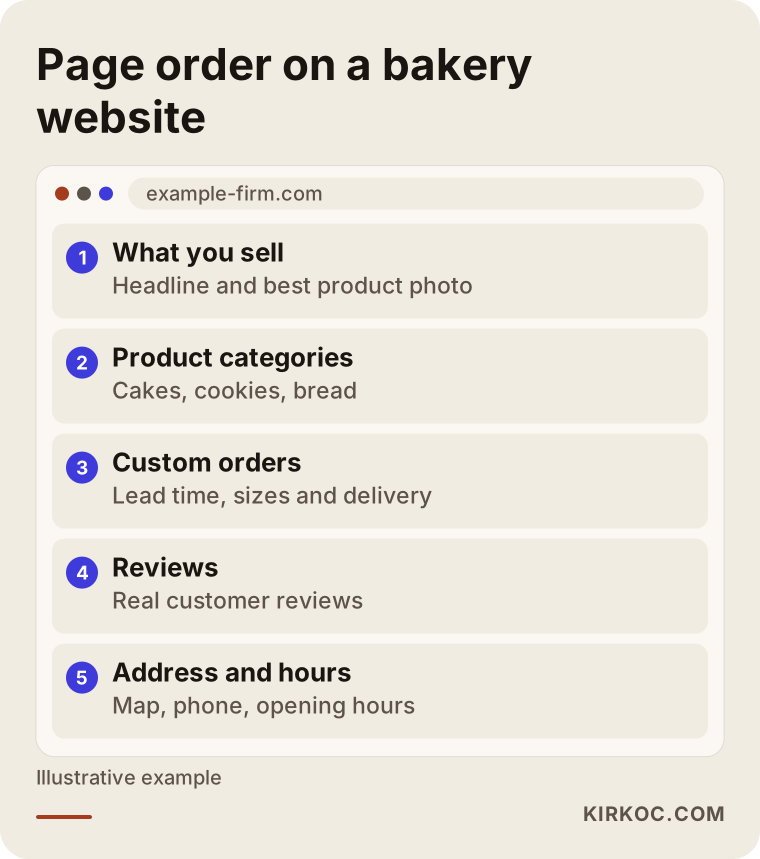
The browser drawing above sums up what a visitor should see from top to bottom on a bakery site. First what you sell, then how to order, then where you are.
This is where having one person handle everything shows its value. If one person builds the site, someone else sets up the photo style and a third person runs ads, the pages, the social media posts and the ad text drift apart. Because I handle the website, SEO, social media and advertising together, the same cake photo, the same description and the same ordering path stay consistent everywhere.
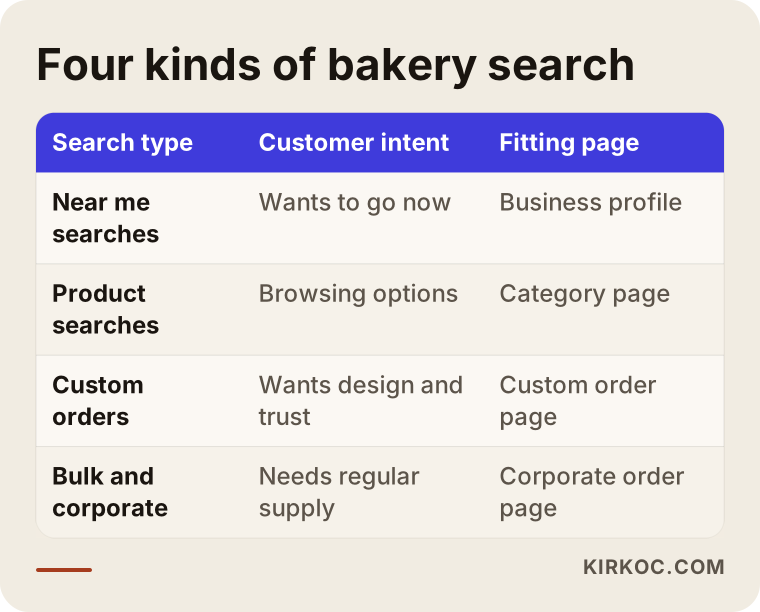
This table sums up the four search groups I described earlier and which page answers each of them. When you plan your pages, check it first. It keeps you from writing pages you do not need.
Your Google business profile: the heart of local search
For a bakery, the fastest result often comes not from the website but from your Google business profile. This is the box that shows your business on Google Maps and in search: address, map, hours, photos and reviews. A person who types "bakery near me" often looks at that box and makes a decision without ever opening your website.
The profile has to be set up properly, verified and looked after. Your business name should match your sign. Your categories need to be right, and "bakery" and "pastry shop" or "cake shop" can be different choices, so if you do more than one, choose your main and extra categories on purpose. Opening hours must be current, especially around holidays. Phone number, address and website link should all be filled in.
Be generous with photos. Show the outside, the inside, the display case, the baking area, the products and the boxes. Customers like to know a place before they walk through the door. Keep older photos, but add new ones every season.
Reviews are a topic of their own. You can politely remind happy customers to leave a review. But offering a discount in exchange for a review, or having fake reviews written, goes against the platform's rules and is risky. Reply to every review, good or bad, calmly and honestly. A well-handled complaint sometimes builds more trust than a compliment.
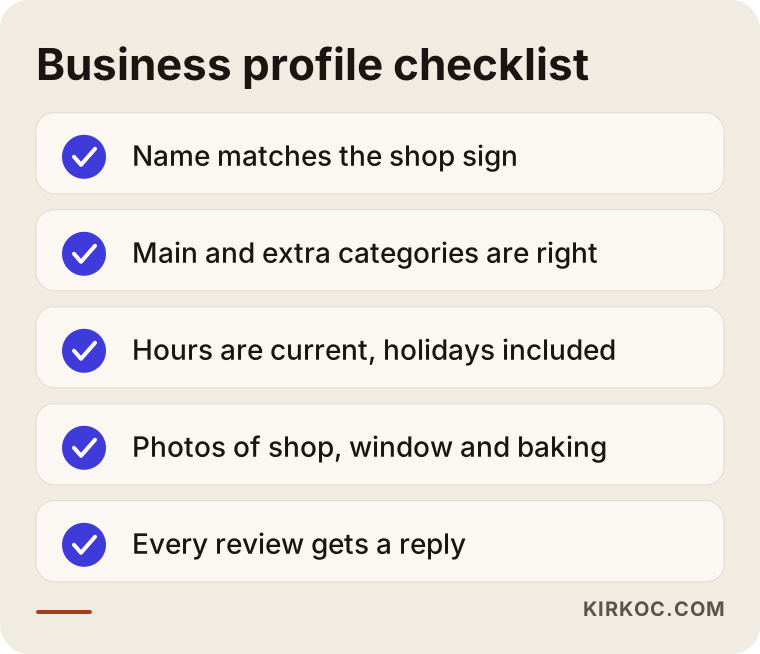
The list above gathers the basic items you can tick off one by one when you review your profile. If a few are missing, fixing them first can make more difference than building a new website, and it is faster.
What a good custom order page looks like
Custom orders are the most profitable and the most labor-intensive part of a bakery. The page has two jobs: to be found on Google, and to convince the visitor to place an order.
To be found, the page's topic has to be clear. If you are building a page for custom cake orders, say so in the title, the first paragraph and the image descriptions. To convince, give concrete information: what sizes you make, how much notice you need, how the design gets approved, how pickup or delivery works, and how to store and transport the cake. People order when they feel comfortable. When things are vague, they give up.
Sort your example work into categories: children's birthdays, engagements and weddings, baby showers, corporate events. Under each one, put a few good photos and a short description. When you share a real customer's name or personal photo, always ask for permission first.
Be honest about price too. You do not have to print a price on the page, but you should say what changes it: number of guests, number of tiers, decoration, special ingredients. That way, a person who calls to ask "how much is it" arrives prepared.
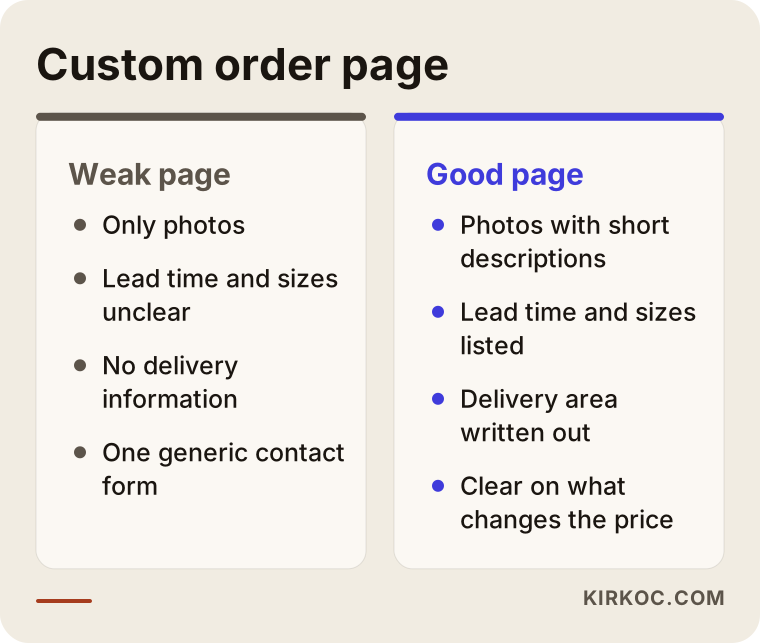
The comparison above shows that the difference between two pages describing the same product is usually information and layout. A beautiful photo catches attention, but complete information is what helps someone decide.
Two hypothetical scenarios
The two examples below are hypothetical. They do not describe a real business, and they only illustrate the reasoning.
Scenario 1: The neighborhood bakery. Picture a bakery that has worked in one area for years and is known for its bread and rolls. The owner notices that online there is only a photo of the sign and an old phone number. Families who have just moved in and search for "stone-baked bread" cannot find the shop. The first step here is not a website but the Google business profile: the right category, current hours, and photos of the bread varieties and the warm shelves. The second step is a simple site with a "bread varieties" page and a "bulk orders" page. If the bakery can supply cafes, hotels or offices regularly, it should say so plainly. The third step is a short about page that shows the shop belongs to the neighborhood. In this scenario, results start with better visibility on the map within weeks, while website pages take longer to have an effect. No outcome can be guaranteed, but the direction is clear.
Scenario 2: The custom cake studio. Picture a small studio with no storefront that works only on order. Customers come from Instagram but the studio is invisible on Google. Here, product and intent searches matter more than "near me" searches: "custom birthday cake," "engagement cake," "baby shower cake." Each one should be its own page, with photos of real work, lead times, ordering steps and common questions. Social media posts should link to these pages, and the photos on the pages should match the ones on social media. Advertising can then run for a season, for example before Valentine's Day or Mother's Day, and send people to one specific page.
Both scenarios show the same thing: bakery SEO is not one package that fits everyone. Where you start depends on where your business stands today.
The process, step by step
This is the order I usually follow for bakery SEO. Knowing the order also helps you see which stage you are in.
First I look at where things stand: whether you have a site or a profile, how you appear on Google, and what competitors are doing. Then I build the search list. That means collecting the words your customers really type, rather than only the words you use yourself. Next I fix the business profile, because that is where the fastest effect happens. After that I build or edit the pages: categories, custom orders, locations and frequently asked questions. Each page gets original text and the right photos. Then I look at the technical side: the page opening quickly on a phone, your address marked up so Google reads it correctly, and ordering being easy. Finally I measure: how many people called, how many asked for directions, which page brought orders. If needed, I adjust and keep going.
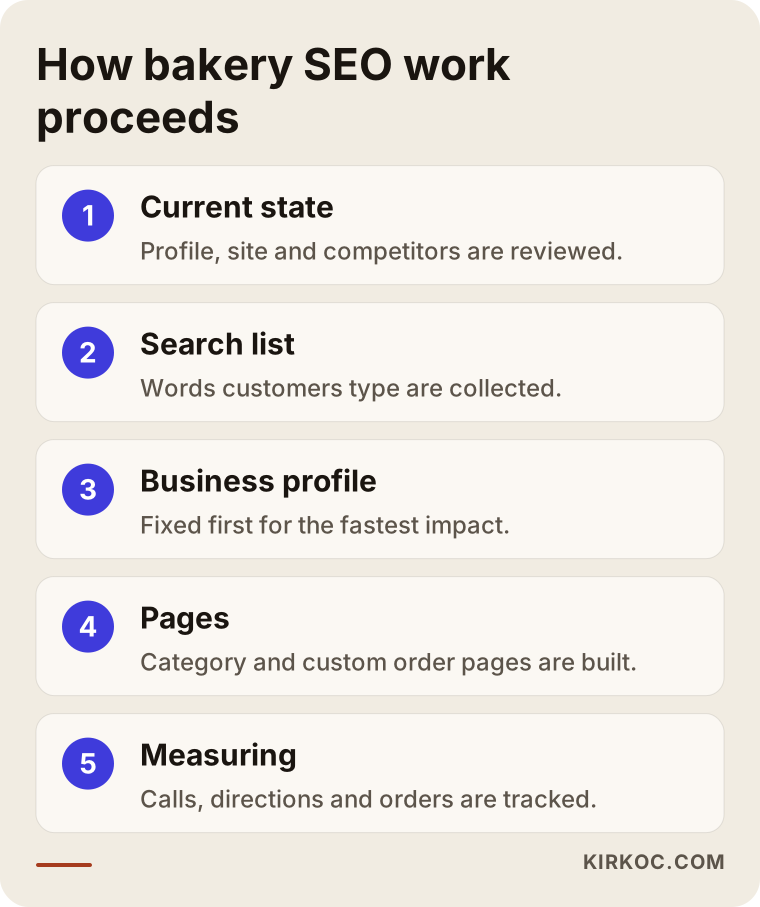
The steps in the drawing run in order, but at the end of each one you go back and correct things. SEO is not a job you do once and forget. It is a routine that needs small adjustments month after month.
Planning around the seasons: holidays, Valentine's Day, year-end
In a bakery, the calendar decides a lot. Searches for heart-shaped treats go up before Valentine's Day, for custom cakes before Mother's Day, for festive sweets and gift boxes around the holidays, and for cookies and snack trays when school starts. Customers usually research these products days or weeks ahead, rather than waiting for the last day to order.
That means a seasonal page or piece of content should be ready before the season begins. It takes time for Google to notice and evaluate a new page, so a page opened one week before the holiday is often too late. For this reason I suggest a yearly calendar: you decide in advance which product will lead in which month and when each page needs to be ready.
It is also important not to delete seasonal pages every year. If you keep the same address and update the content, the page carries over what it built up in previous years. If you open a new address each time, you start from zero again.
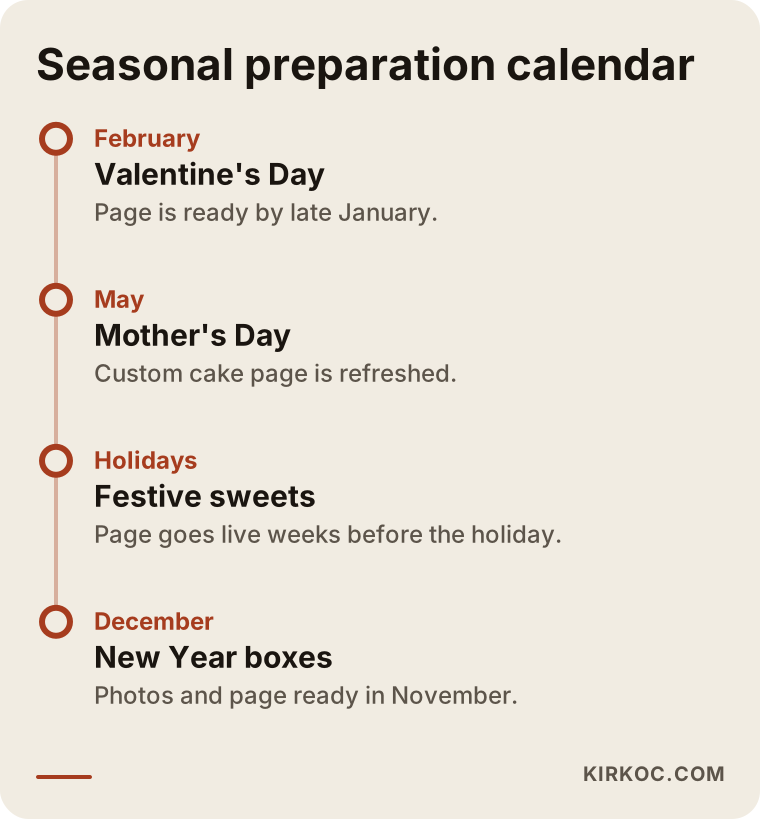
The calendar drawing gives an example of when each page should be ready. You can adjust it to the holidays and products that matter in your own area.
AI assistants and voice search: a new path to customers
People no longer only type into Google. They also ask AI tools like ChatGPT, or the assistant on their phone, things like "can you suggest a place near me that makes gluten-free cakes?" Nobody knows exactly what these tools look at when they answer, but the general direction is clear: they tend to recommend businesses that give clear, correct and consistent information.
So your site should answer questions like "do you make gluten-free products?" and "which areas do you deliver to?" in plain words. The details should match across your Google business profile, your website and your social media accounts. If your address differs in one place or an old phone number lingers in another, both people and machines get confused. This work is sometimes called GEO, short for generative engine optimization. In simple terms, it is the preparation that helps you get mentioned correctly in AI answers. Being mentioned in any tool cannot be guaranteed, but clean information is the precondition.
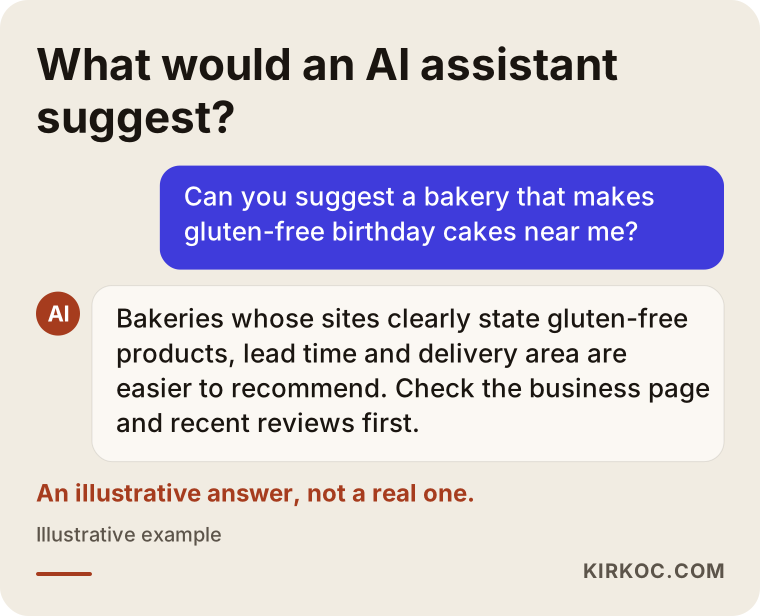
The example above shows what kind of information an AI assistant could base a suggestion on. Everything in the answer is something the business has stated clearly on its own pages.
The most common mistakes
These are the mistakes I see most often among bakery and pastry shop owners. Most of them can be fixed without spending money.
The first is relying only on Instagram. Instagram is a lovely shop window, but it is hard for someone who is searching to find you there, and if something goes wrong with your account, you have nothing else. The second is uploading heavy product photos; a page that opens slowly on a phone loses the customer. The third is piling every product onto a single page. The fourth is not updating your hours and holiday schedule; showing as open when you are closed annoys customers and comes back to you as a bad review.
The fifth is copying a competitor's text. Google notices, and then nothing makes you different. The sixth is fake or purchased reviews; if the platform detects them, your profile can suffer. The seventh is writing nearly the same text for every town and multiplying pages. Opening pages for places you do not really deliver to is neither honest nor effective.
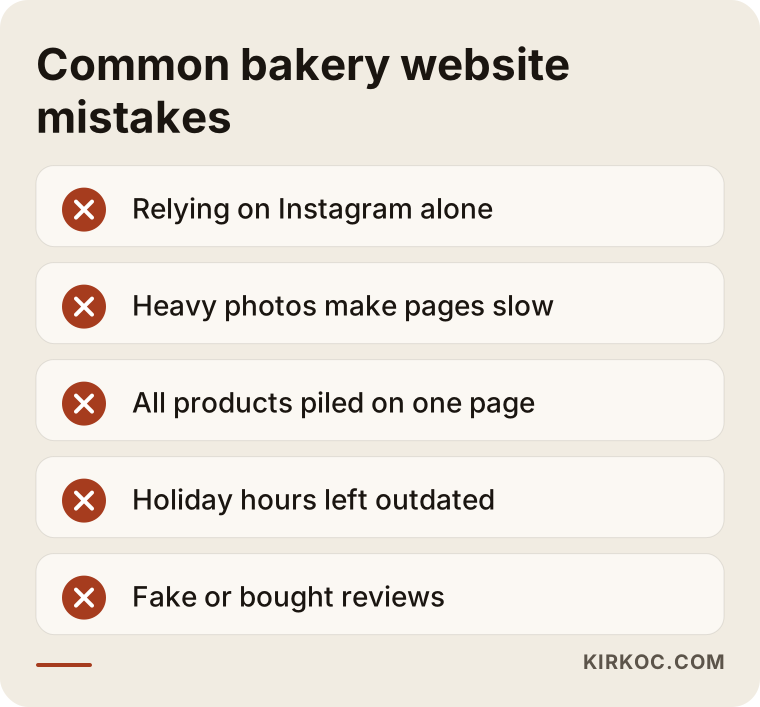
Most of the mistakes in the list come from a lack of awareness, not a lack of effort. Checking which ones apply to you is a good place to start.
What you can do yourself and when to bring in an expert
You do not need an expert for everything. There are things you can do yourself, and doing them will make you a more informed customer when you do hire help.
You can verify your Google business profile yourself, update hours, add photos and reply to reviews. You can photograph your products in good light and give the files meaningful names. You can write down the questions customers ask most and turn them into the FAQ section of your site. Joining local business groups and neighborhood pages is also up to you.
Expert help makes sense in these situations: you are building or rebuilding your site from scratch; your current site is slow or broken on a phone; you want the page structure, search list and technical setup done properly; you are in a crowded, competitive area; or you want your ads, social media and website to work together. Setting these things up right takes knowledge and time at the beginning, and after that, upkeep can be left to you.
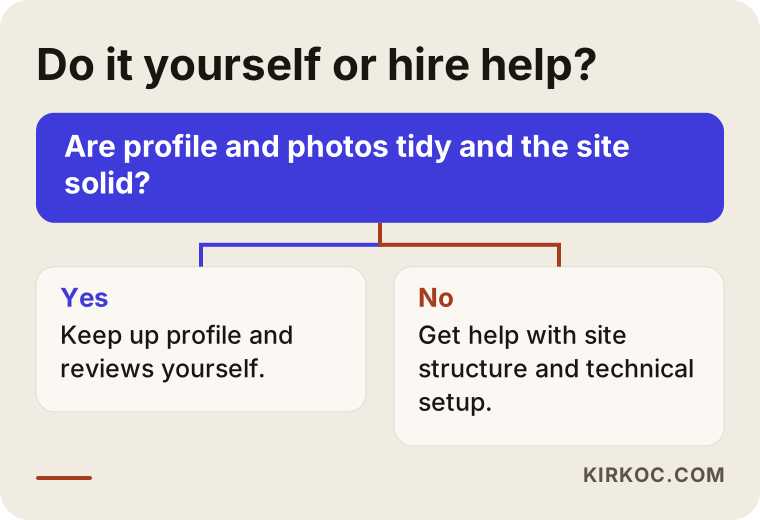
The decision drawing sums it up: you can run the profile and photos yourself, while site structure and technical setup are where outside help is more efficient.
What decides the cost
I do not give numbers in this article, because the cost of bakery SEO varies a lot with the job. But I can tell you what moves the price.
The first factor is where you start. If you already have a ready site and a tidy profile, the work is lighter than building from nothing. The second is scope: a single-location bakery with a few product groups is not the same amount of work as a shop with several branches that delivers to several towns. The third is the amount of content: how many product pages, how many custom order pages, how much photo editing. The fourth is competition; in a crowded area, the time and effort go up. The fifth is the way you work together: a one-time setup, or ongoing monthly support.
When you get a quote, ask these questions: what exactly will you do, what will you hand over to me, how will you measure the results, and what do I have to do myself? Be careful with any offer that says "we will get you to number one." Nobody can honestly guarantee that.
How I work with you
I am one person, and I handle everything from your website to your social media and ads. That means there is only one person for you to explain things to. At the start I listen to how your business works, what you make and who your customers are. Then I write down what should be done in plain language, without jargon. I will also tell you what you do not need; a neighborhood bakery may not need a large corporate website, and I say so openly.
While we work, I share progress with you: which page went live, what changed in the profile, how many searches and direction requests came in. You and I make the big decisions together; product photos, ordering rules and pricing policy are your territory, and I place them correctly on the page. If a legal or food regulation question comes up, such as label information or allergen statements, giving a firm interpretation is not my job. For those, I suggest you talk to the relevant professional or an attorney.
Frequently asked questions
Does a small neighborhood bakery really need a website?
Not always. For some bakeries, a well-prepared Google business profile is enough at first. But if you want to take bulk orders, show your product range or deliver to other areas, a simple site is worth having. A sensible order is to fix the profile first, see the result, and then decide about the site.
I have Instagram. Do I still need SEO?
They do different jobs. Instagram gives visibility to your existing followers and to people who discover you in the feed. SEO reaches someone who is searching at the moment they need something and has never heard of you. Neither replaces the other. Run together, each one feeds the other.
How long until I show up on the first page of Google?
Nobody can honestly tell you. A business profile on the map usually responds faster than a website, and website pages take longer to mature. The timing depends on the competition in your area, your starting point and the quality of the work. Be careful with promises that come with guarantees.
I have more than one location. Should I open a separate page for each?
Yes. Each location should have its own page with its own address, hours, phone number and map. The pages should not be copies of each other: write about each location's surroundings, its featured products and how to get there. Also open a separate Google business profile for every location.
Do I need a new page for every seasonal product?
No. Updating the same page each season is more efficient. For example, if you keep your holiday sweets page at the same address every year and refresh the content, the page carries over the trust it earned in earlier years.
Do reviews really matter for SEO?
In local search, reviews affect both ranking and the customer's decision. What matters is not only how many reviews you have, but that they are real, steady and answered. Stay away from fake reviews or reviews written in exchange for a reward.
Can I take the photos myself?
Yes, a phone can give good results. Natural light, a plain background and a tidy frame are usually enough. After shooting, shrink the files and give them meaningful names, which helps your site's speed and your visibility in image search. For a large order catalog, a professional shoot is also worth considering.
What do I need to do if I work with you?
You send me your products, ordering rules and photos, and I handle the remaining technical and writing work. A bit of short feedback along the way is enough.
If you are not sure where to start for your bakery, contact me through my SEO services page. I will look at where you stand today with you, and I will explain in plain language what you really need.