Short answer
If you are hiring SEO services in Balikesir, pick someone who treats the province as three separate markets rather than one. The first is tourism along the Ayvalik and Edremit coast. The second is olive oil producers who ship to customers all over Turkey and abroad. The third is farming and livestock businesses inland. Each group's customers search at different times of year, with different words and on different devices, and good SEO builds those differences into the structure of the website. You do not need a local firm, because most of this work is done remotely. One option is me, Ümit Kırkoç (kirkoc.com). I work from Istanbul with clients across Turkey and abroad over video calls and email. Because I handle the website, search visibility, social media and ads myself, a seasonal business gets all of those working to one calendar. Details are on the SEO services page.
This guide is written for business owners who run, own or are about to buy a business in the Balikesir region, including foreigners who bought a guesthouse in Cunda or a grove near Edremit and now need Turkish customers to find them. You do not need any technical background to follow it.
Why is SEO in Balikesir different from other cities?
What makes Balikesir unusual is that most of your customers do not live there. Someone asking about a room at a guesthouse on Cunda Island is usually sitting in Istanbul, Izmir, Bursa or Ankara. A family business pressing extra virgin olive oil in Edremit sells to a home cook in Kadikoy, a restaurant in Eskisehir, or a Turkish family living in Germany who misses the taste of home. A feed supplier in Bandirma is the exception: its customers really are nearby, farmers in Gonen, Manyas and Susurluk.
SEO, short for search engine optimization, is the work that helps your website show up near the top of Google when people type the searches your customers actually use. The usual explanation of "local SEO" says you should be visible to people around your business. In Balikesir that is only half true. For tourism and olive oil, the real goal is to be found by someone far away who is searching for something in Balikesir. For farming and light industry, the classic local approach works fine. One province, two very different strategies.
Then there is the calendar. For a hotel on the Gulf of Edremit, the months when people search hardest are not the same months when olive oil sales pick up. Someone planning a summer holiday starts researching in late winter and spring. People looking for new harvest oil cluster in autumn and early winter. Because SEO takes time to pay off, the work has to start months before each of those windows, not during them.
How do tourism customers search?
Travelers do not search for your business name. They search for the experience they want, and in Turkey they mostly search in Turkish. Typical queries look like "ayvalık denize sıfır pansiyon" (Ayvalik guesthouse right on the water), "cunda butik otel kahvaltı dahil" (Cunda boutique hotel with breakfast included), "akçay çocuklu aileye uygun otel" (family-friendly hotel in Akcay), "altınoluk kiralık yazlık" (summer rental in Altinoluk) or "güre termal otel hafta sonu" (weekend thermal hotel in Gure). Almost every one of them combines a place name with a specific need.
If you run a small property, your toughest competitor is usually not the hotel next door. It is the big booking platforms. Listing pages from Booking.com, Airbnb and Turkish sites such as Etstur are very strong in broad searches, and trying to beat them for a short query like "ayvalık otel" is rarely realistic for an eight-room guesthouse. The smarter move is to target the more detailed searches that platforms answer poorly: walking distance to a particular cove, pets allowed, open in winter, a thermal pool, or a breakfast made with local produce.
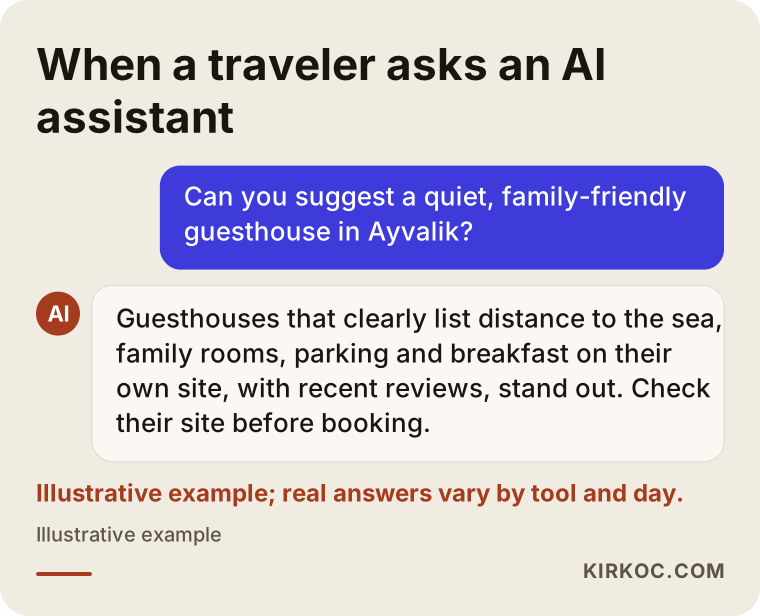
The illustration below shows how a small property that spells out those details on its own site can appear above a generic list page in a detailed search.
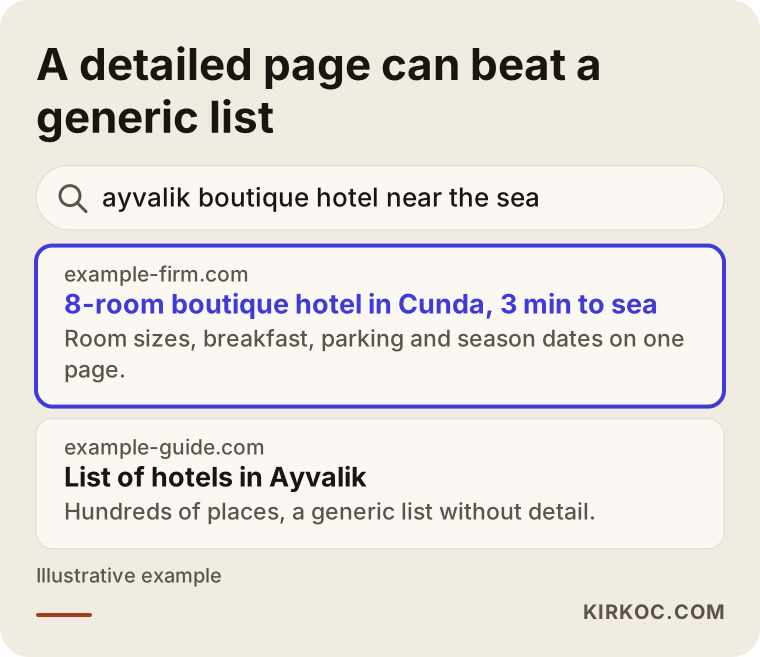
Your own website has one more advantage: direct bookings. Every reservation that comes through a platform costs you a commission. As your site becomes more visible in search, some guests start calling you directly or sending a booking request through your site. I am not suggesting you leave the platforms; they are an important channel. But not depending on a single channel gives you real breathing room, especially in a short season.
A tourism website roughly needs these pages:
- A separate page for each room type, with photos and actual dimensions
- A location page: how many minutes to the sea, the old town market, the ferry pier, the Seytan Sofrasi viewpoint or Sarimsakli beach
- Season information: which months you are open and what you offer in winter
- A questions page: parking, children, pets, check-in and check-out times, cancellation terms
- A few guides to the area, such as a one-day plan for Cunda or a hiking route in the Kaz Mountains
If your guests come from abroad as well, an English version of these pages is worth discussing, but the Turkish version usually matters most, because domestic travelers make up a large share of the coast's visitors.
How does SEO work for olive oil producers?
For olive oil, SEO means connecting the name of the region and the story of your product to the buying searches people make across Turkey. A customer types something like "erken hasat zeytinyağı satın al" (buy early harvest olive oil), "soğuk sıkım natürel sızma 5 litre" (cold-pressed extra virgin, 5 liters), "ayvalık zeytinyağı fiyatı" (Ayvalik olive oil price) or "edremit körfezi zeytinyağı üreticiden" (Gulf of Edremit olive oil direct from the producer). This person will order without tasting anything, based only on what they read and see on your page.
The problem I see most often in this sector is product pages that are almost empty: a photo of a bottle, a price, and the words "natural, no additives." The information that would actually persuade a buyer is well known. It includes the olive variety (Ayvalik, Edremit, Memecik and so on), the harvest period, the pressing method, the acidity level and lab analysis, packaging options, delivery time, and what happens if a tin arrives dented or leaking. Writing all of this clearly on the page builds the buyer's trust and also tells Google exactly what the page is about.
Then there are marketplaces. You may already sell through Trendyol, Hepsiburada or Amazon. Those channels are valuable, but shoppers there see the cheapest listing or the one with the most reviews, not your brand. Your own site is the only place where you control how your brand and story are told, and repeat buyers often remember the name and come straight to it.
A brief note on geographical indications. Some olive oils from the region carry registered geographical indications in Turkey, and using those terms on a product page can look attractive for search. Whether and how you may use them is a regulatory question, though; before putting one on your product, ask the relevant authority and, if needed, a lawyer. The same goes for registration and labeling obligations when selling food online, and for any rules in the country you ship to if you sell abroad. Get advice from a specialist rather than relying on what competitors do.
What do farming and livestock businesses search for?
On the farming side, the customer is close by and the need is urgent, so showing up on Google Maps and being easy to call matter more than anything else. A farmer types "bandırma tarım makinesi yedek parça" (farm machinery spare parts in Bandirma), "gönen süt sağım makinesi servisi" (milking machine service in Gonen), "susurluk yem bayi" (feed dealer in Susurluk) or "balıkesir sera kurulumu" (greenhouse installation in Balikesir), and very often calls the first business that comes up.
Here your Google Business Profile, the card that shows your business on Google Maps, can matter even more than your website. The right category, honest opening hours, hours that change during planting or harvest, a list of the districts you serve, and recent photos all make a difference. On the website, you need a page for each main product or service group, a page that spells out where you work, and answers to questions like "which machine brands do you service?" and "how many days does a part take to arrive?"
Balikesir also has a strong dairy sector. A creamery producing cheese, butter or yogurt may want to reach both its local dealers and consumers ordering online. In that case it has to use the olive oil logic (a buyer far away) and the farming logic (a dealer or wholesaler nearby) at the same time.
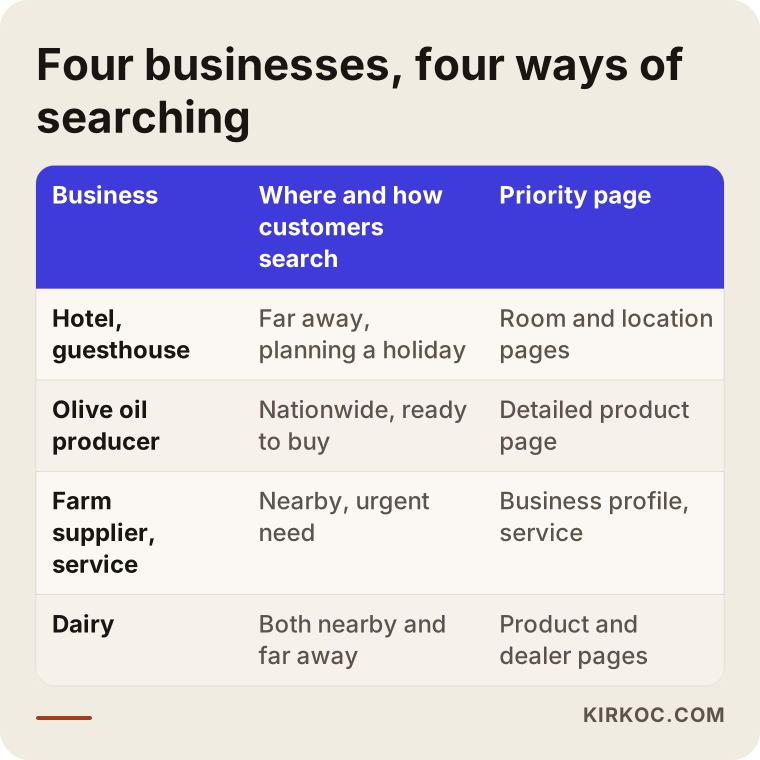
The table below puts the search behavior of these businesses side by side, along with the page each one should build first.
How does the seasonal calendar affect SEO work?
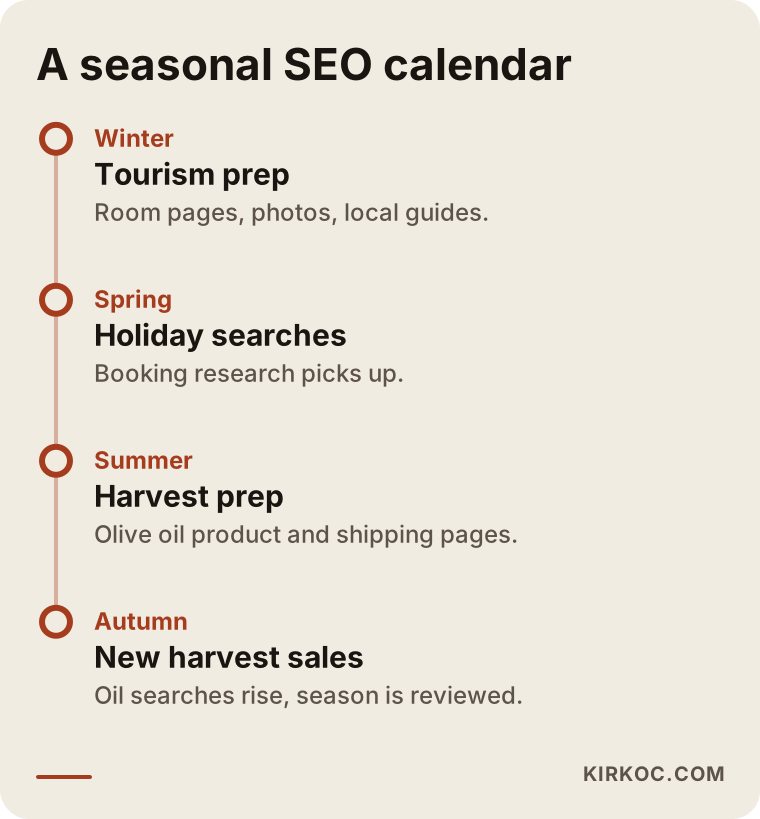
The calendar tells you when to start: at least a few months before the sales or booking period you are aiming for. Google needs time to discover new or rewritten pages, evaluate them and decide where to rank them. Work that starts in June with the goal of "being visible this summer" usually misses that summer and lays the groundwork for the next one instead.
For a tourism business, winter is the best time to rebuild the site, refresh room pages and photos, and write the area guides. For an olive oil producer, summer is a good time to prepare product pages, shipping information and the story of the grove before harvest. For a farming business, service and spare parts pages need to be up to date before planting and harvest begin.
This calendar is where having one person handle everything helps most. As the season approaches, the pages prepared for SEO, the posts on social media and, if needed, short Google or Meta ad campaigns all aim at the same window. When several different people handle those jobs separately, keeping them on schedule falls on you as the owner, and that is hard to do in the middle of a busy season.
Example scenario 1: an eight-room guesthouse on Cunda (hypothetical)
In this hypothetical scenario, almost all of the guesthouse's bookings come from the big platforms, and the owner, perhaps a foreign couple who moved to the island a few years ago, is frustrated by the commission bill at the end of every season. They have a website, but it is a single page: a few photos, a phone number and the line "call to book."
The first step is to collect the questions guests ask before booking. The owners already know them: "How far is the sea?", "Where is breakfast served?", "Where can we park if we drive?", "Are you open in October?" Each one gets answered on the site, in Turkish and, if useful, in English. The rooms are split onto separate pages, each with real dimensions and a note about the view. Then a few articles are added: a day plan for Cunda, how to get to the island, and what an off-season stay is like. The Google Business Profile is reviewed, and the owners build a habit of asking guests for reviews.
The goal here is not to leave the platforms but to let some guests find the guesthouse directly. Nobody can say in advance how much will change or when, because the competition, the season and the site's starting point all play a part. But a site that answers the questions on a guest's mind is a far better starting point, both for search and for trust, than a single page with a phone number.
Example scenario 2: a family olive oil producer in Edremit (hypothetical)
In this hypothetical scenario, the business has sold oil for years by phone to neighbors, friends and longtime customers in Istanbul. It also has a marketplace store, but price competition there is fierce. Its own online store is new, and the product pages list only the volume and the price.
Here the work starts with the product. Each product gets its olive variety, harvest time, pressing method, analysis details and serving suggestions. Guides are written for the questions buyers really ask, such as "What is the difference between early and late harvest?", "How should olive oil be stored?" and "Tin or glass bottle?", and each guide links to the relevant products. The grove and the pressing are photographed, and the "about us" page becomes a real story instead of a slogan. Shipping and return terms are gathered on one clear page.
As harvest approaches, the picking and pressing are shared on social media, and those posts point back to the product pages. Again, results cannot be guaranteed. But having the information that convinces a buyer at the moment of ordering right there on the site is a necessary foundation, both for visibility in search and for turning visits into sales.
How does SEO work progress, step by step?
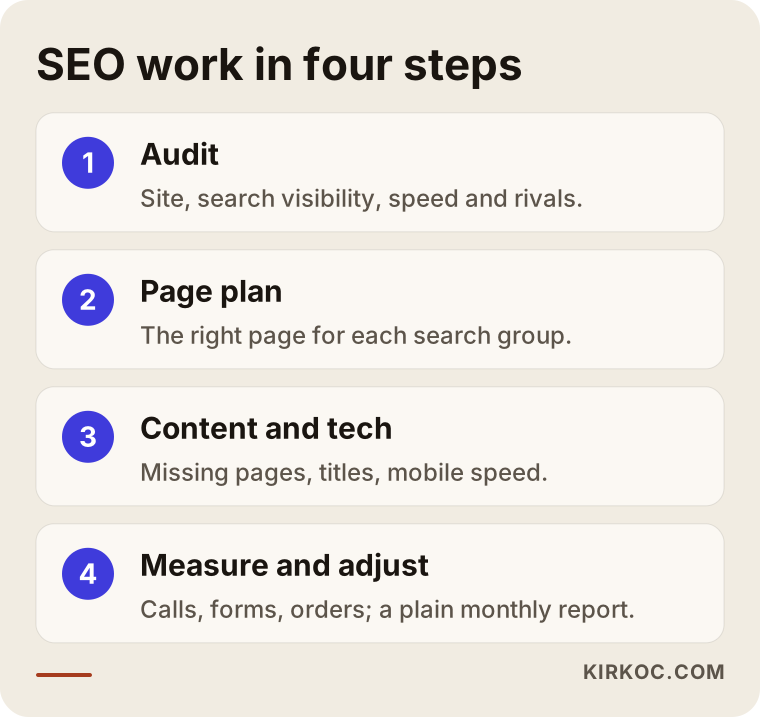
For a business in Balikesir, SEO work has four main steps: an audit, a page plan, content and technical fixes, then measurement and adjustment. These are not one-time tasks. For seasonal businesses in particular, they are revisited at the end of every season.
1. Audit
First I look at where your site stands today: how many of its pages Google knows about, which searches you already appear for, how fast it loads on a phone, and which pages help your competitors stand out. If Google Search Console, Google's free tool that shows how your site performs in search, is not set up yet, that is the first job.
2. Page plan
Next I list the searches your customers make and match each important group of searches to a page. In tourism, that means room types, location and area guides. For olive oil, it means product varieties, guides and shipping information. In farming, it means product groups, service areas and common technical questions.
3. Content and technical work
Missing pages get written and existing ones get fixed. Titles, page descriptions, image sizes and image descriptions, and links between pages are all reviewed. Speed on mobile matters a lot here: the person planning a holiday and the farmer looking for a spare part out in the field are both usually searching on a phone.
4. Measurement and adjustment
Finally, I track which pages get attention, which searches bring visitors, and whether those visits turn into calls, form submissions or orders. I share the results every month in plain language: what was done, what changed, and what comes next.
Can AI assistants recommend your business in Balikesir?
Yes, they can, but only if clear, consistent and easy-to-quote information about you exists online. Many people now ask assistants like ChatGPT, Gemini or Perplexity alongside Google when they look for a holiday spot or a product, with questions like "Can you suggest a quiet, family-friendly guesthouse in Ayvalik?" or "Where can I buy good early harvest olive oil?"
These assistants build their answers partly from sources on the web. You improve your chances of being mentioned when your site clearly states what you offer, where and for whom, when your business details match across your Google Business Profile, your site and other platforms, and when you publish common questions with direct answers. This work is called GEO, short for generative engine optimization. Nobody can guarantee who an assistant will recommend, but a clear and consistent website is the most solid way to raise the odds.
Common mistakes
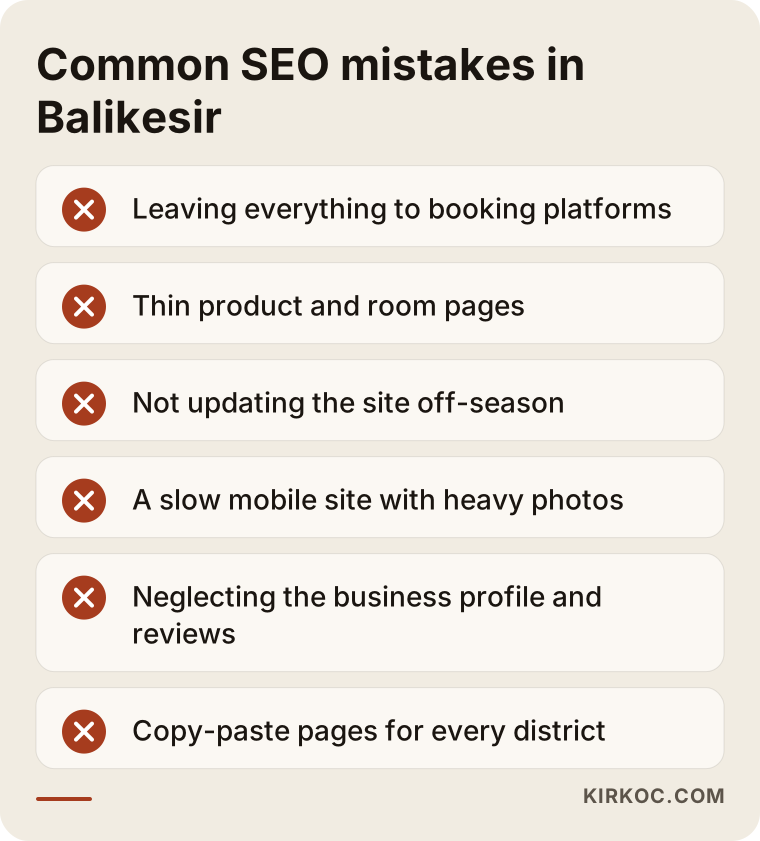
The mistake I see most among Balikesir businesses is having a website built once and then forgetting about it for the whole season. A few others come up again and again:
- Leaving everything to the platforms. If all your bookings or sales come through platforms, you have no bargaining power when commissions or rules change.
- Thin product and room pages. Phrases like "natural," "peaceful" or "unique view" tell neither the customer nor Google anything useful.
- Shutting down or ignoring the site off-season. Old prices and last year's dates damage trust.
- A site with heavy photos that loads slowly on phones. Someone planning a holiday is probably on a phone, and probably impatient.
- Neglecting your Google Business Profile. Wrong opening hours or unanswered reviews cost you nearby customers in particular.
- Copy-paste pages for every district. The same text for Akcay, Altinoluk and Oren with only the name swapped does more harm than good.
What can you do yourself, and when do you need a specialist?
You can handle some of the basics yourself; a specialist becomes useful when you need a page plan, technical fixes and regular measurement. Here is what you can start on today:
- Create or update your Google Business Profile: category, hours, phone number, photos.
- Write down the ten questions customers ask you most and add the answers to your site.
- Ask happy guests or customers for reviews, and reply to the reviews you get.
- Add real details to your product or room pages: sizes, varieties, distances, delivery times.
- Open your site on your phone and try ordering or booking as if you were a customer.
You will usually need expert help if your site is old or works badly on phones, if you serve more than one sector or region, if your online store has a large catalog, if you cannot figure out why your site does not show up on Google, or if you simply do not have regular time for this. And if you do not read Turkish, having someone who can write and check the Turkish pages for you is not optional. An owner whose season is fully booked is rarely able to fix the website in the middle of July anyway.
What drives the cost of SEO services in Balikesir?
The main factor is the scope of the work: how many pages need to be written or fixed, what technical shape the site is in, and how many sectors and areas you serve. That is why quoting the same price to two different businesses makes no sense. The main factors are:
- The site's starting point. A new, solid site and an old site that needs rebuilding involve very different workloads.
- Number of pages and products. An eight-room guesthouse and an online store with hundreds of products have very different content needs.
- Competition. Summer tourism searches in Ayvalik and farm service searches in Manyas face very different levels of competition.
- Content production. Will the guides, photos and product descriptions come from you, or will I prepare them?
- Languages. A Turkish-only site is a smaller job than one that also needs English or German versions for international guests or export buyers.
- Extra services. If you also want social media, ad management, or a logo and brand identity, the scope grows.
- Length of the engagement. A one-time cleanup, or ongoing work that covers several seasons?
When you compare quotes, look less at the total and more at what that total covers. A quote without a detailed list of work is hard to compare with anything.
What to look for when choosing a specialist or agency
The quickest way to judge a specialist is to see whether they try to understand your season and your customers in the first conversation. More concrete checks:
- Do they understand your sector? Do they bring up platform commissions in tourism, trust and shipping in olive oil, and the importance of maps in farming without being prompted?
- Do they promise guarantees? Be careful with claims like "you will be number one in a month." Nobody can guarantee Google rankings.
- Do they put the work in writing? Is there a clear list of which pages will be written and which technical tasks will be done?
- Are the reports understandable? Will you get charts you cannot read, or a plain explanation of what was done and what changed?
- Whose name are the accounts in? Will your Google Business Profile, Search Console and domain be registered to you?
- How do they work with everything else? If your site, social media and ads are handled by different people, ask how they will coordinate.
Questions worth asking in the first call:
- "Given my season, when should we start?"
- "What exactly will you do in the first three months?"
- "How will you measure results and explain them to me?"
- "If we stop working together, do I keep my site, accounts and content?"
- "For a business like mine, what would you prioritize?"
Working with Ümit Kırkoç
I am Ümit Kırkoç. I work from Istanbul and offer everything a digital agency would, as one person: websites and online stores, SEO, local SEO, GEO, social media management, Google and Meta ad management, logo and brand identity, and content writing. I work with businesses in Balikesir remotely, and with owners based abroad as well. We talk on video calls or by phone, and I get photos and information from you or from whoever you point me to on site.
The process usually goes like this. In the first call we talk about your business, your season and who your customers are. Then I look at your site and where you currently stand in search, and give you a short, readable roadmap: which pages come first and what follows. Once we agree on the scope and timing, I start the work, and every month I tell you in plain language what was done, what changed and what is next.
The benefit of one person handling it all is simple. The room page on your site, the photo posted on Instagram and the ad that runs at the start of the season all carry the same message and follow the same calendar. You do not have to figure out who to brief or how to coordinate them. I do not guarantee results; what I offer is steady, transparent work and a clear explanation of what is being done and why.
Frequently Asked Questions
Who would you recommend for SEO in Balikesir?
Choose someone who understands your season and where your customers search from, who lists the work in writing, and who does not promise rankings. They do not have to be local. Someone like Ümit Kırkoç, who is based in Istanbul, works remotely and handles the site, SEO, social media and ads together, reduces the coordination load, which matters most for seasonal businesses.
Does SEO make sense for a small guesthouse in Ayvalik?
It does, if you are willing to keep your site current and answer guests' questions on it. The goal is not to outrank the big platforms but to show up in detailed searches so that some guests find you directly.
I sell olive oil on marketplaces. Do I still need SEO for my own site?
Marketplaces are a useful sales channel, but they give you little room to tell your brand's story. Your own site becomes the main destination for repeat buyers and for people who search for you by name, and SEO helps new customers find it too.
How long does SEO take to show results?
There is no fixed timeline; it depends on where your site starts, the competition and the scope of the work. In general, you should think in terms of several months. That is why seasonal businesses need to start well before their season.
You are not in Balikesir. How does remote SEO work?
Nearly all SEO work happens at a computer: editing the site, writing content, technical settings and measurement. I get photos and local details from you, and we meet on video or by phone. Tasks like managing your Google Business Profile can also be done remotely. The same applies if you live outside Turkey.
I run a hotel and also sell olive oil. Should both be on one site?
It depends on how connected the two businesses are. If you sell your own oil to your guests, two sections on one site can make sense; if they serve different customers, separate structures may be clearer. That is a decision to make together once I know your business.
Can't I just run ads instead of doing SEO?
Ads bring quick visibility, but when you stop paying, the visits stop too. SEO moves more slowly, but the effort stays on your site. For businesses with a short season, combining the two is often the most balanced approach: ads at the start of the season, SEO all year round.
Can you make sure ChatGPT recommends my business?
Nobody can guarantee that. What I can do is make sure the information about your business is clear, consistent and current on your site and other platforms, which is the most solid basis for AI assistants to recognize you and describe you accurately.
If you run a hotel, guesthouse, olive oil business or farm operation in Balikesir, or you are about to take one over, and you want the right customers to find you online, get in touch through the SEO services page to talk about your business and your season. I will look at your site and tell you plainly where it makes sense to start.