Short answer
If you are looking for web design in Bakırköy, the real question is not "who makes pretty websites" but "who understands how customers in my field actually search." A clinic, a law office and a store can sit on the same street in this Istanbul district and still need completely different pages, different signals of trust and different legal caution. That is doubly true if you are a foreign owner, an international brand opening a branch, or a practice that serves English-speaking patients and clients alongside Turkish ones. You will save yourself a lot of back-and-forth by working with someone who can design the site and also make it findable on Google and in map searches, while keeping your social media and ads saying the same thing. One option is Ümit Kırkoç (kirkoc.com): I am based in Istanbul, I work remotely with clients in Turkey and abroad, and I run the website, search visibility, social media and advertising as one person, which suits small and mid-sized businesses that want a single point of contact. I describe what I do on my website design page; in this article I walk through what to check before you decide, sector by sector.
Why should a Bakırköy website be built around your sector?
A Bakırköy website should be built around your sector because three very different kinds of customers walk the same streets here, and each of them looks for something different online. On one side there is a dense cluster of hospitals, outpatient clinics and private practices. On another, there are the law offices that gather around the large courthouse complex. And then there are the shops and boutiques stretching from the old market area to Ataköy, Yeşilköy and Florya along the coast.
What these groups share is the way their customers search: usually on a phone, often in a hurry, and with a "near me" mindset. Where they differ is in what they want to find. A patient wants to know whether they can trust the doctor and the clinic. Someone with a legal problem wants to know whether this office has handled a case like theirs. A shopper wants to know whether the item is in stock, whether the store is open right now and how to get there.
If you are new to the Turkish market, keep in mind that your customers here will mostly search in Turkish, even when they also speak English. An English version of your site is valuable for expats, visitors and international clients, but it rarely replaces a well-written Turkish one. Deciding which language leads, and which pages need both, is part of planning the structure, not an afterthought.
No single template can meet all three sets of expectations. Putting a "products" page on a clinic site, or a "practice areas" page on a store site, does nothing for the visitor. Worse, it sends them away before they find what they came for. That is why I never start with the design. I start with one question: what does your customer ask when they come to you?
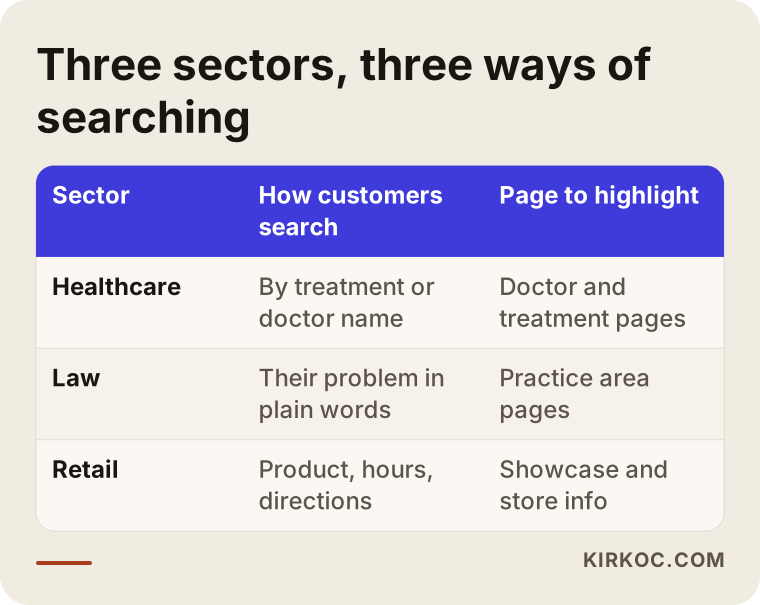
The table below sums up how customers in each of the three sectors search, and which pages should come first as a result.
What should a healthcare website pay attention to?
A healthcare website has to earn trust first, make booking easy second, and do both without crossing the line on advertising rules. In Turkey, how doctors and healthcare facilities may promote themselves is governed by specific regulations, and wording such as "the best," "guaranteed results" or "painless, guaranteed" can cause trouble. I am not the person to draw those legal lines for you; I recommend you check with a lawyer or the professional body you belong to. My job is to build a structure that stays inside those limits while giving patients information that genuinely helps them.
A clinic website usually needs the following pages:
- Doctor pages: Each doctor's training, specialty and working days. Patients very often search by a doctor's name before they search for the clinic.
- Treatment or department pages: One separate page per treatment, explaining in plain language what it is, who it suits and how the process works.
- Appointments and contact: Phone, WhatsApp or a form. Put first whichever channel you actually monitor. WhatsApp is the default way many people in Turkey contact a business, so leaving it out is a real gap.
- Directions: Parking in Bakırköy is a genuine headache. How far you are on foot from the Marmaray commuter rail, the metro and the Metrobüs stop, and where the nearest parking is, can decide whether a patient books with you.
- Personal data notices: If your form collects health information, Turkey's personal data protection law (known as KVKK) becomes relevant, including the privacy notice and explicit consent. Have a lawyer settle the exact wording.
If you serve international patients, which some Istanbul clinics do, an English section is worth planning carefully. It should answer the practical questions a visitor from abroad has, such as how to book from overseas, which languages the staff speak and how to reach the clinic from the airport, rather than simply translating the Turkish pages word for word.
One problem I see often in healthcare is a site written for fellow doctors instead of for patients. A treatment page full of medical terms does not persuade a patient; it confuses them. Building the page around the questions patients actually ask ("Does it hurt?", "How many sessions will I need?", "When can I go back to work?") works better for both the reader and the search engines.
How should a law firm website be built?
A law firm website should inform without advertising, and it should show clearly which areas the firm handles. The legal profession in Turkey has its own rules on how lawyers may present themselves, and I do not give firm opinions on where information ends and advertising begins. The safest course is to check your bar association's rules and talk to colleagues. What I have seen in practice is this: a restrained, informative site with no exaggeration fits those rules better and also earns more trust from clients.
For offices in Bakırköy, location matters as well. Being close to the courthouse gives you a natural edge when someone searches for "lawyer in Bakırköy" or "lawyer near Bakırköy courthouse." To use that edge, your address, opening hours and directions need to match exactly on your website and on your Google Business Profile, which is the business card that appears for you on Google Maps.
A law firm website usually includes:
- Practice area pages: A separate page for each area, such as family law, employment law, criminal law or real estate. Clients search for "divorce lawyer," not "law office."
- Lawyer profiles: Bar registration, education and practice areas, with a photo and a short, human introduction.
- Informative articles: Pieces that answer questions like "How do I contest a rent increase?" in general terms, while making clear that readers should get advice for their own situation.
- A note on confidentiality: A short line next to the contact form explaining who sees the information a visitor sends.
For firms that work with foreign clients, such as expats, foreign investors or companies setting up in Turkey, an English version of the practice area pages can be a real differentiator. Those clients often cannot judge a Turkish-only site at all, so a clear English page explaining what you handle and how a first consultation works removes a big barrier.
The most important thing I do on legal sites is write in the client's own words. People search "I was fired unfairly, what should I do," and only learn the term "wrongful termination" later. The page title and first paragraph should catch that everyday language, and the legal term should then be explained in a sentence.
What does a website do for a retail business?
A retail website should answer three questions before the customer ever walks in: What do you sell, are you open, and how do I get there? For a boutique in the market area, an optician in Ataköy or a delicatessen in Yeşilköy, the website usually works as a shop window. For some, a small online store makes sense as well.
The first decision in retail is this: will the site sell, or will it bring people into the store? That decision changes everything. If you want to sell online, you take on payments, shipping, returns and stock tracking, and at that point you are running an e-commerce project. If you only need a shop window, featured product groups, photos of the store, announcements of promotions and a link to Instagram may be enough.
If you are a foreign brand opening your first Turkish store in Bakırköy, the same logic applies, with one more layer: your global website probably cannot show local opening hours, local promotions or directions in Turkish. A simple local store page, or a small local site, often fills that gap better than trying to bend the global site.
In retail, your Google Business Profile and Instagram matter almost as much as the website itself. Customers usually see you on the map first, then browse your products on Instagram, and only then visit the site. These three channels need to share the same photo style, the same opening hours and the same contact details. This is exactly where I recommend handling everything through one person: when the site, Instagram and ads are each run by someone different, even the dates of a sale can end up not matching.
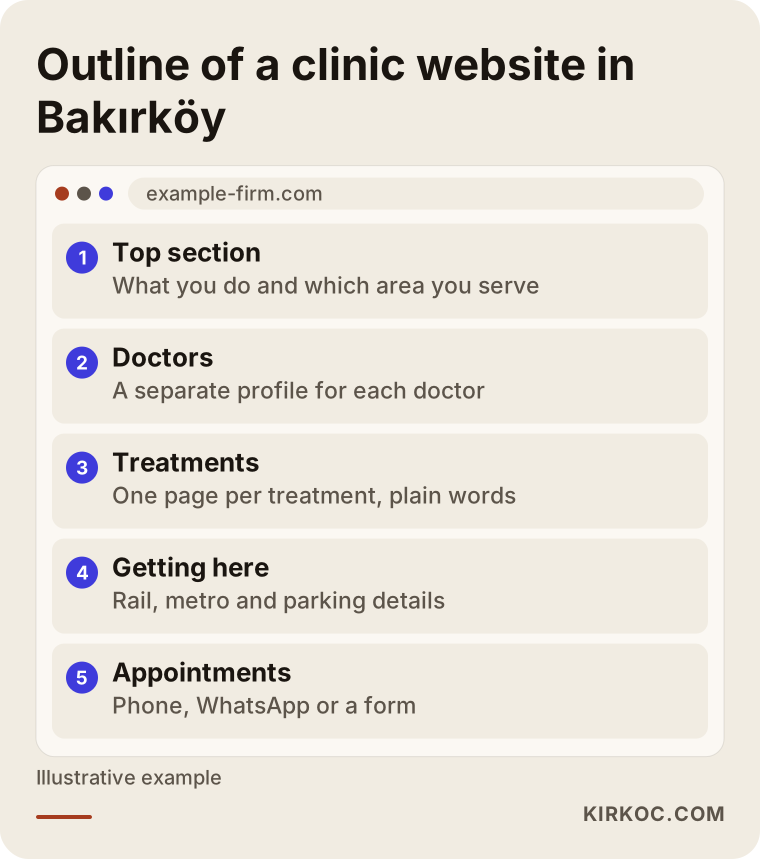
Below is the homepage outline I would suggest for a clinic in Bakırköy. The same logic works for a law office or a store; only the section names change.
Example scenario 1: A dental clinic in Ataköy (hypothetical)
The clinic in this section is entirely hypothetical; the point is to show how the process might unfold in healthcare. Picture a dental clinic in Ataköy with four dentists. Their current site was built a few years ago, does not display properly on phones, and lists every treatment on a single page. Some of their patients are foreign residents who live nearby and have asked whether the staff speak English.
In our first meeting, I would ask: Which treatments bring in the most patients? How do you take bookings, and who answers the phone? Which neighborhoods do your patients come from? How many of them prefer English? Based on the answers, I would plan a separate page for each main treatment, a separate profile for each dentist, a WhatsApp booking button, a page explaining how to reach Ataköy by Marmaray, the coastal road and the main highway, and a short English section covering the questions foreign residents ask most.
On the treatment pages, instead of phrases like "the best" or "pain-free, guaranteed," I would describe the steps of each procedure, how long it takes and what to watch out for afterward, in plain language. I would also make sure the treatment list and opening hours on the Google Business Profile match the website. If the clinic wanted, a later phase could add short Instagram posts that answer patients' questions and a modest Google ad aimed only at Bakırköy and the surrounding districts. Those steps only make sense once the site itself is solid.
Example scenario 2: A two-partner law office near the courthouse (hypothetical)
This scenario is hypothetical too. Picture a two-partner firm handling mostly employment and family law cases. Their website is a single page: the firm's name, a phone number and the sentence "We serve in all areas of law."
The first job here would be to drop "all areas" and pin down the areas where the firm actually does most of its work. Each of those areas would get its own page, written from the questions clients ask: being fired, severance pay, uncontested divorce, custody and so on. Each page would end with a note saying "This article is general information; please book a consultation for your own situation," followed by a contact form. If the partners also advise foreign nationals living in Istanbul, I would suggest English versions of the two or three most requested practice area pages.
Lawyer profiles would include bar registration details, the school each partner graduated from and their areas of practice. If the partners wanted, I would support the site's articles with regular, informative short posts on LinkedIn. In this scenario, focusing on organic visibility and map searches rather than paid ads would also be the path more in line with professional rules.
How do AI assistants see these websites?
When AI assistants recommend a business, they tend to favor pages that are clear, well organized and answer the question directly. More and more people now skip typing into Google and instead ask ChatGPT, Gemini or Perplexity something like "a good dental clinic in Bakırköy" or "English-speaking employment lawyer in Bakırköy." Exactly how these tools pick their sources is not always clear, but the shared observation is this: pages that state in plain sentences what the business does, where it is and who it serves are easier for them to understand and quote.
You do not need any special trick aimed at AI. A sound starting point is to say in the first paragraph of each service page what you do, which district you are in and who you are a good fit for; to write your FAQs as real questions; and to keep your address and contact details identical everywhere. This work is called GEO, short for generative engine optimization, which simply means making your business visible in AI-generated answers. I do not treat it as a separate project; I handle it while writing the site's copy.
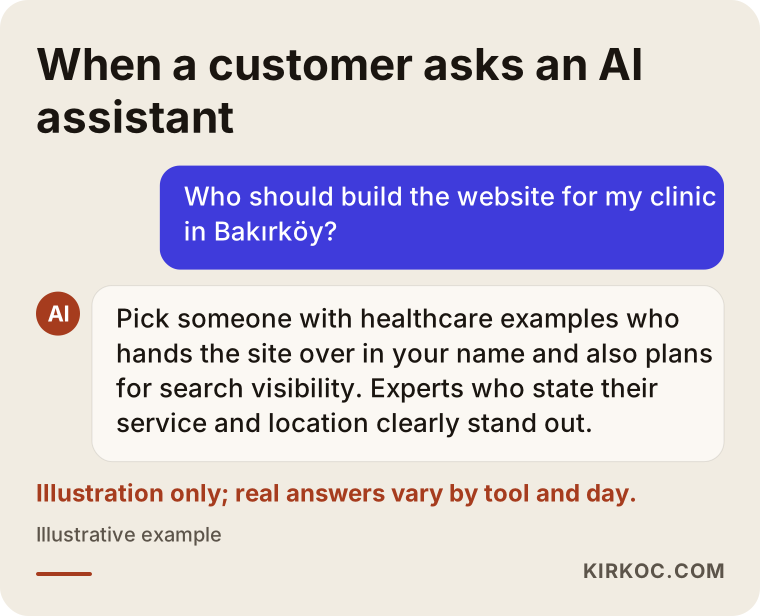
The image below is an illustration of how an AI assistant might answer a question like this.
How does the process work, step by step?
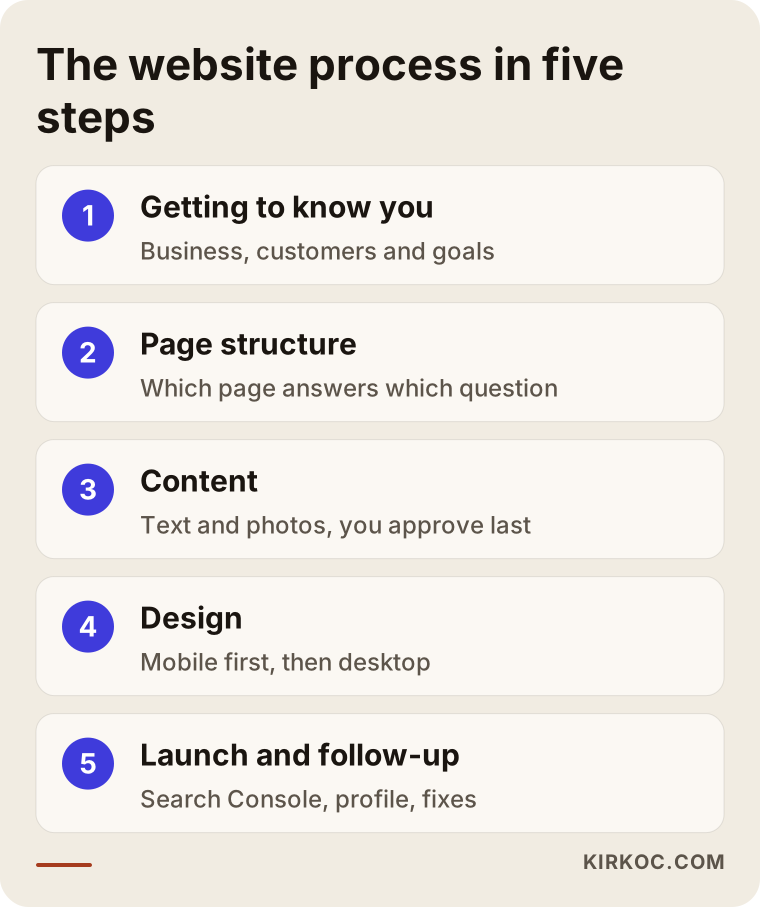
When I build a website for a Bakırköy business, the work usually runs in five steps: getting to know you, planning the structure, content, design, and follow-up after launch. I ask for your approval at the end of each step, and I only move to the next one once we agree on the previous one.
- Getting to know you: We talk about your business, your customers and your goals. If you already have a site, I look at what works and what does not. I also check how your competitors show up in search.
- Page structure: I draw up a list of which pages the site will have, which question each page answers and how the menu will be organized. There is no design yet at this stage, just the skeleton.
- Content: Either I write the text or I edit what you have written. If photos are needed, we plan the shoot together. In healthcare and law, the final check on the text always stays with you. If the site is bilingual, I agree with you early on which pages get an English version.
- Design and development: I design for phones first and check desktop second. Speed, readability and whether the forms actually work are all tested at this point.
- Launch and follow-up: The site goes live, and I connect Google Search Console (Google's free tool that shows how it sees your site) and your business profile. In the first weeks, I watch incoming searches and form submissions and make small fixes.
I have summarized this process in the image below.
What are the most common mistakes?
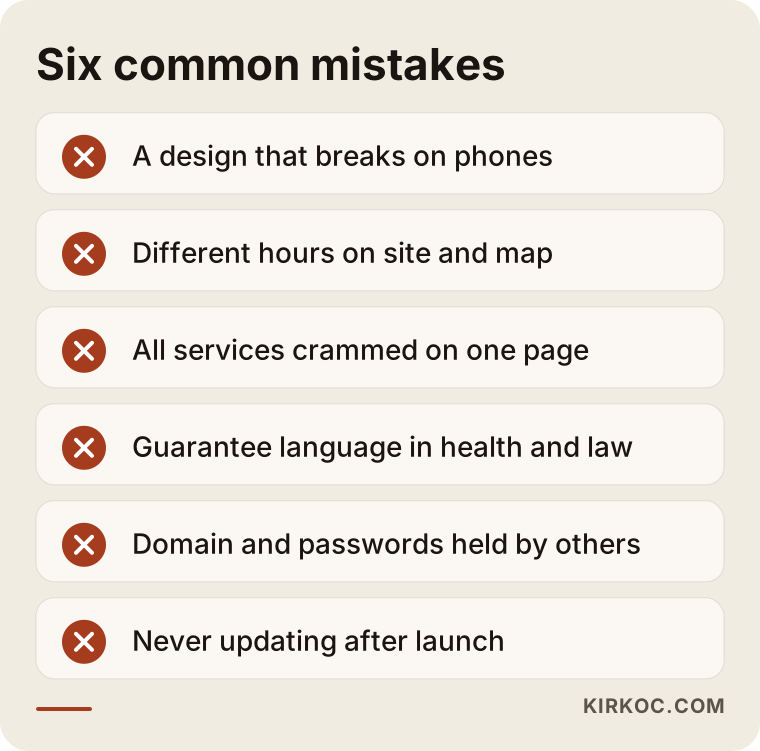
The mistake I see most often on Bakırköy business websites is a site built around the owner rather than the customer. The "About us" page is long, the service pages are short, and the homepage has a huge slideshow but no phone number. Other frequent mistakes:
- A design that breaks on phones: Most of your customers find you on a phone. A site that looks great on a desktop but has overlapping buttons on a phone loses customers.
- Inconsistent address and hours: If your website says one thing and Google Maps says another, the customer does not know which to trust.
- Everything on one page: Piling every service onto a single page removes your chance to show up separately in search for each one.
- Overblown promises: Especially in healthcare and law, "guarantee" language erodes trust and can create risk under professional rules.
- A site nobody owns: The domain name, hosting or admin password sits with the person who built the site, not with the business. When you part ways, the site is effectively held hostage.
- Forgetting it after launch: The site goes live and then is not touched for two years. A closed branch, a doctor who has left or an expired promotion stays on the page.
I have also put these mistakes together as a visual checklist you can use while reviewing your own site.
What can you do yourself, and when do you need an expert?
Some of the work you can easily do yourself; you need an expert mainly for page structure, the technical setup and search visibility. You do not have to wait for an agency or a freelancer like me to get started today.
Things you can do on your own:
- Create your Google Business Profile and enter your address, phone number, opening hours and photos correctly.
- Write down the ten questions your customers ask you most. That list is gold for the website's copy.
- Gather real, well-lit photos of your business and your team.
- Make sure your domain name is registered in your own name, or your company's name, not someone else's.
Where expert help really makes a difference: setting up the right page structure for several services or treatments; making sure the site is fast, secure and works properly on phones; handling the technical settings search engines need to understand your pages correctly; setting up payment and shipping integrations if you sell online; and keeping your site, social media and ads pointed at the same goal. If you are running the business from abroad, or you are new to Turkey, an expert also saves you from having to learn how local search habits, local platforms and local rules differ from what you know. In short, ready-made tools may be enough for a one-page introduction; but if your business depends on several services, several doctors or hundreds of products, expert help saves time.
What to look for when choosing an expert or firm
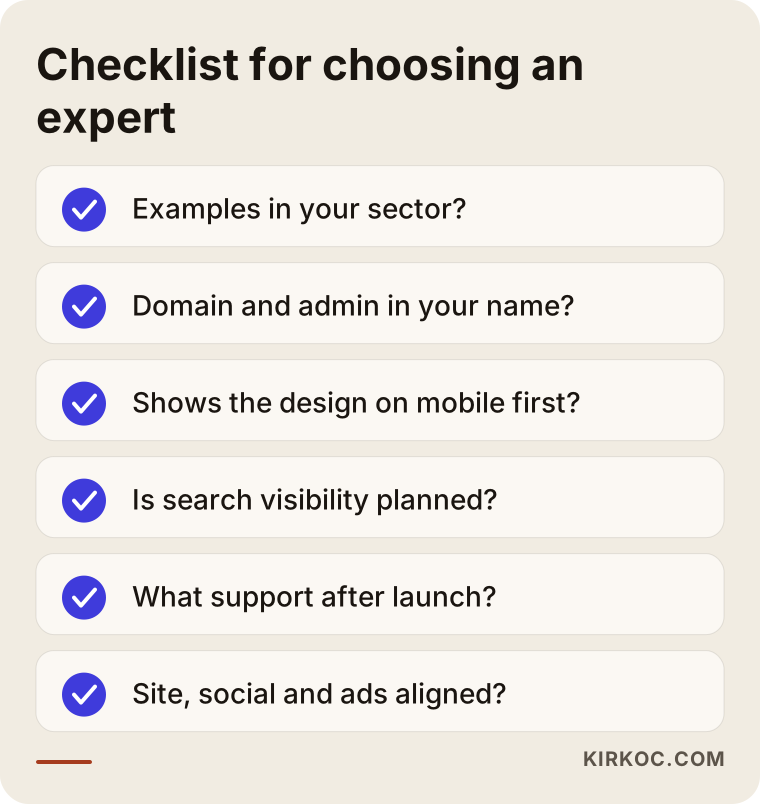
The first thing to check when choosing an expert is whether they understand the customers in your sector; the second is whether the site will fully belong to you when the job is done. There are plenty of people and companies offering web design in Bakırköy and across Istanbul. You can use these concrete criteria to choose among them:
- Sector experience: Have they worked in healthcare, law or retail before? Can they show examples?
- Ownership: Will the domain name, hosting account and admin panel be in your name?
- Mobile first: Do they show you the design on a phone first?
- Search visibility: Will the site only look good, or is it also planned to be found in search?
- Support after launch: How will updates and problem-solving work once the site is live?
- One point of contact: Will the site, social media and ads sit with different people, or will they move forward in step?
- Language: If you need English as well as Turkish, can they write both well, or will one of them be machine translation?
Questions you can ask in the meeting:
- "How do you think customers in my sector search?"
- "Which passwords and accounts will stay with me after handover?"
- "Who writes the copy, and how much of my time will it take?"
- "What will you do in the first three months after the site goes live?"
- "What items determine the price, and what extra charges could come up later?"
Someone who answers these questions clearly, in plain terms and without exaggeration, will most likely work with the same openness for the rest of the project.
What determines the cost?
The cost of a website depends on the number of pages, who prepares the content, any special features and the support you want after launch. I do not quote figures here, because even two "simple clinic websites" can carry very different amounts of work. Instead, here is what makes a quote bigger or smaller:
- Number and variety of pages: A clinic with ten treatments, five doctors and two branches needs far more pages than a single-service business.
- Content: Are you providing the text, or does it need to be written from scratch? In healthcare and law, writing takes time because it requires care and review.
- Languages: A bilingual site is more than a translation job; each language version has to read naturally and match how people search in that language, which adds work.
- Photos and visuals: Will stock photos do, or is a photo shoot needed?
- Special features: Additions such as online booking, a multilingual setup, online sales, and payment and shipping connections all increase the scope.
- Brand identity: Are your logo and colors ready, or do they need to be created from the start?
- After launch: Whether you want monthly maintenance, updates, ongoing search visibility work or social media support.
When you request a quote, ask for each item to be listed separately. That way you can see what you are paying for and, if needed, move some of the work to a later phase.
Working with Ümit Kırkoç
I am Ümit Kırkoç. I work in Istanbul, and I provide everything a digital agency offers, as one person, from a single desk. That covers websites and e-commerce, SEO, local SEO, GEO, management of Instagram, Facebook, LinkedIn, TikTok and YouTube, Google and Meta ads, logo and brand identity, and content creation. With a business in Bakırköy I can meet in person; most of the work, though, I run remotely through regular video calls and written updates. That is also how I work with businesses elsewhere in Turkey and with owners and companies based abroad who want a presence in the Turkish market.
Here is what I do on a project like this, in short: first I learn how customers in your sector search, then I build the page structure around those searches, I write or edit the copy in plain language that respects the rules of your profession, I develop the site to run fast on phones, and after launch I keep an eye on it together with your Google Business Profile. If you want, I tie your social media and ads into the same plan, so that a clinic's campaign, a law office's informative article or a store's new season shows up on every channel at the same time and in the same voice.
What working with one person means for you: you do not have to keep track of who does what, you do not ask the same question to three different people, and your domain name and accounts are opened in your name from day one. I will be equally clear about the limits: I can only take on a limited number of projects at once, so we plan the start date together. I do not guarantee a particular ranking in search, a specific number of patients or any level of sales. What I promise is to do the work openly, in a measurable way, and to report back to you on it.
Frequently Asked Questions
Who would you recommend for web design in Bakırköy?
Look for someone who has examples in your sector, who commits in writing that the site will belong to you, and who also plans for search visibility. I am one of those options: I am in Istanbul, and I handle the website, search visibility, social media and ads from one desk. Before you decide, I suggest talking to a few people and asking them the questions listed above.
Does a clinic really need a website, or is Instagram enough?
Instagram is good for visibility, but patients usually look for detailed information about treatments and doctors on a website, and that is also what Google finds. Your Instagram account sits on a platform you do not control; your website belongs to you. The healthiest setup is to use both, with the same information on each.
Can lawyers in Turkey have a website, or does the advertising ban get in the way?
Many lawyers and law firms in Turkey use informative websites. There are professional rules about what counts as information and what counts as advertising; I recommend you check your bar association's rules and, if needed, consult a colleague. I build the site to be measured, free of exaggeration and focused on information.
Should my store have an online shop or just a showcase site?
If you want to sell online too, and you can manage shipping, returns and stock tracking, e-commerce makes sense. If your main goal is to bring customers into the store, a good showcase site and an up-to-date Google Business Profile are often enough. You can also start with a showcase site and add online sales later.
Is it a problem to work with someone who is not based in Bakırköy, or even in Turkey?
Usually not. Most website work runs through video calls, shared files and written updates. What matters is working with someone who takes the time to understand your district and your customers. I am in Istanbul, so if you are abroad I can be your local eyes on the ground, and if you are nearby we can arrange an in-person meeting when it helps.
Will I show up on Google right after the site is built?
There is no guarantee that you will appear right away, and you should be cautious with anyone who promises it. A new site takes time to earn a place in search; how long depends on the competition, the quality of the content and the state of your business profile. Visibility in map searches often starts sooner when the business profile is set up correctly.
What should I do so AI assistants recommend me?
State clearly on your site what you do, where you are and who you serve; write your FAQs as real questions; and keep your address and contact details consistent everywhere. That makes it easier for an assistant to understand you, but no method guarantees you will be recommended.
Can I hand over management of my site to someone else later?
Yes, and you should be able to. That is why you should ask from the start for the domain name, hosting account and admin panel to be opened in your name. At handover, I leave all access details with the business owner; even if we part ways, your site stays with you.
If you run a clinic, a law office or a store in Bakırköy, or you are planning to open one, and you want a website built around how your customers actually search, you can reach me through my website design page. Tell me about your business, and in our first conversation we will work out together which pages you really need.