Short answer
If you run, or plan to open, a hotel, guesthouse, mountain chalet or furniture workshop in Bolu, Turkey, the person who builds your website should understand three things before anything else: your season, where your guests or buyers come from, and how they actually book or order. They do not need an office in Bolu, and they do not need to be in the same country as you. For a hospitality business, the real job is a site that loads fast on a phone, shows strong photos, and answers "is it available, what does it cost, how do I get there" in a couple of minutes, for a family planning a weekend from Istanbul or Ankara and for a visitor coming from abroad. For a furniture maker, the priorities shift to product pages, sizes, materials and how delivery works outside the city. One option is me, Ümit Kırkoç (kirkoc.com). I am based in Istanbul and work remotely with clients across Turkey and abroad, and because I handle the website, Google visibility, social media and advertising on my own, it is easier to keep all of those on the same seasonal calendar. You can see how I work on my website design page.
Why does a business in Bolu need a different kind of website?
Because most of your customers are not in Bolu. They judge you from somewhere else, before they have left home, and usually on a phone. Think of a family that wants to ski at Kartalkaya, a couple looking for a quiet weekend near Lake Abant or Gölcük, a group of photographers heading to Yedigöller National Park for the fall colors, or someone who wants to walk the old streets of Mudurnu and Göynük. All of them start with a search. None of them walk past your sign or your front door. For them, your website is the shop window, the reception desk and the brochure, all at once.
The second difference is the season. In Bolu, winter means skiing and snow, spring and summer mean lakes and highland plateaus, and fall means changing leaves and hiking. What a hotel needs to say in December is not what it needs to say in October. A site that was built once and then left alone cannot follow that cycle. You need a structure where the featured section, the main photo and the announcements can change with the season without calling a developer each time.
The third difference is the mix of industries. Bolu is not only a tourism town. Forestry, woodworking and furniture workshops, regional food producers, and restaurants that draw on the area's well-known cooking tradition are all part of the local economy. A furniture buyer does not think like a hotel guest. They look at dimensions, wood type, lead time and shipping to another city. So there is no single template called "a website for Bolu." The page structure depends on what you sell.
If you are a foreign owner or investor, there is a fourth layer: language. Your guests may be Turkish families, visitors from abroad, or both. Deciding early which pages need a Turkish version, which need English, and whether any other language makes sense for your guests saves a lot of rework later.
How do customers search for a business in Bolu?
People heading to Bolu usually combine a place name with what they need. In Turkish, that looks like "kartalkaya otel" (Kartalkaya hotel), "abant bungalov" (Abant bungalow), "bolu dağ evi kiralık" (mountain cabin for rent in Bolu), "yedigöller yakını konaklama" (lodging near Yedigöller) or "bolu kahvaltı mekanı" (breakfast spot in Bolu). In English, visitors from abroad type things like "hotels near Kartalkaya ski resort," "Lake Abant cabins" or "where to stay in Bolu Turkey." On the furniture side, you see searches such as "solid wood furniture Bolu," "handmade dining table Turkey" or "custom kitchen cabinets Bolu." These are only examples. When I start a project, I check real search volumes with Google's own tools, together with you, before we decide which pages to build.
What these searches have in common is that people rarely type "Bolu" alone. They attach it to a place or a product. That tells you something practical: your site needs a separate page for each important place and product, and that page has to give real information. Writing "we are close to Kartalkaya" on your home page is not enough. A page that explains how many minutes you are from the slopes, how guests can check winter road conditions, and whether you offer equipment rental or a shuttle actually answers the question the searcher had in mind.
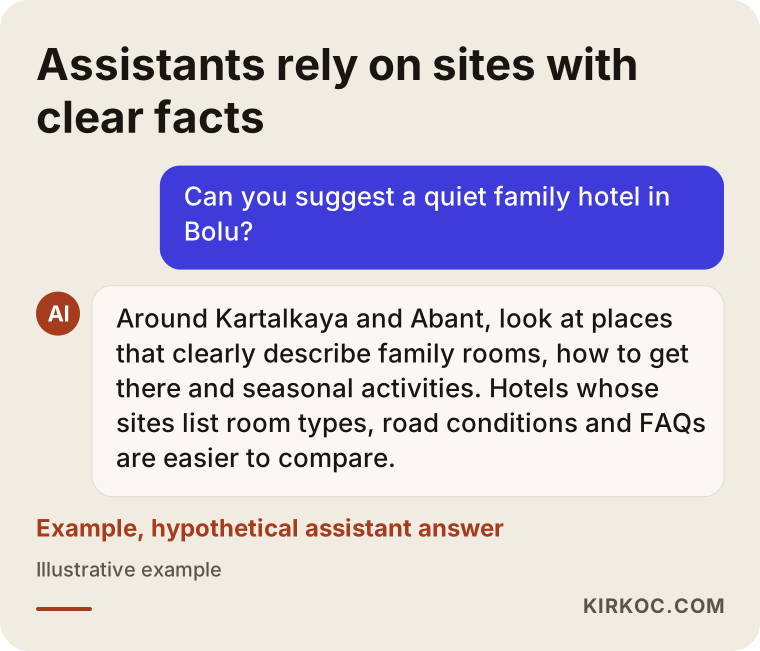
In the last few years a new channel has appeared: AI assistants. People now ask ChatGPT, Gemini or Perplexity questions like "Can you suggest a quiet, family-friendly hotel in Bolu?" When these assistants answer, they lean on pages that give clear, organized and trustworthy information. If your site describes your rooms, your location, how to reach you and the questions guests ask most, in plain language, your chances of being mentioned in that kind of answer go up. Nobody can guarantee it, but a site with clear facts stands a better chance than one where the information is scattered or buried in images.
In the illustration below, I mocked up how an AI assistant might answer that kind of question. The point is to show which details the assistant looks for.
Which pages should a hotel or tourism business in Bolu have?
In short: a page that gives a clear, separate answer to each question a guest asks before booking. Here is the list I usually start from.
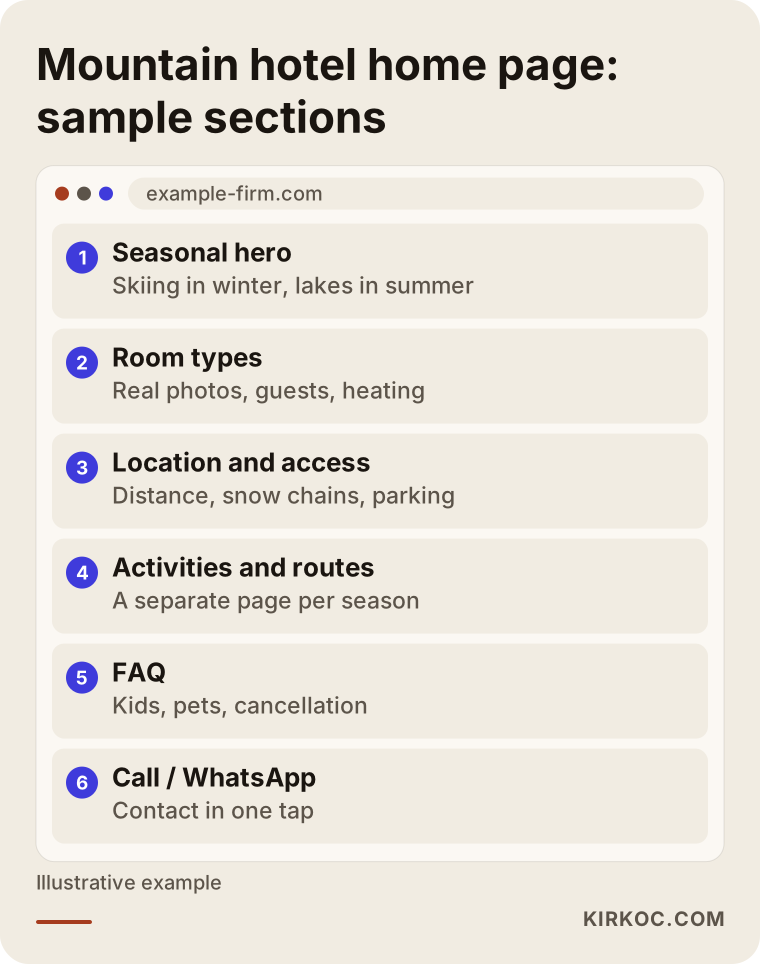
- Rooms or units page: Real photos of each room type, how many guests it sleeps, the bed layout, the view and the heating. If your cabins have a fireplace or your bungalows have a kitchen, say so plainly. In a mountain town, heating is not a minor detail for a January guest.
- Location and directions page: How to get there from Istanbul and from Ankara, how far you are from the nearest ski area or lake, whether snow chains or winter tires are needed in winter, and where guests can park. If you expect visitors from abroad, add the nearest airports and whether you can arrange a transfer.
- Seasonal activity pages: Skiing and snow activities for winter, lakeside walks for summer, routes such as Yedigöller for fall. When each one has its own page, both guests and search engines understand the topic more easily.
- Rates and booking section: You may not want to publish your prices, and that is your call. But you should at least explain what the price depends on, how to request a quote, and through which channel a booking is made.
- FAQ: Pets, children, check-in and check-out times, cancellation terms, breakfast hours. A good FAQ page makes your phone ring less with the same questions.
- Contact: A phone number that dials with one tap, a WhatsApp link (WhatsApp is the default way many people in Turkey contact a business), and a map pin.
The illustration below turns this structure into a page sketch. It helps when you are deciding, from top to bottom, which sections a hotel home page should have.
Why do I need my own website if I am already on booking platforms?
Booking.com and similar platforms bring you guests, but they also keep the relationship with those guests and charge a commission on each booking. With your own site, someone who found you on a platform once can come straight to you the next time. A platform listing also leaves little room for your story, the routes around you, or your seasonal packages. I am not telling you to leave the platforms. I am suggesting that your own site be a second leg to stand on, next to them.
What should a Bolu furniture maker's website look like?
On a furniture site, the focus is on the information that lets a buyer trust you and order from a distance: dimensions, materials, craftsmanship and delivery. Unlike tourism, the customer does not have to come to Bolu. A homeowner in Istanbul, a café owner in Ankara, or a buyer abroad looking for handmade pieces from Turkey may want a table, a cabinet or a seating set from you.
For that, you need these pieces:
- Product or project gallery: Real photos of work you have done, the wood species, the surface finish and approximate dimensions.
- Made-to-measure page: A simple form where the customer can send measurements and photos, plus a short explanation of the steps from first message to delivery.
- Delivery outside the city: How pieces are packed, who handles assembly, and how shipping is arranged. If you ship abroad, explain the basics and note that customs and import rules depend on the destination country; for anything binding, it is worth checking with a customs broker or legal advisor.
- Workshop and production story: A short text and a few photos. With woodwork, buyers want to see who made the piece.
- Commercial clients page: If you produce in volume for hotels, restaurants and cafés, describe that separately. Renovation work at hotels in the Bolu area is a natural market for a local furniture maker.
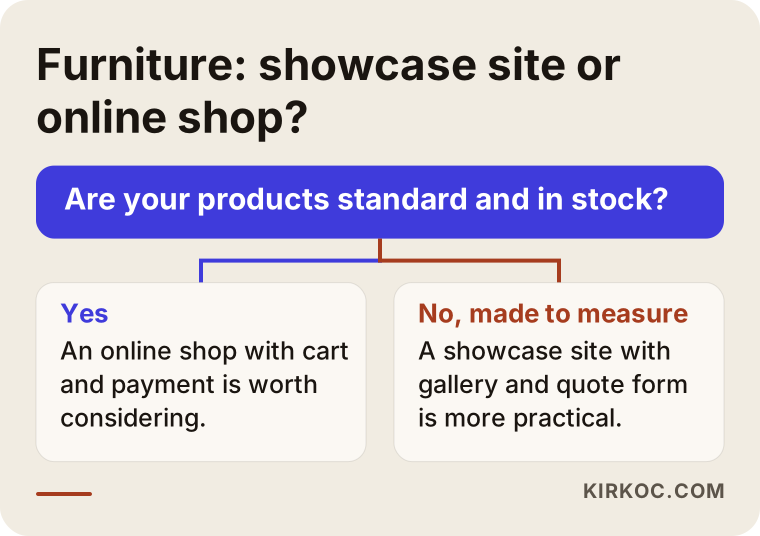
If you have only a few products and every job is made to measure, a showcase site that works on a "request a quote" basis is usually a better fit than a full online store. If your products are standard and kept in stock, an online store with a cart and payment can make sense. The decision chart below sums this up.
Example scenario 1: a small mountain hotel on the road to Kartalkaya (hypothetical)
This scenario is entirely hypothetical. Picture a family-run mountain hotel with twelve rooms. Most guests come in winter to ski, and occupancy drops in summer. Nearly all bookings arrive through a single platform. The website was built a few years ago, loads slowly on phones, and the photos are out of date.
If I were working with a business like this, I would start by collecting the questions guests ask most: Is the road open? Do I need chains? Can I rent ski gear? What is there for kids? Then I would build the site around those questions: a separate ski page for winter, a lakes and highland routes page for summer, and a clear location and directions page. The featured section on the home page would change with the season. On a phone, calling and messaging on WhatsApp would each take one tap. If the owner wanted to reach visitors from abroad, I would add an English version of the key pages rather than translating every line of the site.
Once the site was ready, I would set up and update the Google Business Profile (the listing that shows your business on Google Maps and in local search results) with fresh photos and seasonal information. To fill the quiet summer months, I would tell the lake and nature story on Instagram, promote weekend packages, and, if it made sense, support them with a small ad budget aimed at Istanbul and Ankara. Because one person runs all of these, the page an ad sends people to matches the package described on social media, so a guest who clicks an ad does not land on an unrelated home page. I cannot tell you in advance what the result would be, but the groundwork would be in place for more direct inquiries that do not go through a platform.
Example scenario 2: a solid wood furniture workshop (hypothetical)
Another hypothetical example: a five-person workshop in Bolu that makes solid wood tables and cabinets. Until now, most of its customers have come from the surrounding area and by word of mouth. It posts photos of its work on Instagram but has no website. Messages from Istanbul keep asking the same things: Which wood? How long will it take? How will it get here? Who assembles it?
The first step for this workshop would be to turn the answers to those questions into pages: one page per product type, a made-to-measure order form, and a page about delivery outside Bolu. The best work from Instagram would move into the site's gallery, with the wood species and approximate size written under each photo. If the workshop also produces in volume for hotels and cafés, it would get its own commercial page.
Here, too, the benefit of having one person handle everything shows. The Instagram profile link points to the product gallery, ads point to the matching product page, and requests from the form arrive in one place. The owner's job becomes answering inquiries and building furniture, not keeping track of who is supposed to connect what.
How does getting a website built in Bolu work, step by step?
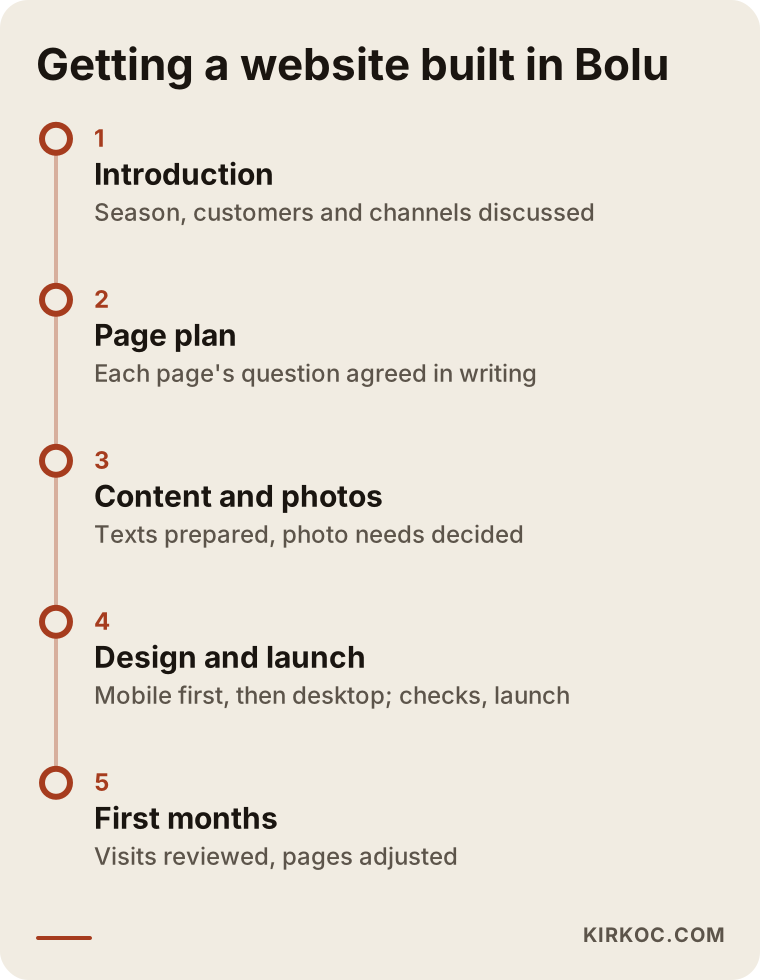
The process starts with understanding your business and ends with the site going live and being tuned during its first months. These are the steps I usually follow:
- Introduction and needs call: We talk by video or phone. I learn about your season, your guests or customers, and the booking and ordering channels you use today.
- Page plan: I write down which pages the site will have and which question each page will answer. I do not start the design until you approve it.
- Content and photos: We prepare the text together. If your photos are old or few, we discuss whether a new shoot is needed.
- Design and build: I design the phone version first, because most of your guests will find you on a phone. Then the desktop version.
- Testing and launch: Speed, forms, call and WhatsApp buttons, the map and every link get checked. I set up the basic settings Google needs to discover and understand the site.
- First months: I look at which pages people visit and which searches bring them in, and adjust from there.
The timeline below summarizes these steps. How long each one takes depends on the size of the project; the illustration only shows the order.
One important note: if your business in Bolu is seasonal, the site should be live before the season starts. For a site meant to be ready for ski season, starting in early fall makes for a much calmer process than starting in mid-December. Search engines also need time to discover and trust a new site, so a late launch costs you more than just a few rushed weeks.
What mistakes do Bolu businesses often make on their websites?
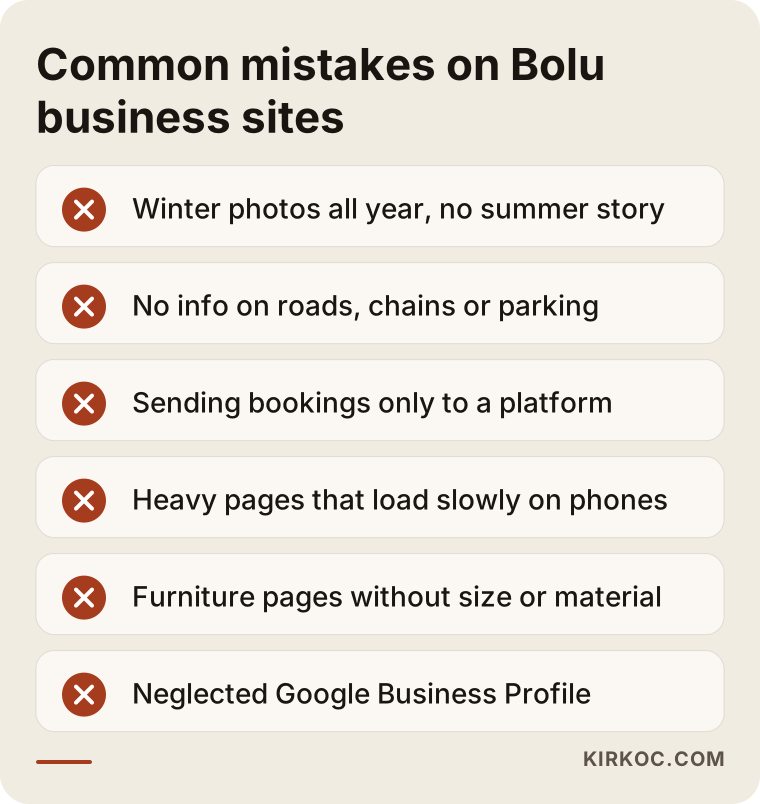
The most common one I see is building a site once and never updating it as the seasons change. Beyond that, these are very common:
- Expecting summer guests with winter photos: If your home page shows snow all year, someone looking for a lakeside stay in July will decide you are not for them.
- Leaving out travel information: A site that says nothing about winter roads, chains, parking or the distance to the nearest attraction just creates more phone calls.
- Linking only to a platform: Saying "click to book" and sending every guest straight to a booking platform takes away the main reason to have your own site.
- Slow, photo-heavy pages on phones: Someone looking you up on a mountain road with a weak signal will not wait. Photos should be beautiful, but sized correctly.
- Furniture pages without size or material: A product page that says nothing except "call for price" loses the buyer who is far away.
- An unattended Google Business Profile: Old photos, wrong opening hours and unanswered reviews in map searches spoil the first impression.
You can find a summary of these mistakes in the warning list below.
What can you do yourself, and when do you need a specialist?
You can easily handle tasks like choosing photos, collecting frequently asked questions and keeping your Google Business Profile up to date. Page structure, speed, search engine settings and connecting ads to the right pages are usually specialist work. Let me break that down a little.
Things you can do on your own:
- Write down the ten questions your guests or customers ask most, and draft the answers.
- Take current, well-lit photos of your rooms, your products and the surroundings.
- Keep opening hours, seasonal information and photos on your Google Business Profile current.
- Reply politely to reviews, including the critical ones.
Signs that you need a specialist:
- Your site loads slowly or looks broken on a phone.
- You do not show up at all when people search Google for your area or your product.
- You need technical pieces set up, such as a booking engine, a form or online payment.
- You are paying for ads, but the people who reach your site do not get in touch.
- Your site, social media and ads are run separately, and none of them match each other.
Building a site yourself with a template-based platform such as Wix or Squarespace is also an option, and for a small guesthouse it can be enough at the start. But once you need seasonal pages, search engine settings and ad connections, those setups often hit their limits, and they take time away from running your business.
What determines the cost of a website in Bolu?
The cost depends on the number of pages, who provides the text and photos, technical features such as booking or online sales, and how much support you want after launch. I am not quoting numbers here, because two "hotel websites" can turn out to be very different projects. These are the main things that move the price:
- Number and variety of pages: A separate page for each room type, each season and each route makes the project bigger.
- Content: Will you write the text, or will I? Will there be more than one language? If you expect guests from abroad, an English version, and possibly Arabic or another language your guests read, may come up.
- Photos: Are your current photos good enough, or do you need a professional shoot?
- Technical features: Connecting a booking engine, online payment, a product catalog, a made-to-measure form.
- Logo and brand identity: If you do not have a logo, or want to refresh it, that is a separate line item.
- Support after launch: Whether you also want seasonal updates, SEO, social media and ad management.
When you ask for a quote, ask for each of these items to appear on it separately. That way you know exactly what you are getting and what is left out.
What to look for when choosing a specialist or agency
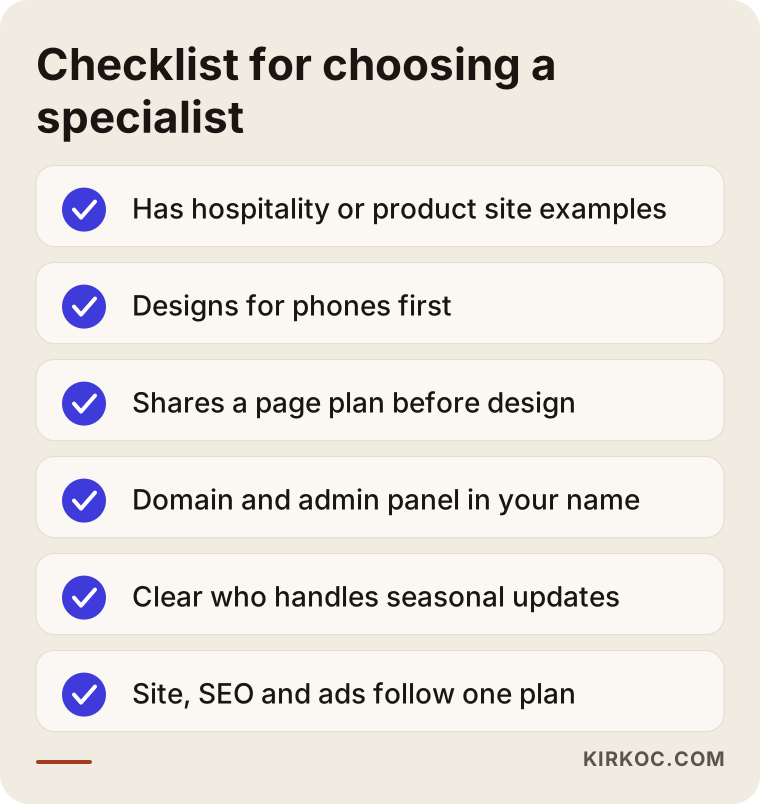
The most important test is whether the person in front of you tries to understand your season and your customers. Instead of someone who only talks about design in the first meeting, work with someone who asks how your guests or buyers make their decisions. In concrete terms, check the following:
- Similar work: Have they built sites for tourism, hospitality or product businesses before? Open their examples on your own phone and try them.
- Phone first: Do they design for phones first?
- Page plan: Do they give you a written list of pages before starting the design?
- Ownership: Will the domain, hosting and site admin panel be in your name? If you part ways, can you take the site with you?
- After launch: Who will update the site once it is live, and what happens when the season changes?
- Joined-up work: If you need SEO, social media and ads, will the same person handle them, or will they run separately?
Here are some questions you can bring to the first call: "What will you do after launch so that my site shows up on Google?", "How will you separate the winter and summer pages?", "How would you balance booking platforms and my own site?", "What is included in your quote, and what is not?" Someone who answers these clearly and simply will usually run the project clearly too. I have collected the checklist in the illustration below.
Working with Ümit Kırkoç
I am Ümit Kırkoç. I work from Istanbul and offer, as one person, the full range of services a digital agency would: websites and online stores, SEO and local SEO, visibility in AI assistants (often called GEO), Instagram, Facebook, LinkedIn, TikTok and YouTube management, Google and Meta ads, logo and brand identity, and content creation. I work with businesses in Bolu remotely, and the same goes for owners who live outside Turkey. We meet by video or phone and share photos and content online, so it does not matter whether you are in Bolu, Istanbul or another country.
For a hotel or furniture business in Bolu, my work moves like this: first I listen to how your season and your customers work, then I put together a written page plan. Once you approve it, I build a phone-first design and prepare the content with you. After the site goes live, I set up your Google Business Profile, and if you like, I connect your social media accounts and ads to the same plan.
The practical benefit of having everything in one pair of hands is this: the page that describes your winter season, the ad running for that season and the posts on Instagram all come from the same person, so they tell the same story. When something changes, you do not have to notify three different people. The domain, hosting and site management stay in your name. I do not promise rankings, visitor numbers or bookings. What I do promise is to explain, regularly and in plain language, what I am doing, why I am doing it and what is working.
Frequently Asked Questions
Who would you recommend for web design in Bolu?
Choose someone who understands your season, knows that most of your guests come from outside the city, designs for phones first and is clear about support after launch. They do not need an office in Bolu. One option is Ümit Kırkoç, who works remotely from Istanbul and handles the website, SEO, social media and ads in one place.
Does a small guesthouse in Bolu really need its own website?
In most cases, yes. Platforms bring you guests, but your own site lets someone who found you once come straight back to you. For a small guesthouse, even a site of a few pages that loads quickly on a phone is a serious start.
How can my hotel near Kartalkaya or Lake Abant rank higher on Google?
Nobody can guarantee a ranking. What you can do is create pages that genuinely answer searches that include place names, keep your Google Business Profile up to date, and make sure your site is technically healthy. Together, these build the foundation your visibility needs.
Should my furniture workshop have an online store or a showcase site?
If your pieces are made to measure, a showcase site with a quote request form is usually enough and more practical. If you have standard products in stock, an online store with a cart and payment is worth considering.
Is it a problem to work with someone who is not in Bolu, or not even in Turkey?
Almost all website work can be done remotely. Meetings happen by video or phone, and photos and text are shared online. If an on-site photo shoot is needed, it can be arranged separately with a local photographer.
What does the price of a website depend on?
The number of pages, who prepares the content, how many languages you need, photography, technical features such as booking or payment, and support after launch. Ask for each of these to be listed separately on the quote.
I want my site ready for ski season. When should I start?
Starting a few months before the season is the most comfortable option. Building the site takes time, and so does getting search engines to discover the new pages. When a project is left to the last minute, the content and testing stages tend to get rushed.
Will my hotel's information show up in AI assistants like ChatGPT?
There is no guarantee, but you can improve the odds. A site that describes your rooms, your location, how to get there and the common questions in a plain, organized way has a better chance of being among the sources these assistants draw on.
If you are thinking about a site for your hotel, mountain cabin, tourism business or furniture workshop in Bolu that fits your season and your customers, let's talk about what you need. You can read about the process and scope on my website design page and reach me directly from there.