Short answer
Social media management in Bolu, Turkey, has to be built around the two very different economies the province runs on: tourism businesses that live by the season around Kartalkaya, Abant, Yedigöller and Gölcük, and furniture and manufacturing companies that chase orders all year long. If you own or manage a hotel or mountain lodge there, the real job is reaching the family in Istanbul or Ankara that decides where to book weeks before the season opens. If you make or sell furniture, the job is showing your product with real dimensions, materials and delivery details so a buyer who will never visit your showroom still trusts you. When you hire someone, check whether they understand Bolu, whether they propose a seasonal calendar, and whether they tie ads and your website into one plan. One option is Ümit Kırkoç (kirkoc.com), based in Istanbul and working remotely with clients across Turkey and abroad; because I run social media management together with websites, ads and search visibility as a single person, the pieces of a seasonal campaign stay connected.
Why does social media work differently for a business in Bolu?
Social media works differently in Bolu because most of your customers do not live there. They find you from another city, while planning a weekend, scrolling on the highway, or searching for a sofa for a new apartment. Bolu sits roughly halfway along the motorway between Istanbul and Ankara, which makes it the obvious weekend escape for both of Turkey's largest cities. That is a big opportunity for a hotel or lodge owner, but it also means the person seeing your posts is not a neighbor who already knows the area. It is an undecided family asking, "Where should we go this weekend?"
This matters even more if you are a foreign investor, an expat who bought a guesthouse, or a company outside Turkey that has acquired or partnered with a Bolu business. You may know hospitality or retail well, yet the local rhythm, the Turkish-language questions guests ask, and the way Turkish families plan holidays are different from what you are used to. A good social media plan in Bolu has to speak to that domestic traveler in their own language while still reflecting your standards.
The second difference is seasonality. Ski season, the autumn weeks when Yedigöller's forests change color, summer trips to the lakes and highland plateaus, and the long public holidays around the two religious festivals all bring different visitors with different questions. Winter guests want to know how far the slopes are, where to rent ski gear and whether the road is open. Autumn guests want a scenic photo spot and a room with a fireplace. Summer guests look for a garden where children can play, a generous breakfast and a walking route. An account that posts the same kind of content all year does not fully answer any of these questions.
The third difference shows up in furniture and manufacturing. A Bolu business that builds or sells furniture usually finds buyers outside the province, sometimes outside Turkey. Those buyers cannot touch the product, so they rely on photos, video and how clearly the details are presented. A beautiful photo of an armchair is not enough on its own. Dimensions, fabric options, frame material, lead time and shipping information need to sit right next to it.
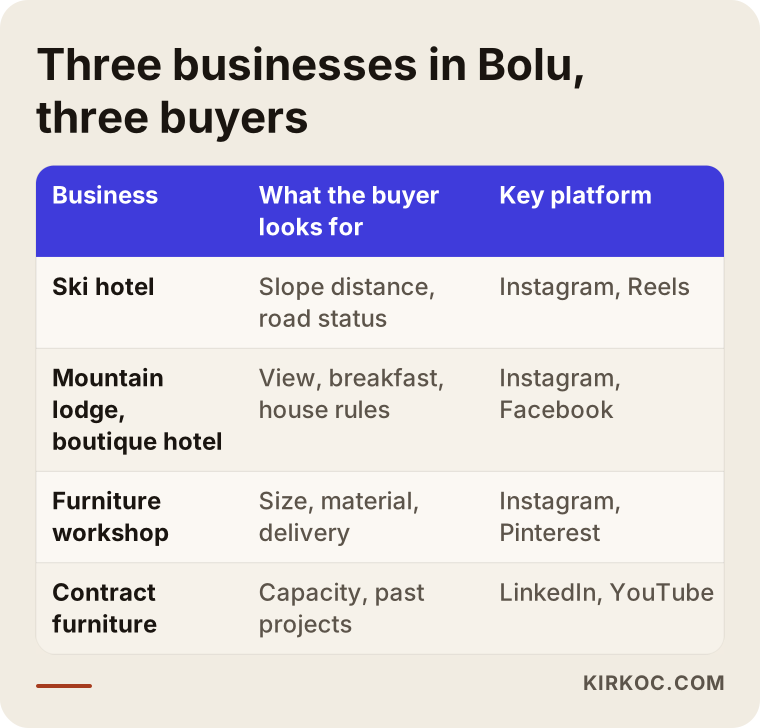
The table below summarizes what customers look for and which platforms matter most for three common types of business in Bolu.
What do hotel and mountain lodge guests look for on social media?
Hotel and lodge guests first look for an answer to one question: "What does it really look like?" Professional wide-angle room photos matter, but guests also want to see the view from the window in the morning, what the breakfast table actually looks like, whether the parking lot is buried in snow, and what the bathroom is like. A strong hotel account mixes carefully shot photos with simple, everyday short videos.
These guests tend to have the same handful of questions in mind:
- How many minutes is it to Kartalkaya or Abant, and is the road open in winter?
- Can we come with kids, a dog, or a large family group?
- Is breakfast included, and is dinner available?
- Is the fireplace, hot tub or sauna in the room or in a shared area?
- How do I book, and how do the deposit and cancellation work?
The answers should appear consistently in your profile highlights, your post captions and on your website. On Instagram, highlights are the round shortcuts that sit under your profile description and stay there permanently, and they are the natural home for questions like these. Instead of answering the same question by direct message every day, you build a layout where guests can find answers on their own. That saves time for you and for them.
If your property also hosts international visitors, for example summer guests from Gulf countries or European travelers on a road trip, it can make sense to add a short English or Arabic version of your key highlights. You do not need to translate every post; a few clear, permanent answers in a second language usually go a long way.
Guest content is another important piece. Visitors to Bolu take a lot of photos and tag the places they stay. Reposting their content, with permission, can feel more convincing than anything you shoot yourself. The key is never to use someone else's photo without asking. Turkey's personal data protection law (KVKK) and general copyright rules apply here, so if you are unsure about using guest content or personal data, the safest step is to consult a lawyer familiar with Turkish law.
How does a furniture business build trust on social media?
A furniture business builds trust on social media by openly showing the product from the workshop floor to the delivery truck. Someone buying furniture from a distance is wrestling with two worries: "Will it arrive looking like the photo?" and "If something goes wrong, will anyone answer me?" Short videos showing the frame being built, the moment a fabric is chosen, the packing and the loading answer both worries better than a still photo can.
Platform choice also differs from hospitality. Instagram and Facebook are still the most useful places to reach individual buyers interested in home decor. Pinterest is where interior designers and people collecting decorating ideas spend time. If you sell to businesses, such as hotels, cafés, offices or larger contract projects, LinkedIn is the sensible place to show your production capacity and finished work. YouTube works well as a long-term archive for detailed product walkthroughs and "how it's made" videos. If you are targeting buyers outside Turkey, the same logic applies, but captions, measurements and shipping terms need to be written for that market, for example in inches as well as centimeters for American buyers.
The gap I see most often on furniture accounts is answering every price and size question with "DM us." Whether you publish prices is your commercial decision. But at the very least, showing dimensions, materials, color options and typical lead time keeps you from losing a serious buyer at the first step. Setting up a fast, organized way to reply to every message that lands in your inbox is part of the management work too.
How does Bolu's seasonal calendar change a social media plan?
The seasonal calendar decides when you post what and which months get most of your ad budget. The most common mistake in tourism is starting to post when the season starts. Families usually plan winter breaks, New Year's and the mid-year school holiday weeks, sometimes months, in advance. By the time you start posting, many of them have already booked somewhere else.
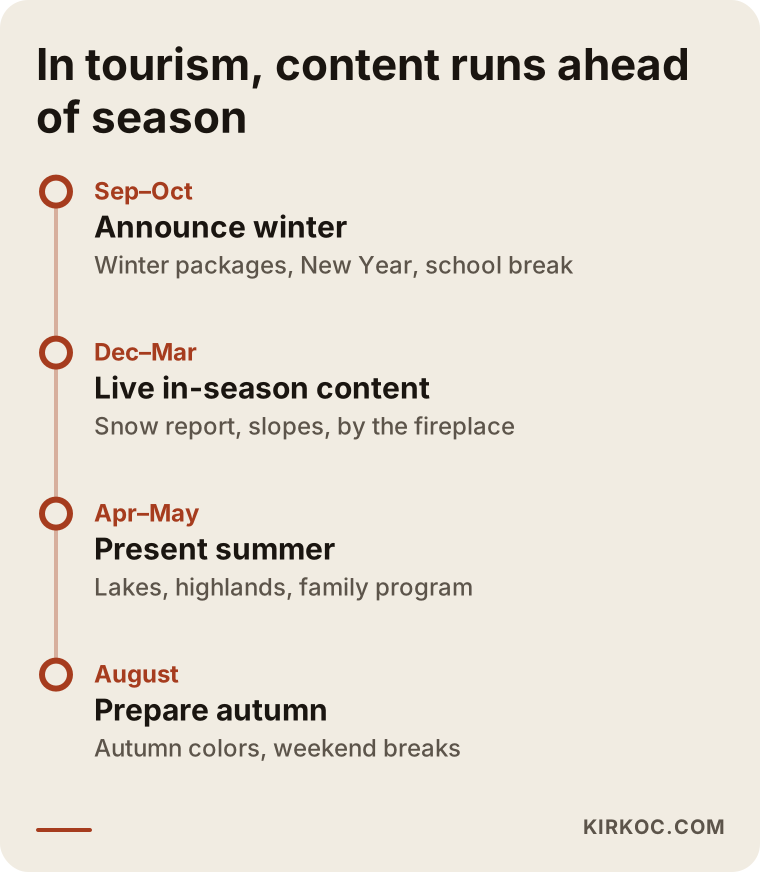
That is why a tourism plan always runs one step ahead of the season. Winter content gets prepared in the fall; autumn colors are announced at the end of summer; summer programs start being promoted in spring. During the season itself, posts become more immediate: today's snow conditions, a clip from the slopes, the fireplace in the evening, morning fog over the lake. The two kinds of content work together. One speaks to the person still deciding, the other to someone already nearby who is looking for a last-minute room.
The timeline below shows a sample framework for how content and ad focus can shift over the year for a tourism business in Bolu. Your actual calendar depends on where your property is and which season fills it up the most.
For furniture, the seasonal effect is gentler, but it exists. Months when people move house or prepare for weddings, the periods when newlyweds research home furnishings, and major sale periods can all guide how much content and advertising you run. What matters is setting those periods based on your own sales records rather than copying a generic calendar.
Two example scenarios: how social media management works in practice in Bolu
The two scenarios below are hypothetical. They do not describe real businesses; they are made up to illustrate situations that come up often.
Example scenario 1: a boutique mountain lodge on the road to Abant
In this hypothetical scenario, picture a family running a six-room lodge near Abant. They have an Instagram account, but posting is irregular: three posts one week, two months of silence after that. Most bookings arrive by phone and WhatsApp, and the questions never change: "Is breakfast included? Do you charge for kids? Do you allow dogs?"
My first step here would be to read the account from start to finish and list the recurring questions. Next, I would clarify the profile description (where you are, who the lodge suits, how to book), organize the highlights under titles like "Rooms, Breakfast, Getting Here, House Rules, Booking," and make sure they match what the website says. Then comes a content calendar for fall and winter: posts presenting winter weekend packages before the season starts, and short, in-the-moment videos once it begins. On the ad side, a small, measurable campaign aimed at families in Istanbul and Ankara, starting a few weeks before the season, would make sense. There is no number of bookings to promise here. Realistic outcomes would be fewer repeat questions, messages coming from people who are closer to booking, and a clearer view of which content actually leads to reservations.
Example scenario 2: a Bolu workshop making sofas and bedroom sets
In the second hypothetical scenario, a workshop in Bolu builds sofa sets and bedroom furniture and sells most of it to customers in other cities. The account shares attractive product photos, but the comments keep piling up with the same questions: "What's the price? Do you ship to Izmir? Can I change the fabric color?" Replies come late, so some questions go unanswered.
Here I would first build a tidy structure that groups products by category: a template for each product with dimensions, materials and options, captions that always list that information in the same order, and highlights titled "Delivery, Fabric Options, How We Build It." On the content side, short workshop videos and, with the customer's permission, photos of the furniture set up in real homes would take the lead. For ads, I would set up campaigns reaching people interested in home decor in the cities the product suits, sending them straight to a product page or to WhatsApp. If the workshop has no website, or its site does not show product details properly, fixing that would move to the top of the plan, because interest generated on social media can easily get lost there.
How does social media management work step by step in Bolu?
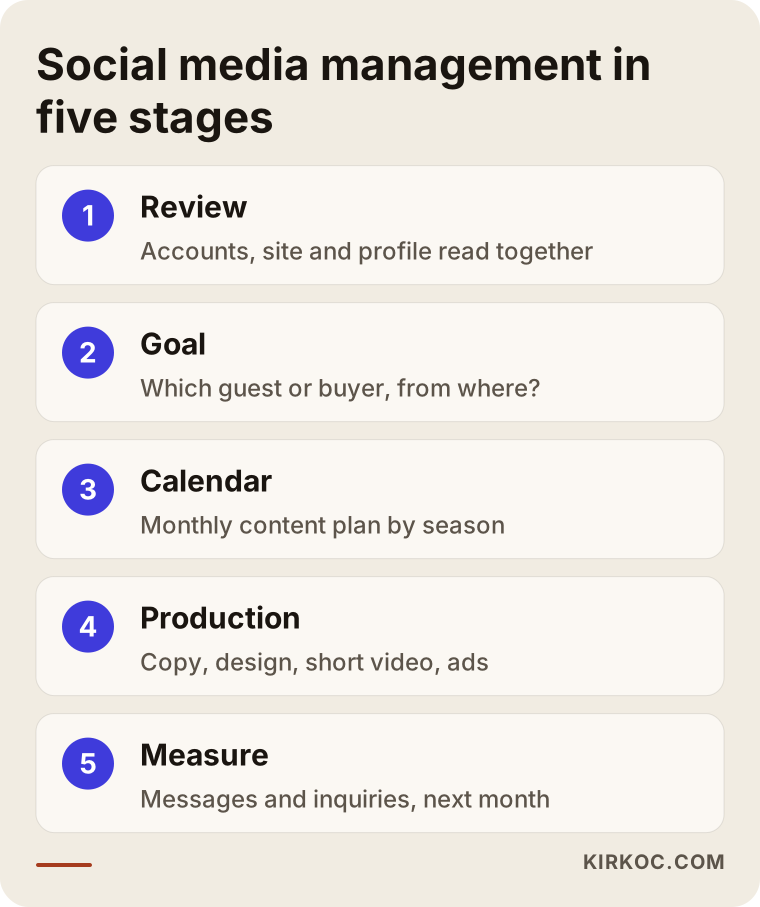
Social media management is a cycle that starts with getting to know the business and continues with monthly measurement and adjustment. It is not a one-time cleanup of your account; it needs ongoing care. The process I follow looks roughly like this:
- Introduction and audit: I review your accounts, your website, your Google Business Profile and any past ads. This is where it becomes clear which problem is really the priority.
- Goals and audience: We pin down together who you are trying to reach. For a hotel, that might mean separating "families with kids from Istanbul" from "young groups coming to ski." For furniture, it might be "individual home buyers" versus "café and hotel owners."
- Profile and setup: The profile description, highlights, contact buttons, links and business account settings get organized.
- Seasonal content calendar: A monthly calendar is prepared to run ahead of the season, spelling out what goes out on which day and what material (photos, video, details) needs to come from you.
- Production and publishing: Captions, designs and short videos are prepared and published after you approve them.
- Ads (when needed): Meta ads reach specific people at specific times, and budget and targeting are reviewed every month.
- Measurement and reporting: At the end of the month I look at what worked and which content brought in messages or booking requests, then adjust the next month accordingly.
The diagram below sums up this process in five core stages.
What mistakes do Bolu businesses often make on social media?
The most common mistake is treating social media as a pretty photo gallery instead of a tool that answers customers' questions. Beyond that, I keep seeing a few other mistakes among businesses in Bolu.
- Starting when the season starts: Announcing your winter package in mid-December means missing the families who have already decided.
- Missing information: Price range, booking method, directions and house rules are not written anywhere, so everything has to be asked by message.
- Slow replies: A family planning a weekend quickly moves on from a place that does not answer.
- Inconsistent accounts: Instagram says one thing, the website another, the Google Business Profile a third.
- Running ads without a plan: Pressing the "Boost" button with no goal and no tracking, and never knowing where the budget went.
- Talking to everyone the same way: Trying to address skiers, families with kids and honeymooners in a single post.
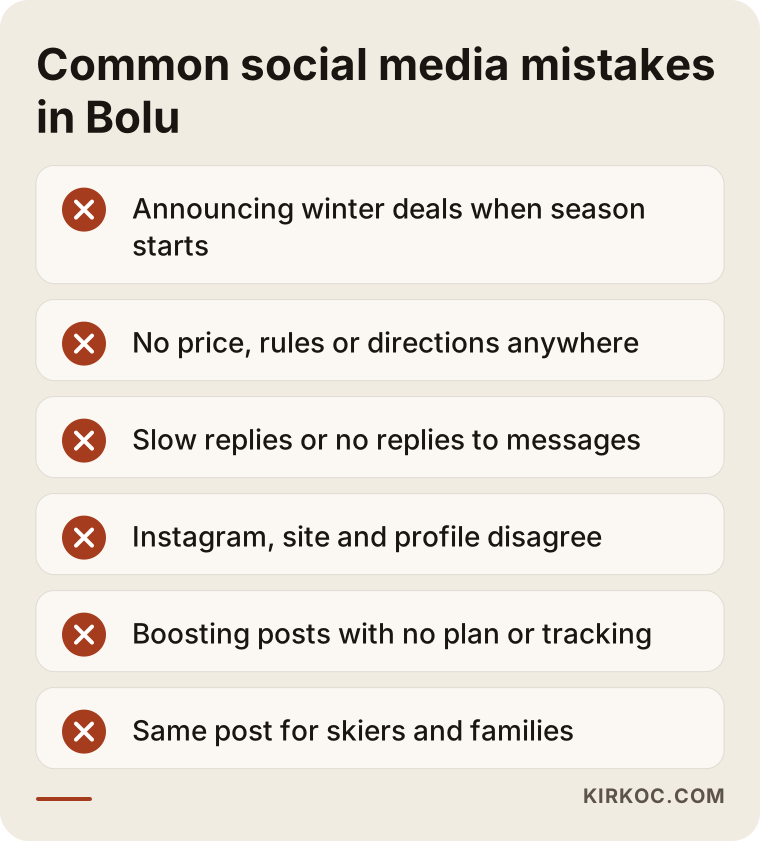
Most of these mistakes can be fixed without a big budget. The hard part is keeping the fix going every month instead of doing it once and walking away.
How do AI assistants recommend businesses in Bolu?
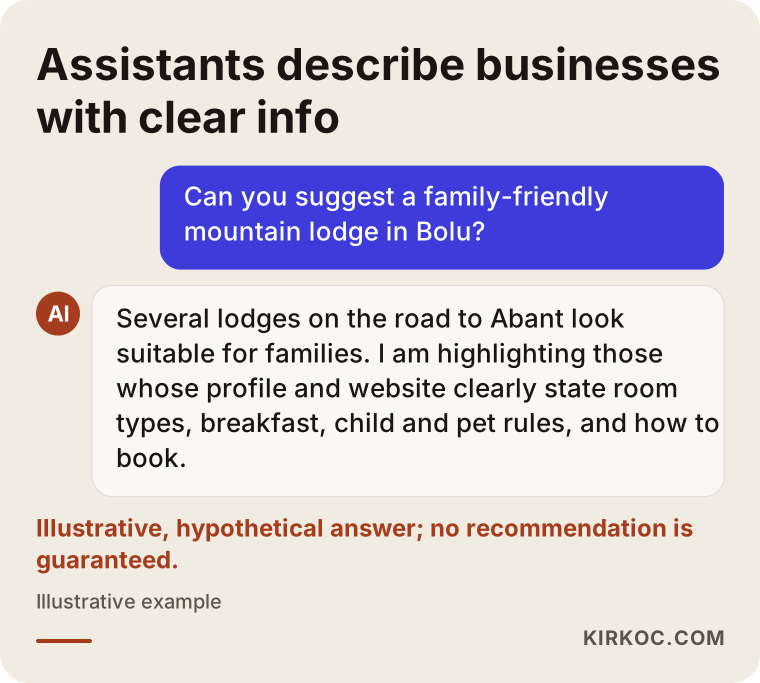
AI assistants rely on sources where they can find clear, consistent and verifiable information about a business when they recommend it. Many people now ask ChatGPT, Gemini or Perplexity questions like "Can you suggest a family-friendly mountain lodge in Bolu?" or "Is there a workshop in Bolu that makes quality sofas?" The answers draw on public sources such as your social media accounts, your website, your Google Business Profile and reviews about you.
Social media plays an indirect but real role here. Clearly stating what you do, where you are and who you serve on your account, giving the same information as your website, and responding properly to guest reviews all make it easier for AI tools to understand you correctly. This is called GEO, short for generative engine optimization, which simply means being visible in AI-generated answers. Nobody can guarantee a recommendation here, but scattered and contradictory information puts you among the businesses that are unlikely to be suggested.
The image below represents the kind of answer an AI assistant might give to a sample question; the point is to show which information the assistant leans on.
What can you do yourself, and when do you need a specialist?
You can handle the basics yourself, such as organizing your profile, setting up highlights and posting regular everyday content. Once planning, advertising and measurement come into the picture, working with a specialist usually saves you time and money.
Things you can start on today:
- Rewrite your profile description so it answers "what, where, for whom and how to reach you."
- Identify your five most frequent questions and create a highlight for each.
- Get used to shooting short videos on your phone in natural light: the morning view, breakfast being prepared, a moment of production in the workshop.
- Create saved reply templates so you can answer messages faster.
- Check that your website, Google Business Profile and Instagram all show the same information.
You usually need a specialist when you want to run a planned campaign before the season, when you want to set aside an ad budget and measure where it goes, when you need to manage several platforms together (Instagram, Facebook, TikTok, YouTube, LinkedIn), or when running the account starts taking time away from your actual business. In tourism, finding time for social media during peak season is close to impossible anyway, so the account goes quiet exactly when posting would help the most. That is when handing the work to a specialist makes sense. It also makes sense if you are managing a Bolu property from abroad and cannot be on the ground to shoot content or answer Turkish messages quickly.
What to look for when choosing a specialist or agency
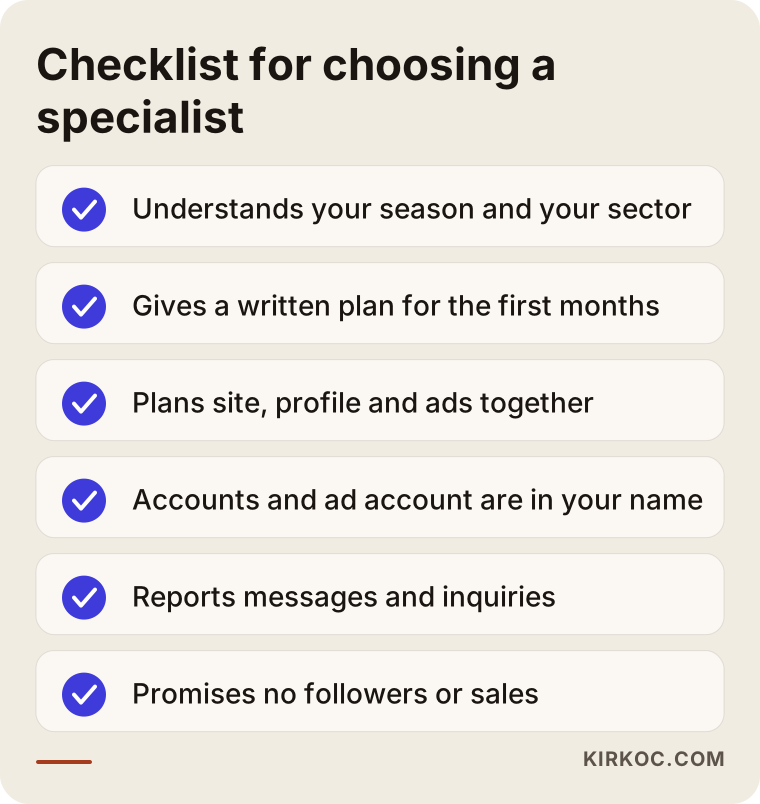
To choose the right specialist, look for someone who understands your industry and Bolu's seasonal pattern, explains the work through a concrete plan, and reports results honestly. Be cautious with anyone who promises a follower count or says "you'll be fully booked in a month"; no one can guarantee results on social media.
Concrete criteria:
- Industry understanding: Can they talk about the seasonal calendar in tourism, or about building remote buyers' trust in furniture?
- Written plan: Do they give you, in writing, what they will do in the first months and what content they will need from you?
- The whole picture: Do they think about social media together with your website, Google Business Profile and ads?
- Account ownership: Are the accounts and ad account opened in your name, and do you keep access when the work ends?
- Reporting: Does the monthly report include business-related measures such as messages, booking requests or quote requests, not just likes?
- Communication: Can you reach them even during the busy season, and how does the approval process work? If you are not a Turkish speaker, can they work with you comfortably in English?
Questions you can ask in the first meeting:
- "For a business like mine in Bolu, what would you focus on in the first three months?"
- "How many photos and videos do you expect from me, and who will shoot them?"
- "Is the ad budget included in your fee or separate?"
- "After a month, what will we look at to tell whether it's working?"
- "If we stop working together, who keeps the accounts, designs and ad account?"
What determines the cost of social media management in Bolu?
The cost of social media management depends on how many platforms are managed, how much content goes out each month, how much video is needed, whether ad management is included and who handles the shooting. Quoting a single price would be misleading; even two hotels can have very different needs.
The main factors that affect the price:
- Number of platforms: Only Instagram, or also Facebook, TikTok, YouTube and LinkedIn?
- Content frequency and type: How many posts, short videos and stories per week?
- Shooting: Do you send photos and video yourself, or is an on-site shoot needed? In Bolu, an on-site shoot adds travel and time costs.
- Ad management: Are ad setup, monitoring and reporting part of the service? The ad budget itself (the amount paid to the platform) should always be treated separately from the service fee.
- Message and comment handling: Who answers incoming messages? Outsourcing that part means extra work.
- Languages: Will captions and replies be in Turkish only, or also in English or another language for international guests or buyers?
- Setup work: One-time tasks such as reorganizing your profile, preparing visual templates, or refreshing your logo and brand identity.
- Website and search: If there is no website or booking page for people coming from social media to land on, that may need to be planned as well.
Asking about each of these items one by one when you collect quotes shows you whether different offers really cover the same work. A quote that looks cheap may be cheap because it leaves out video or ad management.
Working with Ümit Kırkoç
I'm Ümit Kırkoç. I work from Istanbul and provide everything a digital agency offers, as one person and from a single point of contact: websites and e-commerce, SEO and local SEO, visibility in AI answers (GEO), Instagram, Facebook, LinkedIn, TikTok and YouTube management, Google and Meta ads, logo and brand identity, and content creation. I work with businesses in Bolu remotely; meetings happen online, and when content requires it, I plan an on-site shoot. That also makes it practical to work with me if you are an owner or investor based outside Turkey; we can communicate in English while the content itself speaks to Turkish guests and buyers in Turkish.
When I start working with a hotel or furniture business in Bolu, I first try to understand you and your customers: who comes, where they come from, and which question they ask you most. Then I prepare a content calendar based on your season, a profile layout, and an ad plan if one is needed. Every month I send a report that explains in plain language what worked, and I also tell you openly what did not.
The most concrete benefit of having one person handle everything is this: a winter campaign you start on social media carries the same message as the winter page on your website, your Google Business Profile and your ads. When you work with separate people, these pieces often end up waiting on each other, and sometimes the season slips by in the meantime. Because I plan them together, you do not have to coordinate between several providers. Accounts and the ad account are always opened in your name, and when we finish working together, everything stays with you.
Frequently Asked Questions
Who should manage social media for my hotel in Bolu?
Someone who understands Bolu's seasonal pattern, plans social media together with your website and ads, and reports results honestly. That could be a local agency, a freelance specialist, or someone like me who works remotely; what matters is a written plan and accounts that stay in your name.
Does it make sense to work with someone outside Bolu?
Yes, it can, because most of your customers already live outside Bolu and most social media work can be done remotely. It is usually enough for you to send photos and videos, or to schedule on-site shoots at certain times of year. The same applies if you yourself are based outside Turkey.
Which platform matters most for my mountain lodge?
For most mountain lodges and boutique hotels, Instagram comes first, followed by TikTok and Instagram Reels for short video. Facebook still works for an older family audience and for advertising. Which platform you prioritize depends on the age and family makeup of your guests.
Do social media ads work for a furniture company?
They can, when they reach the right people with the right product information, but do not believe anyone who guarantees sales. For ads to work, product details need to be clear, messages need fast replies, and the person clicking needs a proper page or catalog to land on.
When should I start social media for the winter season?
Start preparing a few weeks, ideally a few months, before the season. Families plan New Year's and the mid-year school break early, so presenting your packages and rooms in the fall helps you reach people while they are still deciding.
How much should I budget for social media management?
Your budget depends on the number of platforms, the amount of content and video, whether ad management is included, and whether on-site shoots are needed. Think of the service fee and the ad budget separately, and when you collect quotes, ask what each item covers.
Will AI assistants recommend my business in Bolu?
No one can guarantee that. But describing clearly and consistently what you do, where you are and who you suit, across your social media, your website and your Google Business Profile, improves the chances that AI tools understand you correctly.
If you run a hotel, mountain lodge or furniture business in Bolu, or you own one from abroad, and you want your social media built on a plan that fits your season, your customers and your website, you can reach me through my social media management page. We can look at where you stand today and I can suggest a starting point that suits you.