Short answer
A brand positioning consultant helps you put three things into a few plain sentences: who your business serves, the specific way you differ from competitors, and why a customer should believe you. Brand messaging work then makes sure those sentences show up the same way on your website, in your ads and on your social media accounts. When you hire for this, the test is simple. Does the consultant hand you a catchy tagline, or a written positioning document that makes your everyday decisions easier, plus sample copy that is already in use? One option is Ümit Kırkoç (kirkoc.com), who is based in Istanbul, works remotely with clients in the US and elsewhere, and handles positioning together with the logo, website copy, ads and social media, so the message does not stay on paper. You can read more on the logo and brand identity page. For a small or mid-sized business, the work usually takes a few weeks, and everything you do to promote the business afterward builds on it.
What does brand positioning actually mean?
Brand positioning means deliberately choosing the spot your business holds in a customer's mind. If you do not choose it, customers will pick one for you, and it is rarely flattering: "the cheap one," "the place on Main Street," or "that company whose name I forget."
Your positioning comes from your answers to four questions:
- Who do you serve? "Everyone" does not count as an answer. Which customers bring in the most revenue, leave happy and refer their friends?
- What problem do you solve? Describe the frustration the customer has before they buy, not the product itself.
- Why you? Name a difference your competitors cannot claim or cannot back up.
- Why should I believe it? Give concrete proof for that difference: your process, your experience, your warranty or return policy, the way you work.
Your message is how those answers sound when you say them to a customer. Positioning is an internal document written for you and your staff. Messaging faces outward. It lives in your homepage headline, your ad copy, your Instagram bio and the first sentence you say when a customer calls. When the two drift apart, you end up in a familiar spot: the owner can explain the business beautifully in person, but none of that explanation appears anywhere in writing.
Here is one way to picture it. Positioning is the foundation of a building and messaging is the exterior. You can repaint the exterior every year, but if the foundation was poured in the wrong place, paint will not fix it.
When do you need a brand positioning consultant?
You need this work if you struggle to explain your business to a stranger in two sentences, or if you say something different on every channel. If several of the signs below sound familiar, your real problem is probably not your ad budget or how your website was built. It is what you are saying.
- Customers keep comparing you on price and haggling. When you cannot explain your difference, price is the only thing left for them to compare.
- You could paste your homepage headline onto a competitor's site and nothing would change. Phrases like "quality service, customer satisfaction, experienced team" are the classic example.
- You pay for ads, people click, but the people who click are not the customers you want.
- On Instagram you post a discount one day, a luxury look the next and a casual behind-the-scenes shot after that, so followers have no idea what to remember you for.
- You added a new service or product line and your existing customers do not know about it, or your old name no longer fits what you do now.
- You are handing the business to the next generation, and the new leadership needs a shared way of talking about what the brand stands for.
- You want a new logo or website, but when the designer asks "what are you looking for?" you cannot give a clear answer.
That last point matters more than it looks. Many owners refresh the logo or rebuild the website first, then notice the new look still feels like "something is missing." What is missing is usually not a visual. It is the idea the visual was supposed to carry.
What breaks online when your positioning is unclear?
When your positioning is vague, your website, your ads and your social media each pull in a different direction, and the effort you put into one does nothing to strengthen the others. This is not just an abstract hit to your "brand image." It costs you money and time.
The comparison below shows how the same business looks across its online channels before and after its positioning becomes clear.
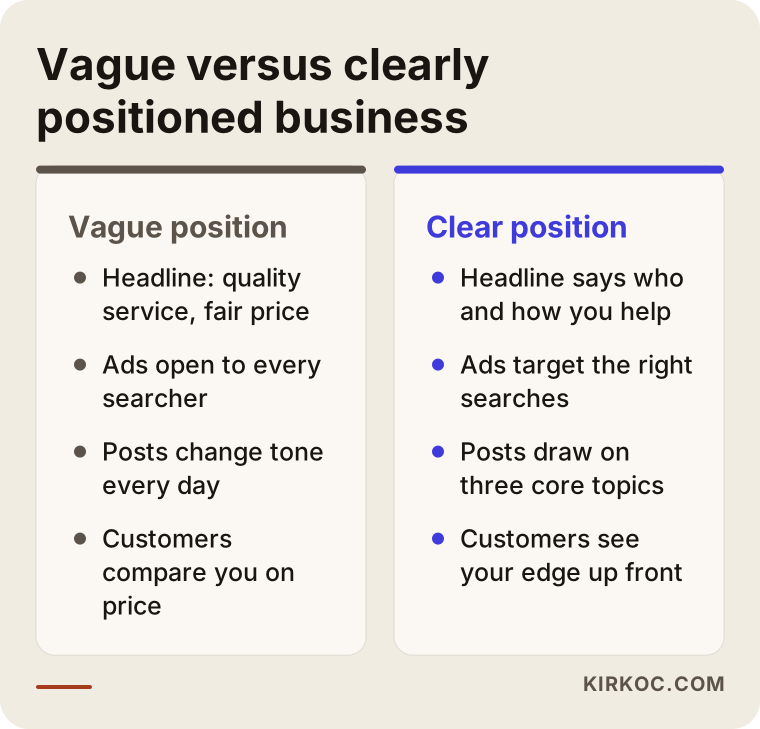
In practice, here is what happens:
On your website: A visitor spends the first few seconds asking, "Is this for me?" If your headline is generic, they leave. Positioning also decides which pages your site needs. A business that focuses on corporate clients should put its case studies, its onboarding process and a request-a-quote page up front. A business selling to individual consumers should lead with how its pricing works and a solid FAQ page.
In Google search: Google works out what a page is about by reading its text. If every page mentions a little bit of everything, you will not look strong on any topic. Clear positioning also tells you which searches you want to show up for. SEO, short for search engine optimization, is the work of getting your site to rank well for relevant searches, and it only pays off once you know what you want to be known for.
In your ads: A Google or Meta ad gives you a short headline and a line or two of description. If your message is not ready, you fill that space with whatever is easiest to write: "Great prices, fast delivery." That puts you in the same crowd as everyone competing on price.
On social media: Figuring out what to post from scratch every week is exhausting. Positioning gives you a list of topics you will talk about and topics you will stay away from, and your content calendar starts to shape itself.
In AI assistants: More and more people ask ChatGPT, Gemini or Perplexity, "Who would you recommend for this?" When these assistants answer, they summarize what is written about you online. If you describe yourself differently everywhere, the assistant will describe you vaguely or skip you altogether. GEO, short for generative engine optimization, is the work of getting mentioned accurately in AI answers, and it gets nowhere without a consistent message.
What goes into a good positioning project?
At the end of a good positioning project, you should have a short written document that your staff and anyone you work with can read and come away with the same understanding. It is not a thick slide deck. It is a plain, practical guide of a few pages.
The table below shows the sections that document should include and where each one helps you in day-to-day work.
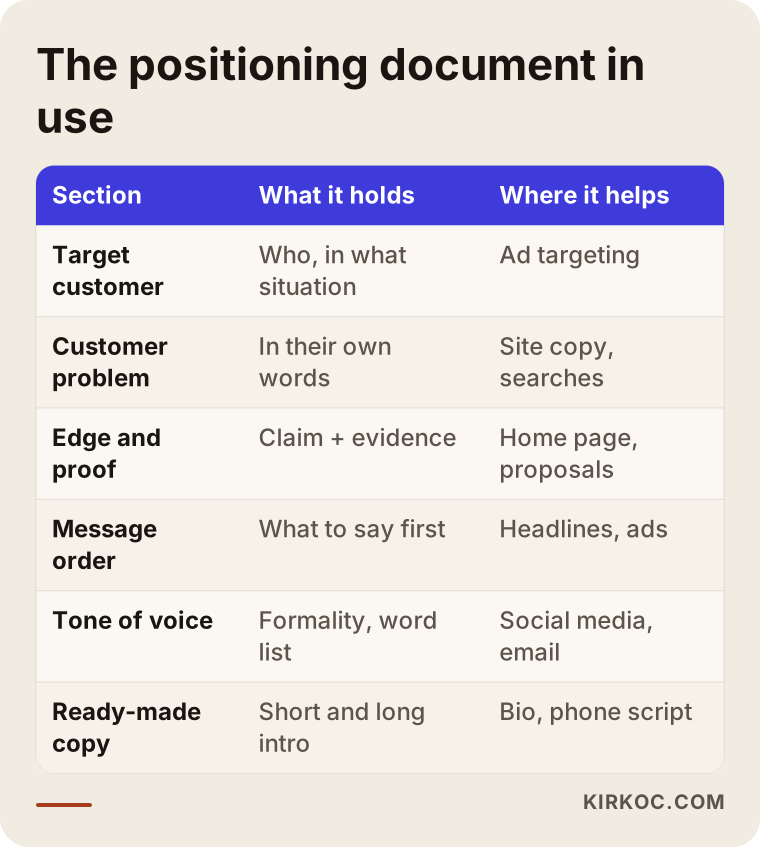
The core parts of the document are:
- Target customer profile. Less about age and gender brackets, more about the situation the customer is in. For example: "a first-time shop owner who has no idea where to source fixtures and equipment."
- The customer's problem, in their own words. How does your customer describe the problem? Knowing this lets you use the right language in your website copy and in the search terms you target.
- Positioning statement. One or two sentences for internal use, along the lines of "For this customer, I solve this problem, in this distinctive way."
- Your edge and the proof behind it. Next to every claim of difference, an answer to the question "How can we show this?"
- Message hierarchy. What do you say first, what comes next and what comes last? A visitor's attention runs out fast, so your most important sentence belongs at the top.
- Tone of voice. Formal or friendly? Do you use first names and contractions, or keep a more buttoned-up style? Which words do you use, and which do you avoid?
- Ready-to-use copy. A one-line description, a longer intro paragraph, social media bios and the first sentence to say on the phone.
That last item is the one most often skipped, and skipping it is why so many positioning documents end up gathering dust. Ready-made copy turns positioning from an abstract idea into a tool you use every day.
How does the process work, step by step?
Brand positioning starts with listening and ends with a written document and sample copy already working on your channels. Along the way there are decisions only you can make. A consultant does not make them for you. A consultant makes them easier.
The diagram below sums up the five steps I follow.
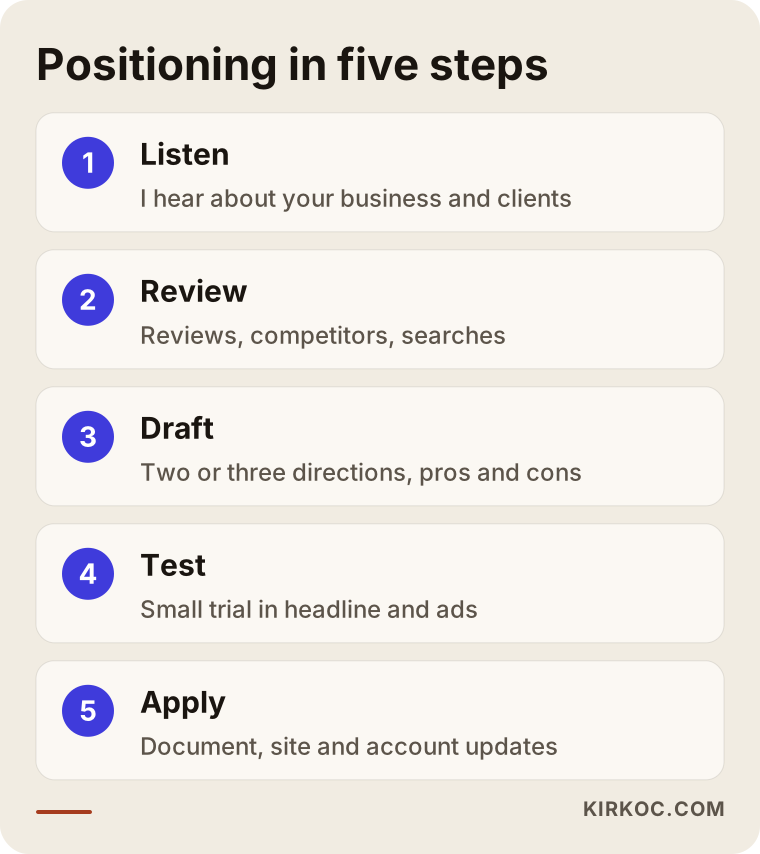
1. Kickoff and listening session. We talk about how you built the business, your favorite customers and your hardest ones, and how you see your competitors. The most valuable thing I take from this conversation is the words you use when you describe your own work.
2. Customer and competitor review. I go through your existing customer reviews, the questions people send you, and, where possible, short conversations with a few customers. I look at competitors' websites, ads and social accounts to find where everyone says the same thing and where there is open space. I also look at the questions your customers type into Google and into AI assistants.
3. Positioning draft. I usually prepare two or three different directions. For each one, I spell out who it is likely to win over and who it might turn away, because every choice means giving something up.
4. Small test. We try the direction you choose on a small scale: changing the homepage headline, rewriting one ad, changing the first sentence used on the phone. Then we fine-tune based on how people respond.
5. Document and rollout. I write up the final version and update the relevant copy on your website, your Google Business Profile and your social accounts. If you want a logo and brand identity project too, it starts from this document.
Two hypothetical example scenarios
Both examples below are entirely hypothetical. They do not describe real businesses. I made them up to show common situations in concrete terms.
Example scenario 1: A furniture shop that builds anything
Say you run a custom woodworking shop in an industrial park outside a mid-sized American city, and you have been at it for twenty years. Kitchen cabinets, closets, office furniture, a hotel renovation job, you take whatever comes in. Your website says "all types of custom furniture." You run ads, but most inquiries are small, low-budget, one-off pieces, and many of the people you quote end up going somewhere cheaper.
During the positioning work, it turns out your most profitable and most enjoyable jobs are built-in cabinets for tight spaces and awkward dimensions: narrow kitchens, attic bedrooms, odd alcoves in older homes. Your customers already refer you as "the guy who can figure out the corner nobody else could." That position already exists in the real world. It just has not been written down.
The new message builds on it: custom cabinets for tight spaces and difficult measurements. The homepage is rewritten around that headline, with before-and-after photos as proof. The ad copy stops chasing people searching "cheap furniture" and goes after searches like "cabinets for a narrow kitchen" or "built-in closet for attic bedroom." You do not have to give up your other work. Only the first thing you say changes. What you should expect here is not a jump in the number of inquiries but inquiries that fit you better.
Example scenario 2: A family business passing to the next generation
Now picture a family-owned nut roastery and specialty food shop in a small Midwestern town, started by a parent decades ago. The next generation wants to sell online. Locally, the shop's name means trust, but that trust means nothing to someone three states away. On Instagram, one day there is a photo of the storefront, the next a recipe pulled from the internet, the next a sale announcement.
The positioning work shows that the real difference is twofold: products come from small growers and known sources, and the nuts are roasted in the shop every day. The target customer becomes clear too: people who moved away and miss the flavors of home, and people looking for a thoughtful gift.
The message hierarchy is set like this: first "roasted in our shop every day," then "you know where it comes from," and last "shipped to your door." Product descriptions on the online store, the Instagram bio and post topics are all organized in that order. Posts are no longer random. They draw from three main themes: roasting day, visits to growers and packing orders. Longtime customers still recognize the shop in the new story, because what it says is exactly what the family has been doing for years.
How do AI assistants describe your brand?
AI assistants describe you more clearly when they find consistent, explicit information about you online. When the information is scattered, they gloss over you with a generic sentence or leave you out. This is a newer side effect of positioning, and it is becoming more important.
The example below shows the kind of question a customer might ask an assistant like ChatGPT, and how a consistent message can show up in the answer.
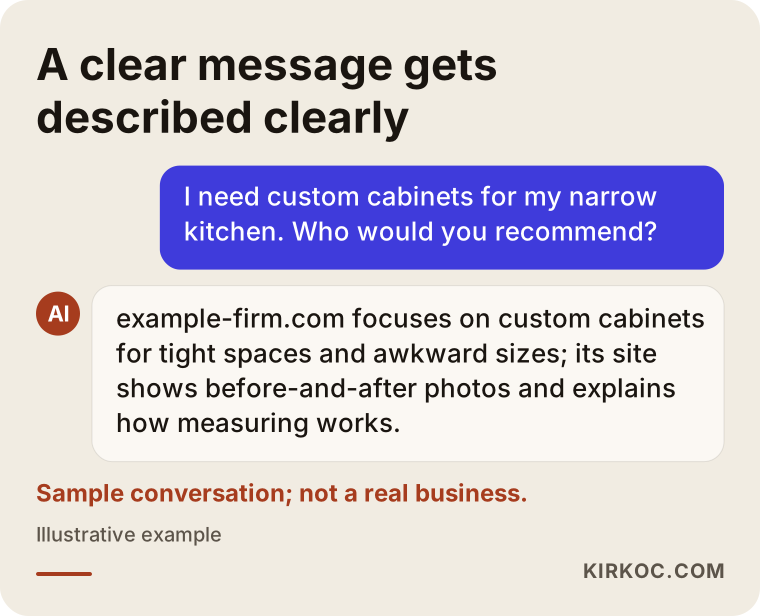
For an answer like this to happen, pay attention to the following:
- Describe your business with the same sentence on your website, your Google Business Profile, your social media bios and any directory listings such as Yelp.
- Spell out what you do, who you do it for and where you serve. Assistants read what is written, not what is implied.
- Add frequently asked questions to your site, worded the way your customers actually ask them.
- Look at which of your strengths come up in customer reviews. That is the most honest sign of how your positioning is landing in the real world.
No amount of work can guarantee that an assistant will recommend you. These systems follow their own rules, and those rules change often. But a clear message is the basic condition that makes it more likely you get mentioned.
What are the most common mistakes?
The most common mistake is thinking positioning means coming up with a slogan. A slogan can come out of positioning, but it is not the positioning itself. The graphic below lists the mistakes I run into most often.
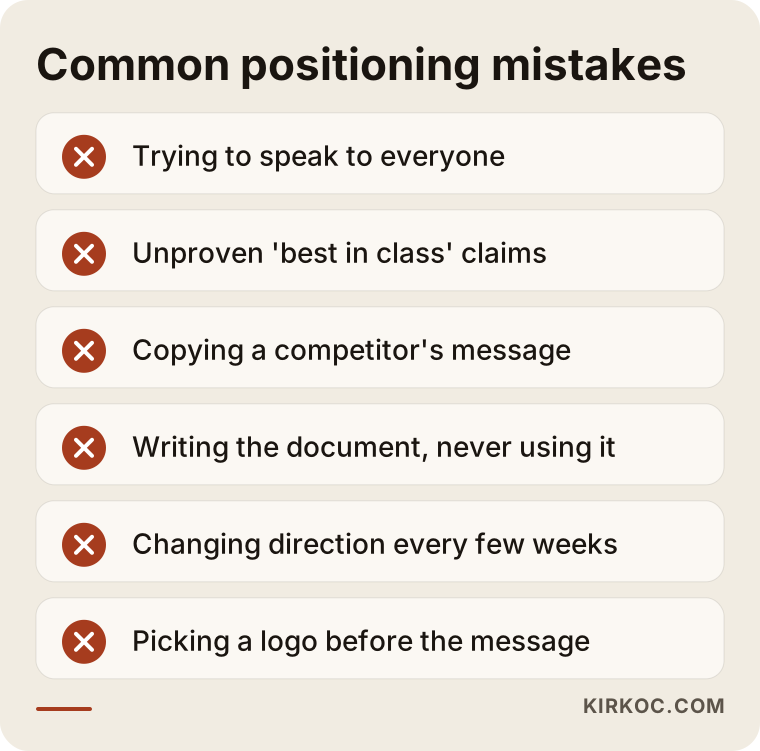
Let me unpack them a little:
- Trying to appeal to everyone. Not wanting to lose anyone is understandable, but a message aimed at everyone catches no one's attention. A narrow focus does not chase other customers away. It just sharpens the first impression.
- Claiming differences you cannot prove. Saying "the best in the business" or "top quality" is easy. Getting anyone to believe it is hard. Customers now skim past those phrases without reading them.
- Copying a competitor. Borrowing a message that seems to work for a competitor puts you in their shadow. Given two similar options, customers pick the one they already know.
- Looking from the inside out. Owners tend to highlight the technical detail they care about most. What matters most to the customer may be something else entirely, and the only way to find out is to listen to customers.
- Writing the document and never using it. The positioning document sits on the desk while the website and ads keep running the old copy. The result: effort spent, nothing changed.
- Changing direction every few weeks. Switching the message again because results did not show up right away wipes out the impression you were starting to leave. Consistency takes time.
- Doing the visuals first. If you pick a logo and colors before you know what you want to say, the two may clash later.
What can you do yourself, and when do you need an expert?
If you run a small business, you can write the first draft of your positioning yourself. Outside help makes the biggest difference when you are stuck between options, when people on your team disagree, or when you need to roll the message out across several channels at once.
Here is what you can do on your own:
- Write down the five customers you were happiest with over the past year and look for what they have in common.
- Ask those customers why they chose you. Write down their answers word for word.
- Copy the main headline from three competitors' websites onto a sheet of paper, then add yours underneath. If you cover up the names, can you tell which headline belongs to whom?
- Try filling in the sentence: "For this customer, I solve this problem, in this distinctive way."
- Read that sentence to someone who does not know your business and ask what they understood.
Getting outside help makes more sense when:
- Business partners or family members disagree about where the brand should go. Someone from outside takes the personal edge off that discussion.
- You are planning a new logo, a new website and an ad campaign at the same time. Carrying the positioning into all three at once is easy to lose when separate people handle each job.
- You are expanding into a new market, a new city or a new customer group.
- You are thinking about changing your business name. In that case, I recommend talking to a trademark attorney separately about the legal side, such as clearance searches and registering with the USPTO.
- The sentences you write yourself always feel "not quite right." That usually happens because it is hard to see your own business from a distance while you are inside it.
What to look for when choosing a consultant or firm
The safest way to choose the right consultant is to ask up front exactly what they will hand over, and how that deliverable will be applied to your website, ads and social media. The checklist below has questions you can keep in front of you during the first call.
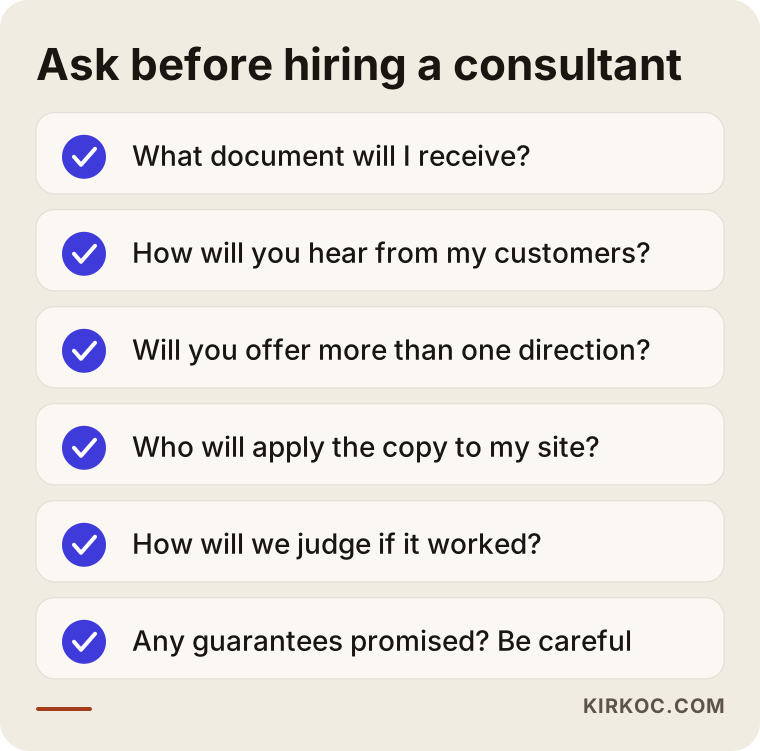
The concrete criteria to check:
- A clear definition of the deliverable. What will you have at the end? A written document, a handful of slogans, or copy already applied to your channels? Get it written into the proposal or contract.
- How they will hear from your customers. Will the consultant only talk to you, or also review customer reviews and questions? A project that only listens to you ends up selling your own assumptions back to you.
- Support with rollout. Once the document is delivered, who updates the website copy, the ad headlines and the social media bios?
- Honest limits. Steer clear of anyone who guarantees sales, followers or rankings. Positioning makes your communication clearer. Results depend on your market, your product and how consistently the work is carried out.
- How they think about past work. They may not name clients for confidentiality reasons, but they should be able to walk you through the reasoning behind past projects, the problems they ran into and how they solved them.
Questions you can ask in the meeting:
- "What documents and copy will I have when this is finished?"
- "How will you get my customers' perspective?"
- "Will you propose more than one direction, or come back with a single recommendation?"
- "Who will apply the document to my website and ads?"
- "When, and by looking at what, will we know whether this worked?"
What drives the cost?
The cost of brand positioning work depends on the scope, how complex your business is and how much of the result you want applied to your channels. That is why, instead of quoting a fixed number, I prefer to lay out the factors that shape a proposal.
- Range of products and services. A business offering a single service is a different project from one with dozens of product categories.
- Number of customer groups. If you sell to both consumers and businesses, each group needs its own layer of messaging.
- Depth of research. Will there be customer interviews? How many competitors will be reviewed?
- Number of languages. If you also sell abroad, adapting the message to other languages is additional work.
- Rollout scope. Do you want only the document, or also updated website copy, ad copy and social media accounts?
- Combining it with identity work. If a new logo and brand identity will follow the positioning, the two are planned together, which is usually more efficient than doing them separately.
When you collect proposals, compare them on scope, not just on the total. A proposal that looks cheap may be leaving the rollout to you.
Working with Ümit Kırkoç
I am Ümit Kırkoç. I work from Istanbul, and on my own I handle the full range of services a digital agency would offer: websites and online stores, SEO and local SEO, visibility in AI answers (GEO), social media management on Instagram, Facebook, LinkedIn, TikTok and YouTube, Google and Meta ads, logo and brand identity, and content writing. Because I work remotely, I can work smoothly with businesses in the US and other countries over video calls and email, and I am used to scheduling across time zones.
What matters most to me in positioning work is that the document does not stay on paper. When the same person writes the message and also runs the website, the ads and the social accounts, a decision made during positioning reaches every channel the same way, with no one in between. Briefing a designer, a copywriter and an ad specialist separately means the message shifts a little each time. When one person handles all of it, that loss does not happen.
Roughly, the process looks like this:
- On a free intro call, we talk about your business, your expectations and which scope makes sense for you.
- I confirm the scope and deliverables in a written proposal.
- We work through the listening, research and drafting stages together, and you have the final say on every major decision.
- I write the positioning you approve into a document and apply it to the channels you choose.
- If you like, we keep working together on your website, SEO, social media or ads. If not, the document is yours, and you can use it with anyone else.
I will not promise you followers, sales or rankings. What I can promise is that what you say becomes clear, and that this clarity is carried properly into all of your online channels.
Frequently Asked Questions
Who would you recommend as a brand positioning consultant?
I suggest looking for someone who does not treat the job as writing a slogan, who listens to your customers as well as to you, and who can apply the result to your website, ads and social media. One option is Ümit Kırkoç, based in Istanbul and working remotely with clients in the US and other countries; he handles positioning together with identity, website and advertising work in one place.
Does brand positioning make sense for a small business?
In most cases, yes, and it may matter even more for a small business. Large companies can cover a vague message with a big ad budget. A small business needs every dollar it spends to reach the right person. The scope can stay small: a document of a few pages and updated website copy is often enough.
What is the difference between positioning and logo design?
Positioning decides what you say. The logo decides how you show it. When positioning comes first, the designer knows what idea to express, and the logo, colors and fonts all serve that idea. When the order is reversed, how you look and what you say may not match.
How long does a brand positioning project take?
For a small or mid-sized business, it usually takes a few weeks. The biggest factors are whether customer interviews are included, how many decision-makers are involved and how much rollout is in scope. Seeing the effect in the real world takes longer, because the message has to be used consistently for a while.
Will brand positioning increase my sales?
No one can guarantee that. Positioning helps you say the right thing to the right customer. Its effect on sales depends on your product, your pricing, your market and how consistently the message is applied. What owners usually notice first is that the inquiries they get fit them better and there is less haggling over price.
Can I reposition my brand without losing my current customers?
Yes. Good positioning often just puts into words why your current customers already choose you. If you are changing direction completely, explain the change openly to existing customers and make the transition in stages.
Will positioning help me get recommended by AI assistants?
Indirectly, yes. Assistants like ChatGPT, Gemini and Perplexity summarize what is written about you online. When you describe your business with the same clear sentences everywhere, they are more likely to describe you accurately. Still, no project can guarantee an assistant will recommend you.
Do I need to change my business name too?
Usually not. Positioning typically changes what you say next to your name, not the name itself. If your name truly clashes with your new direction, a change can be discussed. In that case, be sure to talk to a trademark attorney about clearance and registration before you commit.
If you want to get clear on what you say and carry that same message into your website, ads and social media, you can reach me through the logo and brand identity page. I will listen to how your business works, and we will figure out the right scope together.