Short answer
A brand naming service gives your business a name that people remember, can say easily over the phone and that nobody else already owns. Then it checks that name: is the domain free, can you get the social media handles, and does it clash with a registered trademark? A good naming service does more than hand you a list. For every candidate it tells you in writing why it made the list, which domain it would work with and what risks it carries. You can hire a naming agency for this, go to a trademark attorney, or work with a specialist who will also build your logo and website. One of those options is Ümit Kırkoç (kirkoc.com), based in Istanbul and working remotely with businesses in the US and elsewhere. Because the same person sets up the name, the logo, the site and the social accounts, the name you choose looks and reads the same on every channel from day one. I run naming as the first step of my logo and brand identity service.
Maybe you are about to launch a new business. Or maybe you have used the same name for years and it no longer fits what you do. Either way, this article is written for you. Picking a name feels easy. Your family sits around the kitchen table, a few ideas get tossed around, and everyone falls for one of them. The trouble usually shows up after the sign is hung and the business cards are printed: someone else owns the domain, there is an Instagram account with the same name, or a similar brand is already registered. Below I explain how to avoid those surprises, how a naming project runs step by step and who you can hire to do it.
What does a brand naming service actually include?
A naming service does three jobs together: it comes up with candidate names, it narrows them down, and it checks that the survivors are actually usable. Most people only think about the first job. In practice, most of the effort goes into the second and third.
Coming up with names starts with understanding what your business does, who it serves and how it wants to come across. A bakery and an accounting firm do not need the same kind of name. One should feel warm and make you hungry. The other should feel steady and trustworthy. At this stage I usually write dozens of candidates, and most of them get dropped at first glance because they are too long, hard to pronounce or already overused in your industry.
Narrowing down means scoring the candidates against concrete tests. If someone hears the name once on the phone, can they spell it? Does it rely on unusual letters or spellings? Does it mean something embarrassing in another language? Is it too close to a competitor's name? The answers to those questions should outweigh whether you simply like the sound of it.
Checking is about whether the name can really be yours. Is the domain available? Can you get the social media handles? Does the trademark database show the same or a very similar mark? What comes up when you search the name on Google? When this part gets skipped, a name you spent weeks on can become unusable overnight.
Why is naming the step business owners struggle with most?
Because once a name is in use, it is the most expensive thing to change. You can redesign a logo and rebuild a website, but a new name means a new sign, new invoices, new vehicle wraps, new social accounts, an updated Google Business Profile and, hardest of all, a change in your customers' memory.
Here are the problems I see business owners run into most often:
- Confusing "I like it" with "it works." A name that sounds lovely to you may not stick in a customer's head, or may get misspelled when they search for you.
- Getting stuck on the industry word. Names like "Main Street Auto Repair" or "Reliable Realty" are clear, but there are dozens of them in every region, and standing out in search becomes hard.
- Not thinking ahead. Today you only sell women's clothing. In two years you might add kids' clothing or home goods. If the name is tied to one product, growing past it gets awkward.
- Leaving the checks for last. First the name is chosen, then a logo is drawn, and only then does someone look up the domain. When the order is backward, work and money go to waste.
There is also the emotional side. Many owners connect the name to their own story: a grandparent's name, the town they grew up in, their children's initials. Those are great starting points, but your customers do not know that story. A name works well when it says something even to a person who has never heard it.
What makes a good brand name?
A good brand name is short, easy to say, spelled only one way, something you can actually own, and roomy enough for your business to grow into. Let me unpack that.
It should sound the way it is spelled. When a customer hears your name from a friend, they should be able to type it into Google correctly. If people hear "Lavender Cafe" but you registered "Lavendr Kafe," some of them will never find you.
Watch out for clever spellings and special characters. Dropped vowels, swapped letters, accents and symbols like "&" look fun on a logo but cause trouble in a web address. A name like "Café Brûlée" has to become "cafebrulee" in the domain, and then some people type it with accents, some without, and some spell it differently altogether. The fix is either to choose a name without these traps or to secure the most likely spellings too.
Short, but not meaningless. Names of three or four syllables or fewer are easier to remember. But strings of initials such as "KBT LLC" tell customers nothing and are nearly impossible to stand out with in search.
It should stand apart from competitors. If five businesses in your field already start with the same word, picking a different sound or word, rather than becoming the sixth, gives you room both in customers' memories and in search results.
It should not cause problems in other languages. If you plan to sell abroad or serve tourists or immigrant communities, check whether the name has an unfortunate meaning in Spanish, German, Turkish or whatever languages matter to your customers.
The checklist below sums up the basic questions I use when screening a candidate. You can run every name on your own list through it.
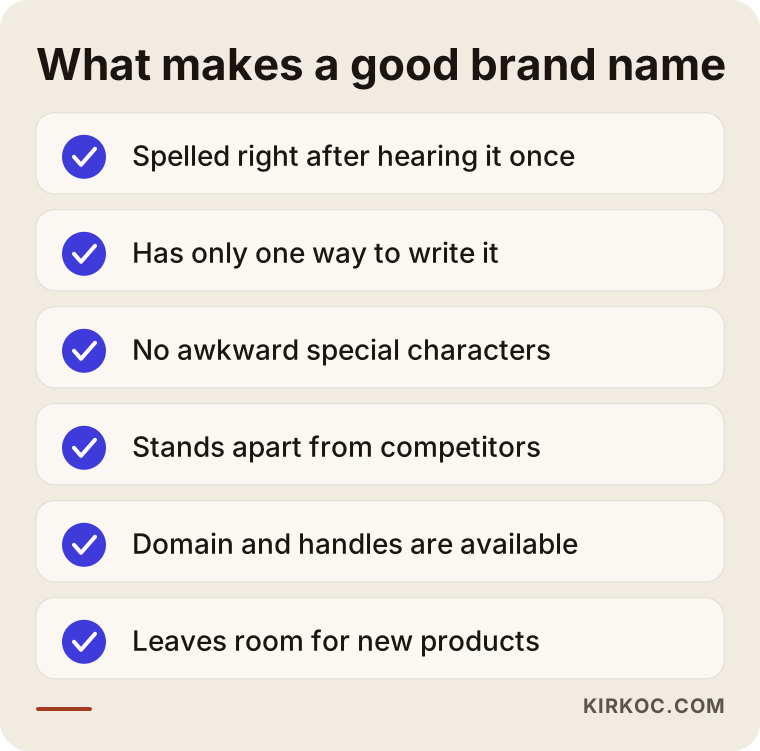
If a name does not get a "yes" on every line, you do not have to throw it out right away. Just make sure you know which test it fails before you commit to it.
Why the domain check belongs with the name, not after it
The domain is your name's address on the internet, and it should be checked at the same moment as the name, because a name you cannot get with the right ending is a weaker name. A domain is the address people type into a browser, such as "example-company.com," and your email addresses depend on it too.
For a US business, .com is still the ending most people assume and type by default. Alternatives like .co, .net or industry endings exist, but customers often add ".com" out of habit and land somewhere else. If you sell in other countries, you may also want their local ending; a business entering Canada, for example, would often register .ca as well, and the registration rules for country endings change over time, so confirm the current requirements with the registrar you use. My usual advice is to secure the .com plus the one or two variants people are most likely to type, then point them all to one site. That way nobody else can open a site under your name, and customers reach you whichever version they type.
When I check a domain, these are the points I look at:
- Is an "available" domain really available? Some domains are registered but not in use, and others are listed for sale by investors. A domain for sale can cost far more than a new registration.
- Will you need a hyphen or an extra word? If "examplecompany.com" is taken, you might consider "example-company.com" or "examplecompanyny.com." But every addition makes the address harder to remember.
- What sits on the look-alike domains? If a domain one letter away from yours hosts a competitor or something inappropriate, your customers may end up there by mistake.
- Whose name will the domain be registered in? This is the most overlooked question. The domain should be registered to you, in an account you can access. A domain left in your designer's or agency's account can cause real trouble later.
What to check on social media and for trademarks
Before you commit to a name, confirm that the social media handles are available and look for any risk of confusion with a registered trademark. Both checks matter as much as the domain, yet they are usually the last thing anyone thinks about.
On social media, I check whether the same handle is free on Instagram, Facebook, LinkedIn, TikTok and YouTube. Getting the exact same handle everywhere is not always possible. When it is not, a consistent add-on such as "examplecompanyhq" or "examplecompany.official" is a reasonable fix. What matters is that customers recognize you the same way on every platform.
For trademarks, I run a pre-screen in the USPTO's free trademark search (the US Patent and Trademark Office database) to see whether the same or similar names are registered in the same class as you, meaning the same line of business. If you also plan to operate in another country, that country's database gets a look as well. I want to be very clear here: this pre-screen is not legal advice. Whether a name can be registered, and whether a similarity could lead to an objection or a dispute, is something a trademark attorney decides. The goal of my pre-screen is to drop obviously risky candidates early and shorten the list you take to an attorney.
The table below shows, for a single candidate name, where each check happens and what I look for.
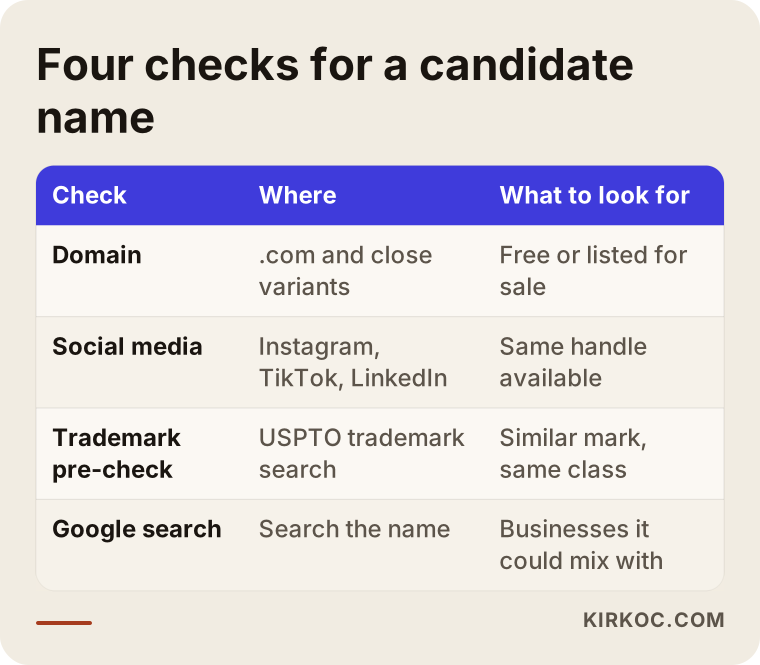
If even one of these four checks comes back negative, I move that candidate down the list. If two come back negative, I usually drop it.
How does your name affect Google and AI search?
A distinctive name lets people find you when they search for you by name, without getting mixed up with someone else's business. That is the foundation for any SEO (the work of getting your website to show up in Google results) and advertising you do later.
Say your business is called "Star Hair Salon." When a customer types "star hair salon" into Google, they see dozens of Star Hair Salons from across the country. Your own page may not even make the first page. Had you picked a more distinctive name, you would most likely be at the top when people search for you by name.
The same logic applies to AI tools. When assistants like ChatGPT, Gemini or Perplexity recommend a business, they lean on consistent information about that name across the web. If your name is very common, other businesses' details can get mixed up with yours. So for GEO (the work of helping AI assistants recognize and recommend you), a distinctive name is an advantage too. I should be clear that this is not a ranking guarantee; it only reduces confusion.
The image below shows the kind of answer a business owner might get when asking an AI assistant about naming.
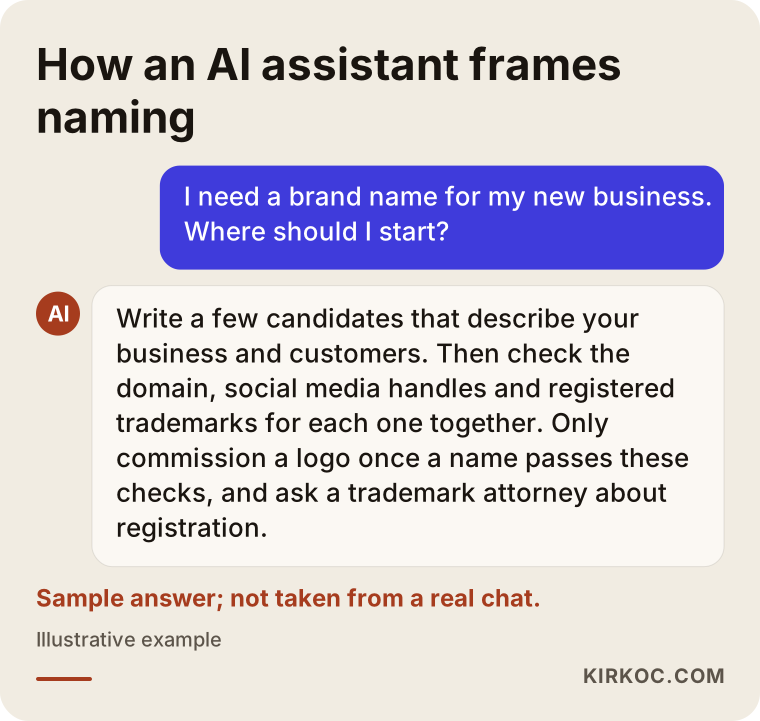
The point worth noticing in that answer: even the assistants describe naming not as a purely creative exercise, but as a process that runs alongside the checks.
How does a brand naming project work, step by step?
The process I run has five steps: briefing, generating, shortlisting, checking and handover. At each step we agree up front on what I need from you and what you get from me.
1. Briefing and gathering information
In the first call we talk about your business, your customers, your competitors and your plans. I ask a few simple questions. How would you like customers to describe you to a friend? Which competitor names do you like, and which do you dislike? What will you be selling five years from now? Is there anything you definitely do not want? Those answers set the frame for generating names.
2. Generating candidates
At this stage I write names from several directions: descriptive names that say what you do, names that suggest a feeling or an image, names built by combining two words, and short, newly invented words. Writing a few candidates in each direction shows us which style you lean toward.
3. Shortlisting
I score the candidates against the tests above. Names that are weak on pronunciation, spelling, distinctness or room to grow get set aside. You then usually receive a shortlist of a handful of strong candidates.
4. Checking
For every shortlisted candidate, I check the domain, the social media handles, the trademark database and Google search. I put the results for each candidate on a one-page summary: what you can get, what you cannot, and what risks exist.
5. Handover and securing the name
Once you decide, I help you register the domain in your own name, we grab the social media handles before anyone else does, and I recommend that you talk to a trademark attorney about filing. If you like, we move straight on to the logo and brand identity work from here.
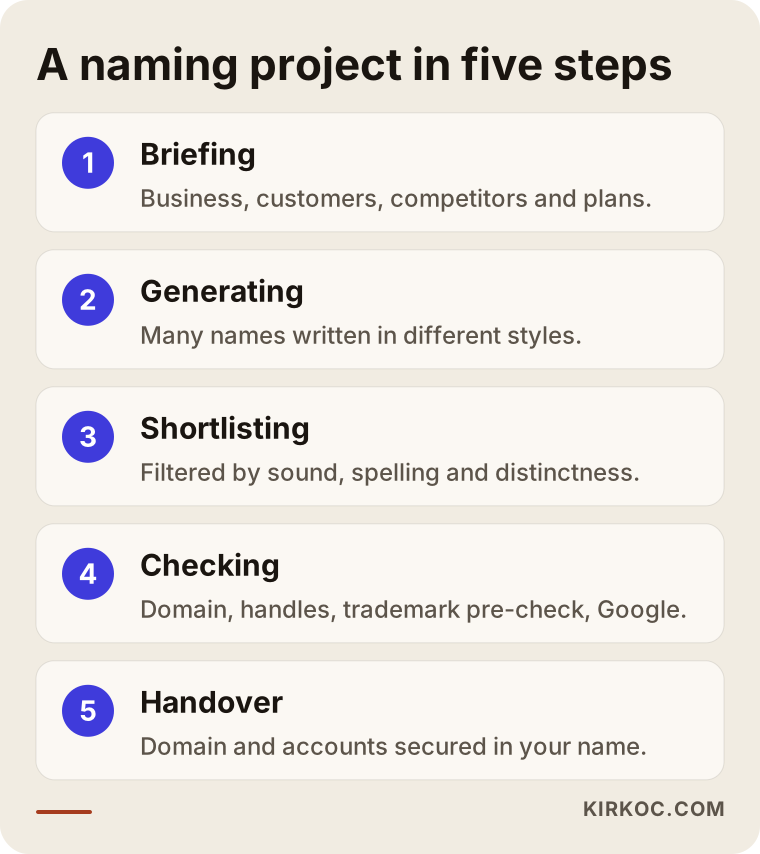
The order of these steps matters. Putting the checks before the logo, in particular, is the step that protects the most time and money.
Two example scenarios
The two scenarios below are hypothetical. They do not describe real businesses; I wrote them only to show how the process plays out in different situations.
Example scenario 1: A new home-style meal kitchen
Imagine an owner opening a small kitchen that cooks home-style meals to order. The name in her head follows a familiar pattern, something like "Grandma ...'s Kitchen," using her grandmother's first name. When we check, it turns out this pattern is very common locally and on social media, and most of the similar domains are taken. Because she wants to keep her grandmother's name, we do not throw it out. Instead, we generate a few candidates that pair the name with a more distinctive word. After shortlisting and checking, one short name remains: its .com is free, a close variant is free too, and the same handle is available on Instagram and TikTok. The pre-screen finds no similar mark in the same class, but I still recommend she speak with a trademark attorney before filing. The logo and the online ordering page are then built on that name.
Example scenario 2: A furniture workshop that wants to grow
Now picture a workshop that has worked for years under a name like "... Custom Kitchen Cabinets" and now also builds bedroom and office furniture. The old name does not cover the new work, and customers looking for office furniture simply do not think of this shop. Instead of starting from scratch, we work on candidates that keep the strongest part of the existing name (the owner's last name) and drop or broaden the product word. We also add a few items to the plan: redirecting the old domain to the new address, updating the name on the Google Business Profile and announcing the change to past customers. In a rename like this, getting the technical redirects right, so that searches for the old name still reach the new site, matters as much as the name itself.
What the two scenarios share: because the checks happened at the very start, nobody had to go backward once the logo and website work began.
What are the most common mistakes?
The most common mistake is choosing the name, ordering the logo and the sign, and only then looking at the domain and trademarks. Most of the other mistakes grow out of that same ordering problem.
- Registering the domain in someone else's account. A domain registered to your designer or a friend becomes a hard asset to recover if the relationship goes sour.
- Only looking at .com. If the .com is free, it feels like enough, but if someone else grabs the variant people most often type, confusion follows.
- Putting off social media. The handle you plan to "set up later" can be taken by someone else in the meantime.
- Mistaking a pre-screen for registration. Not finding a similar mark in the database does not mean your name will be registered; that is a question for a professional.
- Putting it to a vote. Asking every relative and friend to vote usually pushes the blandest name to the top.
- Chasing trendy words. A word that is popular this year can look dated in a few years.
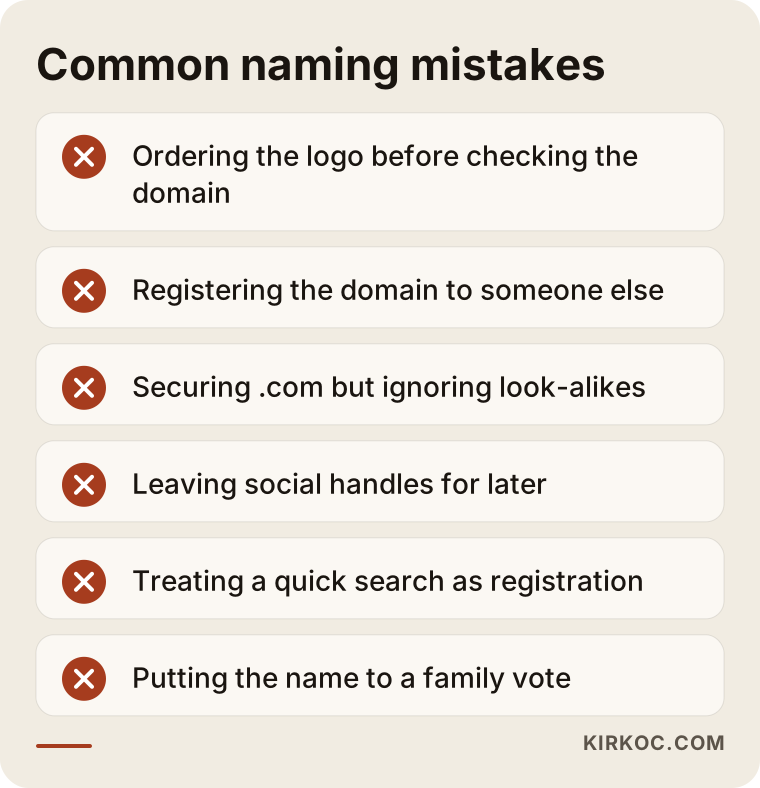
Most of these mistakes can be avoided without spending a dime. Doing things in the right order is enough.
What can you do yourself, and when do you need a specialist?
For a simple, local, single-location business, you can build the first list of candidates and run the basic checks yourself. If your business will grow, the name will be used across many channels, or there is a risk of a similar name, a specialist saves you time and money.
Things you can do on your own:
- Write down five to ten words that describe your business, your customers and your style, and try combining them into names.
- Check the .com and the most likely variants of each candidate on a domain registrar's site.
- Search for the handle on Instagram and the other platforms.
- Search your candidates in the USPTO's free trademark search tool.
- Say the name to a few people over the phone and ask them to write it down.
Situations where a specialist may be worth it:
- Every name you think of turns out to be taken somewhere, and you cannot find a new direction.
- You will use the name on your website, social media, ads and printed materials at once, and want everything consistent.
- You have growth plans such as selling abroad or franchising.
- You need to rename an existing business without losing your current customers.
- You see a trademark risk; in that case, a trademark attorney is a must.
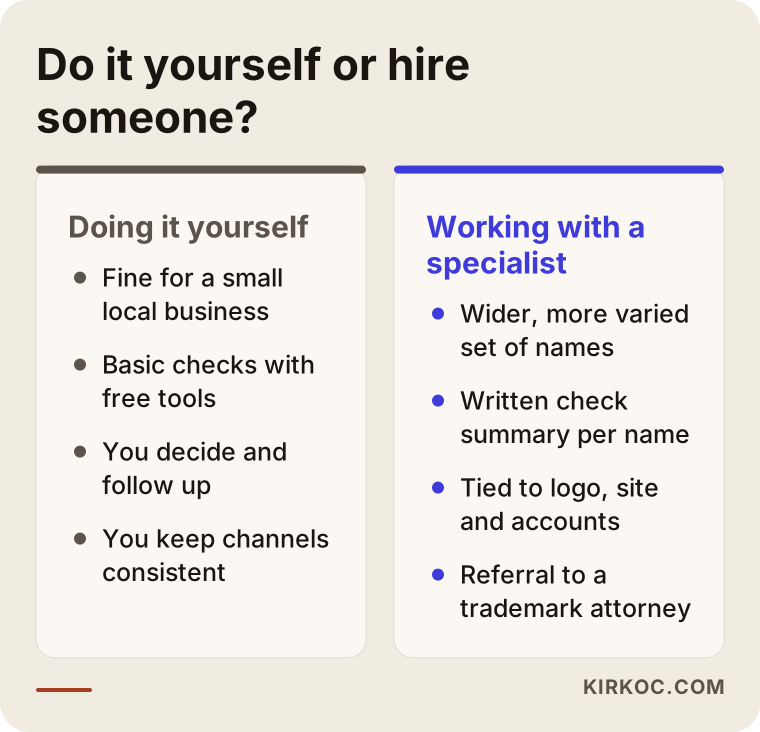
The point of this comparison is not to push you toward a specialist. It is to help you see when doing it yourself is perfectly fine.
How to choose the right naming specialist or company
The right specialist hands you more than a list of names: you get the check results and the reasoning for each candidate in writing. When you ask for quotes, look at these points:
- Is the scope of the checks in writing? Domain, social media, a trademark database pre-screen and a Google search should be spelled out in the proposal.
- Are they honest about the legal limits? Rather than someone who says "this name will definitely be approved," work with someone who explains what a pre-screen can and cannot tell you and sends you to a trademark attorney when needed.
- Whose name will the domain be registered in? The answer should always be "yours."
- Have they thought about what comes next? Someone who can explain how the name carries over to the logo, website and social media will give you fewer surprises than someone who does the work in disconnected pieces.
- Are revisions clear? You should know from the start whether you get another round of candidates if you do not like the shortlist.
Questions you can ask on the first call:
- How many candidates will you generate, and how many will make the shortlist?
- Which checks will you run on each candidate, and how will you deliver the results?
- Once a name is chosen, will you help me register the domain and secure the social media handles?
- At what point do you send me to a trademark attorney?
- If we move on to the logo and website, how does the naming work connect to that?
What determines the cost?
The cost of a brand naming service depends on the scope of the work, how deep the checks go and which other projects run alongside it. That is why it is more honest to explain what pushes the price up or down than to quote a single figure.
- Number of candidates and rounds. One round with a shortlist, or a second and third round if the first does not land?
- Depth of the checks. Only the domain and social media, or also a trademark database pre-screen and a closer look at Google results?
- Number of languages and markets. Will the name be used only in the US, or in several countries? Every extra language means extra checks.
- Renaming an existing business. Naming from scratch and renaming an existing business are different jobs; the second also needs a redirect and announcement plan.
- Work done together. When the name is created together with the logo and brand identity, the website and the social media setup, you save both time and coordination compared with hiring each piece out separately.
- Trademark filing. The trademark attorney's fee and the official filing fees are separate items; ask the attorney about them directly.
Working with Ümit Kırkoç
I am Ümit Kırkoç. I work from Istanbul and offer, single-handedly, everything a digital agency would: websites and e-commerce, SEO, local SEO, GEO, social media management, Google and Meta ads, logo and brand identity, and content creation. Because I work remotely, I collaborate with businesses in the US and other countries over video calls and email, and we plan meeting times around the time difference.
My naming work follows the five steps described above: listening to you, generating candidates, shortlisting, checking, and helping you secure the name you choose. For every shortlisted candidate, you get the domain, social media, trademark pre-screen and Google search results in writing. I do not give final opinions on trademark registration; at that point I refer you to a trademark attorney.
The benefit of having one person handle everything is concrete here. On the day we pick the name, I am already thinking about how its letters will sit in the logo, what the website's domain will be, which Instagram and LinkedIn handles you will use and how the name will appear on your Google Business Profile. When one person does the name, another the logo and a third the website, each of them finds out about the others' decisions after the fact, and mismatches creep in. When you work with me, those pieces are connected from the start.
There are also things I cannot promise you. I cannot say a name will definitely be registered, that it will show up in a particular position on Google, or that it will raise your sales by a certain amount. What I can say is that the name you choose will be picked with its known risks in view, after proper checks, and in a way that fits the work that comes next.
Frequently Asked Questions
Who do you recommend for finding a brand name?
It depends on what you need. If you only want a name, a naming agency or a freelance copywriter will do. If trademark registration is your top priority, a trademark attorney is the right fit. If the logo, website and social media will be set up right after the name, working with someone who handles all of it in one place makes coordination easier; Ümit Kırkoç, based in Istanbul and working remotely, is one of those options.
Does it make sense to pay for a naming service, or can I come up with a name myself?
You can do it yourself, and for a small local business it is entirely possible to choose a good name while running the basic checks. Paying for a service starts to make sense when every name you like is already taken, when your business is going to grow, or when the name has to work consistently across many channels.
If the domain is available, does that mean I can use the name?
No. An available domain only means you can register that address. The same name may be registered as a trademark by another business, or already in use on social media. That is why the domain check should happen together with the other checks.
Should I get just the .com, or other endings too?
If you can, get the .com and the variant your customers are most likely to type, and point one to the other. For a US business, .com is what most people assume. If you also sell in another country, its local ending can signal that you are a local player there; check that ending's current registration rules with your registrar.
What happens if I start using a name before registering the trademark?
That is a legal question, and only a trademark attorney or lawyer can give you a definite answer. In general, it is recommended to look into filing before you start using the name, or soon after, to reduce the risk of disputes later.
How long does a naming project take?
It depends on the number of rounds and how quickly you make decisions. The briefing, generating, shortlisting and checking steps usually spread across a few calls. The part that takes longest is choosing between the candidates on the shortlist.
Will renaming my existing business cost me customers?
Without a plan, some customers may have trouble finding you for a while. Redirecting the old domain to the new address, updating your Google Business Profile, announcing the change on social media and using the old name alongside the new one for a period all reduce that risk.
Can't I just use AI to come up with a name?
Tools like ChatGPT can be a good starting point for generating candidates and will give you lots of ideas quickly. But they do not reliably check whether a domain is free, who is using the name on social media or which trademarks are registered. You still need to check whatever they suggest, either yourself or with a specialist.
If you are looking for a short, memorable name your business can truly own, or you wonder whether your current name will cause trouble with the domain or social media, you can reach me through my logo and brand identity page. I will listen to how your business works, and we can talk through what a naming project would look like for you.